Introduction
Junglerice [Echinochloa colona (L.) Link] is a major summer weed in the northern grain region of Australia (McGillion and Storrie Reference McGillion and Storrie2006). This weed is commonly found in rice (Oryza sativa L.) fields throughout the world (Holm et al. Reference Holm, Plucknett, Pancho and Herberger1977). However, in Australia, it is a problematic weed in the regions of Queensland and New South Wales where grain sorghum [Sorghum bicolor (L.) Moench], corn (Zea mays L.), and mung bean [Vigna radiata (L.) Wilczek] are grown (Walker et al. Reference Walker, Michael, Andrew and Vikki2004). Various studies have reported that E. colona infestation causes significant reductions in yield; 30% to 100% in rice (Chauhan and Johnson Reference Chauhan and Johnson2010b; Smith Reference Smith1983) and 21% to 97% in cotton (Gossypium hirsutum L.) (Keeley and Thullen Reference Keeley and Thullen1991). A survey by Walker et al. (Reference Walker, Taylor, Milne, Osten, Hoque and Farquharson2005) revealed that in summer fallows of subtropical Australia, 82% of the growers rated E. colona as the most common and troublesome weed to control. This weed costs Australian agriculture A $14.7 million, and it ranks among the top five summer-season weeds in Australia (Llewellyn et al. Reference Llewellyn, Ronning, Ouzman, Walker, Mayfield and Clarke2016). Changes in cultural practices (e.g., conservation tillage) and weed management strategies (e.g., repeated use of herbicides) that have improved crop productivity have also caused shifts in weed flora in Australia (Walker et al. Reference Walker, Taylor, Milne, Osten, Hoque and Farquharson2005). The extensive and repeated use of glyphosate for controlling weeds in no-till systems led to the problem of glyphosate-resistant E. colona in Australia (Duke and Powles Reference Duke and Powles2008; Gaines et al. Reference Gaines, Cripps and Powles2012. A target-site mutation was the reason behind the development of glyphosate-resistant biotypes of E. colona in Australia, and a high temperature was found to reduce the efficacy of glyphosate in resistant biotypes (Nguyen et al. Reference Nguyen, Malone, Boutsalis, Shirley and Preston2016). Therefore, rapid evolution of herbicide resistance has contributed to the dominance of E. colona as a summer weed in the northern grain region of Australia (Heap Reference Heap, Pimentel and Peshin2014; Storrie et al. Reference Storrie, Cook, Boutsalis, Penberthy and Moylan2008).
Echinochloa colona can emerge in several cohorts (October to March in Australia), depending on environmental conditions, which increases the probability that it will escape herbicide application (Wu et al. Reference Wu, Walker, Osten, Taylor and Sindel2004). Further, its capacity to produce thousands of seeds per plant builds up persistent seedbanks in the soil (Chauhan and Johnson Reference Chauhan and Johnson2010a). A persistent seedbank study on E. colona revealed that buried seeds of E. colona remained viable for more than 1 yr (Wu et al. Reference Wu, Walker, Osten, Taylor and Sindel2004). In our other work, early cohorts (emerging in November to December) of E. colona were found to produce more seeds than late cohorts (emerging in February) (unpublished data). These studies suggest that E. colona is a problematic weed in Australia.
Weeds compete with crops for light, soil moisture, and nutrients, and soil moisture is an important factor in reducing crop yield (Mahajan et al. Reference Mahajan, Ramesha and Chauhan2015). The northern region of Australia experienced a serious drought recently that had an adverse effect on crop yield and the economy (DEE 2016). Echinochloa colona is a C4 plant, and its high water-use efficiency under water scarcity allows it to grow successfully over a wide range of soil moisture regimes and may reduce crop yields (Lovelli et al. Reference Lovelli, Perniola, Ferrara, Amato and Tommaso2010). For example, E. colona can be found in many places ranging from arid zones to wetlands in Australia (Tanpipat et al. Reference Tanpipat, Steve, John and Mark1997).
Abiotic stresses such as water scarcity restrict the growth of plants, including weeds (Patterson Reference Patterson1995). Varied responses of different plant species to water stress might be due to their diverse genetic makeup and phenological and physiological processes. This differential response may also depend upon climatic conditions of the region, habitat, soil type, plant growth stage, duration of water stress, and management practices (Irmak et al. Reference Irmak, Haman and Bastug2000). Various studies have shown that growth and seed production of some weed species, including Benghal dayflower (Commelina benghalensis L.), itchgrass [Rottboellia cochinchinensis (Lour.) Clayton], and E. colona are reduced significantly under varying degrees and durations of water stress (Chauhan Reference Chauhan2013; Chauhan and Johnson Reference Chauhan and Johnson2010a; Webster and Grey Reference Webster and Grey2008).
It was hypothesized that Australian biotypes of E. colona may have different growth and seed production potential under water stress conditions. Information is limited on the biology of E. colona under dryland conditions in Australia. The literature suggests that in Asia, E. colona is a typical weed of lowland crops like rice (Chauhan and Johnson Reference Chauhan and Johnson2009). Therefore, there is a possibility that Australian biotypes of E. colona may have adaptive traits for a dryland environment, and this phenomenon may influence seed production potential. In Australia, the window for sowing summer crops is wide (October to January), as most summer crops are rainfed, and the timing of rainfall influences the sowing time. This suggests that it is pertinent to evaluate the response of E. colona biotypes to water stress under a wide range of sowing times for summer crops (October to January). Therefore, the objective of this study was to determine the effect of different levels of water stress on the growth and seed production potential of two Australian E. colona biotypes under a wide range of sowing times.
Material and Methods
Experimental setup and conditions
Seeds of two different biotypes of E. colona were collected in March 2017 from two locations in Saint George, QLD, Australia: biotype A from a cotton–fallow (28.3150°S, 148.6892°E) and biotype B from a fence near a water channel (28.1442°S, 148.7469°E). Our purpose was to select biotypes from two different environments (i.e., no water stress and water stress conditions) to evaluate water stress adaptability traits for invasion, if present. After collection, the samples were immediately placed in separate paper bags. Seeds were cleaned manually using different sieves and then stored in a screen house. Seeds of both biotypes were sown in the screen house in two separate 72-cell germination trays containing potting mix, allowing one E. colona seedling per cell. When the seedlings reached the 2-leaf stage, they were transplanted into round, freely draining 30-cm-high pots containing field soil (total pots n = 48. The experiment was conducted in a randomized complete block design with eight treatments (2 biotypes and 4 soil moisture levels) replicated six times in a factorial arrangement. The amount of water applied to each pot was equivalent to 100%, 75%, 50%, and 25% WHC, simulating no, low, medium, and high water stress, respectively.
The pots were kept in the screen house under natural light conditions. The temperature in the screen house was recorded with a Tinytag data logger (Gemini Data Loggers, Chichester, UK) located inside the screen house. The soil used in these experiments was collected from the Gatton Research Farm, University of Queensland, from a field with no history of residual herbicide applied in the last 3 yr. The soil texture was clay loam with a pH of 6.9, an electrical conductivity of 0.16 dsm−1, and organic carbon of 1.3%. No additional fertilizer was added to the soil. The bulk density of the soil was 1.3 g cm−3, and the WHC in the soil was 26% on a dry weight basis.
A modified method of Chauhan and Johnson (Reference Chauhan and Johnson2010a) was used to determine the WHC. Briefly, three pots were filled with 13 kg of soil and saturated with tap water. The pots were then covered with black plastic containers and allowed to drain for 48 h. After this time, the plastic covers were removed, and a 300-g soil sample was taken from the middle of each pot. These samples were weighed (wet weight of soil, X) before being oven-dried (70 C for 72 h) and reweighed (dry weight of soil, Y). The WHC was then calculated using the formula (X − Y) × 100/Y.
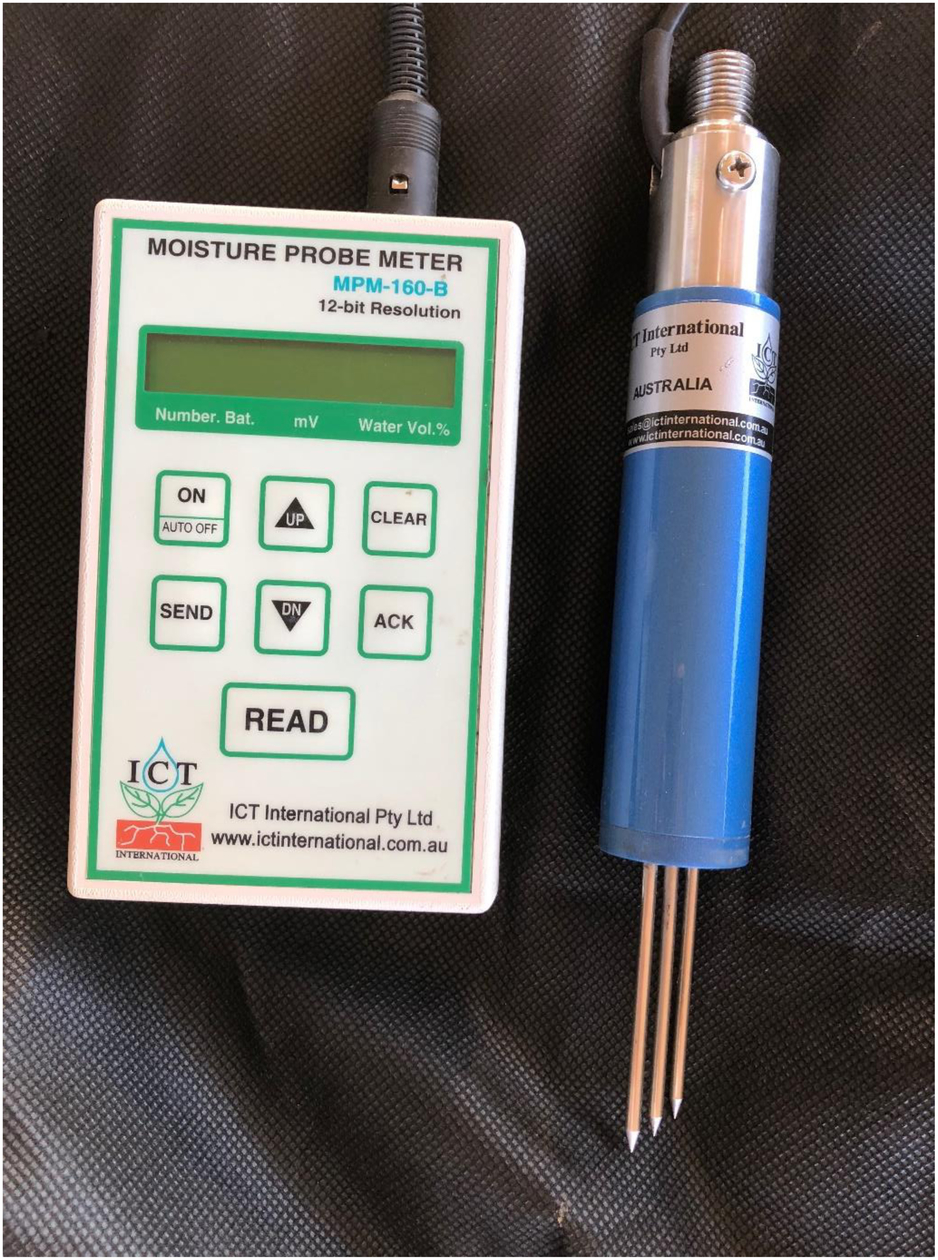
The soil moisture level in each pot was maintained with the help of a soil moisture probe meter (Figure 1) (Mahajan et al. Reference Mahajan, George-Jaeggli, Walsh and Chauhan2018). The pots with treatments of 100% WHC were monitored regularly (each day) with the soil moisture probe meter, and the pots were irrigated with the required amount of water (2.6 L pot−1 of 100% WHC) when the soil water volumetric content in these pots reached 34% on the basis of soil moisture probe reading. The soil WHC was 20% on a dry weight basis when the soil moisture probe had a reading of more than 34% soil water volumetric content. For calculating 75%, 50%, and 25% WHC, the fraction method (i.e., parts of 100%) was used. The experiment ran for 48 and 46 d during the first and second runs, respectively.
Soil moisture content in pots was maintained using a moisture probe meter for various levels of water stress on Echinochloa colona at the University of Queensland, Gatton, Australia.

Sampling and Measurements
Plant height was determined at 7-d intervals starting 14 d after transplanting and continuing until harvest. Plant height was measured from the soil surface to the uppermost tip of the top leaf. At harvest, two intact inflorescences were taken from each plant, placed in a separate bag for each plant, air-dried, and threshed before their seeds were weighed and counted (counts were performed based on weight). Before the onset of seed shattering, all inflorescences on each plant were counted, air-dried, and threshed, and then the seeds were weighed. The total number of seeds per plant in each treatment was estimated on the basis of two intact inflorescences (weight and seed count ratio). At harvest, aboveground shoot biomass and root biomass (70 C for 72 h) were determined separately.
Daily maximum and minimum temperatures were recorded using the Tinytag data logger installed in the screen house. The corresponding cumulative growing degree days (GDD) at each day after emergence were calculated as: [(daily maximum temperature + daily minimum temperature)/2 – Tb], where base temperature (Tb) was considered 10 C for summer weeds (Norsworthy et al. Reference Norsworthy, Oliveira, Jha, Malik, Buckelew, Jennings and Monks2008).
Statistical Analyses
Pots of each combination (2 biotypes by 4 WHC) were arranged in a randomized block design with the factorial arrangement of treatments replicated six times. The experiment was conducted two times (Experiment 1 in November 2017; Experiment 2 in January 2018). The second experiment was conducted after the termination of the first experiment. Emergence to harvesting periods for E. colona were 947 and 870 GDD in the first and second experiments, respectively (Supplementary Appendix 1). Data were subjected to ANOVA using the software Elementary Designs Application v. 1.0 Beta (AgriStudy.com, www.agristudy.com) (verified with GenStat 16th ed., VSN International, Hemel Hempstead, UK).
There were significant differences for most parameters between the two experiments; therefore, the data for each parameter are presented separately for each experiment. All data met assumptions of normality of residuals and homogeneity of variance, except the seed production data, which were subjected to square-root transformation. Biotypes were considered as a fixed factor; because all levels of interest were included in the experiment. Means were separated using a Fisher’s protected least significant difference (LSD) test at P = 0.05.
Data were analyzed using regression analysis for plant height and tiller numbers per plant. A three-parameter sigmoid model was used:
 $$y = a/\left\{ {1 + \exp \left[ { - \left( {x - d{_5{_0}} \right)/b} \right]} \right\}$$
where y is the estimated plant height or tiller number per plant at different days after planting at time x; a is the maximum of the parameter; d 50 is the time to reach 50% of the final plant height or tiller number per plant; and b is the slope.
Results and Discussion
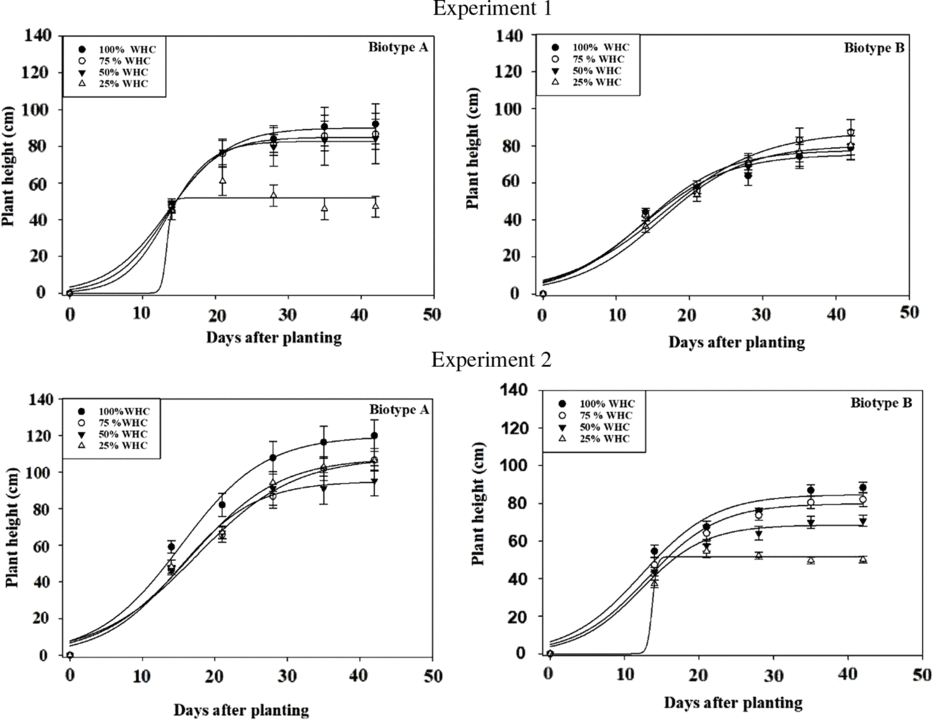
Water stress had a significant effect on plant height of E. colona and a sigmoidal response was observed under different moisture regimes (Figure 1; Supplementary Appendix 2). Both biotypes took 13 to 17 d under different moisture regimes to attain 50% height. Echinochloa colona biotypes behaved quite differently in the second experiment at 25% WHC compared with the first experiment. In the first experiment, the height of both biotypes was reduced at 25% WHC (17 d after planting) compared with 100% and 75% WHC; while no such differences were observed for these biotypes in the second experiment.
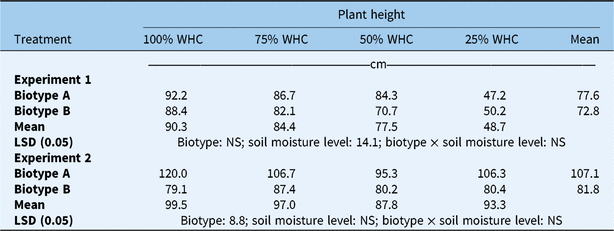
The final plant height in the first experiment was only affected by soil moisture and ranged from 49 to 90 cm (Table 1). It remained similar (77 to 90 cm) at 50%, 75%, and 100% WHC, but higher than final plant height at 25% WHC (49 cm). In the second experiment, soil moisture did not affect final plant height. However, in this experiment, averaged over soil moisture levels, biotype A (107 cm) attained a greater height than biotype B (82 cm). In the second experiment, the increase in plant height of both biotypes at all moisture levels was faster compared with the first experiment, as depicted in Figure 2. This showed that plant established well in the second experiment owing to a favorable environment and their plant height did not reduce even at 25% WHC. These results suggest that biotypes responded differently under different environmental conditions and that this phenomenon occurred due to adaptation to different environments.
Effect of various moisture regimes (25%, 50%, 75%, and 100% water holding capacity [WHC]) on height (cm) of Echinochloa colona biotypes A and B.

Effect of biotypes and soil moisture levels on plant height of Echinochloa colona a

a Abbreviations: NS, nonsignificant; WHC, water holding capacity.
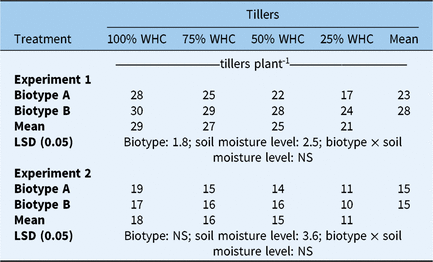
For both biotypes, the tiller density was higher in experiment 1 (21 to 29 tillers plant−1) compared with Experiment 2 (11 to 18 tillers plant−1), and the trend was clearer at 20 d after planting (Figure 2; Supplementary Appendix 3). In the first experiment, biotype B produced a higher number of tillers than biotype A; however, this difference was not observed in the second experiment (Table 2). In both experiments, averaged over biotypes, the tiller number at 100% WHC was higher than at 25% WHC. These observations suggest that water stress reduced the tiller production in E. colona.
Effect of biotypes and soil moisture levels on tiller production (tillers plant-1) of Echinochloa colona. a

a Abbreviations: NS, nonsignificant; WHC, water holding capacity.
There were more GDD during the first experiment than the second experiment, and E. colona produced more leaves and tillers in the first experiment. The present study revealed that the change in ambient temperatures during the two experiments in the summer season and varied soil water contents had a significant influence on the growth and tiller production of the two E. colona biotypes. These results suggest that screening for temperature tolerance and soil water stress among different biotypes of E. colona is necessary for understanding the growth, reproductive behavior, and invasion of E. colona in Australia.
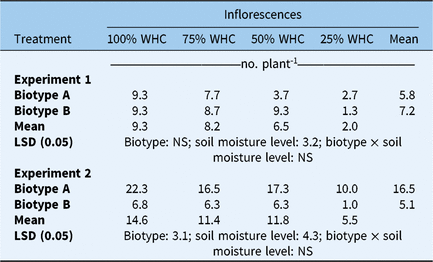
The number of inflorescences was similar for both biotypes in the first experiment (6 to 7 plant−1), but in the second experiment, biotype A produced more inflorescences (16 plant−1) than biotype B (5 plant−1). Averaged over biotypes, the number of inflorescences was similar at 100%, 75%, and 50% WHC in both experiments, but significantly lower at 25% WHC (Table 3). This suggests that biotypes of E. colona exhibit photoperiod sensitivity (Swanton et al. Reference Swanton, Huang, Shrestha, Tollenaar, Deen and Rahimian2000) and that phenological behavior and seed production potential of biotypes need to be studied under a range of temperature conditions.
Effect of biotypes and soil moisture levels on inflorescence (no. plant-1) of Echinochloa colona. a

a Abbreviations: NS, nonsignificant; WHC, water holding capacity.
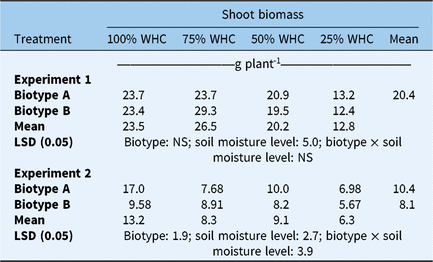
In the first experiment, averaged over biotypes, shoot biomass was lower at 25% WHC (13 g plant−1) compared with other soil moisture levels, and it was highest at 75% WHC (27 g plant−1) (Table 4). A significant interaction between biotype and soil moisture levels was found for shoot biomass in Experiment 2; however, no such interaction was found in Experiment 1. In the second experiment, shoot biomass of biotype A was similar at 75%, 50%, and 25% WHC (7 to 10 g plant−1), which was significantly lower than at 100% WHC (17 g plant−1). However, biotype B behaved similarly for shoot biomass at all soil moisture levels in the second experiment (6 to 9 g plant−1). These results suggest that biotypes respond differently under different environmental conditions for dry matter accumulation. Therefore, knowledge of weed biotype responses to varying sowing times/GDD and water stress levels allows for a better understanding of the interaction of these effects when designing management practices for their control.
Effect of biotypes and soil moisture levels on shoot biomass (g plant-1) of Echinochloa colona. a

a Abbreviations: NS, nonsignificant; WHC, water holding capacity.
Differences in growth of E. colona biotypes under water stress may influence the critical weed-free period for different crop species in particular environmental conditions (Patterson Reference Patterson1995). Weed biotypes that have faster growth rates and high biomass production under a range of temperature and moisture conditions would be considered highly competitive and would require precision weed management (Horak and Loughin Reference Horak and Loughin2000). However, our results suggest that a biotype that produces high shoot biomass under particular environmental conditions would not necessarily produce a high number of seeds as well.
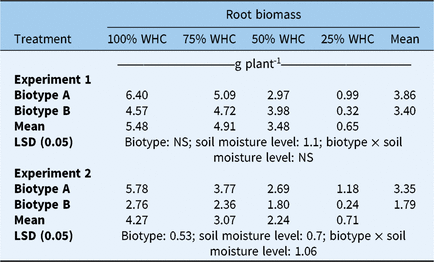
In the first experiment, averaged over biotypes, root biomass was similar at 100% and 75% WHC; however, it was higher than at 25% and 50% WHC (Table 5). The interaction between biotypes and soil moisture levels was significant for root biomass in Experiment 2 (Table 5): biotype A had higher root biomass than biotype B at 100% and 75% WHC. In this experiment, biotype A had the highest root biomass at 100% WHC, with root biomass decreasing with further reduction in soil moisture. However, root biomass for biotype B was similar at 100%, 75%, and 50% soil moisture levels (2.9 to 3.7 g plant−1), but was lower at 25% WHC (0.3 g plant−1).
Effect of biotypes and soil moisture levels on root biomass (g plant-1) of Echinochloa colona. a

a Abbreviations: NS, nonsignificant; WHC, water holding capacity.
High temperature and water-deficit stress can alter root growth in plants (Xu and Huang Reference Xu and Huang2000). Various authors have found that physiological and biochemical changes in response to water and temperature stress can effectively make plants adapt to abiotic stress by developing defensive mechanisms (Hartman and Nippert Reference Hartman and Nippert2013; Ren et al. Reference Ren, Zhou, Zhao, Han, Shi, Duan and Zhao2010; Shah et al. Reference Shah, Huang, Cui, Nie, Shah and Wang2011; Yan et al. Reference Yan, Chen, Shao, Zhao, Zhang, Zhang, Xu and Sun2012). Therefore, it is quite possible that varied temperatures/GDD in different experiments altered physiological and biochemical reactions in both biotypes that enabled biotype A to accumulate regulatory substances and caused enhanced root activity and seed production even in the second experiment (Bengough et al. Reference Bengough, McKenzie, Hallett and Valentine2011). The studies of Masle and Passioura (Reference Masle and Passioura1987) and Young et al. (Reference Young, Montagu, Conroy and Bengough1997) reported that water deficit affected root development, which in turn affected seed production in cereal crops. In the present study, a strong linear correlation was found between root biomass and seed production of E. colona (r = 0.96 in both experiments).
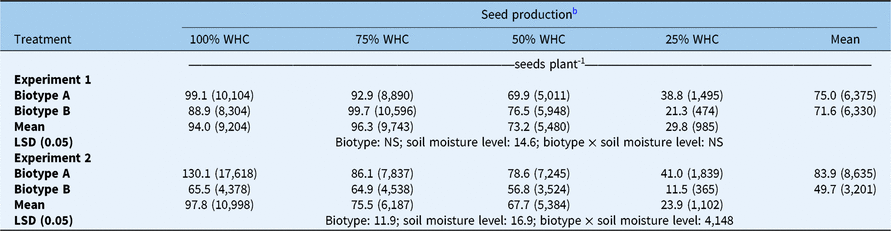
In Experiment 1, only soil moisture levels influenced the seed production of E. colona, and no interaction was found between biotype and soil moisture level for seed production (Table 6). Averaged over biotypes, seed production remained similar at 100% and 75% WHC, but was significantly lower at 25% WHC (985 seeds plant−1) and 50% (9,743 seeds plant−1) WHC. A significant interaction between biotypes and soil moisture levels was found for seed number in Experiment 2. Biotype A produced a higher number of seeds (17,618 seeds plant−1) than biotype B (4,378 seeds plant−1) at 100% WHC (Figure 3). At lower soil moisture levels (75%, 50%, and 25% WHC), biotype A produced a similar number of seeds (1,839 to 7,837 seeds plant−1), but seed production was significantly higher at 100% WHC (17,618 seeds plant−1). The number of seeds for biotype A at 75%, 50%, and 25% WHC decreased by 55%, 57%, and 89% compared with 100% WHC. Biotype B produced a similar number of seeds at all moisture levels in the second experiment.
Effect of various moisture regimes (25%, 50%, 75%, and 100% water holding capacity [WHC]) on tiller density (number) of Echinochloa colona biotypes A and B.

Effect of biotypes and soil moisture levels on seed production (seeds plant-1) of Echinochloa colona. a

a Abbreviations: NS, nonsignificant; WHC, water holding capacity.
b Figures in parentheses are original values.
It was evident that plant height, inflorescence number, and root biomass were higher for biotype A than for biotype B in the second experiment, particularly at 100% WHC. Therefore, biotype A had a greater seed number than biotype B in the second experiment. It was also observed that in both experiments, seed production of E. colona was significantly reduced at 25% WHC compared with 100% WHC, yet biotype A produced >1,000 seeds plant−1 even at 25% WHC.
A previous study by Chauhan and Johnson (Reference Chauhan and Johnson2010a) on E. colona in the Philippines revealed that seed production was sharply reduced in response to water deficit. The present study also revealed that water stress reduced the seed production of E. colona; however, biotypes of E. colona behaved differently for seed production under a range of temperature and water stress conditions. In the second experiment, at 100% WHC, the seed production potential was higher for biotype A than for biotype B. It is possible that biotype B experienced water stress (due to excess water) at 100% WHC, which may have caused the reduced root growth observed in the present study, whereas biotype A was unaffected at 100% WHC. The present study specifically revealed that two E. colona biotypes behaved differently, particularly at high moisture regimes (100% WHC). Biotype A almost produced four times more seeds than biotype B at 100% WHC in the second experiment, indicating strong invasiveness under favorable water conditions. The present study also revealed that higher seed production in biotype A at high soil moisture content was due to relatively high root biomass that resulted in increased shoot biomass and inflorescence number for biotype A compared with biotype B at 100% WHC.
Conclusions and Future Implications
The results of this study provide information about biological attributes and the plasticity behavior of E. colona biotypes under water stress conditions. This information could aid in developing climate change simulation models to understand the effect of drought on crop–weed competition for various weed biotypes.
Drought conditions occurring after weed emergence could make some biotypes able to withstand the dry environment by thickening the leaf cuticles, reducing vegetative growth, or increasing the speed of flowering (Brown Reference Brown2009). This could be the reason that in Experiment 2, biotype A at 50% WHC produced a higher seed number than at 25% WHC. However, no such response was observed for biotype B. The ability of a particular biotype to grow well under a wide range of temperature and water stress conditions could enhance its weedy nature and may lead to its expansion into larger areas. Therefore, the high adaptability observed for biotype A in the present study may reflect that it was collected from a relatively dry area.
Seed production in response to various abiotic stresses (e.g., temperature and water stress) is crucial for weed population dynamics. Sustainable control of any weed depends upon the competitive ability of a particular biotype and the number of seeds returned to the soil seedbank (e.g., Cousens and Mortimer Reference Cousens and Mortimer1995; Norris Reference Norris2003). Therefore, the findings presented here suggest that future studies should include a greater number of biotypes selected from a wider range of environments, and these biotypes should be studied under water stress in competition with crops like mung bean or grain sorghum to evaluate their impact on yield.
In the present study, water deficit led to reduced seed production, but biotype A still produced enough seeds at 50% WHC to cause weed infestation levels sufficient to reduce crop yield. Therefore, the priority in weed management should be given to reducing weed seedbanks by combating weeds at an early stage. It is expected that the joint effect of drought stress and enhanced competitive ability of certain weed biotypes under a particular environment could reduce crop yields significantly. Therefore, it is necessary to control competitive weed biotypes at a very early growth stage to prevent losses of residual moisture for the crop in no-till agriculture systems of Australia. Unlike previous research on E. colona biotypes collected from rice-growing areas, in this study biotypes were collected from a relatively dry region of Australia, and we found that greater root biomass in E. colona contributed to high seed production. Therefore, the findings of the present study could be useful for management of weed biotypes in the northern grain region of Australia by informing agronomic practices (sowing time, water management, herbicide application, etc.) to promote competition in the favor of the crop.
Supplementary material
To view supplementary material for this article, please visit https://doi.org/10.1017/wsc.2019.32
Author ORCIDs
Gulshan Mahajan https://orcid.org/0000-0002-9423-9893
Acknowledgments
The authors would like to thank the Grains Research and Development Corporation (GRDC) for investing in this research under Project US00084. No conflicts of interest have been declared.