


Introduction
For older adults with health impairments, filial care is among the most used types of long-term care (LTC). We define filial care as the assistance with personal or household activities that adult children provide to their parents when needed. As not all children provide care to their health-impaired parent, several studies have investigated what drives filial care and why differences exist among children within and between families (Tolkacheva et al. Reference Tolkacheva, Broese van Groenou and van Tilburg2010; Grigoryeva Reference Grigoryeva2017; Vergauwen and Mortelmans Reference Vergauwen and Mortelmans2021; Vangen and Herlofson Reference Vangen and Herlofson2023). According to the Informal Care Model (ICM) (Broese van Groenou and de Boer Reference Broese van Groenou and de Boer2016), when the parent has a need for LTC (e.g. health impairments), filial care depends on how willing and able children are to support their parents and on the presence of other helpers such as spouses and siblings. This translates to characteristics of parents (e.g. health), children themselves (e.g. gender) and their siblings (e.g. geographic distance to parents) which all determine whether or not children provide filial care to parents (Tolkacheva et al. Reference Tolkacheva, Broese van Groenou and van Tilburg2010; Grigoryeva Reference Grigoryeva2017; Vergauwen and Mortelmans Reference Vergauwen and Mortelmans2021; Vangen and Herlofson Reference Vangen and Herlofson2023).
Over the past decades, however, Western countries have undergone substantial political and socio-cultural changes that can pose challenges for these drivers of filial care. Some societal changes have increased the need for filial care-givers. One example is the reform of the Dutch LTC system, which was being relatively de-familialized in the 1990s, with generous provision of publicly provided care (Verbakel et al. Reference Verbakel, Glaser, Amzour, Brandt and van Groenou2023). Since the 2000s, however, multiple measures were implemented to contain the increasing costs, including a stronger emphasis on informal care: LTC recipients are now expected to take more responsibility in organizing their LTC provision and the mobilization of informal care-givers is promoted and supported (Janssen et al. Reference Janssen, Jongen and Schröder-Bäck2016). In addition, it has become increasingly difficult to maintain a sufficient workforce of professional LTC workers, which has shrunk by 33 per cent between 2001 and 2023 (OECD 2025). These developments have increased the demand for filial care considerably.
Yet, at the same time, several macro-level trends may have reduced the potential of filial care (Broese van Groenou and de Boer Reference Broese van Groenou and de Boer2016). First, decreasing birth rates have led to a smaller group of children that can potentially care for their parents. Consequently, children have fewer siblings to share care responsibilities with. Second, changing gender roles might have also impacted people’s ability to engage in care-giving: Women increasingly participate in the labour market (OECD 2024), which reduces their availability for informal care-giving. Third, increased educational opportunities are associated with greater geographic mobility among children, often resulting in larger distances from their parents (Steinbach et al. Reference Steinbach, Mahne, Klaus and Hank2020), which increases the time required to provide filial care.
It is unclear to what extent the importance of determinants of filial care-giving (LTC needs, willingness and ability to provide care and presence of other helpers) has changed as a result of these socio-cultural and policy changes. The present study addresses this gap in the literature by comparing determinants of filial care in the Netherlands in 2001 and 2023. This was achieved with data from two ancillary studies of the Longitudinal Aging Study of Amsterdam that provide detailed information on parents and the care-giving of all their children, allowing distinguishing between individual and family-level information. This study is based on a previous study (Tolkacheva et al. Reference Tolkacheva, Broese van Groenou and van Tilburg2010), which investigated determinants of filial care-giving using the same 2001 data. We replicated this data in 2023 to enable a comparison between two distinct time periods with regards to LTC policies and socio-cultural factors. This leads to the following research question: to what extent has the impact of determinants of children’s likelihood to provide filial care changed between 2001 and 2023 in the Netherlands?
Theoretical framework
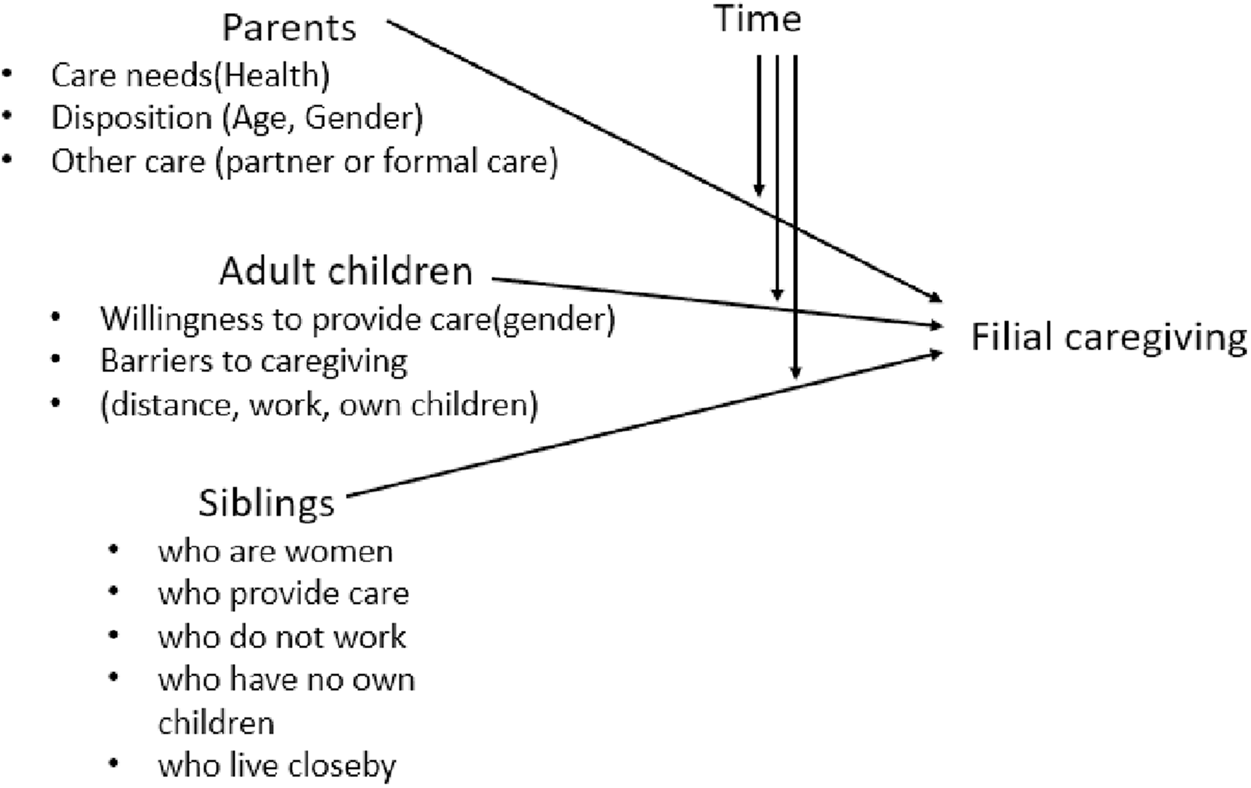
To understand what determines filial care-giving in different time periods, we used the ICM of Broese van Groenou and de Boer (Reference Broese van Groenou and de Boer2016). This model describes how individual and family-level factors determine an individual’s consideration to provide informal care; in our study, that individual is the child (see Figure 1). The first trigger for filial care is the parental need for care. The parental condition sets off the deliberation for each of the children in the family to consider whether or not care will be provided. This parental need for care is thus the same for each child within a family. In addition, the parental use of other sources of care, from the spouse and formal types of care-giver, is also the same for each of the children. This implies that, in this study, the parental factors indicating care need and care context (health, gender, age, use of formal and spousal care) are present at the group/family level.
Conceptual model of parent, adult children and sibling characteristics that determine filial care-giving.

Figure 1 Long description
A line diagram with three text blocks on the left which are labelled “Parents”, “Adult children” and “Siblings” , one block in the center labeled “Time” and one bock on the right labelled “Filial caregiving”. Three diagonal arrows run from the three blocks on the left to the right and converge at “Filial caregiving”. Additionally, three arrows run from the “Time” block towards the center of the other three arrows.l. The three text blockson the left contain bullet lists: Parents - Care needs (health) left parenthesis Health right parenthesis - Disposition left parenthesis Age, Gender right parenthesis - Other care left parenthesis partner or formal care right parenthesis Adult children - Willingness to provide care left parenthesis gender right parenthesis - Barriers to caregiving left parenthesis distance, work, own children right parenthesis Siblings - who are women - who provide care - who do not work - who have no own children - who live closeby Language: English.
Although the parental care context is the same for each of the children, there will be considerable difference among the children in whether they respond to the need for care. At the individual level, important triggers for care provision are one’s disposition and perceived ability to provide care. Dispositional factors are a container of norms, values and preferences to provide care, which are known to vary, among other ways, by gender. In this study we use the gender of the children as a proxy for disposition and assume that, in line with previous literature, daughters will be more likely to provide filial care (Tolkacheva et al. Reference Tolkacheva, Broese van Groenou and van Tilburg2010; Pillemer and Suitor Reference Pillemer and Suitor2014; Van den Broek et al. Reference Van den Broek, Dykstra and Veen2019; Herrera and Fernández Reference Herrera and Fernández2022). In addition to dispositional factors, perceived barriers may indicate to what degree care provision actually occurs. Well-studied barriers to filial care include restrictions in time and distance (Vergauwen and Mortelmans Reference Vergauwen and Mortelmans2021; Vangen and Herlofson Reference Vangen and Herlofson2023). Here, we included the employment of children, their geographic distance from the parent and whether or not they have young children of their own.
When studying family care-giving, we need to acknowledge that these parental and individual child factors determine filial care for each of the children present in the family. As the individual-level determinants may vary across siblings, this implies that siblings’ choices are interdependent. A child is, for example, less likely to provide filial care when one of his or her siblings is living close to the parent and has time to provide care. Given the variation in child characteristics (gender, employment, family status, distance) within the family, we include at the individual child level information about their siblings’ characteristics and filial care-giving. It is assumed that filial care is thus dependent on having at least one sibling who provides care or who, based on characteristics, would be likely to provide care (living close, having no young children, being not employed or being part-time employed).
Our main aim is to compare the impact of these determinants on filial care-giving over historic time. The mechanisms behind informal care-giving are influenced by macro-level factors that can change over time (population ageing and LTC policy, labour market and socio-cultural norms). Therefore, we describe in the following section how macro-level factors can impact the relationship between each determinant and filial care-giving over time.
Parent characteristics that determine filial care
The first trigger for filial care-giving in the ICM is the parent’s health, which defines the need for LTC (Broese van Groenou and de Boer Reference Broese van Groenou and de Boer2016). When health impairments are more severe, children are also more likely to provide care (Lin and Wolf Reference Lin and Wolf2020; Vangen and Herlofson Reference Vangen and Herlofson2023). Owing to increased longevity and improved medical care, children may provide care to increasingly older parents, largely because older adults’ health impairments are now more concentrated at a higher age (Haß et al. Reference Haß, Tulka, Tönnies, Hoyer, Palm, Knippschild and Brinks2023). However, besides the age changes, there is no reason to assume that the severity of health impairments itself changes the likelihood of children engaging in filial care-giving between 2001 and 2023. Therefore, it can be expected that the association between parental health or age and filial care-giving was similar in 2001 and 2023 (Hypothesis 1a).
Parents’ gender can impact filial care-giving by affecting to what extent children are willing to provide care. Children tend to have a stronger bond with mothers (Kwak et al. Reference Kwak, Kim, Lee and Zhang2020) and might therefore be more willing to provide care to them. However, existing evidence is mixed: one study with a large European sample indeed found that children are more likely to provide care to a mother than to a father (Vergauwen and Mortelmans Reference Vergauwen and Mortelmans2021). In contrast, several smaller studies did not find this gender difference (Van den Broek et al. Reference Van den Broek, Dykstra and Veen2019; Lin and Wolf Reference Lin and Wolf2020; Vangen and Herlofson Reference Vangen and Herlofson2023); among these is one from the Netherlands (Van den Broek et al. Reference Van den Broek, Dykstra and Veen2019). Thus, the relationship between parents’ gender and filial care-giving is not sufficiently established. While socio-cultural macro-indicators such as gender norms might play a role in changing this relationship over time, the underlying mechanism behind this remains unclear. Existing evidence does not suggest a change over time: Aaltonen et al. (Reference Aaltonen, Deeg and Broese van Groenou2024) found that older men and women were similarly likely to use non-spousal informal care from 1998 to 2015. In addition, most recent studies also did not find parental gender differences in filial care-giving (Van den Broek et al. Reference Van den Broek, Dykstra and Veen2019; Lin and Wolf Reference Lin and Wolf2020; Vangen and Herlofson Reference Vangen and Herlofson2023). Therefore, we expect that children were similarly likely to provide care to mothers and fathers in both 2001 and 2023 (Hypothesis 1b).
The availability of other types of care-giver (i.e. partner or formal care) plays a crucial role in filial care provision. On the one hand, other care-givers can act as substitutes (Zhang et al. Reference Zhang, Sun and L’Heureux2021): by fully meeting parents’ care needs, they might reduce or eliminate the need for additional filial care. On the other hand, children might choose to provide additional help to complement other care-givers, increasing their likelihood of providing filial care. Most evidence points to the existence of substitution effects where other care-givers lower children’s likelihood to provide filial care (Stuifbergen et al. Reference Stuifbergen, Van Delden and Dykstra2008; Van den Broek et al. Reference Van den Broek, Dykstra and Veen2019; Vergauwen and Mortelmans Reference Vergauwen and Mortelmans2021).
To what degree other care-givers complement or substitute filial care might have changed owing to LTC reforms. As there was increasing pressure for formal care to become more cost-efficient (Janssen et al. Reference Janssen, Jongen and Schröder-Bäck2016) and care personnel became scarcer (OECD 2024) compared to previous decades, the availability of formal care may have been reduced. As a result, parents might increasingly receive an insufficient amount of formal care that does not meet all of their needs. This could necessitate their children providing complementary care to parents who already receive formal care, thus leading to a more positive impact of formal care on filial care provision. This might even be exacerbated by policy efforts that promoted informal care-giving. Partners are another important type of care-giver whose capacity to provide care may have increased over the last decades since older adults live longer in good health compared to previous decades (Timmermans et al. Reference Timmermans, Hoogendijk, Broese van Groenou, Comijs, van Schoor, Thomése, Visser, Deeg and Huisman2019). Consequently, partners might care more often and for longer periods of time, substituting the need for children to step in and provide filial care, thus reducing the likelihood of children providing filial care. Therefore, we expect the association of filial care-giving with formal care to be less negative (Hypothesis 1c) and the association with partner care to be more negative (Hypothesis 1d) in 2023 compared to 2001.
Individual characteristics that determine filial care-giving
Children’s disposition towards providing filial care also depends on their own characteristics (Broese van Groenou and de Boer Reference Broese van Groenou and de Boer2016). The child’s gender is important here as traditionally women are expected to be primary care-givers (Gösenbauer et al. Reference Gösenbauer, Braun and Bilger2025) and daughters generally have a stronger bond with their parents (Suitor and Pillemer Reference Suitor and Pillemer2006).
Gender differences in filial care-giving might have changed over time owing to changing socio-cultural factors: Lopez-Zafra and Garcia-Retamero (Reference Lopez-Zafra and Garcia-Retamero2021) found that between 2006 and 2016 traditionally feminine characteristics such as being supportive to others are increasingly attributed to men, which might indicate that men have also become more willing to take on the role of care-givers. Qualitative evidence indeed suggests that, owing to increasing care demands, men might take on more LTC responsibilities (Comas-d’Argemir and Soronellas Reference Comas-d’Argemir and Soronellas2019). Still, some studies that investigated differences in previous decades did not find a shift towards more egalitarian filial care provision of sons and daughters (Grigoryeva Reference Grigoryeva2017; Van den Broek et al. Reference Van den Broek, Dykstra and Veen2019). However, to our knowledge, no such study has investigated this in a recent sample (after 2014). Thus, we expect that the association between children’s gender and their likelihood to provide filial care was weaker in 2023 compared to 2001 (Hypothesis 2a).
Even when children are willing to provide care, they may not be able to as they can experience barriers with regards to money, time and distance (Broese van Groenou and de Boer Reference Broese van Groenou and de Boer2016). These can increase their opportunity costs of care-giving and impede their ability to balance LTC provision and other obligations (Cohen et al. Reference Cohen, Shiovitz-Ezra and Erlich2023). Having paid (full-time) work (Carrino et al. Reference Carrino, Nafilyan and Avendano2023) and (young) children (Vangen and Herlofson Reference Vangen and Herlofson2023) can reduce the amount of time that they can spare to provide care to their parents. Geographic distance from parents can be an additional barrier, as those who live farther away from their parents would have to invest more time and money in visiting them. Therefore, the likelihood that they provide LTC to parents declines steeply with increasing travel time (Pillemer and Suitor Reference Pillemer and Suitor2014; Vergauwen and Mortelmans Reference Vergauwen and Mortelmans2021; Cohen et al. Reference Cohen, Shiovitz-Ezra and Erlich2023; Vangen and Herlofson Reference Vangen and Herlofson2023).
Most barriers have likely remained similarly difficult to overcome in 2023 as in 2001: in the Netherlands, costs for day-care facilities have increased substantially over time, but young children still receive similar hours of day care over time (Statistics Netherlands 2025). Therefore, adult children likely have similar time constraints when they are raising their own young children. Owing to technological advancements, children have more options to support parents from a distance (e.g. ordering groceries on the internet), but most care tasks still require children to visit parents personally. Thus, geographic distance cannot be easily overcome. Combining work with care tasks, however, might have become somewhat easier as work arrangements have, overall, become more flexible. In 2015, 56 per cent of Dutch informal care-givers adjusted their work arrangement to combine work with care tasks (Oldenkamp et al. Reference Oldenkamp, Bültmann, Wittek, Stolk, Hagedoorn and Smidt2018). This might be exacerbated after the Covid-19 pandemic, after which working from home has become more common (Ropponen Reference Ropponen2025). Not having an obligation to be in the office might make it easier to be present when parents need help and thus increase the likelihood of providing care. Therefore, we expect that the association between full-time work and filial care-giving was weaker in 2023 compared to 2001 (Hypothesis 2b), while the association with having children of their own and living in closer proximity remained stable (Hypothesis 2c).
Sibling characteristics that determine filial care-giving
Whether the intention to provide informal care leads to actual care-giving depends also on the presence of other (potential) helpers among siblings (Broese van Groenou and de Boer Reference Broese van Groenou and de Boer2016) as their choices to provide care depend on each other. The distribution of care-giving responsibilities is often a collective agreement among siblings (Vergauwen Reference Vergauwen2024). Indeed, those with care-giving siblings are more likely to provide filial care themselves (Tolkacheva et al. Reference Tolkacheva, Broese van Groenou and van Tilburg2010). Sharing care-giving responsibilities might have become even more common over the past decades owing to changing demand for informal care: As a result of the limited supply of formal care and governmental promotion of social responsibility, children in 2023 may feel more responsible to fulfil their parents’ care needs together. Indeed, after the reorganization of the Dutch LTC system in 2015, sharing care responsibilities among informal care-givers who live outside their parents’ household became more common (De Klerk et al. Reference De Klerk, De Boer, Plaisier and Schyns2017). Therefore, we expect that having siblings who provide care is more strongly and positively associated with filial care-giving in 2023 compared to 2001 (Hypothesis 3a).
Still, distribution of care responsibilities is often unequal, with some siblings providing no care at all (Leinonen Reference Leinonen2011). Connidis and Kemp (Reference Connidis and Kemp2008) emphasize that negotiation among siblings is generally limited and that often a feasible arrangement emerges based on the siblings’ willingness towards and barriers to filial care-giving. As women are more likely to take over care responsibilities, children who have sisters are less likely to provide care to parents themselves (Grigoryeva Reference Grigoryeva2017; Vergauwen and Mortelmans Reference Vergauwen and Mortelmans2021).
Similar to individual gender differences of children, these sibling gender differences might have weakened over time. As brothers potentially feel more responsible to contribute and less hindered by traditional gender roles in 2023, siblings’ gender might matter less. Therefore, we expect that having at least one sister among siblings is associated less strongly with filial care-giving in 2023 compared to 2001 (Hypothesis 3b).
Vergauwen (Reference Vergauwen2024) argues that siblings consider how filial care can be provided efficiently in terms of time and monetary investments. Therefore, among siblings, those with the lowest opportunity cost generally take over care responsibilities (Chanfreau and Goisis Reference Chanfreau and Goisis2022). This means that if a child has siblings who experience few barriers to care-giving, he or she might leave the task to those siblings and not provide care. Indeed, children who have siblings who live geographically close to a parent (Vergauwen and Mortelmans Reference Vergauwen and Mortelmans2021) or who spend less time on paid work (Vergauwen Reference Vergauwen2024) are less likely to provide care. In contrast, the presence of a sibling with children of their own did not impact filial care-giving in previous studies (Tolkacheva et al. Reference Tolkacheva, Broese van Groenou and van Tilburg2010; Vergauwen and Mortelmans Reference Vergauwen and Mortelmans2021; Vangen and Herlofson Reference Vangen and Herlofson2023).
Over the past decades, the impact of siblings’ barriers on filial care-giving might have changed owing to reforms of LTC, changing social demographics and the labour market participation of younger generations. Formal care provision has become scarcer and the pressure on children has increased. At the same time, children have fewer siblings on average, so there are fewer people among whom to distribute care responsibilities. As a result, an individual’s opportunity costs might serve less as a legitimate reason to refrain from providing care to the same extent. As siblings negotiate, those with fewer barriers might be unwilling to carry the care burden alone and require others to participate, even when these siblings live farther away or have other competing interests. Therefore, we expect that having siblings without barriers to care-giving (no paid work, no children of their own, living a short distance away) has a less negative impact on filial care-giving to parents in 2023 compared to 2001 (Hypothesis 3c).
Method
Participants
Data were used from two ancillary studies of the Longitudinal Aging Study of Amsterdam (LASA), which is an ongoing study of the physical, social, cognitive and psychological functioning of older adults in the Netherlands (Hoogendijk et al. Reference Hoogendijk, van Schoor, Qi, Visser, Swinkels, Broese van Groenou, Kok, Holwerda, Pasman, Onwuteaka-Philipsen, Remmelzwaal, van Ingen, van Tilburg, van Haaster, van der Horst, Poppelaars, Deeg and Huisman2025). The LASA is based on a nationally representative sample of older adults aged 55 and above. Participants were originally recruited in culturally distinct regions in the west, north-east and south of the Netherlands to reflect the national distribution of urbanization and religiosity. Since 1992, measurements have been conducted about every three years, and two refresher cohorts were added in 2002/03 and 2012/13.
The ancillary studies focus on informal care provided by partners and children to older parents. In 2001 and 2023, older adults who participated in the main LASA waves of 1998/99 and 2021/22 were selected on four types of criteria. First, they had to have a need for care, indicated by having at least one health impairment and receiving at least one type of LTC. Second, the respondents had to have sufficiently high cognitive function in order to complete a face-to-face (in 2001) or written (in 2023) questionnaire (MMSE score > 24 in 2001 and > 22.5 in 2023). Third, they had to live independently, as residential care indicates specific care situations that are difficult to compare, Finally, they had to have at least one child alive.
They were interviewed face-to-face or by completing a written questionnaire and provided information about themselves and their children. Of the 354 invited parents in 2001, 289 participated (81.6 per cent) and 161 of the 425 invited parents participated in 2023 (37.8 per cent). In 2023, the response rate was lower because of a different study design in which parents only participated if children also agreed to participate. Unfortunately, in 2023 parents were less in favour of asking their children to participate and children more often declined to participate themselves. Figure 2 provides an overview of the inclusion procedure. After exclusion, the resulting data included 220 parents who reported on 830 children in 2001 and 115 parents reporting on 288 children in 2023. For remaining variables with missing information (for all variables, fewer than 3 per cent of cases), the mean value for that sample was imputed.
Exclusion procedure for the 2001 and 2023 samples.

Figure 2 Long description
The flowchart outlines the exclusion procedure for parents and children in the 2001 and 2023 sample. It starts with a sample of 259 parents and 960 children in 2001 and 161 parents and 366 children in 2023. After excluding parents with children in the household, 257 parents and 927 children remain in 2001 and 157 parents and 341 children in 2023. After excluding children with partner outisde the household, 245 parents and 882 children remain in 2001 and 145 parents and 318 children in 2023. After excluding children without information, 242 parents and 865 children remain in 2001 and 144 parents and 317 in 2023. After excluding children with missing outcome variable, 242 parents and 853 children remain in 2001 and 144 parents and 317 children in 2023. After excluding parents without information on children, 242 parents and 853 children remain in 2001 and 115 parents and 288 children in 2023. After excluding participants who participated in both samples, 220 parents and 830 children remain in 2001 and 115 parents and 286 children in 2023.
Measurements
Regarding outcome at the individual child level, for each child in the family, the parent reported how frequent (0 = never to 3 = often) that child provided help with ten tasks (cooking, shopping for groceries, cleaning, transportation, financial help, washing, showering or bathing, dressing, going to the toilet and standing up or sitting down). This was transformed to a dichotomous variable, where 0 indicated no filial care (score 0 for all tasks) and 1 indicated help with at least one task.
In terms of parent characteristics, physical functioning was measured, based on Katz et al. (Reference Katz, Ford, Moskowitz, Jackson and Jaffe1963), by six questions about the difficulty of daily activities like walking up and down stairs and cutting toenails. Responses indicated the difficulty of each task on a five-point scale from 0 (No, I cannot) to 5 (Yes, without difficulty). The item scores were summed to create a scale from 6 (poor) to 30 (good functioning). Parents provided information about their gender (1 = mother) and age in years. Parents also indicated if they received publicly provided or privately paid formal care (1 = yes). Furthermore, they indicated whether they received care from a partner (1 = yes). Those that did not receive care or did not have a partner were coded as 0.
Regarding child characteristics, for each child, parents reported their gender (1 = female), age, partner status (1 = with partner), full-time employment (1 = employed for more than 28 hours), whether they had their own children under 16 years (1 = at least one) and required travel time (1 = under 30 minutes) to their parents.
Sibling characteristics were calculated from the same information by calculating whether children had at least one sibling who provides care (1 = yes), at least one female sibling (1 = yes), at least one sibling without full-time employment (1 = yes), at least one without a partner (1 = yes), at least one without their own children below the age of 16 (1 = yes) and at least one within 30 minutes of travel time to their parents (1 = yes). These were used as separate dichotomous variables.
Analyses
A mixed-effects regression approach was used to take the clustered nature of the data into account, in which children (Level 1) were nested in families (Level 2). This was achieved using the lme4 package of the statistical package R (Bates et al. Reference Bates, Mächler, Bolker and Walker2015). The lmertest package was used to calculate p-values. First, descriptive statistics were calculated for 2001 and 2023 samples separately and for the combined sample (Table 1). Differences between the 2001 and 2023 samples were calculated with bivariate (logistic) mixed-effects models that include only the variable in question as an outcome (e.g. age), observation (1 = 2023) as a predictor and the random intercept.
Characteristics of parents (family level), adult children and siblings (both individual level)

Table 1 Long description
The table compares characteristics in 2001 and 2023 for three groups: parents, their adult children, and siblings, with totals also shown. In 2001, 220 parents and 830 children participated. In 2023, 115 parents and 288 children participated. Parents are less often female in 2023 (53.9 percent) than in 2001 (65.0 percent), while age is similar at about 78 years. Parents report better physical functioning in 2023 (mean 25.3) than in 2001 (mean 23.4), and slightly fewer chronic diseases (mean 1.6 versus 1.8). Partner care and formal care are similar across years, and the share with at least one child caregiver declines from 77.3 percent to 67.8 percent. Among adult children, the share in full-time employment rises from 54.8 percent to 71.1 percent, while caregiving is similar (54.0 percent in 2001 and 50.7 percent in 2023) and travel time stays around 64 minutes. Sibling networks are smaller in 2023, with mean number of siblings falling from 3.9 to 1.9, and fewer families have at least one sibling not working full time (44.4 percent versus 80.0 percent). Asterisks in the table indicate where differences between years are statistically reliable
* p(2023 vs 2001) < 0.05, **p < 0.01, ***p < 0.001
To investigate the effects of parent, children and sibling characteristics on filial care-giving, a mixed-effects logistic regression model was applied, with filial care-giving (yes/no) as the outcome variable. All independent variables were included in this model (Table 2). This was done for the combined sample that included observations from 2001 and 2023. The outcome and all child and sibling characteristics were measured on the individual child level (Level 1) and all parent characteristics on the family level (Level 2). To investigate changes over time, a separate model for each characteristic was analysed that includes all variables of the full model and the interaction of that characteristic with observation (e.g. partner care*observation). The main and interaction effects are presented in Table 3. Significant interaction effects indicated a change in the association of parent (Hypothesis 1), child (Hypothesis 2) or sibling characteristics (Hypothesis 3). As an additional sensitivity analysis, the full model was also analysed with a stricter criterion for the dependent variable where only providing help with at least three tasks counted as care-giving (see supplementary material table S1) to evaluate whether our findings would change if we focus on more intense filial care-giving.
Mixed-effects logistic regression on filial care-giving in 2001 and 2023; separate models for parent, child and sibling characteristics

Table 2 Long description
The table reports odds ratios with 95 percent confidence intervals for filial caregiving, shown as multivariate and bivariate models for parent, child, and sibling characteristics. In the multivariate model, the strongest association is child proximity: living within 30 minutes is linked to much higher odds of caregiving (about 3.67, confidence interval about 2.64 to 5.10). Parent care by a partner is associated with lower odds of the child providing care (about 0.53, confidence interval about 0.37 to 0.78), while parent use of formal care is associated with higher odds (about 1.59, confidence interval about 1.12 to 2.25). Older parent age shows a small increase in odds, and better physical functioning is linked to slightly lower odds; parent gender and number of chronic diseases are not clearly associated after adjustment. Child gender, full-time employment, and having a child under 16 are not clearly associated in the multivariate model, although having a child under 16 is associated with lower odds in the bivariate model. Among sibling measures, having at least one caregiver is associated with much higher odds in both models, but several sibling estimates have confidence intervals that include no clear effect and some intervals appear inconsistent, so those results should be interpreted cautiously. The indicator for the 2023 observation shows no clear difference from the earlier period in either model.
* p < 0.05,**p < 0.01, ***p < 0.001; −2 loglikelihood 1217.9
Main and interaction effects of each interaction model; each row represents a separate model that includes all parent, child and sibling characteristics (not presented here) and the displayed interaction effects

Table 3 Long description
The table shows one model for each parent, child and sibling characteristic and reports their main- and interaction effects as odds ratios The largest main effect is for siblings having at least one caregiver, with odds a little over five times higher, and child living within 30 minutes also shows a strong increase at a little over three times higher. Among parent factors, older age, use of formal care, and care by a partner show statistically marked main effects, with partner care linked to lower odds while age and formal care are linked to higher odds. Child gender shows a statistically significant main effect andthe only significant interaction effect in this table (OR=.454). Most other child and sibling characteristics have odds ratios near one and are not flagged as statistically marked.
* p < 0.05, **p < 0.01, ***p < 0.001
Results
Descriptive statistics
Table 1 provides an overview of all characteristics of parents and their children. Some characteristics of parents differed in the 2023 sample compared to 2001: fewer parents were female (2023: 53.9%; 2001: 65.0%), they had better physical functioning (25.3; 23.4) and fewer chronic diseases (1.5; 1.8). Characteristics of children did not differ significantly, with one exception: a higher proportion was employed full-time in 2023 compared to 2001 (71.1%; 54.8%). The percentage of children who provided filial care did not differ significantly between both samples. However, in 2023 they had almost half as many siblings on average (1.9; 3.9). Furthermore, they were less likely in 2023 to have at least one care-giver (63.3%; 76.3%), one or more sisters (72.9%; 82.6%) or at least one person without full-time employment among their siblings (44.4%; 80.0%).
Associations of filial care-giving
The association of filial care-giving with parent, children and sibling determinants was analysed in bivariate and multivariate models (Table 2) and the interaction of each determinant with observation (2023 vs 2001) in separate interaction models (Table 3). First, with regards to parent determinants, all had significant bivariate associations with filial care-giving except for the number of chronic diseases (Table 2). The multivariate model shows that having a parent who is older (OR = 1.027, p < 0.05) or who receives formal care (OR = 1.587, p < 0.05) was associated with a higher likelihood of providing filial care. Having a parent who receives partner care (OR = 0.534, p < 0.01) or who has better physical functioning (OR = .955, p < 0.05) was associated with a lower likelihood of providing filial care. To test Hypothesis 1, which stated which parental determinants change over time, Table 3 includes interaction effects between time and each determinant in separate models. No signification interaction effect was observed for the parent characteristics. This indicates that parent characteristics had a similar impact on filial care-giving in 2001 and 2023. These findings support Hypotheses 1a and 1b, which state that age, physical functioning and parental gender have a similar association with filial care-giving in 2001 and 2023. However, we expected that formal care use would have a weaker negative association and parent care a stronger negative association with filial care-giving in 2023 (Hypothesis 1c and 1d), which was not supported by our results.
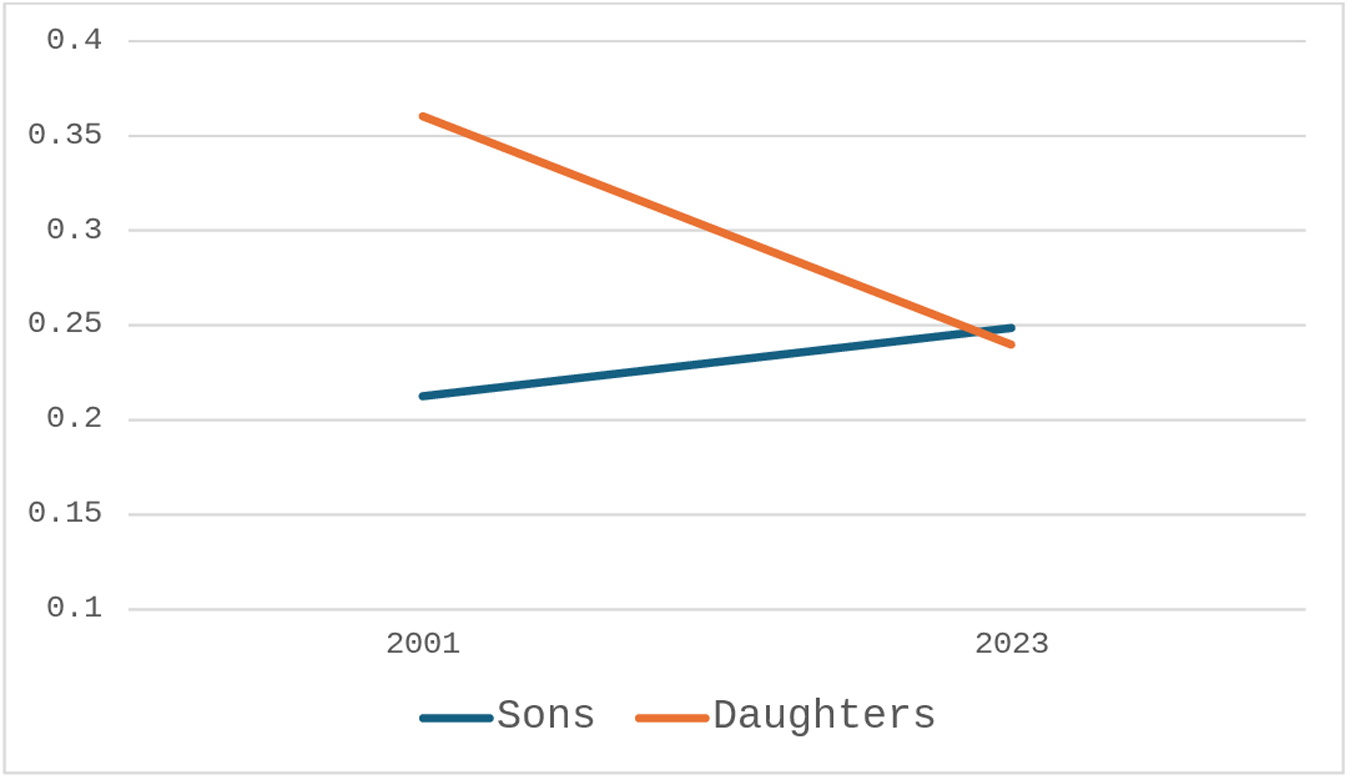
Second, with regards to children’s determinants, having a child of their own had a bivariate negative association with filial care-giving (OR = 0.636, p < 0.05). Living in proximity had a positive association with filial care-giving in the bivariate (OR = 4.331, p < 0.001) and multivariate models (OR = 3.670, p < 0.001). The interaction models (Table 3) revealed that children’s gender had a significant interaction with observation (OR = 0.454, p < 0.05). This indicates that gender differences in filial care-giving between daughters and sons were lower in 2023 compared to 2001, which supports Hypothesis 2a. The predicted probabilities (see Figure 3) revealed that this can be mainly attributed to a lower likelihood of providing care in 2023 among daughters. We also expected a weaker association between full-time employment and filial care-giving in 2023 (Hypothesis 2b), which was not supported by our results. However, as the interaction effect was not significant (Table 3), this hypothesis was not supported. Furthermore, the absence of interaction effects also indicates that the association of filial care-giving with having children of their own and living in proximity was stable over time, which supports Hypothesis 2c.
Predicted probabilities of sons’ and daughters’ care-giving to parents in 2001 and 2023.

Figure 3 Long description
Predicted probabilities of sons’ and daughters’ caregiving to parents in 2001 and 2023. The figure shows a line graph, with one blue line for sons and an orange line for daughters. The orange line was higher in 2001 (around 0.35) and decreases to about 0.2 in 2023. Conversely, the blue line increases from about 0.21 to 0.25. This indicates that the predicted probability to provide filial care was higher in 2001 for daughters, but in 2023, the probability was similar for daughters and sons.
Finally, with regards to sibling determinants, only having at least one care-giver among siblings was associated with a higher likelihood of providing filial care in the bivariate (OR = 6.759, p < 0.001) and multivariate models (OR = 5.451, p < 0.001). No sibling characteristic had a significant interaction with observation, which indicates that their association with filial care-giving was similar in 2001 and 2023. We expected the association of filial care-giving with having care-givers among siblings to be stronger (Hypothesis 3a) and with having a sister (Hypothesis 3b), and with having a sibling that does not work full-time or have their own children (Hypothesis 3c) to be weaker in 2023 compared to 2001. Thus, Hypothesis 3 was not supported.
The same analyses as in Table 3 (separate interaction effects) was also performed with a stricter care-giving criterion (1 = help with at least three tasks). The results were comparable overall (see supplementary material table S1), with three notable exceptions: first, there was an overall main wave effect (OR = 1.885, p < 0.01), which indicates that more intense care-giving has increased between 2001 and 2023. Second, having a sister was now associated with a lower likelihood of providing filial care (OR = 0.481, p < 0.01). Finally, the effect of children’s gender was now significant in the multivariate analysis (OR = 2.236, p < 0.001). As the interaction effect gender*time was still significant (OR = 0.482, p < 0.05), this indicates that gender differences in more intense filial care-giving were overall stronger but also decreased over time.
As an additional post hoc analysis, we also stratified the pooled sample by children’s gender (see supplementary material s2). This analysis indicates that some determinants of filial care-giving (e.g. full-time employment or having a sister) play a different role for sons than for daughters.
Discussion
This study investigated to what extent individual and family-level determinants for filial care-giving differed between 2001 and 2023 in the Netherlands. The findings indicate that, overall, characteristics of parents, children and siblings had comparable associations with filial care-giving in both time periods, with one exception: in 2023, the gap between daughters and sons in the likelihood of providing care had narrowed compared to 2001. This corroborates the robustness of the ICM dimensions, but also shows that societal developments (demography, LTC, cultural and structural factors) may have changed the prevalence of determinants, but not the impact of these determinants on filial care.
The hypotheses on the changing impact of parent characteristics were largely based on population ageing and LTC reforms. Our findings indicate that parents’ need for care (indicated by health, gender and age) remained a strong driver of filial care, supporting Hypotheses 1a and 1b. Probably owing to increased rates of longevity, the 2023 sample appeared a bit older, healthier and more often male compared to the 2001 sample. Yet, as the associations did not vary over time, this merely contributed to a small (non-significant) reduction of filial care in the 2023 sample. Our findings also highlight that filial care remains a substitution of spousal care and complementary to formal care, and that these associations do not change over time (contrary to Hypotheses 1c and 1d). This suggests that LTC reforms may have hampered the availability and quality of formal care less than expected. Yet, our analyses focused on the use of care (yes, no) and did not consider intensity. More detailed information on the intensity of spousal and formal care may shed more light on changing processes of substitution and complementarity with care activities of children (Verbakel Reference Verbakel2018; Vangen and Herlofson Reference Vangen and Herlofson2023), but that was beyond the scope of our study.
Regarding the characteristics of the child, we expected an impact of societal changes on the impact of gender, distance, work and family status on filial care. Our findings only supported Hypothesis 2a as the gender gap in filial care reduced significantly over time. Potentially, this reflects a change of gender norms with regards to care-giving: Daughters might increasingly decline to take over the majority of care responsibilities, while sons might have become more willing to help. Other similar studies did not find these changes (Grigoryeva Reference Grigoryeva2017). Thus, our finding might reflect a recent societal development in the Netherlands, which has been characterized as a country with high gender equality (United Nations 2025). The post hoc analysis, which stratified the model by gender (see supplementary material S2), revealed that filial care-giving depends on somewhat different determinants for daughters than for sons. While an in-depth comparison of sons’ and daughters’ care-giving over time is beyond the scope of the present study, this highlights a potentially complex mechanism behind their decisions to provide care in different time periods that is not well understood yet.
Regarding the barriers to care, our findings show a robust and positive effect of living close to the parent on the likelihood of filial care, but no change in the association over time. The importance of work and family status for filial care was not supported in our findings. This suggests that, in all times, distance limits the ability to combine care tasks with other obligations, potentially because many children might provide care at a relatively low level of intensity. However, Carrino et al. (Reference Carrino, Nafilyan and Avendano2023) found that children do reduce the time they spend on informal care to be able to work. Thus, potential changes over time might affect the intensity of filial care provision rather than the prevalence.
With regards to sibling characteristics, we found only a strong positive main effect for having a sibling care-giver and no variation in this association over time. Hypothesis 3 was not supported. This acknowledges that, both in 2001 and in 2023, filial care is to a large degree shared with siblings, and that processes of substitution are not likely to occur at the sibling level. As the family size of the 2023 parents was about half that of the 2001 parents, this may have reduced the choice for filial care significantly for the 2023 children. Yet, regardless of family size, the mere presence of one care-giving sibling appeared to be a strong predictor of providing care oneself. We also did not find evidence for the assumed lower importance of sibling characteristics, which generally fuel the bargaining among siblings. These sibling characteristics did not even show a direct effect on filial care-giving in the bivariate associations (Table 2), suggesting them to be less important aspects in the consideration to provide filial care. In a large European sample (N = 79,020), Vergauwen and Mortelmans (Reference Vergauwen and Mortelmans2021) also concluded that sibling effects were generally small. They found an effect of paid work on filial care-giving only for children who are the only ones in the family that are not working. This effect would likely be too small to be detected with our smaller sample.
Overall, the findings of the present study highlight that, despite the substantial changes in LTC policies, demography and cultural and structural societal factors, what determines children’s care-giving to parents has remained stable and can be well described with the ICM (Broese van Groenou and de Boer Reference Broese van Groenou and de Boer2016). The findings, however, point towards an important cultural shift as gender differences in filial care-giving have diminished over time. As demands for LTC likely continue to increase, this might impact how men and women distribute work and care responsibilities. Identifying this shift was possible owing to the rich dataset, which is a strength of the present study. While there are numerous studies that investigate this subject, few studies enable detailed comparisons between time periods. Still, there are some study limitations that have to be taken into account. Our sample in 2023 is relatively small, which is partly owing to higher non-response among parents and children. Non-responders in 2023 could differ systematically from participants in 2001; however, the reason for not participating cannot be evaluated based on our information. The smaller sample can also be attributed to the fact that parents have fewer children on average than in 2001. Therefore, some effects in our models that include 2023 data might remain undetected. There might be more determinants of filial care-giving that differed between 2001 and 2023 but were below the significance threshold.
Furthermore, the present study relies solely on information provided by parents about their children. Reports from children themselves might deviate from the parents’ view on their care-giving behaviour. Parents are generally more positive about support from children than vice versa (e.g. Van Houdt et al. Reference Van Houdt, Kalmijn and Ivanova2020), which suggests that the children in our sample may provide less care than is now reported on. Yet, our study needed information on all children in the family in order to obtain information on sibling characteristics and behaviour. Using parental reports on all children may possibly increase the prevalence of care received from the children, but this over-reporting is likely to have occurred for all the children in the family, which enhances the comparability of sibling care within the family.
The present study also relied on one dispostional factor (gender), but other indicators (care preferences, quality of the parent–child bond) could also have driven the likelihood to provide filial care. Therefore, future studies could also focus more on how children’s willingness to provide care has changed, by investigating their normative beliefs and attitudes, which are mentioned as important indicators in the ICM (Broese van Groenou and de Boer Reference Broese van Groenou and de Boer2016). While these have been included in other studies on filial care-giving (e.g. Vangen and Herlofson Reference Vangen and Herlofson2023), we do not yet understand well how they have changed over time. Such a study would shed more light on how children’s deliberation to provide care has changed over time and is shaped by policy and socio-cultural factors. Better understanding how filial care-giving is determined on an individual, family and societal level could be valuable for policy makers and practitioners who aim to design policies to support older parents in mobilizing family members to provide care. It could also help in designing more targeted interventions, for instance to further encourage sons to provide filial care or to support daughters who want to combine work with care and risk becoming overburdened.
Supplementary material
The supplementary material for this article can be found at https://doi.org/10.1017/S0144686X26100828.
Author contributions
Jens Abbing: literature review, writing of the paper, data preparation and statistical analyses. Joukje Swinkels and Silvia Klokgieters: feedback for revision and changes to text, advice for methodological approach, contribution of ideas. Marjolein Broese van Groenou: planning of the study, feedback for revision and changes to text, advice for methodological approach, contribution of ideas.
Financial support
This work was supported by a grant from the Dutch Research Council (grant 406.21.SW.027). Open access funding provided by Vrije Universiteit Amsterdam.
Competing interests
The authors have no relevant financial or non-financial interests to disclose.
Ethical standards
The LASA Steering Group has reviewed and approved the request for data to ensure that proposals do not violate privacy regulations and are in keeping with the informed consent that is provided by all LASA participants. ChatGTP has been used exclusively as a complementary search engine in addition to a regular keyword search. It has also been used as an extra check for the reference list. No text, analysis, table or figure has been generated with the help of artificial intelligence.




 Open access

