1. Introduction
In the external zone of the Andean orogen, the Argentine Precordillera records a series of tectono-stratigraphic events related to the building of Gondwana during early to middle Palaeozoic times (e.g. Cawood, Reference Cawood2005; Rapela et al. Reference Rapela, Verdecchia, Casquet, Pankhurst, Baldo, Galindo, Murra, Dahlquist and Fanning2016). Eastern, Central and Western domains have classically been distinguished after their structural and stratigraphic features (Ortiz & Zambrano, Reference Ortiz and Zambrano1981; Baldis et al. Reference Baldis, Beresi, Bordonaro and Vaca1982). The Eastern and Central Precordillera involve a large passive-margin carbonate platform, Cambro-Ordovician in age, which is overlain by Middle Ordovician siliciclastic foreland-basin deposits that reach up to the Devonian Punta Negra Formation. Conversely, the Western Precordillera exhibits a deep-water succession, with ocean-floor sedimentary rocks containing pillow lavas and mafic–ultramafic bodies in the westernmost sections.
The transition between the Central and Western Precordillera is represented by the disorganized deposits of the Los Sombreros Formation (Cuerda, Cingolani & Varela, Reference Cuerda, Cingolani and Varela1983; Banchig, Keller & Milana, Reference Banchig, Keller and Milana1990) and the Corralito Formation (Furque & Caballé, Reference Furque and Caballé1988; Furque et al. Reference Furque, Cuerda, Caballé and Alfaro1990), recording the slope of a continental margin. However, the complex structure and the scarcity of fossils challenge against a precise depositional scheme, whilst Ordovician and Devonian ages have been proposed for the Los Sombreros Formation (e.g. Benedetto & Vaccari, Reference Benedetto and Vaccari1992; Voldman, Albanesi & Ramos, Reference Voldman, Albanesi and Ramos2009; Peralta, Reference Peralta2013). For instance, Peralta (Reference Peralta2013) considered that all the disorganized deposits slid in Devonian times, after sedimentation of the Punta Negra Formation. Thus, constraining the spatio-temporal framework of the mélanges is essential for understanding the geotectonic evolution of the passive continental margin of the early Palaeozoic Precordillera.
In the present study, new conodont findings along with structural, stratigraphic and sedimentological data for the Los Sombreros Formation in the La Invernada Range are presented. The record of the Hirsutodontus simplex Subzone of the Cordylodus intermedius Zone (upper Furongian, Cambrian) and the Macerodus dianae Zone (upper Tremadocian, Ordovician) in gravity-flow deposits with synsedimentary deformation features suggests the existence of a slope in late Cambrian – Early Ordovician times. Moreover, the defined high-resolution conodont biostratigraphy improves the intrabasinal correlation with the Precordilleran carbonate platform as well as with other regions of the world.
2. Geological setting
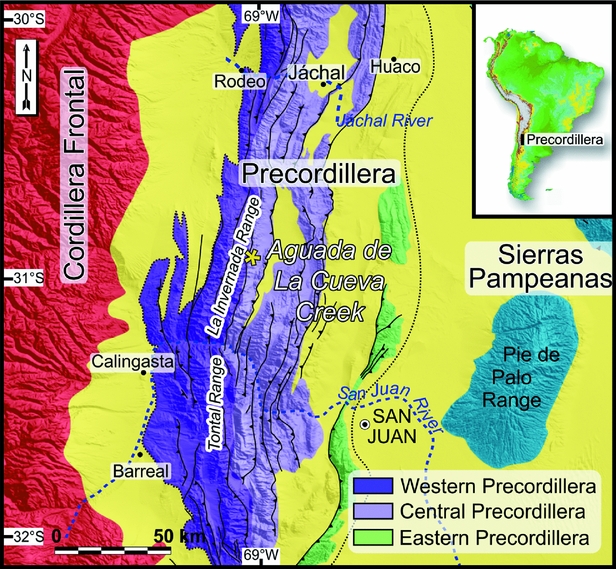
The Argentine Precordillera of La Rioja, San Juan and Mendoza provinces is a c. 80 km wide foreland fold-and-thrust belt that involves Palaeozoic to Cenozoic rocks, which extends between 29º and 33ºS in the Andean foothills above the shallow subduction segment of the Nazca plate (Heim, Reference Heim1952; Allmendinger et al. Reference Allmendinger, Figueroa, Snyder, Beer, Mpodozis and Isacks1990; Gosen, Reference Gosen1992; Ramos, Cristallini & Pérez, Reference Ramos, Cristallini and Pérez2002) (Fig. 1). The Precordilleran Cambrian–Ordovician carbonate platform sequence is unique to South America and makes up part of a larger region of the Andean foothills of western Argentina that is referred to as the Cuyania composite terrane (Ramos, Reference Ramos1995).
Location map of the Argentine Precordillera fold-and-thrust belt showing the studied locality and the western, central and eastern morphostructural domains. Base image derived from Shuttle Radar Topography Mission (SRTM).

At the continental slope and rise, to the west of the Precordilleran carbonate platform, the Los Sombreros mélange is a mudstone-dominated deep-water disorganized unit, containing a diverse array of rocks derived from the platform, the slope and the basement. These rocks include arkosic sandstones, megabreccias, conglomerates with well-rounded basement-derived metamorphic and igneous pebbles to boulders, thin-bedded fine-grained limestones, carbonate breccias and blocks up to several hectometres in size of lower Cambrian to Lower Ordovician limestones displaying platform facies not represented elsewhere (e.g. Bordonaro, Reference Bordonaro2003).
The Los Sombreros Formation displays ubiquitous extensional structures that result in block-in-matrix fabric in some places as a consequence of submarine sliding (Alonso et al. Reference Alonso, Gallastegui, García-Sansegundo, Farías, Rodríguez-Fernández and Ramos2008). The main outcrop belt of the mélange extends along the eastern flank of the Tontal Range (Fig. 1), where the formation is more than 1000 m thick in the Seca Creek type section (Cuerda, Cingolani & Varela, Reference Cuerda, Cingolani and Varela1983; Cuerda et al. Reference Cuerda, Cingolani, Varela, Schauer and Cuerda1986). The outcrops continue patchily to the north up to the Jáchal River area (Benedetto & Vaccari, Reference Benedetto and Vaccari1992), whereas its southern prolongation is represented by the Estancia San Isidro Formation in Mendoza, which exhibits giant Cambrian limestone blocks enclosed in a green shaly matrix of Darriwilian age (Keller, Reference Keller1999; Heredia & Beresi, Reference Heredia and Beresi2004; Ortega et al. Reference Ortega, Albanesi, Heredia and Beresi2007). Thus, the slope facies of the Precordillera extends over 300 km with N–S orientation (Fig. 1).
3. Previous biostratigraphic studies of the Los Sombreros Formation
The Los Sombreros Formation was originally referred to the Lower Ordovician Series based on graptolite records from its lower third (Cuerda et al. Reference Cuerda, Cingolani, Varela, Schauer, Baldis and Bordonaro1985). Later trilobite findings revealed the presence of lower and middle Cambrian rocks (Bordonaro & Baldis, Reference Bordonaro and Baldis1987; Bordonaro & Banchig, Reference Bordonaro and Banchig1990), interpreted as outer-platform resedimented blocks in a Lower – Middle Ordovician succession with autochthonous conodonts and graptolites (Benedetto & Vaccari, Reference Benedetto and Vaccari1992; Bordonaro, Reference Bordonaro2003). Lehnert (Reference Lehnert1994) described the first conodont assemblage of the Cordylodus proavus Zone (upper Furongian) in the Precordillera, from outcrops of the Los Sombreros Formation in the Tontal Range. The conodont association includes Cordylodus primitivus Bagnoli, Barnes & Stevens, Cordylodus proavus Müller and Eoconodontus notchpeakensis Miller. These conodont elements derive from a calcisiltite lens that overlies shales with graptolite specimens that demonstrate its allochthonous character.
Albanesi, Ortega & Hünicken (Reference Albanesi, Ortega and Hünicken1995) proposed that the conformable stratigraphic contact between the Los Sombreros Formation and the overlying Yerba Loca Formation at Ancaucha Creek, 10 km northwest of Jáchal city, is early Darriwilian in age. They determined that the top of the Los Sombreros Formation at this locality is lower Darriwilian at the most, by considering the presence of the index conodont Baltoniodus clavatus Stouge & Bagnoli from the basal beds of the Yerba Loca Formation and the absence of the key species Paroistodus horridus (Barnes & Poplawski), which appears c. 40 m above the Yerba Loca base.
Further fossil findings include upper Cambrian, Tremadocian, Floian and Darriwilian conodont faunas (Voldman, Albanesi & Ramos, Reference Voldman, Albanesi and Ramos2009; Voldman et al. Reference Voldman, Alonso, Albanesi, Banchig, Ortega, Rodríguez Fernández, Festa, Pankhurst, Castiñeiras and Sánchez Martínez2014) as well as graptolites referable to the uppermost Tremadocian, Floian and Sandbian stages (e.g. A. L. Banchig, unpub. Ph.D. thesis, Univ. Nacional San Juan, 1995; Banchig & Moya, Reference Banchig and Moya2002; Ortega et al. Reference Ortega, Banchig, Voldman, Albanesi, Alonso, Festa and Cardó2014). Additionally, Astini, Thomas & Yochelson (Reference Astini, Thomas and Yochelson2004) identified the enigmatic fossil Salterella maccullochi (Murchison) in the Ancaucha Olistolith of the Los Sombreros Formation, composed of inner-shelf deposits that they interpreted as lower Cambrian synrift strata.
4. Study area and methods
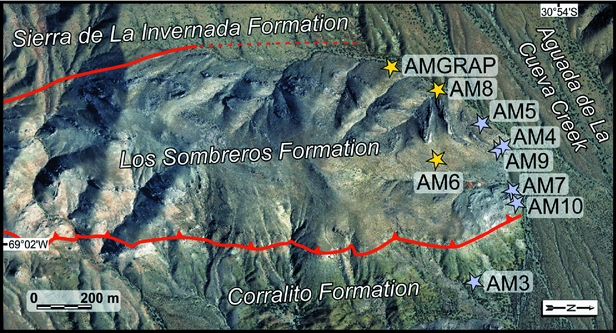
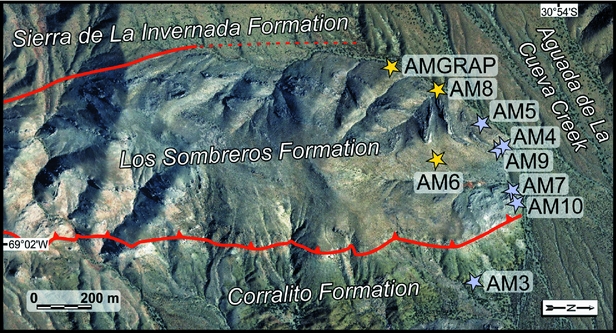
The La Invernada Range constitutes a critical region to investigate the architecture and kinematic development of the disorganized deposits of the Los Sombreros Formation. This range lies to the north of the Tontal Range, extending for c. 60 km with a N–S trend (Fig. 1). It displays E-verging thrusts and related folds, involving a lower Palaeozoic succession that also includes the Siluro-Devonian mélange deposits of the Corralito Formation, which crop out exclusively in this range. In order to determine the age of the Los Sombreros Formation at the Aguada de La Cueva Creek section (Fig. 2), nine limestone samples (14 kg in total) were collected and processed following the standard techniques to recover conodont elements (Stone, Reference Stone and Austin1987). Three samples were productive, yielding 80 specimens that are housed under the repository codes CORD-MP 50734 to 50814 in the Museo de Paleontología, Facultad de Ciencias Exactas, Físicas y Naturales, Universidad Nacional de Córdoba, Argentina. Field work also included structural mapping and stratigraphic and sedimentological studies, during which kinematic data were acquired and rocks were described in terms of their bedding and lithology and sampled for thin-section preparation.
Geological map of the study area with fossiliferous sampling points.
5. Results
5.a. Stratigraphy and structure
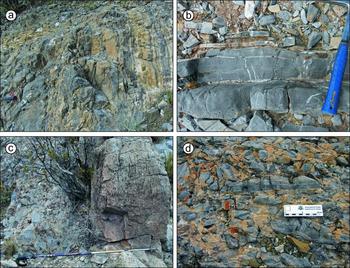
In the Aguada de La Cueva Creek area, the Los Sombreros Formation consists of a c. 500–600 m thick succession of dominantly limestones, carbonate breccias and conglomerates and subordinate shales (Fig. 2). The limestones are thin bedded, varying from peloidal/calcisphere mudstones and wackestones to graded and laminated calclithites (calciturbidites) (Fig. 3a, b), which may pass upwards into a shale division and gradationally overlie a breccia/conglomerate division. Breccias/conglomerates contain mainly clasts of mudstones, peloidal grainstones and recrystallized limestones, with minor amounts of chert and quartz clasts. They constitute beds that are massive or graded, and that may be gradationally overlain by a calciturbidite; some exceptional examples of stratified (laminated) beds also occur (Fig. 3c). The whole succession lacks in situ shallow-water faunas, with the exception of scarce lingulids, and exhibits slight bioturbation restricted to the peloidal/calcisphere limestones. Remarkably, it displays hectometric slump folds, extensional faults and lateral transitions between intact and faulted/brecciated beds (Fig. 3a, d).
Field photographs of selected deposits from the Los Sombreros Formation at the Agua de la Cueva Creek. (a) Detail of an interval made of pebble-to-cobble breccias (left of photograph) and thin-bedded limestones (laminated mudstones and graded and laminated calciturbidites). Notice the local disruption of bedding, which laterally passes into undisturbed bedding. Stratigraphic top towards the left. (b) Interval formed of calciturbidites and variably laminated, slightly bioturbated mudstones with peloids and calcispheres. The lowermost bed is a graded calciturbidite evolving from a basal fine-pebble-bearing granulestone to a sand-grade division, whose upper part is faintly laminated and displays smooth undulations. Younging direction is to the top of the photograph. Hammer handle for scale c. 19cm long. (c) Poorly sorted boulder-to-pebble carbonate breccia/conglomerate, displaying two divisions, a lower graded division and an upper laminated division. Walking pole is c. 120 cm long. Stratigraphic top towards the right. (d) Close-up of an interval made of thin-bedded lime mudstones, commonly laminated, with a variable degree of folding and bed disruption and brecciation. Bedding in the area is parallel to the bed above the scale, which is almost intact. The yellowish matrix surrounding the clasts is mainly dolomitic. Younging direction is to the top of the photograph.

As a whole, most of these facies are indicative of sedimentation from gravity flows, from cohesive debris flows to low-density turbidity currents (see Lowe, Reference Lowe1982; McIlreath & James, Reference McIlreath, James and Walker1984; Mutti et al. Reference Mutti, Tinterri, Remacha, Mavilla, Agnella and Fava1999, amongst others). Fine-grained, peloidal/calcisphere mudstones probably represent the pelagic/hemipelagic background sedimentation. This interpretation is compatible with the synsedimentary deformation features (see also Section 5.a.1. below), all indicating a slope to base-of-slope setting. The relatively deep-water environment is also suggested by the absence of in situ shallow-water fauna and the scarcity of bioturbation.
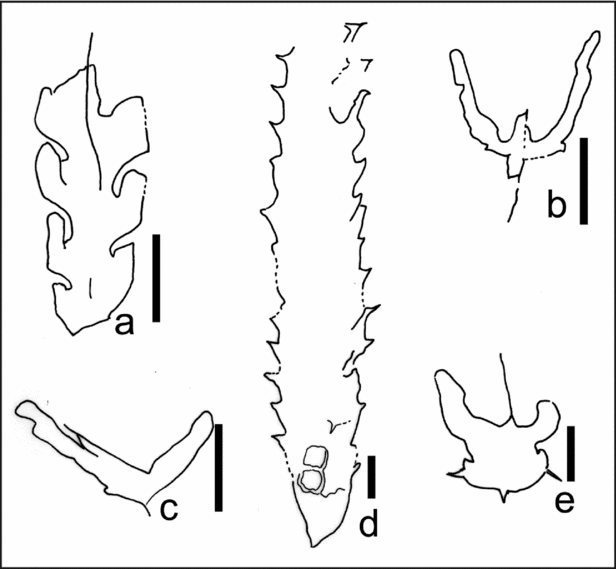
The slumped succession at the Aguada de La Cueva Creek section is unconformably overlain by grey shales with poorly preserved graptolites, including Archiclimacograptus sp., Dicellograptus sp., Dicranograptus sp., Nemagraptus sp. and Reteograptus speciosus Harris, which suggest a late Darriwilian to Sandbian age for the upper part of the Los Sombreros Formation in this area (Sample AMGRAP, Figs 2, 4). These graptolitic shales are in turn unconformably overlain by sandstone–mudstone alternations with scarce calcarenites and interbedded conglomerates and calcareous breccias of the Sierra de La Invernada Formation (Furque et al. Reference Furque, Cuerda, Caballé and Alfaro1990), which are Middle–Late Ordovician in age (Ortega et al. Reference Ortega, Albanesi, Banchig and Peralta2008).
Late Darriwilian to Sanbian graptolites from the upper levels of the Los Sombreros Formation (Sample AMGRAP, see location in fig. 2). (a) Archiclimacograptus sp., CORD-PZ 25705; (b) Dicellograptus sp., CORD-PZ 25706; (c) Reteograptus speciosus Harris, CORD-PZ 25707; (d) Nemagraptus sp., CORD-PZ 25708; (e) Dicranograptus? sp., CORD-PZ 25709. Scale bar: 1 mm.

The Los Sombreros Formation is carried on a W-dipping thrust surface onto the Siluro-Devonian Corralito mélange (Fig. 2), which comprises greenish grey shales and coquinas with extensional features, such as boudins, as well as limestone blocks of the San Juan Formation. The thrust surface displays Cʹ-type shear bands and striations, recording an eastward movement of the hanging wall. It is probably Andean in age because it is located at the toe of the Invernada Range and therefore should have been responsible for the uplift of this modern geomorphic feature. However, this thrust could be the result of rejuvenation of an older Chanic or Gondwanic thrust during Andean times, which commonly occurs in the Argentine Precordillera (Ramos, Vujovich & Dallmeyer, Reference Ramos, Vujovich and Dallmeyer1996; Alonso et al. Reference Alonso, Rodríguez Fernández, García-Sansegundo, Heredia, Farias and Gallastegui2005).
5.a.1. Synsedimentary deformation
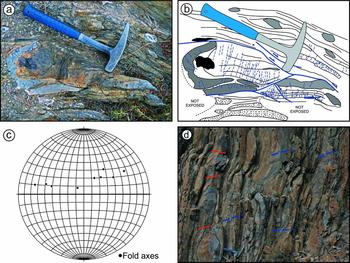
Regarding the internal structure of the Los Sombreros Formation, the most conspicuous features in the study area are hectometric folds that can be interpreted as slump structures (Fig. 2). These folds do not involve the overlying Sierra de La Invernada Formation. As well, most of the smaller, outcrop-scale structures are slump folds with variable hinge-line orientations and pinch-and-swell structures, which record soft-sediment deformation (Fig. 5). Tension fractures perpendicular to bedding and normal faults also occur. In the example of Figure 5a, b, tension fractures are restricted to the yellowish beds, indicating that these beds underwent brittle behaviour, while other beds, with pinch-and-swell boudinage, were stretched by more ductile deformation, probably because the yellowish beds were more lithified. So, pinch-and-swell boudins and tension and shear fractures are more or less coeval and all of them imply bed-parallel extension. Although the development of the slump fold in Figure 5a, b is prior to extensional deformation (both fold limbs are truncated by a normal fault), all the above mentioned structures support the interpretation that gravitational collapse and sliding was the cause of the deformation. In Figure 5d, the cut-off lines of the tension fractures (blue) are parallel to the boudin necks lineation (red), recording the same extension direction.
(a, b) Photograph and outcrop sketch showing a slump fold and pinch-and-swell structures in the carbonate succession of the Los Sombreros Formation. Tensional and shear fractures are depicted. See text for explanation, and location in Figure 2. (c) Stereoplot of fold axes in the study area. (d) Boudinaged limestone bed (on the left) and closely spaced microfractures (on the beds located to the right). Hammer for scale: 33 cm.

5.b. Conodont fauna and biostratigraphy
Three carbonate samples taken at the Aguada de La Cueva Creek section yielded conodonts, which constrain the age of the slump deposits of the Los Sombreros Formation with a high-resolution biostratigraphy and improve the conodont biozonation scheme of the Precordillera. The taxonomy of the identified species is well known, following descriptions of previous authors; therefore, only a brief discussion is presented herein.
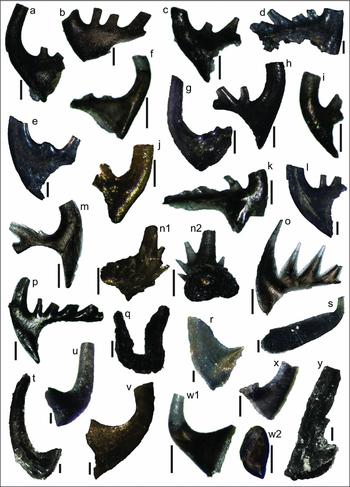
A lime mudstone affected by synsedimentary extensional faults (sample AM6) yielded Cordylodus caboti Bagnoli, Barnes & Stevens, C. cf. tortus Barnes, C. intermedius Furnish, C. proavus Müller, C. cf. andresi Viira & Sergeyeva, Drepanoistodus sp., Teridontus nakamurai (Nogami), Variabiloconus datsonensis (Druce & Jones), Westergaardodina sp. and the index species Hirsutodontus simplex (Druce & Jones) (Fig. 6). The latter species is chronostratigraphically restricted to the Cordylodus intermedius Zone, Stage 10 of the Furongian. H. simplex is characterized by a simple cone with circular cross-section and a series of spines scattered mainly on the anterior and lateral sides of the base and cusp (Fig. 6n).
Conodont elements from the Hirsutodontus simplex Subzone of the Cordylodus intermedius Zone (upper Furongian, Cambrian), sample AM6: (a–f) Cordylodus proavus Müller, (a) S element, lateral view, CORD-MP 50734; (b) S element, lateral view, CORD-MP 50735; (c) S element, lateral view, CORD-MP 50736; (d) P element, lateral view, CORD-MP 50737; (e) S element, lateral view, CORD-MP 50738; (f) S element, lateral view, CORD-MP 50739. (g–i) Cordylodus caboti Bagnoli, Barnes & Stevens, (g) S element, lateral view, CORD-MP 50740; (h) S element, lateral view, CORD-MP 50741; (i) S element, lateral view, CORD-MP 50742. (j) Cordylodus cf. tortus Barnes, S element, lateral view, CORD-MP 50743. (k–m, o, p) Cordylodus intermedius Furnish, (k) S element, lateral view, CORD-MP 50744; (l) S element, lateral view, CORD-MP 50745; (m) S element, lateral view, CORD-MP 50746; (o) M element, lateral view, CORD-MP 50747; (p) S element, lateral view, CORD-MP 50748. (n) Hirsutodontus simplex (Druce & Jones), CORD-MP 50749, (n1) anterolateral view, (n2) posterior view. (q) Westergaardodina sp., lateral view, CORD-MP 50750. (u) Teridontus nakamurai (Nogami), S element, lateral view, CORD-MP 50751. (v) Drepanoistodus sp., S element, lateral view, CORD-MP 50752. (w) Variabiloconus datsonensis (Druce & Jones), CORD-MP 50753, (w1) lateral view, (w2) basal cavity view. (x) Cordylodus cf. andresi Viira & Sergeyeva, S element, lateral view, CORD-MP 50754. (r–t, y) Conodont elements from the Macerodus dianae Zone (upper Tremadocian, Ordovician): (r) Rossodus cf. manitouensis Repetski & Ethington, S element, lateral view, sample AM8B, CORD-MP 50755; (s) Macerodus dianae Fåhraeus & Nowlan, lateral view, sample AM8A, CORD-MP 50756; (t) Scolopodus cf. subrex Ji & Barnes, lateral view, sample AM8B, CORD-MP 50757; (y) Paltodus aff. inaequalis (Pander), lateral view, sample AM8B, CORD-MP 50758. Scale bar: 0.1 mm.

The different species of Cordylodus were distinguished by considering the general shape of the elements, the pattern of denticulation (discrete, confluent) and the basal cavity configuration (number of apices, depth, position and shape of its anterior border). As described by Bagnoli, Barnes & Stevens (Reference Bagnoli, Barnes and Stevens1987), the basal cavity of C. caboti (Fig. 6g–i) is not as deep as in C. proavus (Fig. 6a–e), but also extends above the posterior process. Its basal cavity displays a slightly concave to straight anterior margin that curves near the tip, with its apex centrally located, which differentiates it from C. intermedius (Nicoll, Reference Nicoll1991; Pyle & Barnes, Reference Pyle and Barnes2002; Zeballo & Albanesi, Reference Zeballo and Albanesi2009). Miller et al. (Reference Miller, Evans, Loch, Ethington, Stitt, Holmer and Popov2003) regarded C. caboti as a junior synonym of Cordylodus ‘drucei’ Miller; since we cannot follow his criteria in our collection, we maintain the species C. caboti as valid.
The Cordylodus intermedius Zone is divided into a lower Hirsutodontus simplex Subzone and an upper Clavohamulus hintzei Subzone (Miller et al. Reference Miller, Evans, Loch, Ethington, Stitt, Holmer and Popov2003). The lower subzone begins with the First Appearance Datum (FAD) of H. simplex whereas its top is defined by the FAD of C. hintzei. The presence of advanced species of Cordylodus in sample AM6, such as C. caboti and C. intermedius, which are more frequent in the upper subzone, in the absence of C. hintzei, suggests an upper H. simplex Subzone for this stratigraphic level (e.g. Ross et al. Reference Ross, Hintze, Ethington, Miller, Taylor and Repetski1997).
Cordylodus proavus extends from the upper Cambrian up to the Iapetognathus Zone, indicative of the base of the Ordovician, whereas C. intermedius and C. caboti reach up to the Rossodus manitouensis Zone (Pyle & Barnes, Reference Pyle and Barnes2002). Two elements recovered compare well to the figured forms of Cordylodus cf. andresi sensu Zeballo & Albanesi (Reference Zeballo and Albanesi2009) (Fig. 6x), which exhibit a narrower cavity compared to the nominal species (re-illustrated by Miller et al. Reference Miller, Dattilo, Ethington and Freeman2015). Additionally, C. andresi occurs in older rocks as it is restricted to the Hirsutodontus hirsutus and Fryxellodontus inornatus zones of the C. proavus Zone. Cordylodus cf. tortus is strongly asymmetric, with a denticle flexed compared to the cusp plane and a basal cavity relatively shallow with its apex slightly displaced to the posterior region (Zeballo & Albanesi, Reference Zeballo and Albanesi2009).
The taxonomy of simple cones is complex, particularly owing to their high variability and subtle diagnostic features. Variabiliconus shares with Teridontus a similar apparatus plan, an abrupt junction between the hyaline base and albid cusp, and the surface microstriation. In particular, Variabiliconus (Oneotodus) datsonensis closely resembles Teridontus nakamurai but is distinguished by the circular basal outline, the upturning of the oral termination of the cusp and the presence of shallow furrows associated with carinas (Druce & Jones, Reference Druce and Jones1971; Zeballo & Albanesi, Reference Zeballo and Albanesi2009). Miller (Reference Miller1980) reassigned Oneotodus datsonensis Druce & Jones to T. nakamurai and to Semiacontiodus nogamii Miller. Nicoll (Reference Nicoll1994) rejected the latter suggestion as well as the emended diagnosis given by Ji & Barnes (Reference Ji and Barnes1994 a), as they are not applicable to the type species of the genus, which lacks lateral grooves, costae and keels. Tolmacheva & Abaimova (Reference Tolmacheva and Abaimova2009) suggested introducing a new genus for hybrid Teridontus-like species after further investigations. The limited number of specimens recovered does not allow for adequately defining the latitude of morphologic variability of these primitive forms. Therefore, we cautiously assign a simple sub-symmetrical coniform element with long cusp to T. nakamurai (Fig. 6u) and those with short, erect and keeled cusps with weak grooves to V. datsonensis, which is restricted to the Furongian (Fig. 6w). Younger species of Variabiloconus are easier to distinguish as they exhibit an increase of ornamentation and development of the cusp (Löfgren, Repetski & Ethington Reference Löfgren, Repetski and Ethington1998; Zeballo & Albanesi, Reference Zeballo and Albanesi2013 a). The Teridontus nakamurai specimen recovered from the Los Sombreros Formation lacks the typical microstriation of the genus, as previously observed by Lehnert (Reference Lehnert1994). The genus Orminskia also resembles Teridontus and lacks microstriation, yet it has a hyaline cusp (Landing, Westrop & Keppie, Reference Landing, Westrop and Keppie2007).
Two samples obtained from thin-bedded fine-grained calciturbidites interbedded with marlstones and breccias located a few metres stratigraphically above AM6 were also productive. Sample AM8A yielded one specimen of Macerodus dianae Fåhraeus & Nowlan (Fig. 6s), a distinctive form of the standard North American Midcontinent Realm zonation (Ross et al. Reference Ross, Hintze, Ethington, Miller, Taylor and Repetski1997), whose biostratigraphic range is restricted to a narrow interval of the upper Tremadocian. The M. dianae Zone correlates with the lower part of the upper subzone of the Paltodus deltifer Subzone of the Baltoscandian scheme (Webby et al. Reference Webby, Cooper, Bergström, Paris, Webby, Paris, Droser and Percival2004). Sample AM8B contains eight elements including Drepanodus arcuatus Pander, Paltodus aff. inaequalis (Pander) (Fig. 6y), Rossodus cf. manitouensis Repetski & Ethington (Fig. 6r), Scolopodus cf. subrex Ji & Barnes (Fig. 6t) and a cluster of the paraconodont Phakelodus tenuis (Müller). The S. subrex Zone partly correlates with the Macerodus dianae Zone (Pyle & Barnes, Reference Pyle and Barnes2002), whereas Rossodus cf. manitouensis points to a slightly older Ordovician age; yet the available material is not sufficient to verify its taxonomy.
5.c. Conodont palaeoecology and palaeobiogeographic considerations
The recognition of the Furongian Hirsutodontus simplex Subzone of the Cordylodus intermedius Zone and the Tremadocian Macerodus dianae Zone in the Los Sombreros Formation allows the biostratigraphic correlation between the slope facies and the carbonate-platform domain to be improved, as both zones occur within the La Silla Formation (Lehnert, Miller & Repetski, Reference Lehnert, Miller and Repetski1997). In particular, Albanesi, Cañas & Mango (Reference Albanesi, Cañas and Mangoin press) described thoroughly the conodont association of the M. dianae Zone for the shallow-water carbonates of the La Silla Formation, at the Cerro Viejo de San Roque section. Hirsutodontus simplex, whose biostratigraphic range is restricted to the Cordylodus intermedius Zone, was originally defined in Australia (Druce & Jones, Reference Druce and Jones1971) and subsequently recovered from China (Chen & Gong, Reference Chen, Gong and Chen1986; Chen et al. Reference Chen, Qian, Zhang, Lin, Yin, Wang, Wang, Yang and Wang1988), Laurentia (Miller, Reference Miller1980; Ross et al. Reference Ross, Hintze, Ethington, Miller, Taylor and Repetski1997; Terfelt, Bagnoli & Stouge, Reference Terfelt, Bagnoli and Stouge2012; Miller et al. Reference Miller, Repetski, Nicoll, Nowlan and Ethington2014), Siberia (Abaimova, Reference Abaimova1971, Reference Abaimova1975) and NW Argentina (Zeballo & Albanesi, Reference Zeballo and Albanesi2009). Miller (Reference Miller and Clark1984) suggested that Clavohamulus and Hirsutodontus had a nektobenthic habit of life and that they preferred warm, shallow seas. The record of Hirsutodontus in the Los Sombreros Formation would then indicate reworking of shallow-water deposits into deep-water facies by gravity flows, as observed in the GSSP for the base of the Ordovician at Green Point, Newfoundland (Cooper, Nowlan & Williams, Reference Cooper, Nowlan and Williams2001; Miller et al. Reference Miller, Repetski, Nicoll, Nowlan and Ethington2014). Accordingly, Clavohamulus hintzei Miller, indicative of the upper subzone of Cordylodus intermedius Zone, is present in the shallow-marine facies of the La Silla Formation, at the eastern domain of the carbonate platform (Lehnert, Miller & Repetski, Reference Lehnert, Miller and Repetski1997).
The species Teridontus nakamurai has been found in several lithofacies suggesting a pelagic habit of life (Ji & Barnes, Reference Ji and Barnes1994 b), eventually restricted to the shelf environments owing to a nektobenthic habit (Miller, Reference Miller and Clark1984). After studying a large conodont collection from the Cordillera Oriental, Zeballo & Albanesi (Reference Zeballo and Albanesi2013 b) recognized an antithetical relationship between the cosmopolitan genera Variabiloconus and Teridontus, verifying that the latter predominates in the deeper parts of the platform. In particular, V. datsonensis is present in NE Australia (Druce & Jones, Reference Druce and Jones1971), Antarctica (Buggisch & Repetski, Reference Buggisch and Repetski1987) and NW Argentina (Zeballo & Albanesi, Reference Zeballo and Albanesi2009).
The genus Cordylodus was a major component of most slope and platform communities during Furongian and Early Ordovician times. C. proavus has a widespread geographic distribution and is found in a wide range of lithofacies, which suggests a pelagic habit of life. In contrast, C. andresi, C. caboti and C. intermedius preferred deeper-water environments (lower proximal to distal slope facies), as younger species of Cordylodus adapted to a nektobenthic mode of life (Miller, Reference Miller and Clark1984; Zhang & Barnes, Reference Zhang, Barnes, Beaudoin and Head2004).
The C. intermedius Zone has a wide global distribution and has been documented in China (Chen & Gong, Reference Chen, Gong and Chen1986), Laurentia (Bagnoli, Barnes & Stevens, Reference Bagnoli, Barnes and Stevens1987; Barnes, Reference Barnes1988; Miller, Reference Miller1988; Ross et al. Reference Ross, Hintze, Ethington, Miller, Taylor and Repetski1997; Miller et al. Reference Miller, Evans, Loch, Ethington, Stitt, Holmer and Popov2003) and central Asia (Dubinina, Reference Dubinina2000). A correlative conodont assemblage has been retrieved from Australia (Druce & Jones, Reference Druce and Jones1971) and Iran (Müller, Reference Müller1973). In Argentina, it was previously identified in the Volcancito Formation of the Famatina System (Albanesi et al. Reference Albanesi, Esteban, Ortega, Hünicken, Barnes, Dahlquist, Baldo and Alasino2005) and the Cardonal (Rao, Reference Rao1999) and Santa Rosita formations in the Cordillera Oriental (Zeballo & Albanesi, Reference Zeballo and Albanesi2009).
Although conodont provinces can be already distinguished in the late Cambrian (Jeong & Lee, Reference Jeong and Lee2000), most of the palaeogeographic studies are concentrated in the Ordovician, when major realms were already established by late Tremadocian times (Miller, Reference Miller and Clark1984; Charpentier, Reference Charpentier and Clark1984). Accordingly, the Precordillera is identified as a conodont faunal Province of the Temperate Domain of the Shallow-Sea Realm (or the Open-Sea Realm depending on the sedimentary setting) (Albanesi & Bergström, Reference Albanesi, Bergström, Finney and Berry2010; Serra & Albanesi, Reference Serra, Albanesi, Albanesi and Ortega2013), as it lacks the typical shallow-water, tropical forms characteristic of the Laurentian, Australasian or North China provinces (Bagnoli & Stouge, Reference Bagnoli and Stouge1991; Zhen & Percival, Reference Zhen and Percival2003). Instead, it is distinguished by cosmopolitan or widespread faunas, showing a moderate endemism and diversity when compared with faunas from the Tropical Domain. The Baltoscandian Province of the Cold Domain presents lower diversities and higher abundances instead (Zhen & Percival, Reference Zhen and Percival2003).
Macerodus dianae, an index taxon of the late Tremadocian, appeared in sample AM8A. It was first described from outcrops of the Cow Head Group in western Newfoundland, a series of Laurentian slope deposits fed from the outer shelf and the upper continental slope (Fåhraeus & Nowlan, Reference Fåhræus and Nowlan1978; Pohler, Barnes & James, Reference Pohler, Barnes, James and Austin1987). Ji & Barnes (Reference Ji and Barnes1994 a) emended its diagnosis with material from the Boat Harbour Formation (St George Group) on the Port au Port Peninsula in western Newfoundland. Macerodus dianae is recognized in widely separated geographic locations of the Great Basin (Ethington & Clark, Reference Ethington and Clark1981; Repetski, Reference Repetski1982; Ross et al. Reference Ross, Hintze, Ethington, Miller, Taylor and Repetski1997; Landing et al. Reference Landing, Adrain, Westrop and Kröger2012), the Arctic Archipelago of Canada (G. S. Nowlan, unpub. Ph.D. thesis, Univ. Waterloo, 1976) and northern Norway (Lehnert, Stouge & Brandl, Reference Lehnert, Stouge and Brandl2013). In the Kechika Formation of British Columbia, the Macerodus dianae Zone is absent and is substituted by the shallow-water Scolopodus subrex Zone (Pyle & Barnes, Reference Pyle and Barnes2002).
Rossodus is a typical genus from the Great Basin, characteristic of the North American Midcontinent Province. The latter is approximately equivalent to the Laurentian Province of the Tropical Domain, in the Shallow-Sea Realm, distinguished by shelf areas ˂ 200 m in depth with high endemism and diversity (Ethington & Clark, Reference Ethington and Clark1981; Ross et al. Reference Ross, Hintze, Ethington, Miller, Taylor and Repetski1997; Zhen & Percival, Reference Zhen and Percival2003). Rossodus manitouensis Repetski & Ethington has also been documented in China (= ‘Acodus’ oneotensus sensu An, Du & Gao, Reference An, Du and Gao1985; Wang, Bergström & Lane, Reference Wang, Bergström and Lane1996), Korea (Seo, Lee & Ethington, Reference Seo, Lee and Ethington1994), Thailand (Agematsu et al. Reference Agematsu, Sashida, Salyapongse and Sardsud2008) and Tasmania (R. C. Cantrill, unpub. Ph.D. thesis, Univ. Tasmania, 2003). It is also known from the peri-Gondwanan volcanic arc of the Famatina System, where it occurs along with Drepanodus arcuatus, Cornuodus longibasis (Lindström), Paltodus deltifer pristinus (Viira), P. cf. subaequalis Pander and Paroistodus numarcuatus (Lindström), which characterize a biofacies dominated by pelagic species from deep/cold waters (Albanesi et al. Reference Albanesi, Esteban, Ortega, Hünicken, Barnes, Dahlquist, Baldo and Alasino2005). In the eastern domain of the Precordillera, Lehnert, Miller & Repetski (Reference Lehnert, Miller and Repetski1997) described Rossodus aff. manitouensis from shallow-water facies of the La Silla Formation, along with Aloxoconus cf. propinquus (Furnish), Scolopodus cf. floweri Repetski, Paroistodus numarcuatus and Colaptoconus quadraplicatus (Branson & Mehl). The authors correlated this conodont assemblage with the Low Diversity Interval and the lower Macerodus dianae conodont biozone in North America (Ross et al. Reference Ross, Hintze, Ethington, Miller, Taylor and Repetski1997), consistent with the suggested age for the samples AM8A and AM8B from the slope facies of the Los Sombreros Formation.
The record of Macerodus dianae in the slope facies verifies a strong link between the conodont faunas from the Precordillera with those from Laurentia during Early Ordovician times, demonstrating a connection along the borders of the Iapetus Ocean. Accordingly, Lehnert, Miller & Repetski (Reference Lehnert, Miller and Repetski1997) interpreted that the record of Clavohamulus hintzei in the La Silla Formation as well as the faunal similarities at the species level with the shallow-water North American Midcontinent Province was a consequence of the derivation of the Cuyania Terrane from the Ouachita Embayment in Laurentia. Nevertheless, the conodont faunas do not provide clear evidence to postulate a geographic origin for the Precordillera as they show dominantly Laurentian affinities again in the Middle Ordovician, after a gradual immigration of conodonts from colder regions (Albanesi, Reference Albanesi1998; Albanesi & Bergström, Reference Albanesi, Bergström, Finney and Berry2010).
5.d. Conodont preservation and palaeothermometry
The Cambrian specimens recovered from sample AM6 are well preserved and exhibit a conodont colour alteration index (CAI) 3 that provides some translucency to the conodont elements. The conodonts present smooth surfaces and scarce mineral overgrowths. Microfractures are frequent and are responsible for the lack of apices on cusps and denticles. Conodonts recovered from samples AM8A and AM8B also exhibit a CAI 3 but display a sugary texture with abundant quartz overgrowths instead. In this case, the different type of textural alteration suggests variations in the intensity of the diagenetic processes.
Interestingly, previous findings of reworked pre-Floian conodonts recovered from the Los Sombreros Formation display high CAI values in contrast to the elements recovered from the host rock. This fact was interpreted as a result of burial-related metamorphism and exhumation of the carbonate platform near the suture zone of Cuyania with Gondwana, which supplied detritus to the deep-water basin of the Western Precordillera (Voldman, Albanesi & Ramos, Reference Voldman, Albanesi and Ramos2009).
The record of Furongian–Lower Ordovician conodonts with CAI 3 (~ 110–200ºC; Epstein, Epstein & Harris, Reference Epstein, Epstein and Harris1977) in the Los Sombreros Formation reflects a simpler burial history instead, if a uniform palaeogeothermal gradient in the basin is considered. A rift-related heat source is not possible to discern as CAI values are relatively low, within the range of the observed values in the platform, which can be accounted for solely by sedimentary burial (Voldman, Albanesi & Ramos, Reference Voldman, Albanesi and Ramos2010).
Alternatively, the mafic rocks from the Western Precordillera produced very restricted thermal anomalies in the country rocks given the small volume of single-pulsed basalt intrusions, which could only slightly contribute to a regional increment of the heat flux (Voldman, Albanesi & do Campo, Reference Voldman, Albanesi and do Campo2008; González-Menéndez et al. Reference González-Menéndez, Gallastegui, Cuesta, Heredia and Rubio-Ordóñez2013). This is consistent with the metamorphic conditions inferred from the paragenetic associations of the mafic rocks, which suggests c. 250–350ºC and 2–3 kbar, with palaeogeothermal gradients of ~ 30–35ºC km−1 (Robinson, Bevins & Rubinstein, Reference Robinson, Bevins and Rubinstein2005), which are typical of mature passive margins and foreland basins (e.g. Allen & Allen, Reference Allen and Allen2005). Consequently, the CAI 3 in the studied conodont samples reflects a thermal history related to the sedimentary burial and nappe stacking of the Western Precordillera.
6. Conclusions
The new conodont data from the Los Sombreros Formation in La Invernada Range along with the sedimentological and structural analysis carried out in the study area show that slope sedimentation and gravity sliding has taken place in the Precordillera since at least late Cambrian times, contrasting with the current hypothesis of a Devonian age for the slope deposits of the Los Sombreros mélange. Moreover, the recognition of the Hirsutodontus simplex Subzone of the Cordylodus intermedius Zone (upper Furongian, Cambrian) and the Macerodus dianae Zone (upper Tremadocian, Ordovician) improves the correlation with the La Silla Formation of the Precordilleran carbonate platform as well as with regions of Gondwana and other palaeocontinents. The record of the index species Macerodus dianae in the Los Sombreros Formation, as well as Clavohamulus hintzei in the La Silla Formation, emphasizes the strong faunal affinity of the shelf environments of the Precordillera with the Laurentian Province of the Tropical Domain for the late Cambrian – Early Ordovician periods. However, given the wide global distribution of the studied specimens, the present data are not indicative of a geographic origin for the Precordillera. The thermal alteration of the studied specimens is consistent with the sedimentary burial and nappe stacking of the Western Precordillera.
Acknowledgements
The authors thank Gian Andrea Pini (Università degli Studi di Trieste) for helping with field work. We appreciate Nigel H. Woodcock and an anonymous reviewer for their constructive suggestions. This study was funded by CONICET, Argentina (RD3646/14, RD2827/15 and PIP 11220130100447CO) and the Ministerio de Economía y Competitividad, Spain (project CGL2012-34475). This paper is also a contribution to the IGCP Project 591.