

1. Introduction
This paper presents the first English translation and analysis of selected passages from the Cāṇakyaṭīkā by Bhikṣu Prabhamati who, I shall argue, can be most reliably placed in North India between the 6th and 10th century ce.Footnote 1 The Cāṇakyaṭīkā, which has not yet been fully studied, nor translated into English, is a Sanskrit commentary on the Arthaśāstra,Footnote 2 the most ancient and celebrated Sanskrit treatise from the classical expert tradition on statecraft. As is well known, this text goes into great detail about the king's training, each specific duty of the government officials, the operation of the monarchical bureaucracy, civil and criminal law, public safety, police activity, foreign policy, war, and so forth. The present paper investigates the way in which the Cāṇakyaṭīkā comments upon Arthaśāstra 2.12.24–25, which mentions the activities of the “superintendent of the mint” (lakṣaṇādhyakṣa) and of the “examiner of coins” (rūpadarśaka). The reason is that the commentator's exposition represents an interesting example of what can be defined as a “textual variation”; he employs distinct commentarial techniques in order to stretch the structure of the root-text. The commentator's interpretation of the coinage system of the Arthaśāstra has far-reaching implications. Prabhamati reconstructs those passages mentioned by means of ingenious literary formulae which enable him to align the Arthaśāstra’s view on the coinage system with what is found in the authoritative treatise on law Mānava Dharmaśāstra (2nd – 3rd century ce).Footnote 3 The argument of this paper is that Prabhamati's exegetical strategy follows a deliberate plan which is concerned with the legitimation, validity and textual norms provided by Manu's code. The relevance of this study lies in the further evidence of the connection between the Arthaśāstra and the Mānava Dharmaśāstra which the translation and analysis of the Cāṇakyaṭīkā provides.Footnote 4 In addition, it gives significant information which can be used to date and locate the commentator.
Olivelle shows that among the most ancient treatises on dharma, the pre-eminent position of the Mānava Dharmaśāstra was already established by the fifth century and possibly already by the third century. He cites a passage in which Bṛhaspati, one of Manu's successors and a composer of Dharmaśāstra himself, celebrates Manu as the authority and any text contradicting Manu has no validity.Footnote 5 Yajñavalkya, the legendary author of another early text on Dharmaśāstra known as Yajñavalkyasmṛti (3rd – 4th century ce), places Manu at the head of his list of authors of Dharmaśāstras. Mānava Dharmaśāstra is the most cited Dharmaśāstric text in medieval Nibandhas. The position of the text on legal transactions, morality, penances, social customs, and prescriptions on litigations, marriage, criminal law, loans, payments of debts, and theft reflects the interaction between the political power and the Brahmanical priestly interests.
Olivelle and Sircar observe that in the Arthaśāstra there is no reference to gold coins, although the production of gold articles and ornaments is widely mentioned.Footnote 6 I shall argue that Prabhamati mentions a system of gold coins occurring in the Arthaśāstra. In this respect, the Arthaśāstra diverges from the Mānava Dharmaśāstra; historiography agrees that in Manu's code suvarṇa is a gold coin denomination. Moreover, this paper demonstrates that Prabhamati, commenting upon the passages on the superintendent of the mint and on the examiner of coins, explains the presence in the root-text of a copper paṇa by which, he claims, fines are paid. The copper paṇa is not mentioned in the Arthaśāstra but it is found in the Mānava Dharmaśāstra, in the Yajñavalkyasmṛti, and in the Nāradasmṛti. Footnote 7 It is my intention to show that Prabhamati's exposition follows a precise literary methodology: he elucidates the copper paṇa and gives validity to his analysis by associating it to an unnamed quotation, which I believe to be from the Mānava Dharmaśāstra 8.136, and in this way he finds an ingenious solution to justify the system of the simultaneous twofold paṇa explained by the Arthaśāstra itself in 2.12.25. In fact, Arthaśāstra 2.12.25 says that the examiner of coins “should institute the paṇa currency for purposes of trade (vyāvahārikīṃ) and [the paṇa currency] for receipt into the treasury (kośapraveśyāṃ)”. Prabhamati explains that the vyāvahārikī-paṇa currency is in copper and is used for purposes of trade but for paying fines too. He calls it ājīvapaṇa, and in so doing shows a peculiar interpretation since there is scholarly consensus that, although the ambiguity of the archaic term ājīva somehow remains, pādājīva means “one-fourth of a strengthening alloy (ājīva)”, and in the Arthaśāstra grammatical construction it refers to the copper māṣaka, and not to the paṇa. In order to better understand the commentator's interpretation of the coinage system, Arthaśāstra 2.12.24 and 2.12.25 are to be read one after the other.
The translation of the Sanskrit passage from the Cāṇakyaṭīkā, which is presented in this paper for the first time, shows that Prabhamati is a well-versed commentator: he does deviate from that passage (2.12.24) of the root-text but by presenting a scenario in which he incorporates the vocabulary of the root-text itself, adds new material, and reflects the view of the root-text in the presence of two paṇas mentioned straight after (2.12.25) and finally, in order to give authority to his interpretation he provides an authoritative quotation.
Before concluding this section, I shall clarify the methodological foundations of this paper. It is not my aim to focus on discussions on coins as studies on numismatic do. As is evident from the findings of scholarly studies, historical sources are not always applicable to the normative context of the Arthaśāstra. In Sanskrit literature, texts often do not reflect factual aspects of material culture. This consideration is true for various śāstric traditions. Whenever I refer to studies by archaeologists and numismatists it is to better understand the technical terms found in the Sanskrit passages here analysed and not to propose a new investigation of the practices of currency use of the Arthaśāstra. A common feature among many papers on coins cited here is that they employ the passage on coins of the Arthaśāstra to reconstruct the coinage system of the Mauryan time. They hence try to fit the content of the text to the Mauryan period to reinforce the historical model proposed by some scholars of the Arthaśāstra. This article aims neither to provide anthropological discussion on the social-economic role of the monetary units mentioned nor to investigate specific modes of transaction in ancient India. The argument of this article is that Prabhamati's remarks on coinage can serve as an illustration of his broader commentarial practice and his weighing of textual authorities. I shall argue that his explanation of the coinage systems of the Arthaśāstra shows that Prabhamati uses the Mānava Dharmaśāstra as a criterion for interpreting the Arthaśāstra. This study emphasises the Cāṇakyaṭīkā’s reliance on the Mānava Dharmaśāstra, but this should not be taken to indicate that Prabhamati simply reproduced what he found in Manu's code. The commentator also shows originality and integrates other authoritative sources as well as his own material into his work.
2. The Arthaśāstra: a unique and complex text
Since its first publication, the Arthaśāstra has intrigued and challenged many scholars, who have attempted to find out whether this is a unitary text and what can be said about its date of composition and historical details. The Arthaśāstra consists of both verses and prose. Aspects related to the text's composition have been the main focus of a number of excellent monographs and studies.Footnote 8 The most conservative theories support a traditional view of the text's origins and claim that the treatise in its present form reflects the original composition of a single author usually called Kauṭilya-Cāṇakya.Footnote 9 Although the tradition ascribes to Kauṭilya the composition of the Arthaśāstra, the name of its author is unknown as are any details of his life. Traditionally, parts of historiography have used data from the Arthaśāstra to reconstruct Mauryan society identifying Kauṭilya-Cāṇakya, who is regarded as the prime minister of the Mauryan emperor Candragupta, as the author of the text.Footnote 10
Trautmann attempts to prove the theory that the Arthaśāstra is instead a composite text assembled from disparate sources.Footnote 11 He argues that since the Arthaśāstra has not one author but several, it follows that it is to be referred to not by one date but by as many dates as it has authors. After undertaking a rigorous statistical analysis of word usage in the three longest adhikaraṇas of the text and thoroughly studying a larger number of sources, Trautmann places the Arthaśāstra in the middle of the second century ce.
Scharfe, who dates the Arthaśāstra ca. 150 ce, supports the idea of an original verse-text of the Arthaśāstra which was later transformed into prose.Footnote 12 He cites several pieces of evidence reflecting the process by which the text was transformed from verse to prose, such as for instance the fact the contents of the verses do not always correspond with those of the prose.
Among recent works on the Arthaśāstra are the PhD dissertation by McClish and Willis. McClish demonstrates that the Arthaśāstra as it has come down to us is the result of a textual redaction which McClish calls “adhyāya redaction”, and that the author made use of existing material.Footnote 13 Although their names are unknown, the earlier authors used by Kauṭilya probably belong to the tradition of scholarship in various areas of governance and politics, as well as expert traditions in areas of material culture, such as agriculture, metallurgy, etc. McClish suggests that the adhyāya redaction was carried out just once, sometime after the composition of the Mānava Dharmaśāstra. He argues that Manu used the earlier, initial composition of the Arthaśāstra and was unaware of the emendations of the redactor.
Willis cites archaeological and textual evidence to place the Arthaśāstra in the middle of the fourth century ce.Footnote 14 He translates relevant passages from Kāmandaki's Nītisāra and shows that it celebrates the qualities of Viṣṇugupta, Kāmandaki's master in polity. Viṣṇugupta is also another name by which Kauṭilya-Cāṇakya is known. Willis claims that the incipit of the Nītisāra is an indirect dedication to Candragupta II, who ruled ca. 375–415 ce and concludes that the Arthaśāstra is connected to the early Gupta court.
In his book on early Brahmanical thought, Bronkhorst emphasises that Trautmann's investigations indeed support multiple authorship and that in its present shape, the Arthaśāstra post-dates the Candragupta era.Footnote 15
Olivelle uses the expression “Śāstric redaction” and underlines that this redaction was carried out sometime after Manu by a scholar well versed in Dharmaśāstras who “brought the KAŚ more into line with the mainstream of Brāhmaṇical social ideology expressed most prominently in the Dharmaśāstras”.Footnote 16 Olivelle calls the initial composition of the Arthaśāstra, in which earlier material was incorporated by Kauṭilya into the text the “Kauṭilya recension”. Regarding the chronology, this author suggests that a historical person named Kauṭilya composed his treatise between 50 and 125 ce and that the Śāstric Redaction occurred in 175–300 ce.
The Arthaśāstra is “a unique and complex text that poses challenges to both the translator and the reader. [. . .] It deals with its subject matter at a meta-level, never entering the real and historical world of actual states and kingdoms”.Footnote 17 Undoubtedly, this also pertains to the statements it makes about coins and other matters mentioned in the text. In fact, one finds unexpected things mentioned in the text referring to governance, economy, and foreign affairs that are relevant only to an ideal rather than a historical reality. The Arthaśāstra, like all śāstras, is a “normative” text: it speaks mostly in “shoulds” and “oughts”. This text was deliberately composed independently of its historical context in order to extend its applicability to different circumstances.Footnote 18
3. The commentary Cāṇakyaṭīkā
The Cāṇakyaṭīkā is a commentary on the second book of the Arthaśāstra explaining “the activity of the superintendents” (adhyakṣapracāra). Together with the Jayamaṅgalā, a commentary on the first book of the Arthaśāstra found in the same and only extant manuscript,Footnote 19 the Cāṇakyaṭīkā was published by Harihara Sastri in numerous fascicles in the Journal of Oriental Research (Madras) between 1953 and 1968. The Cāṇakyaṭīkā was reissued by the Kuppuswami Sastri Research Institute (Madras) in 1968. According to Harihara Sastri, the colophon of the only extant manuscript identifies the author as Bhikṣu Prabhamati.Footnote 20 He claims that, on the basis of a comparative analysis mainly centred on the commentarial styles and linguistic techniques used, the Cāṇakyaṭīkā is a continuation of the Jayamaṅgalā, while Kangle has a different opinion and says that the Cāṇakyaṭīkā alone is the work of Prabhamati.Footnote 21 Harihara Sastri seems to have carried out in-depth research on the manuscripts of the Jayamaṅgalā and Cāṇakyaṭīkā, which he elucidates in the introduction of the editions of the two works. He states that the Buddhist monk Prabhamati is a grammarian of the Pāṇinian school, but does not clarify his ideas regarding the author's date and place. He also points out that Sarvānanda, the Bengali commentator on the Amarakośa who is said to have written his commentary in 1159 ce, says that he was quoting from the Cāṇakyaṭīkā and his quotations are found word for word in the commentary.Footnote 22 Harihara Sastri concludes that the Cāṇakyaṭīkā “in order that it should be referred to as an authority in the Amara commentary, must date from a period far earlier than the latter”.Footnote 23 According to Harihara Sastri, a group of commentaries bearing the name Jayamaṅgalā were all written by one and the same author, a Buddhist.Footnote 24 The editor tells us that the tradition transmitted the name Śaṅkarārya and Śaṅkarācārya as the author of the Jayamaṅgalā-commentaries because this was actually the name of the redactor, a certain Śaṅkarārya from medieval Kerala who was, however, not the author of these texts.Footnote 25 In his English introduction to the edition of the Jayamaṅgalā, Harihara Sastri goes into more detail and concludes that Prabhamati is the author of all the Jayamaṅgalā-commentaries. According to the editor, conspicuous similarities with the Cāṇakyaṭīkā are found in a few passages of the Vaijayantī by Yādavaprakāṣa (1100 ce) and, more interestingly, in one fragmentary commentary on the Arthaśāstra, namely the Nītinirṇīti by Yogakṣema. Harihara Sastri claims that from a side-by-side comparison of a few passages that run almost parallel, it seems that Yogakṣema borrowed ideas and expressions from the Cāṇakyaṭīkā.
Olivelle points out that Prabhamati is the only commentator who discusses the overall structure of the Arthaśāstra and “is by far the most perspicacious of all the commentators”.Footnote 26 The commentator displays erudition; he often adopts techniques and formulas of analysis commonly used in the Sanskrit commentarial tradition and quotes authorities on grammar and language such as the Kāśikāvṛtti and the Amarakoṣa.
The Cāṇakyaṭīkā has been re-printed by Pohlus in 2011, whose edition is used for this paper. Though the text of the Cāṇakyaṭīkā in Pohlus is styled as “critically re-edited”, no substantive alterations of the textual readings in Harihara Sastri's edition seem to have been made, and Lubin rightly points out that the 2011 volume might better be called a corrected reprint.Footnote 27 This volume presents the informative and lengthy introduction by Harihara Sastri, while Pohlus’ own remarks are only found in German on the back cover of his book and as notes on the edition.
My study on Prabhamati's commentaries both on the first and second books of the Arthaśāstra reveals that he quotes from works such as the Mahābhārata, the Bhagavadgītā, the Vākyapadiya, the Amarakośa, the Yajñavalkyasmṛti, and others which I have not been able to locate. He almost never explicitly mentions the sources of his quotations. There is no doubt that he had the Mānava Dharmaśāstra in front of him while commenting upon the Arthaśāstra, as he provides quotations several times which I have traced to Manu's code. By quoting such an authority, his commentary becomes authoritative too. While I agree with Harihara Sastri when he argues that Prabhamati seems to be the author of both commentaries on the Arthaśāstra – the Jayamaṅgalā and the Cāṇakyaṭīkā – I am not convinced by his argument of the “conspicuous similarities” between the Vaijayantī by Yādavaprakāṣa and the Cāṇakyaṭīkā. The two works do share some terms but in a rather irregular and sporadic way, and these could even belong to a third common source. It is hard to claim that Yādavaprakāṣa was aware of Prabhamati's work; Harihara himself provides few passages to prove his thesis and justifies the discrepancies by admitting that the author of the Vaijayantī adapted from the Cāṇakyaṭīkā with additions, omissions, and alterations. Conversely, I find his hypothesis of significant borrowings by the Nītinirṇīti more likely. Although Yogakṣema's commentary on the Arthaśāstra is fragmentary and does not cover for instance the passage on coins, the similarities are notable.
Taking into consideration the dates of some traced quotations found in Prabhamati's commentaries on the Arthaśāstra and the works mentioning or borrowing from Prabhamati's texts, I believe that it is safe to place the commentator between the sixth and the tenth century ce. Also, I will explain that his peculiar use of the expression ga(ñ)japati suggests that he hails from North India.
4. The activities of the “superintendent of the mint” and of the “examiner of coins”: the translation
The twelfth chapter of the second book of the Arthaśāstra is called ākarakarmāntapravartana (“the setting up of mines and factories”). It mentions six officers, five of whom seem to be subordinates of the ākarādhyakṣa (“superintendent of mines”), namely: the lohādhyakṣa (“superintendent of metals”), the lakṣaṇādhyakṣa (“superintendent of the mint”), the rūpadarśaka (“examiner of coins”), the khanyādhyakṣa (“superintendent of pit mines”), and the lavaṇādhyakṣa (“superintendent of salt”).
The lakṣaṇādhyakṣa, who is the officer in charge of the manufacturing of coinage, and the rūpadarśaka, who should ascertain the conformity of the currency to the official standards, are the government officials whose duties are described in 2.12.24–25 and which concern this article.
I present below the Sanskrit passages (2.12.24–25) in which the Arthaśāstra introduces the activity of the lakṣaṇādhyakṣa and of the rūpadarśaka. These are followed by Prabhamati's explanation. The English translation of Arthaśāstra 2.12.24–25 is by Olivelle.Footnote 28 The translation of the Cāṇakyaṭīkā’s passages are my own and are presented for the first time here:Footnote 29
The Arthaśāstra 2.12.24–25:
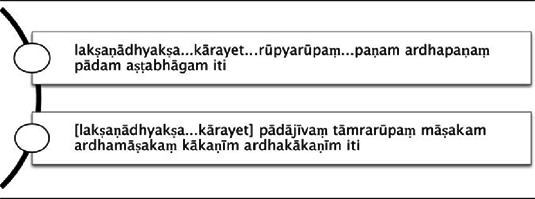
lakṣaṇādhyakṣaś catur bhāgatāmraṃ rūpyarūpaṃ tīkṣṇatrapusīsāñjanānām
anyatamamāṣabījayuktaṃ kārayet paṇam ardhapaṇaṃ pādam aṣṭabhāgam iti
pādājīvaṃ tāmrarūpaṃ māṣakam ardhamāṣakaṃ kākaṇīm ardhakākaṇīm iti || 2.12. 24
rūpadarśakaḥ paṇayātrāṃ vyāvahārikīṃ kośapraveśyāṃ ca sthāpayet || 2.12.25
“The Superintendent of the Mint should get silver coins minted containing 25 percent copper along with one Māṣa of one of the following hardening alloys: iron, tin, lead, and antimony, issuing them in the denominations of one Paṇa, half-Paṇa, quarter-Paṇa and an eighth-Paṇa; as also copper coins containing 25 percent of a strengthening alloy, issuing them in the denominations of one Māṣaka, half-Māṣaka, one Kākanī, and half-Kākaṇī.
The Examiner of Coins should institute the Paṇa currency for the purposes of trade and receipt into the treasury”.
The Cāṇakyaṭīkā comments upon 2.12.24–25 by explaining that:
lakṣaṇādhyakṣaḥ ṭaṅkāṅkitagajapatir ity arthaḥ | ( catur bhāgatāmraṃ ) catur bhāgaṃ tāmraṃ yasya tam | rūpyarūpam iti prādhānyād vyapadeśaḥ | tīkṣṇatrapusīsa lohānām
añjanasya māṣakapramāṇena bīja sthānīyena sarvadravyaikīkaraṇārthena
varṇāntarakaraṇārthena ca yuktaṃ kārayet | varṇādibhedena catur vidham || pādājīvaṃ
tāmraprakṣepād rūpyadalāhataṃ (?) śuddharūpyasamānarūpam ity arthaḥ |
parimāṇaprasiddhayā Footnote 30 ṣoḍaśaparimāṇaṃ yathocyate purākalpe [sic] | etad api
ṣoḍaśamāṣasahācaryāt ṣoḍaśamāṣaṃ kārṣāpaṇam iti | dvādaśapaṇo daṇḍa
ity ādiparijñānārthaṃ tūcyate'traikārṣikaḥ Footnote 31 tāmrikaḥ paṇa iti [sic] | rūpyapaṇādivyavahārād api lāghav ārtham āha tāmrarūpam iti | tāmramāṣakāṣṭabhāgo’ rdhakākaṇī || apare yogavibhāgena vyācakṣate tāmraṃ rūpaṃ Footnote 32 kiṃ pramāṇam iti cet paṇam ardhapaṇam ity ādi [sic] | tac ca daṇḍakarmaupayikam | tato māṣakam ity ādi | evaṃ rūpyarūpaṃ catur vidham aṣṭavidham iti (a?) nayena suvarṇarūpāṇy api vyavahāraviśeṣārthaṃ yojanīyānīti [sic]||
rūpadarśakaḥ parīkṣākuśalaḥ | tad ājīvapaṇasthitiḥ dviḥ prakārā nātispaṣṭāhataiḥ paṇaiḥ kriyādivyavahārārthām | kośapraveśyām cātispaṣṭalakṣaṇaiḥ svārthāni pañcāvarāṇi
“The Superintendent of the Mint means the treasurerFootnote 33 of that which is marked by a die (i.e. a coin).Footnote 34 (25 percent copper means) that which has 25 percent of copper. [Regarding] the expression a silver coin, the designation [of this coin] is [as such] because of the prevalence [of silver on it].Footnote 35 He should get it minted [containing 25 percent copper] along with what stands as the hardening alloy Footnote 36 whose weight is a māṣaka Footnote 37 of an ointmentFootnote 38 of the metals iron, tin, [and] lead; [hardening alloy] whose purpose is to fix all the substances together, [and] whose purpose is to make [the silver coin] of different varṇas [as well].Footnote 39 [The silver coin] is fourfold according to differences in varṇas and so forth. Pādājīvam Footnote 40 [denotes a coin which] because of the insertion of copper is struckFootnote 41 with a piece of silver,Footnote 42 (?) in a few words [a coin] having the same form of [a coin of] pure silver.Footnote 43 Because of the popularity of its weight [i.e. of the coin which is pādājīva], in ancient times this was called a ṣoḍaśaparimāṇa (lit. “sixteen [māṣas] in weight”).Footnote 44 This [coin pādājīva/ṣoḍaśaparimāṇa], also because of its association with sixteen māṣas,Footnote 45 is [called] a sixteen māṣas kārṣāpaṇa.Footnote 46 [On the subject of] quotations such as “twelve paṇas is the fine” and so forth,Footnote 47 for the purpose of a thorough knowledge [I mention the following]: “It is said however that one karṣa of copper makes a paṇa”.Footnote 48 Also because of the common usage of [expressions such as] a silver paṇa and so forth, for the sake of brevity he (i.e. the author of the root-text) says:Footnote 49 a copper coin. A half kākāṇī is 1/8th of a copper māṣaka. Others explain [this sentence] by separating the constructionFootnote 50 [ tāmrarūpaṃ ] (thus reading it as tāmram rūpam), [so that] if one asks: “What is the standard coin as [a] copper [coin]? (tāmram rūpam)?” The reply is: A paṇa, half-paṇa , and so forth. This [coin paṇa] is used as a means for [the payment of] fines.Footnote 51 After that, [the root-text mentions the coin denominations] a māṣaka and so forth. Therefore, the silver coin [paṇa] is fourfold and eightfold. With this scheme,Footnote 52 gold coinsFootnote 53 [which are used] for the purpose of peculiar transactions should be [here] added too.
The examiner of coins is the expert in the inspection [of coins]. The institution of that [mentioned] ājīvapaṇa [is here explained]. There are two varieties [of paṇas]: [the examiner of coins should institute the paṇa currency] with paṇas struck by non-authentic [symbols] for the purposes of trade. [He should institute the paṇa currency] with paṇas [struck] by authentic symbols for receipt into the treasury. [In this regard] there are five (lit.) coverings (materials? designs?) having their own meanings”.
5. On the expression lakṣaṇādhyakṣa
This section is devoted to an analysis of the technical terms used by the commentator for explaining the designation lakṣaṇādhyakṣa, which is the first expression found in the Sanskrit passages of Arthaśāstra 2.12.24. It is interesting to note that the commentator elucidates the lakṣaṇādhyakṣa by referring to the duty of this royal officer and hence to the manufacturing techniques of coins. The Sanskrit term lakṣaṇa (lit. “mark, symbol”) compounded with adhyakṣa (“superintendent, master”) is commonly translated as “mint master” or the “superintendent of the mint”. It is so rendered because in the Arthaśāstra the lakṣaṇādhyakṣa is said to deal with the minting of the standard coin denominations. It must be remembered, however, that this is not a literal translation. In the formulation lakṣaṇādhyakṣa, the term lakṣaṇa may allude to the “symbol” stamped in the coins by the superintendent of the province or region of the state. In 2.12.24, the word used to denote “coin” is rūpa.Footnote 54 Gupta underlines that rūpa (lit. “form, sign”) for “coin” and lakṣaṇa Footnote 55 attached to the word adhyakṣa (in the designation lakṣaṇādhyakṣa) suggest that coins had symbols or figures on them.Footnote 56 Interestingly, in sūtra 4.3.127 Pāṇini says that a saṃgha (used as a synonym of gaṇa or “republic”) has its aṅka and lakṣaṇa. The lakṣaṇa denotes here the heraldic symbols or marks of a saṃgha employed on their coins, seals, and banner. Pāṇini refers to symbols marked on cattle by the terms lakṣaṇas. Also, the third book of the epic Mahābhārata (Vana Parva 240.5) takes aṅka as a synonym of lakṣaṇa in describing the census of the royal cattle by branding them with proper marks.
The so called “punch-marked coins” are among the earliest variety of Indian coins minted during the second half of the first millennium bce. These usually consisted of small thin roughly square, oblong, oval, rectangular, and rounded pieces of metal of predetermined weight bearing up to five symbols impressed by individual punches. Archaeological evidence testifies that Indian punch-marked coins bore various motifs.Footnote 57 According to Agrawala, in the commentary on Kāṣikāvṛtti (7th century ce) it is said that symbols on coins were struck by a punch.Footnote 58 Desikachari highlights that coins very often showed dynastic emblems, the tiger being the dynastic emblem of the Cholas and the fish of the Pāṇṭiya.Footnote 59 Animal motifs on Indian coins of Ancient and Medieval period include the bull, peacock, fish, rhinoceros, and lion. The bull and elephant were particularly prominent, as these two animals dominated ancient Indian art. Sircar points out that royal seals of various kinds and shapes, bearing the emblems of each dynastic family, were attached to copper plate grants to assure their authenticity. He adds that in many cases the same emblem is also found on the coins of the kings.Footnote 60
Kangle explains the expression lakṣaṇādhyakṣa by saying that:Footnote 61
lakṣaṇa in this name apparently refers to the emblem of the king or state stamped on the coins as on the punch-marked coins. [. . .] A characteristic feature of Greek coinage and of Indian coinage inspired by the Greek example is the engraving of the ruler's effigy on the coin. To that there is no reference in the text. The word lakṣaṇa in the designation of the min-master refers to the mark made on the coin. Such marks of various types are to be found on what are known as punch-marked coins. [. . .] The Arthaśāstra, no doubt, mentions the minting of coins by the state.
Prabhamati glosses lakṣaṇādhyakṣa with ṭaṅkāṅkitaga(ñ)japati. I consider the term gaja (lit. “elephant”) to be a wrong transmission for gañja (“treasury”). Prabhamati must anyway have used this term for denoting a royal officer whose duties were, however, different from those of the kośādhyakṣa, who is the “superintendent of the treasury” described in Arthaśāstra 2.11.
Sircar explains that the Scytho-Parthian rulers of the north western regions of Bhāratavarṣa and their Kuṣāṇa successors introduced certain official designations into the Indian administrative system, some of which became popular with the indigenous Indian kings of various parts of Northern IndiaFootnote 62 Among such designations are gañjapati, gañjavara, divirapati, and pīlūpati. He adds that the designation gañjavara, which occurs in a Mathurā inscription of the Śaka chief Ṣoḍāśa (15–25 ce) and in Kalhaṇa's Kashmirian Chronicle (middle of twelfth century ce approximately) is the same as the Persian ganjwar (from ganj or “treasury”) meaning “a treasurer”.Footnote 63 Sircar says that “the same designation occurs as gañjapati in the Taleswar (Almora District, U.P.) plate of Dyutivarman who flourished about the sixth century A.D. About the middle of the tenth century A.D., Utpala, in his commentary on Varāhamihira's Bṛhatsaṃhitā (LII.13), explains gañja as koṣa-bhavanam (i.e. treasury)”.Footnote 64
I believe that the gañjapati might have been known to Prabhamati as the officer in charge of the minting of coins and gañja possibly as the place where coins were produced and maybe kept before circulating. Prabhamati's use of this expression has far-reaching implications and it helps to throw light on the commentator's place of origin. Since research shows that gañjapati was an expression mostly popular in the northern regions of India and since this term seems to have been used with such a connotation exclusively in that area, it may be safe to assume that Prabhamati came from North India.
The expression gañjapati occurs only twice throughout all the commentary. It is found again when Prabhamati comments upon 2.6.2 and explains why the superintendent of the mint is there mentioned, together with other superintendents, as one of the sources of the income of the fort. The commentator elucidates here lakṣaṇādhyakṣaḥ by saying that gajapatirūpyāhananād āyahetuḥ or “the superintendent of the mint” [is here mentioned as a source of the income of the fort]: the reason for the revenue is due to the striking of silver [coins] by the treasurer”.Footnote 65 It points out that in the Arthaśāstra the manufacture of coins clearly appears, in fact, to be a monopoly of the state as was the manufacture of standard weights. A feature that significantly characterises the expression ṭaṅkāṅkitaga(ñ)japati is the technical meaning of these terms. Here, the verbal adjective aṅkita is “marked” and it seems to allude to coins in which symbols were punched by a die.Footnote 66 In this context, the term ṭaṅka used by Prabhamati deserves special attention. Arthaśāstra 4.4.20 deals with the manufacture of false coins and mentions the term ṭaṅka together with tools such as hammer and anvil. It is there compounded with bimba or “image”, so that bimbaṭaṅka probably denotes a punch or a die for marking coins with single or multiple designs.Footnote 67 Therefore, in ṭaṅkāṅkitaga(ñ)japati I interpret the word ṭaṅka as a technical term standing for the tool used by the superintendent of the mint in punching coins with symbol(s).Footnote 68
It seems that:Footnote 69
From about the third century BC, ṭaṅka, a chisel-like metallic object bearing a design at the top became popular for punching a small and individual pattern on coins and other objects. [. . .] It has been described with interesting details in various Pāli works’. [. . .] In this process, a stamp of hard substance, bronze or iron is prepared. The design is created in repoussé on the stamp by chasing, grinding and filing. Then the precious metal on which the design is to be stamped is cleansed of internal impurities and annealed, after which the stamp with the over-all pattern pressed or, if required, hammered.
In the Cāṇakyaṭīkā, the word ṭaṅka is found again while Prabhamati comments upon 2.3.1, which concerns the construction of the fort. In that passage, the Cāṇakyaṭīkā explains prāstaram or “consisting of rocks” with śikharam eva samantaṣ ṭaṅkacchinnapārśvatvād durgamam or “a crest [of a mountain] being all around difficult to access because of having the sides chiseled off”.Footnote 70 In the context of coins, I understand ṭaṅka in ṭaṅkāṅkita to refer to coins which are “marked (aṅkita) by a die (ṭaṅka)”. It is interesting to note that the term ṭaṅka appears to be related to coins in various ways. In fact, when compounded with pati (“master”) ṭaṅkapati is the “mint master”. A footnote in Shamasastri says that a commentary on the Arthaśāstra glosses lakṣaṇādhyakṣa with ṭaṅkaśālādhikārī or “the superintendent (adhikārī) of the mint (ṭaṅkaśāla)”.Footnote 71
6. The commentator's interpretative strategy
In the passages translated and analysed in this paper, the Arthaśāstra presents some ambiguities due to the use of archaic terms such as bīja and ājīva.Footnote 72 These terms mean lit. “seed” and “livelihood, sustenance” respectively. Olivelle openly relies on Kangle's understanding of these terms, according to whom ājīva found in the compound pādājīva probably originates from a metathesis of [pād]abīja. Kangle claims that in this context one should understand ājīva as “the aid of an alloy”.Footnote 73 Olivelle says that: “[. . .] We must assume that ājīva here has the same meaning of bīja used in the context of the silver coins. As Kangle suggests, perhaps the original reading here also was pādabīja”.Footnote 74 Similarly, all later scholars read these terms in such a way.
I am now going to compare the accepted scholarly understanding of 2.12.24 with Prabhamati's commentarial reconstruction of 2.12.24. Scholars agree that in 2.12.24, the Arthaśāstra mentions the following coin denominations:
-
i) paṇa, half-paṇa, quarter-paṇa, and eighth-paṇa: these are four silver coins made of one fourth of copper and one māṣa of a hardening alloy (bījā) of either iron, tin, lead or antimony;
-
ii) māṣaka, half-māṣaka, kākaṇī, and half-kākaṇī: these are four copper coins having one-quarter of an alloy (ājīva).
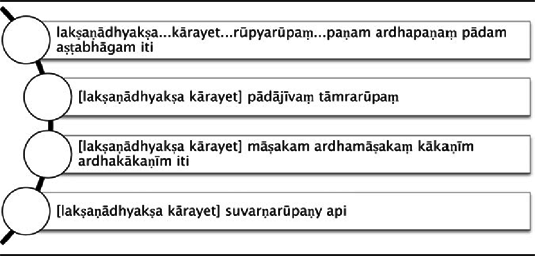
In order to better understand the way Prabhamati re-elaborates the Arthaśāstra’s passage, Table 1 below shows the grammatical construction of 2.12.24, which I compare with the commentator's textual re-elaboration (Table 2).
The Grammatical structure of Arthaśāstra 2.12.24

Prabhamati's INTERPRETATION of Arthaśāstra 2.12.24.

The structure of the Sanskrit sentence of 2.12.24 is fairly straightforward:
In 2.12.24, the use of the adjective anyatama found in the expression anyatamamāṣabījayuktaṃ indicates that only one among the four kinds of metals (iron, tin, lead, and antimony)Footnote 75 mentioned is to be used as the bīja or “hardening alloy” for the minting of silver coins.Footnote 76 This hardening alloy should be of a māṣaka in weight. In this regard, Prabhamati emphasizes that the function of the bīja is to tie up all together the substances involved in the composition of the coins and to make the coins of different varṇas. The commentator's construction with the double genitive of the terms añjana and loha is an interesting variant. In this grammatical formula, añjana seems to mean “ointment” rather than “antimony” as in the Arthaśāstra and it may refer to the unguent used for the preparation of the hardening alloy using the metals (loha) iron, tin, and lead.Footnote 77 Also, while the root-text uses the adjective anyatama to clearly indicate that the hardening alloys should be of one of the four metals mentioned, the commentator does not use this term at all and hence does not mention this detail. From his exposition, one understands that the ointment is made by iron, tin, and lead combined all together.Footnote 78
More important to the present study is the understanding of the term ājīva, which in the root-text is compounded with pāda (usually taken to mean “one-quarter” or “25%”). In the Arthaśāstra, the word ājīva appears elsewhere: in 2.35.5 along with vyaya denotes “earnings and expenditures” respectively.Footnote 79 The idea of the present paper is that Prabhamati shows a peculiar understanding of the expression pādājīvam, and this is related to his view of the paṇa-currency in the Arthaśāstra, a view based on the fact that the commentator reads these passages of the Arthaśāstra having the Mānava Dharmaśāstra as his interpretative criterion. Prabhamati stretches the structure of the passage in the root-text and explains pādājīvam in relation to tāmrarūpam and not in relation to māṣakam as, according to scholarly understanding, this occurs in the Arthaśāstra. In the commentator's interpretative strategy the expression pādājīvam tāmrarūpam introduces a coin, of which Prabhamati specifies details such as its weight, its name, and so forth. An analysis of the grammatical relationships of the expressions used in Prabhamati's passage clarifies my thesis. The commentator reconstructs 2.12.24 in the following way:
To sum up, according to the commentator the sets of coins are:
-
1) the silver paṇa with its submultiples: ardhapaṇa, pāda, and aṣṭabhāga;
-
2) the copper paṇa with its submultiples, which are the same as the silver paṇa. He believes or wants the readers to believe that the Arthaśāstra refers to the copper paṇa by the expression pādājīvaṃ tāmrarūpaṃ. Prabhamati adds a description of this coin, which is:
-
− rūpyadalāhataṃ śuddharūpyasamānarūpam or “struck with a piece of silver, in a few words [a coin] having the same form of [a coin of] pure silver”;
-
− in ancient times this copper coin (tāmrarūpa) which is pādājīva, since its weight was well known to be sixteen māṣas, was called ṣoḍaśaparimāṇa or “sixteen [māṣas] in weight”;Footnote 80
-
− this very same copper coin (tāmrarūpa) which is pādājīva – in the ancient time called ṣoḍaśaparimāṇa – is now known as ṣoḍaśamāṣa kārṣāpaṇa or a “kārṣāpaṇa of sixteen māṣas” [in weight];Footnote 81
-
− this sentence is followed by a quotation which I argue is from Mānava Dharmaśāstra 8.136. There it is said that a paṇa of copper measures a kārṣa.Footnote 82 The full sentence from the Manusmṛti says: kārṣāpaṇa tu vijñeyas tamrikaḥ kārṣika paṇaḥ or “A karṣa of copper however, should be known as a kārṣāpaṇa or simply paṇa”. Mānava Dharmaśāstra 8.136 explains paṇa as an abbreviation for kārṣāpaṇa and as a copper coin weighing a kārṣa;Footnote 83
-
− Prabhamati seems to say that this ṣodaśaparimāṇa/ṣoḍaśamāṣa kārṣāpaṇa/ekakārṣika tamrika paṇa is that which the Arthaśāstra in 2.12.24 means by pādājīvaṃ tāmrarūpam. In fact, the commentator after having quoted the unnamed source explains that rūpyapaṇādivyavahārād api lāghavārtham āha tāmrarūpam iti: in a few words, he says that because rūpyapaṇa is a popularly established use to denote the silver paṇa, it is not surprising that for the same reason the author of the root-text uses the common expression tāmrarūpa or a “copper coin” to denote the copper paṇa;
-
− the commentator uses the formula of question/reply to point out that some authors mention the copper paṇa as the standard coin denomination. The copper paṇa is indeed found in Sanskrit literature, and particularly in the smṛtis as I already stated. He adds that this copper paṇa is daṇḍakarmaupayika or “used to pay fines”. There the commentator provides important information: according to his view, the fines mentioned in the Arthaśāstra were paid in copper paṇas. To strengthen this point a few lines earlier Prabhamati has employed an ingenious literary device: he mentions a fine of twelve paṇas (dvādaśapaṇo daṇḍa) which he causes to be immediately followed by a quotation from the Mānava Dharmaśāstra, where fines are indeed paid in copper paṇas;Footnote 84
-
− it is noteworthy that the expression daṇḍakarmaupayikam is followed by tato māṣakam ity ādi. The adverb tatas is here particularly significant. It emphasises that the māṣaka copper coin denomination and its submultiples are to be understood “after that”, in other words after the coins so far mentioned in the root-text and explained in the commentary. Thus, the third set of coin denominations mentioned by Prabhamati are the māṣaka and its lower denominations;
-
-
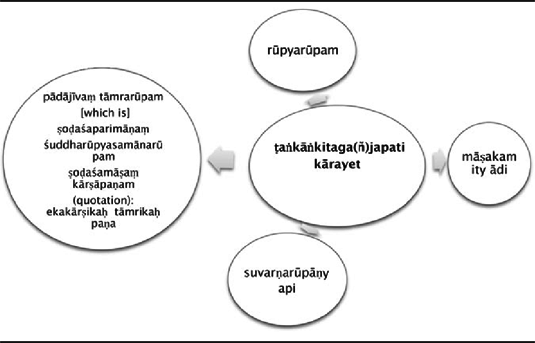
3) lastly, the set of coins mentioned by Prabhamati interestingly includes gold coins.
The commentator ends his passage on 2.12.24 by saying that which in the root-text is called rūpyarūpa is fourfold and eightfold. In my understanding, he states that the rūpyarūpa/rūpyapaṇa is fourfold because it has four silver denominations (paṇa, half-paṇa, etc.), and since there is also a paṇa of copper subdivided into another four exactly comparable denominations (paṇa, half-paṇa, etc) the paṇa-currency is hence eightfold. This is clear while reading the commentator's reconstruction of 2.12.25, where the Arthaśāstra mentions a twofold system of paṇa-currency. He also adds that this scheme is to be applied to gold coins. This seems to be another peculiar remark, as according to historiography gold coins are not explicitly introduced in the Arthaśāstra. Interestingly, gold coins are mentioned in the the Mānava Dharmaśāstra.
In order to clarify my explanation, the table below (Table 3) shows the grammatical objects of the subject ṭaṅkāṅkitaga(ñ)japati and the verb kārayet according to the way the commentator constructs his passage and re-elaborates 2.12.24.
Prabhamati's passage on Arthaśāstra 2.12.24

In concluding this section, I would like to draw attention to Harihara Sastri's remarks on the coinage system explained by Prabhamati.Footnote 85 Harihara Sastri says in his introduction that there are three are groups of standard coins mentioned by Prabhamati; he hence seems to acknowledge something anomalous in the commentary's passages on 2.12.24–25:
-
1) four silver coins (having the same denominations and compositions given in 2.12.24);
-
2) “four silver-coated coins of one fourth pādājīva” having the same weight and form as the silver coins and of the same denominations (paṇa and its submultiples);
-
3) four copper coins (māṣaka and its submultiples as given in 2.12.24).
Harihara Sastri states that, together with the fourfold silver paṇa, Prabhamati mentions a fourfold silver-coated paṇa with the same weight and the same submultiples of the silver paṇa. Unfortunately, the editor does not go into detail nor does he explain, for instance, his reading of pādājīva in Prabhamati's passage; instead, his wording of the explanation of the four silver-coated paṇas is ambiguous: what does “one fourth pādājīva” denote in his sentence? Does pāda for Harihara Sastri mean “one-fourth”? If so, he should normally have said “one fourth of ājīva”, rather than “one fourth pādājīva”. Also, Harihara Sastri states that “the introduction of silver-coated copper paṇas as explained by the commentary recalls the statement in the Pāli commentaries that Kauṭalya debased the coinage by lowering Kārṣāpaṇa in quality”. In addition, he mentions that Agrawala's Indian known to Pāṇini provides archeological references of a punch-marked kārṣāpaṇa coin of copper with traces of thin silver on it, which represents for him the debased coinage of the Mauryan administration (ca. 321–185 bce). Thus, it seems Harihara Sastri tries to fit the content of the Arthaśāstra to the Mauryan time, according to the traditional-conservative view of the historiography of this text.Footnote 86
7. The expression ājīvapaṇa and Prabhamati on Arthaśāstra 2.12.25
A close analysis of the commentator's passage on 2.12.25 helps to better comprehend his presentation of 2.12.24 and of the coinage system of the Arthaśāstra. It has been shown that while 2.12.24 deals with the lakṣaṇādhyakṣa or “superintendent of the mint”, 2.12.25 introduces the activity of the rūpadarśaka or “examiner of coins”.Footnote 87 The latter is in charge of ascertaining the conformity of the currency to the official standards in order to avoid counterfeit coins. The examiner of coins of 2.12.25 “should institute the Paṇa currency for purposes of trade and [the Paṇa currency] for receipt into the treasury”.Footnote 88 Kangle emphasises that in this passage the Arthaśāstra refers to two kinds of paṇa, of which the former had to have a lighter content of the principle metal.Footnote 89
Let us now look at the way Prabhamati comments upon Arthaśāstra 2.12.25.
The commentator, after having glossed rūpadarśaka with parīkṣākuśala or “the expert in the inspection [of coins]”, says that “the institution of that [mentioned] ājīvapaṇa [is here explained]”. The use of the expression ājīvapaṇa in this passage to explain the activity of the rūpadarśaka shows that Prabhamati's analysis of 2.12.24, where the term ājīva is first mentioned by the both the Arthaśāstra and by the commentator in relation to the lakṣaṇādhyakṣa, is to be understood on the light of his interpretation of 2.12.25.
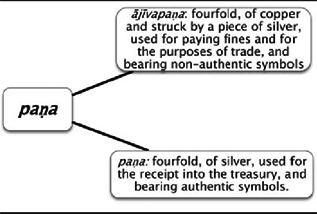
In fact, although the ambiguity of the meaning of pādājīva as understood by the commentator still remains it is evident that, as I have argued so far, for Prabhamati the term ājīva in both 2.12.24 and 2.12.25 is associated with the paṇa and not with the māṣaka as it is in the root-text. It is clear that what, in his passage on 2.12.24, Prabhamati refers to as pādājīva tāmrarūpa/ṣodaśaparimāṇa/kārṣāpaṇa/ekakārṣika tamrika paṇa is the same ājīvapaṇa he mentions in 2.12.25. While commenting upon 2.12.25, he designates the ājīvapaṇa as the paṇa for purposes of trade, which is mentioned by the Arthaśāstra as vyāvahārikī. Scholars agree that in the kingdom described in the Arthaśāstra, the paṇayātrā or “paṇa currency” is established so that there is the paṇa for purposes of trade (vyāvahārikī) and the paṇa for receipt into the treasury (or kośapraveśyā), which is explained in 2.12.25. In my argument this is exactly the reason for which Prabhamati, commenting upon 2.12.24, says that what the root-text calls rūpyarūpa is fourfold and eightfold: he refers to the system of the twofold paṇa mentioned by the Arthaśāstra in 2.12.25 where, he understands, each paṇa-system – one of silver and one of copper – is fourfold. In this respect, I understand the term naya or “scheme” used by the commentator at the end of his analysis of 2.12.24 referring exactly to this “scheme”: an eightfold standard currency in which the fourfold copper currency struck with a piece of silver is used for purposes of trade (the Arthaśāstra’s vyvājarikī) and is marked by non-authentic symbols, while the fourfold silver currency is used for receipt into the treasury (the Arthaśāstra’s kośapraveśyā) and is marked by authentic symbols. Prabhamati says that this “scheme” (naya) applies to gold coins as well (suvarṇarūpāṇy api), and adds that gold coins are used for special transactions.
The term used by Prabhamati apparently only in relation to the paṇa for receipt into the treasury is āvaraṇa. In this context, āvaraṇa (lit. “covering”) is a technical term related to coinsFootnote 90 that may denote: i) special metallic covering materials, or as I believe ii) a special set of “symbols” having particular meaningsFootnote 91 that were stamped on the coins for the receipt into the treasury (symbols in fact do “cover” the surface of the coins). In any case, it seems that āvaraṇa alludes to what distinguishes the paṇa coming into the treasury from the paṇa used for commercial transactions. The author says that the two varieties of paṇa bear symbols stamped in them, but only in the paṇa for the receipt into the treasury are these authentic. One must assume that this paṇa had a higher content of precious metal in it and that, by contrast, the paṇa for trade was lighter and less valuable. A reference to paṇa denominations marked by symbols is found in an article by Verma who says that “we have sufficient reasons to suggest that rūpadarśaka had to punch certain symbols [. . .]”.Footnote 92 In the Arthaśāstra, the aim of the twofold system of paṇa is clearly to make the royal apparatus the best recipient.
The usage of two varieties of the same standard coin denomination appears to us a strange practice but in relation to the Arthaśāstra it should not be surprising. As already mentioned, the normative dimension of this text aims to instruct the royal ministers on how to organise the bureaucratic apparatus and the administration of the state so to achieve the best outcomes for the whole kingdom. The instructions given are often not applicable in real-world situations. When working on śāstras, scholars are aware that “they actually instruct through normative visions of an idealized world” though they often “draw on real-world expertise and observation to furnish their normative visions”.Footnote 93 Although it does offer valuable historical information about customs and practices, the Arthaśāstra describes how things should be. For instance, in 2.19.11–28 a large number of scales is described in great detail. Different scales are used for different purposes, so that there is i) the balance for trade; ii) the balance for payments; iii) the balance for payments from the palace, iv) and the balance for revenue. Here different values are associated with the same weight denominations according to different contexts. In fact, from Kauṭilya's description (2.19.19–24) it appears that the pala weight is heavier when weighed in the balance for revenue so that the state can collect more revenue and it is lighter when used for making payments from the palace so that the king can benefit most. This system works through a set of scales with different degree markings, so what appears the same has in reality different weights. This reveals the intention to secure a double advantage to the state. As Olivelle reminds us, even though the Arthaśāstra gives valuable data on ancient Indian society, “a preliminary issue that must be addressed, however, is how much of what the AŚ has to say about society and material culture reflects historical reality and how much is an idealised portrayal – what should be rather than what is”.Footnote 94
The table below (Table 4) shows the twofold system of standard paṇa according to the Cāṇakyaṭīkā:
The Twofold System of the Standard Paṇa of 2.12.25 as described by Prabhamati.

8. The Mānava Dharmaśāstra and Intertextuality in the Cāṇakyaṭīkā
In his review on the edition of the Cāṇakyaṭīkā by Pohlus, Lubin points out that “the commentary displays erudition in analyses both grammatical and substantive, and explains the text with reference to other literature, including of course Manu's code”.Footnote 95 For instance, in his text Prabhamati selectively quotes from Mānava Dharmaśāstra 8.9–11, 8.60, 11.14, and 11.180. He also quotes from Manu, without mentioning his source, in the Jayamaṅgalā.
Let us now compare Prabhamati's passage while commenting on Arthaśāstra 2.12.24 (i), with the passages from Mānava Dharmaśāstra 8.136 (ii):Footnote 96
-
i) tūcyate'traikakārṣikaḥ tāmrikaḥ paṇa iti
-
ii) kārṣāpaṇa tu vijñeyas tamrikaḥ kārṣika paṇaḥ
These passages though similar do not match perfectly. In the face of elusive modes of textuality, the role played by parallels and similarities identified when comparing texts may be subject to divergent interpretations. The fact that this is not a verbatim quotation opens up intriguing questions that one must take into consideration. Perhaps the first and hardest to address regards Prabhamati's original source: one wonders whether the commentator quotes the Mānava Dharmaśāstra word by word via an intermediary or whether he may have had access to a slightly different recension of the Mānava Dharmaśāstra. In this regard, another interesting basis for discussion is whether Prabhamati's quotation could, instead, be considered a re-arrangement, a re-elaboration, a paraphrase or, employing a recently popular expression in Indological studies, an “adaptive textual re-use”.Footnote 97 Though some may argue the terms above have a different nuance we must imagine, in any case, that there was a shared repertoire and that the passage from the Mānava Dharmaśāstra would have been immediately recognisable to Prabhamati's audience. In Sanskrit literature, it is common to find elusive practices of intertextuality. Authors freely draw on and use early material without quoting direct sources. Making use of whole sentences or even passages from older texts without marking them as quotations appears to have been common practice among Sanskrit authors. Most of the passages parallel to older works are incorporated “silently”. In our case, it seems that the commentator intentionally borrowed that passage from another source and he is keen to show that is a quotation by marking it with a final iti. Citing the Mānava Dharmaśāstra, which by early Medieval India had already been accepted as the established repository of knowledge and instruction on Dharma,Footnote 98 the commentator provides an authoritative formula to support the idea that in the Arthaśāstra there is a paṇa of copper too, which is used for paying fines and for commercial transactions and this is what is meant by the Arthaśāstra itself in 2.12.25. Prabhamati says that whenever the Arthaśāstra mentions fines such as fines of twelve paṇas, these refer to copper paṇas as occurs in the authoritative source quoted. He also states that this copper paṇa is the same pādājīva tāmrarūpa/ṣoḍaśaparimāna/kārṣāpaṇa, and ājīvapaṇa. The way he arranges the Sanskrit sentence provides coherence and indirectly persuades the reader of his point of view. Prabhamati's passage on 2.12–24 –25 represents an example of what we can define as a textual variation, a commentarial reconstruction based on the authority of another work from which a main idea is borrowed.
Before concluding this paragraph, for reason of clarity I present the full passage the Mānava Dharmaśāstra where the coin kārṣāpaṇa is mentioned. The section of this text dealing with standard monetary and weight measuring units is found in the eighteenth chapter where interest and loan-related issues are mentioned in detail.
This passage runs for five ślokas (8.132–137) and it starts with the smallest units of weight such as trasareṇu, likṣā, rājasarṣapa, gaurasarṣapa, yava, and kṛṣṇala. After that, it introduces units of weight for gold and silver. The text continues (verses 8.134–137) with: “Five kṛṣṇalas are one māṣa; sixteen māṣas one suvarṇa; four suvarṇas are one pala; ten palas, one dharaṇa. One should know that two kṛṣṇalas weighed together are one silver māṣaka and sixteen māṣakas is one dharaṇa, as well as a silver purāṇa. A karṣa of copper however, should be known as a kārṣāpaṇa or simply paṇa; ten dharaṇas, as one silver śatamāna, and four suvarṇas as one niṣka”.
As a brief aside, I would like to point out that this passage is an example of the way Sanskrit texts often appear cryptic in treating the relationship between coins and their corresponding weights. This is often confusing even to specialist readers. An interesting feature that we can note is that the Arthaśāstra, in contrast to the Mānava Dharmaśāstra, treats standard coins denominations and standard units of weight separately. In fact, while 2.12.24 deals with the manufacturing of coins, measuring units of weight of silver and gold are mentioned in 2.19, which is devoted to the standardisation of weights and measures. In Sanskrit texts for which the names of coins are exactly the same as the names of weight measuring units (thereby indicating a primary connection), it is not easy to tell whether one of these names actually refers to a weight or a coin. This has often led scholars to divergent conclusions.
Conclusion
The importance of the coinage system represented in a textual source should not be disregarded. It manifests significant features of social organisation, economic relations, hierarchy, and power. This becomes even more relevant when it pertains to legal textual traditions dealing with polity, governance, and religious duties. Coins are widely mentioned in Dharmaśāstric literature in relation to debts, fines, and every kind of economic transaction. The present study analysed the activities of the Cāṇakyaṭīkā’s reconstruction on 2.12.24–25, where the Arthaśāstra presents the lakṣaṇādhyakṣa or the “superintendent of the mint” and of the rūpadarśaka or the “examiner of the coins”. While commenting on these passages, the commentator adds interesting details and introduces technical terms on the minting of coins and on the paṇa-currency used in the administration of the ideal kingdom described in the Arthaśāstra. The analysis of passages from the Cāṇakyaṭīkā demonstrates that Prabhamati shows a peculiar interpretation of the coinage system presented in the root-text, which differs from the scholarly understanding of the passages of the Arthaśāstra. I argued that in presenting the coinage system, Prabhamati uses the Mānava Dharmaśāstra as a criterion for interpreting the Arthaśāstra. In quoting Manu, Prabhamati gives authority to his own work and to his analysis of the text commented upon. Moreover, he seems to establish continuity in the elaborate scholastic system of the expert tradition on law.
In his thorough and pioneering study on the Arthaśāstra, Trautmann notices that:Footnote 99
“The Arthaśāstra’s silver coin is called paṇa, its copper coin māṣaka in Book 2; but the fines laid down in Book 3 are in numbers of paṇas in general agreement with the prescriptions of the smṛtis where, however, the paṇa is a copper coin. [. . .] When it is recognized that Books 2 and 3 are by different hands, however, the problem of internal contradiction disappears”.
The investigation put forward by the present paper is in full agreement with the observation above: as Trautmann emphasises, the fines mentioned in Book Three are generally similar in number to that of the smṛtis, where however the paṇa is of copper.
Arthaśāstra 2.12.25 mentions the simultaneous use of a paṇa-currency: a standard coin denomination used for purposes of trade and denoted as vyāvahārikī and a standard coin denomination used for receipt into the treasury and denoted as kośapraveśya. My translation of Prabhamati's passage on 2.12.24–25 has shown that the commentator explains the concomitant presence in the Arthaśāstra of: i) a system of fourfold silver paṇa used for receipt into the treasury and marked by authentic symbols, and ii) a system of fourfold copper paṇa (which he calls ājīvapaṇa and says to correspond to the well known copper paṇa/kārṣāpaṇa), struck by a piece of silver, used for paying fines and for the purposes of trade, and characterised by non-authentic symbols. The first corresponds to what the Arthaśāstra defines as vyāvahārikī, while the latter corresponds to what the Arthaśāstra defines as kośapraveśya. In this way, the commentator accommodates and reconciles the unusual practice of a twofold paṇa mentioned in the Arthaśāstra to the prescriptions found in the smṛtis, which mention the use of the copper paṇa.
The fact that Prabhamati seems to quote from the Mānava Dharmaśāstra allows us to draw new conclusions and raise new questions about the relationship between the Arthaśāstra and Manu's code as perceived by the intellectual tradition of that time. Prabhamati may have belonged to a political and legal tradition in which statecraft and jurisprudence of the expert tradition of the arthaśāstra were accepted as a subsidiary genre of the expert tradition of dharmaśāstra.
Before concluding this paper, I would like to make a last remark. Interestingly, Kangle emphasises that: “Breloer thinks (KSt, III, 46) that copper coins were used for trade and silver coins alone came into the treasury. This appears to be Cp's idea”.Footnote 100 Kangle's remark points out that Breoloer was influenced in his opinion by what the Pratipadapañcikā by Bhaṭṭasvamin says on the Arthaśāstra’s currency. Breoloer's suggestion of copper coins used for trade and silver coins alone coming into the treasury is obviously very much in tune with the arguments of this paper on Prabhamati's textual interpretation.