Calcium phosphate (CaP) phases and minerals are used in a wide range of clinical, environmental and engineering applications. They are commonly used as substitutes in bones because their biochemical properties make them suitable for medical applications (Alshaaer et al., Reference Alshaaer, Kailani, Ababneh, Mallouh, Sweileh and Awidi2017; Neves et al., Reference Neves, Linhares, Costa, Ribeiro and Barbosa2017; Radwan et al., Reference Radwan, Nasr, Ishak, Abdeltawa and Awad2020) and they are chemically and structurally similar to the mineral phase of bone tissues. Different phases of CaPs serve as precursors in the preparation of biocements and bioceramics, showing potential in the field of advanced materials research and technology (Alshaaer et al., Reference Alshaaer, Kailani, Jafar, Ababneh and Awidi2013, Reference Alshaaer, Kailani, Ababneh, Mallouh, Sweileh and Awidi2017, Reference Alshaaer, Abdel-Fattah, Saadeddin, Al Battah, Issa and Saffarini2020). In general, they show low toxicity, high bioactivity and good biocompatibility. In addition, they exhibit acceptable biodegradable rates and can bond directly to bones given their mineralogical structure and chemical composition resembling the mineral phases of teeth and natural bone (Alshaaer et al., Reference Alshaaer, Kailani, Jafar, Ababneh and Awidi2013, Reference Alshaaer, Kailani, Ababneh, Mallouh, Sweileh and Awidi2017; Khalifehzadeh & Arami, Reference Khalifehzadeh and Arami2020). Therefore, CaPs are excellent candidates for bone tissue engineering, drug delivery and bone-related disease treatment (Shyong et al., Reference Shyong, Chang and Lin2018; Khalifehzadeh & Arami, Reference Khalifehzadeh and Arami2020). In addition to their clinical and pharmaceutical applications, CaPs are used in fertilizers (Liu et al., Reference Liu, Ma, Li, Qi, Han and Chen2020) and as construction materials (Alshaaer et al., Reference Alshaaer, Cuypers, Mosselmans, Rahier and Wastiels2011).
Brushite (dicalcium phosphate dehydrate; DCPD; CaHPO4.2H2O) is one of the best known CaPs (Alkhraisat et al., Reference Alkhraisat, Rueda and Cabarcos2011; Alshaaer et al., Reference Alshaaer, Cuypers, Mosselmans, Rahier and Wastiels2011). Brushite is formed by chemical reactions in slightly acidic solutions (Xue et al., Reference Xue, Wang, Sun, Huang, Wu and Chen2020). This mineral is stable in weakly acidic environments (pH 4.0–6.0) and at low temperatures (<80°C) (Kim et al., Reference Kim, Lee, Roh, Lee, Kim and Lee2015; Xue et al., Reference Xue, Wang, Sun, Huang, Wu and Chen2020). Therefore, it is usually metastable at neutral conditions (i.e. at pH ~7.4), indicating that it may be resorbed within relatively short periods, potentially causing fast substitution of bone material (Mert et al., Reference Mert, Mandel, Tas, Narayan and Colombo2011; Luo et al., Reference Luo, Engqvist and Persson2018).
Large-scale ion replacements reportedly occur in a crystal if the two radii are the same and the valence of the substituted ion is equivalent (Alkhraisat et al., Reference Alkhraisat, Rueda and Cabarcos2011). Calcium and strontium meet these two conditions, and thus the two ions can replace each other in a crystal (Rokita et al., Reference Rokita, Hermes, Nolting and Ryczek1993). The substitution of calcium by strontium in CaP phases such as hydroxylapatite (HA), amorphous CaP (ACP), octacalcium phosphate (OCP) and brushite has been investigated in the past (Sinusaite et al., Reference Sinusaite, Renner, Schütz, Antuzevics, Rogulisc and Grigoraviciute-Puroniene2019; Amjad et al., Reference Amjad, Sattar and Dousti2020; Wu et al., Reference Wu, Ueda and Narushima2020). Various bone cements loaded with Sr have been introduced (Tadier et al., Reference Tadier, Bareille, Siadous, Marsan, Charvillat and Cazalbou2012; Schumacher & Gelinsky, Reference Schumacher and Gelinsky2015). The Ca substitution by Sr in CaPs is the most efficient (Alkhraisat et al., Reference Alkhraisat, Rueda and Cabarcos2011; Suguna & Sekar, Reference Suguna and Sekar2011) because Ca sites in the brushite may be completely replaced by Sr, which is effective for bone-loss prevention. In vitro studies report that strontium ions (Sr2+) may increase apoptosis and decrease the differentiation of osteoclasts. Meanwhile, Sr2+ ions improve cell growth and proliferation. Introducing Sr2+ decreases bone resorption and causes sustainable bone formation (Nielsen, Reference Nielsen2004; Pina et al., Reference Pina, Torres, Goetz-Neunhoeffer, Neubauer and Ferreira2010; Sayahi et al., Reference Sayahi, Santos, El-Feki, Charvillat, Bosc and Karacan2020).
Brushite is one of the most important CaP minerals in bone tissue engineering. Its clinical applications include use as a bone-cement precursor (Roy et al., Reference Roy, DeVoe, Bandyopadhyay and Bose2012; Tamimi et al., Reference Tamimi, Sheikh and Barralet2012). However, to date, the potential of brushite as a bioactive material in the body has not received much attention. The partial or complete replacement of Ca in brushite with Sr to improve its performance as a biomaterial deserves further exploration. The present study therefore aims to synthesize and characterize pure brushite and to study the partial and complete replacement of Ca with Sr in brushite under fixed conditions in a so-called (CaxSr1–x)HPO4.nH2O system. The microstructure of the powders produced was investigated in terms of chemical phase, crystal morphology, thermal properties and shelf storage stability. The possibility of replacing Ca by Sr was explored here in view of the characteristics of the obtained compounds by means of complementary techniques: X-ray diffraction (XRD), scanning electron microscopy (SEM), thermogravimetric analysis (TGA) and ageing under ambient conditions.
Brushite is an important precursor of several bone cements and bioceramics (Alshaaer et al., Reference Alshaaer, Kailani, Jafar, Ababneh and Awidi2013, Reference Alshaaer, Kailani, Ababneh, Mallouh, Sweileh and Awidi2017). The novelty of this research lies in the study of the effects of the full-scale replacement of Ca by Sr as one of the most important elements in biomaterials (Kruppke et al., Reference Kruppke, Heinemann, Gebert, Rohnke, Weiß and Henß2020) starting from pure brushite. The ‘replacement’ in this study is defined as the substitution of Ca by Sr and maintaining the same conditions during the powder preparation. The crystal morphology, chemical composition and mineralogical structure are important factors in the preparation of the reactive components of bone cements such as tetracalcium phosphates (Alshaaer et al., Reference Alshaaer, Kailani, Jafar, Ababneh and Awidi2013). Obviously, the high levels of replacement will result in new forms of crystals and probably other minerals. Accordingly, the scientific community should be able to select the appropriate range of replacements to synthesize a given biomaterial.
Experimental
Materials and chemicals
Sodium dihydrogen orthophosphate dihydrate (NaH2PO4.2H2O) was purchased from Techno Pharmchem (India), while calcium nitrate tetrahydrate (Ca(NO3)2.4H2O) and strontium nitrate (Sr(NO3)2) were supplied by LOBA Chemie (India). Distilled water (0.055 μs cm–1) was acquired using a water purification system (PURELAB Option-Q, ELGA, UK). Each sample was weighed using a digital analytical balance (EX324N, OHAUS, USA) and stirring was performed on a magnetic stirrer (ISOTEMP, Fisher Scientific, China).
Synthesis of (CaxSr1–x)HPO4.nH2O powders
The synthesis of the (CaxSr1–x)HPO4.nH2O powders was performed at room temperature and is based on the following reaction:
 $${XSr}\lpar {{\rm N}{\rm O}_3} \rpar _2 + {\rm \;}\lpar {1-{X}} \rpar {\rm Ca}\lpar {{\rm N}{\rm O}_3} \rpar _2 + {\rm N}{\rm a}_2{\rm HP}{\rm O}_4{\rm \;}\to \lpar {{\rm C}{\rm a}_{1-{x}} + {\rm S}{\rm r}_{x}} \rpar {\rm HP}{\rm O}_4.2{\rm H}_2{\rm O\;} + 2{\rm NaN}{\rm O}_3$$
Two starting solutions were prepared for the synthesis of various powders. The first solution was prepared by dissolving 0.05 mol of Na2HPO4.2H2O in 100 mL of deionized water, and the second solution resulted from dissolution of 0.05 mol of Ca(NO3)2 and/or Sr(NO3)2 in 100 mL of deionized water. The molar ratios of Ca(NO3)2 and Sr(NO3)2 were selected based on Table 1. The pH was fixed at 6.5 for all of the solutions. The powders were prepared according to Table 1.
Composition of the (CaxSr(1–x))HPO4.nH2O powders.

Subsequently, 100 mL of the CaxSr(1–x)(NO3)2 (0 ≤ x ≤ 1) solution was added dropwise using a glass funnel with a glass stopcock (flow rate = 1.7 mL min–1) to the Na2HPO4.2H2O solution under continuous stirring (450 rpm). This solution was stirred (200 rpm) at room temperature for 1 h to ensure a homogeneous mixture. The overall stirring period prior to filtering was ~2 h. The pH of the solution obtained was adjusted during stirring using an ammonia solution (25%; Labochemie, India) to form a white precipitate in a slightly acidic medium (pH 6.0–6.5) using a pH meter (Adwa, Romania). The precipitate was vacuum filtered using qualitative filter paper (45 μ, 12 cm; Double Rings, China) via a Buchner funnel, washed three times with deionized water and washed another three times with ethanol to reduce the possibility of agglomeration (Patil et al., Reference Patil, Jena and Bhargava2012; Piva et al., Reference Piva, Piva, Pierri, Montedo and Morelli2015; Lu et al., Reference Lu, Willhammar, Sun, Hedin, Gale and Gebauer2020), after which it was placed upon a watch glass and dried at 40°C overnight in a drying oven (ED53/E2; Binder, Germany).
After formation of the precipitate, an aliquot of the powder was washed with distilled water and dried using ethanol at 40°C. The remaining part was placed in open plastic containers without washing and air dried for 1 week. The powders were then disaggregated by grinding in a planetary mill for 15 min at a rotation rate of 7000 rpm, using zirconia grinding media and acetone as the disaggregation medium. After disaggregation, the powders were dried in air at room temperature for 2 h. Next, the dried powders were sieved to pass through a 200 μm sieve. The major steps of the experimental design are reported in Fig. 1.
Schematic diagram of the experimental design.

Characterization
The amorphous and major crystalline phases of the powder samples were determined qualitatively using a Shimadzu XRD-6000 (Japan) with a cobalt tube, in a scanning range of 10–60°2θ at a scan rate of 2° min–1. A scanning electron microscope (Inspect F50; FEI, The Netherlands) was used to characterize the morphology of the specimens. The mass loss with heating of the powdered samples (~100 mg) was determined with a thermogravimetric analyser (TG 209 F1 Libra; Netzsch, Germany). The samples were heated in the 40–850°C temperature range with a heating ramp of 5°C min−1 under a helium atmosphere. The surface chemistry and the elemental analysis of the powders obtained were characterized by means of X-ray photoelectron spectroscopy (XPS) with a Thermo K-Alpha XPS spectrometer (USA).
Long-term stability at ambient conditions
The effect of ambient ageing on the microstructural stability of pure brushite (BSr0) and BSr2 (20% Sr) was studied. The samples were left at room temperature for 1, 2 and 20 months, and then were subjected to TGA analysis.
Results and discussion
The phase changes as a result of the full-scale replacement of Ca by Sr, from 0% to 100% in brushite, denoted here as the (CaxSr(1–x))HPO4.nH2O system, were analysed by XRD and SEM, as reported in Fig. 2. According to the XRD analysis, there are two different phases corresponding to different degrees of Sr replacement. The first phase includes 0–50% replacement of Sr phases (BSr0–BSr5), while in the second phase Sr replacement was from 50 to 100% (BSr5–BSr10).
XRD traces (left) and corresponding SEM images (right) of the (CaxSr(1–x))HPO4.nH2O powders.

The first phase (Sr/Ca <1)
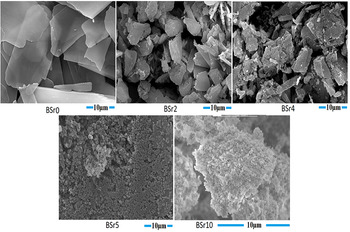
The XRD trace corresponding to the brushite powder BSr0 confirmed that the sample is crystalline and is composed of pure brushite with a monoclinic structure. The BSr0 brushite crystals were grown in proportion to the three major planes, namely (020), (121) and (141). The high-intensity XRD peak at 11.68°2θ intensity (Fig. 2) indicates that the crystal growth is mainly along the (020) crystallographic plane (Rokita et al., Reference Rokita, Hermes, Nolting and Ryczek1993). The BSr0 brushite powder consisted of large, platy crystals, as observed by SEM (Fig. 3) (Suguna & Sekar, Reference Suguna and Sekar2011). These platy crystals were very thin (~200 nm), but their width and elongation were ~10 μm and 20 μm, respectively (Tadier et al., Reference Tadier, Bareille, Siadous, Marsan, Charvillat and Cazalbou2012). The platy morphology is typical of precipitated brushite (Schmacher & Gelinsky, Reference Schumacher and Gelinsky2015; Kruppke et al., Reference Kruppke, Heinemann, Gebert, Rohnke, Weiß and Henß2020).
SEM images of the (CaxSr(1–x))HPO4.nH2O powders.

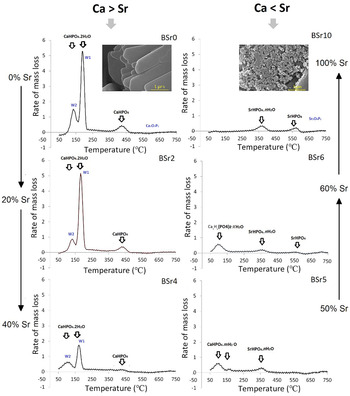
Brushite is classified as a water-bearing phosphate (Sayahi et al., Reference Sayahi, Santos, El-Feki, Charvillat, Bosc and Karacan2020); heating BSr0 at a temperature of 800°C leads to the loss of ~22% of its mass (Fig. 4). Consequently, a portion of its chemically bound water is released during transformation (Liu et al., Reference Liu, Ma, Li, Qi, Han and Chen2020), while the remainder of the bound molecules re-phase themselves to form new CaP phases under alkaline conditions (Shyong et al., Reference Shyong, Chang and Lin2018). Replacement by Sr of up to 20% (BSr2) did not lead to a significant change in the mass loss. However, the mass loss decreased significantly (by ~38%) after Sr replacement increased to 40% (BSr4). The decrease in structural water continued with increasing Sr contents, while the main features of the brushite mineral disappeared (Fig. 1).
Cumulative mass loss of the (CaxSr(1–x))HPO4.nH2O powders with heating (TGA analysis).

Brushite features water molecules with hydrogen bonds in its lattice and adsorbed water molecules on its surface (Tortet et al., Reference Tortet, Gavarri and Nihoul1997; Gashti et al., Reference Gashti, Stir and Jurg2016). These water molecules are released in the 80–220°C temperature range, as is indicated by the extensive mass loss (Fig. 5). The crystal structure of brushite contains compact sheets consisting of parallel chains in which Ca ions are coordinated by six P atoms and two O atoms belonging to the water molecules (Alshaaer et al., Reference Alshaaer, Cuypers, Rahier and Wastiels2011). In addition to the adsorbed water molecules on its surface, two slightly different types of water molecules exist in brushite; one (W1) is linked to the phosphate oxygen by strong hydrogen bonds, whereas the other (W2) presents longer and weaker hydrogen bonds (BSr0; Fig. 5) (Tortet et al., Reference Tortet, Gavarri and Nihoul1997; Suguna & Sekar, Reference Suguna and Sekar2011). The corresponding dehydration peaks of the two water molecules (W1 and W2) are observed in BSr0, BSr2 and BSr4 (Fig. 5). These features of the brushite crystals, with the characteristic presence of two water molecules, disappear with an increase in the Sr replacement to >50% (i.e. in samples BSr5, BSr6 and BSr10; Fig. 5). The removal of the two structural water molecules at 220°C results in the transformation of brushite into monetite (CaHPO4). Monetite decomposes at ~400°C to form calcium pyrophosphate (Ca2O7P2).
Derivative of mass loss of the (CaxSr(1–x))HPO4.nH2O powders as a function of temperature (DTG analysis).

The second phase (Sr/Ca >1)
In the second replacement phase, after replacement of Ca by Sr at >50% (samples BSr5–BSr10), all of the XRD peaks corresponding to brushite diminished (Fig. 2). Moreover, a semi-amorphous phase formed with 50% Sr replacement (BSr5; Fig. 6). The XRD trace of BSr10 (Fig. 6) is consistent with the standard data of β-type SrHPO4 (JCPDS Card No. 12-0368), indicating that the obtained sample had a purely hexagonal crystal structure (Zhuang et al., Reference Zhuang, Tan, Shen, Zhang, Xu and Song2015). The SEM images show that sample BSr10 is composed of nanosheets (Fig. 7). Although the method of preparing the powders is different, there is a noteworthy matching of the results with those from previous studies, particularly the XRD traces (Zhuang et al., Reference Zhuang, Tan, Shen, Zhang, Xu and Song2015).
XRD traces of the second stage of Sr replacement from 50% (BSr5) to 100% (BSr10).

SEM image of SrHPO4 nanosheets (BSr10).

Figure 5 shows the formation of structural water corresponding to SrHPO4 in the second stage of Sr replacement, from 50% to 100%. Three zones of decomposition of (CaxSr1–x)HPO4.nH2O for all of the samples are observed with Sr replacement of ~50% (BSr5). In the first zone, the weight loss results from the removal of surface-adsorbed water molecules and brushite-like crystals. This zone disappeared at 100% Sr replacement (BSr10) with the formation of pure SrHPO4. A significant weight loss for crystals with Sr replacement >40% (BSr5, BSr6 and BSr10) occurred at the second zone between 320°C and 400°C due to the generation of Sr–O–P2O5 (Roming & Feldmann, Reference Roming and Feldmann2008). The degradation of crystals began at 540°C and continued up to 600°C. This decomposition led to the transformation of SrHPO4 into Sr2O4P2.
Elemental and chemical composition
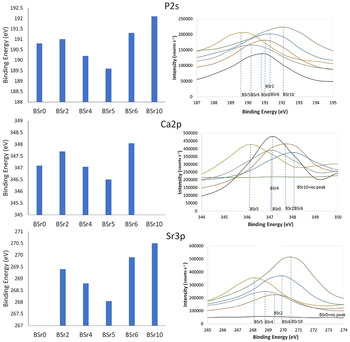
The XPS analysis was used to evaluate the influence of the Sr content on the surface chemistry and chemical state of the elements P, Ca and Sr in the (CaxSr(1–x))HPO4.nH2O powders (Fig. 8). Additional peaks of Sr3p and Sr3d were clearly detectable in the powders with Sr contents (BSr2, BSr4, BSr5, BSr6 and BSr10). With increasing Sr content, from BSr0 up to BSr10, the peak intensities of Sr3d and Sr3p increased gradually and the peaks of Ca2s and Ca2p decreased gradually. No change was detected in the peaks of P2s. The envelopes of the P2p and Sr3d peaks at ~133.6 eV overlapped because of the proximity of the Sr3d and P2p (132–133 eV) lines (He et al., Reference He, Dong and Deng2016). These results confirm that the peak intensities of P, Ca and Sr are comparable to the powder compositions reported in Table 1.
XPS spectra of the (CaxSr(1–x))HPO4.nH2O powders.

The XPS analysis of the chemical state of the elements (P2s, Ca2p and Sr3p) in the (CaxSr(1–x))HPO4.nH2O powders is shown in Fig. 9. The binding energies of P2s, Ca2p and Sr3p exhibit the same trends with increasing Sr content. Replacement of Ca by 20% Sr (sample BSr2) resulted in a slight increase in the binding energies of P2s and Ca2p, from 190.8 to 191.0 eV and from 347.1 eV to 347.7 eV, respectively (Fig. 9). Increasing the Sr content to 40% and 50% (samples BSr4 and BSr5) resulted in decreasing the binding energies of P2, Ca2p and Sr3p. Further increasing the Sr content (samples BSr6 and BSr10) caused an observable increment in the binding energies of the three elements P2, Ca2p and Sr3p. BSr5 represents the inflection point in this ion exchange, which is in good agreement with the XRD and TGA results (Figs 2 & 5).
XPS analysis of the chemical states of the elements (P2s, Ca2p, and Sr3p) in the (CaxSr(1–x))HPO4.nH2O powders.

The XPS results confirmed that Sr was incorporated into the (CaxSr(1–x))HPO4.nH2O lattice. The incorporation of Sr modified the crystal environment of the Ca2p ions, leading to an initial increase in the Ca binding energy. The minimum binding energies of P2s, Ca2p and Sr3p were recorded at the 50% replacement of Ca by Sr. This indicates that the lattice structure was distorted and a semi-amorphous phase was formed (Fig. 2). The lattice was rearranged again when increasing the Sr replacement above the level of 50% and strong chemical binding energies developed, which is in good agreement with the XRD results (Fig. 2).
Mechanism behind the full-scale Sr replacement
The crystal order of the (CaxSr(1–x))HPO4.nH2O system as a function of the Sr molar fraction (analysis carried out on XRD traces using Match! software) is reported in Fig. 10. The crystal order appears to coincide with the previous results (cf. Figs 2 & 3), as increasing the replacement of Sr up to 50% would lead to the formation of a semi-crystalline phase (Fig. 9), yielding a decreased degree of crystal order from 82% to just 15% (Alkhraisat et al., Reference Alkhraisat, Rueda and Cabarcos2011). Increasing the replacement of Ca by Sr to >50% produced crystals of a new compound, which form SrHPO4 nanosheets after the Ca is fully substituted by Sr (Roming & Feldmann, Reference Roming and Feldmann2008; Zhuang et al., Reference Zhuang, Tan, Shen, Zhang, Xu and Song2015). The degree of crystal order increased from 15% up to 55% by increasing the replacement of Ca by Sr from 50% to 100%. The binding energies of Ca, Sr and P (Fig. 9) show trends that are similar to the crystal order.
Qualitative degree of crystal order of the (CaxSr(1–x))HPO4.nH2O mineral system as a function of Sr molar fraction (analysis carried out on XRD traces using the Match! software package).

Long-term stability at ambient conditions
The series BSr0 and BSr2 exhibit the same thermal behaviour after ambient ageing (Fig. 11). The greatest changes in thermal properties and structural water occur during the first 2 months of ageing. In contrast, the structural water of brushite corresponding to the stronger bond (W1) at 210°C increased significantly during this period of ageing (2 months), while the abundance of monetite, with its dehydration peak at 370–470°C, increased significantly for both samples. Increasing the ambient ageing to 20 months barely changed the structural water content. These results confirm that the first 2 months of ageing are most important for the full crystallization of brushite and the formation of stable microstructures.
Effect of ambient ageing on the thermal properties of brushite.

Conclusions
In this work, we investigated the full-scale substitution and replacement of Ca by Sr in the microstructure of the (CaxSr(1–x))HPO4.nH2O system using various analytical techniques. The results obtained show clearly that there are two stages of Sr replacement. In the first stage, from 0% up to 50%, the brushite crystals retain their features.
Replacement of Ca with 50% Sr results in the formation of a semi-amorphous phase. The second stage of Sr replacement (from 50% up to 100%) transformed the brushite into a new crystalline system based on Sr. This is due to the fact that as the Ca content decreases in the system, supersaturation with respect to brushite decreases while it increases with respect to SrHPO4. Finally, full replacement of Ca by Sr in the (CaxSr(1–x))HPO4.nH2O system transforms the brushite crystals into SrHPO4 nanosheets.
The most substantial changes in thermal properties and structural water occur in the first 2 months of ageing, when the structural water of brushite corresponding to the stronger bond (W1) at 210°C increased. These results also confirm that the first 2 months of brushite ageing are vital for the completion of crystallization and to obtain a stable microstructure.