The adaptation of high quality psychological assessment instruments to different languages and countries is relevant for several reasons: it produces good questionnaires, independent of the language and country for which they were designed; it aids global investigation and the collection of extensive samples from different cultures; and it promotes cross-cultural research and facilitates comparative studies using the same scientific language (Dufey, Fernández, & Morgues, Reference Dufey, Fernández and Morgues2011; Groves & Engel, Reference Groves and Engel2007).
The Personality Assessment Inventory (PAI) was designed by Leslie Morey in 1991 to assess personality and psychopathology and was revised in 2007. It is considered one of the most relevant questionnaires in clinical and forensic assessment in the United States (Belter & Piotrowski, Reference Belter and Piotrowski2001; Lally, Reference Lally2003). The PAI’s usefulness as a tool is credited to its accessibility from any educational level, its contemporary conceptualization of diverse diagnoses, and its consideration of treatment-related aspects (Kurtz & Blais, Reference Kurtz and Blais2007).
Adaptations of the PAI
To date, various adaptations of the PAI have been carried out in the United States, Germany, and Greece to produce good and adequate psychometric indexes. In Spain, it was adapted in 2011 by a mixed University-Enterprise team with the collaboration of the Universidad de Malaga, the Universidad Complutense de Madrid, and the TEA Ediciones Enterprise (Ortiz-Tallo, Santamaría, Cardenal, & Sánchez, Reference Ortiz-Tallo, Fierro, Blanca, Cardenal and Sánchez2011). In Chile, the adaptation was concluded in 2012, following the same steps as for the Spanish version and with the same translation and review of the questionnaire (Reference Cancino, Ortiz-Tallo, Santamaría and CardenalCancino, Ortiz-Tallo, Santamaría, & Cardenal, in press).
In Spain, the results obtained by Ortiz-Tallo et al. (Reference Ortiz-Tallo, Fierro, Blanca, Cardenal and Sánchez2011) revealed some differences from the original American sample on the scales of Anxiety (ANX), Paranoia (PAR), Treatment Rejection (RXR) and Warmth (WRM). For the first three scales, the Spanish adaptation sample achieved higher scores than the original American sample. In the case of Warmth, the results were reversed and the Spanish adaptation obtained lower scores than the American sample.
The German adaptation of the PAI (Groves & Engel, Reference Groves and Engel2007) achieved similar results. Higher scores were observed in Anxiety (ANX; Cohen’s d = –0.15), Paranoia (PAR; Cohen’s d = –0.43) and Treatment Rejection (RXR; Cohen’s d = –0.47) and lower scores in Warmth (WRM; Cohen’s d = –0.25) compared with U.S. normative values. The German adaptation also obtained higher scores than the U.S. on the Positive Impression validity scale (PIM; Cohen’s d = –0.38) as well as on the clinical scales of Somatic Complaints (SOM; Cohen’s d = –0.22) and Depression (DEP; Cohen’s d = –0.30).
The internal consistency of the two versions, German and American, showed a similar pattern. Low alphas for the Validity scales and mostly high alphas for Clinical, Treatment, and Interpersonal scales were found in both German and American populations. For some scales, however, differences between the two countries were observed, in particular for Drug problems (DRG), and Treatment Rejection (RXR). Both scales produced smaller alpha coefficients for the German sample (Groves & Engel, Reference Groves and Engel2007).
The Greek adaptation of the PAI obtained similar results (Lyrakos, Reference Lyrakos2011). The comparison of the alpha coefficients between the American and the Greek standardization samples did not present significant differences with the exception of Obsessive-Compulsive (ARD-O), Phobias (ARD-P), Activity Level (MAN-A), Psychotic Experiences (SCZ-P), and Self-Harm (BOR-S), where the reliability was significantly higher in the Greek sample. The subscale Obsessive-Compulsive (ARD-O) obtained the lowest alpha.
Two scales varied greatly from U.S. results. The first one was related to the treatment consideration section, Nonsupport (NON), where the Greeks obtained 16 points lower than the Americans, and the second one was the Warmth (WRM) scale, related to personality traits, which was 10 points lower in the Greek standardization sample compared to the U.S. sample. No values concerning the size of these differences (for example, Cohen’s d) are reported in this study.
Finally, there were also three subscales that showed differences with the Americans: Affective Inestability (BOR-A) where the Greeks obtained a higher result by 8 points, Negative Relationships (BOR-N) where they obtained a lower result by 10 points, and Egocentrity (ANT-E) where their result was lower by 6 points.
Gender differences
The study of sex differences in personality and clinical disorders is considered very important in determining possible cross-cultural influences reflecting idiosyncratic aspects of different countries. Lippa (Reference Lippa2010) analyzed data from men and women of 53 nationalities, by means of the International Personality Item Pool (IPIP); it was found that women scored higher in Extraversion, Warmth, and Neuroticism. Booth and Irwin (Reference Booth and Irwin2011) recently carried out a study and found that men scored lower in Warmth and Sensitivity and higher in Dominance than women.
With regard to personality disorders, histrionic, borderline, and dependent disorders were diagnosed more frequently in women (Johnson et al., Reference Johnson, Shea, Yen, Battle, Zlotnick, Sanislow and Zanarini2003). Men were diagnosed more frequently with antisocial features and antisocial personality disorder (Loinaz, Ortiz-Tallo, & Ferragut, Reference Loinaz, Ortiz-Tallo and Ferragut2012; Loinaz, Ortiz-Tallo, Sánchez, & Ferragut, Reference Loinaz, Ortiz-Tallo, Sánchez and Ferragut2011). Prevalence studies in different countries have found significant inter-sex differences in the ubiquity of personality disorders (Adel, Grimm, Mogge, & Sharp, Reference Adel, Grimm, Mogge and Sharp2006; Furnham & Trickey, Reference Furnham and Trickey2011).
Sex differences are also found in the most frequently studied clinical disorders. On the one hand, there is a consensus in the scientific community that women are more likely than men to develop an anxiety disorder during their lifetime (Angst & Dobler-Mikola, Reference Angst and Dobler-Mikola1985; Bruce et al., Reference Bruce, Yonkers, Otto, Eisen, Weisberg, Pagano and Keller2005; Regier, Narrow, & Rae, Reference Ortiz-Tallo, Santamaría, Cardenal and Sánchez1990). When the diverse anxiety disorders reflected in the Diagnostic and Statistical Manual of Mental Disorders, 5 th edition (DSM-5; American Psychiatric Association, 2003) are specified, sex differences are also consistently obtained across research history in different cultures and nations (Breslau, Davis, Andresky, Peterson, & Schultz, Reference Breslau, Davis, Andreski, Peterson and Schultz1997; McLean, Asnaani, Litz, & Hofmann, Reference McLean, Asnaani, Litz and Hofmann2011). On the other hand, during their entire life span, women also present with more depression; this commonly emerges in adolescence and is maintained throughout adulthood (Cyranoski, Frank, Young, & Shear, Reference Cyranoski, Frank, Young and Shear2000; Sweeting & West, Reference Schmitt, Realo, Voracek and Allik2003). In contrast, alcohol and drug abuse are consistently linked to males, and much less frequently to females (Kessler et al., Reference Kessler, McGonagle, Zhao, Nelson, Hughes, Eshleman and Kendler1994; Ortiz-Tallo, Cardenal, Ferragut, & Cerezo, Reference Ortiz-Tallo, Fierro, Blanca, Cardenal and Sánchez2011).
In some studies with large samples, researchers concluded that women present personality traits that include patterns of surrender, submission, and withdrawal (Cerezo, Ortiz-Tallo, & Cardenal, Reference Cerezo, Ortiz-Tallo and Cardenal2009; Millon & Davis, Reference Millon and Davis1996). In men, patterns of low warmth and low empathy in interrelationships were more frequent (Costa, Terracciano, & McCrae, Reference Costa, Terracciano and McCrae2001; Lippa, Reference Lippa2010; Mestre, Frías, & Samper, Reference Mestre, Frias and Samper2004; Schmitt, Realo, Voracek, & Allik, Reference Sánchez-López, López-García, Dresch and Corbalán2008), and were commonly related to antisocial personality disorder (Cale & Lilienfield, Reference Cale and Lilienfield2002; Ortiz-Tallo et al., Reference Ortiz-Tallo, Fierro, Blanca, Cardenal and Sánchez2011). Such patterns are also congruent with the narcissistic and paranoid profile, which, in turn, is habitually associated with alcohol or substance abuse (Loinaz, Echeburú;a, & Torrubia, Reference Loinaz, Echeburúa and Torrubia2010; Ortiz- Tallo, Fierro, Blanca, Cardenal, & Sá;nchez, Reference Ortiz-Tallo, Cardenal, Ferragut and Cerezo2006).
Hence, many scientific studies have systematically revealed sex differences in some traits and personality disorders as well as in the prevalence of certain clinical disorders. These results have even been found in investigations involving different cultures (Lippa, Reference Lippa2010).
The above-mentioned results are consistent with research on Spanish speaking populations that use personality inventories, such as the Millon Clinical Multiaxial Inventory (MCMI-III; Millon, Davis, & Millon, Reference Millon, Davis and Millon1997). There too, women scored higher in borderline personality traits, depression, anxiety, and post-traumatic stress disorder and significantly lower in antisocial personality traits, drug problems, and thought disorders than men (Ortiz-Tallo et al., Reference Ortiz-Tallo, Fierro, Blanca, Cardenal and Sánchez2011).
Currently, there are no studies that have considered the analysis of gender differences using the PAI. This makes this work a pioneering study and we hope it will be the first of a large series of PAI gender based studies.
This work has the following goals:
Goal 1: To analyze the two standardization samples (Spanish and Chilean) and the differences between them using the PAI scales and subscales.
Goal 2: To study the possible differences in all these variables as a function of the interaction of sex and country (Spain and Chile).
Method
Participants
Table 1 presents the demographic characteristics of each sample (Spanish and Chilean). The collection of both samples was designed to be representative of the adult population in each country. The official population for both countries was consulted, including the corresponding geographic divisions. Age and sex were considered as stratification variables. This was done to ensure a representative sample in each country.
Demographic characteristics of Spanish and Chilean samples (gender, age, marital status, educational level and employment status)

Instrument
We used the Personality Assessment Inventory (PAI; Morey, Reference Morey1991, Reference Morey2007) translated and adapted to Spanish by Ortiz-Tallo, Santamaría, Cardenal, and Sánchez (Reference Ortiz-Tallo, Fierro, Blanca, Cardenal and Sánchez2011) in its entire 344-item version. Items were rated as: TF (totally false), ST (slightly true), MT (mainly true) and VT (very true). These responses provided a raw score that was subsequently transformed into T scores in order to compare them with the normative sample for interpretation.
The PAI was designed to assess personality and psychopathology. The 344 items are distributed in 22 scales: 4 validity scales, 11 clinical scales, 5 treatment-related scales, and 2 scales assessing interpersonal relation styles. In turn, 10 of these scales are made up of 3 or 4 subscales focused on the assessment of more concrete aspects of each construct (Morey, Reference Morey2007). The PAI profile also presents 10 complementary indexes, underlining critical items.
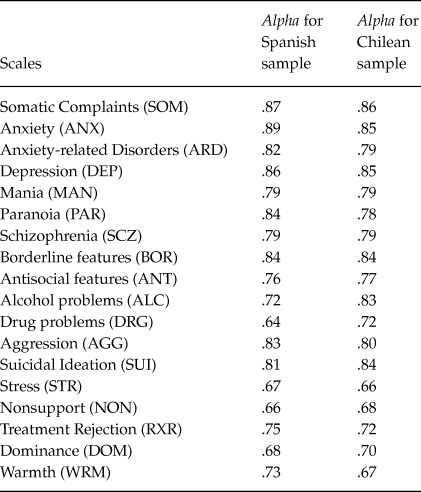
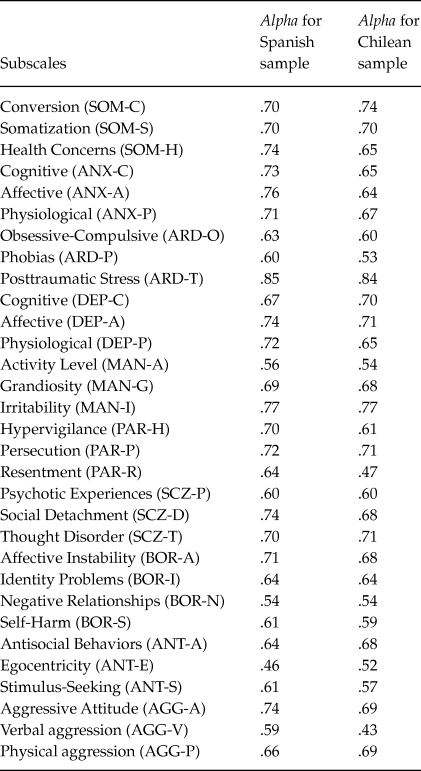
In order to examine internal consistency, alpha coefficients for each scale and subscale in both samples are presented in Tables 2 and 3.
Alpha coefficients for each scale in both samples (Spanish and Chilean)

Alpha coefficients for each subscale in both samples (Spanish and Chilean)

Procedure
Standardization samples should be representative of the target population for each inventory. The collection and classification of both samples, Spanish and Chilean, were designed for this purpose.
Official proportions of regional populations were taken into account when collecting the samples. Age and sex were considered as stratification variables, and information about marital status, educational level, and occupational activity was also collected.
More than 100 psychologists in both countries collaborated on the study, they were previously counseled and trained to collect data and to obtain the results telematically. The psychologists were recruited from different geographical areas of each country to allow easier access to the sample population in each area.
A total of 2435 valid cases from the normal population of the two countries were collected. According to the stratification variables considered, two sets of cases were selected, one of 940 cases from 17 Spanish Autonomous Communities and one of 685 cases from 13 Chilean regions.
Results
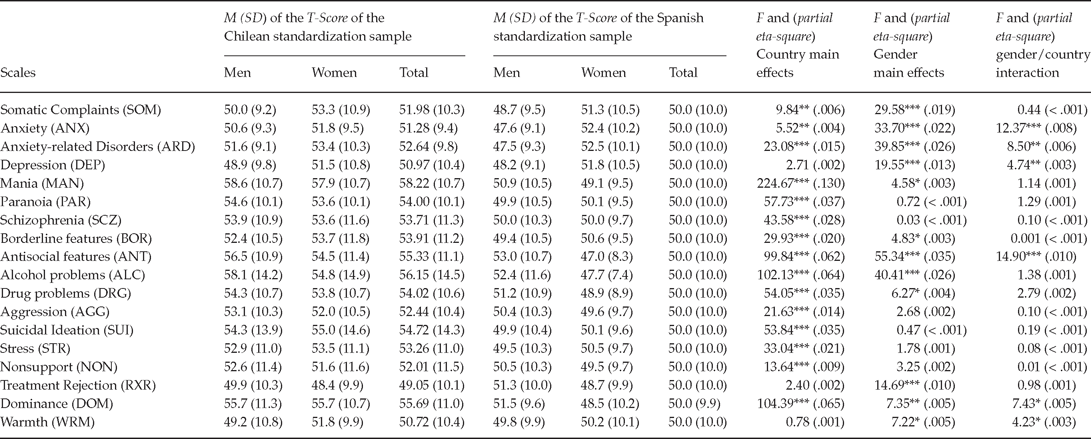
Various 2 x 2 analyses of variance for each dependent variable were applied, using Sex (men and women) and Country (Spain and Chile) as independent variables. The dependent variables were each one of the PAI scales. The confidence level was set at 99.9%. Tables 4 and 5 show the means and standard deviation T-scores obtained by the two standardization samples (Spanish and Chilean), the ANOVA F statistics with its significance, and the effect size (partial eta-square) of the difference in the PAI scales and subscales, both for main effects (Gender and Country) and for the interaction between them.
Means and (Standard Deviations) of the T-Scores in the Scales of Spanish and Chilean samples, ANOVA F statistical and the Magnitude of the Effect Size (partial eta-square) for Country main effects, Gender main effects and Gender/country interaction

Note: *p < .05. **p < .005. ***p < .001.
Means and (Standard Deviations) of the T-Scores in the Subscales of Spanish and Chilean samples, ANOVA F statistical and the Magnitude of the Effect Size (partial eta-square) for Country main effects, Gender main effects and Gender/country interaction

Note: *p < .05. **p < .005. ***p < .001.
Differences between the Spanish and Chilean Standardizations
Main effects between the two samples (Chilean and Spanish) showed statistical differences for many of the scales and subscales. No significant differences were observed between the samples in Depression (DEP), Treatment Rejection (RXR,) and Warmth Scale (WRM) or the subscales of Somatization (SOM-S), Affective Anxiety (ANX-A), Physiological anxiety (ANX-P), Resentment (PAR-R), Affective Instability (BOR-A), and Verbal Aggression (AGG-V). Although significant, some of the differences did not reach the alpha level required, such as Somatic Complaints (SOM), Anxiety (ANX), and the subscales of Conversion (SOM-C), Cognitive Anxiety (ANX-C), Physiological Anxiety (ANX-P), Obsessive-Compulsive (ARD-O), Phobias (ARD-P), Affective Depression (DEP-A), and Identity Problems (BOR-I). In contrast, all the remaining variables showed significant differences at the 0.001 level. The magnitude of the difference in the Mania Scale (MAN) was large, especially in the Grandiosity subscale (MAN-G). Moderate differences were observed in Antisocial Features (ANT), Alcohol Problems (ALC), and Dominance (DOM), as well as in the subscales Activity Level (MAN-A), Hypervigilance (PAR-H), Persecution (PAR-P), Self-Harm (BOR-S) and Egocentricity (ANT-E). In all these scales, the Chileans obtained higher scores than the Spaniards.
Gender differences
Main effects of the difference between men and women showed statistical differences in the general sample (Chilean and Spanish population). With regard to scales, significant differences were found in Somatic Complaints (SOM), Anxiety (ANX), Anxiety-related Disorders (ARD) and Depression (DEP), where women had higher scores. On the other hand, men scored higher in Antisocial features (ANT), Alcohol problems (ALC), and Treatment Rejection (RXR) scales.
For the subscales, women obtained higher scores in all those related to somatic complaints, in all subscales included in anxiety, in all the anxiety-related disorders excepting Obsessive-compulsive subscale (ARD-O), in Physiological depression (DEP-P), and in Identity problems (BOR-I). On the other hand, men scored higher in the subscale Grandiosity (MAN-G), in Social Detachment (SCZ-D), all the subscales included in antisocial features, and in the subscale Physical aggression (AGG-P).
Differences as a Function of Sex and Country
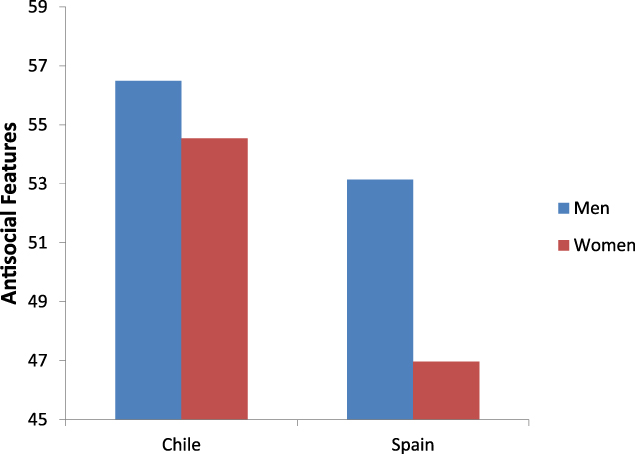
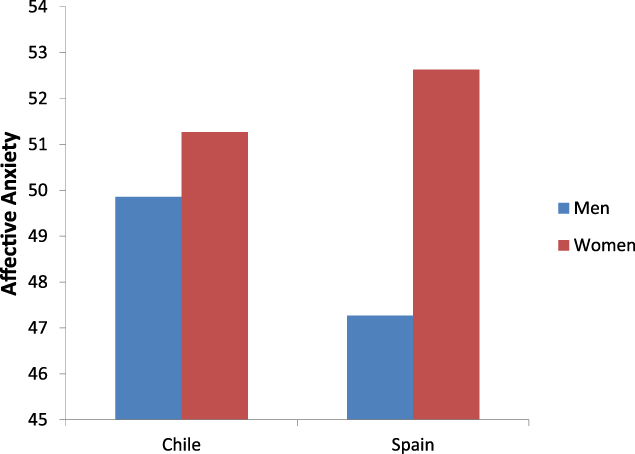
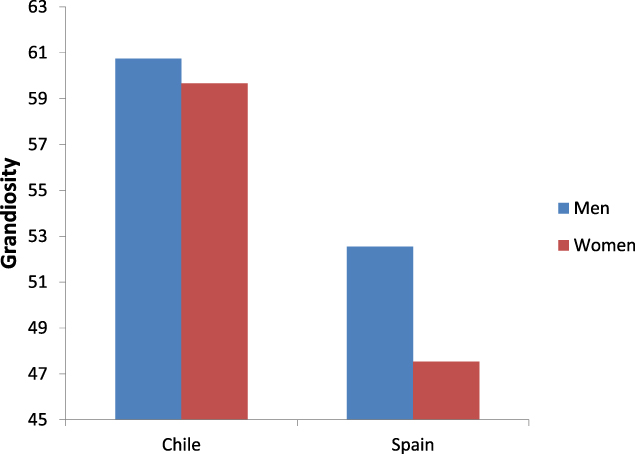
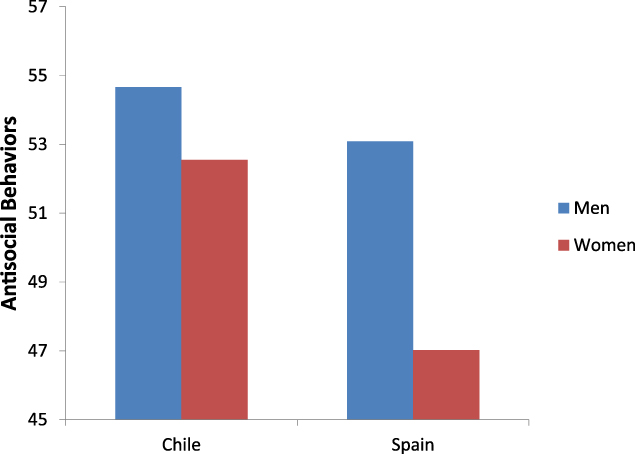
With the confidence level set at 99.9%, the variables that revealed a significant interaction between sex and country were: Anxiety (ANX), F(1, 1505) = 12.36, p < .001, and Antisocial Features (ANT), F(1, 1505) = 14.90, p < .001, and the subscales of Affective Anxiety (ANX-A), F(1, 1505) = 15.48, p < .001, Grandiosity (MAN-G), F(1, 1505) = 12.97, p < .001, and Antisocial Behaviors (ANT-A), F(1, 1505) = 13.31, p < .001.
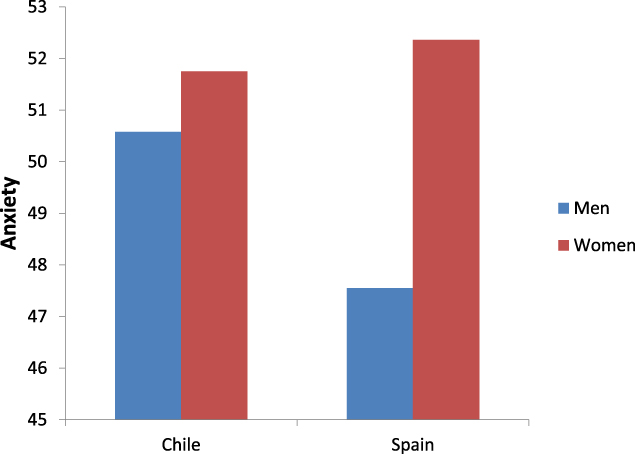
For the variable Anxiety (ANX), as shown in Figure 1, we found sex differences in the Spanish sample, F(1, 1505) = 58.45, p < .001, with Spanish women scoring higher than men (M = 52.36 and M = 47.55, respectively). This was not observed for Chilean women. However, for males, there were differences between Spaniards and Chileans, F(1, 1505) = 31.13, p < .001, with Chilean men (M = 50.57) scoring higher than Spanish men. This difference was not found between the women of the two countries.
Two-factor analysis of variance (Sex and Country) of the Anxiety Scale.

With regard to the Antisocial Features scale (ANT), there were inter-sex differences in the Spanish sample, F(1, 1505) = 88.73 p < .001, where Spanish men scored higher than women (M = 53.14 and M = 46.97, respectively). This was not observed with Chilean men. With regard to country, Chilean men and women (M = 56.49 and M = 54.54, respectively) both scored higher than Spanish men and women, F(1, 1505) = 3.87, p < .001 and F(1, 1505) = 128.51, p < .001, respectively, for men and women. These results can be seen in Figure 2.
Two-factor analysis of variance (Sex and Country) of the Antisocial Features Scale.

With regard to the Affective Anxiety subscale (ANX-A), as shown in Figure 3, there were sex differences in the Spanish sample, F(1, 1505) = 76.96, p < .001, where women presented higher levels than men (M = 52.63 and M = 47.26, respectively for women and men), but such sex differences were not observed in the Chilean sample. With regard to country, there were differences between Spanish and Chilean men, F(1, 1505) = 28.82, p < .001, with Chilean men scoring higher (M = 49.86) than Spanish men. There were also significant differences among the women of the two countries, F(1, 1505) = 8.99, p < .001, with Spanish women scoring higher than Chilean women (M = 51.26).
Two-factor analysis of variance (Sex and Country) of the Affective Anxiety subscale.

Figure 4 shows the results of the Grandiosity subscale (MAN-G), which yielded sex differences in the Spanish sample, F(1, 1505) = 60.67, p < .001, where men presented higher levels than women (M = 52.55 and M = 47.54, respectively). This did not occur in the Chilean sample. With regard to country, Chilean men and women (M = 60.74 and M = 59.66, respectively) both scored higher than Spanish men and women, F(1, 1505) = 70.40, p < .001 and F(1, 1505) = 299.79, p < .001, respectively, for men and women.
Two-factor analysis of variance (Sex and Country) of the Grandiosity subscale.

Lastly, with regard to the Antisocial Behaviors subscale (ANT-A), there were sex differences in the Spanish sample, F(1, 1505) = 86.43 p < .001, with men scoring higher than women (M = 53.09 and M = 47.02, respectively). This did not occur in the Chilean sample. With regard to country, there were differences between the Spanish and Chilean women, F(1, 1505) = 74.41, p < .001, with Chilean women (M = 52.55) obtaining higher scores than Spanish women. No significant differences were found among the men of the two countries. These data are given in Figure 5.
Two-factor analysis of variance (Sex and Country) of the Antisocial Behaviors subscale.

Discussion
The goal of this study was to analyze the differences between two Spanish-speaking countries (in this case Spain and Chile) in clinical and personality variables assessed by means of the PAI, taking into account the influence of sex in the two cultures.
Differences between the Spanish and Chilean Standardizations
With regard to the two standardization samples, the Chilean sample presented higher scores in most of the scales, specifically, in the Grandiosity subscale of the Mania Scale, with a large effect size of the differences. Differences of a moderate magnitude were also observed in Antisocial Features, Alcohol Problems, Drug Problems, Suicidal Ideation, and Dominance, as well as in the subscales Activity level, Irritability, Hypervigilance, Persecution, Psychotic Experiences, Self-Harm, and Egocentricity, with the Chilean participants always scoring higher. We reiterate that these scores were collected from a normal sample (means of T-scores between 50 and 60, which indicate normal scores).
In view of these results, it is important for Chile to have its own standardization of the PAI, so that the comparison of the Chilean results will be congruent with their social and psychological reality, which is different from the Spanish one. This is an important conclusion; although both countries are Spanish-speaking, it would be very important for each country to have a different adaptation of the PAI.
Gender Differences
Starting with the main effects of the differences between men and women, results showed statistical differences in the general sample in both the Chilean and Spanish populations. Women presented more scores in Somatic Complaints, Anxiety, Phobias, Post-traumatic stress disorder, and Depression (especially in physiological symptoms). They also presented higher scores in identity problems, a feature related to borderline personality. Despite these scores not indicate clinical features, these results are in line with previous studies that analyzed clinical syndromes and personality traits using other questionnaires in Spanish-speaking populations (Ortiz-Tallo et al., Reference Ortiz-Tallo, Fierro, Blanca, Cardenal and Sánchez2011); they are also congruent with the prevalence rates presented in the Diagnostic and Statistical Manual of Mental Disorders, 5th edition (DSM-5; American Psychiatric Association, 2003).
Men presented more score in Antisocial features (antisocial behaviors and stimulus-seeking) and consistently, more Physical aggression and Alcohol problems than women. They also scored higher in Grandiosity and Social Detachment. Men tended to reject treatment significantly more than women, and they seemed to be less interested in making psychological changes. These scores were considered non-clinical features, although they were differences that show a tendency in men compared to women. This result is congruent with international studies since the first research was performed using this inventory (Morey, Reference Morey1991). Previous studies with clinical populations have shown in Spanish-speaking people that men are diagnosed more frequently with antisocial features and antisocial personality disorder (Loinaz, Ortiz-Tallo, & Ferragut, Reference Loinaz, Ortiz-Tallo and Ferragut2012; Loinaz et al., Reference Loinaz, Ortiz-Tallo, Sánchez and Ferragut2011) and they are more readily associated with the probability of alcohol abuse (Loinaz, Echeburúa, & Torrubia, Reference Loinaz, Echeburúa and Torrubia2010; Ortiz- Tallo et al., Reference Ortiz-Tallo, Cardenal, Ferragut and Cerezo2006).
Differences as a Function of Sex and Country
Concerning the second goal of this study, the differences as a function of the interaction of sex and country (Spain and Chile), we emphasize that all the significant sex differences observed in the ANOVA of the Sex x Country interaction were found in the Spanish sample. However, when comparing the Spanish sample with the Chilean sample, Chilean men and women seemed to have more similar scores; that is, there were no statistically significant sex differences in the Chileans. In this sense, as expected, Spanish women scored significantly higher than men on the Anxiety Scale and the Affective Anxiety subscale, corroborating the results of other works (Costa et al., Reference Costa, Terracciano and McCrae2001; Ortiz-Tallo et al., Reference Ortiz-Tallo, Fierro, Blanca, Cardenal and Sánchez2011; Sánchez-López, López-García, Dresch, & Corbalán, Reference Regier, Narrow and Rae2008; Schmitt et al., Reference Sánchez-López, López-García, Dresch and Corbalán2008).
Spanish men, however, presented more Antisocial Feature scores on the general scale; that is, they displayed higher levels of antisocial tendencies than women. These personality traits, as well as antisocial personality disorder, have been extensively investigated and related to males (American Psychiatric Association, 1994), and there are notable differences when compared with females (Cale & Lilienfield, Reference Cale and Lilienfield2002; Ortiz-Tallo et al., Reference Ortiz-Tallo, Fierro, Blanca, Cardenal and Sánchez2011).
Spanish men also obtained noteworthy scores on the Grandiosity Scale, where high scores reflected egocentricity, excessive self-confidence, and narcissism. This may be related to previous studies that have always found lower scores for men in variables concerning relations with others, such as warmth, cordiality (Costa et al., Reference Costa, Terracciano and McCrae2001; Schmitt et al., Reference Sánchez-López, López-García, Dresch and Corbalán2008), and empathy (Mestre et al., Reference Mestre, Frias and Samper2004).
Thus, in the Spanish sample, the sex differences found by most prior research were replicated both in personality traits (Adel et al., Reference Adel, Grimm, Mogge and Sharp2006; Booth & Irwin, Reference Booth and Irwin2011; Cale & Lilienfield, Reference Cale and Lilienfield2002; Carrillo, Rojo, & Staats, Reference Carrillo, Rojo and Staats2003; Costa et al., Reference Costa, Terracciano and McCrae2001; Johnson et al., Reference Johnson, Shea, Yen, Battle, Zlotnick, Sanislow and Zanarini2003; Lippa, Reference Lippa2010; Schmitt et al., Reference Sánchez-López, López-García, Dresch and Corbalán2008) and in clinical disorders (American Psychiatric Association, 1994; Ortiz-Tallo, Cardenal et al., Reference Ortiz-Tallo, Fierro, Blanca, Cardenal and Sánchez2011). In this investigation, we used a demanding level of significance (p < .001), because we applied this technique simultaneously to various scales, which could affect the level of error. It is noted that, at the habitual confidence level of 95%, differences are found in more scales than those targeted in this investigation.
With regard to the differences between countries as a function of sex, except for the variable antisocial behaviors, we observed differences between the men of both countries in all remaining variables; significant Country x Sex interactions were found. Chilean men always presented higher scores in all the variables (Anxiety, Antisocial Features, Grandiosity, and Affective Anxiety) in comparison with Spanish men. Among the women, Chilean women also presented higher scores than Spanish women in Antisocial Features, Grandiosity, and Antisocial Behaviors, whereas Spanish women presented more Affective Anxiety than Chilean women, although there were no differences on the general Anxiety Scale.
In the cross-cultural studies on sex differences analyzed by Lippa (Reference Lippa2010), the differences correlated with social variables such as economic development or women’s inclusion in the labor market. Our results, in which a lower inter-sex difference was found in Chile, encourage the analysis in future studies of other variables that could be related to sex differences in different countries. Nevertheless, other investigations in Chile on clinical variables, such as post-traumatic stress, borderline personality, and somatization found sex differences, with the women obtaining higher scores than men (Florenzano et al., Reference Florenzano, Weil, Acuña, Fullerto, Cruz, Muñiz and Leighton2002; Zlotnick et al., Reference Sweeting and West2006).
This study had several limitations that should be taken into account. First, the results did not reveal the possible causes of the differences in personality and clinical variables between the two countries. The samples were from the normal normative population, and the t-scores were not clinically significant. In this sense, the results did not reveal differences in these variables in a clinical population. Future studies might consider adding other variables of interest, such as social variables. This would allow the consideration of possible causes of differences between countries. A study with clinical samples would also complete these findings and strengthen the validity of this investigation. It would be interesting to measure these variables with different tests, thereby providing external validity. More research is needed to continue to extend the investigation with cross-cultural studies in order to assess sex differences, differential profiles, and psychological well-being in diverse Spanish-speaking countries.
In this study, an exigent level of significance (p < .001) was used to combat any possible experimental error. This was used because of the application of the ANOVA technique simultaneously to various scales. Although statistical differences were discussed, these differences were not of great magnitude. Future research could provide more profound results and information.
Although this study identifies normative differences across cultures and sex, such average-level differences do not provide information about other important aspects of differential test functioning across samples. The item response theory could be useful for such analyses in future research.