Introduction
Unlike prey consumed by predators, parasitized hosts remain in the habitat and may be reencountered by parasitoids. Thus, parasitoid females in a competitive scenario face patches that have already been exploited by other females, i.e. patches containing a certain proportion of parasitized hosts. These hosts are of low quality for solitary parasitoids since, by definition, in solitary species only one individual per host can emerge. Accordingly, when the parasitoid female, with the capacity to discriminate between parasitized and non-parasitized hosts, encounters a parasitized host, she can either reject it or accept it according to a number of circumstances (van Alphen & Nell, Reference van Alphen and Nell1982). Generally, acceptance corresponds to leaving a supplementary egg or clutch of eggs, in or on the host, i.e. superparasitsm (van Lenteren, Reference van Lenteren, Nordlund, Jones and Lewis1981). This often leads to intense competition among larvae sharing the same host (van Dijken & Waage, Reference van Dijken and Waage1987; van Alphen & Jervis, Reference van Alphen, Jervis, Jervis and Kidd1996; González et al., Reference González, Montoya, Perez-Lachaud, Cancino and Liedo2007) and only one of them finally survives, which is a common phenomenon in nature (van Lenteren, Reference van Lenteren, Nordlund, Jones and Lewis1981; Bakker et al., Reference Bakker, Peulet and Visser1990; González et al., Reference González, Montoya, Perez-Lachaud, Cancino and Liedo2007). For many years, the occurrence of superparasitism in solitary parasitoids has been considered a somewhat non-adaptive type of behaviour, resulting from discrimination errors (van Lenteren, Reference van Lenteren, Nordlund, Jones and Lewis1981). The fact that only a single individual emerges per parasitized host in solitary parasitoids (in this type of parasitism supernumerary individuals are eliminated during larval competition (Salt, Reference Salt1961)) means that superparasitism has been viewed even as maladaptive in the past. Superparasitism becomes an advantageous (adaptive) strategy when the potential benefits are high, i.e. when there is a high risk that a single egg deposited in the host will fail to develop and, hence, the presence of two or more eggs increases the probability of offspring survival (Rosenheim & Hongkham, Reference Rosenheim and Hongkham1996). In superparasitism, additional and highly influential parameters are those concerning the time between ovipositions and the gender of the first egg (Lebreton et al., Reference Lebreton, Labarussias, Chevrier and Darrouzet2009, Reference Lebreton, Christidès, Bagnères, Chevrier and Darrouzet2010a,Reference Lebreton, Chevrier and Darrouzetb).
Superparasitism can be classified as self-superparasitism when a female lays an egg inside or on a host already parasitized by herself, or conspecific superparasitism when she lays an egg inside or on a host already parasitized by a conspecific female (Waage, Reference Waage, Waage and Greathead1986; van Alphen & Visser, Reference van Alphen and Visser1990; Darrouzet et al., Reference Darrouzet, Bignon and Chevrier2007). These two types of superparasitism may affect the extent to which females are efficient as biological control agents, as well as affecting production in laboratory breeding.
Spalangia cameroni (Hymenoptera, Pteromalidae) is a solitary primary ectoparasitoid of the pupae of various dipteran pests (Tormos et al., Reference Tormos, Beitia, Böckmann and Asís2009). To oviposit, a female drills through the fly's pupal case (the puparium) with her ovipositor and lays an egg on the pupa within. Although sometimes more than one offspring is laid on a given host (by one or more than one female), S. cameroni is described as a solitary species because generally only one offspring develops on each host (Rueda & Axtell, Reference Rueda and Axtell1985; King, Reference King1988). The females of this species use their ovipositor to differentiate between unparasitized and parasitized hosts, preferring the former (Wylie, Reference Wylie1972). Nevertheless, under laboratory conditions this species shows a certain trend towards superparasitism, including self-superparasitism, even when non-parasitized hosts are present in abundance (Alonso, Reference Alonso2009). In any case, only one individual emerges from each host. The elimination of supernumerary parasites (eggs or larvae) is usually performed by the first-hatched larva (Wylie, Reference Wylie1965; Gerling & Legner, Reference Gerling and Legner1968). Therefore, only a 2nd or 3rd instar larva is present per host (Gerling & Legner, Reference Gerling and Legner1968).
Currently, S. cameroni is one of the parasitoids most widely used for the biological control of dipteran species that are harmful in the intensive (confined) production of livestock and birds (Cranshaw et al., Reference Cranshaw, Sclar and Cooper1996). In this respect, it is being used in American, European and Australian countries in overflowing/inundative releases, sometimes reaching parasitism rates of 40% (Steenberg et al., Reference Steenberg, Skovgàrd and Kalsbeek2001; Geden & Hogsette, Reference Geden and Hogsette2006). In Spain, this species has been bred since 2003 in the laboratory using medfly (Ceratitis capitata (Diptera. Tephritidae)) pupae as hosts with a view to testing its usefulness as a biological weapon against this pest (Tormos et al., Reference Tormos, Beitia, Böckmann and Asís2009).
In massive and laboratory production, it has been observed that many hosts suffer superparasitism without any apparent repercussions on the quality of the adult parasitoids. In this study on S. cameroni, we set out to determine whether the lack of apparent repercussions of superparasitism on the quality of adult parasitoids could be verified. Our objectives in this work were: (i) to determine the frequency of superparasitism under laboratory rearing conditions, (ii) to evaluate the effects of different levels of superparasitism on the quality and performance of parasitoids produced under laboratory conditions, and (iii) to discuss the implications of this superparasitism in the context of laboratory rearing.
Materials and methods
Study centre and insectsFootnote 1
This study was carried out at the Valencian Institute of Agrarian Research (Instituto Valenciano de Investigaciones Agrarias (IVIA), Valencia, Spain). To perform the experiments, pupae of medfly C. capitata parasitized by S. cameroni were randomly obtained during 2006–09 following the regular rearing process carried out at that Institute. At the IVIA, the medfly and its parasitoid, S. cameroni have been reared in a laboratory regime for more than four years. The laboratory conditions were 21–24°C, RH 55–80% and a 16:8 (L:D) photoperiod.
The rearing process followed at the IVIA facility for C. capitata and S. cameroni has been described by Pérez-Hinarejos & Beitia (Reference Pérez-Hinarejos and Beitia2008). S. cameroni was reared on 2 to 5-day-old pupae of C. capitata, ten pupae per parasitoid female were offered every 48 h. This ratio was decided because it provides a good rate at which S. cameroni can efficiently kill pupae, also optimizing the number of parasitized pupae, the number of eggs laid and the offspring produced (E. Boeckmann, personal communication). Each rearing cage housed around 600 parasitoids (300 females and 300 males) and every three days 50 females and 50 males were added to the cage. The sex ratio was 1:1. Since the beginning of this study, some 6000 pupae have been offered every two days. The parasitism obtained ranges between 32 and 47%, the proportion of emerging females varying between 52 and 65%. Adult longevity, fecundity, fertility and killed pupae, were, respectively: 18–20 days, 22–24 eggs per female, 13–15 individuals per female and 12–15 pupae per female.
Quality control parameters studied
Following González et al. (Reference González, Montoya, Perez-Lachaud, Cancino and Liedo2007), who have recently studied aspects of the massive rearing of another parasitoid of C. capitata, namely Diachasmimorpha longicaudata (Hymenoptera, Braconidae), five quality control parameters were chosen to assess the effects of superparasitism on laboratory reared S. cameroni: (i)% emergence, (ii) sex-ratio, (iii) ‘emergence ability from soil’, (iv) longevity, and (v) fertility. Although superparasitism could affect the rate of development, emergence indicates practically how superparasitism influences immature development and egg-to-adult survival. Use of soil as a substrate is important, because medfly normally pupates several (4–5) centimetres below the soil surface.
‘Emergence ability from soil’ was considered as an indicator of possible adult damage as a consequence of superparasitism. Adult longevity was taken as an indicator of survival capacity, either with water and food, with water only, or under starvation conditions. Fertility, expressed as the number of female offspring per female per day, was used to infer the reproductive capacity of the emerged parasitoids.
Frequency of superparasitism levels in the laboratory rearing process
To estimate the frequency of superparasitism (number of eggs per host parasitized), we first established an estimation method. The method involved determining, from the ‘marks’ in the puparium (discoloured and dark sites, oviposition holes, etc., henceforth referred to as ‘ovip holes’), the degree of superparasitism. Thus, from a sample of 6000 pupae of C. capitata exposed for 48 h to S. cameroni in five different periods (replicates), a total of 425 pupae (85 pupae per replicate) showing between one and 17 ‘ovip holes’ were separated, specifically, 25 for each ‘number of ovip holes’. Once the number of ‘ovip holes’ on each host had been determined under a stereomicroscope, the pupae were opened under the microscope in order to determine the number of eggs of the parasitoid present in each case (degree of parasitism). At the same time that the attacked pupae were being dissected, pupae from the same sample exposed to the parasitoid, but that did not show signs of having been attacked, were also dissected. No parasitoid eggs were observed in any of the latter. Because the pupae could not be separated and opened on the same day, once they had been separated they were placed in a climatic chamber at a temperature of 4–6°C (to prevent egg development) and dissected the following days.
To estimate the frequency of different levels of superparasitism in the laboratory rearing, a random sample of parasitized pupae of C. capitata (72 h after exposure to parasitoids) was collected from different production batches. In all, 1700 pupae with different degrees of parasitism were obtained (showing between one and 17 ‘ovip holes’).
Emergence and sex ratio
After recording the number of ‘ovip holes’, of the 1700 pupae indicated in the previous heading, the individual pupae were separated and placed according to the number of ‘ovip holes’ in individual plastic boxes (20×15×10 cm) with a cloth-covered window in the lid. The boxes were placed in the climatic chamber under the environmental conditions described above to await the emergence of the parasitoids. Some 28–35 days later, adult parasitoids emerged and these individuals were used to estimate the emergence proportion and sex ratio.
The pupae separated to obtain the frequency of superparasitism were also used to determine the relationship between the level of superparasitism and adult parasitoid emergence and sex ratio (number females/(number males+females)). The number of emerged adults and their sex was recorded over eight days. A total of 1700 pupae were observed. The non-emerged pupae were dissected under the stereomicroscope to check for the presence of immature parasitoids. In this latter case, of the 150 pupae opened, 81 female and 69 male parasitoid pupae were obtained.
Emergence ability from the soil
To evaluate the emergence ability from the soil of the parasitoids, as a function of superparasitism, parasitized pupae were divided into three groups. Group 1 (low) contained pupae with 1–5 ‘ovip holes’, which had 86–92% parasitoid emergence. Group 2 (medium) contained pupae with 6–11 ‘ovip holes’, which had 35–75% emergence. Group 3 (high) contained pupae with 12–17 ‘ovip holes’ had 0–44% emergence. The constitution of the groups was due to the high proportion of abortions (no wasp emerged) shown by the pupae with a high number of ‘ovip holes’. The separation into the three groups proposed was because the pupae are grouped, as a function of superparasitism, into those three classes. Additionally, the pupae were covered with three types of substrate (sand, clay and peat), responding to different soil types with different degrees of penetrability. Penetrability was measured with a penetrometer, which indicates the pressure exerted by the substrate on something buried in it in kg cm−2 at the site of substrate collection. Values for the three substrates were: (i) sandy: 0.90 kg cm−2, (ii) clay: 3.70 kg cm−2, and (iii) peat: 0.12 kg cm−2. Samples of 200 pupae for each group (number of ‘ovip holes’ and soil type) were used. Ten replicates were performed within each group. Each subgroup of 20 pupae was placed inside 15 cm diameter×15 cm high PVC tubes covered with substrate to a depth of about 10 cm. The tubes belonging to each group of pupae were placed inside a 30×80×60 cm cage with a muslin lid and a light bulb (75W) 60 cm above the top of the cage. The adult parasitoids that left the PVC tubes were aspirated every day. After 35 days, the numbers of empty puparium cases and dead adult parasitoids inside each tube were recorded and the percentage of emerged parasitoids (emergence ability from the soil) was estimated by the difference.
Size of females
The size of females was measured by head width, which in S. cameroni is positively correlated with other body size measurements (King, Reference King1988), but is a more reliable indicator of size than weight or abdomen width when females have access to food (Hurlbutt, Reference Hurlbutt1987). The head width of the wasps was measured from a frontal view using a binocular microscope. Each measurement was made twice and averaged. For microscopic examination, the females were prepared following the methodology reported by Docavo et al. (Reference Docavo, Tormos and Fischer2007). In all, 150 randomly selected females were measured, 50 from each of the three groups of pupae established as a function of the number of ‘ovip holes’, with a view to assessing the influence of superparasitism on female size.
Longevity and survival
Female survival was evaluated throughout their life-span under three conditions: (i) with food (honey and sugar) and water, (ii) without food and water, and (iii) only with water. Nevertheless, we have to take into account that the females of S. cameroni host feed; and, therefore, they obtained food and liquids through the host in addition to food given. In all three cases, 50 parasitoid adults were confined in a plastic cage (30×20×20 cm) with ventilation, and offered ten 2 to 5-day-old pupae per female three times per week. Newly emerged females, coming from pupae with a known number of ‘ovip holes’, were placed in 20×20×20 cm plastic cages on the basis of the groups to which they had been allocated. A total of 450 females, 50 from each group created as a function of superparasitism (number of ‘ovip holes’: 1–5, 6–11 and 12–17), were observed with and without food and only with water, respectively. The number of dead females was recorded daily.
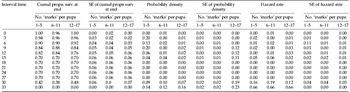
Additionally, in the first case (i), above, 50 females from each pupal group were marked in order to estimate the probability of female survival. In all, 150 females were marked with Unipaint markers (Mitsubishi Pencil Co), colouring the body of the wasps sufficiently for their identification. The marking was carried out by holding the wasps with tweezers under a magnifying glass, like those used on drafting tables. The aim of this was to be able to identify and follow-up the specimens, and evaluate their survival in the box where the laboratory rearing was being carried out. Survival was analyzed every three days. The ‘survival functions’, mentioned in the results section, derive from the descriptive information concerning the time course observations on survival. In this regard, the following were quantified: (i) interval start time (periods of observation, in this case every three days); (ii) number of entries per interval (number of survivors observed per interval); (iii) number of events (number of deaths observed); (iv) proportion of events (proportion of individuals dying in each interval); and (v) survival rate (proportion of individuals surviving in each interval). As mentioned in the ‘Statistical analysis’ section, the Kapplan-Meier method was followed to obtain the survival function. The different groups were compared using the D statistic, obtained from the survival scores by using the Lee and Desu algorithm.
Fertility
Fertility was determined for the females with food (honey and sugar) and water supply. For each category of superparasitism (low, medium, high), 50 male and 50 female parasitoids were released into a plastic box (400×20×20 cm) with a cloth-covered window in the lid. In these boxes, ten pupae of C. capitata were provided per female every 48 h until all females died. After an exposure of 24 h, the pupae were separated and placed in ventilated plastic containers (20×15×10 cm) awaiting the emergence of the parasitoid adults. Fertility was estimated as the number of female offspring emerged per female throughout their life-span.
Statistical analysis
Frequency analysis of superparasitism was performed using the number of ‘ovip holes’ per pupa. A simple linear regression analysis was used to show that the pupae, with respect to the number of ‘ovip holes’ per pupa and superparasitism, were distributed in three groups; subsequently, one-way factorial ANOVA with an additional Tukey HSD test was used to test the effect of the number of ‘ovip holes’ on the number of parasitoid eggs per host pupa. The data on adult emergence and sex ratio were processed with linear regression and a chi-square, respectively. Differences in the ‘emergence ability from the soil’, and longevity and fertility, were calculated by factorial ANOVA followed by Tukey's HSD test. In the first case, the data were normalized by log10 transformation prior to analysis. The survival analysis was performed according to the method of Klapan-Meier. Differences between the means of head size were tested with the Student's t-test (after verifying the homogeneity of variances with the F-test). All analyses were performed using the SPSS statistical package (12.0).
Results
Relationship between the number of ‘ovip holes’ per pupa and superparasitism
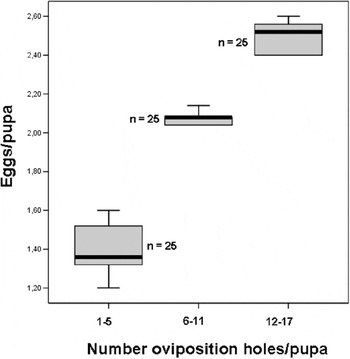
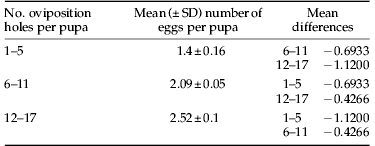
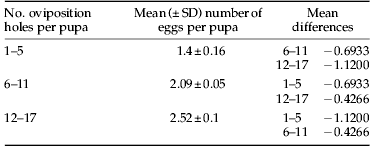
A linear regression analysis revealed a significant regression between the number of ‘ovip holes’ and the number of eggs per pupa (F=177.11, df 1, 15, P<0.001), and it was possible to separate all pupae into three groups (fig. 1), which facilitated subsequent experiments. A subsequent one-way factorial ANOVA revealed significant effects of the number of ‘ovip holes’ on the superparasitism (F=143.19, df 2, 14, P<0.001). An additional Tukey's HSD test revealed significant differences at the 95% confidence level between the pairs of means of three well-differentiated pupae groups (fig. 2 and table 1).
Relationship between the number of ‘marks’ (oviposition holes) per pupa of C. capitata and number of eggs per pupa in S. cameroni among parasitized hosts; i.e. excluding hosts without ovip holes, which had no eggs (number of oviposition holes per pupa: 1, 1–5; 2, 6–1; 3, 12–17); 1, 1–5 oviposition holes per pupa (1.2–1.6 eggs per pupa); 2, 6–11 oviposition holes per pupa (2.04–2.16 eggs per pupa); 3, 12–17 oviposition holes per pupa (2.40–2.64 eggs per pupa)) ( , 1,00;
 , 2,00;
 , 3,00).

Boxplot depicting the box diagrams representing the median, quartiles and superior and inferior whiskers of the number of eggs per pupa (superparasitism) as a function of the number of oviposition holes per pupa. No outliers are seen in any case.

S. cameroni: eggs per pupa as a function of the number of oviposition holes (means obtained from five replicates).
Frequency of superparasitism in the laboratory rearing process
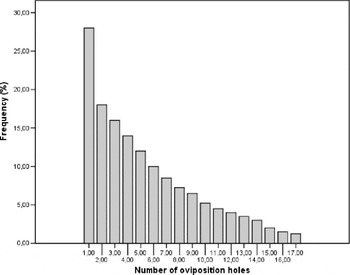
Of the 1700 pupae observed, 28% showed a single ‘ovip hole’ (fig. 3). The mean (±SD) number of ‘ovip holes’ per pupa was 2.8±3.4, this number corresponds to 2.04±0.47 eggs per pupa. The maximum number of ‘ovip holes’ per pupa was 17 (1.25%).
Frequency of number of ‘marks’ (oviposition holes) per pupa of C. capitata in laboratory rearing of S. cameroni.

Adult emergence and sex ratio
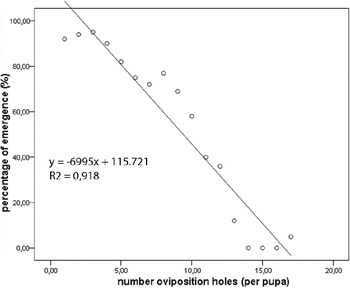
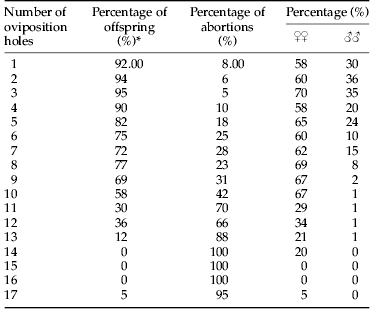
There was a significant negative regression between the number of ‘ovip holes’ per pupa and adult parasitoid emergence (F=167.92, df 1,15, P<0.001) (fig. 4). The greatest percentage of emergence was recorded from pupae with fewest (one to three) ‘ovip holes’. There was also a significant effect of the number of ‘ovip holes’ per pupa on the sex ratio (emergency of female or male) (χ2=25.03, df 16, P<0.001). As the number of ‘ovip holes’ per pupae increased, the probability of the emergence of females increased (fig. 5), although the overall adult emergence generally decreased (table 2a, b).
Relationship between the number of ‘marks’ (oviposition holes) per pupa of C. capitata and the percentage of emergence in S. cameroni.

(a) Age-specific survival with food, (b) without food, and (c) with water only in S. cameroni females that emerged from hosts with different levels of superparasitism ( , 1–5 oviposition holes;
 , 6–11 oviposition holes;
 , 12–17 oviposition holes).

Percentage of emergence (i.e. percent of parasitized hosts from which a parasitoid emerged), abortions and sex ratio of S. cameroni from pupae with different numbers of oviposition holes.
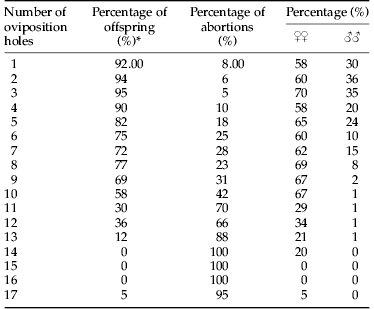
* Values differ significantly with respect to number of oviposition holes/emergence but not with respect to soil type/emergence (Tukey α=0.05).
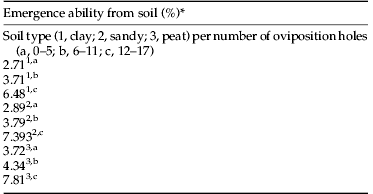
‘Emergence ability from soil’ of S. cameroni from pupae with different numbers of oviposition holes.
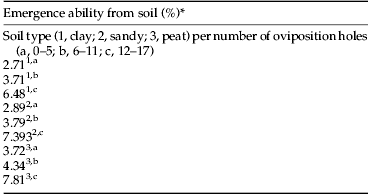
* Values are significantly different with respect to number of oviposition holes/emergence but not with respect to soil type/emergence (Tukey α=0.05).
Female size
Since in all cases only one wasp emerges per host, size differences between females are not expected. Nevertheless, no significant differences were observed in the mean head width of females of S. cameroni between the parasitoids emerged from pupae with: (i) 1–5 versus 6–11 ‘ovip holes’ (Student's t-test, F-test for equal variance: F=0.960, ≤0.329; df=98, t=−0.412, P≥0.681); (ii) 1–5 versus 12–17 ‘ovip holes’ (Student's t-test, F-test for equal variance: F=3.361, ≤0.070; df=98, t=0.564, P≥0.574); and (iii) 6–11 versus 12–17 ‘ovip holes’ (Student's t-test, F-test for equal variance: F=2.750, ≤0.100; df=98, t=0.702, P≥0.484). The range and mean (±SD) head width of the parasitoids emerged from each of the three groups of pupae were: (i) 1–5 ‘ovip holes’ (0.43–061; 0.56±0.04); (ii) 6–11 ‘ovip holes’ (0.41–0.63; 055±0.03); and (iii) 12–17 ‘ovip holes’ (0.40–0.63; 0.55±0.06).
Emergence ability from soil
There were significant differences in ‘emergence ability from the soil’ among the parasitoids coming from hosts with different degrees of superparasitism (F=233.34, df 2,87, P<0.001) (table 2), but not as a function of the type of substrate (soil) in which the host pupae were buried (F=1.74, df 2,87, P>0.181). In this last case, there are not significant differences. The highest ‘emergence ability from the soil’ values were observed in those parasitoids that emerged from strongly superparasitized hosts (pupae with 12 or more ‘ovip holes’).
Longevity, fertility and survival
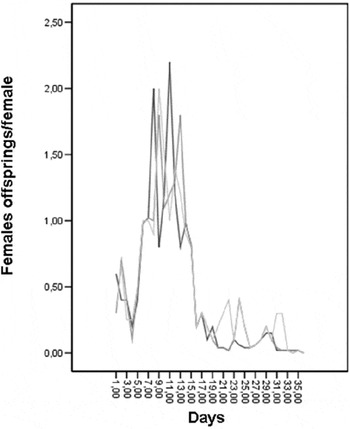
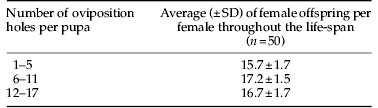
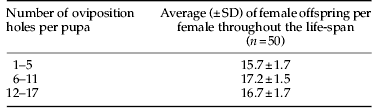
The number of ‘ovip holes’ per pupa did not have a significant effect on the longevity of female parasitoids, either with food and without food, or with water only (F=0.072, df 2, 147, P>0.931; F=0.121, df 2,147, P>0.886; and F=0.110, df 2,147, P>0.891, respectively). Figure 5a, b shows the survival curves for females in the three groups (1–5, 6–11 and 12–17 ‘ovip holes’ per pupa) with food (fig. 5a), without food (fig. 5b) and with water only (fig. 5c), respectively. Mean longevity (±SD) was 26.6±10.7 days for females with food, 7.4±2.7 days for females without food, and 11.7±3.2 with females with only water. Female fertility was not correlated with the level of superparasitism (F=0.083, df 2, 105; P>0.921) and was similar for all three groups (table 3). Maximum female offspring production occurred when the parasitoids were between five and 15 days old (fig. 6). Average lifespan offspring production was 15.7±1.6 females per female (pooled data).
Age-specific fertility in S. cameroni females that emerged from hosts with different levels of superparasitism (, 1–5 oviposition holes; , 6–11 oviposition holes; , 12–17 oviposition holes).

Female offspring of S. cameroni from mothers from pupae with different numbers of oviposition holes.
The median survival time for females with food and for each of the three groups was: (i) (pupae with 1–5 ‘ovip holes’): 32.14 days; (ii) (pupae with 6–11 ‘ovip holes’): 31.88 days; and (iii) (pupae with 12–17 ‘ovip holes’): 32.73 days. Table 4 shows the survival functions for the females from the three groups of pupae: (i) the estimated probability that the individuals of a given age will survive (a); (ii) the estimated probability, per unit of time, of the death of individuals at a given age; and (iii) an estimation of the probability, per unit of time, that females of a certain age would die during that period. From a comparison of the survival of the females from the three groups of pupae (fig. 7a–c), it may be deduced that the slight differences in the survival medians of each of the groups are not significant, thus being due to chance (females from pupae with 1–5/6–11 ‘ovip holes’ (D=0.32, P=0.57), females from pupae with 1–5/12–17 ‘ovip holes’ (D=0.02, P=0.87), females from pupae with 6–11/12–17 ‘ovip holes’ (D=0.23, P=0.62)). These results were expected because only one adult emerges per pupa.
Cumulative survival of S. cameroni females as a function of the type of pupa (number of ‘marks’ (oviposition holes)) (a) 1–5; Pupae (, 1–5 “marks”; , 6–11 “marks”), (b) 6–11; Pupae (, 0.00 1–5 “marks”, , 1.00 12–17 “marks”), (c) 12–17; Pupae (, 1.00 6–11 “marks”; , 2.00 12–17 “marks”) n=50 pupae of each group.

Survival functions calculated for females of S. cameroni in a Laboratory rearing (proportion of cumulative survival at the end of the interval, probability density, hazard rate). The interval time was established every 3 days. n=50 pupae for each group (1–5, 6–11, 12–17).

Discussion and conclusions
The pupae of C. capitata become discoloured near the drilling site of the ovipositor of S. cameroni; however, the intensity and extent of discolouration are similar to those produced by this parasitoid on Musca domestica (Diptera: Muscidae) (Wylie, Reference Wylie1972) and less prominent than the ‘ovip holes’ produced in fly pupae pierced by other pteromalid species. Nevertheless, the number of these ‘ovip holes’, like the number of ‘scars’ produced by females of D. longicaudata on the larvae of this dipteran species (Montoya et al., Reference Montoya, Liedo, Benrey, Barrera, Cancino and Aluja2000), provides information about the degree of superparasitism sustained by medfly pupae.
Our results support the notion that superparasitism is common under massive S. cameroni rearing conditions. Over 72% of the pupae sampled had more than one ‘ovip hole’, usually more than one egg. This superparasitism could be attributed to the rearing procedures, due to factors such as those indicated by Mousseau & Fox (Reference Mousseau and Fox1998) and González et al. (Reference González, Montoya, Perez-Lachaud, Cancino and Liedo2007): (i) hosts limited, (ii) a high proportion of old females, (iii) long host exposure time, among others. Additionally, high levels of self-superparasitism were observed by E. Böckmann et al. (personal communication), even when females were kept on individual Petri dishes (5×1 cm), without competition and with high (one female wasp per ten hosts) and low (one female wasp per two hosts) host proportions. Finally, we would like to comment that, although the first record of S. cameroni as a parasitoid of C. capitata is recent (Falcó et al., Reference Falcó, Garzón-Luque, Pérez-Hinarejos, Tarazona, Malagón and Beitia2006), this does not mean that the medfly is not a natural host of S. cameroni. This parasitoid is a generalist pupal ectoparasitoid of several taxonomic families in the order Diptera, including Tephritidae: Anastrepha suspensa, Bactrocera. cucurbitae, B. passiflorae (Noyes, Reference Noyes and Dicky2005), and it was obtained in the laboratory emerging from pupae of the medfly found in the field (Falcó et al., 2006). Then, the high degree of superparasitism shown by S. cameroni on C. capitata cannot be C. capitata, due to the fact that C. capitata is not the natural host of S. cameroni.
The present study revealed that individuals developing in pupae with more than one ‘ovip hole’ (superparasitized), in comparison with those emerging from pupae with only one ‘ovip hole’, suffered more abortions; but the sex ratio was biased (more females) and they had a better ‘emergence ability from the soil’ (this ability did not depend on the type of soil). These results suggest that, in this species, the presence of more than one egg per host may represent a conditional strategy that increases reproductive success. This finding is relatively common in solitary parasitoids, which may lay clutches of more than one egg in each host encountered (González et al., Reference González, Montoya, Perez-Lachaud, Cancino and Liedo2007). Rosenheim & Hongkham (Reference Rosenheim and Hongkham1996) have argued that for solitary parasitoids, multiple-egg clutches and self-superparasitism are fundamentally different behaviour patterns, entailing different costs and benefits. For example, when females encounter a parasitized host, self-superparasitism increases the chances that the winner of the larval competition will be an offspring of that female (Visser et al., Reference Visser, van Alphen and Hemerik1992). The pay-off from this strategy is expected to increase with the level of intraspecific competition (i.e. when the number of parasitized hosts increases in the patch) (Visser et al., Reference Visser, van Alphen and Hemerik1992). Additionally, in one solitary parasitoid wasp that commonly produces multiple-egg clutches, Comperiella bifasciata (Hymenoptera: Encyrtidae), Rosenheim & Hongkham (Reference Rosenheim and Hongkham1996) observed that clutch size varied in response to aspects such as host quality or the presence of conspecific wasp females. In S. cameroni, the females lay one or more eggs in each act of oviposition, preferring unparasitized hosts to those attacked by conspecifics (Wylie, Reference Wylie1972); and the clutch size, as a response to large hosts, is affected by previous experience with host size. Fewer offspring are produced by females that have been exposed to small hosts than by females that have been exposed previously to large hosts (King, Reference King1994a).
As indicated previously, like D. longicaudata (González et al., Reference González, Montoya, Perez-Lachaud, Cancino and Liedo2007), S. cameroni displays a favourable sex-ratio bias in favour of females in superparastitism. To date, some authors (Galloway & Grant, Reference Galloway and Grant1989; Mayhew & van Alphen, Reference Mayhew and van Alphen1999; Darrouzet et al., Reference Darrouzet, Imbert and Chevrier2003) have suggested that superparasitism would be the cause of a female-biased sex ratio in hymenopteran parasitoid species (Darrouzet et al., Reference Darrouzet, Bignon and Chevrier2007). Recently, González et al. (Reference González, Montoya, Perez-Lachaud, Cancino and Liedo2007) have proposed superparasitism as one of the mechanisms that would explain the occurrence of a female-biased sex ratio under mass rearing conditions. In these conditions, the parameters that could lead to a sex ratio favourable to females were based on host quality (size, age, parasitized/unparasitized hosts ratio, etc.), inbreeding, sex specific dispersal and favourable mass rearing conditions (high host quality and/or a high parasitoid/host ratio) (Hamilton, Reference Hamilton, Blum and Blum1979; Charnov et al., Reference Charnov, Los Den Hartogh, Jones and van dem Assem1981; Werren, Reference Werren1984; Waage et al., Reference Waage, Carl, Mills, Greathead, Singh and Moore1985; Waage, Reference Waage, Waage and Greathead1986; Heimpel & Lundgren, Reference Heimpel and Lundgren2000). Nevertheless, other authors have indicated that superparasitism either fails to alter the sex ratio (Rivers, Reference Rivers1996) or results in a male-biased sex ratio (Wylie, Reference Wylie1965). In S. cameroni, there is evidence that previous experience of host size affects the sex ratio. The sex ratio response to large hosts is more female-biased for mothers that have previously been exposed to small hosts than for mothers that had previously been exposed to large hosts (King, Reference King1994a). Therefore, the results concerning this solitary ectoparasitoid wasp support the prediction of Charnov et al. (Reference Charnov, Los Den Hartogh, Jones and van dem Assem1981) that there would be a negative relationship between host size and the wasp sex ratio (lower proportion of sons). Nevertheless, it should be noted that this species has a sex-ratio response to host species that at first appears independent of host size (for example, S. cameroni oviposits a higher proportion of daughters in stable-fly pupae than in house-fly pupae, even though stable-flies are smaller than house-flies). In this case, the sex ratio manipulation in response to host quality has been modelled as being adaptive, due to an effect of host quality on parasitoid size; and, hence, daughter offspring are produced (King, Reference King1996). Additionally, in this species, the overall female-biased sex ratio can be explained in terms of the negative relationship between the sex ratio and the number of offspring produced that characterises it (the more descendants, the more female-biased) (Hurlbutt, Reference Hurlbutt1987) or by the presence of local mate competition (King, Reference King1989).
The current laboratory rearing conditions of S. cameroni afford high rates of superparasitism but also a good proportion of emerging females. It is known that parasitoids have behavioural mechanisms through which females assess the environment for sex ratio manipulation in order to maximize their reproductive success (Godfray, Reference Godfray1994). For this reason, under solitary superparasitism, and because only one individual survives out of all the eggs, females tend to favour a sex ratio biased towards the sex that is the best competitor (King, Reference King1987; van Dijken & Waage, Reference van Dijken and Waage1987). In S. cameroni, female larvae should be the best competitors under superparasitism conditions, as reported for other solitary ectoparasitoids such as Anisopteromalus calandre (Hymenoptera, Pteromalidae) (Lebreton et al., Reference Lebreton, Chevrier and Darrouzet2010c) and Eupelmus vuilleti (Hymenoptera, Eupelmidae) (Darrouzet et al., Reference Darrouzet, Imbert and Chevrier2003). Another relevant factor that may influence the sex ratio of the offspring in the case of superparasitism is host quality. This factor has been studied in depth in S. cameroni (King, Reference King1989, Reference King, Wrensch and Ebbert1993, Reference King1994a,Reference Kingb, Reference King1996, Reference King1998, Reference King2002a). This pteromalid is apparently the first species that has been shown to manipulate the offspring sex ratio in response to both host size and the number of mothers presents (King, Reference King1988, Reference King1989, Reference King, Wrensch and Ebbert1993). As in many parasitoid wasps, including this solitary parasitoid, females oviposit a greater proportion of sons in lower quality hosts (for example, older and smaller) when presented with equal numbers of high and low quality hosts (King, Reference King1988, Reference King1990, Reference King, Wrensch and Ebbert1993, Reference King2002a). In addition, S. cameroni respond to host species by giving rise to a greater proportion of daughters in some species than in others (King, Reference King1996). Female-biased sex ratios may be very effective in laboratory rearing for biological control releases because adult females kill hosts both by oviposition and, as occurs in this species, also by feeding on host fluids themselves (King, Reference King2002a). It is, therefore, crucial to know the factors that influence sex ratio for successful parasitoid rearing for mass release (Waage, Reference Waage, Waage and Greathead1986).
As may be seen from the results of the present study, in laboratory rearing and under the established conditions, the size of S. cameroni females is not determined by superparasitism. In this regard, it should be noted that wasp size has a positive effect on the reproductive success of many solitary species (Charnov et al., Reference Charnov, Los Den Hartogh, Jones and van dem Assem1981). In this species of pteromalid, extremely small (‘dwarf’) females may have lower reproductive success, but there is no evidence of an effect within the normal size range (King, Reference King1988; King & King, Reference King and King1994; King & Lee, Reference King and Lee1994). However, that there may be an effect under certain conditions cannot be ruled out. Even if size affected female reproductive success, superparasitism would not directly benefit reproductive success through the production of larger females, but it also would not harm it as it would reduce the reproductive success of the parasitoid with the production of smaller females.
As in the case of D. longicaudata (González et al., Reference González, Montoya, Perez-Lachaud, Cancino and Liedo2007), S. cameroni from superparasitized hosts show a higher rate of emergence, greater ‘emergence ability from the soil’ and gives rise to more females. All this suggests that in this species superparasitism does not elicit negative effects and that it should be considered as an adaptive reproductive strategy. According to van Alphen & Visser (Reference van Alphen and Visser1990) and Cullen et al. (Reference Cullen, Sherratt and Hubbard1991), the probability of a parasitoid emerging from a superparasitized host is greater than that of one emerging from a singly parasitized one. In fact, the probability of an offspring emerging from a given host must be increased by superparasitism. Such a situation might occur when: (i) the mortality of parasitoid eggs is high, so the first egg stands a good chance of being eliminated before competition occurs, (ii) two eggs in a host have a better chance of overcoming its immune response, (iii) interlarval competition in the host eliminates the weakest parasitoids, and (iv) females are better burrowers through selection to reach more hosts for oviposition. In Spalangia endius, males do not burrow as deep as females (King, Reference King2002b).
The results discussed here were obtained from a laboratory rearing that has been maintained under laboratory conditions for more than 50 generations. It remains to be determined whether natural parasitoid populations show similar patterns of superparasitism and what consequences this might have on the performance of their offspring. Nevertheless, the present results are relevant to recommendations for rearing S. cameroni for biological control releases and for testing the importance of superparasitism under laboratory conditions and in the field. A fundamental finding of our study is that in order to achieve a more efficient laboratory rearing the pupae host/parasitoid ratio, the host exposure time and host exposure area should be optimized. Specifically, every three days, ten pupae should be supplied per parasitoid. The latter should be housed in a plastic cage (30×20×20 cm), in which no more than 600 parasitoids are confined (around 300 males and 300 females) with ventilation and a supply of water and honey, and placed in a climatic chamber (light 16 h, 24±1°C, 60–70% RH; dark 8 h, 21±1°C, 70–80% RH).
Acknowledgements
We are indebted to Bethia King (Illinois University, USA), Eric Darrouzet (Université de Tours, France), Kevin Floate (Lethbridge Research Centre, Canada) and Jerome Hogsette (United States Department of Agriculture, USA) for their observations and critical reading of the manuscript. This study was carried out in the laboratories of the Centro de Protección Vegetal y Biotecnología, IVIA (València, Spain). Financial support for this paper was provided from the Junta de Castilla y León, project SA064A08.