




No CrossRef data available.
The Rise and Decline of Presidential Populism
Published online by Cambridge University Press: 01 March 2005
Extract
At a Democratic Leadership Council meeting in the summer of 2002, centrist leaders of the Democratic Party took Al Gore to task for his use of populist rhetoric during the 2000 presidential campaign. Ed Rendell, the current governor of Pennsylvania and the former Democratic National Committee Chairman, bemoaned: “We wish Al had refined the message and not used the ‘poor people versus the rich’.” Striking a similar note, Joseph Lieberman charged that Gore's populist language made it difficult for the Democratic ticket to gain the support of middle-class, independent voters who did not see America as “us versus them,” and that these verbal attacks were to blame for Gore's failure to win the popular vote by a more convincing margin. The apparent backlash against Gore's use of populism is the latest manifestation of a transformation that has characterized presidential rhetoric over the past several decades. Put simply, the language of populism, which in the nineteenth century constituted one of the most formidable rhetorical weapons in the arsenal of Democratic presidents, has faded and been displaced by a more consensual language. This trend contrasts with the striking, though limited, embrace of populism by such Republicans as Richard Nixon and Ronald Reagan.
Information
- Type
- Research Article
- Information
- Copyright
- 2004 Cambridge University Press
At a Democratic Leadership Council meeting in the summer of 2002, centrist leaders of the Democratic Party took Al Gore to task for his use of populist rhetoric during the 2000 presidential campaign. Ed Rendell, the current governor of Pennsylvania and the former Democratic National Committee Chairman, bemoaned: “We wish Al had refined the message and not used the ‘poor people versus the rich’.” Striking a similar note, Joseph Lieberman charged that Gore's populist language made it difficult for the Democratic ticket to gain the support of middle-class, independent voters who did not see America as “us versus them,” and that these verbal attacks were to blame for Gore's failure to win the popular vote by a more convincing margin.1
Donald Lambro, “Gore Sends DLC his regrets,” The Washington Times, July 31, 2002; Dan Balz, “Democrats Assessing the New Climate,” Washington Post, July 29, 2002.
Democrats continue to draw upon populist appeals in their campaigns. Bill Clinton campaigned against special interest- induced gridlock in 1992, and four years earlier, Michael Dukakis attacked “fast operators” on Wall Street and defended the people “who don't have any special friends at the bank or special interest lobbyists in Washington, D.C.” However, we find that Democratic presidents have moved away from using such populist appeals in their major formal governing addresses. (William J. Clinton, speech delivered in Columbus, Ohio, Sept. 29, 1992, Michael Dukakis, speech given in Peoria, Illinois, Sept. 27, 1988; and Michael Dukakis, speech given in Peoria, Illinois, Sept. 27, 1988. All speeches are taken from the Annenberg/Pew Archive of Presidential Campaign Discourse CD-ROM.)
By highlighting the prominence of populist appeals among nineteenth-century Democratic presidents, our account of the development of executive leadership departs from scholarship emphasizing the “modern-traditional divide.”3
For instance, see Theodore Lowi, The Personal President: Power Invested, Promise Unfulfilled (Ithaca, NY: Cornell University Press, 1985); Elmer E. Cornwell, Presidential Leadership of Public Opinion (Bloomington: Indiana University Press, 1965); and James MacGregor Burns, The Deadlock of Democracy: Fourth-Party Politics in America (Englewood Cliffs, NJ: Prentice Hall, Inc., 1963). Recent work by Karen Hoffman (“Misunderstanding Executive Representation: Causes and Consequences” Congress & The Presidency 28 [2001]: 185–207): Michael Korzi (A Seat of Popular Leadership: The Presidency, Political Parties, and Democratic Leadership [Amherst: University of Massachusetts, 2004]): Mel Laracey (Presidents and the People: The Partisan Story of Going Public [College Station, TX: Texas A&M Press, 2002), and David Zarefsky (“The Presidency Has Always Been a Place for Rhetorical Leadership,” in The Presidency and Rhetorical Leadership [College Station, TX: Texas A&M University Press, 2002], 20–41) are important exceptions. See also the important edited volume, Richard J. Ellis, Speaking to the People: The Rhetorical Presidency in Historical Perspective (Amherst: University of Massachusetts Press, 1998).
Elmer E. Cornwell, Presidential Leadership of Public Opinion, 7–8. Keith E. Whittington, “The Rhetorical Presidency, Presidential Authority, and Bill Clinton,” in The Presidency Then and Now, ed. Phillip G. Henderson (Lanham, MD: Rowman and Littlefield Publishers, 2000), 202.
James W. Ceaser, Glen E. Thurow, Jeffrey Tulis, and Joseph Bessette, “The Rise of the Rhetorical Presidency,” in Rethinking the Presidency, ed. Thomas E. Cronin (Boston: Little, Brown, and Company, 1982), 238.
Jeffrey K. Tulis, The Rhetorical Presidency (Princeton, NJ: Princeton University Press, 1987), 5.
Within this bifurcated framework, popular presidential leadership did not emerge until the presidencies of William McKinley, Theodore Roosevelt, Woodrow Wilson, and Franklin Roosevelt. While each of these presidents is credited with paving the way for the plebiscitary presidency, it is Wilson who is commonly referred to as the author and chief proponent of the popular leadership doctrine. Wilson is recognized for transforming the constitutional executive and setting the mold for twentieth-century presidents. For example, Jeffery Tulis asserts that Wilson's doctrine of popular leadership represented nothing less than “a major shift, indeed a reversal, of the founding perspective.”7
Ibid., 132.
Arthur Link, “Woodrow Wilson: The Philosophy, Methods, and Impact of Leadership” in Woodrow Wilson and The World of Today, ed. Arthur P. Dudden (Philadelphia: University of Pennsylvania Press, 1957), 9.
Ceaser, Presidential Selection, 51, 183, 208. Yet, Ceaser in his latest work (“Doctrine of Presidential-Congressional Relations,” Separation of Powers and Good Government, ed. Bradford P. Wilson and Peter W. Schramm [Lanham, MD: Rowman & Littlefield Publishers, Inc., 1994], 89–112) recants this position, contending that the idea of presidential popular authority is consistent with the Founding view of the Constitution.
The expectation, then, would be to find presidential populism in which presidents draw upon their role as a representative of the people to attack a special interest (a more elaborate definition of presidential populism follows in the next section) flourishing after, but not before, the presidency of Woodrow Wilson. A systematic examination of presidential rhetoric from George Washington to George W. Bush, however, reveals that populist leadership does not fit neatly within the modern-traditional divide. Instead, we find a strong vibrant tradition of populist leadership existed among nineteenth-century Democratic presidents. Far from adhering to a solemn ceremonial format, nineteenth-century Democratic presidents, conceiving of themselves as tribunes of the people, peppered their addresses and messages with images of the working classes struggling against a monied elite, as well as of workers and farmers battling against manufacturing interests. While the conventional wisdom concerning nineteenth-century presidents is more accurate with respect to Whig and Republican executives, even the latter began to accept a form of party-based popular leadership starting with Lincoln. In short, it is difficult to confine presidential populist leadership to the twentieth century and beyond.
The trajectory of presidential populism thus serves as a useful lens for reframing our understanding of the presidency and moving beyond the modern- traditional divide in order to better understand the relationship between past practice and current governing challenges. In place of the modern-traditional divide, we argue that populism is linked to the state-building goals of presidents and their parties. In both the nineteenth and twentieth century, antagonistic and consensual models of rhetoric existed along side one another, and each was linked to a distinctive stance toward the scope of the national government. In the nineteenth century, Democratic presidents generally advocated an anti-statist agenda, and they adopted populist rhetoric targeting national governing institutions in their addresses and messages. Democratic presidents used populism to attack the legitimacy of governmental policies and institutions that linked a powerful national government with the promotion of business. In contrast, the Whig presidents, seeking to expand national institutions such as the Bank of the United States, adopted a more consensual rhetoric that emphasized the benefits of governmental activism for the nation as a whole. However, as the Democratic Party shifted its stance from being the party against government to being the party for government, Democratic presidents gradually moved away from the fiery, antagonistic rhetoric of the nineteenth century. Instead, they found that consensual rhetoric emphasizing the interdependence of interests was better suited to their state-building and state-maintaining aspirations.
Presidential populism persists, but now primarily in Republican hands and in a more limited fashion than in the nineteenth century. Twentieth-century Republican populism, like its nineteenth-century Democratic counterpart, is directed against the national government, though the state's relationship to nonproducers and monopolists is no longer the focus. Instead, Republican presidents target the corrupt connection between the state and overbearing bureaucrats, liberal special interests, arrogant experts, and academics. Perhaps more important, even contemporary Republican presidents have had to come to terms with “big government” in the form of popular programs such as Social Security, Medicare, and the national defense state. As a result, Republican presidents have generally confined their populism to their campaign and minor speeches, but have made much less use of populism than nineteenth-century Democrats in their major national addresses.
In sum, the rise and legitimation of a far-reaching national administrative state has led to the toning down of presidential populist rhetoric. In place of a passive nineteenth-century presidency and active and aggressive twentieth-century presidency, we instead posit that presidential populist leadership has been closely linked to wider changes in the relationship between presidents and governing institutions. It is true that all presidents are expected to be popular leaders today; but they are not expected to be antagonistic, populist leaders.
I. Components of Presidential Populism
Presidential populism consists of two core features. The first is the legitimation of presidential action through popular authority. The president identifies himself as the representative of the people, attempts to rally popular support for his position, and uses that claim of popular support as a weapon in political battles. From the beginning, presidents accepted a modest conception of the chief executive as a popular leader, in the sense that the president, through his good character, represented the nation as a whole.10
See Ralph Ketcham, Presidents Above Party: the First American Presidency 1796–1829 (Chapel Hill: University of North Carolina Press, 1984).
It is worth emphasizing that our conceptualization does not require that presidents make their popular appeals directly to the public. In his work on the rhetorical presidency, Jeffrey Tulis argues that popular leadership entails both the invocation of popular authority and the practice of appealing directly to the people through personal contact or radio and television messages. He focuses specifically on “unofficial rhetoric” – speeches that were not part of the official repertoire of inaugural addresses, annual messages, and other forms of official communications—to come to his conclusions about the principles and practices of the traditional presidency.11
Ironically, most of Tulis's evidence for his claims about nineteenth-century informal rhetoric come from James B. Richardson's compilation of formal addresses and messages for that period. As Gerald Gamm and Renée Smith (“Presidents, Parties, and the Public: Evolving Patterns of Interaction, 1877–1929,” in Speaking to the People, 88–89) point out, many of the informal speeches made on presidential tours are missing from Richardson's volumes. This casts doubt on Tulis's conclusions about informal presidential rhetoric in the nineteenth century.
Tulis examines very briefly the “official rhetoric” of our first presidents in his introductory chapter, covering in a cursory manner the addresses and messages of George Washington, John Adams, Thomas Jefferson, and Andrew Jackson. See Tulis, The Rhetorical Presidency, 47–59.
Empirically though, it is clear that the language in annual messages and other written messages belies the claim that official communications were not venues for expansive presidential leadership claims.13
Kenneth Cmiel, Democratic Eloquence: The Fight Over Popular Speech in Nineteenth-Century America (New York: William Morrow and Company, 1990) traces the transition from a neoclassical tradition to a more “crude and raw” standard of popular speech in the early nineteenth century. This shift in standards was reflected in political oratory as well as in news stories published in the popular press.
Mel Laracey, Presidents and the People: The Partisan Story of Going Public (College Station, TX: Texas A & M University, 2002), 80, 87. Laracey points out that Democratic presidents were much more likely than Whig presidents to use the official paper to press their own leadership claims.
William Jennings Bryan confronted this reality as late as 1896 when he decided to read his nomination acceptance speech to a large crowd that had gathered at Madison Square Garden in order to ensure that the newspapers had an accurate record. Disappointed by Bryan's dry performance, the crowd filtered out early. Bryan explained his decision to read his speech rather than to speak extemporaneously: “In order to secure the publication of an accurate report of the speech in the daily papers it would be necessary to furnish a copy in advance of delivery . . . . I concluded that it was . . . better . . . to disappoint the few thousands who would be in the hall in order to reach the hundreds of thousands who would read it in print.” As quoted in Richard Ellis, “Accepting the Nomination: From Martin Van Buren to Franklin Delano Roosevelt,” in Speaking to the People, 120.
Laracey, Presidents and the People, 70–71.
As public attention has been drawn to this subject, it is deemed proper, in order to prevent misunderstanding or misrepresentation, to lay before the people the communication made by the President as above mentioned, and a copy has been furnished to us for that purpose, which we now proceed to publish.17
Ibid., 71.
Although this message was ostensibly addressed to his cabinet, Jackson clearly was using the press to target a wider audience.
One might object that the intermediation of newspapers and their often-partisan editors constrained presidential rhetoric in important ways.18
Michael Korzi (manuscript for “A New Migration of Political Forces: Party Decline and Presidential Leadership in Late Nineteenth Century America,” June 2003) and Gerald Gamm and RenéeSmith (“Presidents, Parties, and the Public: Patterns of Interaction, 1877–1929,” in Speaking to the People, 90–91) suggest that parties, through their control of newspapers, tempered and restrained presidential rhetoric, preventing the emergence of the plebiscitary presidency until after the Civil War, or, in Gamm and Smith's account, the 1890s, when the partisan press and party organization began to decline. However, newspapers' policy of printing the full text of annual messages shows that nineteenth-century presidents were able to use these written communications to disseminate their message—in their own words—to the general public. As discussed below, it is also clear that Democratic presidents used their messages to pursue policies that showed considerable independence of their party. Furthermore, Democratic presidents used their messages to shape their party's stance on key issues, rather than simply being agents constrained by their party's stands.
When disputes broke out between presidents and partisan editors of the official organ, it was usually the partisan editor who suffered the consequences. When the US Telegraph continued to endorse Calhoun after he had fallen out of favor with Jackson, the seventh president switched the government's patronage to the Globe, replacing Duff Green with Francis P. Blair as editor. Similarly, Polk sought out a more receptive editor of the official organ because of Blair's opposition to Texas annexation, one of Polk's major policy goals. In a letter to Jackson, Polk complained: “I must be the head of my own administration, and will not be controlled by any newspaper or particular individual whom it serves” (John Tebbel and Sarah Miles Watts, The Press and the Presidency: From George Washington to Ronald Reagan [New York: Oxford University Press], 116–19). Shortly after his inaugural address, Polk selected the Washington Union, edited by Thomas Ritchie, as the administration's official organ. The president's control over the official organ guaranteed that he would have a mouthpiece to present his agenda if needed.
The supplement copy was aimed at members of Congress.
The second core element of populist leadership is the use of an antagonistic appeal that pits the people as represented by the president against a special interest. For example, Polk attacked the Whig American system with the claim that it “fostered and elevated the money power and enriched the favored few by taxing labor, and at the expense of the many.”21
James K. Polk, “Fourth Annual Message,” Dec. 5, 1848, A Compilation of the Messages and Papers of the Presidents (New York: Bureau of National Literature, 1897–1922), 4:2511.
Although special interests have taken on a variety of identities throughout the years, there are certain characteristics that they share in common. More often than not, presidents portray special interests as parasites on state resources. For example, Jackson's populist attacks on monied elites stemmed from his belief that they were deriving an unfair advantage from their association with the state, not because the wealthy were inherently evil. Similarly, Nixon framed “bureaucratic elites” as a special interest by highlighting their use of state resources to control the lives of American citizens. In their bids to eliminate these special interests, presidents have regularly contended that parts of the state apparatus must be torn down, reduced in size, or radically restructured.
Just as important as challenging special interests, populist appeals have also become a way for the president to wage the struggle for increased institutional power vis-à-vis Congress. Presidents often have charged that the Congress bears responsibility for the granting of unfair political privileges. In this line of reasoning, members of Congress are portrayed as servants of selfish factions because venal members represent a particular state, district, or class, instead of the entire nation. In addition, presidents and outside observers have pointed to logrolling, district gerrymandering, the Senate filibuster, and the seniority system as other features that prevent members of Congress from being attuned to the popular will.22
Bruce Miroff, “Monopolizing the Public Space: The President as a Problem for Democratic Politics,” in Rethinking the Presidency, ed. Thomas E. Cronin (Boston: Little, Brown and Company, 1982), 223. Samuel Popkin, The Reasoning Voter: Communication and Persuasion in Presidential Campaigns (Chicago: University of Chicago Press, 1991), 67; Willmoore Kendall asserts that defenders of the presidency as popular leader often point out that the Senate filibuster and the seniority principle “make it possible for little bands of willful men to frustrate alleged majority mandates” (“The Two Majorities,” Midwest Journal of Political Science 4 [1960]: 321).
Miroff, “Monopolizing the Public Space: The President as a Problem for Democratic Politics,” 223.
Understanding presidential populism in terms of antagonistic appeals builds upon earlier work by Michael Kazin, Thomas Goebel, and John Gerring, each of whom also views populism as a form of rhetorical appeal. Kazin, in The Populist Persuasion, conceptualizes populism as a tradition that puts forth an image of conflict between the powerful and the powerless. In Kazin's words, “it is a language whose speakers conceive of ordinary people as a noble assemblage” pitted against elite opponents who are defined as “self-serving and undemocratic.”24
Michael Kazin, The Populist Persuasion: An American History (New York: Basic Books, 1995), 1.
Thomas Goebel, “The Political Economy of American Populism from Jackson to the New Deal,” Studies in American Political Development, 11 (Spring 1997): 109–148. For other definitions of populism, see Richard Hofstadter, “The Temper of Populism,” in Populism: The Critical Issues, ed. Sheldon Hackney (Boston: Little, Brown and Company, 1971), 119–33; Michael P. Federici, The Challenge of Populism: The Rise of Right-Wing Democratism in Postwar America (New York: Praeger, 1991), 35–36; and Margaret Canovan, “Two Strategies for the Study of Populism,” Political Studies 30 (1982): 552.
John Gerring, Party Ideologies in America 1828–1996 (New York: Cambridge University Press, 1998), 187–231.
Thus, central to Kazin's, Goebel's, Gerring's, and our definition of populism is the rhetorical image of a unified people opposing a corrupt interest. This definition of populism as a political argument has the benefit of sidestepping debates over the substance of a populist appeal and whether or not a policy in fact harms the people. Similarly, our conceptualization of populism departs from works that focus on populism as a social and political movement.27
See John D. Hicks, The Populist Revolt: A History of the Farmers' Alliance and the People's Party (Minneapolis: University of Minnesota Press, 1931); Lawrence D. Goodwyn, Democratic Promise: The Populist Moment in America (New York: Oxford University Press, 1976); Gretchen Ritter, Goldbugs and Greenbacks: The Antimonopoly Tradition and the Politics of Finance in America, 1865–1896 (New York: Cambridge University Press, 1997); and Elizabeth Sanders, Roots of Reform: Farmers, Workers, and the American State (Chicago: University of Chicago Press, 1999).
The recurrent pattern of presidents appealing to the people against special interests suggests the potential importance of populism for understanding the presidency. Nonetheless, some critics might contend that presidential rhetoric is extraneous to real politics and that rhetoric is just the reflection of other political factors that are truly decisive.28
For example, see Jeff Fishel, Presidents and Promises: From Campaign Pledges to Presidential Performance (Washington, DC: CQ Press, 1985), 9–12.
On this point, see Keith E. Whittington, “The Rhetorical Presidency, Presidential Authority, and Bill Clinton,” in The Presidency Then and Now, 201–18.
Philip Abbott, The Exemplary Presidency: Franklin D. Roosevelt and the American Political Tradition (Amherst: University of Massachusetts Press, 1990), 6–14.
Rhetoric is also significant for understanding how the president perceives his political position, which groups he chooses to align with, and which groups he decides to oppose.31
Ibid.
Murray Edelman, Constructing the Political Spectacle (Chicago: University of Chicago Press, 1988), 76.
II. Measuring Presidential Populism
In order to trace the development of presidential populism, we conducted a content analysis of all of the inaugural addresses and annual messages from George Washington to George W. Bush. These tasks were made considerably easier by the recent release of several CD-ROMs and electronic publications of presidential messages and speeches, including the American Freedom Library CD-ROM, which contains electronic versions of the presidential papers from George Washington to the first year of Bill Clinton's administration; the Federal Register's electronic publication of Bill Clinton's presidential papers; and of the Weekly Compilation of Presidential Documents for George W. Bush. 33
The American Freedom Library CD-ROM (Orem, UT: Western Standard Publishing Company, 1998). The AFL CD-ROM is missing the last two years of Taft's administration and the entire Wilson, Harding, and Coolidge administrations. To fill in the gaps on the CD-ROM, we have coded digital copies of the text of the inaugural addresses and state of the union messages for the omitted administrations. The Weekly Compilation of Presidential Documents for George W. Bush is available at: http://www.archives.gov/federal_register/publications/weekly_compilation.html (accessed Sept. 24, 2003). The Public Papers of President Bill Clinton are available at http://www.gpoaccess.gov/pubpapers/index.html (accessed Sept. 24, 2003).
The content analysis followed two methods. The first consisted of reading through all of the presidential inaugural addresses and annual messages and noting by hand claims of popular authority, interpretations of electoral mandates, and antagonistic appeals that pitted the people against the special interests. The second method involved computer searches for words and phrases that tapped into the ideas of popular authority and populism in the presidential messages and papers collected from the electronic sources listed in the above paragraph. As a validity check, we compared the results from the computer searches of the inaugural and state of the union messages with those obtained by manually coding each of these speeches. The two approaches generate reasonably similar results: The number of populist appeals for each president counted in the manual coding correlates at .78 with the number of appeals counted in the computer searches. In discussing the results below, we emphasize the electronic coding approach but note any differences that emerge in the hand coding.
The content analysis itself consisted of an examination of each address or message for popular leadership claims and antagonistic appeals.34
In the case of the Weekly Compilation of Presidential Documents and the electronic version of Bill Clinton's presidential papers, it involved examining all documents for a specific search term.
We then read the paragraph, as well as the preceding and following paragraph, to determine whether it constituted an actual claim of popular authority and to pinpoint what program or policy the president was advocating with the popular appeal. The same process was done in the detection of antagonistic appeals.
Franklin D. Roosevelt, “Address at the Dedication the New Chemistry Building, Howard University, Washington, D.C.,” Oct. 26, 1936, AFL CD-ROM; Franklin D. Roosevelt, “Veto of a Revenue Bill,” Feb. 22, 1944, AFL CD-ROM.
III. The Evolution of Popular Leadership
Although popular leadership claims thrived in the twentieth century, they also were a hallmark of the rhetoric of nineteenth-century Democratic presidents. These presidents routinely claimed the mantle of “popular leader” in their respective inaugural addresses and formal messages, often placing the presidency above the Congress in terms of its representative role. In contrast, the Whig presidents spurned popular leadership, believing that the proper place for popular leadership was the legislative branch.37
During the election campaign, the Whig party and sometimes the presidential candidate himself would claim a closeness to the people. These campaign claims, however, did not translate into popular leadership once in the White House.
Douglas Jaenicke, “The Jacksonian Integration of Parties into the Constitutional System.” Political Science Quarterly 101 (1986): 89.
Paradoxically, it might have been this opposition to strong leadership that provided the foundation for the evolution of presidential popular leadership. By promising to be “stewards of the people” and to follow the dictates of the “popular will,” Democratic presidents overcame to some extent public apprehension over presidential power.39
See also Richard Ellis and Aaron Wildavsky, Dilemmas of Presidential Leadership: From Washington through Lincoln (New Brunswick, NJ: Transaction Publishers, 1989), 112–13.
Susan Herbst, “Public Opinion from the Presidents' Perspective: What Can We Learn from their Speeches?” paper presented at the Midwest American Political Science Association meeting, April 19–22, 2001.
One might suspect that Democrats' partisan commitment to a limited state was a major constraint on Democratic presidents' power. This is not necessarily the case, however, since attacking the state can entail substantial independent presidential action. Jackson claimed to be the agent of the popular will and then proceeded with one of the most aggressive acts by a president in American history: the routing of funds from the National Bank to several state banks across the United States. The removal of deposits case shows how presidential power and a commitment to a limited state could be linked.
One might suspect that this close tie between presidential popular authority and party leadership among nineteenth-century Democrats imposed severe constraints on their exercise of power, particularly after Jackson left the scene and the Democratic party organization became more institutionalized. Nonetheless, Democratic presidents were by no means simply agents of their party. As Stephen Skowronek points out, it is impossible for a president – even an orthodox-innovator following closely in the footsteps of a reconstructive leader – to simply reproduce and sustain existing governing commitments. Presidents must translate vague and often ambiguous conceptions of party orthodoxy into a specific policy course that responds to new challenges. As popular leaders, Democratic presidents used their official communications to help shape and define their party's commitments. For example, Van Buren's pursuit of the independent treasury was a response to the governing challenges created by Jackson's slaying of the Bank. The proposal fit Van Buren's understanding of how to reconcile the contending factions within his party, but it was clearly the president's initiative. Even James K. Polk, who won the Democratic nomination by promising equal and exact justice to each party faction, nonetheless sought to carve out independent leadership. On more than one occasion, he announced his intention “to be myself President of the United States.”42
Stephen Skowronek, The Politics Presidents Make: Leadership from John Adams to Bill Clinton (Cambridge, MA: Belknap Press of Harvard University Press), 161. Tebbel and Watts, The Press and the Presidency, 118.
All five Democratic presidents serving from the inception of the Democratic Party through the Civil War either directly claimed or endorsed the concept of a mandate in their inaugural addresses or annual messages, as can be seen in Table 1. Jackson developed the frame for the Democratic model of presidential popular leadership. In his inaugural address in 1829, Jackson set forth his view that his election represented a mandate to clean up the electoral process that had four years earlier denied him the presidency even though he had won a plurality of the popular vote, declaring:
The recent demonstration of public sentiment inscribes on the list of Executive duties, in characters too legible to be overlooked, the task of reform, which will require particularly the correction of those abuses that have brought the patronage of the Federal Gov- ernment into conflict with the freedom of elections.43
Andrew Jackson, “First Inaugural Address,” Mar. 4, 1829, Messages and Papers, 2:1001.
In his first and second annual messages, Jackson followed up this mandate claim, calling for a constitutional amendment to eliminate both the electoral college and the run-off election in the House of Representatives. Jackson contended that these intervening institutions distorted the choice of the people. He particularly despised the run-off election that was required by the Constitution when no candidate had won a majority of the electoral college votes. “It was obvious,” Jackson observed, that “the will of the people may not be always ascertained, or, if ascertained, may not be regarded” in the House of Representatives. Members of the House could be corrupted with promises of “honor and offices” that were “at the disposal of the successful candidate;” they could “err from ignorance of the wishes of [their] constituents;” or they could simply exercise their “own judgment of the fairness of the candidates” by rejecting their constituents' will. Each of these possibilities risked preventing the “Office of the Chief Magistrate” from being conferred upon the candidate who had gained the “fair expression of the will of the majority.”44
Andrew Jackson, “Second Annual Message,” Dec. 6, 1830, Messages and Papers, 2:1081. Despite these popular leadership claims, Stephen Kirk and Richard Ellis label the 1828 election “the mandate not taken” (“Presidential Mandates in the Nineteenth Century: Conceptual Change and Institutional Development,” Studies in American Political Development 9 [1995]: 127–33). They point out that Jackson neither campaigned on nor claimed a mandate for his position on tariff policy, banking issues, or federally sponsored internal improvement projects. Although Ellis and Kirk are right that Jackson did not claim a mandate on these policy issues, Jackson unequivocally broke new ground in claiming a clear mandate for electoral reform. If the House of Representatives was capable of distorting the popular will in the run-off election of the president, what was to prevent it from ignoring the popular will on policy? Jackson's inaugural address, in combination with his first two annual messages, provided a bold expression of Jackson's theory of popular leadership that would guide his subsequent actions as president.
In his 1833 “Removal of Deposits” message, Jackson even more clearly asserted his right to interpret the popular will. Jackson declared that his reelection was “a decision of the people against the Bank” of the United States and that by removing the deposits, he was simply “carrying into effect their decision so far as it depends upon him.”45
Andrew Jackson, “Removal of the Public Deposits,” Sept. 18, 1833, Messages and Papers, 2:1226.
Presidential Mandates, 1828–1900

Henry Clay, leader of the Senate and Jackson's opponent in the 1832 presidential election, responded to Jackson's actions with grave concern:
Sir, I am surprised and alarmed at the new source of executive power which is found in the result of a presidential election. I had supposed that the Constitution and the laws were the sole source of executive authority . . . that the issue of a presidential election was merely to place the Chief Magistrate in the post assigned to him. But it seems that if, prior to an election certain opinions, no matter how ambiguously put forth by a candidate, are known to the people, those loose opinions, in virtue of the election, incorporate themselves with the Constitution, and afterwards are to be regarded and expounded as parts of the instrument.46
Quoted in Robert Remini, “Election of 1832,” in History of American Presidential Elections 1789–1968, ed. Arthur M. Schlesinger, 4 vols. (New York: Chelsea House Publishers, 1971), 1:516.
Clay moved to formalize his complaints, sponsoring a Senate resolution censuring Jackson for assuming these novel, unconstitutional powers in removing the deposits. The censure read:
Resolved. That the President, in the late Executive proceedings in relation to the public revenue, has assumed upon himself authority and power not conferred by the Constitution and laws, but in derogation of both.47
Facts about the Presidents: A Compilation of Biographical and Historical Information, ed. Joseph Nathan Kane, Janet Podell, and Steven Anzovin (New York: The H.W. Wilson Company, 2001), 89.
After the censure passed, Jackson issued a protest, claiming that he, as president, better represented the people than did the Senate.48
The Senate passed the censure on Mar. 28, 1834, by a vote of 26 to 20. The breakdown of the vote was as follows: Jacksonians voted 18 to 1 against the censure; the nullifiers voted 2 to 0 in favor of the censure; and the Anti-Jacksonians voted 23 to 2 in favor of censuring Jackson (Congressional Roll Call Voting Records, 1789–1996, ICPSR File No. 0004). Party affiliations were derived from Keith Poole and Howard Rosenthal's data set on members' partisanship and ideology. On this, see Poole and Rosenthal, “Patterns of Congressional Voting,” American Journal of Political Science 35 (1991): 228–78.
Andrew Jackson, “Protest,” Apr. 15, 1834, Messages and Papers, 2:1310, 1309.
Ibid., 2:1296.
With his response to this censure resolution, Jackson set up a hierarchy of popular legitimacy, with the House and the president ranked at the top as direct representatives of the people and the Senate placed at the bottom. Jackson, at this point, was very favorable to the House because of its recent acceptance of a majority report in favor of the president and against the Bank.51
In the House, the Jacksonian party had a large majority numbering 150 members out of a total of 222. For more information on the resolutions that the House passed in December 1833, see Donald B. Cole, The Presidency of Andrew Jackson (Lawrence: University Press of Kansas, 1993), 207.
See Andrew Jackson, “Fourth Annual Message,” Dec. 4, 1832, Messages and Papers, 2:1165.
The Senate voted 24 to 19 to expunge the censure from the Senate Journal on Jan. 16, 1837: Jacksonians voted 24 to 0 for removal of the resolution; the nullifiers voted 2 to 0 against removal; and the Anti-Jacksonians voted 17 to 0 against removal.
As the Democratic successor to “Old Hickory,” Martin Van Buren incorporated Jackson's referendum theory of popular leadership both in practice and in theory. In his inaugural address, Van Buren expressed his belief that it was the “solemn duty” of every politician to educate the public on his issue positions. Van Buren recounted how he had laid his “opinions on all the most prominent . . . subjects” before the public with “great precision” during the campaign. The election then signified that a majority of the people of the United States “approved and . . . confided” in the winning candidate's issue positions. After winning the 1836 election, Van Buren claimed the following mandate on the slavery issue:
I declared [during the campaign] that if the desire of those of my countrymen who were favorable to my election was gratified, “I must go into the Presidential chair the inflexible and uncompromising opponent of every attempt on the part of Congress to abolish slavery in the District of Columbia against the wishes of the slaveholding States, and also with a determination equally decided to resist the slightest interference with it in the States where it exists.”54
Martin Van Buren, “Inaugural Address,” Mar. 4, 1837, Messages and Papers, 2:1535.
In his book on the origins and history of parties in America, Van Buren endorsed Jackson's theory of popular leadership, contending that it was the “true view of the Constitution.”55
Martin Van Buren, Inquiry into the Origin and Course of Political Parties in the United States (New York: Hurd and Houghton, 1867), 330.
if different interpretations are put upon the Constitution by the different departments, the people is the tribunal to settle the dispute. Each of the departments is the agent of the people . . . and where there is a disagreement as to the extent of these powers, the people, themselves, through the ballot boxes must settle it.56
Van Buren is citing Judge White, whom Van Buren believed had expressed “in a perspicuous and satisfactory manner” the views of President Jackson (Inquiry, 329–30).
While the president derives his right to interpret the Constitution from the oath of office he takes under the Constitution, according to Van Buren, it is the people, in the end, who determine if that interpretation is correct by deciding whether to endorse the president and his issue stands at the polls.
Jeffrey Tulis argues that the framers envisioned a system in which the executive's primary concern was “self-preservation” or national security, its secondary concern was popular rights, and its tertiary concern was the popular will. The executive's list of priorities differed from those of legislators, whose first and foremost concern was the popular will.57
Tulis, The Rhetorical Presidency, 43. Robert Dahl makes a similar point in “Myth of the Presidential Mandate,” Political Science Quarterly 105 (1990): 357.
Following Jackson's and Van Buren's lead, Polk viewed his 1844 election as a mandate to annex Texas. In his inaugural address, he promised to “consummate the expressed will of the people and the Government of the United States by the reannexation of Texas to our Union at the earliest practicable period,” and more generally to carry out the “principles and policy of those who have chosen him.”58
James K. Polk, “Inaugural Address,” Mar. 4, 1845, Messages and Papers, 3:2231.
James K. Polk, “Fourth Annual Message,” Dec. 5, 1848, Messages and Papers, 4:2514–15.
Taking over the presidency after Abraham Lincoln's death, Andrew Johnson could not claim a direct electoral mandate.60
Still, as a Democratic senator from Tennessee in 1844, Johnson heartily endorsed the idea that Polk's election represented a mandate to annex both Texas and Oregon. He proclaimed,
The country has settled this question [of the reannexation of Texas and Oregon]; the people have pronounced in decisive tones in favor of the principles of the Baltimore convention, and of the President whom they nominated; and it is the duty of Congress to carry out the wishes of the people. (Ellis and Kirk, “Presidential Mandates in the Nineteenth Century,” 162)
I am your instrument. Who is there I have not toiled and labored for? . . . They say that man Johnson is a lucky man, that no man can defeat me. I will tell you what constitutes luck. It is due to right and being for the people . . . Somehow or other the people will find out and understand who is for and who is against them. I have been placed in as many trying positions as any mortal man was ever placed in but so far I have not deserted the people, and I believe they will not desert me.61
Eric L. McKitrick, Andrew Johnson and Reconstruction (New York: Oxford University Press, 1988), 295.
Johnson's official orations were perhaps not so “mystical,” but they still put forward the same view of the president. In claiming the president's right to remove public officers, Johnson asserted that the chief executive represented “the collective majesty” and spoke “the will of the people.”62
Andrew Johnson, “Third Annual Message,” Dec. 3, 1867, Messages and Papers, 5:3769.
I return the bill to the Senate, in the earnest hope that a measure involving questions and interests so important to the country will not become a law, unless upon deliberate consideration by the people it shall receive the sanction of an enlightened public judgment.63
Andrew Johnson, “Veto of the Freedmen's Bureau,” Feb. 19, 1866, Messages and Papers, 5:3603.
Just as Jackson and Polk had done before, Johnson claimed to be the true spokesman of the nation and was willing to place his interpretation of the popular will against Congress's in the upcoming 1866 congressional elections. Johnson's “swing around the circle” during the campaign set up the 1866 election as a referendum on reconstruction. Had his allies not performed so poorly in that election, Johnson could have claimed a mandate for a lenient readmittance policy of southern states back into the Union.
Jeffrey Tulis contends that Johnson's “swing around the circle” violated constitutional doctrines that prohibited presidential popular leadership.64
Tulis, The Rhetorical Presidency, 87–93.
“Articles of Impeachment,” Messages and Papers, 5:3912–15.
It should be noted that there is no consensus about the importance of the tenth article. Benjamin Butler, the congress member who drafted the tenth article, remarked that this article was of “merited insignificance” compared to the other articles of impeachment. See Lloyd Paul Stoker, Andrew Johnson: A Study in Courage (New York: Macmillan, 1929), 626. For modern authors that belittle the tenth article, see Hans L. Trefousse, Impeachment of a President: Andrew Johnson, the Blacks, and Reconstruction (Knoxville: University of Tennessee, 1975), 147; Robert W. Winston, Andrew Johnson: Plebian and Patriot (New York: Henry Holt and Company, 1928): and Martin E. Mantell, Johnson, Grant, and the Politics of Reconstruction. (New York: Columbia University Press, 1973). In contrast, Keith Whittington (“Constitutional Construction: Divided Powers and Constitutional Meaning,” Ph.D. diss., Yale University, 1995) points out the tenth article's importance in signaling the political construction of the impeachment hearings.
Our analysis of presidential populism suggests the need to reconsider Tulis's claims about the tenth article of impeachment. Tulis argues that the “purpose of [Johnson's] speech to rouse public opinion in support of his policy initiatives in Congress” was of an “illegitimate” nature.67
Tulis, The Rhetorical Presidency, 93.
Indeed, the Republican charges against Johnson bore an unmistakable resemblance to the Whig attacks on Jackson in the wake of his “Removal of Deposits” message. Both sets of attacks reflected the Whig-Republican conviction that the president should not appeal to popular sentiment in his policy battles with Congress. However, the Democrats never accepted this theory. The vote to censure Jackson was highly partisan, pitting Whigs against Democrats, just as the Johnson impeachment battle was fought largely along partisan and ideological lines. Furthermore, as noted above, Democrats made it their mission to erase the censure of Jackson from the Senate's Journal. Congress's condemnation of Jackson did not indicate a bipartisan consensus on the appropriateness of presidential popular appeals. The subsequent embrace of Jackson's example by both Van Buren and Polk reinforces the conclusion that presidential attempts to rally public opinion were not inherently regarded as illegitimate, at least by one of the two major parties.
This is not to say that Johnson's remarks did not backfire. The extreme tone, rather than the purpose, of his verbal assaults goes far in explaining the ire he drew from Congress. The tenth article of impeachment is laden with descriptive adjectives that focus on Johnson's “loud voice” (mentioned four times) along with criticisms of his “intemperance” and “inflammatory” tone. Within the article itself, three of Johnson's speeches are quoted. The third speech is probably most illustrative of the bizarre tone of many of Johnson's remarks:
I have been slandered, I have been maligned, I have been called Judas Iscariot and all that. . . . If I have played the Judas, who has been my Christ that I have played the Judas with? Was it Thad Stevens? Was it Wendell Phillips? Was it Charles Sumner? These are the men that stop and compare themselves with the Savior, and everybody that differs with them in opinion, and [that tries] to stay and arrest their diabolical and nefarious policy, is to be denounced as a Judas.68
“Articles of Impeachment,” 5:3915.
Johnson perhaps would have avoided some criticism if in this passage he had framed the people as the victim rather than himself. The crucial point is that the metaphors Johnson adopted – particularly, linking his struggles to the betrayal of Christ – would be just as unacceptable under today's rhetorical standards as under nineteenth century ones.
Although avoiding the paranoid language of Johnson, the other nineteenth-century Democratic presidents – Franklin Pierce, James Buchanan, and Grover Cleveland – drew upon popular authority to bolster their leadership claims. Each endorsed the concept of a mandate, although Pierce's mandate claim is the weakest among nineteenth-century Democrats. In his first inaugural address, Pierce stated that “the sentiments I now announce were not unknown before the expression of the voice which called me here.” Buchanan was more direct, in proclaiming in his first inaugural address that the election results showed that the country was ready to set aside its differences on the slavery issue.69
Franklin Pierce, “Inaugural Address,” Mar. 4, 1853, Messages and Papers, 4:2735; James Buchanan, “Inaugural Address,” Mar. 4, 1857, Messages and Papers, 4:2962.
Grover Cleveland, “First Annual Message,” Dec. 4, 1893, Messages and Papers, 8:5891.
This alternative source of power provided by claims to popular authority was particularly important because many nineteenth-century presidents lacked the personal stature of such patrician leaders as George Washington, Thomas Jefferson, and James Madison. In the absence of a national reputation, Democratic presidents pursued alternative sources of authority provided by their popular support. Van Buren reflected this faith in the importance of popular authority when he professed that “those who have wrought great changes in the world never succeeded by gaining over chiefs, but always by exciting the multitude.”71
Arthur Schlesinger, The Age of Jackson (Boston: Little, Brown and Company, 1945), 51.
The Whigs, on the other hand, strongly resisted the establishment of the president as a popular tribune. While Whig campaigns depicted their presidential candidates as men of humble origins and friends of the people, once in office Whig presidents were reluctant to claim that the people had endorsed a set of promises in the presidential election. Clinging to older norms of presidential behavior, the Whigs strongly adhered to the notion that presidents retain a degree of independence from popular judgments. The Whig presidents viewed elections mainly as contests over character, not policy issues. In an 1840 campaign speech, William Henry Harrison argued that citizens should cast their vote based on “his past actions and life” and that electoral promises and pledges generally corrupted the presidency.72
William Henry Harrison, “[Sept. 10, 1840] Speech in Dayton, Ohio,” in History of American Presidential Elections 1789–1984, 2:737–44.
William Henry Harrison, “Inaugural Address,” Mar. 4, 1841, Messages and Papers, 3:1860. Both Patricia Heidoting-Conley (Presidential Mandates: How Elections Shape the National Agenda [Chicago: University of Chicago Press, 2001], 54) and Michael Korzi (A Seat of Popular Leadership, chap. 5) classify this claim as an example of a mandate. While Conley does not explain her coding decision, Korzi argues that Harrison was a popular leader and with this statement was responding to opposition attacks that he was simply making empty pledges in the 1840 campaign. Harrison, however, articulates the antithesis of a theory of popular leadership repeatedly in his campaign by refusing to make campaign pledges and promises. In a campaign speech, Harrison states that he “cannot consent to make mere promises the condition of obtaining the office which you kindly wish to bestow on me.” He adds that “his long and arduous life” is a pledge of my future course (“Speech in Dayton, Ohio,” 2:738). Although Harrison discusses issues in his campaign and in his inaugural address, he never links these issue positions to his election or his party's election victory, and thus remains faithful to Whig Party doctrine.
John Ashworth, Agrarians & Aristocrats: Party Political Ideology in the United States, 1837–1846 (London: Royal Historical Society, 1983), 58.
Indeed, the premise of the Whig Party was to provide a principled opposition to strong executive leadership based on popular authority.75
Wilfred E. Binkley, President and Congress, 3d ed., (New York: Vintage Books, 1962), 166.
On the creation of the Whig party, see Edward L. Mayo, “Republicanism, Antipartyism, and Jacksonian Party Politics: A View From the Nation's Capital, American Quarterly 31 (1979): 3–20.
Michael F. Holt, The Rise and Fall of the American Whig Party: Jacksonian Politics and the Onset of the Civil War (New York: Oxford University Press, 1999), 17.
[I]t is preposterous to suppose that a thought could for a moment have been entertained that the President, placed at the capital, in the center of the country, could better understand the wants and wishes of the people than their own immediate representatives, who spend a part of every year among them, living with them, often laboring with them, and bound to them by the triple tie of interest, duty, and affection.78
Harrison, “Inaugural Address,” Messages and Papers, 3:1865.
Similarly, Zachary Taylor, denying that the president had the right to “dictate” measures to Congress, pledged to implement “the will of the people, legitimately expressed on all subjects of legislation through their constitutional organs, the Senators and Representatives of the United States.”79
Zachary Taylor, “First Annual Message,” Dec. 4, 1849, Messages and Papers, 4:2561. The only partial exception was the mongrel Whig/Democrat John Tyler, who took over as president after Whig president Harrison died. In his fourth annual message, given after Polk's 1844 election victory, Tyler acknowledged a mandate for the annexation of Texas, noting that “the isolated question of annexation . . . has been submitted to the ordeal of public sentiment.” However, Tyler viewed the mandate as being directed primarily at members of Congress not the incoming president: “Instructions have thus come up to both branches of Congress from their respective constituents in terms the most emphatic” supporting the reannexation of Texas (Dec. 3, 1844, Messages and Papers, 3:2197). It is also important to remember that Tyler was not a candidate in the 1844 presidential election and that Tyler had been rejected as a heretic by his fellow Whigs following his vetoes of a series of Whig policy initiatives. Thus, Tyler's claim of a mandate does not undermine the theory of popular leadership being based on party traditions.
The transition to Republican acceptance of presidential popular authority began with Abraham Lincoln, the first Republican president. Lincoln started his political career as a Whig critic of presidential power; however, he nonetheless moved toward a limited embrace of presidential popular authority. Lincoln took the significant step of becoming the first Whig-Republican president to both employ the veto and claim a mandate.80
The only exception was John Tyler, who cast six vetoes. William Henry Harrison, Zachary Taylor, and Millard Fillmore cast no vetoes.
Richard J. Ellis and Stephen Kirk point to these messages as crucial moments in the development of Republican popular leadership (“Presidential Mandates in the Nineteenth Century: Conceptual Change and Institutional Development,” Studies in American Political Development 9 [1995]: 117–86).
In his first inaugural address, Lincoln contended that the election extended beyond a contest of character, but stopped short of claiming a mandate. Lincoln stated:
Those who nominated and elected me did so with full knowledge that I had made this and many similar declarations and had never recanted them; and more than this, they placed in the platform for my acceptance, and as a law to themselves and to me, the clear and emphatic resolution which I now read . . . .82
Abraham Lincoln, “First Inaugural Address,” Mar. 4, 1861, Messages and Papers, 5:3206.
He went on to read verbatim a resolution pulled from the Republican platform regarding the “right of each state to order and control its own domestic institutions.” In claiming that the people in the latest election had endorsed the Republican Party's views, Lincoln foreshadowed the new emphasis within the Whig/Republican tradition on the president as spokesperson of the party.
In the Wade-Davis case, Lincoln countered congressional plans for Reconstruction by questioning the “competency in Congress” to carry out such plans. He implied that, although this plan might have represented the “sense of the Congress,” it did not necessarily represent the wishes of the people.83
Abraham Lincoln, “Proclamation,” July 8, 1864, Messages and Papers, 5:3423–24.
Ibid. Despite Lincoln's circumspection, his pocket veto and proclamation generated outrage from the congressional sponsors of the bill, Republicans Benjamin Wade of Ohio and Henry Winter Davis of Maryland. In the Wade-Davis Manifesto, they blasted Lincoln's “grave Executive usurpation” in pocket-vetoing their Reconstruction bill, and they denounced his proclamation as a “studied outrage on the legislative authority of the people” (“The Wade-Davis Manifesto,” in History of American Presidential Elections, 2:1195–96).
Lincoln's interpretation of the 1864 election as a mandate to abolish slavery represented one more step in his move away from strict adherence to Whig doctrine. In his December 1864 annual message, Lincoln proclaimed that the “voice of the people” had spoken in favor of a constitutional amendment banning slavery.85
Abraham Lincoln, “Fourth Annual Message,” Dec. 6, 1864, Messages and Papers, 5:3453. See Ellis and Kirk, “Presidential Mandates in the Nineteenth Century,” 168–70 for a more detailed analysis of the 1864 election.
Lincoln, “Fourth Annual Message,” 5:3453.
Lincoln's use of the mandate, moreover, coincided closely with Republican Party commitments.87
Although Lincoln pushed for inclusion of the anti-slavery plank in the GOP platform, it is unclear whether his support was critical to its inclusion. See J. G. Randall and Richard N. Current, Lincoln the President: Last Full Measure (New York: Dodd, Mead & Company, 1955).
James M. Ashley (R-OH) changed his vote from yea to nay so that, in accordance with the House rules, he could move for a reconsideration of the resolution at the next session of Congress.
Arthur Schlesinger, Jr., History of American Presidential Elections, 2:1169.
Subsequent nineteenth-century Republican presidents used popular leadership claims in much the same manner as Lincoln – that is, they used popular leadership to reinforce party prerogatives. Unlike Jackson, these presidents did not employ popular authority as a means of establishing their own power base. Mandates and public speaking were usually gestures of party cooperation, a way for Republican presidents to align themselves closer to party leaders in Congress. Although Republican presidents embraced the notion of presidential popular authority, they defined this authority in terms of the president's party ties.
The mandates declared by Republican presidents in the late nineteenth century were centered on planks in the party's platform, and did not set out a justification for independent presidential initiative. For Rutherford B. Hayes, the fact that both parties included planks for civil service reform in their platforms “must be accepted as a conclusive argument in behalf of these measures.” “It must be regarded,” he continued, “as the expression of the united voice and will of the whole country upon this subject.” He then stated that “the President of the United States of necessity owes his election to office to the suffrage and zealous labors of a political party.”90
Rutherford B. Hayes, “First Inaugural Address,” Mar. 5, 1877, Messages and Papers, 6:4397. The Republican Party had managed to place a weak civil service reform plank in its platform despite deep divisions within the party over this issue. Hayes, in contrast, was committed to passing civil service reform. Thus, of nineteenth-century post-Civil War Republican presidents, Hayes comes closest to claiming a mandate for a personal, rather than a party, policy goal.
William McKinley, “First Inaugural Message, Mar. 4, 1897, Messages and Papers, 8:6238. McKinley reinforced his initial claim of a mandate in his second inaugural address [Mar. 4, 1901, Messages and Papers, 9:6465] where he proclaimed that “The national verdict of 1896 has for the most part been executed. Whatever remains unfulfilled is a continuing obligation resting with undiminished force upon the Executive and the Congress.”
McKinley, “First Inaugural Address,” 8:6242.
While McKinley was a strong believer in his party's protectionist policies. He was the chief author of the 1890 McKinley Tariff, which raised rates substantially, it would be a stretch to claim that McKinley led his party to its pro-tariff position. Indeed, his leading rival for the GOP nomination, Thomas Reed of Maine, was also committed to high tariffs.
This same party-minded approach continued to shape the mandate claims of Republican presidents in the early twentieth century. Although Theodore Roosevelt did not claim a mandate, his successor Taft struck out for tariff revision, a Republican Party pledge, in his first inaugural address. Taft announced that,
in accordance with the promises of the platform upon which I was elected, I shall call Congress into extra session to meet . . . in order that consideration may be given at once to a bill revising the Dingley [Tariff] Act.94
William Howard Taft, “First Inaugural Address,” Mar. 4, 1909, Messages and Papers, 10:7749.
Likewise President Warren Harding interpreted the 1920 election as a mandate for rejecting the League of Nations. In support of Senator Henry Cabot Lodge (R-MA) and other leading congressional Republicans' rebuke of Woodrow Wilson's efforts, Harding noted that,
The success of our popular government rests wholly upon the correct interpretation of the deliberate, intelligent, dependable popular will of America. In a deliberate questioning of a suggested change of national policy, where internationality was to supersede nationality, we turned to a referendum, to the American people. There was ample discussion and there is a public mandate in manifest understanding.95
Warren G. Harding, “First Inaugural Address,” Mar. 4, 1921, Messages and Papers, 18:8924.
Harding's use of the mandate is striking because it highlights the Republican Party's approach to popular leadership. For Republican presidents, popular leadership was an interactive exercise between the two major parties and the people. Contemporary scholars often juxtapose popular leadership with the supposedly competing values of party organization and deliberation.96
James W. Ceaser, “Political Parties and Presidential Ambition,” The Journal of Politics 40 (1978): 730.
Of all Republican presidents between 1860 and 1932, Calvin Coolidge and Herbert Hoover provide the clearest exposition of the concept of a party mandate. Both depict the parties as representing alternative policy agendas: Votes for a particular party indicate public preference for one set of policies, thus awarding the winning party with a mandate to pursue its agenda. In his inaugural address, Coolidge declared:
If there is to be responsible party government, the party label must be something more than a mere device for securing office. Unless those who are elected under the same party designation are willing to assume sufficient responsibility and exhibit sufficient loyalty and coherence, so that they can cooperate with each other in the support of the broad general principles of the party platform, the election is merely a mockery, no decision is made at the polls, and there is no representation of the popular will. . . . When the country has bestowed its confidence upon a party by making it a majority in the Congress, it has a right to expect such unity of action as will make the party majority an effective instrument of government.97
Calvin Coolidge, “Inaugural Address,” Mar. 4, 1925, in The Inaugural Addresses of the Presidents (New York: Gramercy Books, 1995), 355.
Hoover reprised Coolidge's theory of the party mandate in his inaugural address, asserting that it is not the president who receives the mandate from the people, but the party. The party, in Hoover's words, was the “instrument through which policies are determined.” He elaborated on this theory by arguing:
In our form of democracy, the expression of the popular will can be effected only through the instrumentality of political parties. We maintain party government not to promote intolerant partisanship but because opportunity must be given for expression of the popular will, and organization provided for the execution of its mandates and for accountability of government to the people. It follows that the government both in the executive and the legislative branches must carry out in good faith the platforms upon which the party was entrusted with power.98
Hoover, “Inaugural Address,” Mar. 4, 1929, in The Inaugural Addresses of the Presidents, 372.
Coolidge and Hoover, as well as most other Republican presidents in the nineteenth and early twentieth century, placed great emphasis on the construction of the party platform as a blueprint for the government's agenda. Unlike the Democratic conception of popular authority in which there was no intermediary between the president and the people, the Republican conception of popular leadership placed the party squarely in between the people and the president.
The boisterous and seemingly independent Theodore Roosevelt, who is generally credited with first referring to the presidency as a “bully pulpit,” might seem like an exception to the Republican model of popular leadership. Yet it is important to emphasize how even his presidency was constrained by the prevailing expectations of the party model. Roosevelt worked hard to gain party leaders' approval before tackling new policy initiatives. As Stephen Skowronek points out, Roosevelt's “extrapartisan politics” was designed in part to “serve his party's higher purposes.”99
Skowronek, The Politics Presidents Make, 249.
See Tulis, The Rhetorical Presidency, 106–10.
It was only toward the end of his term, between 1907 and 1909, that Roosevelt abandoned this method of party cooperation. Faced with mounting congressional resistance to his conservation proposals, Roosevelt battered Congress with special messages. In his autobiography, Roosevelt commented that he could only achieve results at this point in his administration by “appealing over the heads of the Senate and House leaders to the people, who were masters of us both.”101
Theodore Roosevelt, The Autobiography of Theodore Roosevelt (New York: Charles Scribner's Sons, 1958), 196.
Subsequent Republican presidents (Taft, Harding, Coolidge, and Hoover) did not adopt the aggressive model of popular leadership put forth by Roosevelt in the closing days of his administration. Although they engaged in popular appeals, they did not use these claims of popular authority to challenge congressional authority or other established interests so much as to reinforce the goals of their party. Still, even this limited use of popular authority demonstrates that Republican presidents had evolved and diverged from their Whig predecessors on the first dimension of populist leadership. But it is critical to recall that while Republicans show signs of significant, if gradual, development along this dimension, the Democratic presidents had been relying heavily upon popular authority since the inception of their party.
Our account of the development of presidential popular leadership departs not only from literature that posits a modern-traditional divide, but also from recent empirical work on presidential mandates. Patricia Heidotting Conley, in her book, Presidential Mandates: How Elections Shape the National Agenda, argues that mandate claims are determined by the margin of victory in the election, predictions of congressional and public support, as well as the president's own preferences.102
Conley, Presidential Mandates, 6–7.
Ibid., 53–54.
Conley also omits party mandate claims by Rutherford B. Hayes (“First Inaugural Address,” 6:4397; “First Annual Message,” Dec. 3, 1877 Messages and Papers, 6:4413, 4417) pledging support for civil service reform and the resumption of specie payments, and James Garfield (“Inaugural Address,” Mar. 4, 1881, Messages and Papers, 6:4597) promising to enact the party platform at the behest of the people who “passed judgment upon the conduct and opinions of political parties” in the last election.
IV. Attacking the Special Interests
The modern-traditional divide fares no better when one focuses on the antagonistic element of populist leadership in which the president uses appeals that pit the people against a special interest. Contrary to the view that the traditional presidents were restrained statesmen who did not stir public passions with their rhetoric, we find that nineteenth-century Democratic presidents made extensive use of antagonistic appeals in their formal communications (state of the union messages and inaugural addresses). As shown in Table 2, Andrew Jackson's inaugural addresses and state of the union messages prove to be the pinnacle for attacks on special interests, a mark that no other president has managed to reach. In his attacks on the protective tariff, costly internal improvement projects, and the Second Bank of the United States, Jackson appealed to the Congress and the public by framing himself as the defender of the people against the powerful interests. Jackson blamed high tariffs for creating “the germs of dependence and vice” that “proved so destructive of liberty and the general good;”105
Jackson, “Fourth Annual Address,” 2:1162.
Andrew Jackson, “Veto of the Maysville Road,” May 27, 1830, Messages and Papers, 2:1053.
Andrew Jackson, “Bank Veto Message,” Messages and Papers, 2:1153.
The language of populism soon became the battle cry of the nineteenth-century Democratic Party as reflected in the party's banner “Equal and exact justice to all men, special privileges to none.” Martin Van Buren, James K. Polk, Andrew Johnson, and Grover Cleveland each wrapped themselves in the populist legacy of Jackson. Like Jackson, these Democratic presidents believed the political community contained several corrupting influences: the “monied aristocracy,” monopolies, corporations, currency speculators, and a Congress blinded by local interests. After Jackson, these four Democrats rank as the most frequent practitioners of populist appeals during the nineteenth century.108
This calculation is based on the total number of populist appeals for each president. Examining the average number of populist appeals per speech, the Whig Harrison actually scores higher than Polk. Harrison, who died after one month in office, employed two populist appeals in his inaugural address. One of these, however, was directed at demagogues and the spirit of faction (i.e. Jackson and his followers), and thus might be considered a populist salvo against populism. Decades later, Teddy Roosevelt made such attacks on populists one of the staples of his antagonistic appeals.
The image of Van Buren as a populist is particularly surprising, given that he is often credited with taming the dangers posed by the rise of Jackson. James Ceaser, in Presidential Selection, suggests that Van Buren's promotion of the two-party system was designed to prevent the demagogic antics of a “popular hero” presidency and to promote a “skilled broker” presidency in its place.109
Ceaser, Presidential Selection, 167.
Ellis and Wildavsky, Dilemmas of Presidential Leadership, 131–34.
to gain for the few an ascendancy over the many by securing to them a monopoly of the currency . . . ; to produce throughout society a chain of dependence which leads all classes to look to privileged associations of the means of speculation and extravagance; . . . to substitute for republican simplicity and economical habits a sickly appetite for effeminate indulgence and imitation of wreckless extravagance . . . and to fix upon us . . . a system of exclusive privileges conferred by partial legislation.111
Martin Van Buren, “Third Annual Message,” Dec. 2, 1839, Messages and Paper 3:1771.
The links between Jackson's battle against the Second Bank of the United States and Van Buren's attack on the state banking system could not be more striking.
Number of Populist Appeals Contained In Inaugural Addresses and State of the Union Messages, 1828–2004 (CD–ROM Coding)

No less than Van Buren, James K. Polk astutely integrated many Jacksonian themes, especially in his assault on Henry Clay's American System, which sought to package high tariffs, internal improvement projects, and a large debt as inextricable parts of a single plan for national development. “Young Hickory” declared that the consequence of Clay's invention was to “[enrich] the favored few . . . at the expense of the many”; its effect was to “make the rich richer and the poor poorer”; and its tendency was to “create distinctions in society based on wealth and to give to the favored classes undue control and sway in government.”112
Polk, “Fourth Annual Message,” Messages and Papers, 3:2511.
Ibid.
Viewed as a part of this Democratic populist tradition, Andrew Johnson's antagonistic populist language no longer stands out as entirely anomalous. During his four years as president, Johnson issued a total of twelve populist appeals, trailing only Jackson and Van Buren. When tackling economic issues such as the currency question, Johnson followed the same formula of economic populist appeals as his Democratic predecessors. Yet, when it came to the dominant issue of his administration, the restoration of the former Confederacy to the Union and to Congress, Johnson identified a wholly different set of special interests. Taking up the cause of the South in their resistance to Congressional reconstruction plans, Johnson characterized African Americans as a special interest and the Freedmen's Bureau as special interest legislation. He contended:
A system for the support of indigent persons in the United States was never contemplated by the authors of the Constitution; nor can any good reason be advanced why, as a permanent establishment, it should be founded for one class or color of our people more than another.114
Johnson, “Veto of the Freedmen's Bureau,” 5:3599.
The Freedmen's Bill was part and parcel of Congress's plan “to place the white population under the domination of persons of color in the South.”115
Andrew Johnson, “Fourth Annual Message,” Dec. 9, 1868, Messages and Papers, 5:3870.
Andrew Johnson, “Veto of Civil Rights Bill,” Mar. 27, 1866, Messages and Papers, 5:3611.
Johnson, “Third Annual Message,” Messages and Papers, 5:3764.
These populist attacks were far more invidious than the economic-based attacks of Jackson and Polk. Rather than attacking a group for their zealousness in gaining undue advantage, Johnson extended his attack to the innate character of African Americans. He labeled them as morally and intellectually inferior to whites and, thus, undeserving of American citizenship. In Jackson's and Polk's messages, the enemy could easily be restored to the “People” by removing preferential treatment and reinstating a level playing field. For Johnson and most Democrats, African Americans had never been part of the people. Even after governmental protections of minorities were stripped away, African-Americans would remain outside the president's conception of the people, forbidden from entry until deemed deserving.
With reconstruction issues no longer dominating the political arena, Cleveland returned to the protective tariff issue, a stock theme in the Democratic populist tradition. He objected to the tariff on the grounds that it represented an example of inequitable taxation as well as unjustifiable governmental interference and bias. In Cleveland's words, the tariff not only hurt the consumer who purchased imported goods, but it burdened “those with moderate means and the poor, the employed and unemployed, the sick and well, and the young and old,” while swelling “the profits of a small but powerful minority.” Tariffs should be used only to provide needed revenue, not to shelter domestic manufacturers from foreign competition. Under the Republicans' protective tariff system, he charged, the government was no longer the “embodiment of equality” but an “instrumentality through which especial and individual advantages are to be gained.” Such “perversions of governmental energy” had a tendency to “undermine self-reliance” and “[stifle] the spirit of true Americanism.”118
Cleveland, “Second Inaugural Address,” Mar. 4, 1893, Messages and Papers, 8:5822.
Cleveland's arguments about the tariff shared much in common with the arguments advanced by Jackson and Polk against the Whig's American system, which like the Republican program of the late nineteenth century, also centered on protectionism. They each struck out against the inequities inherent in the tariff system and denounced the increasing governmental activism associated with high tariff rates. Cleveland, in his fourth annual address, referred back to this tradition, quoting a lengthy passage from Andrew Jackson's Protest to the Senate over its censure of him:
The ambition which leads me on is an anxious desire and a fixed determination . . . to persuade my countrymen . . . that it is not in a splendid government supported by powerful monopolies and aristocratic establishments that they will find happiness or their liberties protection, but in a plain system, void of pomp, protecting all and granting favors to none, dispensing its blessings like the dews of heaven, unseen and unfelt save in the freshness and beauty they contribute to produce.119
This passage is found in Cleveland's Fourth Annual Message [Messages and Papers, 8:5364] and in Andrew Jackson's “Protest to the Senate of the United States” [Messages and Papers, 2:1312].
With this passage, Cleveland suggested that Jackson's past words and targets were still relevant in the 1880s. Recognizing this connection, one observer remarked that Cleveland's argument had “the ring of the good old Democratic days of the republic.”120
Nevins, Grover Cleveland, 381. For an opposing assessment, see Richard McCormick, The Party Period and Public Policy: American Politics from the Age of Jackson to the Progressive Era (New York: Oxford University Press, 1986), 323. McCormick argues that the theme of political-business corruption that was so central to Jackson's attack on the Bank was absent in Cleveland's fight for tariff reform. The quotes drawn from Cleveland's annual messages above, however, show that Cleveland more than once connected the tariff to political-business corruption. For corroborating evidence, see Robert R. Kelley, The Transatlantic Persuasion, 325–26.
Types of Populist Appeals Across Inaugural Addresses and State of the Union Messages

In a systematic and insightful examination of party platforms and presidential nomination acceptance addresses, John Gerring argues that populism was not a key part of the Democratic party ideology until 1896, the year that William Jennings Bryan delivered his fiery Cross of Gold speech to the Democratic National Convention.121
John Gerring, Party Ideologies in America, 1828–1996 (New York: Cambridge University Press, 1998), 181.
John Gerring, “A Chapter in the History of American Party Ideology: The Nineteenth-Century Democratic Party (1828–1892),” Polity, 26 (1994): 753.
Schlesinger, Age of Jackson, 521–23; John Ashworth, Slavery, Capitalism, and Politics in the Antebellum Republic (New York: Cambridge University Press, 1995), 1:289–90, 302–15.
William Jennings Bryan, “Cross of Gold” speech given at the Democratic National Convention, July 9, 1896, para. 8 (Douglass Archives of American Public Address), http://douglass.speech .nwu.edu/brya_a26.htm (accessed Aug. 8, 2002).
Instead, the major difference between Jacksonian populism and Bryan's populism can be found in their respective state-building objectives. The Jacksonian Democratic antidote to special interest dominance was limited government, or, in Jackson's own words, “simplicity and economy.” According to Jackson, if government was kept to its bare essentials, then, by definition, no group or class could be favored. Democrats pointed to areas of state activism – the tariff, the Bank, internal improvements – as sources of governmental bias that harmed the general population. Without such programs, the marketplace would be left open for all interests to compete with equal opportunity. Bryan, in contrast, expressed a more sanguine view of the functions of the national government. In his 1908 address accepting the Democratic presidential nomination, Bryan asked:
Shall the people control their own government, and use that government for the protection of their rights and for the promotion of their welfare? Or shall the representatives of predatory wealth prey upon a defenseless public while the offenders secure immunity from subservient officials whom they raise to power by unscrupulous methods?125
“Acceptance Speech by William Jennings Bryan,” Aug. 12, 1908, in History of American Presidential Elections, 1798–1968, 3:2125.
Bryan argued that though the government had been corrupted by business interests in the past, simply scaling back governmental activism would not create equality of opportunity. Corporate concentration had grown to such proportions that only the national government could rein in the dominance of big business. As Robert Cherny observes, Bryan in effect fused “Jacksonian antimonopolism to a commitment to governmental intervention on behalf of the people.”126
Robert W. Cherny, Introduction to Cross of Gold: Speech Delivered Before the National Democratic Convention at Chicago, July 9, 1896 by William Jennings Bryan (Lincoln: University of Nebraska Press, 1997), 13.
While populism was a dominant strain in Democratic presidential rhetoric in the nineteenth century, not all Democratic presidents relied equally upon it. In particular, when the foundational Democratic issues of the tariff, internal improvements, and finance were pushed off the agenda, Democratic presidents used fewer antagonistic appeals. This shift of issues accounts for Pierce's and Buchanan's low levels of antagonistic appeals. As the Civil War loomed closer on the horizon, Democratic presidents put aside their concerns about reducing the tariff and about repealing internal improvements and devoted their energies to the preservation of the union. As the party's policy priorities switched from an attack on the status quo to its maintenance, Democratic presidents toned down their antagonistic appeals and adopted more consensual appeals. Pierce highlighted his allegiance to the principle of “equal and exact justice” for each faction, and Buchanan claimed that earlier political divisions concerning slavery “have passed away and are now nearly forgotten.”127
On Pierce's use of the phrase “equal and exact justice,” see Skowronek, The Politics Presidents Make, 183. On Buchanan's insistence that nothing was wrong, see Buchanan, “Inaugural Address,” 4:2963.
More so than the Democrats, the ideas of balance, consensus, and harmony played a prominent role in the rhetoric of the Whig presidents.128
For more on the Whig party's ideology, see Daniel Walker Howe, The Political Culture of the American Whigs (Chicago: University of Chicago Press, 1979), 21; Ashworth, Agrarians & Aristocrats, 69–70.
Harrison, “Inaugural Address,” 3:1873.
Whig presidents, for the most part, conformed to the standards laid down by Harrison. In their official messages, the Whigs seldom used antagonistic appeals. Our content analysis of presidential inaugural addresses and state of the union messages confirms John Ashworth's finding of two distinct leadership traditions in the nineteenth century.130
Ashworth, Agrarians & Aristocrats, chaps. 1–2.
Ibid., 69.
V. The Taming of Presidential Populism
Based on scholarly criticism of the plebiscitary presidency, one might conclude that the populist Democratic presidency of the nineteenth century was the harbinger of contemporary leadership practices while the Whig/Republican model faded away. However, the distinction between popular leadership and populist leadership becomes especially important in the twentieth century. Although both parties readily accepted the concept of the president as a popular leader by the mid-twentieth century, populism has become a highly contested feature of Democratic presidents' rhetoric. At the same time, while a version of antistatist populism has developed under the Republican banner, it has only sporadically reached the intensity of nineteenth-century Democratic populism.
As Table 2 suggests, Truman and Clinton were the only twentieth-century Democrats to average more than one populist appeal per inaugural address or State of the Union message. While FDR used populism at times during his administration – particularly from 1935 to 1938 – most of Roosevelt's major state-building accomplishments were marked by consensual appeals. His successor, Harry Truman, is arguably the premier practitioner of Democratic populism in the twentieth century. Although Truman's populist salvos in the 1948 campaign might have helped him win reelection, they failed to generate much in the way of liberal policy achievements in the ensuing 81st Congress (1949–1951). By contrast, the major expansion of federal activism in the 1960s coincided with the extensive use of consensual rhetoric in both the Kennedy and Johnson administrations. Johnson, in particular, was quite conscious of the need to frame his Great Society programs in terms that would demonstrate that “every American” would benefit. It appears to be the case that populism has proven a more effective rhetorical strategy for tearing down state institutions than for building an activist government.132
See Terri Bimes, The Metamorphosis of Presidential Populism, Ph.D. Dissertation, Yale University, 1999.
At the same time, while both Jimmy Carter and Bill Clinton made use of populism during their administrations, the targets of their populist appeals departed substantially from those of nineteenth-century Democrats (see Table 3). Whereas Jacksonian Democrats often pitted the poor against the rich and attacked “class legislation,” both Carter's and Clinton's populism has essentially been a “good-government populism in which economic classes and interests are barely mentioned. Moreover, for discussions of his signature issue of health care, Clinton largely relied on consensual appeals, following the advice of his advisor Ira Magaziner, who told him that “at this point in time, no one can win an ‘us’ versus ‘them’ fight on comprehensive health care reform.”133
As quoted in Haynes Johnson and David S. Broder, The System: The American Way of Politics at the Breaking Point (New York: Little, Brown and Company, 1996), 16.
It is also worth noting that although Clinton discussed campaign finance reform repeatedly in his formal addresses, the issue was not, by most accounts, a high priority of his administration. See William Saletan, “What Gore Doesn't Get: Al Gore's Bogus Defense of His Populist Message,” Slate [online accessed August 5, 2002: available on the internet at http://slate.msn.com/?id=52069005] for a useful comparison of Clinton and Gore's populism.
In contrast, while Democrats have tempered their populism, Republicans have tentatively embraced an antistatist version of populism that bears at least some resemblance to the rhetoric of nineteenth-century Democrats.135
Julian E. Zelizer argues that popular resentment of taxation has generally been at odds with statebuilding. This suggests a potential wellspring of popular support for presidents' populist attacks on the state. See Zelizer, “The Uneasy Relationship: Democracy, Taxation, and State Building Since the New Deal,” in The Democratic Experiment: New Directions in American Political History, ed. Meg Jacobs, William J. Novak, and Julian E. Zelizer (Princeton, NJ: Princeton University Press, 2003), 276–300.
Gerring, Party Ideologies in America, 137.
See Terri Bimes, “Reagan: The Soft-Sell Populist” in The Reagan Presidency: Pragmatic Conservatism and Its Legacies, eds. W. Elliot Brownlee and Hugh Davis Graham (Lawrence: University Press of Kansas, 2003), 61–81.
The Democrats' move away from populism and the Republicans' tentative embrace of that approach underscore how the expansion of national administrative power has impacted the presidency. Nineteenth-century Democrats framed themselves as defenders of limited government, battling for the people against special interests that had corrupted the state. As the Democrats' programmatic goals shifted from fighting the state to calling for expansions in governing authority, their rhetorical patterns shifted. The politics of building the state rely more heavily on forming coalitions and creating agreement among various actors. Major state programs, such as social security, Medicare, and national defense were not structured around attacking an enemy. Instead, they were targeted at either the whole citizenry or at large swaths of the population. These programs thus complement the president's conception as representing the “whole nation.”
In contrast, the politics of state-leveling seems to necessitate finding some sort of corruption and, often, an enemy. Such initiatives as tearing down the Bank or eliminating unresponsive bureaucrats puts the president in an antagonistic relationship with the state – to purify the state, which he represents, he must cleanse it of corrupting elements. Presidents who identify with a limited state have more latitude to develop an antagonistic rhetorical strategy against the state that they so closely embody. Yet it is equally striking that contemporary Republican presidents, notwithstanding their praise for limited government, nonetheless have had to come to terms with national administrative authority. In some cases, such as the fostering of a national security state, they have done so with enthusiasm. But even when it comes to major domestic programs, such as Social Security and Medicare, Republican presidents have avoided frontal assaults. Instead, they have framed proposed reforms in terms of making programs more efficient so that they can be sustained without individual sacrifice. The modern presidency is marked not by the triumph of popular leadership or the degradation of rhetorical standards, but rather by an accommodation of presidential populism to the task of sustaining a new administrative state.
The trajectory of presidential populism suggests that development does not only occur in terms of the creation of new forms of appeals that then spread and become more influential. A bold new model of presidential leadership was created by Andrew Jackson, developed by his Democratic successors, but has since faded as presidents have reverted to a new kind of technocratic populism that is antithetical to explicit class-based appeals. Although all presidents “go public” now, the presidency is less explicitly politicized in regard to class today than it was in the nineteenth century. The critical, confrontational presidency created by nineteenth-century Democrats, which thrived on populist attacks on the “monied powers,” is gone and all but forgotten in national presidential addresses.
Search Words And Phrases

Aggregate Target Codes

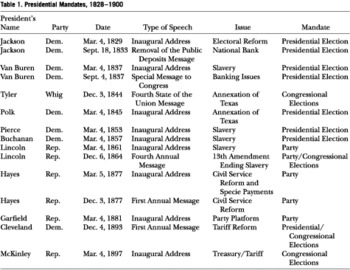
Presidential Mandates, 1828–1900
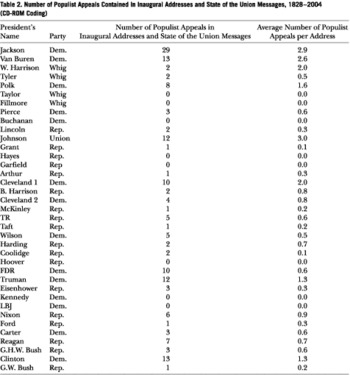
Number of Populist Appeals Contained In Inaugural Addresses and State of the Union Messages, 1828–2004 (CD–ROM Coding)
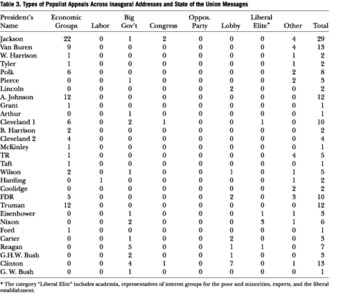
Types of Populist Appeals Across Inaugural Addresses and State of the Union Messages
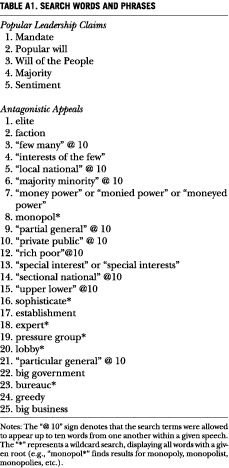
Search Words And Phrases
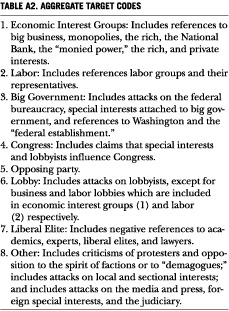
Aggregate Target Codes
 You have
Access
- 26
- Cited by