1. Introduction
Heritability is standardly defined as the ratio of genetic variance to phenotypic variance (Falconer and Mackay Reference Falconer and Mackay1996). This statistical measure is used in a variety of contexts from breeding programs to behavioral genetics. It has long been recognized that there is not one but several concepts underlying the word ‘heritability’. Perhaps the most well-known distinction is between ‘broad-sense’ and ‘narrow-sense’ heritability (Downes Reference Downes and Zalta2009). Broad-sense heritability is the ratio of total genetic variance to phenotypic variance, while narrow-sense heritability considers only the additive component of genetic variance to phenotypic variance. Another distinction rests on the concept of the gene underlying a particular heritability definition. In classical quantitative genetics, the genetic component typically refers to an evolutionary concept of the gene in which a ‘gene’ is a postulated physical basis for the phenomenological relationships between phenotypes in successive generations. In this context a ‘gene’ could have a number of possible physical substrates, including but not limited to DNA (Griffiths and Neumann-Held Reference Griffiths and Neumann-Held1999; Griffiths and Stotz Reference Griffiths and Stotz2013; Lu and Bourrat Reference Lu and Bourrat2018). Other material substrates include transgenerational epigenetic materials that do not have a DNA-sequence basis. In the context of molecular biology—including genome-wide association studies (GWAS), as we will see—it refers to a more restricted notion of the gene, such as a particular DNA sequence. In addition to the different issues surrounding the theoretical definition(s) of heritability, a gap often exists between a definition and the available methods for estimation.
Because of these different moving parts, heritability is a rich target for philosophical investigation. Previous philosophical analyses on this notion have aimed at assessing the extent to which it tracks genetic causation (e.g., Sesardic Reference Sesardic2005; Lynch and Bourrat Reference Lynch and Bourrat2017; Bourrat Reference Bourrat2019a), in particular when a gene-environment covariance or interaction exists for a trait. Prompted by new methods of estimation, other philosophical analyses have tackled a narrower issue, namely, the missing heritability problem (Turkheimer Reference Turkheimer2011; Bourrat and Lu Reference Bourrat and Lu2017; Bourrat, Lu, and Jablonka Reference Bourrat, Lu and Jablonka2017; Matthews and Turkheimer Reference Matthews and Turkheimer2019), of which one aspect is that heritability estimates obtained from GWAS are much lower than those obtained from classical family studies (e.g., twin studies, parent-offspring regression).
The aim of this article is to evaluate in what sense and to what extent heritability estimates obtained from GWAS track genetic causation from correlations. As rightly pointed out by Turkheimer (Reference Turkheimer2011), the notion of genetic causation used in the context of GWAS and heritability is often left to the intuition of the reader. I aim to clarify it. To do so, I rely on the interventionist account of causation, more particularly the analysis proposed by Woodward (Reference Woodward2010). I start by introducing the interventionist account. I then show how this account can be applied to single nucleotide polymorphism (SNP) heritability in an ideal setting. Finally, I show to what extent the relationships identified by SNP heritability estimates depart from what represent paradigmatic causal relationships within the interventionist account. In particular, the lack of known gene to phenotype mechanisms is an obstacle for these relationships to be paradigmatic.
2. The Interventionist Account of Causation
Following the interventionist account of causation, a variable C is a cause of another variable E, if changing the value of C by means of an ideal intervention, say from c 1 to c 2, is associated with a change in the value of E, say from e 1 to e 2 at a later point in time (see Woodward Reference Woodward2003, Reference Woodward2010). This provides a minimal criterion for causation within this account. An ideal intervention on C is defined as a change in the value of C at a given point in time that is associated with no other change in any other variable at that time.
Although this minimum criterion permits us to distinguish causes from noncauses, it provides no guidance to select the most salient cause(s) among different causes involved in a causal explanation. This is unsatisfactory because any given effect has infinitely many causal precedents. Yet, when one provides a causal explanation, one only cites a subset of this infinity of causes—those that are considered as the most relevant or important in some sense. The problem of choosing which of the causes should be cited in a causal explanation has been called the ‘problem of causal selection’ (Hesslow Reference Hesslow and Hilton1988). Within the interventionist account, the minimal criterion for causation can be supplemented by a number of ‘causal dimensions’ permitting us to systematically rank causal relationships according to these dimensions with the idea that, everything else being equal, the higher a causal relationship scores on any given dimension, the ‘better’, ‘stronger’, ‘more salient’, or ‘more relevant’ the causal relationship.
Following the analysis provided by Woodward (Reference Woodward2010), the causal dimensions of ‘range of influence’, ‘specificity’, and ‘stability’ are all relevant to ranking causal relationships.Footnote 1 Range of influence concerns the extent to which one can intervene in a fine-grained way on a causal variable to produce a fine-grained effect. One example commonly used is the tuning dial of a radio, which has a larger range of influence on what we hear when compared to the on/off switch. The on/off switch has only two states leading to two effects: we hear something, or we do not, and when we hear something there is no control over what we hear. In contrast, the tuning dial determines which of many channels we hear when the radio is on.
Specificity is the extent to which there is a one-to-one mapping between cause and effect variables. Sometimes the same effect is obtained from different causal states, or the same cause produces different effects. In such cases, the specificity of the causal relationship is low. Contrasting examples here are an enzyme that catalyzes a wide range of chemical reactions (low specificity) and one facilitating a single product (high specificity).
Finally, stability concerns the extent to which a causal relationship holds in different backgrounds. The higher the range of backgrounds against which a causal relationship holds, the more stable it is. For instance, Huntington’s Disease occurs in 100% of individuals when a gene on the short arm of the fourth chromosome has a particular sort of genetic abnormality (Walker Reference Walker2007). Whether the disease occurs in such a situation is insensitive to the interventions made in the background of individuals with the genetic abnormality. Malignant hyperthermia is another condition under genetic control (Rosenberg et al. Reference Rosenberg, Davis, James, Pollock and Stowell2007). It leads some individuals with a mutation—generally on the long arm of chromosome 19—to manifest, among other things, a strong fever and muscle rigidity, only during general anaesthesia. If left untreated, the condition can be lethal. This condition results from anaesthetic agents perturbing a physiological mechanism leading to muscle contraction and generation of heat. Individuals with the mutation are otherwise normal. The causal relationship between the mutation and the disorder is much less stable than in the case of Huntington’s Disease, since it only occurs in a particular background, namely, being exposed to some anaesthetic agents.
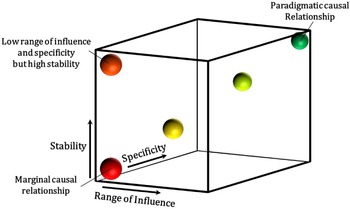
With some exceptions, the higher a causal relationship scores on each of the three dimensions discussed, the more explanatory the cause(s) involved in a relationship. To see that, consider how, everything else being equal, an explanation invoking a causal relationship scoring higher on range of influence, specificity, or stability would generally be preferred over one invoking a causal relationship scoring lower on any one of these dimensions. For this reason, I refer to causal relationships scoring maximally on the three dimensions as ‘paradigmatic causal relationships’. For the same reason, I refer to causal relationships scoring low on the three dimensions as ‘marginal causal relationships’ (see fig. 1). The former ones have a high explanatory power. The latter ones satisfy the minimal criterion, but their explanatory power is greatly diminished.
Three important dimensions of causal relationships for causal explanation: ‘range of influence’, ‘specificity’, and ‘stability’ (see main text for definitions of these dimensions). The higher a causal relationship scores on each of these dimensions, the more paradigmatic it is. In contrast, the lower it scores, the more marginal it is. It is a general feature of sciences to seek paradigmatic causal relationships.

Having presented some of the most important features of the interventionist account, in the next section I apply it to an ideal case in which heritability estimates obtained from GWAS could be causally interpreted straightforwardly and would capture paradigmatic causal relationships. In section 4, I present a number of limitations to that interpretation.
3. GWAS Heritability Estimates: An Ideal Case
At the core of GWAS are SNPs—substitutions of a single nucleotide. When such a mutation occurs, a given nucleic base A, C, T, or G is replaced by another one in the genome. In some cases, because the genetic code has some redundancy, this type of mutation leads to no change in phenotype—the amino acid coded for in protein synthesis by the nonmutant and mutant DNA sequences are the same. Such mutations are called ‘synonymous substitutions’. In other cases, a substitution will lead to phenotypic change. The aim of GWAS is to unravel from correlations the substitutions making differences to a complex phenotype—that is polygenic—such as being affected by asthma.
To do so, when GWAS are conducted, individuals of a population are classified into two groups, namely, those having the disease and those not having it.Footnote 2 If a given SNP is more strongly associated with the disease state, one can conclude—with some confidence—that the difference in phenotype is due in part to the nucleotidic variant.Footnote 3 When this happens, the variant is said to be ‘causal’ (Yang et al. Reference Yang, Zeng, Goddard, Wray and Visscher2017, 1305).
Despite being purely observational studies as opposed to experiments in which interventions are performed, GWAS emulate the minimal criterion of causation, a claim made explicitly in the literature (see Lee and Chow Reference Lee and Chow2013). Although no ideal interventions are performed on nucleotides in GWAS, one can assume, following the law of large numbers, that the phenotypic differences made by the genetic background and the environment of the individuals of the two groups are, on average, the same when the population is large and the factors are independent. It should be clear, however, that because one is dealing with correlations rather than causation qua ideal interventions here, despite all the precautions one might take to assess whether an SNP is causal, there is no guarantee that it truly is so. Some confounding factors might be the reason an SNP is associated with a phenotypic difference, such as when there is some population stratification (see, e.g., Mathieson and McVean Reference Mathieson and McVean2012). Putting the problems surrounding confounding variables to one side, one can estimate the (SNP) heritability of a trait from associations between SNPs—assumed to be causal—and phenotype.
Early attempts to estimate heritability from GWAS have aimed to discover all causal variants for a given phenotype by conducting a series of GWAS and summing the variance explained by each of the different causal variants identified for a trait (Yang et al. Reference Yang, Zeng, Goddard, Wray and Visscher2017). Once this sum is divided by the total phenotypic variance, we obtain a heritability estimate. It came as a surprise to geneticists that these estimates account for less than 5% of the phenotypic variation for human height—the most studied human phenotype—much less than the estimates obtained by traditional family studies (around 80% for height). This observation motivated the quest for the now-famous missing heritability problem (Maher Reference Maher2008; Turkheimer Reference Turkheimer2011; Bourrat and Lu Reference Bourrat and Lu2017; Bourrat et al. Reference Bourrat, Lu and Jablonka2017; Matthews and Turkheimer Reference Matthews and Turkheimer2019). Using a method based on maximum likelihood estimation that takes into account all the information from SNPs at once rather than independently as with the early GWAS estimates, Yang et al. (Reference Yang2010) were able to explain about 45% of the variance in height, with the hope that new, more powerful, studies will close the remaining gap with family studies’ estimates.Footnote 4
4. SNP Heritability and Causal Dimensions
In the previous section, I presented an ideal situation in which heritability estimates obtained from GWAS capture the extent to which SNPs make differences to a given phenotype. I have already mentioned that the existence of confounding factors might render an estimate spurious. Apart from this problem, there might be different reasons why an estimate refers to causal relationships that depart from what I called ‘paradigmatic causal relationships’ (see fig. 1). To refer to paradigmatic causal relationships, SNPs would have to be difference makers of phenotypes, scoring high on range of influence, specificity, and stability (and certainly other dimensions not treated here). Is that the case?
Let us start with range of influence. Because SNPs represent the smallest possible intervention-like changes one can make on the genome, this may be interpreted as a high range of influence from SNP to phenotype. In spite of this, the range of influence here is restricted to only a subset of what is meant by ‘genetic’ change, in particular when ‘genetic’ is understood from the perspective of the evolutionary gene concept.
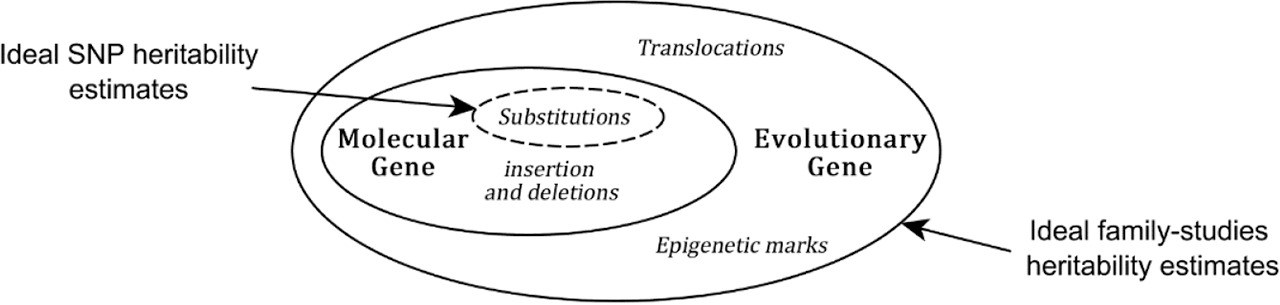
To see this, recall that SNPs refer to only one type of mutation, namely, substitutions. However, other types of mutations occur on the genome. The most common are insertions and deletions—mutations that, as the names indicate, insert or delete a number of nucleotides on a DNA strand. We know that these types of mutations are involved in a number of diseases such as some cases of cystic fibrosis (Iannuzzi et al. Reference Iannuzzi1991). Insofar as SNPs concern only substitutions, the genetic variance they refer to is a restricted conception of the molecular gene, as opposed to a notion of the molecular gene that would include insertions and deletions (see fig. 2).
SNP heritability refers to a restricted notion of the molecular concept of the gene, which is itself less general than the concept of the evolutionary gene used in classical quantitative genetics.

Furthermore, other types of changes in the cells can have phenotypic effects. Some concern DNA itself; others do not (see fig. 2). For instance, it is well known that a particular DNA sequence being at one position rather than another on a chromosome can make a phenotypic difference. The position-effect variegation observed in Drosophila melanogaster in which mutants express a variegated eye pattern, as opposed to a uniformly red color in nonmutants (see Elgin and Reuter [Reference Elgin and Reuter2013] for details on this fascinating case) is one such example. The cause for the phenotypic difference is due to a chromosomal translocation (more particularly an inversion) on the X chromosome. Because of the change in position, the gene responsible for eye color is located in the heterochromatin (a condensed part of nuclear DNA difficult to access for RNA polymerases) in mutant individuals, as opposed to the euchromatin (less condensed and thus more easily accessible for RNA polymerases) in wild individuals. This change in position explains why the gene is expressed in some cells but not others in mutant individuals: when polymerases reach the gene, it is expressed; otherwise it is not. This difference is ‘genetic’ in the sense that it is heritable and thus corresponds to the evolutionary notion of the gene, but it is not genetic from the perspective of the DNA sequence underlying the character since this sequence is the same (but with an inversion) in mutant and wild individuals. Causal variants identified in GWAS do not capture these factors.Footnote 5
These different cases indicate that if the causal relationships between SNPs and phenotype, and consequently their aggregation and normalization into SNP heritability estimates, satisfy—or more accurately emulate—the minimal criterion of causation, the type of ‘genetic’ causal relationships they capture have restricted ranges of influence. They refer to a narrower notion of the gene than that referred to in classical quantitative genetics. The extent to which these relationships have restricted ranges of influence would, however, be difficult to estimate and is ultimately an empirical question that will probably lead to a different answer for different phenotypes.
Having shown in what sense SNP heritability departs from a paradigmatic genetic causal relationship with respect to range of influence, I now move on to specificity. We saw that SNPs can be conceptualized as emulations of idealized interventions. Substituting one nucleotide for another by means of an ideal intervention in one individual (at the zygote stage) would, following the interventionist account, make a phenotypic difference, if this nucleotide is causal. But one might legitimately ask whether in general the focal phenotypic difference made would be the only one, that is, whether SNP-to-phenotype causal relationships are specific. Were those relationships unspecific, claims about SNPs being important causes of phenotype would be somewhat undermined.
The example of the gene FOXP2 is a case in point. This gene has been presented as a gene for language in popular media. This is because a number of mutations on this gene—located on the seventh chromosome in humans—are associated with language impairment (for a review including the history of the discovery of this gene, see Nudel and Newbury [Reference Nudel and Newbury2013]). Yet, one might reasonably ask whether speech impairment is only one of the outcomes of a number of other phenotypes. For instance, it is well known that very precise motor coordination is necessary in order to be able to speak. Research on the FOXP2 gene shows that mutations on this gene can lead to difficulties with fine motor coordination such as individuals having challenges tying their shoelaces or buttoning their clothes (Morgan et al. Reference Morgan, Fisher, Scheffer, Hildebrand and Adam1993). It is also clear that FOXP2 is involved in the development of many parts of the brain, as well as the development of the lungs and gut. Knockout of the gene in mice leads to reduced life expectancy (Vargha-Khadem et al. Reference Vargha-Khadem, Gadian, Copp and Mishkin2005).
It is also important to recognize that without a mechanism explaining the mode of action of differences made by a nucleotide change, assessing the degree of causal specificity of causal relationships from SNPs to phenotypes will be undermined.Footnote 6 This is, however, mitigated by measures of genetic correlation between different traits that permit estimates of the pleiotropy for a given genetic variant—that is the extent to which a gene influences more than one trait, a form of causal specificity. Using such estimates, Visscher et al. (Reference Visscher, Wray, Zhang, Sklar, McCarthy, Brown and Yang2017) report that pleiotropy is pervasive for many human complex traits. Finally, and related to that point, the extent to which a relationship from SNP to phenotype is specific will, in many cases, depend on the way a phenotype is defined. A complex trait such as hypercholesterolemia would perhaps appear as a number of different traits—different subtypes of hypercholesterolemia—if one knew all the different mechanisms involved in the development of the condition.Footnote 7
In sum, even though an SNP might be causally linked to some of the variation in a particular phenotype, it might only be so very nonspecifically. Without details of the molecular mechanisms underlying the expression of a phenotype, however, it would be difficult to assess the extent to which the variation results from a specific causal relationship.
Moving on to stability, it should be stressed that all associations between SNPs and phenotype happen in particular populations. Why does that matter? Simply because establishing a causal relationship between an SNP and a phenotype in one population does not mean that this relationship would hold in a different background—especially in the absence of knowledge of underlying mechanisms. It could very well be the case that the same variant in one population has the opposite effect or no effect in a different population.Footnote 8 Recall the case of malignant hyperthermia. The disorder occurs as a result of a single mutation and in very particular circumstances. From this example, it is possible to imagine that many of the causal variants influence complex phenotypes only under specific conditions (e.g., diet, climate, cultural practices) varying between different populations. Were this to be the case, SNP heritability estimates would refer to unstable causal relationships (see fig. 1). The possibility of such phenomena is recognized in the literature, and it is hoped that studies of populations of non-European descent will soon be available (Visscher et al. Reference Visscher, Wray, Zhang, Sklar, McCarthy, Brown and Yang2017) to permit us to assess the stability of the SNP heritability estimates.
5. Conclusion: Where Are We At?
I have shown that applying the interventionist account of causation to the notion of SNP heritability can help us understand some of the challenges surrounding the claim that SNP heritability captures causal relationships between genes and phenotypes. More particularly, if (strictly speaking) it is true that causal variants represent loci of genetic causation for phenotypes (insofar as they emulate ideal interventions), they generally do not correspond to the full range of influence classically associated with genetic causation. It is also doubtful that the causal relationships identified in GWAS have high specificities in general—although there might be some exceptions—especially in the absence of known mechanisms underlying the relationships (see Matthews and Turkheimer Reference Matthews and Turkheimer2019). Finally, it is unclear whether all the associations found in populations of European descent will remain once samples from a wider range of populations become available. Having framed some of the problems surrounding the notion of heritability from the perspective of the interventionist account, I expect the ins and outs of other problems surrounding this concept—especially those pertaining to causation in the context of the advent of new biotechnologies—to be more easily assessed thanks to this framing.