Introduction
Indigenous livestock breeds are known for their hardiness, disease resistance, survival on little inputs and adaptability to variable environments (Köhler-Rollefson et al., Reference Köhler-Rollefson, Rathore and Mathias2009). Such breeds are therefore believed to be more economically efficient than other breeds when raised in their home tract (Ayalew et al., Reference Ayalew, Rischkowsky, King and Bruns2003). Many indigenous livestock breeds are, however, on the verge of extinction because of their gradual dilution, as driven by market demands and inappropriate use of new breeding technology (Köhler-Rollefson et al., Reference Köhler-Rollefson, Rathore and Mathias2009). Limited awareness of the adaptive characteristics of indigenous livestock breeds owing to a lack of proper scientific documentation is one of the key reasons for such dilution (Hassen et al., Reference Hassen, Bekele, Ayalew and Dessie2007; Köhler-Rollefson et al., Reference Köhler-Rollefson, Rathore and Mathias2009).
There are quite a number of indigenous livestock breeds that still need to be scientifically documented and characterized to enable their conservation (Bhatia & Arora, Reference Bhatia and Arora2005). To make the conservation of indigenous breeds a reality and ensure sustainable use of their genetic diversity, it is particularly desirable that their phenotypic characteristics and performance be evaluated in their home tracts and under traditional management conditions (Zarate, Reference Zarate1996). Identification of specific breed attributes can also contribute to better use of these genetic resources by farmers (Mwacharo et al., Reference Mwacharo, Okeyo, Kamande and Rege2006).
In Pakistan, the most thoroughly studied indigenous buffalo breeds are Nili-Ravi and Kundi, though 37 percent of the buffalo population has been categorized as non-descript (Khan et al., Reference Khan, Khan, Ahmad and Mahmood2007). These non-descript breeds also include Azikheli, which is known for its adaptation to the mountain environment (Khan et al., Reference Khan, Rahim, Rueff, Saleem, Maselli, Mohammad and Wiesmann2011). The present investigation is thus designed to study the morphological (physical and morphometric) characteristics of Azikheli in its home tract under traditional management conditions.
Materials and methods
Home tract and study area
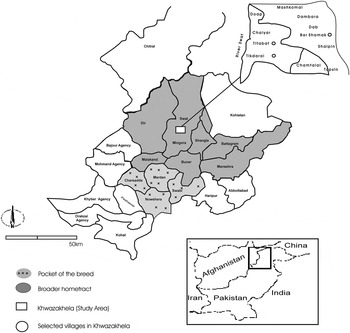
The Azikheli is named after its original home tract known as Azikhel (Khwazakhela union council). Khwazakhela, which covers an approximate area of 124 km2 and is one of several tributary valleys of the Swat River, has been chosen as the study area for this investigation (Figure 1). Khwazakhela has a mean temperature ranging from −2°C to 33°C and an average annual rainfall of 1400 to 1500 mm (Khan & Atta-ur Rahman, Reference Khan2010).
Map of the study area.

The broader home tract of the breed includes the watershed of the Swat River (Swat district) and the Panjkora River (Lower and Upper Dir districts), as well as the Shangla, Buner, Batagram, Manshera and Malakand districts, and covers approximately 20 000 km2 and has an elevation range from 516 to 3 314 m a.s.l. Pockets of the breed can also be found in the districts of Mardan, Charsadda, Nowshera and Sawabi as a result of buffalo transhumance that prevails in some farming communities.
Sampling pattern
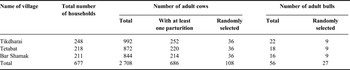
Khwazakhela union council includes seven main villages. Three villages were randomly selected: Tikdarai, Tetabat and Bar Shamak (Figure 1). The number of cows (with at least one parturition) and bulls (aged 3 years or more, and which are used for breeding purposes) randomly selected from these villages is presented in Table 1. For the cows, measurements were made within 2–3 months after parturition by using measuring tape according to Food and Agriculture Organization (1986).
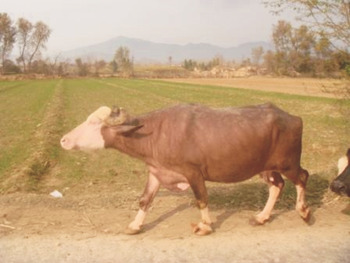
Azikheli cow.

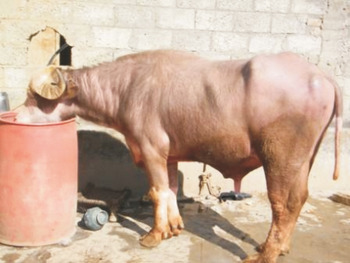
Azikheli bull.

Sampling pattern.

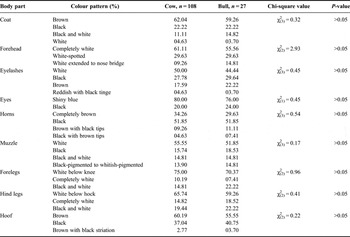
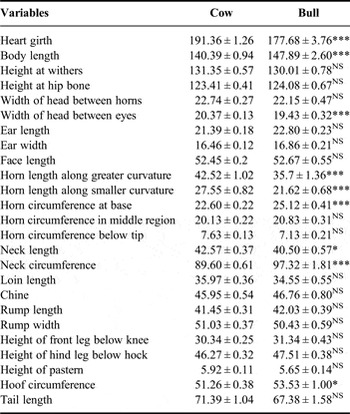
Physical characteristics (colour of the body coat, forehead, eyelashes, eyes, horns, muzzle, forelegs, hind legs and hooves) were recorded for each selected animal, and measurements were taken for the heart girth (body circumference immediately posterior to the front leg), body length (distance from shoulder point to pin bone), height at withers (the vertical distance from the ground level to the highest point of withers) and at hip bone (the vertical distance from the ground level to the hipbone), width of head (between horns and between eyes), ear length (distance from the tip of the ear to the base of the ear), ear width (at the widest part of ear), face length (the distance between the head pol and muzzle), horn length (the distance from the tip of the horn to the base of the horn both along greater and smaller curvatures), horn circumference (at base, middle region and below tip), neck length (the distance from at the junction with shoulder to at the junction with head) and circumference (at the midway from the junction with shoulder and junction with head), loin length (distance from withers to last rib), chine (distance from last rib to hipbone), rump length (distance from hip to pin bone) and width (distance between the lateral surfaces of the tuber coxae), height of front leg below the knee (vertical distance from knee to the ground level), height of hind leg below hock (vertical distance from hock to the ground level), height of pastern (vertical distance from pastern to ground level) and circumference of hoof and length of tail (distance from the tail drop to the tip of the tail).
Statistical analysis
Chi-square tests of independence were used to compare the physical characteristics of bulls and cows. Mean, standard error and Student's t test were calculated for morphometric measurements of both sexes.
Results
Physical characteristics
No significant differences were observed between cows and bulls (Table 2). Figures 2 and 3 show examples of the Azikheli cow and bull, respectively.
Physical characteristics of Azikheli.

Morphometric characteristics
Table 3 shows that Azikheli cows have a significantly larger heart girth, wider forehead, longer horns and longer neck than bulls. On the other hand, bulls have a significantly longer body, thicker horns and neck, and larger hooves than cows. Horns are flat laterally, and directed backwards and slightly upwards without twisting. The upward curve is variable and gives the horn a sickle or semi-sickle appearance. This is a specific characteristic of the Azikheli breed.
Mean values ( ± SEM) of morphometric measurements (cm) of Azikheli.

NS, non-significant.
*P < 0.05, ***P < 0.01.
Discussion
Buffaloes show a variety of coat colours, with most riverine buffaloes being black to ashy grey (Soysal et al., Reference Soysal, Tuna, Gurcan, Ozkan, Kok, Castellano, Cobanoglu and Barone2007), while the coat colour of swamp buffaloes ranges from grey to completely black, with very few having a white coat (Miao et al., Reference Miao, Wu, Wang, Li, Tang, Liang, Mao, Luo and Zhang2010). The common buffalo breeds of Pakistan are predominantly black (Khan et al., Reference Khan, Younas, Riaz and Yaqoob2005) with only occasional occurrence of brown coats (8 percent) in Nili-Ravi and Kundi buffalo (Maqsood, Reference Maqsood1980). A dark coat causes heat intolerance because it absorbs a great deal of solar radiation and this is one of the reasons why dark-coated breeds wallow in swamps (Marai & Haeeb, Reference Marai and Haeeb2010). The dominant brown coat colour (62.04 percent) in Azikheli seems to be an adaptation to the mountainous environment, where swamps are not available.
The farmers of the area prefer Sra Chargai (a brown coat colour with a completely white forehead) to Sra Tikai (a brown coat colour with a white spot on forehead).
The non-significant difference between the colour patterns of various body parts of the Azikheli cow and bull may be due to the prevalence of natural selective forces over social preferences in determining coat colour in bovines (Seo et al., Reference Seo, Mohanty, Choi and Hwang2007).
Information on morphological characteristics is helpful in ensuring effective management and conservation of animal genetic resources with a view to obtaining phenotypically pure local genetic resources for future selection and breed improvement strategies (Yakubu et al., Reference Yakubu, Salako, Imumorin, Ige and Akinyemi2010). Berthouly et al. (Reference Berthouly, Rognon, Van, Berthouly, Hoang, Bed'Hom, Laloe, Vu Chi, Verrier and Maillard2009) recorded heart girth, body length, height at withers, neck circumference, ear length and thorax depth as appropriate variables to differentiate the local Vietnamese swamp buffalo population from other buffalo breeds. For Pakistani buffalo breeds, such information is limited to heart girth, body length and height at withers, hence comparative measurements shown in Table 4 are limited to these three parameters.
Comparison of morphometric measurements (cm) of Azikheli and Nili-Ravi.

aKhan, Younas & Hanjra (Reference Khan, Younas and Hanjra1982), Ranjhan & Pathak (Reference Ranjhan and Pathak1993), Borghese & Moioli (Reference Borghese, Moioli and Borghese2005).
bValues for morphometric measurements of Nili-Ravi are in ranges.
Comparison of these parameters between the two breeds reveals that the body size of Azikheli is smaller than that of Nili-Ravi, a breed that is well adapted to life in the plains. Owing to their low maintenance requirements (Ibrahim & Brannang, Reference Ibrahim and Brannang2001), smaller animals are considered less susceptible to fodder shortages (Hall, Reference Hall1998) and are able to move more easily and rapidly on mountain slopes (Ouma et al., Reference Ouma, Abdulai, Drucker and Obare2004). As the Azikheli is native to mountain valleys with high seasonal fluctuations in the availability of feed resources, its smaller body size can be interpreted as an adaptive trait to fodder fluctuations, as well as to grazing in mountain terrain and transhumance. Sexual size dimorphism has been observed in the present study, with a longer body of the bull, whereas the cow has a large heart girth size and wider head at the eyes.
Conclusion
Given its small body size and brown coat colour, it appears that the breed is well adapted to mountain slope grazing and variable availability of feed resources. Differentiating characteristics of the Azikheli include the dominant brown coat colour and the sickle-shaped horns. In view of climate change and the likelihood of an increase in the frequency of extreme weather events in mountain regions in particular, livestock breeds like the Azikheli could prove to be a valuable resource for mountain dwellers in terms of adaptation to such weather extremes. The morphometric characteristics described here provide a basic description of the breed, but studies on genotypic characteristics and plans for in situ participatory conservation of the Azikheli are suggested measures to secure its appropriate conservation.
Acknowledgements
This study was conducted within the framework of the Joint Research Partnership funded by the Swiss National Science Foundation (SNSF) and the Swiss Agency for Development and Cooperation (SDC). It was also conducted within the framework of the Swiss National Centre of Competence in Research (NCCR) North–South: Research Partnerships for Mitigating Syndromes of Global Change. The NCCR North–South is co-funded by SNSF and SDC, and the participating institutions.