


1. Introductory remarks
Mukrī Kurdish is a group of distinct but distantly related varieties classified collectively as a variety of Central Kurdish. The affiliation of Central Kurdish within the general grouping of “Kurdish” is a matter of ongoing scientific debate. Mukrī is a little-studied variety, with no previous research of its dialectal variation.
1.1. Mukrī language variety in the literature
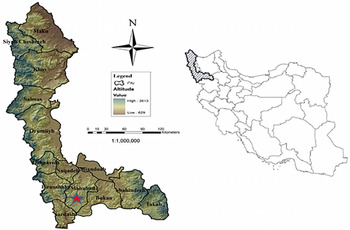
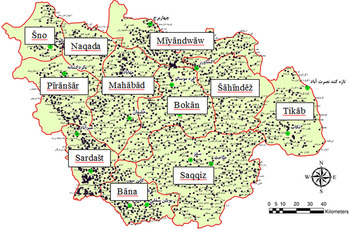
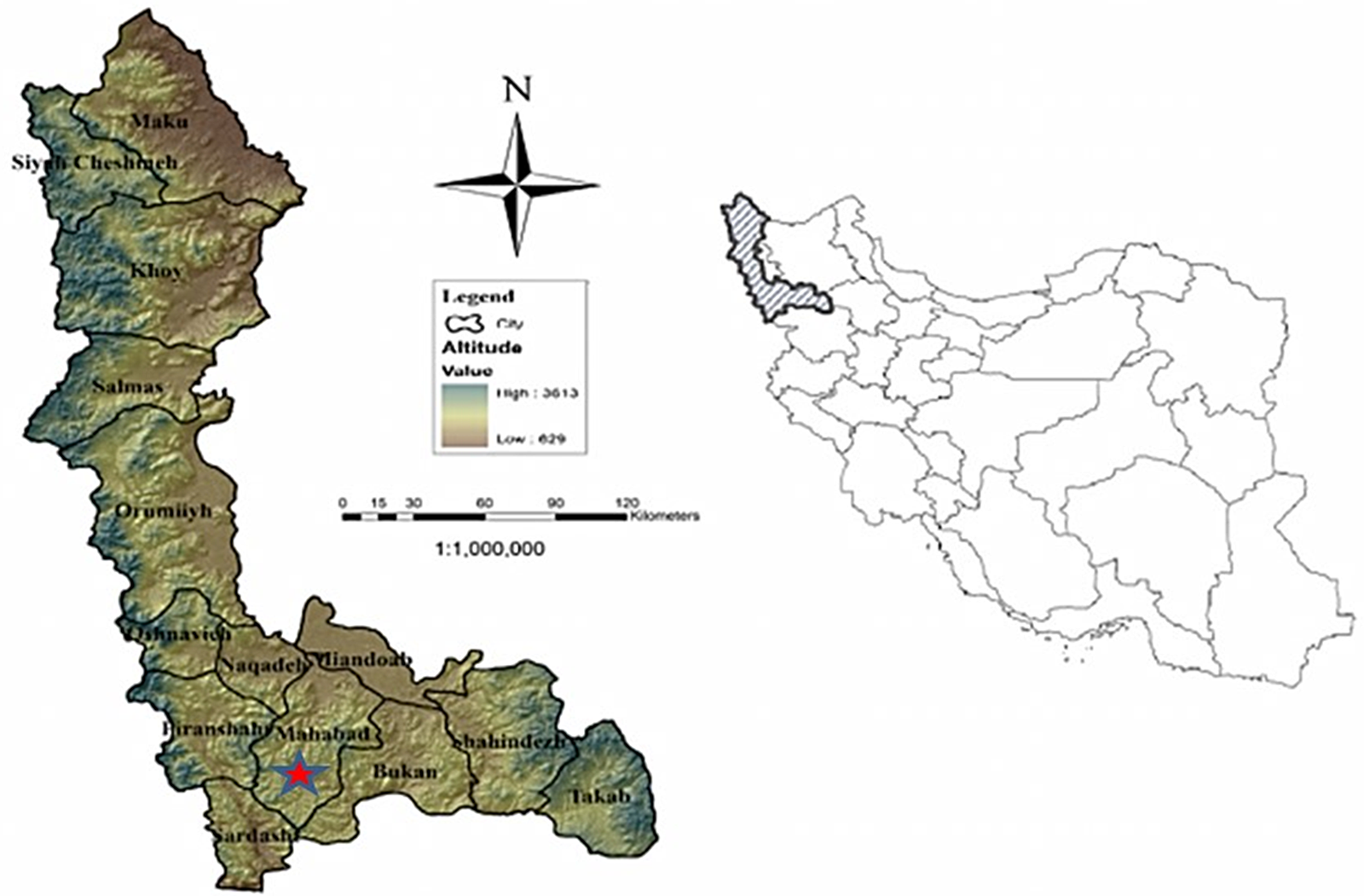
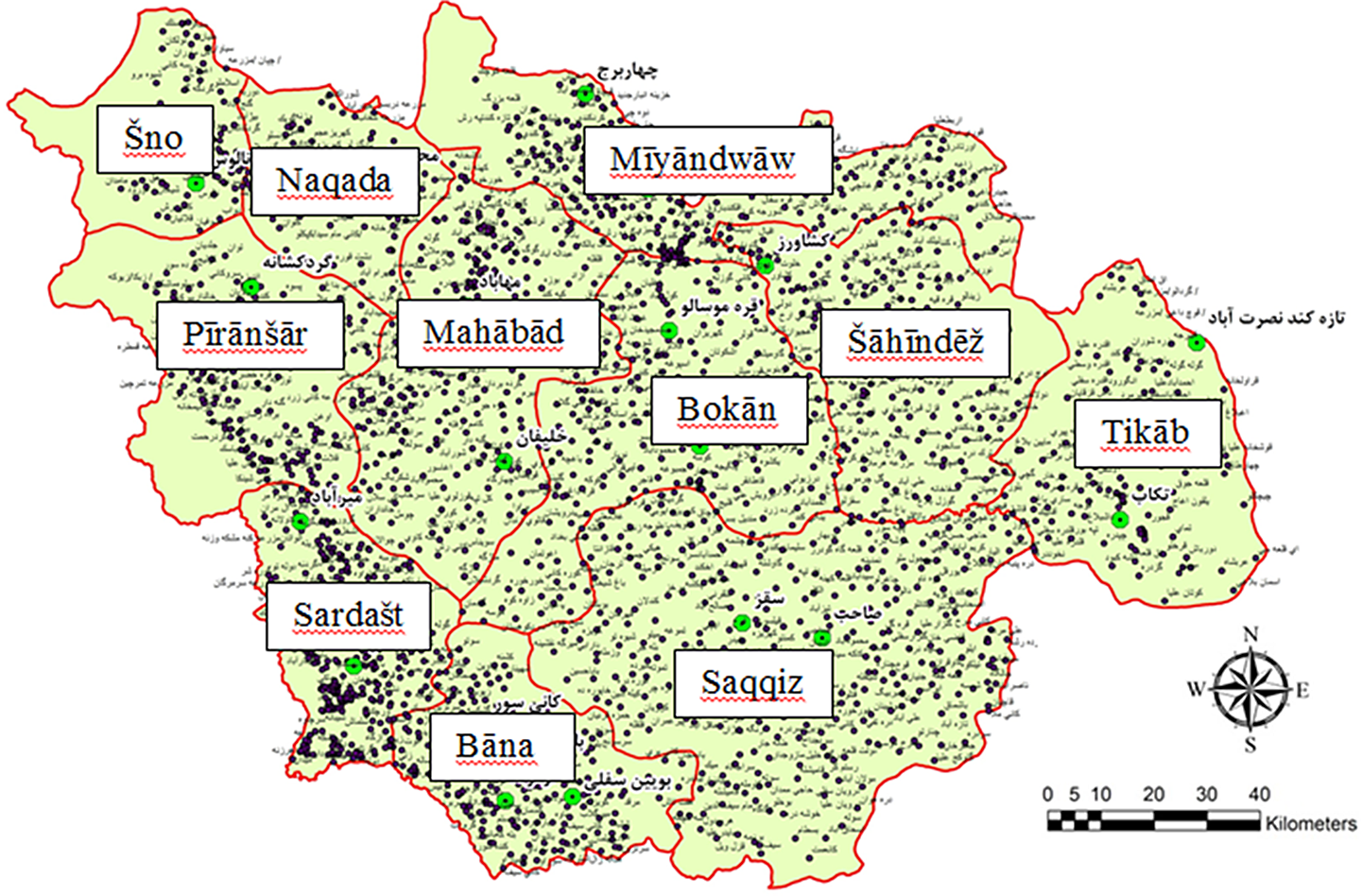
Kurdish is a term applied to a group of varieties which are quite different linguistically. With respect to Kurdish, it is hard to answer the question of what constitutes a language and what constitutes a variety in an absolute way. One can consider Kurdish a language group (Haig and Matras, Reference Haig and Matras2002) rather than a single language made up of several regional forms. Due to this difficulty, there is no reliable language mapping of Kurdish or any tree diagram that would illustrate the genetic relationship among Kurdish varieties. Therefore, I will use the term “Kurdish” as an “ethnic” rather than “linguistic” definition, in line with the speakers’ ethnic Kurdish identity that stretches across several linguistic varieties. Map 1 illustrates West Azerbaijan Province in northwest Iran where Mukrī is spoken, and Map 2 shows the administrative boundaries of the MukrīyānFootnote 1 region in the southern areas of West Azerbaijan.
The map of West Azerbaijan in Northwest Iran.
The administrative divisions of the Mukrī dialect area.
The term Mukrī is derived from the name of the Mukrīyān Principality (q.v.; late 9th/14th-late 13th/19th century)Footnote 2 with its capital in MahābādFootnote 3 (Sāvojbolāḡ, Kurd. Sāblāḡ)Footnote 4 (cf. Minorsky, Reference Minorsky1957: 65–67 for further information). This variety was in contact with Armenian, Azeri Turkic, and North-East Neo-Aramaic (NENA) in northwest Iran for a long time. Mukrī is considered a sub-variety of Central Kurdish (CK) (cf. De Morgan, Reference De Morgan1904; Mann, Reference Mann1906; McCarus, Reference McCarus1958, Reference McCarus1960; Minorsky, Reference Minorsky1957; MacKenzie, Reference MacKenzie1961; Hassanpour, Reference Hassanpour1992; Öpengin, Reference Öpengin2016). Mukrī as it has been known is not a uniform language variety. Its sub-varieties have not been the subjects of a thorough descriptive study nor have they been classified. Mann (Reference Mann1906) published a grammar of Mukrī based on folk tales which contains a number of errors, while MacKenzie (Reference MacKenzie1961) gives a more detailed classification of CK dialects and an overview of Mukrī based on Mann’s (Reference Mann1906) grammar, thus reproducing the latter’s errors. Hassanpour (Reference Hassanpour1992) divides CK dialects into two main groups: Mukrī and Silēmānīya. Both MacKenzie and Hassanpour restrict Mukrī to Iran. McCarus (Reference McCarus1958:4) also mentions similarity between Mukrī and Silemānīya Kurdish and he categorized both in the same dialect group. Kalbasi (Reference Kalbasi1983) offers a formal grammar of Mukrī of Mahābād. Her work is descriptive, and no explanatory grammatical rules are given. Finally, Öpengin (Reference Öpengin2016) gives a more detailed account of Mukrī grammar, based on data collected in the villages of Sarāwānān (12 kilometers east to Mahābād) and Qozluje (32 kilometers south to Mahābād), and in the town centers Mahābād and Šino. None of these works provide a full comparative study of phonological features across the different varieties of Mukrī.
1.2. Objectives of the study
In this article, I will introduce major phonological phenomena occurring in the Mukrīyān region in order to establish a language mapping with a special focus on the specific dialectal boundaries. The outer boundaries of the language mapping will be established comparatively, but this study focuses mainly on the urban areas of the Mukrīyān region. The exact location of the geographical boundaries must await the completion of further detailed studies in small towns, rural areas, and villages. In general, there is considerable skepticism among the scholars with respect to the Kurdish dialectal boundaries, particularly concerning Mukrī.
I will present examples of archaic forms which are preserved in Mukrī. The reasons why these varieties are so conservative are the topography of the region, the communication habits of the people, and their language awareness. This study also shows that Mukrī, although mainly spoken in the Kurdish areas of Iran, also plays an important role as a bridge variety and a transition zone from CK in southern areas in Iran to Northern Kurdish in Iran, Iraq, and Turkey, as well as to other CK varieties close to the borders of Iran. Furthermore, all CK varieties are linguistically very distinct from each other.
1.3. The Mukrīyān region and the Mukrī sub-varieties
Before talking about the phonological features of the Mukrī dialects, I will first give a general overview of the Mukrīyān region and its population size.
1.3.1. Districts of the Mukrīyān region
For a better understanding of the degree of dialectal diversity in Mukrīyān region, it is essential to know some information about the population size and demography of the region and their effects. So far, such studies have not been carried out on this area. Large or small population sizes might have an influence on the underlying mechanisms and expected linguistic patterns of language contact and change. For an exhaustive study of their correlation, there is a need for an empirically and statistically robust methodology for the study of rates of language evolution and its correlation with population size. It is important to find out which population size generates more language innovation or is less prone to loss of archaic linguistic forms. Moreover, one should consider that there are several factors which might be influential in such generalizations, for example, cultural norms in a specific society, degree of resistance to change in a speech community, and colonization of speech communities into different clans and tribal systems.
Mukrīyān Kurdistan is bounded in the north by the Urmia county, on the west by Iraq and Turkey, and on the southern areas by the north of Kurdistan Province. The central regions of Mukrīyān consist of several counties. These include SardaštFootnote 5 (118,849 inhabitantsFootnote 6), Mahābād (236,849), Bokān (251,409), Pīrānšār (138,864), all of which are mostly Mukrī Kurdish speaking, but there are Azeri Turkic speakers, who work in official and governmental organizations.Footnote 7 In addition, the region includes Šino (73,886), where Mukrī speakers are in contact with the Harkī dialect of Kurmānjī, and with Azeri Turkic. Other districts include Naqada (127,671), Mīyāndwāw (273,949), Šāhīn Dēž (92,456), and Tikāb (80,556); in these cities Mukrī Kurdish speakers are in contact with Azeri Turkic speakers. Outside of West Azerbaijan borders and within the official borders of Kurdistan Province, BānaFootnote 8 (115,325Footnote 9), and Saqqiz (168,359) are considered part of the Mukrīyān region. Both cities are Mukrī Kurdish-speaking zones. The total population of the Mukrīyān region based on the 2017 census is 1,696,132. The real number could be higher than the official census, because many people do not participate in the official statistics.
1.3.2. Language attitudes
Individual perception and understanding of the language and culture is also an influential factor in the language diversity of the region. Educated people, especially teachers, university graduates, and clan leaders, exert crucial influences on the speech community. The people express their ethnic, communal, and cultural identity via their language. Some speech communities easily change their speech types and others resist any kind of language innovation. As such, language perception of the speech community will contribute to the heterogeneity of individuals in the same speech community or in a different speech community. For example, Bokānī speakers think they are closer to Sardašt (145 km from each other) in terms of language although they are closer in distance to Saqqiz (35.8 km) and to Mahābād (69.6 km). Speakers in Mahābād consider themselves totally different from almost all other regions and they group the variety of Bokān with that of Saqqiz, Sardašt with Pīrānšār (92.2 km apart), and Pīrānšār with Šino (47.7 km apart). During my fieldwork interviews (June and July 2005) and my recent online interviews (August to October 2017) with informants in the western areas, the majority of people almost always discussed the linguistic differences in their region, including villages and cities, without expressing any negative judgment. For example, Sardašt and Pīrānšār speakers consider the Šino variety a “rural variety”Footnote 10 and the Naqada variety a mixed Kurdish-“Ajam”Footnote 11 variety. On the other hand, speakers in Mahābād were mainly talking about correct grammatical forms and standard language.Footnote 12 Furthermore, in Mahābād, if a speaker does not speak in a way similar to the Mahābād variety, he/she will be first considered a Mangūř,Footnote 13 and if the speaker says he or she is not Mangūř, the Mahābādī informants refer to them as a speaker of the Sardašt and Pīrānšār variety or ultimately, as someone with an Iraqi Kurdish accent.Footnote 14
2. Data collection
The current article is part of two bigger research projects: my PhD research project on word order in the languages of Northwest Iran and the Linguistic Atlas of Azerbaijan Qarbi (cf. Asadpour, Reference Asadpour2011 for detailed information about the locations and informants). The study is based on data which I collected from 2004 to 2006. Additionally, until 2014, I continued traveling to different cities and villages to collect additional data and information. The corpus of the study includes a questionnaire, free speech narratives, conversational data, and crowdsourcing data. The data is partially transcribed, recorded, and archived in a personal digital storage and The Language Archive (TLA)Footnote 15 in Nijmegen. For the purpose of this study, I explored those parts of the material which are necessary to pinpoint parallels in each area. The current analysis deals with the Mukrī regional varieties. Some outlier language varieties in Kurdistan Province and Iraqi Kurdistan have been introduced to show a clear picture of differences and similarities across Central Kurdish varieties. A more fine-grained Central Kurdish dialectology awaits further investigation. In order to show the dialectal differences, I choose only those candidate features which divide the areas into separate isoglosses. The main aim is to identify geographically continuous and uniform features, with those that occur frequently being my priority. In addition, they should be easily identified and confirmed by the native speakers. The features shown in this study are selected on the basis of a) consistency, b) exclusiveness, c) high frequency, d) variability in the distribution, and e) systematicity.
While selecting informants for this study, I chose those who preferred to use a language form associated with a specific locality, as opposed to the regional variety spoken commonly by all Mukrī speakers. Informants included both males and females. The interviewees were also divided into literate, those who studied at school and university, and illiterate informants, those without any proper educational training. The phonemic system of each village has been determined by the speech of an informant, later checked with several other informants. The dialect differences were noted during the interviews. In addition, the informants also randomly reported the linguistic differences of the neighboring villages. Notes were taken during non-linguistic group conversations among the informants. The information, which is gathered based on the questionnaire and the free speech data, was analyzed. Then several hypotheses were made based on the recorded dialectal differences. These hypotheses were tested over the last years with the informants. This was done partly via crowdsourcing through social media networks like Telegram, WhatsApp, Viber, IMO, Facebook, and Skype. Independently of eventual advantages and disadvantages of using social media, it was highly beneficial for the current study. For instance, there is the possibility of joining a chat room and hearing each other’s opinion live. Moreover, it was also possible to observe the written output in both Kurdish-Roman and Kurdish-Arabic scripts. This gave me a clear picture of how the informants perceived different local and regional phonetic differences and how they expressed it spontaneously. All the informants had been informed of the purpose of the discussions before the interviews and asked for their permission to use their data.
These linguistic data have been supplemented by another set of data on perception and language awareness of the informants. The purpose was to determine to what extent the villages in different regions were aware of language differences both in form and function. I also asked questions about their attitude toward their language variety and the neighboring varieties such as: What do you think about your language and the other varieties? Which one is standard? How would you characterize your language and neighboring languages—“useful,” “sweet,” “interesting,” etc.? Selected information regarding these interviews is presented along with the list of linguistic features below.
3. Analysis of phonological and phonetic featuresFootnote 16
I will point out the similarities and differences with outlier language varieties. Some features, which are analyzed in this study, include the distribution of pharyngeal /ħ/ and /ʕ/, dark and light /ł, l/, flap and trill /ɾ, r/, glottal /h/ and /ʔ/, velar fricative /x/, palatalized velar /k, g/, palatal affricates /tɕ, dʑ/, palatal nasal /ɲ/, front vowel close /i/, back close vowel /u/, front close mid /ø/, and syllabicity.
3.1. Alternation in pharyngeals (ħ vs. ʕ, ʕ vs. ħ) and glottal stop /ʔ/
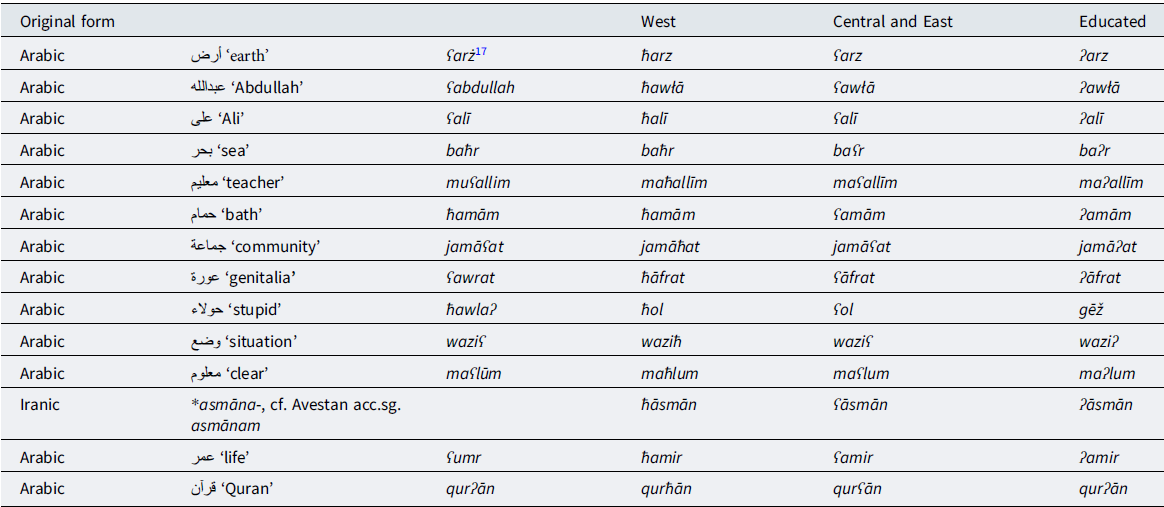
Mukrī varies with regard to the pharyngeals (ħ > ʕ, ʕ > ħ). The pharyngeal system of the language varieties in Mukrīyān displays a fusion to some extent between three types: /ħ/-type e.g., ħerz ‘earth,’ /ʕ/-type e.g., ʕerz ‘earth,’ and /ʔ/-type e.g., ʔerz ‘earth.’ The glottal stop /ʔ/ is emerging as a recent phenomenon. Such distinction is mainly due to their geographical position straddling West and East Mukrī. Regional variation plays an important role in the choice between /ħ/ or /ʕ/. In West Mukrī (for instance, Sardašt and Pīrānšār) and parts of the Central Mukrī of Mahābād (mainly in Pišttap, Maydānī Haywānān (Istiqlāl Square), Rabat, and Nałās) speakers use /ħ/, see Table 1. Moreover, in South Mukrī, for instance in Bāna, /ħ/ is preferred over /ʕ/ and in Saqqiz /ʕ/ and mostly /ʔ/ over /ħ/. Saqqiz is almost like the Ardałān area, but the parts of Saqqiz that are in contact with East and Central Mukrī show an allophonic relationship between /ʕ/ and /ʔ/. In general, a recent tendency in Central and East Mukrī is the replacement of /ħ/ and /ʕ/ by /ʔ/, which occurs mainly among literate people especially females. In Mahābād, the literate people during the interviews stated that “the /ħ/ and /ʕ/ forms are uneducated speech.” Some of the literate informants laughed as they said they did not understand why the people in the West pronounced /ħ/ where it would be “natural” to pronounce /ʕ/”. Making fun of the other regions regarding their pronunciation shows that the informants consider their language a standard, correct, and more prestigious form. On the other hand, the illiterate informants considered /ħ/ form a non-Mahābādī form. They did not make any judgment regarding the choice between /ħ/ and /ʕ/. The literate informants that preferred /ʔ/ over /ʕ/ considered /ħ/ and /ʕ/ forms incorrect. This can be due to the influence of Persian as the language of education, media, and prestige, as Persian substitutes Arabic /ʕ/ with /ʔ/. People want to enter the higher educational system in Iran and to find a proper job in the cities like Tehran. Because of this intention, they try to imitate the Standard Persian pronunciation in order to be recognized as educated. One should point out that the younger generations show a mix of a conservative attitude by preserving the original Arabic forms in loanwords and a dynamic attitude by adopting new forms. The first one suggests that the speaker values his/her own mother tongue and local language, and the second one presupposes applying standard phonological forms of media and official Persian with copying from this language variety. In opposition to this, the West Mukrī speakers pointed out the differences between /ħ/ and /ʕ/. They stated: “We pronounce /ħ/, and the /ʕ/ form is typical of Mahābād.” They did not judge the two forms. In South Mukrī, the informants stated: “We only pronounce /ʔ/ but in our city, there are people who also pronounce /ħ/ and /ʕ/.” Outside of the Mukrīyān region, the Silēmānīya literate informants stated: “We do not know why those languages are flawed, the correct form is /ʔ/.” The illiterate Silēmānīya informants said: “/ħ/ and /ʕ/ do not exist in our language but are typical of somewhere in the north like Hawlēr and Iran.” For the Silēmānīya variety, this perception cannot be correct because in this language variety all the expressed forms exist. Farther north in Hawlēr, Rānīye, and Qałādze, the informants recognized similarities and differences with Iranian and other Iraqi neighbors without any judgments.
The distribution of ħ vs. ʕ, ʕ vs. ħ, and ʔ in Mukrīyān region

Whenever a word in East Mukrī is pronounced with /ħ/, in West Mukrī it is pronounced with /ʕ/. If a word in East Mukrī is pronounced with /ʕ/, in West Mukrī it is pronounced with /ħ/. Footnote 18 As a general tendency, /ħ/ is the typical feature of West Mukrī. In Iraqi Kurdistan, Hawlēr, Rānīye, and Qałādze show similar features to West Mukrī. However, Silēmānīya shows a different pattern in comparison with Mahābād and Bokān. This variety shows features similar to East Mukrī. In the Ardałān area and Sina, i.e., close to the borders of the Mukrīyān region, the speakers show similarities to Silēmānīya Kurdish. With respect to an agreement among all areas of speech, the informants mentioned /ʔ/ as the written and literary form. They pointed out that /ħ/ and /ʕ/ are dialectal forms and these two should be excluded from the written form. This was stated by Silēmānīya speakers even more strongly than the rest of Mukrīyān region.
Furthermore, in the northern areas of Mukrī where the Northeastern Kurdish (NEK) varieties start, a similar phenomenon happens.Footnote 19 For instance, in contact with Mukrī, Northern Kurdish varieties also present similar behaviors, e.g., Šikākī: *mār > maħr ‘snake,’ *ǰaϑra- > *jahra- > žaħrî ‘poison,’ bibhoræ > bibħoræ ‘forgive’; Jalālī Mako: mæʕr ‘snake,’ žæʕr ‘poison’; Harkī: maʕr ‘snake,’ žaʕr ‘poison,’ biboræ ‘forgive’; Urmia Kurmānjī: zæħr ‘poison,’ Jaʕfar > jævær (proper name), dane > dahæn > dan ‘seed.’ In these examples, mār/maʕr and žār/žaʕr seem to suggest a dissimilation of old *ā. It could be generalization of cases like *ǰaϑra- > *žahr > žār in some varieties and to žaʕr in others, therefore, the old ā was also affected.
It should be mentioned that most of these words in the Table 1 are of Arabic origin.
3.2. Glottal fricative *h vs. ʔ/ zero phoneme
Another distinctive feature is the pronunciation of /h/ and the loss of /h/ to /Ø/. For instance: mehmān > *mīhwān > mīwān ‘guest,’ fahm > fām ‘understanding.’ In these examples, h > ʔ/Ø is typical in West Mukrī, such as mīwān ‘guest,’ ʔawał ‘first,’ while in East and South Mukrī there is more tendency to use the /h/ sound mehmān ‘guest,’ hawał ‘first.’ Outside of the Mukrīyān region, Rānīye, Qałādzē, and Hawlēr are similar to West Mukrī. On the other hand, Silēmānīya is similar to South and East Mukrī, since they pronounce the /h/ sound. The /h/ sound in demonstratives appears in West Mukrī and several other areas like Rānīye, Qałādzē, and Hawlēr, for instance: awa ‘that,’ ama ‘this,’ awha ‘that over there.’ /h/ also shows semantic differentiation in this demonstrative but this feature does not exist anymore except for some villages between West Mukrī and the Hawlēr district. East and South Mukrī do not feature the /h/ sound with demonstratives, for example: awa ‘that’ and ama ‘this’ (see Asadpour, Reference Asadpour2018). In general, the informants did not show any judgment regarding the production of /h/. In all areas, they were able to point out different variations and possible locations where they are produced. In Mahābād, the informants who were more fond of their Mahābādī identity pronounced the /h/ stronger. They highlight the /h/ sound to make a differentiation between their variety and the rest. The /Ø/ form was considered more acceptable for the prospective written and standard form.
3.3. h vs. x and g vs. x
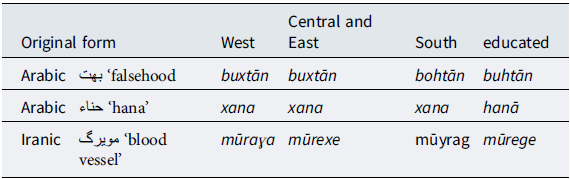
This feature is common among most parts of the Mukrīyān region, including outlier varieties, such as Sina and Silēmānīya. For instance: *bōxt > *boht > botan > buhtān > buħtān > buxtān ‘falsehood,’ ħanā > hanā > xana ‘Hanna (a proper name).’ In Mahābād, literate female informants preferred the /h/ sound to /x/ for buhtān. The illiterate informants preferred the /x/ sound. Regarding *g > x (for example: muraga > muraxa = mūraɣa ‘capillary’), the /x/ sound among elderly people and /ɣ/ among middle-age and younger generation is almost distributed in West Mukrī, but in East to South Mukrī, including some parts of Mahābād, the /g/ sound is preferred. Thus, two /x/ and /g/ types can be differentiated here, respectively for West and North Mukrī vs. Central and South Mukrī. To lesser degrees, in all areas there was no strong acceptability judgment except for /x/ vs. /g/ distinctions. The South and East Mukrī informants considered /g/ a better form, but they did not make any judgment about the /x/ sound. West Mukrī speakers preferred the variant /x/. Several educated West Mukrī speakers considered /x/ a non-Persian and local sound.Footnote 20 With respect to the sound change of /h/ > /x/, the literate female informants preferred the /h/ sound as a correct and standard form, but the literate and illiterate male informants confirmed /x/ as the standard form. Also, they preferred /x/ over /g/ as the standard Kurdish form (Table 2).
The distribution of h with x and g with in Mukrīyān region

3.4. Palatalized /ñ/
This feature has not been observed in West, North, and East Mukrī, but in the Southern part of Mukrīyān, it is attested. It extends to Sina in Kurdistan Province, some neighboring areas like Marīwān, Bījār, and in the environs of Saqqiz up to the northern areas of Kirmānšāh. It also covers areas close to Silēmānīya. For example: qung, qing, qiñ ‘buttocks’; qiling, qiliñ ‘pick, pickaxe’; māng, māñ ‘moon’; *pahn, **pahna-ka-, *paŋg, pāñ ‘wide.’ The peculiarity is the assimilation of n to ŋ before g and dropping the final /g/. Bāna shows a mixed form of velarized /ñ/ and alveolar /n/, for example: qing, qiñ, and qun ‘hip.’ In Silēmānīya, qiñ is the common form. In addition, all words which end in /n/ will drop the /n/ and the preceding vowel will be nasalized. This is typical of Ardałānī areas up to the southern part of Mukrīyān, i.e., Saqqiz, for instance: min > mĩ ‘I,’ fin > fĩ ‘snivelling,’ birdin > birdĩ ‘to take.’ Bāna informants did not show any sensitivity to the different forms mentioned above. The informants from other areas of the Mukrī region consider this a peculiarity of Bāna and Saqqiz. They would also jokingly mimic the sound during the interviews. Several informants from Saqqiz, mainly those who preferred the non-nasalized forms, were making fun of the nasalized forms in the Ardałānī variety of Sina. Also, some of the Silēmānīya educated informants found particularly funny forms such as qun, which are common in other areas of Mukrī including Bāna, or qīn in Hawlēr surroundings up to Koye, Rānīye, and Qałādze. Upon hearing recorded sounds of South Mukrī, the speakers of Silēmānīya preferred the forms from Bāna to those from Saqqiz. West, North, and East Mukrī informants preferred qun as a standard and written form. In their opinion, nasalization of vowels is a dialectal feature which should not be reflected in the written and literary form. On the other hand, southern informants including Silēmānīya preferred their own varieties to the written and literary forms. They were highly surprised by the non-nasalized vowel pronunciation of northern areas in Mukrīyān.
3.5. Palatalization
Another key difference between Mukrī and other Central Kurdish speaking regions is palatalization (Stilo, Reference Stilo and Marashi1994) of the velar stops in all positions. This feature has various forms. The maps that informants drew for me based on their perception and awareness quite accurately reflected the linguistic boundaries. They showed a high sensitivity to this feature. Front and back allophones of /k/ exist in Mukrī areas. In West Mukrī, particularly the northern areas of West Mukrī close to Urmia, these stops are palatalized. This palatalization decreases in the peripheral varieties, i.e., in the Mahābād district. In the southern areas, especially Saqqiz as well as Kurdistan and Kirmānšāh provinces, palatalization stops. On the Iraqi side, up to Rānīye, Qałādzē, and Hawlēr, there are traces of palatalization like in West Mukrī. More towards the southern areas of the Iraqi Sorani region, i.e., Silēmānīya, there is a decrease in the palatalization of the stops in all positions.
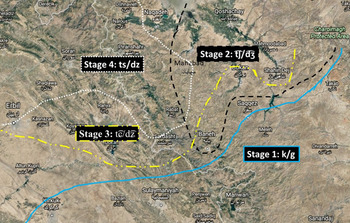
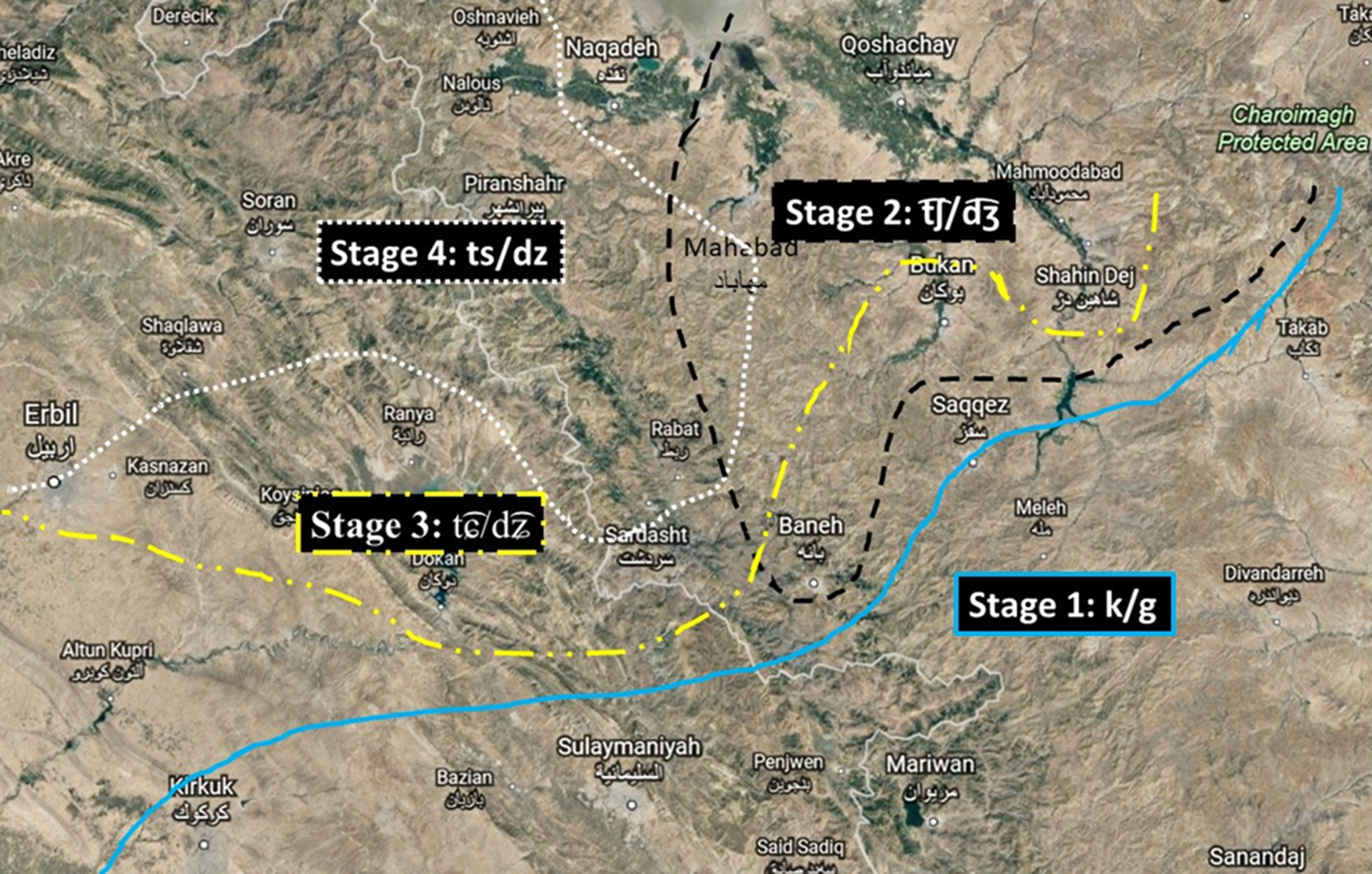
I consider four stages of palatalization of the velar stops /k, g/. The first stage is zero palatalization of /k/, /g/. For example, kēw ‘mountain’; gēž ‘dizzy’; gwē, go and gö ‘ear’; and gēzer ‘carrot,’ which occurs in East and South Mukrī and Ardałānī, and gwēzer in Silēmānīya. The first stage among Silēmānīya speakers greatly depends on the contact of the informants with other speech communities and areas. Those informants who had little to no contact with areas where palatalization is common showed preference for non-palatalized forms. Meanwhile, those who were in contact with informants who had palatalized forms used palatalized and non-palatalized forms interchangeably. Moreover, during recent years, education and media have used the non-palatalized as the standard forms, therefore, the younger generation of Silēmānīya speakers are resistant to palatalized forms.
The second stage is post-alveolar affricates /tʃ/, /dӡ/. For example, tʃēw ‘mountain’; dӡēž ‘dizzy’; dӡwē, dӡö, dӡo ‘ear,’ dӡēzer ‘carrot,’ which happens in Central to North Mukrī, i.e., the peripheral area. At stage two, there is a steep fronting of the velar stops /k/ and /g/ and a shift from zero palatalization to post-alveolar affricates. This phenomenon occurs in both loanwords and native words.
The third stage is further fronting of post-alveolar affricates /tɕ/, /dʑ/, e.g., tɕēw ‘mountain’; dʑēž ‘dizzy’; dʑwē ‘ear’; and dʑēzer ‘carrot’. This occurs mostly in West Mukrī.
Finally, the fourth stage is fronting of fully palatalized forms i.e., usage of post-velar stops /ʦ/, /dz/. In the last stage, the palatalized phonemes move forward, e.g., tsēw ‘mountain’; dzēž ‘dizzy’; dzwē ‘ear’; and dzēzer ‘carrot.’ This occurs further West to the Iraqi borders including Hawlēr and its surroundings up to the western section of North Mukrī in the villages around Pīrānšār. Stage four, i.e., post-velar stops /dz ˜ ʦ/, is more common in Sardašt to Pīrānšār in towards the Iraqi borders like Koye, Rānīye, and Qałādzē up to Hawlēr. Central Mukrī towards the North, i.e., Naqada, is in the stage three and two. Palatalization gradually weakens towards the eastern and southeastern areas.
There are more examples of fronting of the velar stops and emerging post-alveolar affricates in Mukrī, for instance palatal affricates tɕ and dʑ Footnote 21 in words, such as: tʃēštengaw Footnote 22 and tsēštengaw ‘mid-morning meal’;, tɕaw ‘eye’; tɕa ‘tea’; tɕa and tʃē ‘who’; tɕī ‘what’; tɕewr ‘fatty’; tɕîstan ‘expression’; kitɕ ‘girl’; qalotɕe Footnote 23 ‘ant’; tɕak ‘well’; brīndʑ ‘rice’; dʑa ‘well'; dʑarēk ‘once’; dʑudʑke Footnote 24 ‘chick’; dʑur ‘set’; dʑē be dʑē ‘ok’; dʑē ‘place’; dʑurēk ‘in a way’; xindʑīlane ‘cute, nice’; and dʑeħēł ‘teenage.’ There are two kinds of palatalization shift which are observed in Mukrī dialects: k > tɕ with the preservation of tʃ; and, k > tʃ and tʃ > ts. In the latter, the old difference is maintained, and this is happening gradually from North Mukrī to South Mukrī.
With respect to the positioning of front palatals, in the western section of North Mukrī up to Hawlēr, the varieties show the last stage of fronting in all word positions, e.g., initial, middle, and final. In the peripheral varieties mostly, it occurs in the word-initial and word-final position. Most of the informants were able to recognize the different palatalized forms and associated each feature with a specific region. They all insisted that palatalization is dialectal and would not represent it while writing text messages. Interestingly, both literate and illiterate informants believed the written form must be a zero-palatalization form. The isogloss line dividing the region into [+palatalization] and [-palatalization] areas lies through Bāna. Although Saqqiz is close to Central and East Mukrī, the informants separated themselves in this respect which means they showed palatalized forms in spontaneous speech and non-palatalized forms during elicitations and preferred the non-palatal forms. Some of the informants with mixed Mukrī-Ardałānī dialects did not demonstrate a clear preference. In the end, when I repeated my question as to which form they preferred for writing and for the standard language, they answered that they preferred the non-palatalized form. On the other hand, Silēmānīya informants considered fronted palatalized forms incorrect. An educated female speaker called such forms saqat ‘flawed’. She mentioned that in Sorani, i.e., the Silēmānīya variety, people do not use fronted palatal forms while speakers from Hawlēr and its surrounding area made their language xwār ‘flawed, broken’ which means they use the palatal forms. Some educated informants in Central Mukrī who were producing a stage three form /tɕ/, considered stage four /ts/ a “sweet-sounding” form and expressed this with a smile and in a funny but positive way. They identified such forms as being a peculiarity of the western section of North Mukrī. In general, there is a great deal of free variation for palatalization and a step further in fronting of the palatals. Below, Map 3 shows the distribution of palatals in the Mukrī region and Iraqi Kurdistan.
The distribution of palatalization in Mukrī and outlier areas.
3.5. Gemination or consonant doubling
Mukrī is different from southern Central Kurdish varieties, such as Ardałāni, and Kirmānšāhi, with respect to gemination. In general, Mukrī speakers in all areas avoid gemination, apart from some exceptional cases in South Mukrī. There are some tendencies in East and, to some extent, Central Mukrī, towards displaying gemination due to dissimilation or hypercorrection, while in West Mukrī, this is not observed, for example: fann > /fand/ and /fant/ ‘craft,’ jahannam > /jahandam/, /jaħandam/ ‘hell,’ ħadd > /hand/, /hand/ ‘some, amount,’ but: ʃamba > ʃamma Footnote 25 ‘Saturday.’ In Southern Mukrī, Ardałān area they all say ʃammo ‘Saturday.’ The geminated forms in Mukrī have mainly been observed among educated informants or those who had more contact with southern areas. The gemination is not as strong as gemination in Arabic, but the second /m/ is released. Also, the informants in West and Central Mukrī qualified the use of geminates, as such, in a hypothetical natural conversation and considered the geminated form non-local and copied from Persian. Although several educated informants made fun of those who pronounced the non-geminated form, the overall preference of other informants was the non-gemination over the gemination for written and standard language.
3.6. /ł/, /l/, /ɾ/ and /l/, /ɾ/, /b/ distinctions
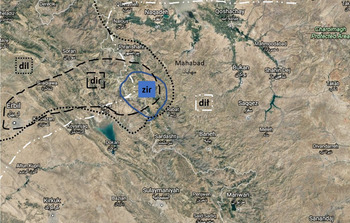
Instability of /ł/, /l/, and /ɾ/ is another distinctive feature in Mukrī and outlier dialects. As an example, dił ‘heart’ with a dark /ł/ is present in almost all East, Central, North, and South to some parts of West Mukrī in Sardašt, Pīrānšār, and Šino. In West Mukrī, the field records from Nałās and small pockets of villages within mountainous areas indicate the existence of the other two forms, /l/, and /r/, for example, /dil/ and /diɾ/. These two forms are present in the villages, such as Wāwān, Saršīw, Divalān, and Bānī Xałāł, and the districts of Dāwdāwē, Māmkāwē and Kānī Zard.Footnote 26 Light /l/ is also encountered in the Bādīnān region of the Urmia district. The transition from /ł/ to /l/ happens in the areas between West and Central Mukrī and the transition from *rd > ł > l and *rd > *rr > ɾ starts from the Nałās area and continues up to Iraqi Kurdistan in the regions Hawlēr, Koye, Žārāwā, Sangasār, and the neighboring areas. The usage of the /ɾ/ form increases in Iraqi Kurdistan while the usage of the /l/ form decreases. The origin of this word is *δrdaya- > *dird > dil in Middle Persian /dił/ in common Kurdish, so diɾ does not come from dił (Korn, Reference Korn2013: 106-107). Dil is more common among the informants who are in contact with West Mukrī (see Map 4). In the West Mukrī region, the informants considered the /l/ and /ɾ/ forms as having a different sound and being pronounced in a funny accent (with both positive and negative connotations). They referred to such speech as “rural accent,” old-fashioned, and low-prestige. Some informants even considered people who showed the /ɾ/ realization as primitive and uneducated. In general, in the regions where /l/ and /ɾ/ forms prevail, the young, educated generation tended to qualify the /ł/ form as prestigious and standard.
The distribution of /ł/, /l/, /ɾ/ in Mukrīyān and the neighbouring areas.

During an interview in June 2005 in West Mukrī and in an August 2016 online interview, some informants said laughingly that saying /l/ or /ɾ/ were characteristics of areas such as Kānī Zard and Wāwān.Footnote 27 The Central, East, and South Mukrī informants were not aware of the /ɾ/ form except for the older generation that had been in contact with such speech varieties. Those informants were able to associate /l/ or /ɾ/ with villages in West Mukrī, like in Pīrānšār and Sardašt. Comparing their language perception with the linguistic data shows that their intuition was correct. On the other hand, young, educated informants were not able to distinguish the /l/ and /ɾ/ forms. Their answers associating /l/ and /ɾ/ with the southern areas of Kirmānšāh were wrong, implying a lack of contact with northern varieties. They also considered these sounds non-inherited. The informants in Koye and Hawlēr considered the /l/ and /ɾ/ forms as correct and acceptable. They considered the /l/ more standard and the /ɾ/ form typical of villagers or the elderly. In Silēmānīya, the informats considered /ł/ as standard and the other two forms as “strange.” Map 4 shows three types: the /ł/-type, the /l/-type and the /ɾ/-type varieties. Based on this feature, the areas between Sardašt and Pīrānšār are considered peripheral regional varieties.
Map 4 presents a schematic representation of typical patterns for the word dił ‘heart.’ The peripheral area between West and Central Mukrī is the main area of transition between different speech variants. The existing clans in the area include Mangūř and non-Mangūř clans. In the middle of the isogloss bundle, village residents tend to associate themselves with a clan cluster group.
Furthermore, in the villages like Wāwān, Saršīw, Divalān, Bānī Xałāł in the direction of Iraq border areas, the illiterate elderly people used ziɾ or diɾ interchangeably. Based on the data and interviews, diɾ is more common among middle-aged speakers and the younger generation uses diɾ and dil interchangeably. Generally, in the areas between West Mukrī and the Iraqi side, there are cases in which /d/ is pronounced as the original Kurdish form /z/,Footnote 28 for example, daɾyā ‘sea’ is pronounced as zaɾyā.
Based on Map 4, I can conclude that the most divergent region is the area between West and East Mukrī, i.e., between Sardašt, Pīrānšār, and Naqada. Mahābād is the bridge variety between the two zones. In this area, different Mangūř clans have different speech types. The clans in the West Mukrī show free variation between the /l/ type and the /ɾ/ type and the area between East Mukrī and Mahābād shows the /ł/ type.
3.7. Intervocalic [-d-] > [-r-]/[-w-]
Similar to the /ł/, /l/, /ɾ/ type distinctions, there are d > ɾ,Footnote 29 ɾt > ɾd > ɾ, and ɾd > ɾ distinctions as well. Generally, from East to West Mukrī, there is a transition of d > ɾ, and ɾt > ɾd > ɾ. The transition overlaps dił, dil, and diɾ distinctions, for instance: didan > dɾan ‘tooth,’ Muħamad > Miħamar ‘Muhammad,’ Aħmad > Aħmar ‘Ahmad,’ Jamšīd > Jamšīr ‘Jamshid,’ detʃim > ɾetʃim ‘I go,’ pird > pid = piɾ = pil ‘bridge,’ kiɾdin > kiɾin = kilin ‘to do,’ biɾdin > biɾin = bilin ‘to bring, to take,’ miɾdin > miɾin = milin ‘to die,’ zard > zar(d) ‘yellow.’ In Saqqiz, some parts of Bāna, and as far south as Dīwandere and other cities in Kurdistan Province, as well as Silēmānīya, all /d/ sounds change to /w/, for instance: Muħamad > Miħamaw ‘Muhammad,’ Aħmad > Aħmaw ‘Ahmad.’Footnote 30
Three types can be classified here: /d/ type (Central and East Mukrī), /ɾ/ type (from the westernmost part of Mukrī to the Iraqi Kurdish side), and /w/ type (South Mukrī towards Silēmānīya). It is worth mentioning that in Bāna and Saqqiz, people demonstrate free variation between the above-mentioned forms. This has been observed for all /l/ and /ɾ/ forms. Those who pronounce /d/ and /w/ consider the /r/ form low-prestige, old-fashioned, or strange. In West, Central, and East Mukrī, informants were mimicking the /w/ and /r/ in a funny way and they expressed interest for such differences. It was also a question for them why such distinction exists and why someone should change the /d/ to /w/ and /r/. In general, the /d/ form was accepted almost by all informants as a written form but the rest was considered sub-standard. In their opinion, spoken and written forms are different from each other. In their daily text messages, they used mainly the /d/ form. Exceptionally, the informants reported using dialectal forms for intracommunal, friendly, and informal communication.
3.8. Devoicing z > s
With respect to devoicing, two language types can be distinguished. The first type involves a devoicing of the voiced alveo-dental sibilant, a phenomenon, which occurs in the Bādīnānī varieties of the region as well. It also includes West Mukrī to the northwest area of Mukrī, i.e., Pīrānšār and Šino. The second type involves retaining voiced phonemes and covers East and South Mukrī.Footnote 31 For instance, sarbaz > sarbas ‘soldier,’ nizim in both ways nizim and nisim ‘order,’ badra > batra ‘others,’ Rebāz > Rebās ‘Rebaz (proper name),’ mazin > masin ‘big,’ mazintir > masintir Footnote 32 ‘bigger,’ dast > dazd Footnote 33 ‘hand,’ zig > sig ‘stomach,’ zimān > simān ‘tongue,’ wazīr > wasīr ‘minister,’ tazħeb > dasħeb ‘Muslim prayer beads.’ For those who produced voiced consonants, devoicing was considered a rural form. They also confirmed that devoicing is a peculiarity in their regions and has a more local character. The voiced form was generally accepted by all informants as a more literary form.
3.9. u/e > ǝFootnote 34
The back close vowel /u/ and the close-mid front vowel /e/ commonly contrast in East Mukrī, while they have merged as /e/ in Central and South Mukrī and as /ǝ/ in West Mukrī, for instance: Muħemmed ‘Muhammad’ in East Mukrī, Meħemmed (Central Mukrī), and ǝħemed (West Mukrī), tǝkaye ‘please, you’re welcome’ is common in West Mukrī and tekaye in Central to East and South Mukrī mainly among middle-aged and elderly informants. Younger informants generally use the /ǝ/ form. The reduction of short vowels to a schwa happens systematically between West Mukrī and Iraqi Kurdistan in the direction of Hawlēr, while in the east it is not the case. The schwa form was mainly observed in formal conversations in places like mosques and official meetings, while the other vowels have been observed in informal contexts. Interestingly, in South Mukrī, especially in Bāna, all three forms are common, and they have been accepted without any judgment. From Bāna and in the direction of West Mukrī, the /ǝ/ form, inside Bāna /e/ form, and towards East Mukrī /u/ form are used. In general, the informants only pointed out that these are regional differences. In the end, while answering which form they preferred for written communication or considered more standard, many of the informants and mainly the younger generation preferred the /ǝ/ form.
3.10. u/ī and xw/ī/ö/ē distinctions
Although West Mukrī presents features similar to Iraqi Kurdistan, such as in Rānīye, Qałādzē, Hawlēr, and the neighboring areas, they differ with respect to the words that end in /u/. For instance, they pronounce a word like mandū ‘tired’ with /u/ and this is widespread in the whole Mukrī region. This does not happen in verbs with original ū-sounds such as čū ‘went’ and bū ‘became.’ There is a change from /ū/ to a short /i/ only in the Hawlēr region up to the West Mukrī borders in Islāmābād, in villages such as Bētuš and Bēžwē. This occurs in fast speech; otherwise in normal-paced speech, it is usually realized as /u/. The /u/ form continues into Rānīye, Qałādzē, and further south to Silēmānīya. In comparison, speakers from Hawlēr and its surroundings pronounce all words ending in /u/ with /ī/, such as mandī in Bahdīnānī. In this respect, there are two types of language varieties: the /u/ type and /ī/ type. Some informants in the southern areas and Silēmānīya were commenting on the language use in Hawlēr, for instance, a female informant shook her head and said, “what kind of language is this Hawlērī and Mukrī, they have changed almost everything. One should really make it rāst ‘correct’ again.” Moreover, the Mukrī informants considered the /ī/ type a rural form. Most of the informants said that they did not use the /ī/ type in the city and several of them mentioned that /ī/ is a wrong form. They considered /u/ a standard form. Furthermore, several young educated Hawlērī informants were surprised by the /u/ type. They were thinking that the /u/ form might be wrong or there can be a reason for such differentiation. Interestingly, they did not consider the /u/ type wrong. In the end, after negotiating with other friends and colleagues, they agreed that /u/ can be the right form to follow. Four educated Hawlērī informants stated that /ī/ may not be proper Kurdish.
3.11. xwē vs. xö vs. xē vs. xī
Other features which differentiate the Mukrī region, including Sorani areas in Iraq, are the transfer of the labial articulation of the secondary feature of labio-velar phoneme xw to the following vowel as well as the delabialization of this vowel, such as xwV- to xö- and elsewhere to xi- or xē, see the following examples:

In all West Mukrī, the xw form, for example, in xwē ‘salt,’ is widespread, including in cities and their surroundings such as Sardašt, Pīrānšār, Šino, and some parts of South Mukrī in Bāna close to the West Mukrī area. Central Mukrī is known for the ö form. This form is an obvious feature used to tell locals from non-locals. In East and South Mukrī, the ē form is a prominent feature which makes them stand out against the other regions. In Central Mukrī, many speakers used ö/ē interchangeably. The ö/ē is mainly concentrated in Mahābād, but it also depends on the informants’ degree of contact with the neighboring areas and/or migration background. In Iraqi Kurdish, up to Koye, Rānīye, and Qałādzē the xw form is common. From Rānīye to Hawlēr the sequence xw + ē is replaced by an x + ī sequence. Silēmānīya behaves more like East Mukrī and South Mukrī.
The majority of the speakers in Mukrīyān stated that the xw form is the written and standard variety, while the other forms are local and dialectal and therefore sub-standard. Outside the Mukrī region, Silēmānīya informants also viewed xw, which belongs to the northern areas, as the standard form. One of the educated female speakers mentioned that Rānīye and the neighboring areas write in the same way as they pronounce. She confirmed several times that in her opinion, the language variety of these areas is more standard than what she uses in her Silēmānīya Central Kurdish.
3.12. <ö> close-mid rounded long front vowel [øː]
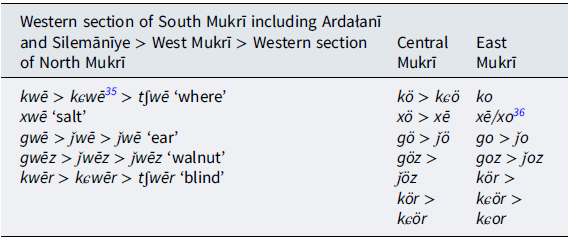
This vowel is also a distinctive feature, which makes a clear isogloss between West and East Mukrī. The area where this vowel is produced is centered around Mahābād and continues on both sides to areas in the northwest and East Mukrī. More to the west, speakers use the labial co-articulation Cw such as xw, kw, gw, and tw that yields an assimilation of the following vowel with subsequent loss of the feature Cw to consonant vowel (CV) see Table 3.
The distribution of close-mid rounded long front vowel in Mukrī

According to Table 3, South and West Mukrī show similar features to Ardałānī and Silēmānīya Kurdish. On the other hand, Central Mukrī is unique in the region and East Mukrī is somewhat like West Mukrī (cf. MacKenzie, Reference MacKenzie1961: 10-11; Öpengin, Reference Öpengin2016: 36). The informants in all the regions pointed out that /ö/ is typical of Mahābād. The informants in Mahābād distinguish non-Mahābādī people immediately if someone does not pronounce the /ö/ form. In a natural conversational situation with several West Mukrī informants, they were making fun of a friend who was replacing West Mukrī form with Central Mukrī. They pointed this out while trying to portray him as “different.” This shows that they preferred their own form of speech. In the end, most of the informants characterized xw as the standard form and ö/o as dialectal or local.
4. Summary and conclusion
According to what has been stated, Mukrī Kurdish includes different distinctive varieties. The current language mapping of Mukrī Kurdish is only a static representation of some salient phonological characteristics. The dialectal boundaries established in this study are based on a systematic analysis of phonological relations in the Mukrī language system. They show a high degree of convergence between isoglosses based on regional linguistic differences. In addition, they are not based on coincidence with previous studies, but on the correlation between geography and linguistic structures.
The most interesting findings of the current study are regional differences between West, Central, East, and South Mukrī, which show language change in progress and the varieties becoming similar to each other. The output of this study is a regional classification of Mukrī varieties in a descriptive way. This classification is not an end in itself, but a springboard for a more detailed study of regional variations in the Mukrī region and across Kurdistan. With respect to the current classification, there are several questions, such as how these became differentiated across the varieties in the first place, how to deal with isoglosses with a tight bundle in the region, and what the triggering factors for variation in the region are. These questions and many others show the interplay of historical and topographic factors with linguistic structures, which lead to spatial diffusion and, consequently, to language contact and language change.
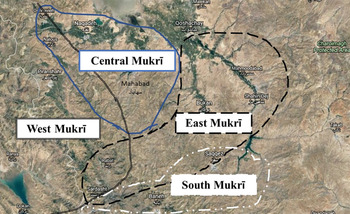
So far, there is no dialectological study of the language variety in the whole region; therefore, no linguistic barriers have been detected among Mukrī varieties. As such, Mukrī is considered a single language with a group of varieties. However, the current dialectological overview has revealed that the distribution of minor speech variants are not idiosyncratic but are patterned and socially and regionally determined. As has been said, communication is one key factor for determining language variation in the Mukrī region. For example, one of the social systems that West Mukrī speech preserves is residential patterns, ritual ceremonies, and ritual purity.Footnote 37 In addition, this area is more šīret ‘clan’-based and most of the villages are related to each other. They also have families and relatives on the other side of the border, in Iraq. Kinship is an essential factor by which people connect themselves to an identity or ethnicity. Therefore, it is highly important for the families to recognize which tribe they belong to. To tighten the relationship, in their daily life, they communicate more with each other than with speakers of Central and East Mukrī. Work and economic contact are other factors that increase the range of communication among them and across the border. Those who engage in smuggling are also in contact with Central Mukrī; therefore, Central Mukrī shows variants in combining features from West and East Mukrī. On both sides travel is part of the people’s daily lives, creating an atmosphere of informal adult friendship.Footnote 38 Such communication intensity breaks down the barriers of sociolects and individual varieties and becomes part of the social structure of the communities. In the discussion of language distribution in Mukrīyān, it is convenient to distinguish four dialect varieties in Mukrī (see Map 5).
Mukrī isoglosses and dialect sub-divisions.
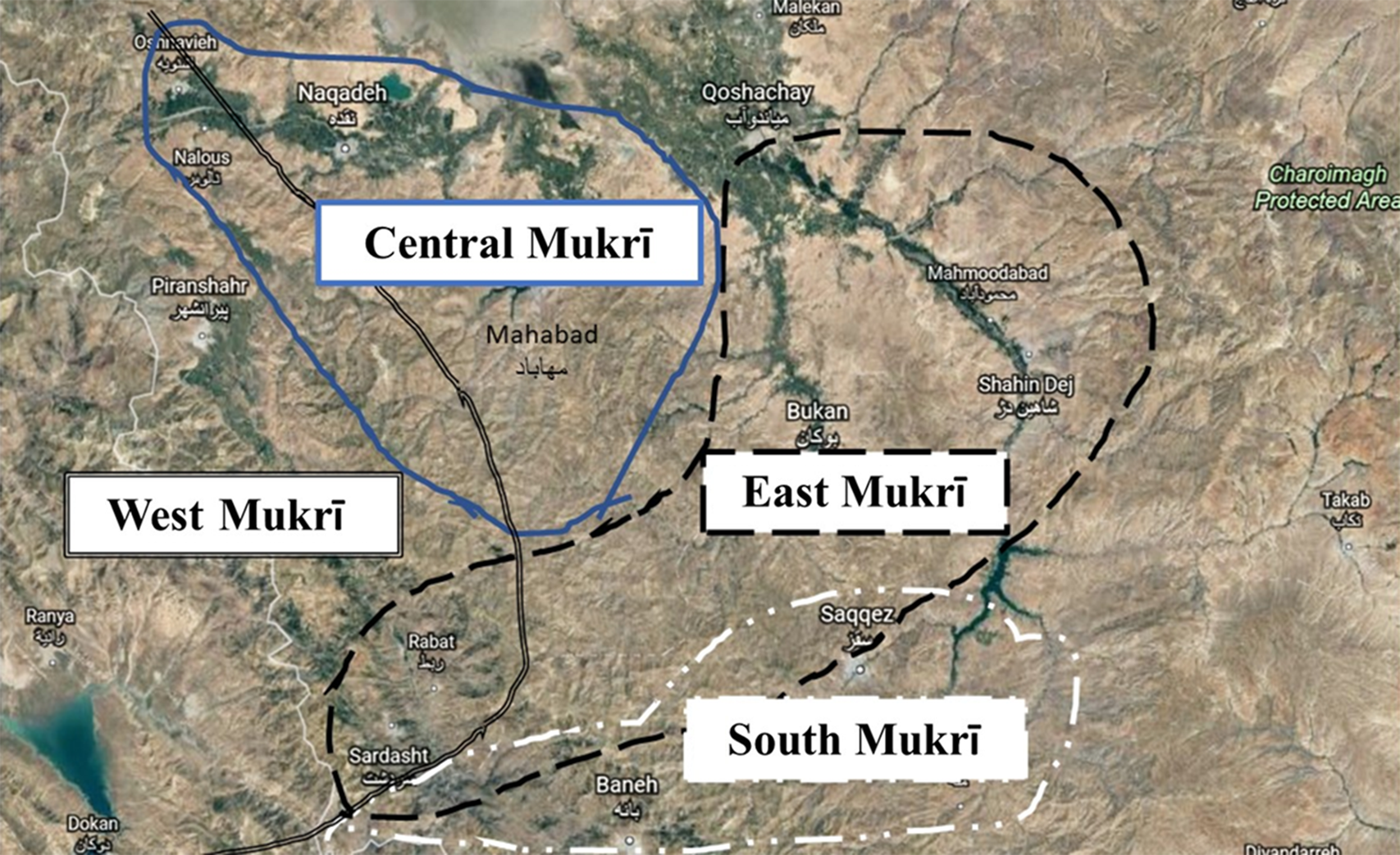
Map 5 shows Mukrī isogloss bundles and division into four dialects: (1) West Mukrī with high density in daily communication with the neighboring areas, (2) East Mukrī with the least density of communication with others, (3) South Mukrī with an average density in the communication with other regions and outsiders, and (4) Central Mukrī. In Central Mukrī, it is highly important for people to know with whom they are in contact and with which tribe they are communicating, who their best friends are and with whom they share labor and agricultural apparatuses. Such views assign direction to people’s social communication. It also structures their residential communities. At the local level, villages on all sides are different from their respective neighbors in many respects and are divergent from each other. On the other hand, in a larger area, they overlap with each other and make up a uniform region. In general, on all linguistic levels, mutual intelligibility exists although in many cases the lexicon and individual linguistic features may show differences.
Most men travelling between the regions of West Mukrī and the neighboring Iraqi cities and villages can speak or at least imitate the regional varieties. People in West Mukrī use their native language variety at home or with relatives. When they meet outsiders to do trade and business, they use the regional varieties which the outsiders speak. Among all the other Mukrī varieties, West Mukrī speakers adapt to the other Mukrī varieties more easily, mainly to the East variety. East Mukrī speakers also interchangeably use their local and the regional varieties of outsiders that they encounter. The only exception is Central Mukrī, i.e., Mahābād, where both male and female speakers are resistant to adopting the accent of other areas be it at home or outside, with locals or with outsiders.
These sociological factors and their relationship with linguistic structures require further study and elaboration. There is a high need for distinguishing the type of contact which spreads linguistic innovation. Once we apply sociological factors and contact between the informants, it is easier to track the areal feature among different language varieties in the region. Doing so has shown that contact-induced change is another factor in language innovation and distribution in the Mukrīyān region. Such comparative dialectological study of languages in the region helps to determine the origins of certain isoglosses in various varieties as lying in other languages such as Armenian, Azeri Turkic, North-East Neo-Aramaic, and Persian in the Mukrī region. Moreover, one can also suspect language-internal development by individuals and their communities within their local communication, i.e., individual innovations can have an influence on communication within the community. Social and geographical distances and multilingualism are significant triggering factors in language variation in Mukrīyān. In general, with respect to linguistic development, the Mukrīyān region is constantly changing its speech types and is very variable. Different linguistic forms are acquired, and archaic forms are dropped from the Mukrī linguistic system. Finally, Mukrī among other CK dialects is less innovative but in recent years is changing rapidly.
Acknowledgment
I am indebted to Thomas Jügel for his enthusiasm and generosity, and for continuously providing help and support as I was bringing this article into existence. I also thank Murad Suleymanov, Donald Stilo, and the anonymous reviewers for their valuable comments, which helped improve the work, as well as Jost Gippert, and Evelyn Reuter for contributing their thoughts and ideas on the structure. Additionally, I am grateful to Geoffrey Khan for inviting me to Cambridge, where I had the possibility to further expand the current study. I am also thankful to the many informants who participated in this study, particularly those who actively helped me through each step: Khadija Piroti (Šīwāšān-Rabat), Rabiha Asadpour (Sardašt), Nashmil Maroufpour (Bokān), Naser Hashimpour (Šino), Roshanak Hassanpanah (Bāna), Shahbaz Mohseni (Saqqiz), Vahab Ahmadi (Mahābād), Firozeh Rasouli (Naqada), Sadun Mohammadzadeh (Bētūš), Resche Fatah and her family (Hawler), Binayi Baker, Shene Othoman Hassan, and Jihad Karimi (Silemānya). The responsibility for all remaining errors rests with the author.