Introduction
Dementia is a neurodegenerative disease characterized by a progressive loss of cognitive and functional abilities and social skills, often impinging on quality of life and the individual's capacity for independent living. It is also a very expensive disease. A recent report estimated the current worldwide cost of dementia to be $818 billion (Prince et al., Reference Prince, Wimo, Guerchet, Ali, Wu and Prina2015). In Ireland, the total burden of dementia is an estimated €1.9 billion (Connolly et al., Reference Connolly, Gillespie, O'Shea, Cahill and Pierce2014). A major issue in all health and social care systems is how to keep people with dementia on the boundary of residential care living at home for longer, rather than be admitted to expensive long-stay care facilities. Not only this is what people want (Donnelly et al., Reference Donnelly, O'Brien, Begley and Brennan2016), but keeping people living at home for longer, or preventing admission to long-stay facilities entirely, has the potential to reduce the overall cost of long-stay care for government (Wubker et al., Reference Wübker2015).
The current study examines the cost of care for people with dementia on the boundary between home care and residential care in Ireland. People on the boundary of care are defined as those currently living at home, but with a significant risk of admission to residential care in the medium term. The data are generated from a new and innovative program of personalized supports for people with dementia piloted across four sites in Ireland over three years between 2012 and 2015 (O'Shea and Murphy, Reference O'Shea and Murphy2014). The first stage of the research is concerned with identifying participants in the program living at home, who meet the criteria of being at risk of admission to long-stay care in the medium term. In the second stage, resource utilization and costs are examined for this group of people on the boundary of care between community and residential facilities. Knowing the cost of care for people with dementia will facilitate better decision-making in regard to the optimal allocation of public resources necessary to support people to live well with dementia in their own homes. While the analysis is focused on actual provision rather than optimal provision, the study provides new information on resource use and costs of community-based care, both formal and informal, for people with dementia in Ireland.
Balance of care
Dementia has long been rooted in a medical model of care (Cahill et al., Reference Cahill, O'Shea and Pierce2012). However, this conceptualization of dementia is increasingly being recognized as too narrow, carrying the risk of bias toward residential care provision, as well as diminishing the personhood and citizenship of the individual with dementia (Bartlett and O'Connor, 2010). Governments are now looking for more holistic, individualized services and supports to meet the complex needs of people living with dementia delivered in the person's own home (Johnston and Narayanasamy, Reference Johnston and Narayanasamy2016). Recently, the Health Service Executive (HSE) and Genio have combined to develop care consortia in four sites across Ireland to promote and deliver person-centered care to people with dementia living in their own homes, including those on the boundary of care between community and residential settings. The HSE is a government agency charged with responsibility for delivering health and social care in Ireland, while Genio is a charitable trust working to bring Government and philanthropic funders together to develop better ways to support disadvantaged people to live full lives in their communities.
While the stated policy of many developed nations is to care for people with dementia in their own homes for as long as possible (Challis and Hughes, Reference Challis and Hughes2003; Colombo et al., Reference Colombo, Ana, Jérôme and Frits2011; OECD, 2015), dementia is a degenerative disease, and the changing needs over time of the individual will eventually mean that, for some people, home is no longer the most appropriate setting for care. There is much uncertainty surrounding the timing of this transition, as the decision to institutionalize a person with dementia is based on multiple factors, including preferences and expectations, level of dependency, multi-morbidity, formal care provision, location, family care networks, social connectivity, and the vagaries of local and national financing arrangements (Afram et al., Reference Afram2014).
A number of cost-of-illness studies of dementia have been conducted worldwide, including Ireland (Connolly et al., Reference Connolly, Gillespie, O'Shea, Cahill and Pierce2014), and while these studies have provided decision-makers with valuable information regarding the economic impact and broad cost components of dementia, less is known about the comparative costs of community and institutional care (Wimo, Reference Wimo2010; Schaller et al., Reference Schaller, Mauskopf, Kriza, Wahlster and Kolominsky-Rabas2015). Balance of care (BoC) studies offer a more nuanced and systematic approach to determine the optimal mix of services by focusing on the identification of groups of people whose dependency characteristics are such that they are at the margin of care between community and institution (Tucker et al., 2008). For these people, care needs can potentially be met through providing enhanced community-based supports rather than by admission to long-stay care facilities (Challis and Hughes, Reference Challis and Hughes2002; Challis and Hughes, Reference Challis and Hughes2003). One of the key aspects of the BoC approach, therefore, is to help identify how investment in community care can impact on the “tipping point” for admission to long-stay care facilities. BoC research suggests that, all other things being equal, shifting the balance of resource allocation toward more community supports at the local level can reduce the risk of institutionalization for some older people (Tucker et al., Reference Tucker2016).
Methods
The HSE-Genio Dementia Programme, described in detail elsewhere (O'Shea and Murphy, Reference O'Shea and Murphy2014; O'Shea and Monaghan, Reference O'Shea and Monaghan2015), allows us to take advantage of a comprehensive data-set on current resource allocation for people with dementia living at home in Ireland to investigate boundary of care issues between community and residential care. The aim of the HSE-Genio Dementia Programme was to develop and test a range of community-based, personalized, flexible, and responsive services and supports that might enable people with dementia to live more complete lives in their own home for as long as possible and practicable. The program was introduced in 2012 in four sites in Ireland and has developed incrementally since then into other geographical areas and activities, mostly connected with the interface among community-based care, acute care, and residential care.
We collected a wide range of community-based data on people with dementia on the boundary of care and their primary informal caregiver (defined as the person who normally provides unpaid help, support, and supervision for the person with dementia), including duration in the HSE-Genio Dementia Programme, dependency, risk of institutionalization, formal resource use, and caregiver time commitment. The study examines the costs and potential benefits of investment in personalized, community-based care, including the financial implications of placement decision-making, taking account of both formal and informal provision, as well as probability-based residential care alternatives. Ethical approval for the study was obtained through the NUI Galway Ethics Committee.
Identification of people with dementia on the margins of residential care
All the people with dementia involved in the HSE-Genio Dementia Programme were eligible for selection to participate in the boundary of care study. Two criteria were used to determine the number of people on the boundary between community and residential care. First, the Institutional Risk Trigger identified people within the HSE-Genio Dementia Programme, who had impaired physical and cognitive functioning and, therefore, were at high risk of admission to residential care in the next six months. The questionnaire is a part of the InterRAI suite of tools that Ireland is currently adopting to use as a Single Assessment Tool for assessing the care needs of all older people in need of health and social care supports in the country. Any person with dementia who had at least four of the specified conditions on the questionnaire was considered to be on the boundary of nursing home placement and, therefore, eligible for inclusion in the study. The second criteria used was a subjective Institutional Probability Scale, completed by the primary informal caregiver, which elicited their views on the likelihood of the person with dementia under their care entering residential care in the next six months. For our study, any person with dementia who scored 50%, or higher, probability of admission to long-stay care within the next six months was included as part of the boundary of care group. To be eligible for inclusion in the study, a person had to satisfy one or both of the criteria. Any person who did not have the Institutional Risk Trigger or the subjective Institutional Probability Scale completed was excluded from the analysis.
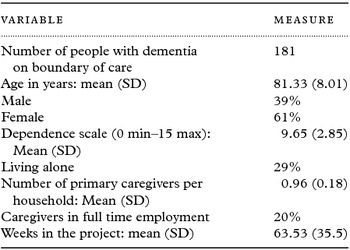
There were a total of 568 people with dementia assessed for inclusion in the study. Based on the boundary of care risk review, it was estimated that there were 181 people with dementia (32%) on the margin between community and residential care across the four sites (Table 1). All 181 people identified as being on the boundary of care were included in the study. The boundary of care cohort had an average duration in the project of approximately 15 months – very few people started at month zero and finished at month 36. The Dependence Score (DS) ranges from zero, meaning not dependent at all, to 15, which would indicate a patient is fully dependent, so average dependency of 9.65 was, as you might expect, relatively high overall.
Descriptive analysis

Formal resource use
Data on the utilization of formal supports from within the health and social care system were collected at intervals throughout the duration of the HSE-Genio Dementia Programme. Data on formal, usual care, resource utilization were collected on the following services and supports provided to people with dementia: home help visits, public health nurse visits, home care packages, community mental health nurse visits, meals on wheels, visits by other community organizations, day care and respite care. These data were generated through a questionnaire developed specifically for the study, and administered to caregivers in interview form by the key HSE-Genio project leader in each of the four sites. Resource use attributable to the HSE-Genio Dementia Programme of personalized and social supports was extracted from clients’ records set up especially for the project.
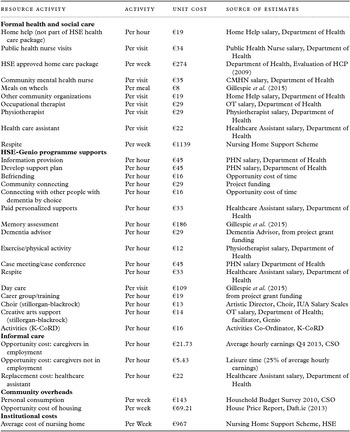
The total cost of formal service provision is calculated by attaching the appropriate unit cost to the relevant average resource use across all elements of provision. There is no common, uniform database that covers unit costs in community-based care in Ireland. Consequently, information on unit costs comes from a variety of Irish data sources, as well as estimates from other countries for some resource items. All unit costs have been adjusted to 2013 prices (Table 2). Labor costs were calculated using consolidated salary scales available from the Department of Health for public-sector employees, with associated non-pay costs estimated according to the methods outlined by the Health Information and Quality Authority (2015). Social supports, such as befriending, which rely heavily on volunteer time, are valued using an opportunity cost methodology (Drummond et al., Reference Drummond, O'Brien, Stoddart, Torrance and Sculpher2005). In those cases where opportunity cost is reflected only by leisure time foregone, 25% of the average hourly wage is used as a proxy value for volunteer activity.
Unit costs for formal and informal resource use

Informal care
Informal care inputs were estimated from questionnaire data provided by family carers on the total hours of informal support provided to the person with dementia in an average day in respect of each type of support: activities of daily living (ADLs), instrumental activities of daily living (IADLS), and supervision. An opportunity cost methodology is used to measure the cost of informal care (Gillespie et al., Reference Gillespie2015). The labor force participation status is available for a sample of carers in each of the demonstration sites, thereby allowing us to extrapolate the results to the whole population of carers. The opportunity cost of time for caregivers categorized as employed was valued at the average hourly wage for all industrial sectors in Ireland in 2013 (Central Statistics Office, 2014). For those categorized as unemployed, the opportunity cost of time was valued at leisure time; a percentage (25%) of the average hourly wage was used as a proxy for leisure time (Gillespie et al., Reference Gillespie2015). A replacement cost method was also used to value informal care provision. Each hour of informal care was valued using the equivalent market price of a close substitute. For this study, the market wage for a healthcare assistant was used to value replacement informal care.
Personal consumption
People living in their own homes in the community expend resources in the personal consumption of items, such as food, fuel, light, and household maintenance. If those identified as being on the margins of residential care had in fact been institutionalized, these costs would be included as part of the direct costs of care by the institution. Wubker et al. (Reference Wübker2015) suggest that the exclusion of personal consumption for people living in their own homes would diminish some of the differences between community care and institutional care costs, as this consumption could amount to 15% or more of nursing home outlays. Personal consumption costs must, therefore, be included to make the costs of institutional and community care comparable for people on the boundary of care between the two settings. The costs of personal expenditures for people living in the community in this study are based on the Household Budget Survey 2010 estimates of household expenditures of a retired household (Central Statistics Office, 2010).
Capital costs
The cost of housing for people with dementia living in the community must be calculated if valid comparisons are to be made between the cost of community-based care and residential care. If an older person with dementia is admitted to residential care, a potential space becomes available for alternative use. The two components of capital cost are the opportunity cost of keeping the capital item another year, in this case the house, and the depreciation over time of the asset itself. One method of valuing major capital costs is to calculate the equivalent annual cost by annuitizing the initial capital outlay over the useful life of the asset, assumed to be 50 years, using a real interest rate of zero per cent. In calculating the opportunity cost of housing, we assume that the space created by admission to long-stay care will be put to alternative use (Blackwell et al., Reference Blackwell, O'Shea, Moane and Murray1992). The average price of housing in each of the four sites is used to determine the replacement value of the house in that region. The assumption is that the increasing value of the house is offset by annual depreciation.
Institutional care
People with dementia in the HSE-Genio Dementia Programme were considered to be on the boundary of institutional and community care based on their Institutional Risk Trigger score, and/or if their carers reported a greater than 50% probability of them entering institutional care within the next six months. Therefore, when estimating the potential cost of institutional care as the alternative to community-based care, costs were calculated on the number of weeks the individual might have spent in residential care if the HSE-Genio Dementia Programme did not exist (time in the project by weekly cost of residential care by 0.5). The weekly cost of residential care is based on the average cost of public and private long-stay care in each of the four HSE-Genio sites.
Results
Resource allocation
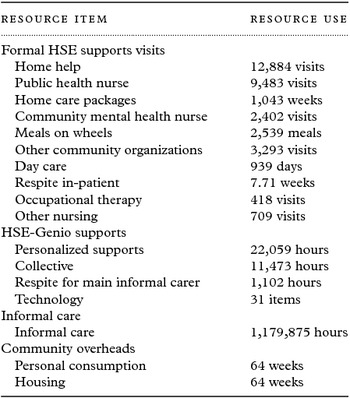
Resource use for people with dementia on the boundary of community and residential care is presented in Table 3. In general, despite a relatively high risk of institutionalization, a large number of participants in the study were not in receipt of community-based formal provision such as basic nursing and home help services. Less than half of people with dementia (47%) on the boundary of care between community and residential care received any visit from the home help services, while only 50% received a visit from the public health nurse. Only 12% of respondents received a home-care package consisting of a more complex set of supports. Less than one fifth (18%) of participants were attending day care.
Total resource use by people with dementia on the boundary of care over the three-year duration of the HSE-Genio Programme

Support provided through the HSE-Genio Dementia Programme to people with dementia and their informal carers is categorized by the nature of the delivery of the support. A total of 34,635 of additional (to usual care) support hours were provided over the duration of the Dementia Programme for this subgroup of 181 people. Over half of these hours (18,876) were delivered directly to individuals in the form of individualized care, while one third was provided collectively in activities such as choirs, exercise classes, and information sessions. Approximately 15% of the additional HSE-Genio hours were used to connect people with dementia to others with the disease. Only 8% of participants utilized assistive technology supports as part of individualized care. On average, family carers for this cohort reported spending 15 hours per day providing informal care.
Cost of care
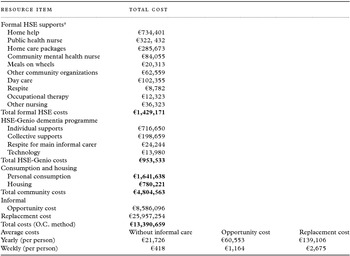
Table 4 shows the total costs for community care for people with dementia over the three year project duration. The total cost of care (formal HSE supports plus the HSE-Genio dementia programme) of the project was €2,382,704. The cost of ongoing formal HSE public support is 50% higher than the cost of personalized supports provided by the additional HSE-Genio Programme. Home help visits are the largest driver of costs for formal supports provided by the HSE, followed by public health nurse visits. Within the HSE-Genio Dementia Programme, paid personalized supports are the largest driver of costs, approximately 3.6 times higher than collective social supports.
Total cost of care for people with dementia on the boundary of care over the three-year duration of the HSE-Genio Dementia Programme

aHome Help visits are assumed to have three hour duration; all other costs are calculated assuming a one hour visit to include travel and other associated costs.
Including both consumption costs and housing costs raised the overall cost of community-based care to €4,804,563 over the duration of the project. Personal consumption comprises 34% of total community-care costs. The opportunity cost of housing for the duration of the project amounted to 16% of total costs. Informal care is the major contributor to the cost of community care. Utilizing the opportunity cost method, the total cost of informal care over the duration of the project for people with dementia identified as being on the boundary of care was €8,586,096.
The estimated weekly average cost of community care per person with dementia on the boundary between community and residential care, which includes formal HSE provision, HSE-Genio supports, consumption and housing is €418 per week. Costs rise to €1,164 per week when informal costs are valued using an opportunity cost methodology; when a replacement valuation is applied to informal care, costs rise to €2,675 per week.
We also examined the potential cost of care if people with dementia had been institutionalized rather than cared for in the community. Our estimates suggest a potential total cost of €5,552,265 for institutionalized care, based on a 50% chance of people ending up in long-stay care for the average length of time spent in the project (63.53 weeks). In contributing to potentially keeping people living at home for longer, the overall estimated potential savings associated with the program was €3,169,561, if the comparison is only with formal HSE provision and HSE-Genio personalized support services. The inclusion of personal consumption and housing costs reduces the cost-savings associated with keeping people living at home rather than in long-stay care to €747,702 over the duration of the project. The inclusion of informal care costs makes community care more expensive than residential care, marginally so when informal care is valued on an opportunity cost basis and significantly when informal care is valued at replacement cost.
Discussion
This analysis explored data from the HSE-Genio Dementia Programme on the risk of institutionalization, resource utilization, and costs for people with dementia who were on the boundary between community and residential care. The results suggest that increased investment in community care services, particularly in the form of personalized supports, can potentially impact on the BoC for people with dementia. Existing community-based services for people with dementia are low in Ireland (Cahill et al., Reference Cahill, O'Shea and Pierce2012; Connolly et al., Reference Connolly, Gillespie, O'Shea, Cahill and Pierce2014), so any new investment, particularly if it leads to more personalized care, is likely to yield positive returns. The average weekly exchequer cost of formal HSE services and the additional HSE-Genio Dementia personalized supports program, when combined, was significantly less than the potential cost of institutionalization, based on risk assessment.
Including housing and personal consumption costs raised the cost of community-based care, but costs were still well below residential care alternatives, less than 50% of current weekly costs. If formal community-based care is characterized by its absence in Ireland, family care is the opposite and is the main bulwark of care for people with dementia, as well as the principal contributor to costs. Adding family care costs, valued using an opportunity cost methodology, pushes weekly community care costs above residential care costs by about €200 per person. Therefore, when measured in social terms, community care is more expensive than residential care. That differential could be interpreted as the price people are willing to pay to support home care over residential care (O'Shea et al., Reference O'Shea, Gannon and Kennelly2008).
The cost of community care estimated in this study is based on actual resource allocation rather than optimal allocation. Resource utilization, particularly of formal HSE supports was subject to the availability of the resources in each of the sites and the vagaries of the community-based allocation process therein. There is evidence of fragmentation and curtailment in relation to community care services for many people with dementia in Ireland (Cahill et al., Reference Cahill, O'Shea and Pierce2012). Even when services are provided, it is not always clear that people are getting what they really need. Formal supports may not always meet the preferences of the person with dementia in an optimal manner (Donnelly et al., Reference Donnelly, O'Brien, Begley and Brennan2016). This is the reality of public, community-based, care provision for people with dementia living at home in Ireland.
There is a greater likelihood that the HSE-Genio Dementia Programme supports are directly responding to the expressed needs of people with dementia and their family carers by providing more personalized supports to clients. It is likely, based on the testimony of people with dementia and informal caregivers, that it is the personalized element of care that contributes to potentially keeping people out of long-stay care (O'Shea and Murphy, Reference O'Shea and Murphy2014; O'Shea and Monaghan, Reference O'Shea and Monaghan2015). Changing to a demand-led model of care in Ireland would require significant changes in supply-side structures and behaviors, including changes to information systems and work practices within the formal care sector. It would also leave open the possibility of developing a rich tapestry of tailored psychosocial supports in response to the expressed needs of people with dementia and their family carers (Clarkson et al., Reference Clarkson2015).
Our results are consistent with previous studies which have identified higher costs in institutional long-term care settings compared to formal, exchequer-funded community care provision. Data from a study involving eight European countries found that residential costs were higher than basic home care costs (Wübker et al., 2015). The same study also found that home care costs are sensitive to the valuation of informal care. Similarly, Leicht et al. (Reference Leicht2013) suggest that the societal cost of caring for people in the community can be considerably higher than nursing home costs if informal care is taken into account.
Regarding the effect of individualized supports on institutionalization, our results are in line with a previous study which found that intensive preference-based programs, allowing the caregiver and person with dementia to choose services and supports tailored to their needs, are capable of decreasing the odds of institutionalization, as well as increasing the time to admission (Spijker et al., Reference Spijker2008). Enhanced community care did not prevent some people with dementia actually being admitted to residential care in this study (15% of the study population were admitted to care), but it did offer the opportunity for more people to be looked after at home.
There are some limitations with the present analysis. Data were collected locally, leading to variation in how some personalized supports were recorded and reported across the four sites. While data collection templates were provided for both formal and informal resource use, the fragmented and irregular nature of existing provision meant that it was not always possible to record retrospective activity with the precision that one would have liked. For example, the data for public health nurses and home helps were only available in categorical visiting ranges, which were subsequently transformed into median estimates. Unit cost data were not available for some services and estimates were drawn from a variety of sources, which undoubtedly led to some imprecision. However, while the data underpinning the cost analysis are far from perfect, it is more comprehensive than what is currently available elsewhere in relation to community care services in Ireland.
Another potential limitation of the analysis relates to the valuation applied to informal care. This study employed an opportunity cost approach which assigned a higher rate per hour to carers in employment than those not currently in employment. There is still some disagreement around the use of the opportunity cost approach for the valuation of caregiver time. Moreover, we did not differentiate between types of informal support; all tasks were valued in the same way, irrespective of their level or complexity. Neither did we collect longitudinal information on carer satisfaction nor burn-out, or on patient functioning. Supervision was measured, leading to some carers reporting 24 hours care provision per day (Van der Berg et al., Reference Van den Berg, Brouwer and Koopmanschap2004). In contrast to this approach, Wubker et al. (Reference Wübker2015) placed a limit on the time informal carers could spend caring – up to a maximum of 16 hours per day assisting with ADLs and IADLs – and valuing supervision inputs at zero cost. We did not address the benefits associated with caring, which may carry significant utility for some family carers. Consequently, our estimate of informal care costs may be exaggerated as a result of not providing an offsetting monetary valuation of the benefits of caring. Finally, it is worth pointing out that this was not a randomized trial of personalized community-based supports versus usual care, which limits, therefore, the conclusions that can be drawn from the work.
In conclusion, the study has shown that it is possible to increase the availability of personalized supports to augment existing formal provision in the community and still not exceed 50% of weekly residential care costs. Investment in personalized supports for people on the boundary between community and residential care is good value for money for the public sector. New investment in community-based care may also take some of the burden of care off family carers, who currently do so much for people with dementia in the absence of formal supports, allowing them to care for longer. This does not mean that community care should be supported at any cost. Better outcomes will likely incur higher costs and in a budget constrained environment trade-offs will always be necessary. Moreover, residential care will sometimes be the best and most preferred option for some people on the boundary of care, so we should be mindful of individual circumstances and preferences when deciding on optimal placement. That does not detract from the fact that for a relatively small investment in innovative, personalized supports, the lives of some people with dementia can be enhanced and residential care costs postponed.
Conflict of interest
None.
Description of authors’ roles
Eamon O'Shea formulated the research question and designed the study, supervised the data collection, and wrote the final paper. Christine Monaghan provided research assistance on the paper including: data cleaning, data analysis, and wrote the first draft of some of the sections.
Acknowledgments
The study upon which this paper is based was commissioned by Genio. The authors would like to thank the HSE-Genio Dementia Programme staff and the people with dementia and their caregivers who participated in the study. Fiona Keogh deserves special mention for her support in the research. This work was financially supported by Genio.