I. INTRODUCTION
Ni-based superalloys are widely used in aero-engines due to their excellent mechanical properties and oxidation resistance at high temperatures.Reference Reed1,Reference Sims, Stoloff and Hagel2 The phase of superalloys comprises a face-centered cubic (fcc) Ni-rich solid solution (γ phase) strengthened by coherent particles of L12-ordered Ni3Al precipitates (γ′ phase). In a series of commercial Ni-based superalloys, such as Inconel 939, CMSX-4, TMW, and so on, Co and Cr are the main alloying elements, partitioning preferentially in the γ phase.Reference Jahangiri, Arabi and Boutorabi3–Reference Gu, Harada, Cui, Ping, Sato and Fujioka5 Additions of Co and Cr elements certainly produce solid-solution strengthening (SSS) for the γ phase in superalloys. Furthermore, Co is reported to increase the lattice misfit between the γ and γ′ phases and then enhances the high temperature strength and creep resistance of superalloys.Reference Reed1 High concentrations of Cr element allow the formation of a continuous chromia (Cr2O3) scale with inherent sulfidation and oxidation resistance at high temperatures.Reference Christofidou, Jones, Hardy and Stone6
SSS plays an essential role on mechanical properties of Ni-based superalloys, and it has been investigated theoretically and experimentally for the past several decades.Reference Mishima, Ochiai, Hamao, Yodogawa and Suzuki7–Reference Akhtar and Teghtsoonian10 On the mechanism of SSS, it is commonly assumed that dislocations move through the solvent lattice and are impeded by the solute atoms, contributing to the strength of the alloys. The general way to assess SSS is the linear elasticity theory, in which the two important strengthening parameters are atomic and elastic misfit parameters, respectively. The classic Fleischer model treats the interaction of dislocations with strong pinning solute atoms on the gliding plane, giving rise to the square-root-power dependence of strengthening on the solute concentration, which applies to the dilute solid solutions.Reference Fleischer11 The statistical theory proposed by Labusch models the interaction of gliding dislocations with weak pinning solute atoms all around the space, resulting in the two-thirds power dependence of strengthening on the solute concentration, which is applicable to the concentrated solid solutions.Reference Labusch12 A way to treat SSS of the multicomponent alloys was further proposed by Gypen and Deruyttere,Reference Gypen and Deruyttere13 when the binary SSS caused by each of the solutes is known. Recently, studies of SSS in the binary Ni-based alloys, such as Ni–Fe, Ni–Mo, Ni–Co, and so on, by means of diffusion couples combined with nanoindentation showed that the two-thirds power dependence of hardness on the solute concentration predicted by the Labusch model is generally followed.Reference Kadambi, Divya and Ramamurty14–Reference Zhao16 However, few studies of SSS have been reported up to now in the ternary Ni-based alloys.
Employing the Labusch theory to predict SSS, it is necessary to obtain information on the atomic and elastic misfit parameters of the alloys, which can be effectively calculated by using density functional theory (DFT). In this work, the compositional dependences of lattice parameters and elastic properties of the binary Ni–Co, Ni–Cr and ternary Ni–Co–Cr alloys have been investigated by using the exact muffin-tin orbitals (EMTO) method. The coherent potential approximation (CPA) has been used to describe the random distribution of the alloying atoms in the alloys. Based on the calculated results of lattice parameters and elastic properties, the SSS effect of these alloys was studied by using the Labusch theory. Particularly, the SSS model proposed by Gypen and DeruyttereReference Gypen and Deruyttere13 for the multicomponent solid solutions has been discussed for the ternary Ni–Co–Cr alloys.
II. COMPUTATIONAL METHOD
First-principles calculations were performed by using the EMTO method based on DFT.Reference Vitos, Abrikosov and Johansson17–Reference Hohenberg and Kohn19 The EMTO method is an improved screened Korringa–Kohn–Rostoker (KKR) method,Reference Andersen, Jepsen, Krier, Kumar, Andersen and Mookerjee20 where the one-electron potential is represented by large overlapping muffin-tin potential spheres. Generalized gradient approximation (GGA) parameterized by Perdew, Burke, and Ernzerhof (PBE) was used to treat the exchange-correlation density functional.Reference Perdew, Burke and Ernzerhof21 In the self-consistent calculations, the one-electron equations were solved within the soft core scheme and scalar-relativistic approximations. The Green’s function was calculated for 16 complex energy points distributed exponentially on a semicircular contour, including states within 1 Ry below the Fermi level. The basis sets included s, p, d, and f components. The Ni-3p 64s 23d 8, Co-3p 64s 23d 7, and Cr-3p 64s 23d 4 were treated as valence states. The irreducible parts of the Brillouin zones were sampled by uniformly distributed k-points. The k-points of 27 × 27 × 27 were chosen for the fcc structure.
The disordered binary Ni–(5–30)Co and Ni–(5–25)Cr alloys and ternary Ni–(10–30)Co–(10–25)Cr alloys (in at.%) are described with the CPAReference Gyorffy22 as implemented in the EMTO method. CPA is an efficient and useful approach to dispose the compositional and magnetic disorder in random solid-solution alloys. It is noteworthy that local atomic relaxations are neglected within the CPA method. Previous studies have demonstrated that the local lattice distortion has negligible effect on the equilibrium volume and elastic properties of solid solutions.Reference Tian, Wang, Harris, Irving, Zhao and Vitos23 In the systems where the elements are similar in size, i.e., Fe–Cr,Reference Olsson, Abrikosov, Vitos and Wallenius24 Fe–Ni–Cr alloys,Reference Vitos, Korzhavyi and Johansson25 and the multicomponent high entropy alloys,Reference Tian, Delczeg, Chen, Varga, Shen and Vitos26 the single-site CPA method has been successfully used to study the phase stability and elastic properties. In this work, these ternary Ni–Co–Cr alloys are considered to be ferromagnetic for their total energies of ferromagnetic (E FM) states, which are smaller than those of paramagnetic (E PM) states. The magnetic critical temperature (Curie temperature, T C) can be estimated from the total energy difference, according to the equation 3k BT C = 2 (E PM − E FM)/(1 − c),Reference Ma, Grabowski, Körmann, Neugebauer and Raabe27 where k B is the Boltzmann constant and c is the concentration of the nonmagnetic component. Since there is no nonmagnetic component in the alloys, (1 − c) is set to 1. The paramagnetic state is described by the disordered local moments approach.Reference Győrffy, Pindor, Staunton, Stocks and Winter28 The estimated critical temperature ranges from 85 to 228 K for the ternary Ni–Co–Cr alloys. Therefore, the calculated results of the ternary ferromagnetic Ni–Co–Cr alloys are strictly valid at low temperature.
The fcc structure has three independent elastic constants C 11, C 12, and C 44. These elastic constants were calculated by volume-conserving distortions. The orthorhombic distortion was used to determine the tetragonal shear modulus C′ = (C 11 − C 12)/2:
 $$\left[ {\matrix{ {1 + {\delta _{\rm{o}}}} & 0 & 0 \cr 0 & {1 - {\delta _{\rm{o}}}} & 0 \cr 0 & 0 & {{1 \over {1 - \delta _{\rm{o}}^2}}} \cr} } \right]\quad .$$
The energy change is expressed as
 $$\Delta E\left( {{\delta _{\rm{o}}}} \right) = 2VC'\delta _{\rm{o}}^2 + O\left( {\delta _{\rm{o}}^4} \right)\quad ,$$
 $$B = {{\left( {{C_{11}} + {C_{12}}} \right)} / 3}\quad ,$$
where B is the bulk modulus calculated from the equation of state fitting the total energy against volume from the volume optimization. C 11 and C 12 were obtained from equations of C′ = (C 11 − C 12)/2 and B = (C 11 + C 12)/3. The monoclinic distortion was used to determine C 44:
 $$\left[ {\matrix{ 1 \hfill & {{\delta _{\rm{m}}}} \hfill & 0 \hfill \cr {{\delta _{\rm{m}}}} \hfill & 1 \hfill & 0 \hfill \cr 0 \hfill & 0 \hfill & {{1 \over {1 - \delta _{\rm{m}}^2}}} \hfill \cr} } \right]\quad .$$
The energy change is given by
 $$\Delta E\left( {{\delta _{\rm{m}}}} \right) = 2V{C_{44}}\delta _{\rm{m}}^2 + O\left( {\delta _{\rm{m}}^4} \right)\quad ,$$
where δ is the strain and five strains δ = 0.01–0.05 were used for each distortion in the calculations. The polycrystalline shear modulus G is derived from the single-crystal elastic constants using the Voigt–Reuss–Hill average method,Reference Hill29
 $${G_{\rm{H}}} = {{\left( {{G_{\rm{V}}} + {G_{\rm{R}}}} \right)} / 2}\quad ,$$
 $${G_{\rm{V}}} = {{\left( {{C_{11}} - {C_{12}} + 3{C_{44}}} \right)} / 5}\quad ,$$
 $${G_{\rm{R}}} = {{5\left( {{C_{11}} - {C_{12}}} \right){C_{44}}} / {\left[ {4{C_{44}} + 3\left( {{C_{11}} - {C_{12}}} \right)} \right]}}\quad .$$
The Young’s modulus E and the Poisson ratio ν are connected to B and G by the relations of E = 9BG/(3B + G) and ν = (3B − 2G)/(6B + 2G).
III. RESULTS AND DISCUSSION
A. Lattice parameters and magnetic moments
1. Binary Ni–Co and Ni–Cr alloys
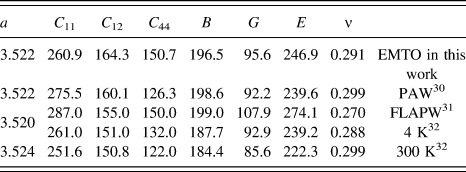
The ground state properties of the fcc Ni metal were first calculated, and the results are presented in Table I, in which other theoretical results and experimental data are also given for references. It can be seen from Table I that the lattice parameter of fcc Ni calculated by the EMTO method agrees well with the other theoretical results achieved by the projector augmented wave method (PAW)Reference Shang, Saengdeejing, Mei, Kim, Zhang, Ganeshan, Wang and Liu30 and all-electron full-potential linear augmented plane wave method (FLAPW),Reference Guo and Wang31 and experimental results in the literature.Reference Ledbetter and Reed32
Theoretical and experimental lattice parameter a (Å), elastic constants (GPa), elastic moduli (GPa), and Poisson’s ratio (ν) of pure Ni.

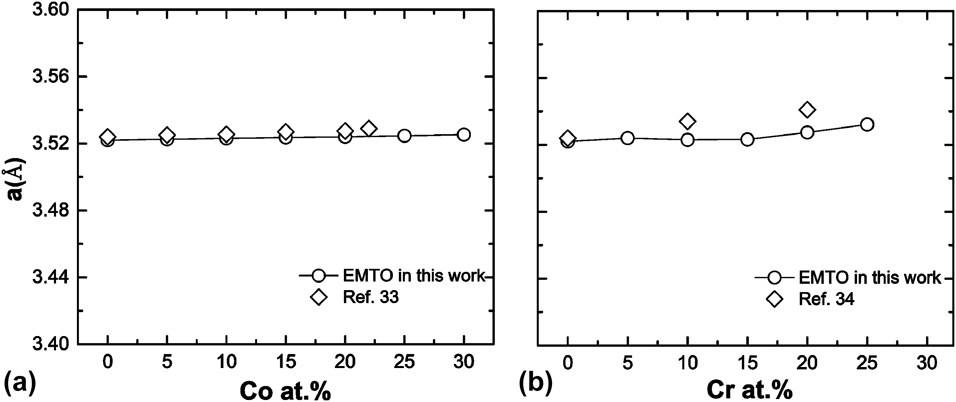
The calculated lattice parameters as a function of the Co and Cr concentrations in the binary Ni–(5–30)Co and Ni–(5–25)Cr alloys are shown in Figs. 1(a) and 1(b), respectively. The theoretical results are in good agreement with experimental data, with the typical level of error (∼2%) for DFT lattice constants.Reference Pearson and Thompson33,Reference Taylor and Floyd34 The different errors for the calculated lattice parameters of the Ni–Co and Ni–Cr alloys result from the exchange-correlation density functionals, for there is no universal gradient-level approximation, yielding a consistent error for transition metals and alloys. Recently, based on an element-specific optimization of the parameters in the exchange-correlation functionals, a concept of quasi-nonuniform gradient-level approximation was introduced for DFT calculations, and the theoretical lattice parameters and bulk moduli are in better agreement with the experimental results.Reference Levämäki, Punkkinen, Kokko and Vitos35,Reference Levämäki, Punkkinen, Kokko and Vitos36 Both Co and Cr increase the lattice parameter linearly. The slope of the lattice parameters Δa/Δx of the Ni–Co alloys is smaller than that of the Ni–Cr alloys by a factor of 3.7.
Dependence of lattice parameters on (a) Co content in Ni–Co alloys and (b) Cr content in Ni–Cr alloys.

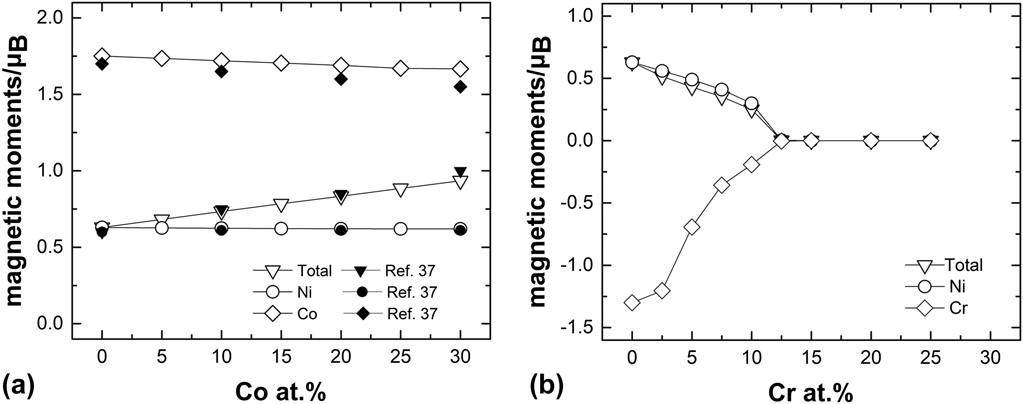
The total and local magnetic moments as a function of the Co and Cr concentrations in the Ni–Co and Ni–Cr alloys are presented in Figs. 2(a) and 2(b), respectively. The magnetic moments of Co and Ni [μ(Co) and μ(Ni)] show a very weak dependence on the Co concentration, which is in line with the experimental results.Reference Kudrnovský, Drchal and Bruno37 The total magnetic moment increases linearly with increasing the Co concentration. In the Ni–Cr alloys, Ni and Cr atoms are antiferromagnetically coupled and the magnetic moments [μ(Ni) and μ(Cr)] decrease with the Cr concentration due to magnetic frustration.Reference Punkkinen, Kwon, Kollár, Johansson and Vitos38 Both magnetic moments vanish at 12.5Cr at.%. A similar compositional dependence of the magnetic moment was observed in the binary Fe–Cr alloys.Reference Olsson, Abrikosov and Wallenius39
Dependence of total and local magnetic moments on (a) Co content in Ni–Co alloys and (b) Cr content in Ni–Cr alloys.

2. Ternary Ni–Co–Cr alloys
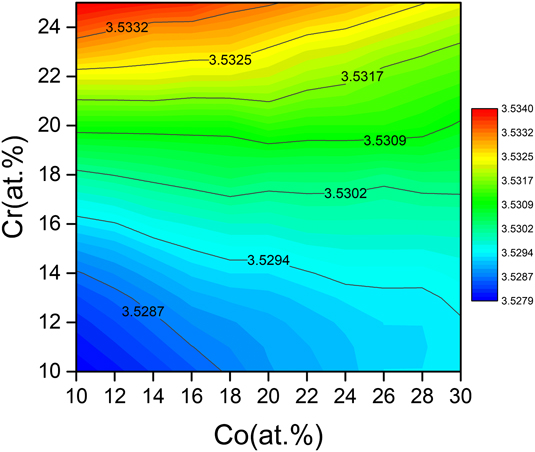
For the ternary Ni–(10–30)Co–(10–25)Cr alloys, all properties were actually calculated with a compositional interval of 2%. The calculated results were then used for plotting the contour figures. The calculated lattice parameters as a function of the Co and Cr concentrations in the ternary Ni–(10–30)Co–(10–25)Cr alloys are shown in Fig. 3. It can be seen that at various concentrations of Co, the lattice parameter always increases approximately linearly with Cr addition, with a larger slope of Δa/Δx at lower Co concentration. However, Cr addition leads to a nonlinear dependence of the lattice parameter, that is, to say at low Cr concentration (∼16 at.%), the lattice parameter almost monotonously increases with Co addition, while at high Cr concentration (∼22 at.%), it decreases with Co addition. The maximum lattice parameter appears at the Ni–10Co–25Cr concentration. The equilibrium lattice parameters for Ni, Co, and Cr pure metals with the fcc structure are 3.52 Å, 3.53 Å, and 3.63 Å (equivalent to 2.96 Å in bcc Cr), respectively. Obviously, the calculated lattice parameters for the ternary alloys do not follow the linear rule of mixing (Vegard’s law). To understand this, it is recalled that the experimental slopes of the lattice parameters Δa/Δx for Ni1−xCox, Ni1−xCrx, and Cr1−xCox systems are 0.2 × 10⁻³ Å/at.%,Reference Pearson and Thompson33 1.2 × 10⁻³ Å/at.%,Reference Pearson and Thompson33 and −2.1 × 10⁻³ Å/at.%,Reference Yukawa, Hida, Imura, Mizuno and Kawamura40 respectively. The variations in the lattice parameters of the ternary Ni1−x−yCoxCry alloys when the Cr concentration is fixed and Ni is replaced by Co may be approximated by three respective binary systems via (1 – y)Ni1−zCoz + y(Ni1−zCrz + Cr1−zCoz), where the interaction coefficients of different pairs of atoms are assumed to be the weight factor 1 – y and y, respectively.Reference Nurmi, Wang, Kokko and Vitos41 Thus, the slopes of the lattice parameters Δa/Δx are estimated as δ(Ni1−x−0.1CoxCr0.1) = 1.0 × 10⁻³ Å/at.%, δ(Ni1−x−0.18CoxCr0.18) = 0.02 × 10⁻³ Å/at.%, δ(Ni1−x−0.2CoxCr0.2) = −0.02 × 10⁻³ Å/at.%, and δ(Ni1−x−0.25CoxCr0.25) = −0.075 × 10⁻³ Å/at.%, which are in line with the calculated results presented in Fig. 3. This indicates that it is important to consider the Cr–Co chemical interactions on the lattice parameters of the ternary Ni–Co–Cr alloys when Cr concentration is high.
Contour plot of compositional dependence of lattice parameters of the ternary Ni–Co–Cr alloys.

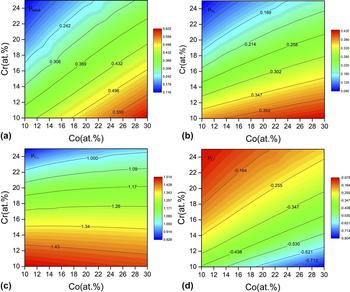
The total and local magnetic moments as a function of the Co and Cr concentrations in the ternary Ni–(10–30)Co–(10–25)Cr alloys are shown in Figs. 4(a)–4(d), respectively. The Ni moment μ(Ni) increases mildly with Co addition but decreases markedly with Cr addition. μ(Co) depends weakly on the Co concentration, similar to that in the Ni–Co alloys, but decreases significantly with Cr addition. μ(Cr) decreases with Co addition but increases with Cr addition. As a result, the total magnetic moment in the ternary Ni–(10–30)Co–(10–25)Cr alloys increases markedly with Co addition while decreases with Cr addition.
Contour plot of compositional dependence of total (a) μ(total), and local magnetic moments (b) μ(Ni), (c) μ(Co), and (d) μ(Cr) of the ternary Ni–Co–Cr alloys.

B. Elastic constants and moduli
1. Binary Ni–Co and Ni–Cr alloys
As shown in Table I, the elastic constants of fcc Ni from the present EMTO calculations are in reasonable agreement with those from other theoretical calculationsReference Shang, Saengdeejing, Mei, Kim, Zhang, Ganeshan, Wang and Liu30,Reference Guo and Wang31 and from experimental measurements,Reference Ledbetter and Reed32 except that the elastic constant C 44 is somewhat overestimated (The deviation still falls into the typical range of error for the DFT elastic constants). The polycrystal elastic moduli of fcc Ni from the present EMTO calculations also agree reasonably with those in the literature.Reference Shang, Saengdeejing, Mei, Kim, Zhang, Ganeshan, Wang and Liu30–Reference Ledbetter and Reed32
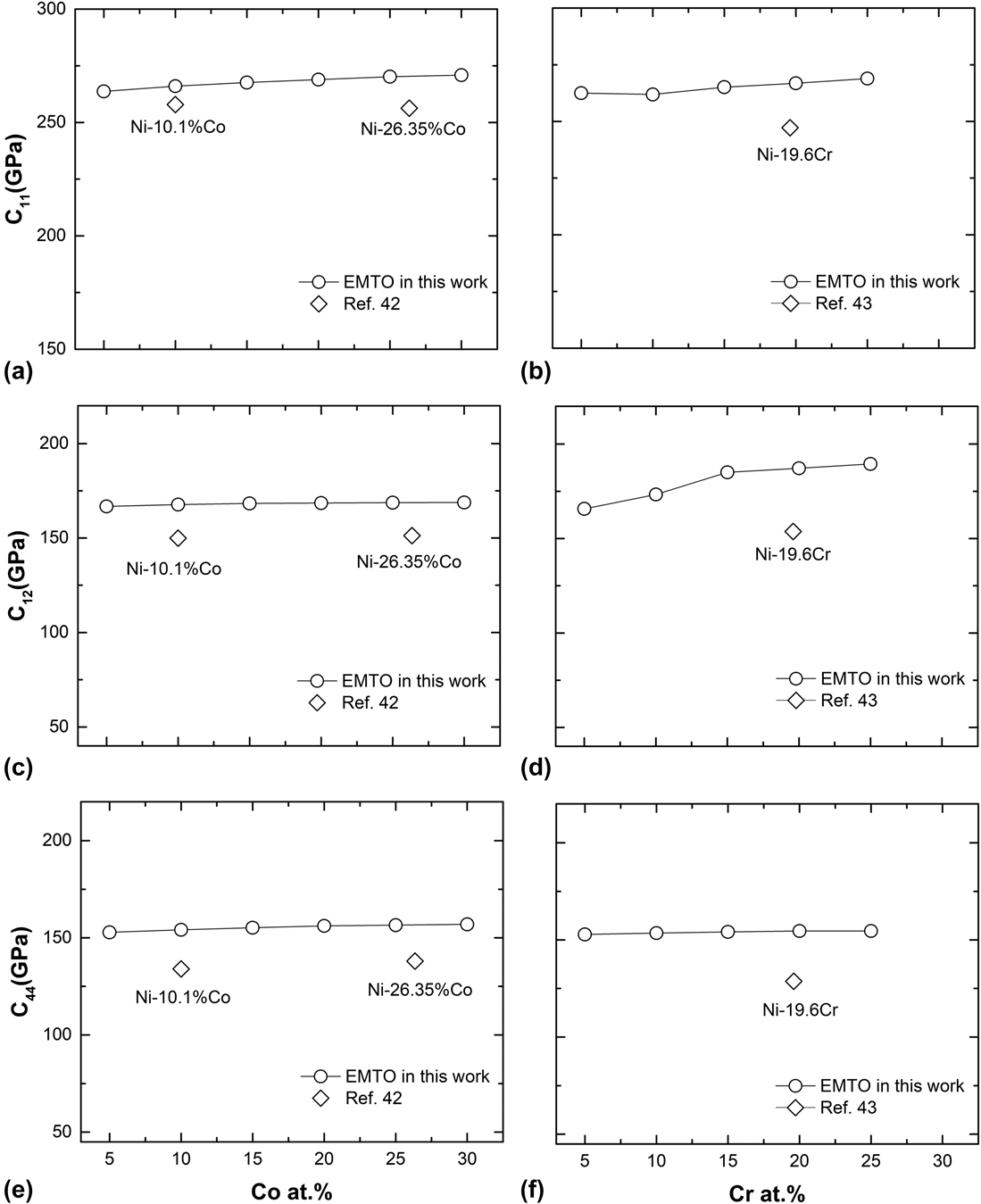
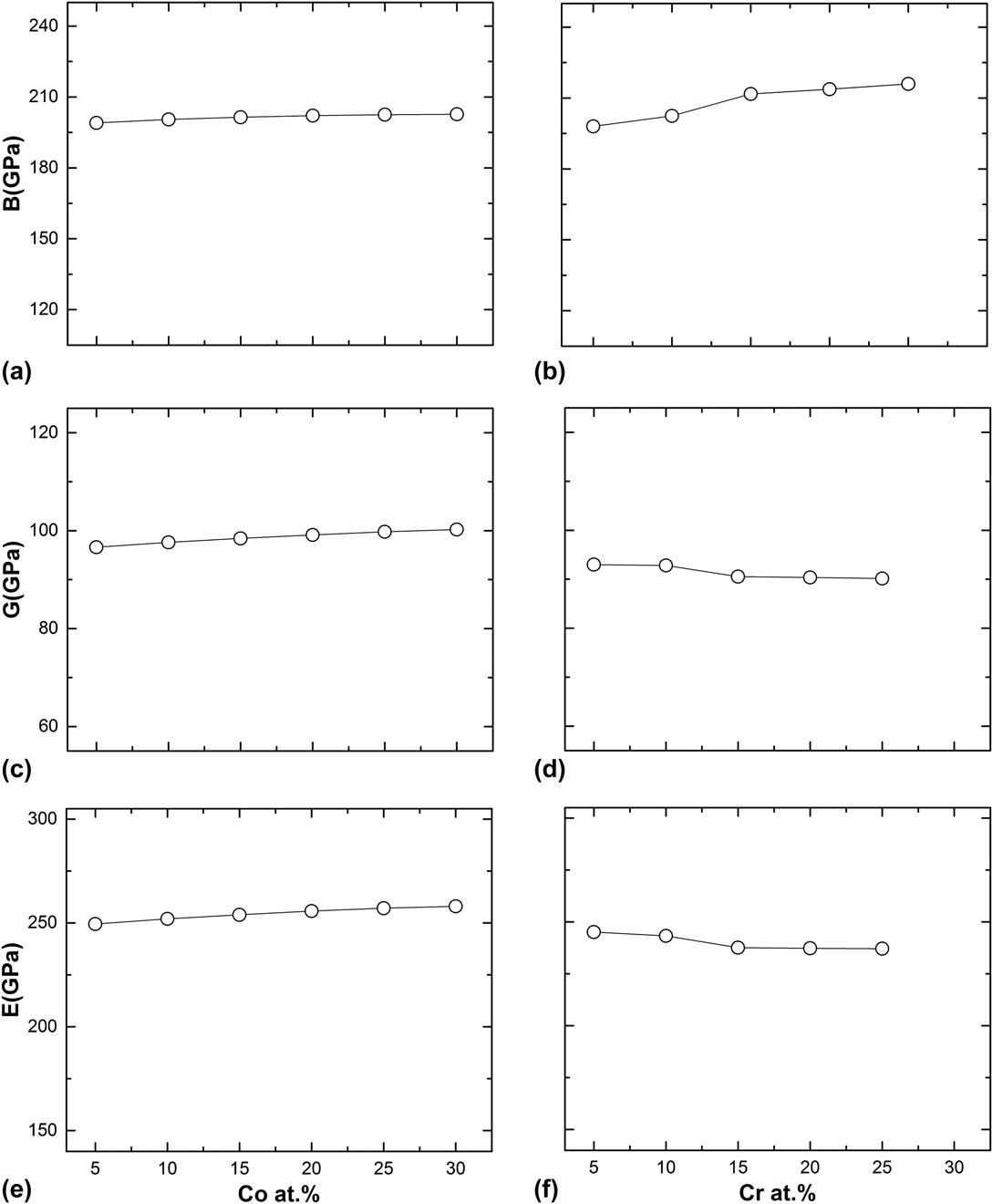
The calculated elastic constants as a function of the Co and Cr concentrations in the Ni–Co and Ni–Cr alloys are presented in Figs. 5(a)–5(f), respectively. All the elastic constants increase mildly with an increase in the Co and Cr concentrations in the Ni–Co and Ni–Cr alloys, respectively. The calculated elastic constants of Ni–10Co, Ni–25Co, and Ni–20Cr alloys are overestimated in comparison with the experimental values of Ni–10.1Co and Ni–26.35Co alloys by less than 15%Reference Leamy and Warlimont42 and of the Ni–19.6Cr alloy by about 20%.Reference Lenkkeri43 In general, there are two sources of error for the DFT elastic constants. The first part of the error comes from the neglect of thermal and zero-point vibration in the present calculations. The second error arises from the exchange-correlation density functionalsReference Levämäki, Punkkinen, Kokko and Vitos35,Reference Levämäki, Punkkinen, Kokko and Vitos36 discussed above. As shown in Figs. 1(a) and 1(b), the EMTO calculations underestimate the lattice parameters of the Ni–Co and Ni–Cr alloys, leading to overestimation of the elastic constants. Although there is deviation between the calculated elastic constants and experimental ones, this deviation does not affect the trend of compositional dependence of elastic properties for the Ni–Co and Ni–Cr alloys. The bulk, shear, and Young’s moduli (B, G, and E) as a function of the Co and Cr concentrations in the Ni–Co and Ni–Cr alloys are presented in Figs. 6(a)–6(f), respectively. For the Ni–Co alloys, they all slightly increase with the Co concentration. For the Ni–Cr alloys, the bulk modulus increases, and the shear and Young’s moduli decrease with the Cr concentration. The theoretical compositional dependence of the Young’s modulus agrees with the experimental results for both Ni–Co and Ni–Cr alloys.Reference Mishima, Ochiai, Hamao, Yodogawa and Suzuki7
Dependence of elastic constants (a, c, and e) on Co content in Ni–Co alloys and (b, d, and f) on Cr content in Ni–Cr alloys.

Dependence of elastic moduli (a, c, and e) on Co content in Ni–Co alloys and (b, d, and f) on Cr content in Ni–Cr alloys.

2. Ternary Ni–Co–Cr alloys
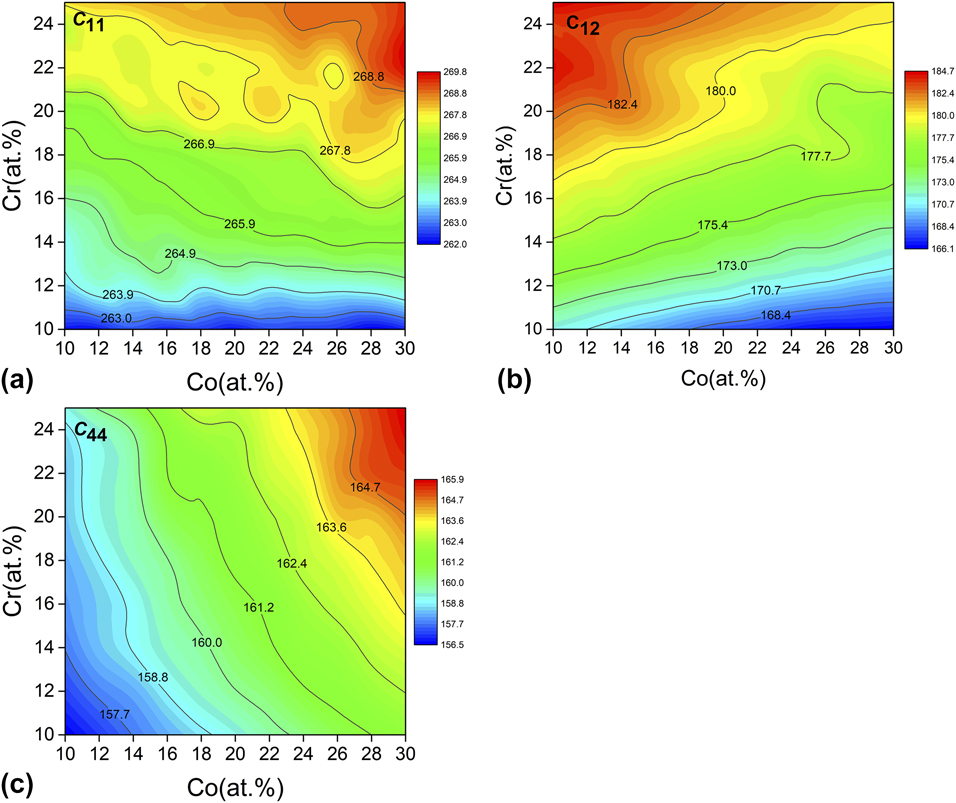
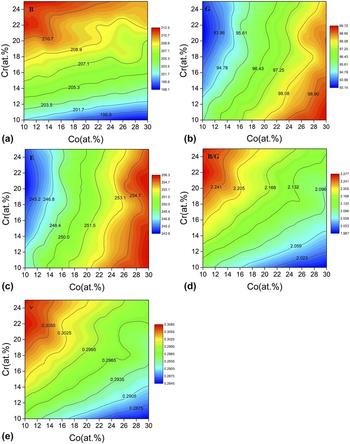
The calculated elastic constants of the ternary Ni–(10–30)Co–(10–25)Cr alloys as a function of composition are plotted in Figs. 7(a)–7(c). It is seen that C 11 increases with Cr addition at various Co concentrations and with Co addition at high Cr concentration. C 11 is weakly dependent on the Co addition at low Cr concentration. The maximum C 11 occurs at high Cr and Co concentrations [Fig. 7(a)]. C 12 increases with Cr addition, especially at low Co concentration, while C 12 decreases with Co addition [Fig. 7(b)]. C 44 increases with both Cr and Co additions, and the maximum C 44 is located at high Cr and Co concentrations [Fig. 7(c)]. The overall variations of C 11, C 12, and C 44 as a function of composition are relatively small. The elastic moduli and Poisson’s ratio of the ternary Ni–(10–30)Co–(10–25)Cr alloys as a function of composition are plotted in Figs. 8(a)–8(e). The bulk modulus increases with Cr addition but decreases with Co addition. The maximum B appears at the Ni–10Co–25Cr concentration [Fig. 8(a)]. On the contrary, the shear modulus decreases with Cr addition but increases with Co addition. The maximum G occurs at the Ni–30Co–10Cr concentration [Fig. 8(b)]. The Young’s modulus has a similar compositional dependence as that of the shear modulus [Fig. 8(c)]. The ratio of B and G is often used to evaluate the ductile/brittle behavior of the alloys. According to Pugh’s approximation, the material is ductile when its B/G is larger than 1.75; otherwise, it is brittle.Reference Pugh44 For the studied compositional range, all B/G values for the ternary Ni–(10–30)Co–(10–25)Cr alloys are larger than 1.75, indicating that the alloys are ductile. They show a similar compositional dependence as the bulk modulus [Fig. 8(d)]. Poisson’s ratios, ν, of the ternary Ni–(10–30)Co–(10–25)Cr alloys were also calculated, showing a similar compositional dependence as B/G [Fig. 8(e)].
Contour plot of compositional dependence of elastic constants (a) C 11, (b) C 12, and (c) C 44 of the ternary Ni–Co–Cr alloys.

Contour plot of compositional dependence of elastic moduli (a) B, (b) G, (c) E, (d) B/G, and (e) ν of the ternary Ni–Co–Cr alloys.

C. SSS
1. Binary Ni–Co and Ni–Cr alloys
According to Labusch,Reference Labusch12 the additional strength resulting from SSS for a solute atom i can be expressed as
 $$\Delta \tau = {B_i}{C_i}^{{2 / 3}}\quad ,$$
 $${B_i} = 3G{\varepsilon ^{{4 / 3}}}Z\quad ,$$
where B i is the strengthening parameter, corresponding to the experimental hardening rate of k. Z is a constant independent of the solute atom. G is the shear modulus of the matrix. C i is the atomic fraction of the solute atoms. ε and η′ are the Fleischer parameter and modulus interaction term, which are expressed by
 $$\varepsilon = {\left( {{{\eta '}^2} + {\alpha ^2}{\delta ^2}} \right)^{{1 / 2}}}\quad ,$$
 $$\eta \prime = {\eta / {\left( {1 + 0.5\left| \eta \right|} \right)}}\quad .$$
Here, η and δ are the modulus and atomic misfit parameters, which are given by
 $$\eta = {1 \over G}\left( {{{\partial G} \over {\partial C}}} \right)\quad ,$$
 $$\delta = {1 \over a}\left( {{{\partial a} \over {\partial C}}} \right)\quad ,$$
where α is the constant (3 < α < 16) for the interaction between solute atoms and screw dislocations (α is usually assumed to be 16 for fcc-structured alloys) and a is the lattice constant. Using the lattice parameters and shear moduli shown in Figs. 1 and 6, the average strengthening parameters were calculated to be 31.35 MPa/at.%2/3 for the Ni–Co and 85.73 MPa/at.%2/3 for the Ni–Cr alloys, respectively. It can be seen that both Co and Cr additions result in a distinct SSS for the Ni–Co and Ni–Cr alloys, respectively, and the SSS effect of Cr is stronger than that of Co by a factor of 2.7 because the atomic misfit parameter of the Ni–Cr alloys is larger than that of the Ni–Co alloys. This indicates that the SSS is governed by the atomic misfit parameter, and the contribution of the modulus misfit parameter is small. The average strengthening parameter is close to the experimental result of 96.8 MPa/at.%2/3 for the Ni–Cr alloys,Reference Davies, Sagar and Stevens9,Reference Franke, Durst and Göken15 while for the Ni–Co alloys, the average strengthening parameter is smaller than the experimental value of 54.9 MPa/at.%2/3.Reference Akhtar and Teghtsoonian10,Reference Franke, Durst and Göken15 The reason could be ascribed to the contribution of stacking faults to SSS in the Ni–Co alloys. It was claimed that Co addition decreases dramatically the stacking fault energies in the Ni–Co alloys,Reference Akhtar and Teghtsoonian10 leading to additional strengthening through the suppression of cross-slip mediated deformation.
2. Ternary Ni–Co–Cr alloys
According to Gypen and Deruyttere,Reference Gypen and Deruyttere13 the additional strength resulting from SSS for the multicomponent alloys can be expressed as
 $$\Delta \tau = {\left( {\sum\limits_i {B_i^{{3 / 2}}{C_i}} } \right)^{{2 / 3}}}\quad .$$
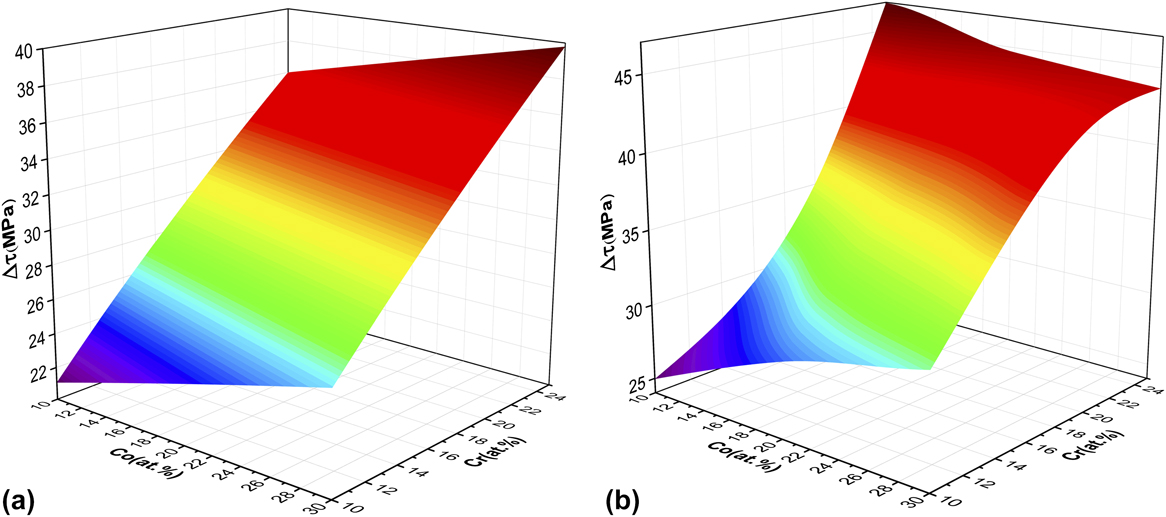
Using the lattice parameters and shear moduli of the binary Ni–Co and Ni–Cr alloys shown in Figs. 1 and 6, the compositional dependence of SSS in the ternary Ni–(10–30)Co–(10–25)Cr alloys was calculated, as shown in Fig. 9(a). It is seen from Fig. 9(a) that SSS increases linearly with both Co and Cr concentrations, and the maximum SSS effect is found at the Ni–30Co–25Cr concentration.
Solid-solution strengthening (a) from the model in the literatureReference Gypen and Deruyttere13 and (b) from revised model in this work for the ternary Ni–Co–Cr alloys.

It is noteworthy that in Eq. (15), the calculated SSS effect for the ternary Ni–Co–Cr alloys arises only from the contributions of the binary Ni–Co and Ni–Cr systems, but not from the Co–Cr system. As a matter of fact, present calculations have shown that the lattice parameters are related to the interactions among the Ni–Co, Ni–Cr and Co–Cr systems for the ternary Ni–Co–Cr concentrated alloys. Therefore, the SSS model proposed by Gypen and DeruyttereReference Gypen and Deruyttere13 for the multicomponent solid solutions may not apply to the ternary Ni–Co–Cr concentrated alloys. To fully account the SSS effect in the ternary alloys, the lattice parameters and shear moduli of the ternary alloys shown in Figs. 3 and 8 are used to calculate the related parameters in Eqs. (11) and (12) for the ternary Ni–(10–30)Co–(10–25)Cr alloys, where Co and Cr are treated as the “effective solute” and Ni as the solvent as suggested in Ref. Reference Wu, Gao and Bei45. The atomic and modulus misfit parameters in Eqs. (11) and (12) are expressed as
 $$\delta = {{{a_{{\rm{N}}{{\rm{i}}_{1 - x - y}}{\rm{C}}{{\rm{o}}_x}{\rm{C}}{{\rm{r}}_y}}} - {a_{{\rm{Ni}}}}} \over {\left( {1 - {C_{{\rm{Ni}}}}} \right){a_{{\rm{Ni}}}}}}\quad ,$$
 $$\eta = {{{G_{{\rm{N}}{{\rm{i}}_{1 - x - y}}{\rm{C}}{{\rm{o}}_x}{\rm{C}}{{\rm{r}}_y}}} - {G_{{\rm{Ni}}}}} \over {\left( {1 - {C_{{\rm{Ni}}}}} \right){G_{{\rm{Ni}}}}}}\quad .$$
The SSS effect for the ternary Ni–(10–30)Co–(10–25)Cr alloys is then calculated according to Eqs. (9) and (10). The compositional dependence of SSS of the ternary Ni–(10–30)Co–(10–25)Cr alloys is shown in Fig. 9(b), in which a larger SSS effect is observed compared to the results in Fig. 9(a). Furthermore, a different compositional dependence of SSS is revealed. At fixed Co concentrations, SSS always increases with Cr addition. While the effect of Co on SSS depends strongly on the actual Cr concentration, i.e., at low Cr concentration, SSS mildly increases with Co addition, which is in accordance with that from the model proposed by Gypen and Deruyttere,Reference Gypen and Deruyttere13 but at high Cr concentration, it slightly decreases with the increasing Co concentration due to the Cr–Co chemical interactions.
Co and Cr are the main alloying elements partitioning preferentially in the γ phase of the Ni-based superalloys.Reference Jahangiri, Arabi and Boutorabi3–Reference Gu, Harada, Cui, Ping, Sato and Fujioka5 The present work shows that the addition of Co and Cr produces a significant SSS in the matrix of the Ni-based superalloys. With the DFT results of compositional dependence of SSS, the alloy composition is able to be optimized to improve the mechanical properties of the Ni-based superalloys.
IV. SUMMARY
The elastic properties and SSS of the binary Ni–(5–30)Co and Ni–(5–25)Cr and ternary Ni–(10–30)Co–(10–25)Cr (at.%) solid-solution alloys have been investigated using the EMTO–CPA method. The calculated results are summarized as follows:
(1) Both Co and Cr increase the lattice parameters of the binary alloys linearly. The slope of the lattice parameter Δa/Δx of the Ni–Co alloys is smaller than that of the Ni–Cr alloys by a factor of 3.7. However, nonlinearity is found in the compositional dependence of the lattice parameter in the ternary Ni–Co–Cr alloys, i.e., Co increases and decreases the lattice parameter at low and high Cr concentrations, respectively, which emphasizes the effect of chemical interactions among alloying elements on the lattice parameter.
(2) The total magnetic moment increases with increasing the Co concentration for the Ni–Co alloys while decreases markedly with increasing the Cr concentration and reaches zero at 12.5Cr at.% for the Ni–Cr alloys. In the ternary Ni–Co–Cr alloys, the total magnetic moments increase markedly with Co addition but decrease with Cr addition.
(3) The bulk, shear, and Young’s moduli of the Ni–Co alloys increase with Co addition. The bulk modulus increases, while the shear and Young’s moduli decrease with Cr addition in the Ni–Cr alloys. The bulk modulus increases with Cr addition while decreases with Co addition in the ternary Ni–Co–Cr alloys. On the contrary, the shear and Young’s moduli decrease with Cr addition but increase with Co addition.
(4) Both Co and Cr additions result in effective SSS for the Ni–Co and Ni–Cr alloys, and Cr addition has a larger effect. In the ternary alloys, SSS increases significantly with Cr addition and mildly with Co addition at low Cr concentration but decreases with Co addition at high Cr concentration in the ternary Ni–Co–Cr alloys. For the present Ni–Co–Cr concentrated alloys, the model proposed by Gypen and Deruyttere may not be enough.
ACKNOWLEDGMENTS
This research is supported by the National Key R&D Program of China (Project No. 2016YFB0701405) and the Science and Technology Committee of Shanghai Municipal (Project No. 14521100601).