Introduction
Democracy in rural China has attracted much attention in recent years.
During President Bill Clinton's visit to China in 1998, he made a public
stop at a village outside Xian to chat with a few Chinese villagers
about village elections in China. In fact, village democracy has become
one of the rare subject matters that the Chinese government is eager to
publicize and the Western academia and media are interested to
investigate. The Chinese government, often through the Ministry of Civil
Affairs, has organized and allowed foreign journalists, social
scientists, dignitaries, diplomats, and political, academic, and social
organizations (such as the U.S. International Republican Institute, the
Ford Foundation, the Carter Center, and the National Committee on
U.S.-China Relations) to go to Chinese rural areas to observe village
selfgovernment and elections. There is no doubt that the Chinese
government intends to showcase its village selfgovernment to the outside
world, hoping to improve its tarnished image from the Tiananmen
crackdown in 1989. Western media and governments are interested in this
new development in China in the hope that this will be the beginning of
the long-delayed democratic transition in the most populous country in
the world.
It is ironic that the Chinese government first introduced democratic
elections into the Chinese countryside since the Chinese government
often argues that the main obstacles to further democratization are low
educational levels among the vast Chinese peasant population and the
lack of economic development in rural China. In fact, the Chinese
government is not alone in holding a negative perception of Chinese
peasantry. Historically, Chinese peasantry has been viewed as a
conservative social and political force. A popular view among Chinese
intellectuals and the general population in China is still that Chinese
peasantry is one of the main obstacles to Chinese democracy due to their
conservative political culture, despite the fact that meaningful
villager committee elections are taking place in many Chinese villages
and the recent scholarship suggesting that Chinese peasants are very
conscious about their rights and are willing to protect their rights
through “rightful resistance” (O'Brien and Li 1995, 756–783). In fact, some scholars even suggest that the
Chinese countryside may end up leading democratization to the rest of
China (White 1992, 277).
Is this popular negative view about Chinese peasantry valid? What is the
current status of political culture and participation among Chinese
peasants? How do Chinese peasants compare to Chinese urban residents
with regard to their political views on democracy and economic reforms?
Answers to these questions are crucial to understanding political
developments and in predicting the path of democratization in the most
populous country in the world. Unfortunately, there have been few
empirical studies on this subject in contemporary Chinese scholarship.
This paper attempts to provide some answers to these questions by
drawing findings from a unique survey conducted in Jiangsu province. It
is not the author's intention to generalize these findings from southern
Jiangsu province, which is one of the most developed rural areas in
China, to the rest of China's rural population. Findings from this study
demonstrate that the Chinese countryside is more stratified than many
people think and that the political culture of peasants in China's
developed rural areas is quite advanced and does not lag far behind that
of China's urban residents. As rural areas in the Chinese hinterland
become more economically developed, Chinese peasants in those regions
will take on the political culture characteristics of today's Jiangsu
peasants, which will provide a brighter future for further
democratization in rural China.
Data
This research is based on a random public opinion survey conducted in the
summer of 2000 in 12 Jiangsu counties. Jiangsu is a major populous
province and one of the most economically and culturally developed areas
in China. Southern Jiangsu is historically known as yu mi zhi
xiang or land of fish and rice. Jiangsu's economic development
has accelerated since the economic reforms of the late 1970s due to its
successful rural industrialization drive led by the collective economy
of township and village enterprises (TVEs).1
The southern Jiangsu economic development model is often
differentiated from the Wenzhou development model that
emphasizes private enterprises and the Pearl River delta
development model that is based on massive foreign
investment.
Due to the province's long-held respect for
knowledge and education and its recent economic development, the
educational level and literacy rate of the rural population in southern
Jiangsu are much higher than those in most other rural areas in
China.
2 The illiteracy rate in Jiangsu
is 9% while the national average is around 19%, see Suzhou
Statistical Yearbook, Wuxi Statistical Yearbook, Changzhou
Statistical Yearbook and Suzanne Ogden 1999, 4.
If we accept the
positive linkage between economic development on the one hand and
democratization and development of democratic political culture on the
other in Western literature, it seems that Jiangsu offers one of the
best sites to study how far democracy can develop in rural China.
The survey, conducted in cooperation with a Chinese research
institute,3
By mutual agreement we
must maintain the anonymity of this organization.
draws
from the literate rural adult population (with rural residency status or
hukou) over 18 years of age residing in 21 towns and
townships in southern Jiangsu.
4 The reason
we decided not to include illiterate peasants in our survey is
based upon the results of a pre-test conducted prior to the
survey. Our experience with the pre-test is that most of the
illiterate peasants had so many cognitive problems in
comprehending the questions that we had to explain the entire
questions. In fact, we observed that when the interviewers tried
to explain the questions to the respondents they tended to
inject their own opinions or biased examples. To avoid such
biases and induced answers, we decided to eliminate the
illiterate population from our survey. Fortunately, only 9% of
the rural population in the areas we surveyed is illiterate. We
do not think this elimination should have major impact on our
findings in this study.
Our sample obtained 1,162 valid
responses of 1,270, using multistage random sampling procedures.
5 A multi-stage sampling procedure was used
to conduct the survey. Twenty-one towns and townships were
randomly chosen after the first stage of sampling. Four villages
were randomly chosen from each town or township after the second
stage of sampling. The third stage of sampling produced
approximately 16 households from each randomly chosen village.
One individual adult was randomly chosen from each randomly
chosen household as the respondent at the final stage of
sampling in our Jiangsu rural survey. A total number of 1,270
respondents were randomly chosen; 1,162 responded to our
surveys.
The gender distribution among our respondents
was 60% male to 40% female due to the fact that we excluded illiterates
in our survey and the illiteracy rate in China is higher among women
than among men. About half (52%) of the people in the survey were below
40 years of age. We employed advanced and trained undergraduate and
graduate students as field workers to conduct the survey. A field worker
brought the questionnaire to the randomly-chosen individual respondent
who filled out the questionnaire; the field worker then brought the
questionnaire back to the survey center. As a result of this survey
method, the response rate is close to 92%.
6 On the high response rate in China, see Tianjian Shi 1997.
Care was taken to
minimize respondent effects and linguistic misinterpretations. The
original wording of our questionnaire, first designed in the U.S., was
reviewed by our cooperating research institute in China to fit the
Chinese social and cultural context. Respondents were assured of
absolute confidentiality and encouraged to provide answers that best
captured their true feelings.
7 On
conducting public opinion surveys in China, see Melanie Manion
1994.
Findings from the Survey
Gabriel A. Almond and Sidney Verba, in their classical work The Civic
Culture, define political culture as “the political system as
internalized in the cognitions, feelings, and evaluations of its
population” (Almond and Verba 1989, 13).
Democratic political culture involves cognitions and feelings toward
democratic values or principles such as political tolerance,
appreciation of liberty, consciousness of civic/political rights,
support for an independent media, and support for competitive elections
(Gibson, Dutch, and Tedin 1992). A democratic
citizen is one who believes in political tolerance and dissent,
individual liberty, who is conscious about his or her civic and
political rights, who favors more independent media, and who supports
and participates in competitive elections. Level of political interest
or apathy is also an important ingredient of political culture.
Political interest as psychological involvement in politics and public
affairs often leads to more active political participation (Verba, Nie,
and Kim 1978, 71). Any study of political
culture in China should also touch upon the significant economic reforms
that have been intricately related to political changes in that country.
Many scholars have long argued that there is a strong correlation
between free-market economics and democracy (Schumpeter 1942; Moore 1966;
Lindblom 1977; Dahl 1989; Almond 1991). Moreover, as
indicated earlier, political culture should concern citizens' subjective
evaluation of their government and policies.
Levels of Political Interest and Participation
Literature on Chinese political culture and participation often
describes three relatively distinct stages with regard to mass
political interest in contemporary China. The first stage was before
the 1949 Chinese Communist revolution when most Chinese seemed to be
politically apathetic and ignorant (Zhu, Zhao, and Li 1990). This stage was also characterized by
what one China scholar typified as a “popular isolation from
politics” (Townsend 1967, 10–20). The
second stage between the 1950s and 1970s was marked by a
“participation explosion” (Townsend 1967,
10–20) due to the Chinese Communist Party's (CCP) sustained
mobilization efforts that led to unprecedented enthusiasm on the
part of the population about public and political affairs,
especially during the 10 years of the Cultural Revolution. In fact,
political participation (in terms of private citizens' efforts to
influence public affairs) in the Chinese countryside was much more
active than many people think during this period. Peasants used
various means to protect and voice their interest, including state
institutions (such as local assemblies, mass organizations,
elections, and media) and non-conventional activities (such as
passive resistance and collective violence) (Burns 1988, 1–2). During the third stage, which
covers most of the post-Mao reform period and continues to the
present, a popular perception among China observers is that the
Chinese people are consumed with material goods and making money and
have become increasingly apolitical and pragmatic.8
For this perception, see Nicholas Kristof and
Sheryl WuDunn, 1994, and Arthur
Lewis Rosenbaum 1992, 19.
Deng Xiaoping's slogan “Getting rich is glorious” carries the day in
modern China.
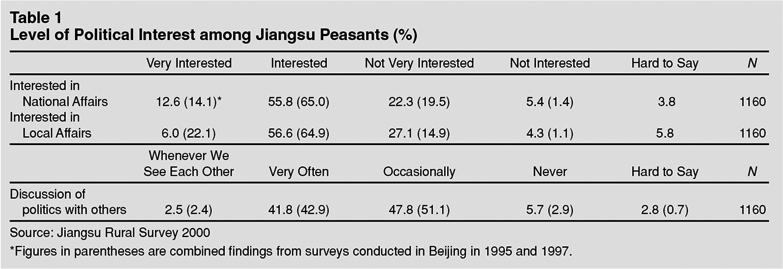
However, our Jiangsu rural survey shows that this perception of a low
level of political interest may not be the case. As Table 1 shows, about two thirds of our
respondents were still interested or very interested in national
affairs. This figure is surprisingly close to that found in two mass
surveys among Beijing residents conducted in the 1990s.9
On the two Beijing surveys conducted
among Beijing residents in the 1990s, see Yang Zhong, Jie
Chen, and John Scheb 1998.
A slightly lower percentage of our
respondents (about 62%) cared for local public affairs. This figure
is more than 25% lower than what we found among urban residents in
Beijing. However, the bottom line is that the majority of the
peasants in our survey showed some or strong interest in national as
well as local public affairs. These findings seem to contradict the
popular perception that most Chinese people, especially most Chinese
peasants, are apolitical and not interested in public affairs and
politics. In fact, there are many national and local issues that
Chinese peasants are truly concerned about, such as corruption at
various governmental levels, abuse of power by local and village
government officials, and government rural policies.
Even though most of our respondents were still interested in public
affairs, the number of people who talked about politics with others
was lower. Less than half of the respondents in our survey said they
talked about politics often with their family members, relatives,
colleagues, and friends (see Table 1).
Yet, this number is still very impressive given the stereotype about
political inactivity among Chinese peasants. Also, this figure is
very close to that in the Beijing surveys, indicating that rural
residents in Jiangsu are almost as active as urban residents in
Beijing in talking about politics and public affairs.
Next, we wanted to find out how often the rural residents in our
survey engage in participatory political acts.10
Another venue of participation that this survey did
not cover is the court system in China. There is evidence
that Chinese peasants increasingly use the law and the
courts to protect their rights and interests. See Kevin
O'Brien and Lianjiang Li 1995,
766.
Political participation is a complicated and
ambiguous term in China. In general, political participation in
China can be divided between officially sponsored and mobilized
participation and unofficial and spontaneous participation. We dealt
with both in our surveys. In the former, we included voting in
government-sponsored elections to local people's congresses and
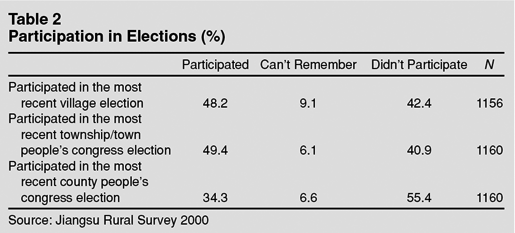
villagers' committees. As
Table 2 shows,
only about a third of our respondents participated in the most
recently held election to the county people's congress and about
half participated in the most recently held township people's
congress elections. Unlike people's congress elections at higher
levels (city, provincial, and national), elections to both county
and township people's congress are direct elections, meaning regular
voters cast votes directly for their representatives. Since people's
congresses at both county and township levels are primarily
rubber-stamp organizations, people in China generally show low
levels of interest in these organizations. As a result, the
government has to make great efforts to mobilize people to vote in
these elections to legitimize the existence and functions of these
“representative” organs. Even though the voting in these elections
is government mobilized, the percentage of voting in these elections
in Jiangsu's rural areas is still lower than many would expect. This
is primarily due to the fact that failure to show up for these
elections is no longer treated as a punishable act by the
authorities.
As mentioned at the beginning of the paper, villagers' committee
elections have attracted much attention both at home and abroad.
Just how many Chinese peasants vote in village elections? The
figures vary significantly from one report to the next. The Chinese
press routinely reports voter turnout in these elections at above
90%. In a document prepared by the Taicang (a county-status city in
southern Jiangsu) government, it reported a 99.4% voter turnout in
village elections held in Taicang in 1997 (Taicang Municipal
Government 1999). Tianjian Shi reports
around 76% of the people in his 1990–1991 survey participated in the
semi-competitive elections of local work unit leaders (village
elections included), even though the figure does not differentiate
unit leaders' elections between urban and rural areas (Shi 1999, 1123).
Our survey finds much lower peasant voter turnout in village
elections in the areas covered by our study. Approximately half
(48%) of the eligible voters in our survey reported they actually
went to the central polling station to cast their vote while 42% did
not (see Table 2). Interestingly enough,
the voter turnout in village elections in our surveyed areas is very
close to that in township/town people's congress elections, while
peasants' participation in county people's congress elections is the
lowest among the three.
The low voter turnout in villagers' committee elections has much to
do with institutional constraints and limited choices in these
elections in Jiangsu.11
For a more
detailed discussion and history of villagers' committee
elections in Jiangsu, see Yang Zhong 2000.
For the most part, nomination of
villagers' committee candidates is still very much controlled by the
township/town government and the village communist party branch.
Open nomination (or “sea election”) was not widely practiced in
Jiangsu when the survey was conducted. In addition, open campaigning
by candidates was discouraged. What is even more detrimental to the
effectiveness of villagers' committee elections in China is the
limited power of villagers' committees, which are subject to the
authority of the village communist branch. The village party branch
secretary is the so-called first hand, or the most important cadre
in the village, while the villagers' committee chair is usually the
deputy party secretary. All major decisions have to be approved
first by the village party branch before adoption and implementation
by the villagers' committee. In addition, the power and authority of
the villagers' committee is also circumscribed by higher
authorities, especially township/town governments. Given these
institutional constraints, it is not surprising that peasants in
China lose interest in villagers' committee elections.
Apart from officially organized and sanctioned political
participation, there are also spontaneous yet conventional political
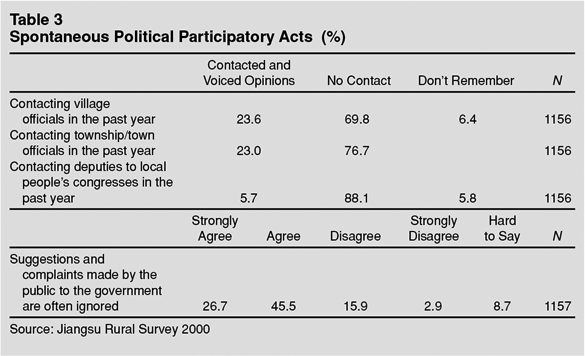
acts initiated by private citizens in China. In our survey, we
included voicing opinions or writing letters to village and
township/town government leaders and deputies to the county and
township/town people's congresses. As shown in Table 3, close to a quarter of our respondents voiced
opinions to their village officials and township/town officials.
Much fewer people ever contacted their deputies to the township/town
and county people's congresses. Apparently, many people were not shy
in contacting local government officials, even though it remains
doubtful whether contacting officials could effectively affect
officials' behavior. In our survey, more than 70% either agreed or
strongly agreed with the statement that opinions and concerns voiced
by the people to government officials are most often ignored (see
Table 3). Very few people in our
survey ever contacted deputies to the local people's congresses,
even though they are supposed to be official representatives for the
people. Obviously, the local people's congresses have yet to become
effective representative, legislative, and supervising bodies in
China.
Selected Democratic Values among Peasants
There has always been serious debate about whether traditional
Chinese political culture is inherently authoritarian and
incompatible with modern democratic values (Goldman 1994, 1). Chinese peasants in particular are
suspected as carriers of authoritarian culture. In fact, the absence
of democratization in China is often blamed on the Chinese peasants
who are believed to have a low level of democratic political culture
and lack democratic traditions. Moreover, the Chinese people have
lived under communism for over half a century, which is likely to
leave an indelible imprint on their political orientation and
behavior. On the other hand, some China scholars have predicted that
marketization of the Chinese economy will inevitably lead to a
gradual process of political democratization, if one believes in the
linkage between economic development and democratization (White
1993; White 1994; Overholt 1993). What,
then, is the picture of mass political culture among Chinese
peasants toward democratic elections, pluralism, tolerance, and
authorities? Our survey attempts to shed some light in this
regard.
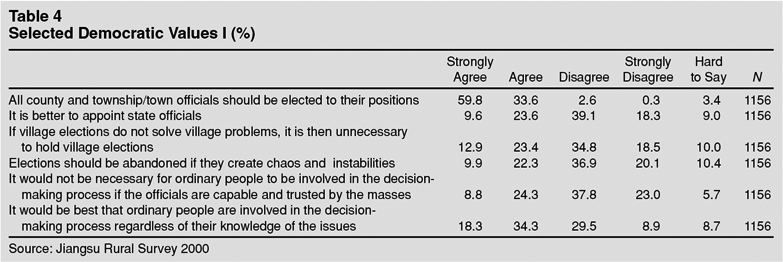
Findings presented in Table 4 show that
peasants in our survey strongly endorsed democratic elections. An
overwhelming majority of our respondents supported the concept that
township and county officials, who are currently not directly
elected by voters, should be popularly elected to their positions.
Close to 60% seemed to support the idea that state leaders should
also be promoted through elections. In another survey question, we
asked whether all village Party secretaries should be popularly
elected. An overwhelming majority of our respondents (82%) favored
popular election of village Party secretaries. A major constraint
and drawback in current village self-government in China, as
mentioned earlier, is the fact that the village Party secretary is
the most powerful cadre (or the “first-hand”) and the elected
village committee chairman is usually a deputy to the Party
secretary. Yet, the Party secretary is not popularly elected. The
lack of power by the villagers' committee chairman significantly
reduced the meaningfulness and effectiveness of village elections in
China.
It is even more surprising to find that a majority of our respondents
were not willing to give up on democratic elections even if elected
officials did not solve their problems and if elections created
chaos, indicating a strong belief in democracy. It should be noted
that the Chinese people have a special fear of chaos or
luan after experiencing centuries of upheavals,
revolutions, and instabilities. The chaotic Cultural Revolution is
still fresh in peoples' minds. Capitalizing on this fear, the
Chinese government, since the Tiananmen Democracy Movement in 1989,
has relentlessly emphasized the need for stability for greater
economic development. Chinese leaders have used the stability
argument to suppress dissent and garner regime legitimacy by
equating democratization with chaos and constantly reminding Chinese
people that the unstable situation in some Eastern European
countries and Russia in their transition to democracy could happen
to China (Zhong 1996, 214–215). Therefore,
the survey findings are especially interesting given the Chinese
peoples' traditional concern for stability over chaos. Moreover, we
also found a strong sense of popular participation. Over 60% of
people in our survey did not believe in elite politics and over 50%
supported a citizen's right to participate regardless of one's
knowledge and educational levels. These findings contradict the
negative perception of low political democratic culture among
Chinese peasantry.
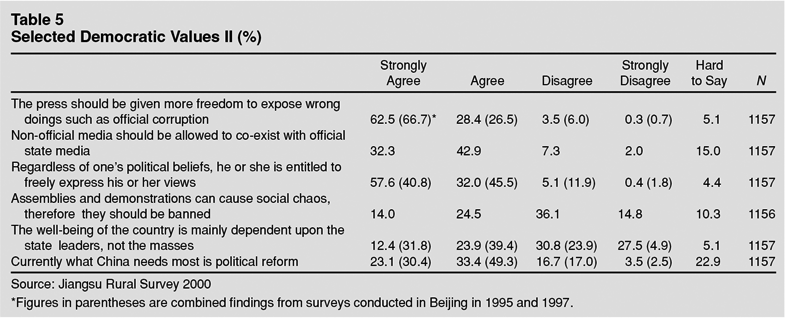
Table 5 presents findings on attitudes
toward press freedom, tolerance, political efficacy, and the
necessity for political reforms. Press freedom seems to be strongly
favored by our respondents. An overwhelming majority of the peasants
in our survey believed that the press should be given more freedom
to expose wrong doings such as official corruption, and a
significant majority favored the existence of a non-official media
alongside the official state media. Close to 90% of our respondents
agreed that one is entitled to the same right of free speech as
everyone else regardless of his or her political beliefs. When
asserted that assemblies and demonstrations should be banned if they
cause social instability, more than half of our respondents
disagreed. In addition, peasants in our survey seemed to have strong
internal political efficacy. Close to 60% of our respondents
believed that the well-being of the country is mainly dependent upon
the masses, not state leaders. This indicates a strong sense of
confidence in themselves among our peasant respondents. Moreover,
over 50% of the people in our survey believed that political reforms
are sorely needed in China. These findings seem to defy the
conventional wisdom that Chinese peasants are socially and
politically conservative forces and hold values incompatible with
democracy.
In fact, on most of these questions, our peasant respondents in
Jiangsu fared equally well or even better than the urban residents
in our Beijing surveys. For example, on the question upon whom the
well-being of the country relies, most people in our Jiangsu rural
survey chose the masses, while most Beijing residents selected state
leaders. Findings like these are indeed thought-provoking and need
more research and exploration.
Attitudes toward Economic Reforms
As mentioned earlier, many scholars have long argued that there is a
strong correlation between the free market economic system and
democracy. Given that connection, it is interesting to discover how
Chinese peasants feel about the on-going market-driven reforms
started in the late 1970s. It is apparent that the economic reforms
have dramatically changed the face of China, making it one of the
fastest growing economies in the world. These reforms have markedly
improved the standard of living for ordinary Chinese. Yet, these
reforms have also brought negative consequences such as inflation,
declining social welfare programs, corruption, a widening gap
between the rich and the poor, and job insecurity. In our surveys
conducted in Beijing in the 1990s, we found lukewarm support for the
adoption of a complete or predominantly market economy (Zhong, Chen,
and Scheb 1998, 773). These economic
reforms started in the rural countryside, where they received strong
initial support from the peasantry who benefited from the rural
reforms in the 1980s. However, since the late 1980s the economic
situation in rural China has deteriorated and the income gap between
urban residents and peasants has widened to the disadvantage of the
peasants due to declining prices for agricultural products, the
rising cost of farming, and excessive fee collection by local
governments. Given the new peasants' circumstances, we were
interested in what peasants thought about the market-driven reforms.
We particularly wanted to tap into the opinions and attitudes of the
rural residents toward economic and ownership systems, the speed of
economic reforms, and widening income inequality.
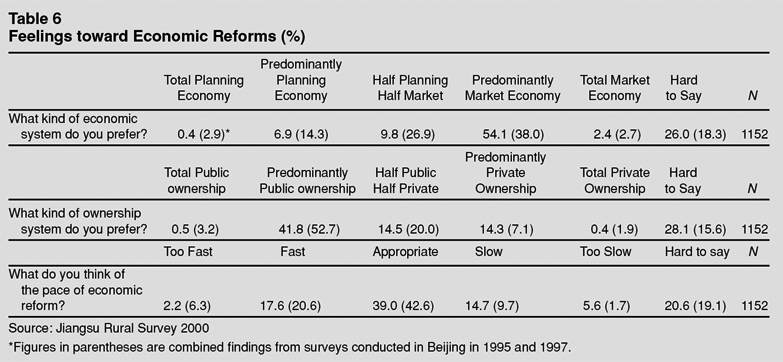
The responses to our questions on preferences for economic systems
and ownership structures showed an interesting pattern. With regard
to economic systems, very few preferred a total central planning
economy or CPE or a predominantly CPE genuinely mixed economy (see
Table 6). Also not many people (only
9.8%) preferred a genuinely mixed economy. Compared to data from our
Beijing surveys, these figures are much lower. Around 56% of our
respondents preferred either mostly market economy or a total market
economy. This figure is much higher than that in our Beijing
surveys. A quarter of the people in our Jiangsu rural survey had
hard time in deciding what system would be best for them. It seems
that a market economy, which has been favored and promoted by the
government since the early 1980s, is more acceptable and more
supported by rural peasants in Jiangsu than among urban residents in
Beijing. This is probably due to the fact that Beijing urban
residents have been more affected negatively than Chinese peasants
by the market-driven reforms which have led to layoffs of
state-owned enterprises. Also, Chinese peasants are more
economically independent and do not receive much in the way of state
welfare and subsidies.
When it comes to forms of ownership of the means of production, most
of the peasants in our survey still preferred predominantly public
ownership, even though the figure is lower than that in our Beijing
surveys. Close to 15% supported an evenly mixed ownership system,
with very few favoring totally private ownership. The support for a
predominantly public ownership system among our respondents can be
contributed to two factors. The first is the official policy of
maintaining a predominantly public ownership system in the economy
even though private business (including foreign investment) has made
tremendous strides and has been playing an increasingly important
role in the Chinese economy in the past two decades. The second
factor is the predominant position of collective township and
village enterprises (TVEs) that existed in Jiangsu. In fact,
southern Jiangsu is well known for its successful collective TVEs,
which have been referred to as the “Sunan model” of rural economic
development in China.
When asked about the speed of economic reforms, close to 40% of our
respondents seemed satisfied with the current pace. However, around
20% thought the reforms have been moving fast (17.6%) or too fast
(2.2%). Interestingly, about an equal number of the respondents
believed the economic reforms have been moving either slow (14.7%)
or too slow (5.6%). Again, these last two figures are higher than
those in our Beijing surveys, suggesting peasants in our Jiangsu
survey are more reform-minded than the urban residents in Beijing.
Once again, around 20% of the respondents had difficulty in
answering the question. These findings show that there is no
consensus among our peasant respondents on the pace of economic
reform, even though most people seemed content with the current pace
of economic reforms.
Economic equality is a major socialist value and used to be touted as
a proud achievement by the Chinese Communist Party. During the
reform era, however, the income gap has widened significantly. In
fact, the income gap in China is on par with some developed
capitalist countries and worse than others. For example, the Gini
coefficient for China in 2001 is 0.458, higher than those in Japan
(0.219), South Korea (0.28) and the United States (0.457), and close
to those in Hong Kong (0.487) and Singapore (0.481) (Lianhe
Zhaobao May 11, 2000, 17; February 10, 2001, 1). The
widening income gap often makes many of the less fortunate resentful
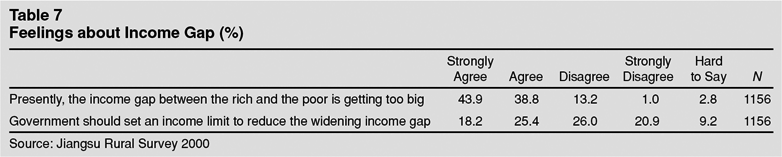
of the market-driven economic reforms. When asked whether the income
gap has become too wide, over 70% of our respondents either agreed
or strongly agreed (see Table 7).
Obviously, it is a concern for the rural population in our Jiangsu
survey. However, when asked whether the government should set an
income limit to reduce the widening income gap, more people (46.8%)
disapproved of than supported (43.4%) such a move (see Table 7). It might very well be that one's
economic standing determines one's position on that issue.
Specifically, the less affluent peasants supported a limit on
people's income while the well-to-do peasants opposed such a move.
Nonetheless, it is sufficient to say that the notion of an income
cap is not popular with a substantial number of the peasants in our
survey and the socialist value of income equality is probably
disappearing in the Chinese countryside.
Evaluation of Government Performance
How do peasants evaluate the performance of the Chinese government?
Perceived government performance can be directly linked to regime
legitimacy and political stability. Rural instability has become a
major concern for the Chinese government in recent years. We believe
that peasants' evaluations of government performance reflect their
level of satisfaction and can be used as a predictor of stability in
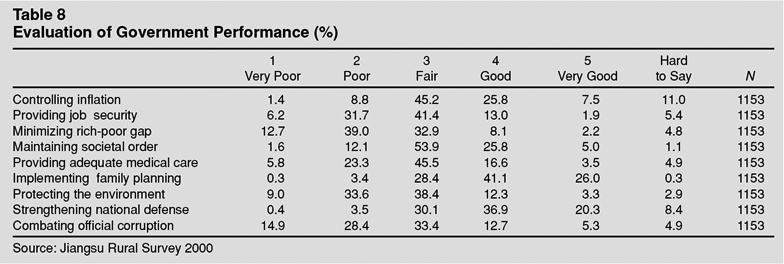
the Chinese countryside. The respondents in our survey were asked to
rate the performance of government in a number of issue areas using
a scale of 1 to 5 points (1-very poor, 2-poor, 3-fair, 4-good, and
5-very good).
The grades they gave are presented in Table
8. Satisfaction with Chinese government performance
varies with different issue areas. On the one hand, a substantial
number of the peasants in our survey were not happy with the
government's efforts in providing job security or employment,
minimizing the gap between the rich and the poor, providing adequate
medical care, protecting the environment, and combating official
corruption. In these issue areas, many people simply gave a passing
grade (fair) and few rated government performance as good or very
good. It seems that the least satisfied areas among our respondents
were the widening income gap and official corruption. Over 50% of
our respondents gave either poor or very poor grades to government
efforts in minimizing the richpoor gap and over 40% gave similar
grades to government performance in reducing official corruption.
These two issues are often the sources of instability in China's
rural areas. On the other hand, peasants in our survey were more
content with the government's efforts in controlling inflation,
maintaining social order, family planning, and strengthening
national defense. These ratings are understandable. The Chinese
government has done a relatively good job in controlling inflation
since the late 1990s and the authoritarian nature of the communist
regime in China makes it easier to implement policies in the areas
of maintaining social stability, family planning, and national
defense.
Overall, the evaluation of Chinese government performance is mixed,
though there is a considerable level of discontent with government
performance in many policy issue areas. It should be noted again
that Jiangsu's rural areas are more economically developed than most
other rural areas in China. It is safe to predict that the
dissatisfaction level among the peasant population in less developed
rural areas should be higher than that in Jiangsu.
Concluding Remarks
Through the survey conducted in Jiangsu, we get a glimpse of the popular
political culture and mood among Chinese peasants. Since this survey was
done only in the Jiangsu countryside, an economically developed area of
China, we do not intend to generalize the findings to the rest of
China's rural areas. In addition, it should be noted that one inherent
problem with survey research is that responses are often poor guides to
predicting the actual behavior of human beings, and our survey is no
exception. With these two cautions in mind, we derive the following
tentative implications based upon the findings.
First, we found that materialism has not reduced peoples' attention to
and interest in politics and public affairs among Jiangsu peasants. Not
only were they interested in state and local public affairs, but a large
number also talked about politics on a regular basis. Yet, their
political interest has not found legitimate and effective venues for
political participation. Voting by peasants in local elections was low.
If these elections were meaningful, the participation level would have
been much higher. The findings in our survey seem to confirm that. Only
one third of our respondents participated in much less meaningful county
people's congress elections while close to half voted in the more
meaningful villagers' committee elections. One important finding is that
the peasants in our survey showed relatively high levels of political
culture. They overwhelmingly endorsed elections as the means of official
promotions and appointments; they were extremely supportive of press
freedom; and they showed relatively high levels of political tolerance.
Our findings in Jiangsu in this regard are not that different from those
in our Beijing surveys in the 1990s. Moreover, peasants in our survey
did demand more political reforms. These findings indicate that it may
be premature and incorrect to say that all Chinese peasants are not
ready for democracy. It seems that peasants in our survey area are quite
ready for democratic change.
Second, on the economic front, it seems that the government's efforts to
develop a market economy while maintaining a primarily public ownership
system enjoy a high degree of support among the peasants in our survey.
In fact, more people in our Jiangsu rural survey supported a market
economy than the respondents in our surveys in Beijing. Also, income
disparity is a major concern for peasants in our survey. Yet, more
people are reluctant to adopt extreme measure such as capping one's
income by administrative means to bring about economic equality. It
seems that the socialist value of absolute income equality may be
declining in the more economically developed rural areas of China.
Third, we found that many people were fairly dissatisfied with government
performance in a number of issue areas, such as the government
redistribution policy to narrow the income gap between the rich and the
poor, combating official corruption, and providing employment
opportunities. If not handled properly and adequately, these problems
could lead to serious instability in China's rural areas.
In fact, over the past decade there has been a general and steady
deterioration of stability in the Chinese rural areas due to a
combination of factors such as misbehavior and corruption by the local
government officials, misguided government policies, and lack of
improvement in peasants' living conditions. Peasants' riots and
disturbances are not uncommon these days in the PRC. Fortunately for the
Chinese government, these riots and disturbances are seldom well
organized and tend to be spontaneous and incident driven. The stability
and economic development of China depend much on the situation in the
vast rural areas. How to accommodate the political demands of the
peasants while maintaining a steady economic growth is still a huge
challenge for the Chinese government.