Following World War II, the war-devastated French economy experienced strong and sustained growth based on a series of national economic plans, the “capital transfusion” of the Marshall Plan, and improved economic and financial environments. The period of rapid expansion that began after the war and lasted until the mid-1970s is often called “Les Trente Glorieuses” (The glorious thirty).Footnote 1 French industrial production increased by 61 percent between 1949 and 1956 and grew at an annual rate of 6 percent during the 1950s and 1960s.Footnote 2 The 1960s were characterized by a significant rise in U.S. direct investment by firms that were seeking European footholds. The average annual growth rate of U.S. investment in France from 1959 to 1963 was approximately 18 percent.Footnote 3
Compared with other European nations, France initially showed little enthusiasm for attracting American investment. General de Gaulle returned to power in 1958, and French anti-Americanism reached its peak in the 1960s because of de Gaulle's obstructionist politics, France's foreign-policy assertions, and the revival of French nationalism.Footnote 4 Although not all French people opposed the entry of American businesses into France, French society generally expressed skepticism about substantial inflows of American capital. A series of notorious “scandals” involving American enterprises in France, beginning in 1962, aggravated such concerns. Jean–Jacques Servan–Schreiber's famous Le Défi Américain predicted that within only fifteen years, the world's third industrial power—after the United States and the U.S.S.R.—would be the sum of the U.S. enterprises in Europe. The book embodied the anxiety of French society with respect to the “invasion” of American investment in France.Footnote 5 In the early 1960s, the French government even adopted restrictive policies toward American investment and attempted to influence other European Economic Community (EEC) countries to formulate a common policy to limit or control foreign investment in the Common Market.
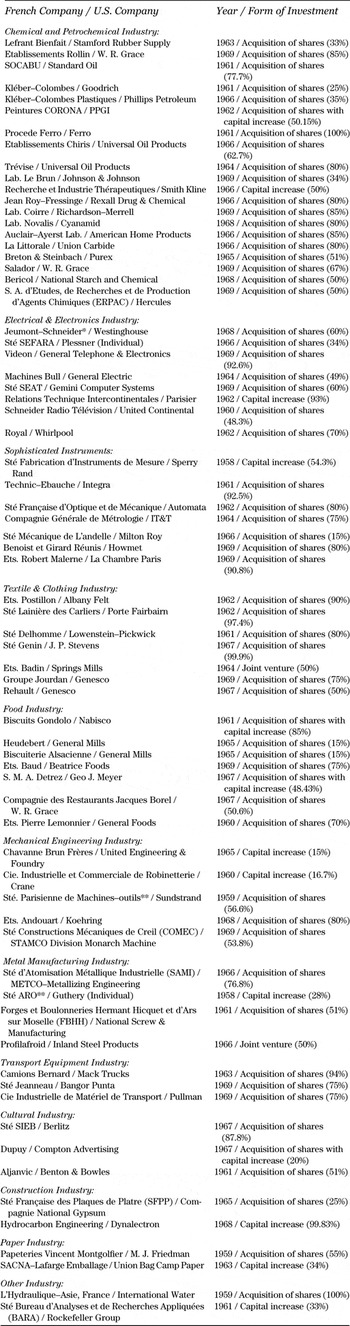
An interesting trend can be noted in the corporate materials held in the archives of the Banque de France (BdF) and of the French Ministry of Finance (Centre des Archives Economiques et Financières [CAEF]): there are many cases in which French companies took the initiative to seek out American investment—a subject rarely raised in the literature on foreign investment in France.Footnote 6 Using these records on American investment from 1958 to 1969, I randomly selected as my sample seventy cases in which French companies were obviously looking for American investment and verified the outcome of their investment applications.Footnote 7 The findings challenge the prevailing opinion that French authorities and businessmen were hostile to American investment and demonstrate that the French Fifth Republic's restrictive policies toward American investment in the 1960s have been exaggerated.
“L’État-banquier” and SMEs
The instances identified in the corporate files of the BdF archive show that the majority of companies pursuing American investment were small and medium-sized enterprises (SMEs); they were rarely large. Companies with capital of one million to five million francs constituted the highest proportion (thirty companies), whereas companies with capital of more than one hundred million francs constituted the lowest (three companies). France defines SMEs as enterprises with capital below five million francs.Footnote 8 Most of the sample's enterprises seeking American investment were SMEs—fifty-one of seventy companies (73 percent).
Why did these SMEs actively pursue the assistance of American investment? The French government's need for urgent reconstruction after World War II forced it to launch a series of national economic plans that have frequently been criticized as a root cause of the lack of adequate financial resources in the private sector. French companies, particularly SMEs, often complained that their financing and development difficulties stemmed from a lack of financial support from the government and domestic banks, forcing them to seek American capital to solve their problems.Footnote 9 However, in the aftermath of World War II, devastated industries, balance of payments deficits, persistent currency instability, and problematic chronic inflation tormented France. State intervention was crucial to effectively address these economic issues and the conversion of the economic structure.Footnote 10
Moreover, World War II had reduced France to a second-class power in the Cold War order and made it clear to France that superpower status required a strong economy.Footnote 11 Jean Monnet, the head of the French national economic planning commission, and the commission members were aware that, considering France's severe economic situation, the only way to rebuild a powerful industrial sector within a short time was to rely on American assistance and to adopt the American model. The French government's ultimate objective was to restore France's position as a great power and to have France replace Germany as the axis of Europe. The United States also wished to see an integrated economic and political order in Europe. In the bipolar world of the Cold War, Washington's principal objectives were to prevent the U.S.S.R. from filling the vacuum in central and western Europe, to harness Germany, to establish a multilateral world trading system, and ultimately to achieve a greater Atlantic economic and political community. The Marshall Plan represented the main financial support initiative to achieve these objectives.Footnote 12 In 1948–1949, the Marshall Plan granted $1.215 billion to France in one year—funds that certainly helped the country take its first steps toward recovery.Footnote 13
To quickly restore the country's economy, it was imperative for French authorities to control and allocate the lion's share of domestic financial resources.Footnote 14 L’État-banquier (“the state as banker”) became the French government's inescapable role.Footnote 15 The planners of the time widely assumed that France's small-scale enterprises, low concentration, and industrial Malthusianism were the primary causes of its weak global competitiveness.Footnote 16 Under the guidance of these technocrats, from the postwar period through the oil crisis of the 1970s, one of the credos of the French economy was “The bigger the better.” The French government encouraged the development of large-scale production units that could compete with foreign rivals and called incessantly for mergers to strengthen industries.Footnote 17 Accordingly, the state directed funds to competitive key sectors and then allocated most of the funds either to itself or to large-scale enterprises, particularly to nationalized enterprises, which made it difficult for companies in the private sector, in particular SMEs, to procure the capital they required in the financial markets.Footnote 18
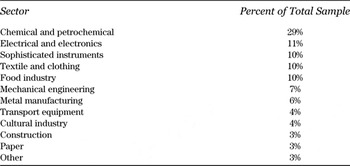
Is it true that French companies sought American investment because of a lack of financial support from the government and from domestic banks? The evidence drawn from the seventy sample firms and the industry analysis helps to identify the causal factors influencing the decisions of French companies. However, before we analyze relevant industries, we first need to know the industries in which these companies operated. The sectoral distribution of French companies that sought American investment, shown in Table 1, reveals that among this sample, companies in the chemical and petrochemical industry occupied the largest proportion among all sectors seeking American investment (twenty cases). The electrical and electronics industries and sophisticated instruments sectors recorded the second- and third-highest proportion of companies, respectively.
Sample Companies that Sought American Investments, 1958–1969 (by sector)

Source: Corporate files, 1958–1969, varied boxes, Versement 1462200501, Archives de la Banque de France, Paris.
In addition, these industries were characterized by a highly competitive and intense concentration. Following the Treaty of Rome, the number of mergers and acquisitions in these industries rose sharply.Footnote 19 Taking the pharmaceutical sector as an example, the number of laboratories was 1,960 in 1950 and had fallen to 510 in 1967, while the turnover of eighty-nine companies represented 83 percent of the industry's total turnover.Footnote 20 Further consideration of economic developments in each sector demonstrates a strong correlation between the level of concentration and that of economic growth.Footnote 21 The greater the growth, the higher the level of corporate mergers and acquisitions and the greater the proportion of foreign investment. In other words, strong industrial concentration often seems to exist in those dynamic and profitable sectors that also attracted the most foreign direct investment.
According to the BdF, between 1959 and 1962, the four sectors that attracted the largest amount of American investment were the metal and engineering, chemical, energy, and food industries, all of which were high-growth, high-profit, and highly competitive.Footnote 22 These four industries were also the most active in seeking both capital and technological assistance from the United States and had a high proportion of American investment, particularly the chemical and petrochemical industry. According to Gilles Bertin, the French industries that attracted the most foreign investment were—in addition to high-concentration and high-growth industries—those in which the level of concentration had a low starting point but began increasing rapidly as international competition intensified, and those that had vast room for growth, such as the pharmaceutical and the food industries.Footnote 23 The results of François Caron's study of the chemical industry correspond with my observations. Caron notes that in 1969, of the 121 French pharmaceutical laboratories with a turnover of more than ten million francs, 47 were foreign controlled, and of those, 26 were American controlled.Footnote 24
Sectoral Analysis
The main reason for French chemical and petrochemical companies to pursue American investment stemmed from this industry's intense concentration, which was a strategy in response to substantial foreign-investment inflows and intense competition in the French market. For example, the pharmaceutical industry was the largest of all sectors seeking American investment. Because of population growth and France's adoption of Sécurité sociale (Social Security), the French pharmaceutical industry experienced remarkable growth from the end of World War II to the 1960s. In the 1950s, the domestic market was well protected by the government's pharmaceutical regulations and price-control policy, which discouraged the inflow of foreign companies into this sector. French pharmaceutical companies confined their business mostly to the domestic market in the postwar era.
Although the French government's price-control policy restrained health expenditures, it also prevented French pharmaceutical companies from earning sufficient profits to finance research and commercial prospects overseas. Restrictions on funding for laboratories effectively prevented the entry of foreign capital into French pharmaceutical companies, but these restrictions also deprived SMEs of the resources needed for development.Footnote 25 The contraction of French pharmaceutical activities in overseas markets and the absence of the therapeutic revolution of the 1940s and 1950s seriously affected the international competitiveness of France's pharmaceutical industry.Footnote 26
The opening of the Common Market and the liberalization of the French pharmaceutical policy resulted in a large inflow of foreign firms into the French pharmaceutical market in the 1960s. Most of the French companies were small-scale, family-owned businesses that were unable to compete with large foreign multinationals.Footnote 27 The entry of a substantial number of foreign firms and keen market competition compelled French companies to unite, which further strengthened the merger movement in the country's pharmaceutical industry.Footnote 28
Because of government's price-control policy, the ratio of productive investment to the pharmaceutical companies' turnover remained at approximately 2 to 3 percent in the early 1960s.Footnote 29 Moreover, until 1967 the funding regulations of the French pharmaceutical industry still favored large-scale companies.Footnote 30 Under these circumstances, many SMEs were compelled to close, were absorbed by large domestic companies, or sought foreign investment to remain viable. The pharmaceutical cases in the sample of seventy firms show that most of the companies seeking American investment were small and medium-sized laboratories.
The pharmaceutical industry, with six group companies, was at the top of sectors seeking American investment. After adding laboratories and subsidiaries, fifteen companies belonged to these six pharmaceutical groups; of these fifteen pharmaceutical companies, six had capital of one million to five million francs, while nine had capital below one million francs. At that time, 82 percent of pharmaceutical companies had turnover of less than ten million francs.Footnote 31 This proportion is consistent with my observations. Of the fifteen companies, ten offered records of their turnover during that time; of these ten, seven had turnovers below ten million francs. Many of the laboratories and small-scale pharmaceutical companies that sought American assistance were unwilling to be absorbed by large local companies in the highly concentrated pharmaceutical industry. Based on this reasoning, which was further aggravated by the formation of the Common Market, a high proportion of pharmaceutical cases in the sample (including numerous American subsidiaries not listed in it) decided to pursue outside investment.Footnote 32
The Jean Roy–Fressinge pharmaceutical group clearly noted in its investment application that because of the French government's drug-control and price-freeze policy, along with foreign competition after the opening of the Common Market, numerous small and medium-scale pharmaceutical companies experiencing highly competitive pressure and difficulties were compelled to seek outside support. Many even disappeared. Facing a rapidly evolving industry and lacking the money to finance modernization projects, the Jean Roy–Fressinge Group attempted to merge with Rexall, a large American pharmaceutical and chemical company.Footnote 33 Two perfumeries, Trévise and the two-hundred-year-old Etablissements Chiris, declared that they had suffered from competition with European rivals and could not unite with domestic firms; thus, they sought the help of Universal Oil Products.Footnote 34 The pharmaceutical price-freeze policy of the French government indirectly affected the exports of the French pharmaceutical industry.Footnote 35 One way to overcome this difficult financial position was to seek foreign assistance. The main motivation for Laboratoires Novalis (sold to Cyanamid, an American chemical multinational) and Laboratoires Coirre (sold to Richardson–Merrell, a large American pharmaceutical firm) was to develop exports.Footnote 36
Another industry that experienced a situation similar to that of the pharmaceutical industry was the food industry. France's food industry contained a large number of small and medium-sized businesses that were widely dispersed, inefficient, and weakly competitive relative to foreign rivals. Until the 1960s, few food companies in the French food industry had been large enough to compete with foreign multinationals. The merger movement came too late; for example, the degree of concentration in the dairy industry was not intense until the mid-1960s.
Under fierce competition, concentration in the food industry became indispensable, and companies that remained isolated from this movement were unlikely to survive.Footnote 37 However, even when French food companies intended to unite, their financial resources and technology were frequently inadequate and government subsidies were insignificant.Footnote 38 American multinational enterprises became a lifeboat for many French food companies threatened by foreign businesses. Like most French cookie makers of the time, Biscuits Gondolo (a family-owned company) was stuck in a difficult situation caused by rigorous competition in the Common Market. The National Biscuit Company (Nabisco), the largest cookie producer in the world, was attracted by the Common Market and intended to establish itself in France.Footnote 39 If Nabisco had established a factory in France, Biscuits Gondolo would have been doomed. The company realized that the only way to avoid disaster was to join its foreign rival.Footnote 40 Heudebert and Biscuiterie Alsacienne sold part of their capital stock to General Mills for the same reason.Footnote 41
The electrical and electronics industries were characterized by explosive growth, high concentration, and strong foreign penetration in the postwar years.Footnote 42 Both the domestic and export markets were expanding rapidly: these industries recorded an average annual growth rate of 7.8 percent between 1945 and 1980.Footnote 43 The electrical and electronics industries were highly diversified and each branch's situation was different. International competitiveness was strong among the high-powered equipment sector; however, some in the low-powered equipment sector could not compete against areas with low labor costs, such as Japan and Eastern Europe.Footnote 44 The significant growth of the electrical and electronics industries was accompanied by substantial debt. As interest rates gradually increased—accompanied by a trend toward market saturation and high competition from less-expensive foreign products following the opening of the EEC market—French electrical companies encountered many difficulties in the 1960s, particularly in relation to funding. Indeed, almost all the electrical companies in the sample had financial difficulties.Footnote 45
Due to the strong trend toward concentration and severe competition in this sector, the television-receiver manufacturer Videon could not procure the necessary capital in France and eventually joined its potential rival, the American firm General Telephone and Electronics.Footnote 46 Similar cases can be found in the French household appliance industry. The example of Royal, a French manufacturer of domestic refrigerators that sold itself to Whirlpool, is typical.Footnote 47
In addition to the chemical and pharmaceutical, food, and electrical industries, which grew at a rapid and sustained pace, sectors representing a high proportion of those seeking American investment included such declining industries as the textile industry. In the period of the glorious thirty, when many industries experienced vigorous growth, the French textile industry—a very old industry—was in decline. France's textile industry had maintained a structure of family-owned businesses from ancient times; its management methods were generally obsolete and conservative. International instability in the 1950s greatly reduced the demand from colonial markets, and the loss of Indochinese colonies caused a sharp rise in raw-material costs. In the domestic market, competition from textile products from low-labor-cost countries and technological backwardness led to the shrinkage of French textile activity and a high level of debt—problems that became worse in the 1960s.Footnote 48
Among the seventy sample firms, Delhomme, a textile-printing factory, was a typical case of failing to compete with cheap Italian products and bailing itself out by selling to an American company.Footnote 49 The traditional concept of family capitalism and managerial paternalism had weakened the French textile industry's ability to finance its industrial restructuring and achieve modernization after World War II.Footnote 50 In the cascading collapses of the 1960s, American investment became lifeboats for certain French textile factories, including Postillon, one of France's most important felt producers.Footnote 51
Main Reasons for Seeking American Investment
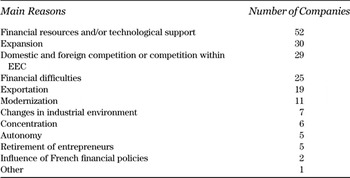
Table 2 shows the main motivations of the seventy sample firms for seeking American investment. Almost all the companies stated that their motivations encompassed several objectives, some of which are mutually dependent. Table 2 shows that fifty-two of the seventy companies indicated that they had sought American financial assistance and technical support. Twenty-nine companies indicated that they needed American assistance due to severe competition. This type of company can be found in all sectors, particularly in those industries characterized by fierce competition and high concentration, such as the chemical industry.
Reasons for Seeking American Investment in Sample Cases, 1958–1969

Source: Corporate files, 1958–1969, varied boxes, Versement 1462200501, Archives de la Banque de France, Paris.
It is notable that of these twenty-nine companies, four are categorized as “seeking refuge with rivals.” Some French companies searched for an American partner to better compete with their primary European competitors, whereas others looked for American partners that were potential rivals, to avoid competition with them. On the one hand, these large “Yankee” behemoths—which were typically sustainable, well resourced, and equipped with sophisticated techniques—offered the best chance of survival for many French companies threatened by European competition; on the other hand, these companies posed their own threat to French companies.Footnote 52
Companies that wished to maintain their independence turned to the option of U.S. capital and technological wealth because the Americans provided their subsidiaries with greater autonomy.Footnote 53 Five French companies, shown in Table 2, belong to this group. Compagnie des Restaurants Jacques Borel, wishing to maintain its autonomy, preferred to form a joint venture with a large American noncompeting company, W. R. Grace. The Jean Roy–Fressinge pharmaceutical group attempted to merge with Rexall for the same reason.Footnote 54 With the exception of Gilles Bertin's brief explanation of French companies pursuing foreign investment in a report submitted to the Commissariat Général du Plan (Economic Planning Commission), almost no scholars of foreign investment in France have even mentioned the motivations of French companies for seeking foreign investment.Footnote 55 Although my classification differs from that of Bertin, the main trends observed in the two studies are similar.
As mentioned, SMEs complained that in the absence of government and bank support, they were compelled to seek external sources of financing. Such cases can be found in the seventy sample firms. For example, in addition to the above-mentioned Videon, Société Française d'Optique et de Mécanique (SFOM), a producer of optical instruments, declared that one of its reasons for seeking American investment was a lack of access to medium-term credit.Footnote 56 Does the above argument imply that under the framework of the French government's policies of modernization and large-scale industrialization after World War II, the main reason for French SMEs to seek American investment was their inability to procure financial support from the state or capital from financial markets? The familiar argument is not exactly justified. The state financed many large companies in the first two economic plans after World War II; however, the number was greatly reduced following Plan III.Footnote 57 Using the metallurgical industry (one of the key sectors of French economic planning) as an example, the percentage of state funding rose to 37.4 percent during the years of Plan I (1946–1952) but fell to 7 percent during the years of Plan III (1958–1961).Footnote 58
With respect to financing for SMEs, despite the problem of variance between banks' operating procedures and the real needs of companies, there were still many regional and local banks and other sources of funding. In 1957, there were approximately 180 of these banks throughout France.Footnote 59 Mutual savings banks such as Banques Populaires, Crédit Agricole, and Crédit Hôtelier were semipublic financial institutions that could offer medium- and long-term loans to SMEs. In addition, SMEs from all types of industries could obtain financing from Société de Caution Mutuelle des Industries Diverses (SOCOMID–PME). Some financial institutions existed for specific sectors.Footnote 60 Moreover, Les Sociétés de Développement Régional, formed by Crédit National and investment banks, was a financial institution that targeted the huge financing requirements of industrial concentration.Footnote 61
SMEs' principal problems were financial. However, these financial problems cannot be pinned either on their abandonment by the government or on the deficiencies of financial sources. In addition to the previously mentioned funding sources, the French government offered many tax preferences and made concessions to SMEs, both in the reform measures of Plan II and in certain policies involving credit restrictions.Footnote 62 Instead, the underlying cause was SMEs' narrow profit margins, which added to the antagonism between entrepreneurs and family stockholders regarding profit distributions and resulted in a lack of capacity to self-finance.Footnote 63 The president of the National Council of French Employers (Centre National du Patronat Français) clearly stated to U.S. businessmen in Paris that the low profit margins of French companies reduced their self-financing capacity in productive investment, in turn reducing their independence.Footnote 64 Furthermore, not only were SMEs' credit costs higher than those of large companies, but certain characteristics of SMEs—including their mistrust of external financing, mismanagement, backward facilities, and lack of technology—obstructed their expansion and financing.Footnote 65 After the creation of the Common Market, these disadvantages became more apparent in the face of foreign competition and were the main reasons that SMEs were pursuing American investment.
French industries were not weak and Malthusian; indeed, numerous dynamic and competitive large-scale enterprises were located in France, including Saint–Gobain and Renault.Footnote 66 Whether in lagging or high-growth sectors, after the opening of the Common Market both large and small French companies were confronted with the unprecedented challenge posed by the EEC market. The four most common reasons for seeking American investment, which constitute 70 percent of all reasons, highlight the general difficulties faced by French companies (see Table 2). SMEs, whose competitiveness was weak, were least capable of confronting the challenge. This explains why, of the seventy sample firms (in any industry) that sought American investment, most were small-scale enterprises.
The Stance of the French Government
The French Fifth Republic's control of and resistance to American investment was related to de Gaulle's Cold War foreign policy. From 1959 to 1962, France actively encouraged U.S. investment. However, after 1962, NATO and nuclear issues stirred up political friction between Paris and Washington. Moreover, de Gaulle, suspicious of America's superpower status, was even more hostile to the United States—the lone superpower after the Eastern bloc was weakened by the Sino-Soviet split. De Gaulle's consistent stance with regard to France's independence vis-à-vis the United States and overcoming the Cold War's bipolar order was strengthened by the détente and France's economic recovery.Footnote 67
The general aimed for autonomy with regard to not only defense but also the economy. De Gaulle asserted to Chancellor Erhard at the Rambouillet summit that “he [de Gaulle] must keep France's economic situation firmly in his own hand.”Footnote 68 Economic autonomy became a prerequisite for France to achieve its world political objectives, namely, to build a “European Europe” and to prepare France for an important global role.Footnote 69 Large U.S. enterprises that dominated certain of France's dynamic sectors whose decision-making centers were located outside of France were a matter of deep concern to the French. Furthermore, the French government worried that such companies were not necessarily as willing as local companies to comply with the objectives of French economic planning.Footnote 70 Adopting restrictive policies thus became an indispensable measure to resist American investment, which would threaten French economic autonomy.
The French government first attempted to block American capital flows into the Common Market with the “European solution.” The French economics minister, Giscard d'Estaing, called on other EEC countries to agree to stipulate restrictive measures regarding investment originating from third-party countries. However, none of the other member states agreed to this proposal. Whether in law or in practice, such policies were very difficult to implement. In legal form, they were restricted by the EEC regulations and the Organization for Economic Co-operation and Development along with the Code of Liberalization of Capital Movements; in practical terms, American companies could turn to other EEC countries to establish their plants and could invest in France through their European subsidiaries.Footnote 71
Because the “European solution” was impracticable, Paris turned to the “French solution,” using administrative obstructions to limit American investment in France. Beginning in 1962–1963, the French finance ministry's scrutiny of American investment applications became stricter and processing became slower. The French ministry of finance even commanded all American, British, and Swiss investment files to be sent to the Cabinet.Footnote 72 The reason for overseeing British and Swiss applications was that they usually hid American investment.Footnote 73 Moreover, all foreign investment in which the amount of the acquisition was more than 5 percent of the shares of a French company were to be examined by the BdF, while those with more than 20 percent of shares, or investment value of more than five hundred thousand francs, were to be examined by the Comité des Investissements Étrangers (Commission on Foreign Investments). The takeover of French companies by U.S. enterprises would be strictly examined on a case-by-case basis.Footnote 74 French authorities made every effort to block foreign-capital flows into key and politically sensitive industries, such as nuclear energy and defense businesses, aerospace, and information technology, and prevented any foreign interests from obtaining a dominant position in French industries because of the fear that France would be reduced to playing a minor role in a French industry.Footnote 75
The official statement of the French government about its restrictive policies toward American investment was consistently presented under the pretext of the balance of payments and inflation. However, it admitted in an interior financial meeting that since 1965, its motivations for restricting foreign investment had been more political and psychological than technical. It was unwilling to see that some important French firms encountering temporary financial difficulties had positioned themselves to be purchased by American investors, thereby bringing the companies and their well-established commercial networks under U.S. control.Footnote 76 Nevertheless, the French government's restrictive policies were mostly futile. In the computer industry, the noted GE–Bull case is a classic example of France's posture and its failed interventions.
La Compagnie des Machines Bull was a large French manufacturer of computers and data-processing machines. Beginning in the early 1960s, the company gradually became mired in financial difficulties caused by high costs and mismanagement. Moreover, competition from IBM had forced Bull into a corner.Footnote 77 To escape the crisis, Bull sold 20 percent of its shares to General Electric (GE) in order to obtain financial resources and technological support.Footnote 78 The French authorities expressed strong objections to this investment project, fearing that the Americans would completely dominate the French computer industry if Bull fell into GE's hands.
Determined to preserve the company's national character, the government rejected the GE–Bull investment and insisted on a “French solution” to Bull's problems.Footnote 79 French authorities intervened, asking Bull to merge instead with two local companies, CGE and CSF. However, reluctant to accept the government's arrangement, Bull secretly formulated a new plan with GE.Footnote 80 Despite itself, the French government reluctantly approved GE's participation in Bull; in exchange, it insisted that a new French group be introduced into Bull's new project.Footnote 81
Another case that typifies the French government's interventionist posture is the Westinghouse–Jeumont–Schneider affair. At the end of 1968, Jeumont–Schneider, the largest French producer of heavy electrical equipment, encountered financial difficulties and sought the help of Westinghouse. The deal was restrained by the French government. In fact, by the early 1960s, the French authorities had attempted to frenchify the Schneider group.Footnote 82 The authorities were unwilling to see this symbol of French industry fall into the hands of foreign investors, fearing that the entire electromechanical sector would be dominated by American firms. Moreover, the deal would compromise Alsthom, the French electromechanical industry's flagship company.Footnote 83
Authorities in France sought to merge Jeumont–Schneider with a French group, CGE–Alsthom, but Jeumont–Schneider rejected the proposed merger.Footnote 84 After realizing the impossibility of the “French solution,” the French government attempted a “European solution” by proposing the merger of Jeumont–Schneider with Germany's Siemens; however, Siemens found little advantage in this arrangement and rejected the French proposal.Footnote 85 By the early 1970s, Westinghouse had renegotiated with the French government by offering more advantages to Jeumont–Schneider, but the French authorities again refused.Footnote 86
Is it true that the French Fifth Republic's restrictive policies toward American investment in the 1960s were strictly implemented, as posited by the prevailing opinion? I examine these policies using the results of my study. Among all the investment applications, the number of approved cases authorized by the French finance ministry was high: sixty-seven of the seventy cases obtained government approval. Only one case was rejected, while one case was suspended for further study, and one was withdrawn with no reason given.
Enlarging the scope of the investigation allows me to obtain a more precise outcome. Although minutes of the meetings of the Comité des Investissements Étrangers did not include all of the American applications, of 227 American cases from 1962 to 1966 (regardless of the scale of the company), 168 received a favorable opinion, 39 received a favorable opinion in principle, 3 received no decision, and only 17 were rejected or adjourned pending review.Footnote 87 Even at the time of the upsurge of the French government's restrictive policies (1964–1967), few American investment applications were rejected. Having verified the U.S. corporate materials for the period from 1964 to 1966 held in the BdF archive, I observed that among 107 American cases (regardless of the scale of the company), 5 received a favorable opinion in principle, 1 was suspended for further study, 1 was withdrawn, and only 5 were rejected. In other words, 95 of the 107 cases obtained approval.Footnote 88 Whether based on the corporate materials of the BdF or the minutes of Comité des Investissements Étrangers meetings, it can be concluded that despite the French government's clear intention to limit U.S. investment, most American applications did obtain French government approval.
Another myth prevails: that the French government was unwilling to allow foreign investors to control a majority of shares in existing French companies; and that such investment applications, or those seeking to purchase existing French companies outright, were normally not approved.Footnote 89 My study also challenges this view. For all forms of investment in the companies sampled, American investors controlled more than 50 percent of the shares of the investee company in fifty-two out of the seventy companies, and most of them obtained approval from the French government.
Conclusion
Of course, one may be curious about the size of French companies that took the initiative to seek out American investment. In 1968, the rate of American net capital outflows for direct investment in the EEC countries fell by nearly 50 percent from the previous year, which is when the U.S. government adopted a mandatory policy—the “Action program”—to restrict direct investment abroad because of a serious balance of payments deficit at the time. The policy continued into 1969, but was less vigorous; however, it was not until 1970 that the controls were liberalized.Footnote 90 The impact of these events in 1968 was too strong to allow me to obtain a reasonable number, and thus I chose the recovery year of 1969 as the sample year.
I conservatively estimated that, of 113 American investment cases in 1969, there were thirty-nine (35 percent) in which French companies obviously took the initiative to seek out American investment; six with a strong likelihood that French companies looked for American assistance; and fourteen of twenty U.S. subsidiaries which sought assistance from parent companies. When adding the strong-likelihood cases and the subsidiary cases to the American investment records for 1969, French companies sought American investment in 52 percent of the cases.Footnote 91 By selecting the second year of the “Action program” as the sample year, it is clear that, even in the “difficult time,” half of French companies sought American assistance. We can thus estimate that the proportion was even higher in the “normal years.”
French businessmen were well aware that the injection of U.S. capital and technology enabled them to maintain their competitiveness in world markets, as illustrated by the GE–Bull case.Footnote 92 The merger had a positive effect on Bull in the year following the GE–Bull agreement; it received an increase in orders of more than 25 percent over the previous year, with 50 to 60 percent of its production exported worldwide.Footnote 93 Bull became profitable from 1969 onward, and its turnover reached 592 million francs in 1969.Footnote 94 To break the quasi-monopoly of IBM in the global market, GE and Honeywell merged their IT-related activities in 1970, and Bull's business was further expanded after Honeywell's participation.Footnote 95 In 1975, Bull became a multinational, comprising thirty-two subsidiaries worldwide.Footnote 96 With substantial investment by W. R. Grace, the previously-mentioned Compagnie des Restaurants Jacques Borel expanded rapidly and became the leader in the French restaurant sector.Footnote 97 The same outcome can also be seen beyond the seventy sample firms. In addition to the acquisition of Laboratoires Coirre, mentioned previously, Richardson–Merrell also acquired Laboratoires Toraude, which, following the injection of American capital and technology, soon ranked among the top twenty laboratories in France.Footnote 98 Exports by SIMCA—one of the France's largest automakers—doubled in the U.S. market after it was acquired by Chrysler in 1963.Footnote 99
A contrasting example is provided by the Westinghouse–Jeumont–Schneider case. The French government successfully blocked the merger of Westinghouse with Jeumont–Schneider but failed to bring about alliances between Jeumont–Schneider and local groups. In the 1980s, Jeumont–Schneider's financial situation began to deteriorate, and in the 1990s, Schneider abandoned Jeumont–Schneider by divesting all of its shares.Footnote 100
Following the opening of the EEC market, both the government and industries recognized that France's industrial structure had to be substantively adjusted and improved in order to stay ahead of intense international competition.Footnote 101 The French government encouraged mergers and asked all sectors to form large “champion enterprises” to act as the “pilots” that could lead others to follow in the same direction. French authorities often adopted a selective or reserved attitude toward U.S. investment in acquisitions involving the takeover of medium-sized or large French enterprises, particularly in key industries. They feared that American companies would come to control these industries and that decision making and innovation would depend on foreigners.Footnote 102 The Westinghouse–Jeumont–Schneider and GE–Bull affairs are typical examples.
The controversies provoked by these high-profile cases, by de Gaulle's Cold War foreign policy, and by France's intention to control American investment can provide the false impression that France was hostile to and adopted strict control measures against American companies. However, although the French government usually appealed for a “French solution” to solve the problems of French companies, in most cases it eventually made concessions to American investment because of the lack of domestic capital and technology. Officials from the French ministry of finance assured Washington that most American applications would be approved.Footnote 103 The results of my investigation confirm these statements as well as William J. Adams's view that de Gaulle's restrictive policies toward American investment were only words; in reality, he maintained a liberal attitude toward such matters.Footnote 104
The French government did not really resist American investment. On the one hand, it knew that within the framework of the EEC, France was unable to unilaterally block flows of American capital, and on the other hand, it recognized that the United States was the leader in many advanced industries, such as electronics. It was therefore unwise to refuse the U.S. capital and technology that French industries needed.Footnote 105 The French ministry of industry notified the prime minister that, in a free trade system, France could not restrict foreign investment if the country expected to maintain its industries' international competitiveness. For example, American investment could help to enhance the competitiveness of France's mechanical and electrical industries vis-à-vis Germany in the EEC market. In addition, the technological contribution of the U.S. computer companies located in France could help the French computer industry take the leading position in Europe.Footnote 106
The French government welcomed the types of American investment that could bring new technology, capital, and exportable products. It required that foreign investment conform to the aims of the country's economic policies and expected investment in “priority industries” such as the machine-tool industry. The government also encouraged American investment in lagging and distressed industries, such as the canning industry, and utilized various preferential measures in order to implement its industrial decentralization policy and regional transformation plan.Footnote 107 For example, investment in the Languedoc region by Libby's, a large U.S. food processing company, received enthusiastic support from the French government.Footnote 108
Thus, U.S. investment was important to the French economy. During the period from 1958 to 1969, the total aggregate direct investment in France by U.S. firms was $15,752 million. American investment accounted for 2.4 percent of France's total productive investment over this period. In 1969 alone, U.S. manufacturing and petroleum subsidiaries accounted for more than 10 percent of French exports. They employed 4 percent of France's industrial labor force and paid 8 to 9 percent of France's nonagricultural enterprise taxes. American investment also introduced new technology. In 1966 alone, payments of royalties and fees by U.S. subsidiaries in France to their parent companies amounted to $63 million.Footnote 109
De Gaulle's government decided to enter into the EEC and adopted convertibility of the franc to improve French economic and financial structures in order to attract American investment. The fifth plan in 1966 also sought foreign capital and technology. The principal object of these measures was to improve the competitiveness of French industry.Footnote 110 France's ultimate objective in the postwar years was to restore the power of the past. To achieve this goal, it had to rely to a large extent on a strong economy, and American investment certainly represented an important means of enabling France to achieve this goal. Under such circumstances, France was unable to refuse American investment, which is why the French Fifth Republic did not block such investment during this period.
Sample Firms Seeking American Investment