Implications
In the Mediterranean area, fatter pigs are desirable to elaborate dry-cured products. Gilts generally exhibit lower carcass and muscle fat content in comparison with barrows. The surgical castration of gilts could resolve it, but it also has negative effects on animal welfare. Immunocastration thus appears as an interesting alternative. Besides, a barley-based diet inducing a reduction in the CP/energy ratio has been shown to increase carcass fatness. Therefore, immunocastration of gilts and the use of barley as a single major ingredient in the diet might be two strategies aiming to improve carcass fatness in gilts.
Introduction
In Spain, the industry that manufactures dry-cured products (ham, shoulder and loin) requires heavy pigs (>100 kg BW), a minimum level of fat thickness over the Gluteus medius (GM) muscle (>16 mm), and a minimum C18:2n-6 proportion in subcutaneous backfat (<15%) to improve the uniformity and quality of the end-products. In several studies, Latorre et al. (Reference Latorre, García-Belenguer and Ariño2008 and Reference Latorre, Ripoll, García-Belenguer and Ariño2009a) concluded that a significant proportion of gilt carcasses are rejected at slaughterhouse because they did not reach the minimum fat depth required, which carries out an important economic problem for producers.
Several management and nutritional strategies have been tried to increase carcass backfat depth in heavy gilts and also intramuscular fat (IMF) percentage in pork. According to Peinado et al. (Reference Peinado, Serrano, Medel, Fuentetaja and Mateos2011 and Reference Peinado, Serrano, Nieto, Sánchez, Medel and Mateos2012), the surgical castration might be a strategy, but it also carries out negative consequences on animal welfare. For that, currently, the immunocastration against GnRH appears as an interesting chance. In Iberian pigs, which is a Spanish autochthonous fatty pig breed, Gómez-Fernández et al. (Reference Gómez-Fernández, Horcajada, Tomás, Gómez-Izquierdo and de Mercado2013) observed that immunocastration provided better growth performance than surgical castration in gilts. However, although there are several reports on the influence of immunocastration in male pigs on productive results and meat quality (Pauly et al., Reference Pauly, Spring, O’Doherty, Ampuero Kragten and Bee2009; Fábrega et al., Reference Fábrega, Velarde, Cros, Gispert, Suárez, Tibau and Soler2010), the information about gilts is more scarce.
On the other hand, D’Souza et al. (Reference D’Souza, Pethick, Dunshea, Pluske and Mullan2003) observed that pigs fed diets with 15% and 30% reduced CP : digestible energy ratio or with reduced vitamin A level had higher IMF content in the Longissimus thoracis (LT) muscle compared with pigs fed conventional diets. In addition, Daza et al. (Reference Daza, Latorre and López-Bote2010 and Reference Daza, Latorre and López-Bote2012a) found that the replacement of the commercial feed by granulated barley as a single ingredient during the finishing period led to enhanced IMF content and its C18:1n-9 proportion. The use of barley in such a great proportion means a reduction in CP : energy ratio and a deficiency in vitamin A regarding the requirements for pigs of that BW.
Therefore, the aim of this study was to investigate the effect of immunocastration in gilts, the replacement of a conventional feed by granulated barley as the only main ingredient during the finishing phase, and their interaction on growth performance and carcass, meat and fat quality.
Material and methods
Animal husbandry and feeding management
All the experimental procedures used in this study were in compliance with the Spanish guidelines for the care and use of animals in research (Boletin Oficial Estado, 2007). A total of 48 Duroc×(Landrace×Large White) gilts of 33.2 kg BW (62±3 days of age) were used. Before the trial, all pigs came from the same farm where they had the same feeding and management. On arrival at the experimental facilities (El Chantre, Teruel, Spain), gilts were individually weighed and were randomly allotted to 16 pens of three pigs each, according to the BW.
From the beginning of the trial (day 0) to 72 days later, all animals received a commercial cereal–soya bean meal diet containing 14.02 MJ of digestible energy/kg, 15.8% CP and 1.02% of total lysine. During that period, a total of 24 gilts, from eight pens, were vaccinated twice against GnRH with Improvac (Pfizer, Madrid, Spain), at days 0 and 28 (with 33.2 and 57.4 kg BW, respectively). The vaccination protocol followed the recommendations of Pfizer Company.
From day 72 of the trial up to slaughter at day 97, two feeding treatments (control diet v. granulated barley: GB) were provided. The control feedstuff was a commercial diet based on cereals and vegetable meals and the GB feedstuff consisted of barley as the only main ingredient in the diet. Therefore, there were four treatments including two sexes (entire gilts: EG v. immunocastrated gilts: IG) and two diets (control v. GB). Each treatment was replicated four times and the replicate was a pen with three pigs.
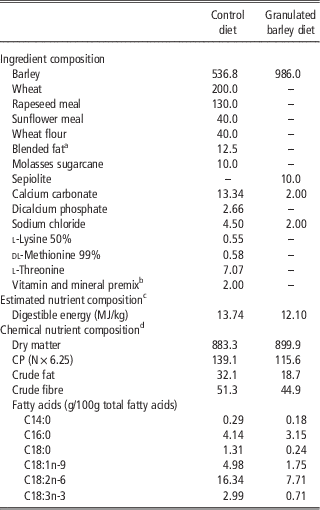
Pigs were housed in 30% slatted floor pens (2.30×2.60 m) in a controlled environment barn and had free access to pelleted diets and water throughout the trial. Composition of the experimental diets is shown in Table 1. Chemical analysis of feeds was carried out according to Association of Official Analytical Chemists (2000) procedures.
Composition of experimental diets used for heavy gilts from 103 to 126 kg BW (g/kg as fed, unless otherwise indicated)

a Mixture of fat from cattle and pig.
b Supplying per kg diet: 8000 IU of vitamin A, 1000 IU of vitamin D3, 15 IU of α-tocopherol acetate and 10 mg of copper sulphate.
c According to Fundación Española Desarrollo Nutrición Animal (2010).
d According to Association of Official Analytical Chemists (2000).
Growth performance
Individual BW and feed consumption per pen were recorded at day 0 (beginning of the trial and 1st Improvac vaccine), at day 28 (2nd Improvac vaccine), at day 72 (beginning of dietary treatment) and at day 97 (end of the trial). Those data were used to calculate average daily gain (ADG), average daily feed intake (ADFI), and feed conversion ratio (FCR) per period and replicate. In addition, ultrasonic measurements of fat thickness were taken at days 28, 72 and 97 on the right side of all animals at the last rib level by the same operator, measuring over the skin without clipping the fleece using an ultrasound RTU apparatus (600V-V2.232; Kretz Technick Inc., Sonovet, Austria). Animals were slaughtered at heavy BW (around 126 kg BW and 159±3 days of age) for processing into dry-cured products.
Slaughter, carcass measures, and meat and fat sampling
The day before slaughter, feed was withdrawn 7 h before weighing and transportation of pigs to a commercial abattoir. There, animals were kept in lairage for 10 h with full access to water but not to feed and were slaughtered according to standard commercial procedures. Hot carcass weight was individually recorded and used to calculate dressing percentage. At 45 min postmortem, carcass length from the posterior edge of the Symphysis pubis to the anterior edge of the 1st rib, ham length from the anterior edge of the Symphysis pubis to the hock joint and ham circumference at its widest side were measured on the left side of each carcass. In addition, backfat thickness was measured at the levels of the 10th rib and over the GM muscle. Carcass compactness was then calculated as carcass weight/carcass length and the proportion of rejected carcasses was calculated using the fat thickness at GM level (<16 mm) as the criterion. After those measures, omental fat samples (53±5 g) were collected from the left side of each carcass for posterior analyses.
After refrigeration at 2°C (1 m/s; 90% relative humidity) for 2 h, carcasses were processed according to commercial standards. The ham, shoulder and loin from the right side of each carcass were trimmed to fit commercial requirements, and individually weighed to calculate their yields. After the carcass had been processed, a section of 500±20 g of the LT muscle excised at the level of the last rib from each left loin was excised. Subcutaneous fat samples (58±7 g) including the fat layers, skin and lean were also taken at the tail insertion in the coxal region. All the meat and fat samples were vacuum-packaged in individual bags and stored at −20°C until subsequent analyses.
Colour of subcutaneous fat and LT muscle
Just after muscle sampling at slaughterhouse, the colour of subcutaneous backfat and LT muscle was measured as described by Latorre et al. (Reference Latorre, Ripoll, García-Belenguer and Ariño2009b) using objective measurements (L*, a*, b*, C* and hº), according to Commission International de l’Eclairage (1976). Measurements were taken using a colourimeter (Model CM 2002; Minolta Camera, Osaka, Japan), with illuminant D65 and 10° Standard Observer, which was previously calibrated against a white tile according to the manufacturer’s recommendations.
Fatty-acid analyses of feeds and fat
The fatty acids (FA) of diets were extracted and quantified by the one-step procedure described by Sukhija and Palmquist (Reference Sukhija and Palmquist1988) in lyophilized samples. Pentadecenoic acid (C15:1) (Sigma, Alcobendas, Madrid, Spain) was used as internal standard. Previously, methylated FA samples were identified according to Rey et al. (Reference Rey, López-Bote and Arias1997) using a gas chromatograph (Model HP6890; Hewlett Packard Co., Avondale, PA, USA) and a 30 m×0.32 mm×0.25 μm cross-linked polyethylene glycol capillary column (Hewlett Packard Innowax, Avondale, PA, USA). A temperature programme of 170°C to 245°C was used. The injector and detector were maintained at 250ºC. The carrier gas (helium) flow rate was 3 ml/min.
Lipids from subcutaneous and omental fat were extracted by the procedure proposed by Bligh and Dyer (Reference Bligh and Dyer1959), whereas lipids from the LT muscle were obtained, according to the method developed by Marmer and Maxwell (Reference Marmer and Maxwell1981). Fat extracts were methylated in the presence of sulphuric acid and analysed as described above.
Statistical analyses
Data were analysed as a completely randomized design with treatments arranged factorially (2×2) using the SPSS-14 statistical package. The model included the sex (IG v. EG) and dietary treatment (control v. GB) as main effects, the interaction sex×diet, and the initial BW of pigs, initial backfat depth by ultrasound or carcass weight as covariates when P<0.05, for growth performance, backfat depth measures or carcass characteristics, respectively. The least significant difference test was used to compare means or lsmeans. The pen was the experimental unit for the statistical analysis of productive performance traits, whereas the pig was the experimental unit for the remaining dependent variables. Shaphiro and Wilk (Reference Shapiro and Wilk1965) test was used to evaluate the normal distribution of the data carrying out the transformation arc sin (x/100)0.5 for those whose distribution was not normal (ham, shoulder and loin yields, as well as percentage of rejected carcasses because of low fatness).
Results
One pig died at the beginning of the trial, but it was not related to experimental treatments (data not shown). No relevant interaction was detected for the variables studied and then, except for the FA profile of omental fat, only main effects of sex and diet are presented.
Growth performance
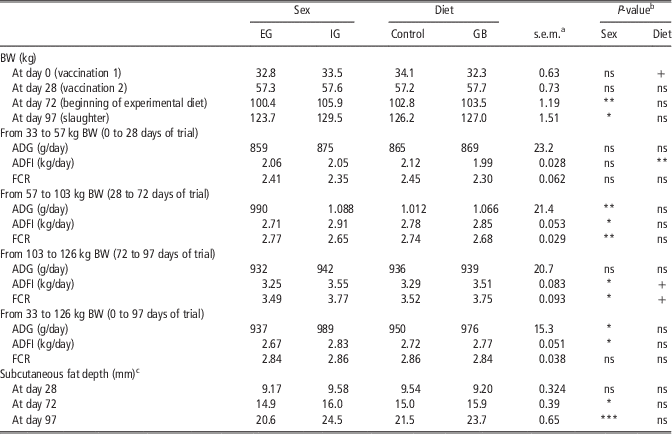
From day 0 (1st Improvac vaccine) to day 28 of the trial, no influence of immunocastration was observed (P>0.10;Table 2). However, from day 28 (2nd Improvac vaccine) to day 72 of the trial, the IGs grew faster (P<0.01), ate more feed (P<0.05) and were more efficient (P<0.01) than EGs. Therefore, at the end of that period, IGs were heavier (P<0.01) and fatter (P<0.05). From day 72 (beginning of the experimental diets) to day 97 of the trial, the IGs had higher FCR than EGs (P<0.05) because they had higher ADFI (P<0.05) and similar ADG (P>0.10). During that time, the dietary treatment had no effect on daily growth but gilts fed GB diet tended to show higher ADFI (P=0.07) and FCR (P=0.09) and had thicker fat depth (P<0.05) than those fed control diet. At the end of the trial, the experimental diet did not modify any variable studied (P>0.10) but the IGs had higher ADG (+5.5%, P<0.05) and ADFI (+6.0%, P<0.05) than the EGs. The IGs were also heavier (+5.8 kg, P<0.05) and fatter (+19% backfat depth, P<0.001) at slaughter than the EGs.
The effect of sex and diet on productive performance traits and subcutaneous fat depth

EG=entire gilts; IG=immunocastrated gilts; control=commercial diet; GB=granulated barley as only main ingredient; ADG=average daily gain; ADFI=average daily feed intake; FCR=feed conversion ratio.
Data presented are lsmeans.
a Standard error of the mean, calculated using n=8 pens as experimental units per main effect of sex or diet.
b ns: not significant (P>0.10); + P<0.10; *P<0.05; **P<0.01; ***P<0.001. No significant interaction (sex×diet) was found.
c Measures taken in vivo by ultrasounds.
Carcass quality
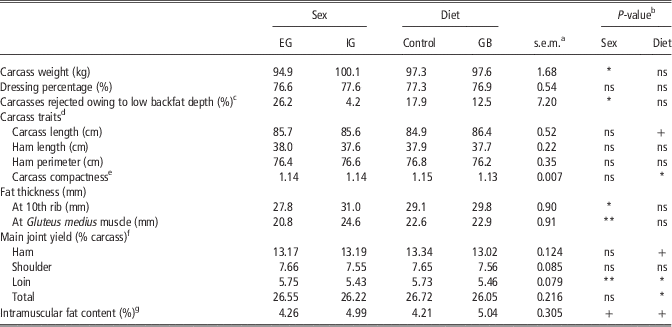
The carcasses from IGs were heavier than those from EGs (P<0.05); however, no effect of immunocastration was detected on dressing percentage and dimensions of carcass and ham (P>0.10; Table 3). A lower proportion of carcasses were rejected at slaughterhouse owing to lack of fat depth in the IG group (4.2% v. 26.2%; P<0.05). In fact, the IGs had fatter carcasses than the EGs at both the 10th rib (P<0.05) and GM muscle level (P<0.01). In addition, the IGs had lower loin weight and yield (P<0.05 and 0.01, respectively) than the EGs.
The effect of sex and diet on carcass characteristics and meat intramuscular fat content of heavy pigs

EG=entire gilts; IG=immunocastrated gilts; control=commercial diet; GB=granulated barley as the only main ingredient.
Data presented are lsmeans.
a Standard error of the mean, calculated using n=24 pigs as experimental units per main effect of sex or diet.
b ns=not significant (P>0.10); + P<0.10; *P<0.05; **P<0.01. No significant interaction (sex×diet) was found.
c A minimum of 16 mm of backfat depth is required in Spain.
d Carcass length was measured from the posterior edge of the Symphysis pubis to the anterior edge of the 1st rib, ham length from the anterior edge of the Symphysis pubis to the hock joint and ham circumference at its widest side.
e Carcass weight (kg)/carcass length (cm).
f Data recorded from the right side of each carcass.
g Measured at the Longissimus thoracis muscle.
The carcasses from gilts fed GB diet tended to be longer (P=0.06) and had lower compactness (P<0.05) than those from gilts fed control diet. The yield of total main lean joints (ham+shoulder+loin) was lower when GB was consumed (P<0.05) and it was because of the lower ham (P=0.07) and loin (P<0.05) proportions.
Meat characteristics and subcutaneous fat colour
The immunocastration had no influence on the colour of the LT muscle or subcutaneous fat (P>0.10) (data not shown). Nevertheless, meat from IGs tended to have higher IMF proportion than meat from EGs (P=0.09; Table 3). The dietary treatment did not modify LT muscle colour (P>0.10) but loin from gilts fed GB diet tended to show the highest IMF content (P=0.06). In addition, subcutaneous fat from gilts given diet based on GB tended to show higher b* value (P=0.06) than that from gilts fed control diet.
Fatty-acid profile of subcutaneous fat
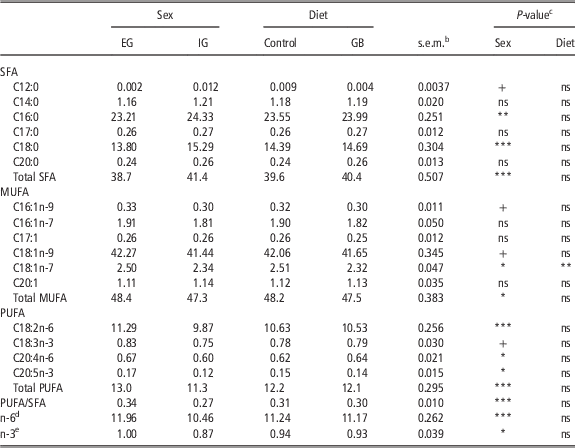
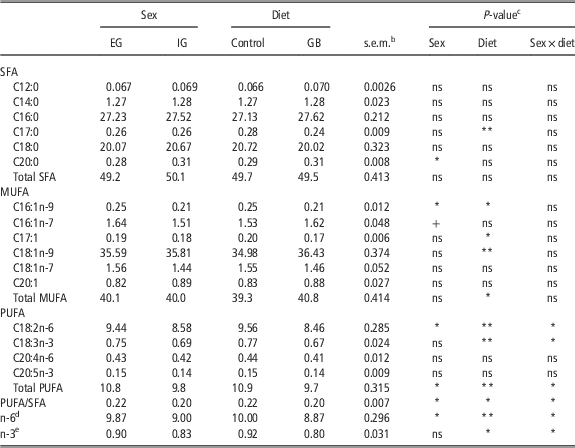
The total saturated fatty acid (SFA) proportion in backfat was higher in the IGs than in the EGs (P<0.001) owing to the higher C12:0 (P=0.07), C16:0 (P<0.01) and C18:0 (P<0.001) contents (Table 4). The total monounsaturated fatty acid (MUFA) percentage was lower in IGs than in EGs (P<0.05) owing to the lower C16:1n-9 (P=0.06), C18:1n-9 (P=0.10) and C18:1n-7 (P<0.05) contents. The total polyunsaturated fatty acid (PUFA) proportion was also lower in IGs than in EGs (P<0.001) owing to the lower C18:2n-6 (P<0.001), C18:3n-3 (P=0.08), C20:4n-6 (P<0.05) and C20:5n-3 (P<0.05) contents. The backfat from the IGs had lower n-6 (P<0.001) and n-3 (P<0.05) and also lower PUFA/SFA ratio (P<0.001) than that from the EGs. In addition, fat from gilts fed GB diet had lower C18:1n-7 proportion than fat from gilts fed control diet (P<0.01).
The effect of sex and diet on fatty-acid profile (%) of subcutaneous fatFootnote a

EG=entire gilts; IG=immunocastrated gilts; control=commercial diet; GB=granulated barley as the only main ingredient; SFA=saturated fatty acids; MUFA=monounsaturated fatty acids; PUFA=polyunsaturated fatty acids.
Data presented are means.
a Samples taken at the tail insertion in the coxal region (58±7 g).
b Standard error of the mean, calculated using n=24 pigs as experimental units per main effect of sex or diet.
c ns=not significant (P>0.10); + P<0.10; *P<0.05; **P<0.01; ***P<0.001. No significant interaction (sex×diet) was found.
d n-6=C18:2n-6+C20:4n-6.
e n-3=C18:3n-3+C20:5n-3.
Fatty-acid profile of omental fat
In omental fat, the immunocastration increased C20:0 (P<0.05) and reduced C16:1n-9 (P<0.05) and C16:1n-7 (P=0.06) contents, although SFA and MUFA were not affected (P<0.10; Table 5). In addition, the C18:2n-6 and PUFA percentages and the PUFA/SFA ratio were lower in fat from IGs than that from EGs (P<0.05). The use of barley as a major ingredient in finishing diet decreased C16:1n-9 (P<0.05) and C17:1 (P<0.05) contents and increased C18:1n-9 (P<0.01), resulting in a higher MUFA proportion (P<0.05). Some significant interactions sex×diet were detected (P<0.05). In the EGs, the intake of GB diet reduced the proportions of C18:2n-6, C18:3n-3, n-6, n-3 and PUFA percentages and also the PUFA/SFA ratio (P<0.05), whereas omental fat from the IGs was not affected by the dietary treatment.
The effect of sex and diet on fatty-acid profile (%) of omental fatFootnote a

EG=entire gilts; IG=immunocastrated gilts; control=commercial diet; GB=granulated barley as the only main ingredient; SFA=saturated fatty acids; MUFA=monounsaturated fatty acids; PUFA=polyunsaturated fatty acids.
Data presented are means.
a Samples taken covering intestines (53±5 g).
b Standard error of the mean, calculated using n=24 pigs as experimental units per main effect of sex or diet.
c ns=not significant (P>0.10); + P<0.10; *P<0.05; **P<0.01.
d n-6=C18:2n-6+C20:4n-6.
e n-3=C18:3n-3+C20:5n-3.
Fatty-acid profile of IMF from the LT muscle
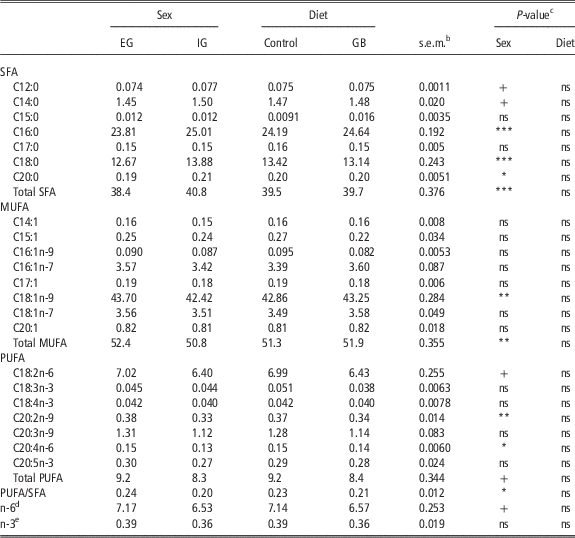
The SFA proportion in IMF of the LT muscle was higher in IGs than in EGs (P<0.001) owing to the higher C12:0 (P=0.08), C14:0 (P=0.09), C16:0 (P<0.001), C18:0 (P<0.001) and C20:0 (P<0.05) contents (Table 6). The MUFA and PUFA proportions in IMF were lower in IGs than in EGs (P<0.01 and P=0.06, respectively) owing to the lower C18:1n-9 (P<0.01), C18:2n-6 (P=0.09), C20:2n-9 (P<0.01) and C20:4n-6 (P<0.05). The IMF of the LT muscle from IGs had lower PUFA/SFA ratio (P<0.05) than that from EGs. The dietary treatment had no effect on FA profile of IMF of loin (P>0.10).
The effect of sex and diet on fatty-acid profile (%) of intramuscular fat from the Longissimus thoracis muscleFootnote a

EG=entire gilts; IG=immunocastrated gilts; control=commercial diet; GB=granulated barley as the only main ingredient; SFA=saturated fatty acids; MUFA=monounsaturated fatty acids; PUFA=polyunsaturated fatty acids.
Data presented are means.
a Samples taken at the level of the last rib from each left loin (500±20 g).
b Standard error of the mean, calculated using n=24 pigs as experimental units per main effect of sex or diet.
c ns=not significant (P>0.10); + P<0.10; *P<0.05; **P<0.01; ***P<0.001. No significant interaction (sex×diet) was found.
d n-6=C18:2n-6+C20:4n-6.
e n-3=C18:3n-3+C18:4n-3+C20:5n-3.
Discussion
Growth performance
Over the whole experimental period, the gilt immunocastration had led to increased ADG and ADFI but had no effect on FCR. However, it is observed that these effects are shown after the 2nd Improvac vaccine because there was no influence from day 0 to 28 (between 1st and 2nd injections). There is scarce information in the literature about immunocastration in gilts or comparing immunocastrated and surgically castrated gilts. Oliver et al. (Reference Oliver, Mc Culey, Harrel, Suster, Kerton and Dunshea2003) found that immunocastration led to a reduction in ovary weight and an increase in daily BW gain and feed intake. In a recent study, Gómez-Fernández et al. (Reference Gómez-Fernández, Horcajada, Tomás, Gómez-Izquierdo and de Mercado2013) observed that Duroc×Iberian IG had higher ADG, ADFI and FCR than EG. On the other hand, Peinado et al. (Reference Peinado, Serrano, Nieto, Sánchez, Medel and Mateos2012) reported in (Pietrain×Large White)×(Landrace×Large White) gilts, from 60 to 114 or 122 kg BW, and in Duroc×(Landrace×Large White) gilts, from 28 to 119 or 132 kg BW, that surgical castration had no influence on BW gain and ADFI, but impaired FCR. In another study, Serrano et al. (Reference Serrano, Valencia, Fuentetaja, Lázaro and Mateos2008) observed in Duroc×Iberian gilts reared indoor from 25 to 145 or 156 kg of BW that, although surgical castration did not affect ADG, it increased ADFI and tended to enhance FCR. All these results suggest that both kinds of castration might carry out different effects on the performance of gilts probably because of the start-up time (being younger animals in the case of surgical castration).
The replacement of the control by the GB diet during the finishing period did not modify growth performance variables. However, in previous studies (Daza et al., Reference Daza, Latorre and López-Bote2010 and Reference Daza, Latorre and López-Bote2012a), the GB diet had a negative effect on ADG and FCR, probably because of the low CP content of barley (Fundación Española Desarrollo Nutrición Animal, 2010). In the present trial, the concentration of CP in the barley used for feedstuff fabrication was very high (more than 13%) and the CP/digestible energy ration was slightly lower (9.55 v. 10.12) in the GB diet in comparison with the control diet, which can explain the results obtained on productive performance. In agreement, D’Souza et al. (Reference D’Souza, Pethick, Dunshea, Pluske and Mullan2003) observed in pigs that a reduction in 15% of CP/digestible energy ratio in the diet of pigs during their growing period had no influence on ADG, ADFI and FCR in the growing and finishing phases.
Carcass quality
It has been reported that immunocastration of gilts increased carcass fatness (Oliver et al., Reference Oliver, Mc Culey, Harrel, Suster, Kerton and Dunshea2003), which is confirmed by the present data. Serrano et al. (Reference Serrano, Valencia, Fuentetaja, Lázaro and Mateos2008) also observed that surgical castration of gilts increased subcutaneous fat thickness. Similar to productive traits, the results obtained by ultrasounds show that the influence of immunocastration on backfat depth was clear after the 2nd Improvac vaccine. As a consequence, at slaughterhouse, the percentage of rejected carcasses to elaborate dry-cured products was higher in EGs owing to their thinner fat thickness at the level of GM muscle. According to Walstra (Reference Walstra1974), the castration affects the physiology and metabolism of nutrients in pigs increasing the fat tissue and decreasing the lean tissue. It suggests that castration might also modify the proportion of major cuts of the carcass depending on its proportion of fat tissue. Gómez-Fernández et al. (Reference Gómez-Fernández, Horcajada, Tomás, Gómez-Izquierdo and de Mercado2013) observed that immunocastration of Duroc×Iberian gilts had no effect on ham and shoulder weight but decreased loin weight and ham, shoulder and loin yield, whereas in the current study the immunocastration only reduced the loin weight and yield. Serrano et al. (Reference Serrano, Valencia, Fuentetaja, Lázaro and Mateos2008) showed that gilt castration did not affect carcass weight and yield but reduced ham, shoulder and loin weights and yields. The different results obtained among experiments on carcass major joint weight and yield might be related to the higher subcutaneous fat proportion per se in the Iberian pigs than in commercial crossbreed pigs, to the differences in tissular composition among pieces and also to the amount removed in the trimming of carcass main joints.
In the present trial, the carcasses from gilts fed GB diet had lower compactness than those from gilts fed the control diet, owing to a tendency for longer carcasses in GB gilts, in agreement with data from Daza et al. (Reference Daza, Latorre, Olivares, Amazán and López-Bote2012b). The substitution of the control feed by a diet based on GB had no effect on fat thickness at the GM muscle level, which is in agreement with results obtained in previous studies (Daza et al., Reference Daza, Latorre and López-Bote2010, Reference Daza, Latorre and López-Bote2012a and Reference Daza, Latorre, Olivares, Amazán and López-Bote2012b). The increase in backfat depth at 97 days in pigs fed GB, compared with control diet, did not reach significance in the present study, but a higher backfat thickness has been previously reported in gilts fed a GB compared with a common diet (Daza et al., Reference Daza, Latorre and López-Bote2012a). The discrepancies between studies may be explained by different points of measurements of backfat thickness on pigs. The slightly lower yields of loin and total main joints of gilts given the GB diet agree with the lower loin yield of pigs fed a barley-based diet compared with a control diet in a recent report (Daza et al., Reference Daza, Latorre, Olivares, Amazán and López-Bote2012b), whereas in another study no significant difference was found between pigs fed a GB or a commercial diet on weight and yield of main lean joints (Daza et al., Reference Daza, Latorre and López-Bote2010). Altogether, this indicates that feeding pigs with a GB instead of control diet may lead to fatter carcasses and lower yields of lean cuts.
Meat characteristics
Muscle and fat colour are sensorial characteristics that have a great influence on consumers to choose pork. In the present trial, no influence of immunocastration was observed on colour variables of subcutaneous fat and LT muscle. Several authors (Serrano et al., Reference Serrano, Valencia, Fuentetaja, Lázaro and Mateos2008; Peinado et al., Reference Peinado, Serrano, Medel, Fuentetaja and Mateos2011 and Reference Peinado, Serrano, Nieto, Sánchez, Medel and Mateos2012) neither detected differences between surgically castrated and intact gilts for meat colour. In addition, no significant effect of dietary treatment was observed on colour tissues in line with results reported by Daza et al. (Reference Daza, Latorre and López-Bote2012a and Reference Daza, Latorre, Olivares, Amazán and López-Bote2012b).
In the present experiment, the immunocastration and the GB diet tended to increase the IMF content in the LT muscle. One could have expected an interaction effect of immunocastration and GB diet on IMF, but this was not achieved in the present study. Some studies reported that female castration led to a slight, although not significant, increase in IMF percentage (2.4 v. 2.0; Peinado et al., Reference Peinado, Serrano, Medel, Fuentetaja and Mateos2011 and Reference Peinado, Serrano, Nieto, Sánchez, Medel and Mateos2012). Previously, Daza et al. (Reference Daza, Latorre and López-Bote2010 and Reference Daza, Latorre, Olivares, Amazán and López-Bote2012b) observed that the use of a diet based on GB led to an increase in IMF content. According to D’Souza et al. (Reference D’Souza, Pethick, Dunshea, Pluske and Mullan2003), the high (30%) reduction of CP or lysine/energy ratio in the feed enhances IMF proportion. The positive effect observed in GB diet on loin chemical composition could be partly because of the lack of vitamin and mineral premix in that diet, especially vitamin A. Thus, D’Souza et al. (Reference D’Souza, Pethick, Dunshea, Pluske and Mullan2003) observed a higher IMF content in the muscle when vitamin A was completely removed from the vitamin–mineral mixture. However, the influence of dietary vitamin A on IMF content in meat is controversial, as other experiments (Olivares et al., Reference Olivares, Daza, Rey and López Bote2009) did not find any influence. According to Brandebourg and Hu (Reference Brandebourg and Hu2005), the retinoids, which are derivatives of vitamin A, have an inhibitory effect on cultured preadipocytes differentiation; therefore, it has been proposed that the influence of dietary vitamin A level on IMF is mediated by adipocyte differentiation (Dimaculangan et al., Reference Dimaculangan, Chawla, Boak, Kagan and Lazar1994).
Fatty-acid profile of tissues
In the current experiment, the immunocastration increased SFA and reduced MUFA and PUFA in subcutaneous backfat and in IMF and decreased PUFA in omental fat. It agrees with the previous studies that have reported on Durox×(Landrace×Large White) and (Pietrain×Large White)×(Landrace×Large White) gilts that surgical castration led to an increase of C16:0 and C18:0 and to a decrease of C18:2n-6 in IMF (Peinado et al., Reference Peinado, Serrano, Medel, Fuentetaja and Mateos2011 and Reference Peinado, Serrano, Nieto, Sánchez, Medel and Mateos2012), although Serrano et al. (Reference Serrano, Valencia, Fuentetaja, Lázaro and Mateos2008) did not report any significant influence of castration on concentration of these FA profiles in IMF from Duroc×Iberian gilts. This discrepancy could be because of the possible influence of genetic type. The results obtained in the current study are interesting as an increase in PUFA content reduces consistency of subcutaneous fat, impairs water migration and reduces the rate of moisture loss during the curing process (Ruíz Carrascal et al., Reference Ruíz Carrascal, Ventanas, Cava, Andrés and García2000). Moreover, fat oxidation rate is positively related to PUFA content, and an increase in the oxidation rate of the fat might negatively affect the aroma and flavour of dry-cured products (Wood et al., Reference Wood, Enser, Fisher, Nute, Sherad, Richardson, Hughes and Whittington2008). In the present trial, PUFA/SFA ratio was lower in IGs than in EGs. Therefore, it would better fit for the technological processes of dry-cured products than EG, in base on the lower PUFA content, although the nutritional quality of their fat would be impaired, taking into account the higher SFA content.
The use of the GB feed during the finishing period only increased MUFA and decreased PUFA in omental fat but had no strong effect in subcutaneous fat or IMF. These results are not in agreement with those obtained in previous studies. Thus, Daza et al. (Reference Daza, Latorre and López-Bote2010 and Reference Daza, Latorre, Olivares, Amazán and López-Bote2012b), in Duroc×(Landrace×Large White), found that granulated barley increased MUFA and reduced PUFA and did not affect SFA in IMF. However, as in the current experiment, Daza et al. (Reference Daza, Latorre and López-Bote2012a and Reference Daza, Latorre, Olivares, Amazán and López-Bote2012b) did not observe any influence of granulated barley on FA composition of outer and inner layers of subcutaneous fat. These results suggest that lower CP content and the lack of vitamin–mineral premix in the GB diet had scarce influence on FA composition of subcutaneous backfat. In addition, Olivares et al. (Reference Olivares, Daza, Rey and López Bote2009) did not find any effect of dietary vitamin A level in finishing diets on FA composition of subcutaneous backfat. It is important to note that C18:2n-6 proportion found in the tissues, according to sexual status and dietary treatment given during the final period, was lower than 12%, which is a positive result because a higher value than 12% is not recommended for transformation and conservation processes of pork (Wood et al., Reference Wood, Enser, Fisher, Nute, Sherad, Richardson, Hughes and Whittington2008).
Conclusions
The immunization against GnRH in gilts improved ADG and reduced the percentage of carcasses rejected at slaughterhouse, both aspects being of importance for pig producers. In addition, gilt immunocastration tended to increase the IMF proportion of meat, which is desirable by consumers, although it resulted in higher SFA content in meat. The replacement of conventional feed by GB diet during the finishing period did not affect growth performance but tended to increase IMF content and affected the FA profile of omental fat with scarce influence on FA profile of subcutaneous fat and IMF.
Acknowledgements
The research was supported by Project PET-2007-08C11-05 (INIA, Spain). The authors thank Elifio Feliz de Vargas and Itziar Garitano (El Chantre, Teruel, Spain) for the care and control of experimental animals.