In July 1906, the Voice of the Negro, an Atlanta-based monthly founded in January 1904 and possessed of a national readership, published a five-page essay on Shakespeare by “Mrs. Adrienne E. Herndon.”Footnote 1 Herndon, who at that time had taught for more than a decade at Atlanta University, the most prestigious of the many historically black southern schools founded after the Civil War, reported on the great popularity of the university's recent production of The Taming of the Shrew and on the similar success the previous year of The Merchant of Venice. Endorsing Shakespeare's universality (he “wrote … for all times and all peoples”), she asserted that black Americans, by virtue of their having so deeply “lived and suffered, and striven,” had the most “dramatic” life imaginable and therefore could be expected to “produce in the future some of the world's greatest dramatic artists.”Footnote 2 After highlighting the immense theatrical potential of “the American Negro” who was yet “unmarred by the conventional training of more highly cultured races,” she concluded by underscoring the need for a new university auditorium and for a “circuit” of theaters for southerners “debarred from white theaters” and in need of “wholesome entertainments.”Footnote 3
Anyone who spends time perusing the Voice of the Negro will quickly see that collegiate Shakespeare was not its usual fare. While editors John W. E. Bowen and Jesse Max Barber occasionally included literary criticism and poetry in their pages, they mostly focussed on current events, reporting on volatile issues affecting black people around the world as well as in Georgia. For example, the journal devoted an entire issue to the precarious situation in Haiti and San Domingo; it reported on the civil rights agenda of the Niagara movement launched by W. E. B. Du Bois and others in 1905; it expressed outrage about peonage labor practices; and it chronicled lynchings and other racial violence endemic in Georgia, the state with the largest black population. Significantly, just two months after the Voice of the Negro published Herndon's Shakespeare article, the journal's editors directly felt the effects of a now infamous race riot in which thousands of white Atlantans, spurred on by false claims about black men assaulting white women, terrorized black people in downtown streets and on streetcars, attacking black-owned businesses, leaving dozens traumatized and physically wounded and at least twenty-five people dead. After the riot, Bowen, who served as president of Gammon Seminary, was beaten and arrested for having opened it as a sanctuary, while Barber, who publicly rebuked the white press for inciting the violence, was run out of Atlanta. Although Barber briefly reestablished the journal in Chicago, it ceased publication in 1907.Footnote 4
Why would a journal with such an activist stance against racial injustice make space for Herndon's report on Shakespeare at Atlanta University? Certainly, to modern ears, Herndon's lofty rhetoric about what she called “histrionic art” may appear out of touch with her turbulent times, especially when juxtaposed with the journal's characteristically forthright discourse, such as the account in the same issue of a white mob's lynching of a white man, which includes the proposition that “the only way we are going to stop lynching in this country is if the white people lynch each other for a while.”Footnote 5 From this perspective, Herndon's championing of Shakespeare may suggest the conservatism of respectability politics, an act at odds with the later calls by Harlem Renaissance writers for indigenous cultural productions to replace “classic” works. But when Herndon's activities as a Shakespearean are set against the backdrop of the Jim Crow South with its daily assaults on the personhood of black Americans, another conclusion is in order: no less than Du Bois's Niagara movement, Herndon's Shakespeare work was rooted in an unapologetic vision of black collective action in pursuit of equality and self-determination. What she espoused in fact was an insurrectionary politics of embodiment.
Born in 1869 to an unmarried and formerly enslaved seventeen-year-old domestic servant, Adrienne McNeil Herndon attended Savannah's public schools before being admitted as a scholarship student to Atlanta University, where she would later teach until her early death from Addison's disease in 1910.Footnote 6 As a student at the university, Herndon earned distinction in oratory and followed the normal school program, which enabled her to become an Atlanta public-school teacher upon her graduation in 1891. Two years later, her life changed dramatically when she married Alonzo Herndon, a highly successful barber serving Atlanta's white elite in his own lavishly furnished downtown barbershop known as the “Crystal Palace.” Born into slavery in Georgia, Alonzo Herndon's rise was meteoric: known in his lifetime as Atlanta's first black millionaire, he invested in real estate and in 1905 founded Atlanta Life Insurance Company, one of the country's most profitable black-owned financial institutions. With his support, Adrienne Herndon completed additional studies at the Boston School of Expression, and in 1895 she joined Atlanta University, where she worked for some fifteen years, apart from two terms she spent studying college theater production at New York's American Academy of Dramatic Arts. As instructor of elocution, she initially oversaw physical exercises, voice drills, and public speaking; before long, her work encompassed Shakespeare as well. With her husband and their son, born in 1897, she lived in a university-owned cottage alongside students and staff, including the school's only other black faculty, her good friends George Towns, who held a master's degree in English from Harvard and was hired to teach literature in 1895, and Du Bois, who was already prominent when he was hired to teach history and economics in 1897.
Herndon unquestionably secured an important place for herself in black theater history through her Shakespeare work, which extended beyond her pedagogy to include solo public performance. She was one of the first black women to give dramatic readings of Shakespeare in the United States, having made her professional stage debut (as the racially ambiguous Anne Du Bignon) in Boston in 1904 in a critically acclaimed one-woman Antony and Cleopatra during which she impersonated some twenty-two Shakespearean characters. Although her plans to continue as a professional actor were likely thwarted by the racism of the professional theater, Herndon continued to offer dramatic readings and recitals at southern churches and other institutions even as she pursued her career at Atlanta University. She was also, as Errol Hill has observed, a “pioneer” as a Shakespeare teacher–director when, in 1905 – several years in advance of the Shakespeare forays of other historically black institutions – she directed the student production of The Merchant of Venice to which she referred in the Voice of the Negro.Footnote 7 That performance was the first in a series of four Shakespeare comedies she directed to mark each year's commencement. It was followed by The Taming of the Shrew (1906), As You Like It (1907) and Twelfth Night (1908).
Herndon has rightly been credited with enabling many students to acquire a familiarity with high European culture that enabled their social advancement,Footnote 8 but the insurgent political force of her Shakespeare work has gone unnoticed. We have yet to acknowledge that her full-throated endorsement of black expressivity, something plainly on view in her Voice of the Negro article, ramified well beyond her success training black actors, creating black audiences, and helping students to ascend the social ladder. Why is it remarkable that Herndon celebrated the sounds of black voices and the movements of black bodies and that she asserted in the Voice of the Negro that ordinary black Americans lived lives of significance, that their strivings and sufferings were meaningful? Surely it matters because such acts were deeply courageous: she made such claims, after all, at a time when the speech and mobility of black Americans were severely circumscribed and campaigns of racial terror were in full swing. Implicit in her claims about the potential of “a race as yet so natural in all its infinite expression” to convey “the depths and intensity of a [Shakespearean] character,” in other words, was a vociferous rejection of white America's denigrating claims about blackness.Footnote 9 Likewise, in declaring that she would cultivate such embodied and infinitely varied black expression through dramatic training, she repudiated widespread efforts to discipline and punish black Americans. As though responding to the era's lynch-mob culture, which horrifically showcased the dismemberment and desecration of black bodies, Herndon metaphorically pieced these fragments together and made the bodies whole again: calling upon Shakespeare, she defined black expressive performance as a matter of “hands, face and body, as well as … voice” working in unison.Footnote 10
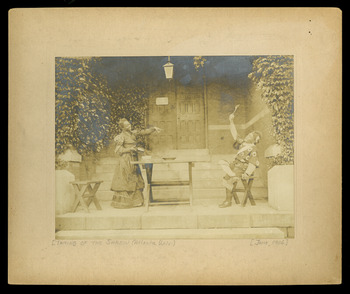
What Herndon's Shakespeare article underscores, in short, is her political vision, a stance not unlike that which Daphne Brooks has termed “bodies in dissent” and identified with nineteenth-century black popular performances of spiritualism, Victorian pantomime, magic, and minstrelsy.Footnote 11 Perhaps the clearest image of this dissident aesthetic is on view in the three Taming of the Shrew photographs accompanying the article. The most striking of these photographs, which, according to the journal's caption, depicts a moment from the play's fourth act, shows a richly garbed couple caught in profile as they regard each other, and their gestures, even more than their ornate attire, hold the viewer's gaze (Figure 1). The woman, in a billowy dress with ruffles and striped edging, stands at a wooden table preparing a meal and pointing with one outstretched hand toward a man in similarly bold clothing sprawled out on a bench across from her, energetically gesturing upward with what seems to be a wooden spoon. Surprisingly, as the caption reveals, the image does not capture the spirited heroine Katherine resisting the efforts of Petruccio to transform her into his submissive wife; rather it shows Petruccio's servants, Curtis (who has unconventionally been cast as a woman) and Grumio. Here, the servants who wield domestic implements comfortably occupy the master's house: as Curtis stands confidently, Grumio looks up at her with evident pleasure and, perhaps, desire. The bodily postures convey ease and self-possession in free movement; this suggests a scene of mock aggression rather than the real violence that directors often locate in the play's so-called “battle of the sexes.” Put otherwise: the photograph hints at how Herndon's staging of Shakespeare not only resignified the usual social hierarchies of both gender and class but also challenged racist stereotypes of black violence and licentiousness, rewriting the meanings of black embodiment in a joyous code.
The Taming of the Shrew by T. E. Askew, 1906, Atlanta University Photograph Collection, Atlanta University Center, Robert W. Woodruff Library.

Central to Herndon's radicalism is the fact that she staged Shakespearean narratives showcasing comic scenes of black domestic life precisely when the prospect of finding a safe home was, for many black Americans, completely unimaginable. As the Atlanta riot, of course, underscored, Herndon, for all her wealth, was not immune from the terrorism inflicted by white mobs. While she and her family escaped physical harm, her husband's opulent barbershop had been vandalized, and – more shockingly – both a bootblack in his employ and two barbers working nearby had been murdered, with the corpses of the barbers grotesquely put on public display.Footnote 12 In a moving letter to Booker T. Washington in February 1907, she wondered whether any space existed where black Americans might live in peace:
The riot and the unsettled conditions here make us feel that we can never hope to have one [a home] in this ungodly section. Sometimes I doubt if there is any spot in this country where one with Negro blood can plant a home free from prejudice scorn & molestation. The sanctity of the Negro home is to the majority (the vast majority) of the white race a thing unrecognized. I appreciate it most highly.Footnote 13
In the wake of the riot, Herndon sent her son to boarding school and left Atlanta for New York. Upon her return and despite the always looming racial violence, she did something remarkable: she drew up architectural plans for a home for her family near campus, chose lavish furnishings for its many rooms, and helped to oversee the black craftsmen who began working on it in 1908. Sadly, the home was completed only weeks before her sudden death in 1910. Now a designated historic landmark, the Beaux-Arts structure was, even in her day, recognized as an extraordinary building. In fact, in his 1908 sociological study The Negro American Family, Du Bois placed a photograph of the still-in-progress home as the grand finale in a series of forty-three images, which began with images of African huts and was entitled “The Evolution of the Negro Home.”Footnote 14 Significantly, among the house's features are not only its rooftop performance space, but also a frieze on the parlor walls in which an image of the Egyptian pyramids leads to images of Herndon's husband and his relations working in the fields, and culminates in an image of the mansion itself. As this domestic decoration underscores, Herndon both recognized the power of visual narrative and knew how to refashion European traditions through a black aesthetic rooted in her family's shared history.
Significantly, long before her home's completion, Herndon had already begun to conjure potent images of black domesticity for black audiences, ones that likely aimed to be as solid as the wooden table at which the student actors gather in the published Taming of the Shrew photograph. In fact, that photograph's depiction of the huge door and stone steps of the campus building that served as a set suggests just how effectively Herndon transformed the university itself into a home. Through such appealing domestic imagery as well as dramatic narratives focussed on romantic love and marital alliances, Herndon's productions contested widespread caricatures of black people as bereft of money, ignorant of social ties, and prone to violence and debauchery. Indeed, through their attention to the vibrancy of black households, her Shakespeare productions may suggest to us the plays of the 1910s and 1920s printed in journals like The Crisis that Koritha Mitchell has identified as “lynching dramas” – works by Angela Weld Grimke, Alice Dunbar Nelson, Mary Burrill, and Georgia Douglas Johnson (Herndon's Atlanta University classmate) that often focussed on the aftermath of violence, countering scenes of extreme brutality with positive narratives of black familial bonds.Footnote 15 Above all, perhaps, Herndon's Shakespeare work suggests bell hooks's evocative writing on “homeplaces,” especially her observation that, historically, black women have resisted racism “by making homes where all black people could strive to be subjects, not objects, where we could be affirmed in our minds and hearts despite poverty, hardship, and deprivation, where we could restore to ourselves the dignity denied on the outside in the public world.”Footnote 16
To encounter the extant photographs of Herndon's Shakespeare productions – a small collection of luminous images, much like the three published in the Voice of the Negro, depicting costumed student actors carefully posed in campus settings, some of which apparently decorated the university walls – is to sense that Herndon called on photography to do more than merely extend the life of her productions. In a time of racial terror, these images surely provided visual sustenance, bearing vital witness to black Americans in community. Assisting Herndon in the creation of this living archive was Atlanta-based photographer Thomas E. Askew, who shot the archived Shakespeare photographs and was also credited with several photographs, including that of the Herndon home, in Du Bois's 1908 sociological study. Significantly, Askew had previously shot most of the 363 uncaptioned portraits of individuals and families, many from Atlanta, which were part of Du Bois's prizewinning “American Negro Exhibit” at the 1900 Paris Exposition.Footnote 17 Du Bois described this show, which Herndon attended, as “an honest straightforward exhibit by a small nation of people, picturing their life and development without apology or gloss, and above all made by themselves.”Footnote 18 Similarly, the archival traces of Herndon's gorgeous Shakespeare productions suggest that she was intent on “picturing” – that is, both documenting and envisioning – a new reproducible aesthetic of blackness. Clearly, Askew's Shakespeare photographs allow us to glean a sense of the politics of visuality underlying Herndon's appeal in her article for a “circuit” of theaters in which black actors would perform Shakespeare for black audiences. More broadly, these photographs also illuminate the pivotal role Herndon's pedagogy and stage productions played in the struggle for racial justice. They attest, in short, to the potency of the world she called into being through Shakespeare to counter the racial terror and trauma of white supremacy: a world in which black bodies remain exuberantly alive and black homeplaces flourish.