INTRODUCTION
Studies have been conducted to explain patterns in the abundance and richness of the macrofauna of sandy beaches (Defeo & McLachlan, Reference Defeo and McLachlan2005, Reference Defeo and McLachlan2011). Worldwide data compilation and analyses have shown an increase in the richness and abundance of communities from reflective to sheltered beaches, including dissipative microtidal beaches (Dexter, Reference Dexter1992; McLachlan & Brown, Reference McLachlan and Brown2006). However, overall functionalities of benthic communities (i.e. trophic relationships) have been scarcely documented in the sandy beaches literature. In the past few years there has been a growing interest in elucidating trophic pathways of sandy beach ecosystems with the use of the stable isotopes of carbon and nitrogen (Lercari et al., Reference Lercari, Bergamino and Defeo2010; Bergamino et al., Reference Bergamino, Lercari and Defeo2011; Colombini et al., Reference Colombini, Brilli, Fallaci, Gagnarli and Chelazzi2011).
There are few detailed studies of how species respond to environmental variations in feeding modes, i.e. whether feeding guild features (including trophic importance and trophic diversity) undergo environmental changes (McLachlan et al., Reference McLachlan, DeRuyck and Hacking1996). A recent meta-analysis where sandy beach communities were deconstructed to discriminate among groups with different feeding habits showed that filter feeders, scavengers and deposit feeders increased in richness and abundance from reflective to dissipative conditions (Defeo & McLachlan, Reference Defeo and McLachlan2011).
Studying feeding guilds is the most common method to examine the structure of the communities in sandy beaches (Putman & Wratten, Reference Putman and Wratten1984; Arruda et al., Reference Arruda, Domaneschi and Amaral2003). Root (Reference Root1967) and Fauchald & Jumars (Reference Fauchald, Jumars, Johnson and Boudreau1979) defined feeding guilds as the assemblages of species that exploit the same class of environmental resources (i.e. the size and composition of food particles) in a similar manner (i.e. the mechanism of ingestion and the mobility patterns that are associated with feeding). The use of this concept allows researchers to group species with overlapping niche requirements, without considering their taxonomic position (Arruda et al., Reference Arruda, Domaneschi and Amaral2003).
An analysis of the trophic structure of a community may also provide indirect information about the physical characteristics of the environment because these characteristics control the presence of species with suitable functional morphologies for optimizing food capture. Therefore, the feeding of species depends on physical environmental characteristics. According to Arruda et al. (Reference Arruda, Domaneschi and Amaral2003), the feeding of the infauna is related, to some degree, to the physical characteristics of the substrata.
Polychaetes are important components of the macrofauna of sandy beaches and are considered to be key organisms within the macrofauna (Papageorgiou et al., Reference Papageorgiou, Arvanitidis and Eleftheriou2006), and reliable indicators for assessing pollution perturbation source in sandy beach ecosystems (Bergamino et al., Reference Bergamino, Muniz and Defeo2009). Studies of polychaete feeding guilds have been conducted, primarily in subtidal environments (Paiva, Reference Paiva1993; Muniz & Pires, Reference Muniz and Pires1999; Cheung et al., Reference Cheung, Lam, Wu and Shin2008; Castenedo et al., in press), mangroves (Pagliosa, Reference Pagliosa2005), reefs (Porras et al., Reference Porras, Bataller, Murgui and Torregrosa1996) and mussel banks (Damianidis & Chintiroglou, Reference Damianidis and Chintiroglou2000); however, sandy beaches have been neglected in this fieldwork.
The aim of this study was to verify the effect of environmental gradients on the structure of polychaete feeding guilds in 12 beaches from five islands in Sepetiba Bay. We identified which feeding guild occurs at each beach and whether the guild type varied among the studied beaches and observed factors that influenced the feeding guilds. The tested hypotheses were: (1) that the sheltered beaches have a greater polychaete abundance and species richness than the exposed beaches; and (2) that feeding guilds are unaffected by physical factors in sandy beaches.
MATERIALS AND METHODS
Study area
Sepetiba Bay (22°54′–23°04′S 44°34′–44°10′W) is a sedimentary embayment located in Rio de Janeiro State, south-eastern Brazil, with an area of 520 km2. The bay was shaped by an extensive process of sand deposition, which formed a barrier beach at the southern end of the bay. Sepetiba Bay ends in a wide confluence with the Atlantic Ocean at its western boundary (Azevedo et al., Reference Azevedo, Araújo, Cruz-Filho, Pessanha, Silva and Guedes2007). The bay can be divided into three zones (the inner, middle and outer zones) based on environmental characteristics. The islands, and consequently the beaches studied here, are in the outer zone, where the substrate is mainly sandy, with a mean salinity of 33 and a maximum depth of approximately 28 m (Pessanha & Araújo, Reference Pessanha and Araújo2003).
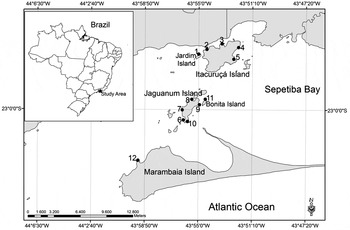
Twelve microtidal sandy beaches on five islands were sampled in two periods, summer 2007 (Boi, Flexeiras, Catita, Escalhau, Bonita and Jardim) and summer 2008 (Gamboa, Leste, Estopa, Pitangueiras, Sul and Pier) (Figure 1). Sampling was carried out during spring low tides in the summers of both years to reduce biotic and abiotic interannual variability linked to the seasonal cycle (Defeo & Rueda, Reference Defeo and Rueda2002), and we did not consider changes between years, as we focused only spatial analysis.
Locations of the 12 beaches that were sampled in Sepetiba Bay, also showing the bay mouth and the Atlantic Ocean: 1, Jardim; 2, Flexeiras; 3, Gamboa; 4, Leste; 5, Boi; 6, Sul; 7, Escalhau; 8, Estopa; 9, Pitangueiras; 10, Catita; 11, Bonita; 12, Pier.

Field sampling and laboratory procedures
The biological samples were taken along five transects, equally spaced perpendicular to the shoreline. On each transect, 10 equally spaced sampling units (SUs) were established: the first unit (SU1) at the waterline, the second-to-last unit (SU9) on the drift line and the last unit (SU10) 3 m above the drift line (supralittoral). One sample at each unit was taken with a 0.04 m2 quadrat sampler to a depth of 25 cm. The collected sediment was sieved through a 0.50 mm mesh, and the retained material was taken to the laboratory. The polychaetes were identified to the lowest possible taxonomic level, counted, fixed in a 10% formalin solution and preserved in a 70% alcohol solution.
The sediment samples for a particle-size analysis were collected with a 3.5 cm diameter corer to a depth of 15 cm at the strata 1 (lower), 5 (middle) and 10 (upper) of the central transect of each sandy beach. The samples were oven-dried at 70°C and passed through a progressively finer series of sieves (−2.5 to 4.0 phi) to determine the mean grain size (Folk & Ward, Reference Folk and Ward1957). The slope of the beach face was determined by the height difference (Emery, Reference Emery1961) between the supralittoral and the waterline on the central transect. Google Earth® was used to determine the distance between the beaches and the bay mouth. The beach index (BI) was calculated for each beach as a measure of its morphodynamic state, using the following formula: BI = (mean grain size•tide)/slope (McLachlan & Dorvlo, Reference McLachlan and Dorvlo2005). The exposure index proposed by McLachlan (Reference McLachlan1980) was used to categorize the beaches on the basis of their exposure.
Feeding guilds
A fundamental question in guild studies is the determination of the deciding factor to group the species into guilds. Although there are quantitative methods to divide the community into guilds, setting with relative accuracy the borders between the groups is subjective and dependent on knowledge about the species biology and on the judgment of the researcher (Pagliosa, Reference Pagliosa2005). We adopted the method of determination proposed by Fauchald & Jumars (Reference Fauchald, Jumars, Johnson and Boudreau1979) and Cheung et al. (Reference Cheung, Lam, Wu and Shin2008), and the resulting organizations are listed in the Supplementary Information.
Data analysis
The trophic importance of each group was evaluated according to the trophic importance index (TI) proposed by Paiva (Reference Paiva1993) and modified by Muniz & Pires (Reference Muniz and Pires1999), using the following formula:
 $$\hbox{TI}=\sum^s_{i-l} \ln n_{i\lpar +0.1\rpar }$$
where s is the number of species of a trophic group in a defined area, ln is the natural logarithm, n i is the number of individuals (individuals counts) of the ith species, and 0.1 is a constant.
The index of trophic diversity (1-ITD) was calculated as follows: ITD = ∑θ 2, where θ is the contribution of the density of each trophic group to the total polychaete density. The 1-ITD ranged from 0.90 (the highest trophic diversity; i.e. the ten trophic guilds account for 10% each) to 0.0 (the lowest diversity; i.e. one trophic guild accounts for 100% of the polychaete density: Heip et al., Reference Heip, Vincx and Vranken1985).
The relationships between the biological and physical variables were modelled using linear or non-linear fitting procedures, and the model with the best fit was selected.
A canonical correspondence analysis (CCA) was performed to explore the distribution of the polychaete guilds in relation to the beaches and environmental factors. The CCA was conducted using the software CANOCO (ter Braak & Smilauer, Reference ter Braak and Smilauer1998), with the software options set for forward selection to test the significance of the environmental variables. For the CCA, we used a log transformation for the species abundance and some of the environmental factor data (grain size, distance from the bay mouth, exposure rate and beach length) and an arcsine transformation for the other environmental factors (silt–clay content), and we did not transform the data for the BI. The transformations were employed to achieve linearization of the datasets.
RESULTS
Physical characterization
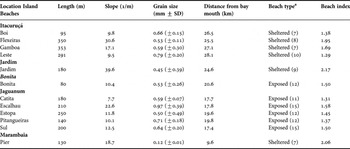
The environmental characterization of the study area is presented in Table 1. The longest and shortest beach measured 353 m (Gamboa) and 80 m (Bonita), respectively. The beach slope ranged from 1/7.7 m (Catita) to 1/39.6 m (Jardim). The mean grain sizes varied from 0.12 mm (fine sand) to 0.97 mm (coarse sand) sands on the Pier and Escalhau beaches, respectively. The beaches of the Itacuruçá and Jardim islands are located far from the bay mouth, compared with the other beaches. The BI ranged from 1.29 (Leste) to 2.17 (Jardim). The beaches of the Itacuruçá, Jardim and Marambaia islands were classified as sheltered while the beaches located on the Bonita and Jaguanum islands were exposed.
Environmental characterization of the study area, based on variables measured at the 12 beaches located in Sepetiba Bay.

a, values in parentheses are derived from the summation of scores (see McLachlan, Reference McLachlan1980 for details).
Polychaetes and feeding guild characterization
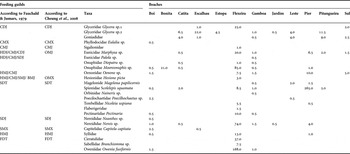
The polychaetes that were collected comprised approximately 24 morphospecies, grouped into 21 families and organized in 10 feeding guilds. The species Scolelepis squamata, Owenia fusiformis, Mooreonuphis sp. and Neanthes sp. together accounted for more than 70% of the total polychaete abundance of the inner Sepetiba Bay. Glycera sp. 2 showed the highest frequency, occurring in 7 of the 12 beaches, followed by Scolelepis squamata, Mooreonuphis sp., Nereis sp. and Marphysa sp. in 6 beaches (Table 2).
Abundance (ind.m−2) of the polychaete morphospecies at the 12 beaches located in Sepetiba Bay.

The SDT guild (suspending deposit feeders, discretely motile, with tentacles) was the most abundant feeding guild, accounting for 34.2% of dominance (mainly represented by Scolelepis squamata), followed by the FDT guild (feeders, discretely motile, with tentacles), with 24.1%, and the OMJ guild (omnivorous, motile, with jaw apparatus), with 18.9%. Despite their low dominance, members of the CDJ guild (carnivorous, discretely motile, with jaw apparatus) showed the largest distribution in Sepetiba Bay, occurring in 9 of the 12 beaches, followed by the OMJ guild in 8 beaches (Table 2).
The OMJ and FDT guilds were the most abundant feeding guilds on the beaches from Itacuruçá Island. The guild CDJ was dominant in Jaguanum Island. The SDT guild dominated in Marambaia Island, mainly represented by Scolelepis squamata (Table 2).
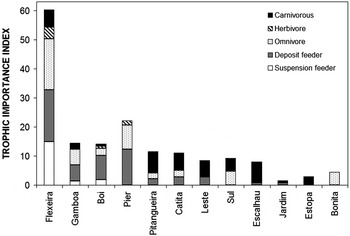
The highest trophic importance index (TI) values were recorded on the sheltered beaches. The highest TI was recorded on the Flexeiras beach, which was the only beach that contained all of the feeding guilds. On the exposed beaches, suspension feeders and herbivores were not found whereas the carnivores (mainly in the Pitangueiras and Escalhau beaches) and omnivores (mainly in the Sul and Bonita beaches) were more dominant (Figure 2).
Trophic importance index values for the sandy beaches.

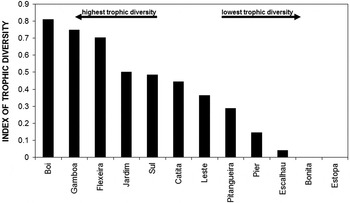
The values for the index of trophic diversity (1-ITD) were higher on the Boi, Gamboa and Flexeiras beaches, all of which were classified as sheltered. The Bonita and Estopa beaches contained only one trophic guild each (OMJ and CDJ, respectively), with a zero ITD value (Figure 3). All of the correlations between the biological and physical variables were best fitted by a linear model. The 1-ITD was negatively correlated with the exposure rate (r = −0.54; P = 0.050) and positively correlated with the distance from the bay mouth (r = 0.69; P = 0.037). The richness was negatively correlated with the exposure rate (r = −0.66; P = 0.020), whereas the silt–clay content was positively correlated with the exposure rate (r = 0.63; P = 0.027). The total abundance was positively correlated with the silt–clay content (r = 0.60; P = 0.040).
Index of trophic diversity values for the beaches.

Distribution of the feeding guilds along the environmental gradients
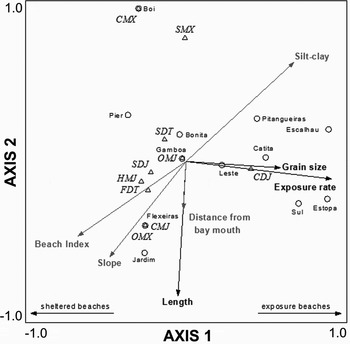
The CCA indicated that of the seven environmental variables studied, the exposure rate (F = 4.57; P = 0.002), beach length (F = 2.78; P = 0.022) and grain size (F = 2.57; P = 0.066) contributed significantly to explain the variation in the polychaete feeding guilds among the beaches. The first and second axes accounted for 36.5 and 18.4% of the variance observed in the feeding guild data, respectively. A Monte Carlo permutation test indicated that the first canonical axis was significant (F = 2.30; P = 0.032), and all of the other canonical axes were also significant (F = 2.67; P = 0.006).
On the CCA plot (Figure 4), the exposed and sheltered beaches were plotted on opposite sides along axis 1. The beaches with a smaller grain size (Flexeiras, Pier and Boi) showed the highest diversity of feeding guilds, which are located on the left of the graph along axis 1. The Boi beach was plotted on the upper part of the plot, suggesting that this beach was distinguished from the others along axis 2, which was negatively associated with beach length. The beaches located on the Jaguanum and Bonita islands (the beaches with the largest grain size and exposure rates) were plotted on the right side of the graph on axis 1, where the CDJ guild dominated.
Canonical correspondence analysis plot with the beach and polychaete feeding guild scores. The black arrows indicate significant environmental variables, and the grey arrows indicate a non-significant value.

DISCUSSION
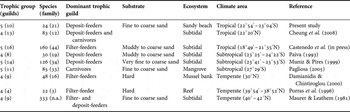
Diverse modes of feeding guilds were reported for the sandy-beach-dwelling polychaetes in this study. Similarly, other studies have shown a large number of polychaete feeding guilds in marine environments (Table 3). The differences in the number of trophic groups and feeding guilds among these marine environments could be associated with: (1) the environmental characteristics (sediment type, depth, salinity, etc.); (2) the latitudinal variation; and (3) the sampling effort (species/family richness). Among the studies listed in Table 3, the deposit-feeders were the dominant trophic group on soft substrates while the filter-feeders dominated the areas with hard substrate. Muniz & Pirez (Reference Muniz and Pires1999) and Pagliosa (Reference Papageorgiou, Arvanitidis and Eleftheriou2006) observed that feeding guilds were mainly controlled by sediment type while depth and salinity were the most important factors found by Maurer & Leathem (Reference Maurer and Leatham1981) and Castanedo et al. (in press). According to Paiva (Reference Paiva1993), the water depth acts on sediment stabilization and consequently increases the feeding guild variety. In sandy beaches, where there was no depth variation, the morphodynamic type and grain size was highly correlated; thus, these physical variables structured the feeding guilds. A food web study using stable isotope analysis found differences between reflective (coarse sand and steep slope) and dissipative (fine sand and gentle slope) conditions, where the dissipative beach supported a more complex food web with more trophic links and higher number of prey and top predators than the reflective beach (Bergamino et al., Reference Bergamino, Lercari and Defeo2011).
Polychaete feeding guilds from different marine ecosystems and climate areas.

n.a., not applicable.
The exposed beaches had a higher grain size and lower silt–clay content than the sheltered beaches. In addition, these beaches had a lower richness and abundance of polychaete species (Dexter, Reference Dexter1992) and consequently fewer feeding guilds than the sheltered beaches. The feeding guilds of the exposed beaches were composed mainly of carnivorous (CDJ, CMJ and CMX) and omnivorous (OMJ and OMX) species. According to Paiva (1994), sandy bottoms with low silt–clay content (such as exposed beaches) allow the proliferation of potential prey organisms inside their interstices and are the most suitable for carnivorous feeding guilds. This relationship between the exposed beaches and the abundance of carnivorous organisms is clear in the CCA plot (Figure 4), where the exposure rate and coarse grain size show a positive correlation with the CDJ guild and exposed beaches. According to Cheung et al. (Reference Cheung, Lam, Wu and Shin2008), high abundances of predators (carnivores) are directly associated with high environmental quality. In this sense, the exposed beaches were located on islands with lower human disturbance, and this trophic group (due to its high position in the trophic web) can be considered to be very important to measure the degree of community structure and environmental stress (Muniz & Pires, Reference Muniz and Pires1999).
The sheltered beaches had a smaller sediment grain size and higher silt–clay content than the exposed beaches. Consequently, the guilds that fed on organic material (FDT, SDT and SDJ) were more abundant. These beaches were dominated by the muddy sediment fraction and therefore dominated by deposit-feeders. The sheltered beaches showed an exclusive trophic group (herbivores) and feeding guilds such as the CMX (represented only by Eulalia sp.), HMJ (Syllidae) and OMX guild (Hesione picta). The high diversity of the feeding guilds on sheltered beaches and the presence of herbivores may be explained by the muddy/fine sandy sediment that accumulates nutrients and the high sediment stabilization that permits the growth of microphytobenthos (Sanders, Reference Sanders1958; Gray, Reference Gray1981). Another hypothesis is that these beaches were located near sources of pollution, such as the harbour and houses without treated sewage along the shoreline, which could increase the relatively high percentage of organic matter and associated bacteria (Longbottom, Reference Longbottom1970).
The Flexeiras beach showed the greatest abundance and richness of the feeding guilds among the sheltered beaches, containing eight of the 10 feeding guilds. This result can be explained by the local environmental heterogeneity, with the sediment mainly composed of sand (medium to coarse grain size) with rock fragments and seagrass beds of Halodule wrightii (Caetano et al., Reference Caetano, Cardoso, Braga and Mattos2008). Therefore, on beaches with vegetation, the number of trophic guilds may increase because the habitat becomes more complex, supporting a rich fauna, compared with beaches devoid of vegetation (Sumerson & Peterson, Reference Summerson and Peterson1984). Seagrass beds stabilize the sediment, providing refuge for certain species (Fitzhardinge, Reference Fitzhardinge1983; Sumerson & Peterson, Reference Summerson and Peterson1984; Watson et al., Reference Watson, Robertson and Littlejohn1984) and creating microhabitat that does not exist in areas without vegetation (Collet et al., Reference Collet, Hutchings, Gibbs and Collins1984). The rock fragments allow for the presence of species that are typical of rocky shores, increasing the local diversity (McQuaid & Dower, Reference McQuaid and Dower1990; Denadai & Amaral, Reference Denadai and Amaral1999; Caetano et al., Reference Caetano, Cardoso, Braga and Mattos2008).
The Bonita, Estopa and Escalhau beaches showed the lowest trophic importance (TI) and diversity (ITD). This finding conforms to one of the paradigms of beach ecology, which states that the species dwelling in exposed beaches are composed of specialist taxa because of the environmental severity produced by the hydrodynamic conditions (McLachlan & Brown, Reference McLachlan and Brown2006). Usually, crustaceans are dominant organisms on exposed beaches, being more generalist and adapted to live on harsh, reflective beaches. In contrast, polychaetes and deposit-feeding molluscs are specialists and may be delicate or slow burrowers, tending to dominate benign environments, such as sheltered beaches, dissipative beaches and tidal flats. In these environments, the variations of physical factors are more limited (Cardoso et al., Reference Cardoso, Mattos, Caetano, Cabrini, Galhardo and Meireis2012).
According to the CCA results, the beaches of Sepetiba Bay have a group of several polychaete feeding guilds and other beaches with the CDJ guild, the last guild collected mainly on beaches with a higher exposure rate and coarse grain size (exposed beaches) (Figure 4). The CDJ feeding guild was represented by two families, Goniadidae and Glyceridae, and these taxa were found in several of the sampled beaches. Additionally, in the Escalhau and Flexeiras beaches, we observed a high concentration of Glycera spp. The CMX feeding guild was represented by one species, Eulalia sp. that was found only in the Boi beach. The OMJ guild was represented by three families and five species. Mooreonuphis sp. was the most abundant species and was well distributed. Therefore, this species showed high abundances in the Bonita and Flexeiras beaches. According to Warwick (Reference Warwick1982), the suspension-feeding component of benthic communities is usually dominated by a single species. Our results show that the feeding guilds were dominated by different species. Our results are also supported by the findings of Sanders (Reference Sanders1958) because the suspension-feeders (SDT, SDJ, and SMX) were more abundant in the fine and well-sorted sediments, and the deposit-feeders (FDT and HMJ) were more abundant in the fine sediments with higher silt–clay content. Frequently, deposit-feeders are associated with an environment of low hydrodynamism and consequently with high concentrations of organic matter (Gambi & Giangrande, Reference Gambi and Giangrande1985; Muniz & Pires, Reference Muniz and Pires1999).
We can conclude that sheltered beaches contain a higher diversity of feeding guilds than exposed beaches, showing the same pattern found by reflective–dissipative gradient, where dissipative beach supported a more complex food web with more trophic links, as a response to a combination of environmental (e.g. a favourable hydrodynamic regime and benign swashes) and biotic (e.g. higher productivity) features (Bergamino et al., Reference Bergamino, Lercari and Defeo2011). Therefore, the exposure rate and grain size are the most influential factors, strongly influencing the diversity and composition of the polychaete feeding guilds. These physical factors structure the macrofauna of sandy beaches (Cardoso et al., Reference Cardoso, Mattos, Caetano, Cabrini, Galhardo and Meireis2012) and, consequently, the feeding guilds.
ACKNOWLEDGEMENTS
The authors express their deepest gratitude to all fieldwork participants, and American Journal Experts staff for English language revision. The study was suported by FAPERJ (Fundação de Amparo à Pesquisa do Estado do Rio de Janeiro) and CT-Infra (Fundo Setorial de Infra-Estrutura) by MCT/CNPq (no. E-26/171.164/2006). A.S.S. acknowledges Coordenação de Aperfeiçoamento de Pesquisa do Ensino Superior and Conselho Nacional de Pesquisa for financial support from 2008 to 2010 and 2010 to 2014, respectively. Dr Omar Defeo (UNDECIMAR) and an anonymous referee provided very useful comments and suggestions on an earlier version of this manuscript, for which we are most grateful.
Supplementary materials and methods
The supplementary material refered to in this paper can be found online at journals.cambridge.org/mbi.