Why does prejudice escalate? In this view, Putra (Reference Putra2014) pointed out that prejudice may increase because of two models of thinking. First, it is because how group members think that their own group negatively thinks about an outgroup. Second, it is because how an ingroup member thinks that his or her ingroup is negatively viewed by outgroup members. The former model of thinking is called as ingroup meta-prejudice, while the latter is called as outgroup meta-prejudice. In the study, it appeared that ingroup and outgroup meta-prejudice play a key role in predicting prejudice. In order to extend the previous finding, the present study seeks to explore the role of ingroup and outgroup meta-prejudice in influencing prejudice in the high and low condition of positive ingroup self-evaluation.
Meta-prejudice and prejudice
In psychology, research on thinking of what others are thinking is not new. In general, this model of thinking is called as meta-cognition, meta-knowledge, or meta-perception.
Putra (Reference Putra2014) has introduced a new idea called meta-prejudice, which is what group members think that other people negatively think about others. This idea is closely related to meta-stereotypes, which is defined as people’s beliefs about how they are viewed by others (Vorauer, Hunter, Main, & Roy, Reference Vorauer, Hunter, Main and Roy2000; Vorauer, Main, & O’Connel, Reference Vorauer, Main and O’Connel1998). In some regards, however, there are differences between meta-prejudice and meta-stereotypes. First, meta-stereotypes focus only on how group members are viewed by outgroup members, whereas meta-prejudice focuses both on how “my” group perceives the outgroup and how the outgroup perceives “my” group. The notion of meta-prejudice considers two types of perceptions in intergroup relations, whereas meta-stereotypes only one. Second, meta-stereotypes focus on stereotypes traits (e.g., Indonesians are aggressive), that are known as general characteristics of a particular group; whereas meta-prejudice concerns to negative feelings or hatred (e.g., Indonesians are a threat) toward a particular group. In some cases, it is possible that some groups are described as having positive characteristics, however, these characteristics do not mean to associate with a low level of prejudice. For example, the Nazis describe the Jews as experts on doing business, but because business skills are considered a threat, the Jews are hated by the Nazis and their sympathizers. In addition, meta-stereotypes tend to understand ingroup characteristics as viewed by the outgroup, while meta-prejudice tends to understand ingroup and outgroup feelings perceived by ingroup members.
In this study, prejudice is defined as negative qualities about others as part of a group (Crandall & Eshleman, Reference Crandall and Eshleman2003; Reicher, Reference Reicher, Dixon and Levine2012), which in particular relates to negative beliefs, thinking, or feeling. “I believe Jews are evil” or “I believe Indonesians are a threat to our group” are some examples. Putra (Reference Putra2014) suggests that both ingroup and outgroup meta-prejudice plays a central role in influencing prejudice. However, since the research was conducted primarily in a place where Muslims are the majority, further study needs to be carried out in a different context, such as in a place where Muslims are the minority.
Religious groups and its members’s perceptions
According to reports by Pew Research Center (2012) and Central Intelligence Agency (CIA, 2013), more than 80% of the world population identify themselves with a religious group. This is evidence that globally, religion is important for identity (Verkuyten, Reference Verkuyten2007). In particular, religion has been reported to be of great importance in non-western societies (Sen, Wagner, & Howarth, Reference Sen, Wagner and Howarth2014) or cultures (Verkuyten, Reference Verkuyten2007).
Often, people affiliated with a religious group justify their own group as more positive than others (Verkuyten, Reference Verkuyten2007; Verkuyten & Zaremba, Reference Verkuyten and Zaremba2005). It is because their religion provides meaning and guidance for their lives (van Tongeren, Hook, & Davis, Reference van Tongeren, Hook and Davis2013; Yssedyk, Matheson, & Anisman, Reference Ysseldyk, Matheson and Anisman2010); thus individuals who highly identify with a religious group will place their religion as important for their self-concept. Some findings have also reported that religiosity relates to individual well-being and health behaviors (Jackson & Bergeman, Reference Jackson and Bergeman2011; Lawler-Row, Reference Lawler-Row2010). Yssedyk et al. (Reference Ysseldyk, Matheson and Anisman2010) suggest that it is because there are mechanisms that stimulate religious people to associate with healthy lives, one of those is social support from members of their religious community. For this reason, it is understandable that religious people are loyal to their religion through which they believe that their religion is the correct one and the only truth to follow.
Even though group members are inclined to evaluate their own group more positive than outgroups, there is evidence that group members are diverse in evaluating their own group (Jaspars & Warnaen, Reference Jaspars, Warnaen and Tajfel1982; Verkuyten, Reference Verkuyten2007; Warnaen, Reference Warnaen2002). For some reason, one of group members may evaluate their own group in a negative way. A study conducted by Warnaen (Reference Warnaen2002) revealed that group members know and are aware of the negative and positive characteristics of their group. Therefore, it is very likely that a group member may perceive their ingroup in a negative way when the negative characteristics are more salient than the positive. For example, Major, Kaiser, O’Brien, and McCoy (Reference Major, Kaiser, O’Brien and McCoy2007) suggest that the ingroup can be perceived as a threat when it is considered to contribute to low status and discriminations.
In terms of interreligious relations, previous studies reported that religious people can be either more or less tolerant toward outgroup members (Allport, Reference Allport1958; Brambilla, Manzi, Regalia, & Verkuyten, Reference Brambilla, Manzi, Regalia and Verkuyten2013). Brambilla et al. (Reference Brambilla, Manzi, Regalia and Verkuyten2013) demonstrated that individuals who identify with a religion that endorses prosocial values were negatively related to prejudice; in contrast, religious people who conform to norms saying that they should distrust those who are from different beliefs were found positively related to prejudice. The findings suggest that it is not their religiosity that makes people tend to be prejudiced or tolerant, but it depends how the religion is internalized; it depends on how it is shown or understood.
In regard to the present study, another possibility to find out how religious people tend to be prejudiced is by analyzing how they think what others are thinking. A lot of studies have suggested that people are able to see and interpret things from the point of view of others (see e.g., Goldstein, Vezich, & Shapiro, Reference Goldstein, Vezich and Shapiro2014; Long & Andrews, Reference Long and Andrews1990; Quintana, Ybarra, Gonzalez-Doupe, & De Baessa, Reference Quintana, Ybarra, Gonzalez-Doupe and De Baesa2000) This ability allows people to learn ideas, beliefs, and behaviors from others and to think what others are thinking. More often than not, what people think others are thinking can be an influential tool to justify others (Elcheroth, Doice, & Reicher, Reference Elcheroth, Doise and Reicher2011). It is then understandable why ingroup meta-prejudice and outgroup meta-prejudice play a key role in influencing prejudice (Putra, Reference Putra2014). Nevertheless, it seems plausible that the effect of ingroup and outgroup meta-prejudice on prejudice depends on high and low positive self-evaluation toward the ingroup. Individuals who justify their own group as highly positive are more likely influenced by ingroup and outgroup meta-prejudice.
The present study and religious life in indonesia
The field study was conducted in the context of interreligious relations in Indonesia. There are two reasons why it is done in Indonesia. First, religion is regarded as something very important in Indonesia. In Pancasila, the official philosophical foundation of the Indonesian state, the first of five principles (sila) says “Belief in the one and only God”. In public schools from elementary to state universities, religious education is compulsory, wherein all students must study about their own religion. Second, based on a report from Human Rights Watch (2013), the conflicts that occurred in Indonesia were frequently interreligious.
Generally, Sunni Islam is the largest religious group in Indonesia. However, in some regions like the eastern part, namely Papua, Maluku, Flores, and Timor, Christianity is the majority. In places where Sunni Islam is the majority, Ahmadiyya and Christian groups are among the victims of discrimination and violence.
In Indonesia and other countries, Ahmadiyya is a minority group within Islam. Among other Islamic denominations, Ahmadiyya is seen as different. First, its founder Mirza Gulan Ahmad is believed by the Ahmadis (the adherents of Ahmadiyya) to be the Messiah and a prophet who did not bring a new religion and holy book. This belief is very different from the two biggest denominations in Islam, Shia and Sunni. Second, an Ahmadi can only do congregational prayer in its own community, and with an Ahmadi Imam (leaders). On the other hand, other Muslims can do congregational praying anywhere, even when the Imam is not from the same community. Third, even though Ahmadiyya also accept the Quran as their holy book, their interpretation of it is very exclusive. Ahmadiyya do not accept Quran interpretations from outside its community, while other Muslim communities are very open to interpretations developed by others (Hanafi, Reference Hanafi2011). At least because of these three points, Ahmadiyya’s existence has triggered fierce debates within majority Sunni Muslim groups. The debates surround the question of whether Ahmadiyya is still part of Islam or not. This issue has even been covered by some national TV stations in Indonesia.
Different from Ahmadiyya and because it is legally acknowledged, the existence of Christianity (i.e., Catholic and Protestant) in Indonesia is not debated (Syihab, Reference Syihab2013). In Indonesia, important and holy dates in Christianity are recognized as national holidays. However, in social life, tensions and frictions between Muslims and Christians often occur. More often, the tensions appeared to be triggered by proselytization issue (Bertrand, Reference Bertrand2004). In Indonesia, proselytism is considered a sensitive issue, especially in Muslim-Christian relations.
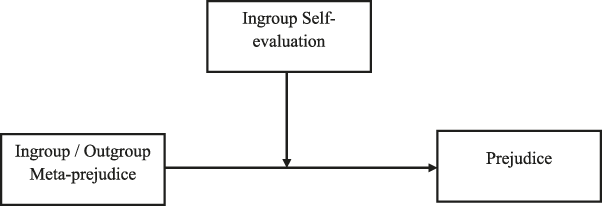
The present study was conducted in Flores, located on the eastern part of Indonesia. A previous study (Putra, Reference Putra2014) has shown that ingroup and outgroup meta-prejudice play a role in predicting prejudice in the context where Muslims are the majority group. The present study tested the relationship between meta-prejudice and prejudice where Christianity is the largest religion (i.e., ± 90% in Flores) and Islam is the second (i.e., ± 8%). From information given by a member of Ahmadiyya community, there is no news about Ahmadiyya activities in Flores. Nevertheless, not far from Flores, in Lombok island there are some Ahmadi refugees exiled from their hometown. Considering this, it is then important to explore the level of prejudice within Muslims and Christians in Flores. Furthermore, the present study extended the previous study by examining the role of ingroup self-evaluation in moderating the effect of ingroup and outgroup meta-prejudice on prejudice. In doing so, hypotheses are as follows (see figure 1 to see the model illustration):
Path diagram of moderated regression analysis of the effect Ingroup/outgroup meta on prejudice moderated by Ingroup Self-evaluation.

Hypothesis 1. The relation between ingroup meta-prejudice and prejudice will be moderated by perceptions of whether ingroup is or is not positively evaluated within religious group members. More specifically, when positive ingroup self-evaluation is perceived as high, there will be a positive relation between ingroup meta-prejudice and prejudice (H1a); but no such relation would exist if positive ingroup self-evaluation were low (H1b).
Hypothesis 2. The relation between outgroup meta-prejudice and prejudice will be moderated by perceptions of whether ingroup is or is not positively evaluated within religious group members. More specifically, when positive ingroup self-evaluation is perceived as high, there will be a positive relation between outgroup meta-prejudice and prejudice (H2a); but no such relation would exist if positive ingroup self-evaluation were low (H2b).
Method
Participants
One hundred ninety nine Christians living in Maumere, Flores Island, participated in the study. Twenty two were eliminated for poorly incomplete data. It left me with 68 men and 104 women (5 did not report their gender) aged between 18 and 45 (M age = 24.18, SD = 5.32, 3 did not report their age). The descriptions of educational background were 11 with a high school degree, 4 students of associate degree, 3 with an associate degree, 160 students of bachelor degree (mostly from University of Nusa Nipa), and 5 with a bachelor degree (16 did not report their educational background). For Muslims, 196 Muslims living in Maumere participated in the study. Fifteen were eliminated for poorly completing demographic data. In total, 185 Muslim participants (Men = 81, Women = 104) aged between 16 and 60 (M age = 26.75, SD = 8.07, 6 did not report their age). The descriptions of educational background were 7 with a junior high school degree, 57 with a high school degree, 10 students of associate degree, 6 with an associate degree, 63 students of bachelor degree (mostly from University of Muhammadiyah and Nusa Nipa), and 23 with a bachelor degree (19 did not report their educational background).
Procedures and measures
The research packet consisted of several parts. The first was an informed consent to confirm participants’ agreement to voluntarily participate in the research, introduced as a research about interreligious groups. In the second part, participants were asked to fill out measurements of 6-point scales: prejudice belief, meta-prejudice, and ingroup self-evaluation (see appendix for detailed items). Prejudice belief scale, developed by Putra (Reference Putra2014), consists of six bipolar adjective items (i.e., threatening – trustworthy, hostile – friendly, slothful – industrious, evil – good, stupid – clever, and undignified – dignified) to indicate participants’ judgments toward an outgroup (i.e., “You think [outgroup] is…”). In the main analysis, the items of the scale were reversed so that high scores corresponded to high negative judgment. Among Muslim participants, prejudice belief scale obtained Cronbach’s alpha of .96 (corrected item-total correlations ranged between .82 and .89) toward Ahmadiyya, and .93 (corrected item-total correlations ranged between .73 and .86) toward Christians. Among Christians, it was .96 (corrected item-total correlations ranged between .83 and .89) toward Ahmadiyya and .93 (corrected item-total correlations ranged between .70 and .85) toward Muslims.
Following prejudice belief scale was meta-prejudice scales (developed by Putra, Reference Putra2014), which consists of two measures referring to indicators of ingroup meta-prejudice (i.e., “Do you think that in Indonesia [ingroup] perceive [outgroup] as…”), and outgroup meta-prejudice (“Do you think that in Indonesia [outgroup] perceived [ingroup] as…”). Among Muslim participants, the Cronbach’s alpha of ingroup meta-prejudice was .94 (corrected item-total correlations ranged between .76 and .87) in targeting Ahmadiyya, and .93 (corrected item-total correlations ranged between .72 and .82) in targeting Christians; while Christian participants obtained .92 (corrected item-total correlations ranged between .74 and .81) in targeting Muslims and .93 (corrected item-total correlations ranged between .69 and .87) in targeting Ahmadiyya. Regarding outgroup meta-prejudice, Muslim participants reported reliability of .96 (corrected item-total correlations ranged between .87 and .93) in targeting Ahmadiyya and .96 (corrected item-total correlations ranged between .84 and .94) in targeting Christians; while Christian participants reported .96 (corrected item-total correlations ranged between .82 and .93) in targeting Muslims and .96 (corrected item-total correlations ranged between .87 and .92) in targeting Ahmadiyya.
Next, participants were given an ingroup self-evaluation scale to measure evaluations toward their ingroup (i.e., “You think [ingroup] is…”). The scale consists of six bipolar adjective items similar to prejudice belief. For Muslim participants, the score of Cronbach’s alpha was .94 (corrected item-total correlations ranged between .78 and .89); for Christian participants, it was .94 (corrected item-total correlations ranged between .71 and .88).
The final part of the questionnaire was about demographic information including religion (i.e., “What is your religion?”), gender, age, education, institution, and job. Upon finishing, participants were debriefed and thanked.
Results
Preliminary analysis
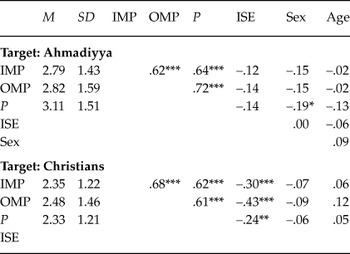
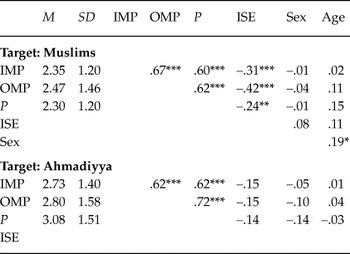
Independent sample t-test was used to examine sex differences in prejudice belief, ingroup and outgroup meta-prejudice, and ingroup self-evaluation. No significant sex differences were found in all main key variables (except prejudice toward Ahmadiyya in Muslim participants (t(159) = –2.43, p < .05, M men = 2.79, M women = 3.36). Moreover, bivariate correlation analyses were inspected to check the correlations between age and the key variables (see table 1 and 2). Except the correlation between age and prejudice toward Muslims in Christian participants (r = .15, p = .051), none of the significant correlations were found between age and all key variables. Therefore all data were collapsed across age and gender.
Descriptive statistics and correlations by Muslims

Note: IMP = Ingroup Meta-prejudice; OMP = Outgroup Meta-prejudice; P = Prejudice; ISE = Ingroup Self-evaluation; Sex: 0 = Women, 1 = Men; *p < .05; **p < .01; ***p < .001.
Descriptive statistics and correlations by Christians

Note: IMP = Ingroup Meta-prejudice; OMP = Outgroup Meta-prejudice; P = Prejudice; ISE = Ingroup Self-evaluation; Sex: 0 = Women, 1 = Men; *p < .05; **p < .01; ***p < .001.
Moreover, positive group evaluations Footnote 1 found that either Muslim (Greenhouse-Geisser correction: F = 121.21, p < .001, η p Footnote 2 = .37, Wilks’ Lambda = .45, F(2, 157) = 94.82, p < .001) or Christian (Greenhouse-Geisser correction: F = 101.89, p < .001, η p Footnote 2 = .37; Wilks’ Lambda = .46, F(2, 69) = 99.60, p < .001) participants evaluated their ingroup (Christians: M = 5.55, SD = .78; Muslims: M = 5.55, SD = .80) higher than targeted outgroups; Ahmadiyya was evaluated at the lowest level of positive ingroup self-evaluation (amomg Christians: M = 3.92, SD = 1.51; among Muslims: M = 3.89, SD = 1.52).
Moderated regressions
In this section I present the results relating H1 and H2, that is, predicting the effect of ingroup and outgroup meta-prejudice on prejudice within high and low condition of ingroup self-evaluation. As predictors, ingroup and outgroup meta-prejudice were tested separately. Here, ingroup/outgroup meta-prejudice (i.e., focal predictor/F; mean centered), ingroup self-evaluation (i.e., moderator/M), and their cross product (F × M) were entered as predictors in predicting prejudice Footnote 2 .
The distribution of ingroup self-evaluation was negatively skewed (Christians = –3.03; Muslims = –3.06) and the mode was 6.0 (M Christians = 5.56, SD = .77; M Muslims = 5.57, SD = .78). To this matter, and since I would treat ingroup self-evaluation as a moderator, I would estimate the conditional effect of ingroup and outgroup metaprejudice based on low (2 or 3 on the scale) and high (5 or 6 on the scale) level of ingroup self-evaluation scale.
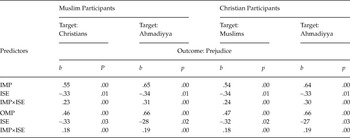
In targeting Ahmadiyya (see table 3 for all moderated regression results), the regression equation of ingroup and outgroup meta-prejudice was significant in Muslim partipants (R Footnote 2 (ingroup meta-prejudice) = .48, F(3, 15) = 46.38, p < .001; R 2 (outgroup meta-prejudice) = .55, F(3, 15) = 61.91, p < .001)) and in Christian participants (R 2 (ingroup meta-prejudice) = .45, F(3, 163) = 45.16, p < .001; R 2 (outgroup meta-prejudice) = .55, F(3, 164) = 67.32, p < .001). The interaction variable of ingroup/outgroup meta-prejudice with ingroup self-evaluation showed a significant relation on prejudice either in Muslim participants (b (F = ingroup meta-prejudice) = .31, SE = .07, t = 4.50, p < .01, ∆R 2 = .07, 95% CI [.17, .44]; b (F = outgroup meta-prejudice) = .19, SE = .06, t = 3.00, p < .01, ∆R 2 = .03, 95% CI [.07, .32]) or in Christian participants (b (F = ingroup meta-prejudice) = .30, SE = .07, t = 4.36, p < .001, ∆R 2 = .06, 95% CI [.17, .44]; b (F = outgroup meta-prejudice) = .19, SE = .06, t = 3.06, p < .01, ∆R 2 = .026, 95% CI [.07, 32]).
Moderated regression results among Muslims and Christians

Note: IMP = Ingroup Meta-prejudice; OMP = Outgroup Meta-prejudice; P = Prejudice; ISE = Ingroup Self-evaluation.
Among Christian participants targeting Muslims, the regression equation of ingroup and outgroup meta-prejudice was significant (R 2 (ingroup meta-prejudice) = .41, F(3, 168) = 38.54, p < .001; R 2 (outgroup meta-prejudice) = .42, F(3, 169) = 41.29, p < .001). The interaction variable of ingroup/outgroup meta-prejudice with ingroup self-evaluation showed a significant relation on prejudice (b (F = ingroup meta-prejudice) = .24, SE = .075, t = 3.17, p < .01, ∆R 2 = .03, 95% CI [.09, .39]; b (F = outgroup meta-prejudice) = .18, SE = .06, t = 3.15, p < .01, ∆R 2 = .034, 95% CI [.07, .29]). Among Muslim participants targeting Christians, significant results of the regression equations were also revealed (R 2 (F = ingroup meta-prejudice) = .422, F(3, 16) = 38.01, p < .001; R 2 (F = outgroup meta-prejudice) = .41, F(3, 16) = 35.95, p < .001). These effects were qualified by a significant interaction between the two predictors, F × M (b (F = ingroup meta-prejudice) = .23, SE = .08, t = 3.02, p < .01, ∆R 2 = .03, 95% CI [.08, .38]); b (F = outgroup meta-prejudice) = .18, SE = .06, t = 3.08, p < .01, ∆R 2 = .036, 95% CI [.065, .298]).
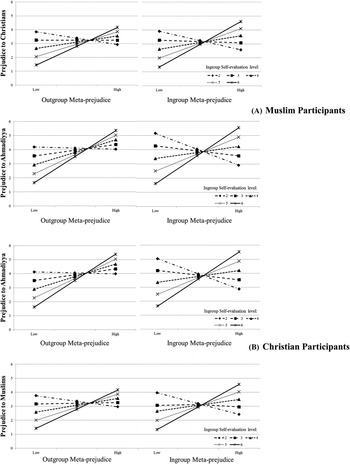
Furthermore, as seen in figure 2, all inspections of a simple slope analysis in Muslim and Christian participants consistently showed that at the low point on the ingroup self-evaluation scale (2 or 3 on the scale), the effect of ingroup and outgroup meta-prejudice on prejudice was not significant. On the other hand, at the high point on the ingroup self-evaluation scale (5 or 6 on the scale) the effect of ingroup and outgroup meta-prejudice was positively significant in Muslim and Christian participants Footnote 3 . The findings, thereby, support H1 and H2.
Visual depictions of the interaction between ingroup/outgroup meta-prejudice and ingroup self-evaluation in predicting prejudice.

Discussion
The aim of this study was to examine the relationship between ingroup/outgroup meta-prejudice and prejudice in a condition of high and low ingroup self-evaluation. The analysis of moderated regressions from Christian and Muslim participants showed consistent effects; when positive ingroup self-evaluation is high, there is a positive relation between ingroup/outgroup meta-prejudice and prejudice. These findings then support H1a and H2a. In contrast, when positive ingroup self-evaluation is low, there is no relation between ingroup/outgroup meta-prejudice and prejudice. These findings thus support H1b and H2b. In addition, the findings showed that ingroup self-evaluation by Muslim and Christian participants were highly skewed with the mode on the highest score. In my opinion, it is not surprising since religion provides the believers with moral guidance and understanding on how to live their life (Verkuyten, Reference Verkuyten2007).
Previous studies showed that when people are negatively viewed by outgroup members, ingroup members tend to see outgroup members in a negative way (e.g., Phelps, Ommundsen, Türken, & Ullerberg, Reference Phelps, Ommundsen, Türken and Ulleberg2013; Vorauer et al., Reference Vorauer, Main and O’Connel1998, Reference Vorauer, Hunter, Main and Roy2000). In the case of Islamist terrorist groups in Indonesia, one of the findings from a research conducted by Putra and Sukabdi (Reference Putra and Sukabdi2013) revealed that terrorism attacks occurred not because the terrorist group members do not want peaceful or positive relationship with non-Muslims, but because they think that non-Muslims hate Muslims and want to wage war against them. Similar findings were also found in the conflict between Palestine and Israel. In interviews, Salinas’ (Reference Salinas2007) study demonstrated that Palestinians might hate Jews or Jews might hate Palestinians because the ingroup members think that outgroup members hate or do not want peace with the ingroup. It suggested that what outgroups are thinking really matter in shaping ingroup members’ perceptions and behaviors (Elcheroth et al., Reference Elcheroth, Doise and Reicher2011). This phenomenon, however, is strongly influential when ingroup members positively evaluate their group.
Another aspect that cannot be forgotten is ingroup meta-prejudice process, that is, how ingroup members think that their group negatively think toward an outgroup. Putra’s (Reference Putra2014) study showed that ingroup meta-prejudice is stronger than outgroup meta-prejudice in predicting prejudice. The effect of ingroup meta-prejudice, though, would strongly be influential within group members who positively evaluate their group. In an extreme way, when everything in a group is considered positive, ingroup members are willing to die for their group (Putra & Sukabdi, Reference Putra and Sukabdi2013). I assume, within these group members, what they think that their group is thinking would be very influential in shaping group members’ perceptions and behaviors.
Furthermore, in the present study, Christian and Muslim participants were found to evaluate Ahmadiyya more negatively than other religious groups (i.e., Christian participants toward Muslims; Muslim participants toward Christians). In 2005, Indonesian Ulama (clerics) Council had announced that Ahmadiyya is an astrayed group of Islam. It was followed, in 2008, by three ministerial (Ministry of Religious Affairs, Attorney General, & Ministry of Internal Affairs, 2008) decrees, announcing that Ahmadiyya must stop their strayed activities and interpretations of Islamic teachings. After 2005, a report from Human Rights Watch (2013) showed that violence by majority (Sunni) Muslim against Ahmadiyya had increased. On the other hand, a 2012 survey report from Lingkaran Survei Indonesia (LSI, 2012), a leading survey institution, found that about 46.6 % (non-Ahmadiyya) respondents do not want to live next-door to Ahmadis. Compared to 2005 LSI national survey, the rejection is 7.5% higher. This national report, however, did not give detailed information about respondents’ religious background, especially how members of religions such as Christian, Hindu, or Buddha responded about Ahmadiyya group. Therefore, by investigating Christian participants’ perceptions about Ahmadiyya, the present findings have filled previous informational gap. I suspect that the involvement of governmental elements in supporting the view that Ahmadiyya is a “deviant” group of Islam might stimulate hatred toward Ahmadiyya to widen, that is, by influencing non-Muslims perceptions.
Nevertheless, some limitations of the present study need to be addressed. The present study was aimed to extend a study by Putra (Reference Putra2014) in the different contexts of interreligious groups in Indonesia. The findings showed that in Indonesia, either in the context where Muslims are the majority or the minority, ingroup and outgroup meta-prejudice play a key role in predicting prejudice. Such effect will be higher in the condition when group members highly and positively evaluate their ingroup. These findings, however, need to be confirmed in the different contexts of intergroup relations. On the other hand, since individuals are engaged with more than one group identities, research regarding meta-prejudice needs to consider the complexity of multiple group identifications (Brewer & Pierce, Reference Brewer and Pierce2005; Roccas & Brewer, Reference Roccas and Brewer2002). The results may provide better understanding in searching for a solution to develop intergroup harmony.
In conclusion, the present study has demonstrated research analyzing types of group evaluations. Those are ingroup self-evaluation, ingroup and outgroup meta-prejudice, and prejudice. To my knowledge, very few studies have investigated group members’ perceptions and responses based on evaluations which I investigated. The findings suggest that it is important to consider how group members evaluate their own group, and how group members think what others are thinking, in the study pertaining to intergroup relations.
I thank Simon Weking for his help in collecting the data at Maumere, Flores. This work was supported by Lembaga Pengelola Dana Pendidikan (LPDP) for 2014 grant.
Appendix
Measurement Scale Questions Used in the Study