INTRODUCTION
Pepper and sweet pepper (Capsicum spp.) have global economic importance, being grown in 116 countries spread over all continents. The Asian continent covers 0·59 of the total area under cultivation in the world, with the main growing areas located in China (672 330 ha), Indonesia (237 520 ha) and South Korea (49 976 ha). Africa comes next with 0·19 of the planet's cultivated land (FAOSTAT 2010). The annual global production is 31·13 million t, of which China accounts for 0·51, followed by Mexico (0·074), Turkey (0·069) and Indonesia (0·055) (FAOSTAT 2013).
The Capsicum genus belongs to the Solanaceae family and comprises 36 taxa, including species and some botanical varieties, all of them native to tropical regions of the Americas (Pozzobon et al. Reference Pozzobon, Schifino-Wittmann and Bianchetti2006). Five species of pepper (Capsicum annuum, Capsicum frutescens, Capsicum baccatum, Capsicum pubescens and Capsicum chinense) are considered domesticated, showing varied distribution throughout tropical America (Loaiza-Figueroa et al. Reference Loaiza-Figueroa, Ritland, Cancino and Tanksley1989; Perry Reference Perry and Russo2012). This genus shows great diversity in colour, size, shape, pungency and use of its fruits (Bosland Reference Bosland1992) which impart colour, aroma and flavour to various foods (Korel et al. Reference Korel, Bağdatlioğlu, Balaban and Hisil2002). In addition, the fruit is an excellent source of vitamins A and C (Miean & Mohamed Reference Miean and Mohamed2001), and possess medicinal properties (Knotkova et al. Reference Knotkova, Pappagallo and Szallasi2008; Leung Reference Leung2008; Oh et al. Reference Oh, Kim, Lim, Hou, Chang and You2008; Silva et al. Reference Silva, Scherer, Alves and Oliveira2009; Wong & Gavva Reference Wong and Gavva2009; Costa et al. Reference Costa, Moura, Marangoni, Mendes and Teixeira2010; Joo et al. Reference Joo, Kim, Choi and Yun2010; Thoennissen et al. Reference Thoennissen, O'Kelly, Lu, Iwanski, La, Abbassi, Leiter, Karlan, Mehta and Koeffler2010; Yang et al. Reference Yang, Wang, Wang, Hu, Zheng and Li2010; López et al. Reference López, Gorzalczany, Acevedo, Alonso and Ferrraro2012).
Like other species of plants that are able to establish a symbiotic association with soil fungi, when the soil has low nutrient availability roots of Capsicum spp. typically form arbuscular mycorrhizae (Davies et al. Reference Davies, Potter and Linderman1992).
Mycorrhiza is defined as a non-pathogenic symbiotic association between certain types of soil fungi and plant roots. The arbuscular mycorrhizal (AM) fungi are of agronomic importance. They are capable of forming mycorrhizae with >0·80 of plant species, including most of the cultivated species (Strack et al. Reference Strack, Fester, Hause, Schliemann and Water2003; Gosling et al. Reference Gosling, Hodge, Goodlass and Bending2006). The AM fungi fall within the Phylum Glomeromycota, represented by 18 genera recognized mainly by the morphological characteristics of asexual spores. These genera include Redeckra, Acaulospora, Pacispora, Scutellospora, Gigaspora, Dentiscutata, Cetraspora, Racocetra, Claroideoglomus, Glomus, Funneliformis, Septoglomus, Rhizophagus, Sclerocystis, Ambispora, Geosiphon, Archaeospora and Paraglomus, which currently comprise about 230 species (Schüβler et al. Reference Schüβler, Shwarzott and Walker2001; Peterson et al. Reference Peterson, Massicotte and Melville2004; Redecker et al. Reference Redecker, Schüβler, Stockinger, Stürmer, Morton and Walker2013). Intensive field research carried out in the Colombian Amazon (Cardona et al. Reference Cardona, Peña-Venegas and Arcos2008), Shandong Province, China (Chen et al. Reference Chen, Liu, Guo, Liu and Li2012) and West of Rajasthan, India (Vyas & Vyas Reference Vyas and Vyas2012) showed a high diversity of AM fungi in rhizosphere of Capsicum spp. Glomus occurred most frequently among the genera, followed by Acaulospora, Gigaspora and Scutellospora.
Mycorrhizal relationships formed by AM fungi benefit their hosts by increasing the absorption of soil mineral nutrients, particularly phosphorus (P) as well as nitrogen (N), potassium (K) and micronutrients (Linderman Reference Linderman, Bethlenfalvay and Linderman1992; Perner et al. Reference Perner, Schwarz, Bruns, Mader and George2007). In addition to these benefits, AM fungi improve plant–water relations, increase resistance or tolerance to biotic and abiotic stresses and improve soil structure (Smith & Read Reference Smith and Read2008).
The first to establish the benefits of AM fungi in plants of the genus Capsicum were Hirrel & Gerdemann (Reference Hirrel and Gerdemann1980), who observed that bell pepper plants inoculated with AM fungi could be more tolerant to salt stress than non-inoculated plants. Two years later, Bagyaraj & Sreeramulu (Reference Bagyaraj and Sreeramulu1982) confirmed the benefits of pre-inoculation with AM fungi on height, dry weight and yield of hot peppers transplanted into the field.
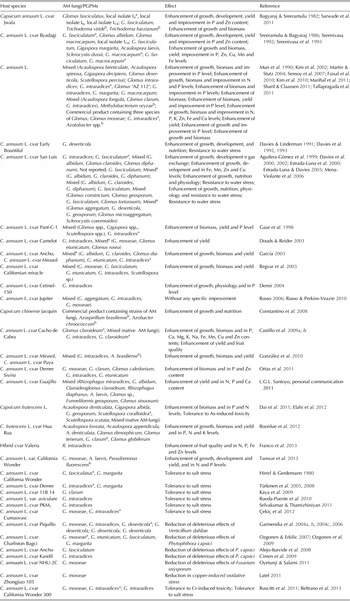
In recent years, there has been a growing interest in the associations between AM fungi and Capsicum spp. related to P and water absorption (Estrada-Luna & Davies Reference Estrada-Luna and Davies2003; Sharif & Claassen Reference Sharif and Claassen2011), growth, yield, nutritional status (Boonlue et al. Reference Boonlue, Surapat, Pukahuta, Suwanarit, Suwanarit and Morinaga2012; Franco et al. Reference Franco, Carrillo, Chairez and Cabrera2013), physiology (Estrada-Luna et al. Reference Estrada-Luna, Davies and Egilla2000; Demir Reference Demir2004) and tolerance to biotic (Ozgonen & Erkilic Reference Ozgonen and Erkilic2007; Goicoechea et al. Reference Goicoechea, Garmendia, Sánchez-Díaz and Aguirreolea2010; Oyetunji & Salami Reference Oyetunji and Salami2011) and abiotic stresses (Mena-Violante et al. Reference Mena-Violante, Ocampo-Jiménez, Dendooven, Martínez-Soto, González-Castañeda, Davies and Olalde-Portugal2006; Elahi et al. Reference Elahi, Mridha and Aminuzzaman2012; Beltrano et al. Reference Beltrano, Ruscitti, Arango and Ronco2013). In view of this interest, a bibliographical search on the relationship between AM fungi and Capsicum spp. resulted in 60 published works involving 33 taxa of Capsicum, including crops and botanical varieties and the effects of mycorrhizal associations on these species (Table 1). Thus, the current review summarizes the effects of AM fungi on nutrition, growth and yield in Capsicum spp., paying particular attention to AM fungi–pathogen interactions, in response to some environmental stresses, as well as biochemical and physiological aspects of AM fungi–plant interactions in C. annuum L.
Effects of arbuscular mycorrhizal fungi (AM fungi) and plant growth-promoting microorganisms (PGPMs) on Capsicum spp.

a Mycorrhizal inoculum with best response.
b Plant growth-promoting microorganisms used in co-inoculation with AM fungi.
EFFECTS OF ARBUSCULAR MYCORRHIZAL FUNGI ON NUTRITION, GROWTH AND YIELD IN CAPSICUM SPP.
The symbiotic association of roots with AM fungi is a widespread strategy by which plants facilitate the acquisition of mineral elements from the soil. This association basically happens in two phases: extra-radical, in which hyphal contact with the root cortex of the host plant occurs; and intra-radical, with the development of intra-radical hyphae and specialized structures called arbuscules (finely branched hyphae involved in nutrient exchange) (Peterson et al. Reference Peterson, Massicotte and Melville2004; Smith & Read Reference Smith and Read2008; Giovannetti et al. Reference Giovannetti, Avio, Sbrana, Koltai and Kapulnik2010). Extra-radical mycelia continue to extend into the soil which encourages further exploration, transferring water and minerals back to the plant roots (Franken Reference Franken, Koltai and Kapulnik2010).
In the mycorrhizal association, the fungus enhances the acquisition of soil mineral nutrients, particularly P and N, as well as K, sulphur (S), magnesium (Mg), copper (Cu), zinc (Zn) and iron (Fe) by the host plant, which in turn provides products from carbon metabolism to the fungus (Linderman Reference Linderman, Bethlenfalvay and Linderman1992; Caris et al. Reference Caris, Hördt, Hawkins, Römheld and George1998; Allen & Shachar-Hill Reference Allen and Shachar-Hill2009).
The effects of AM fungi on the absorption of P have been studied extensively and supported by several researchers. Possible explanations for the success of AM fungi on the acquisition and subsequent phosphate nutrition improvement in their hosts are well described by Smith & Read (Reference Smith and Read2008). The AM hyphae absorb P from soil solution and transfer it to the roots at a speed higher than the diffusion of this element by the soil. Hyphae are able to transpose the P depletion regions that form around the roots. In addition, the smaller hyphal diameter allows greater exploration of the soil volume (Smith & Read Reference Smith and Read2008).
Several experiments have demonstrated the absorption, transport and transfer of P and N in various plant–AM fungi relations under different environmental conditions (Hattingh et al. Reference Hattingh, Gray and Gerdemann1973; Ames et al. Reference Ames, Reid, Porter and Cambardella1983; George et al. Reference George, Häussler, Vetterlein, Gorgus and Marschner1992; Smith et al. Reference Smith, Jakobsen and Smith2000; Wang et al. Reference Wang, Funakoshi, Dalpé and Hamel2002). Other studies have also confirmed the absorption of Zn (Bürkert & Robson Reference Bürkert and Robson1994; Jansa et al. Reference Jansa, Mozafar and Frossard2003), S (Rhodes & Gerdemann Reference Rhodes and Gerdemann1978; Allen & Shachar-Hill Reference Allen and Shachar-Hill2009) and Fe (Caris et al. Reference Caris, Hördt, Hawkins, Römheld and George1998) via AM fungi. In addition, an increase in the absorption of Cu by mycorrhized plants has often been observed (Li et al. Reference Li, Marschner and George1991; Lee & George Reference Lee and George2005).
In Capsicum, arbuscular mycorrhizae represent an alternative way to obtain improvements in growth and development. The main benefits of mycorrhizal inoculation in pepper and sweet pepper plants include improvement in seedling growth (Davies & Linderman Reference Davies and Linderman1991); economy in phosphate fertilization (Bagyaraj & Sreeramulu Reference Bagyaraj and Sreeramulu1982); increased seedling survival and development (Estrada-Luna et al. Reference Estrada-Luna, Davies and Egilla2000; Estrada-Luna & Davies Reference Estrada-Luna and Davies2003); increased resistance or tolerance to pathogens (Garmendia et al. Reference Garmendia, Goicoechea and Aguirreolea2004a ; Alejo-Iturvide et al. Reference Alejo-Iturvide, Márquez-Lucio, Morales-Ramírez, Vázquez-Garcidueñas and Olalde-Portugal2008); increased resistance or tolerance to abiotic stresses (Mena-Violante et al. Reference Mena-Violante, Ocampo-Jiménez, Dendooven, Martínez-Soto, González-Castañeda, Davies and Olalde-Portugal2006; Kaya et al. Reference Kaya, Ashraf, Sonmez, Aydemir, Tuna and Cullu2009; Ruscitti et al. Reference Ruscitti, Arango, Ronco and Beltrano2011); early flowering and fruiting (Castillo et al. Reference Castillo, Ortiz, Borie and Rubio2009a ; Ortas et al. Reference Ortas, Sari, Akpinar and Yetisir2011) and increased fruit yield and quality (Castillo et al. Reference Castillo, Sotomayor, Ortiz, Leonelli, Borie and Rubio2009b ; Franco et al. Reference Franco, Carrillo, Chairez and Cabrera2013).
Several studies have reported the effects of AM fungi on development and nutritional status of peppers. Most of the results have shown significant improvements in yield, growth and nutrition of plants grown conventionally and organically.
Improved pepper plant nutrition
Seedlings pre-inoculated with AM fungi under field conditions presented a significant increase in growth (39%), flowering (46%), yield (39%) and contents of P (62%) and Zn (65%) (Bagyaraj & Sreeramulu Reference Bagyaraj and Sreeramulu1982; Sreeramulu & Bagyaraj Reference Sreeramulu and Bagyaraj1986). Regvar et al. (Reference Regvar, Vogel-Mikuš and Ševerkar2003) reported improved pepper plant nutrition and yield of fruit under both field cultivation and in greenhouse experiments. Under greenhouse conditions an increase in plant height (19%), plant biomass (38%) and fruit yield per plant (82%) was reported. Under field cultivation, increases of 9, 47 and 78% in plant height, plant biomass and fruit yield per plant, respectively, were recorded. Inoculated bell pepper plants were found to be more developed and taller compared to non-inoculated plants (Mun et al. Reference Mun, Kim and Choe1990): the authors found, after 7 weeks, an increase in the shoot area from 9 cm in control plants to 19 cm in the most effective mycorrhizal treatment which, according to them, was due to an increase of P in the vegetable tissue.
Sreenivasa (Reference Sreenivasa1992) observed that pepper plants inoculated with AM fungi had an increase of 73% in their dry biomass as well as in the mass (64%) of the green fruits from the cultivar Byadagi. In addition, mycorrhizal inoculation increased absorption of P, Zn, Cu, Mn and Fe. Similar results for both growth and nutrient uptake were obtained by Sreenivasa et al. (Reference Sreenivasa, Krishnaraj, Gangadhara and Manjunathaiah1993) using half of the recommended dose of superphosphate for the crop: according to the authors, the increased levels of nutrients in inoculated plants led to improved growth and yield of the crop.
Increased levels of P and Zn in shoot biomass were also observed by Ortas et al. (Reference Ortas, Sari, Akpinar and Yetisir2011). In addition, plants flowered 16 days earlier when compared to the control treatment. In fact, mycorrhizal inoculation accelerates plant development, so mycorrhized plants display early maturation. Phosphate transport to the roots via mycorrhizal hyphae can be a thousand times faster than by diffusion in soil (Bieleski Reference Bieleski1973) and contributes up to 0·75 of total P absorbed by the plant (Kothari et al. Reference Kothari, Marschner and George1990). Sensoy et al. (Reference Sensoy, Demir, Türkmen, Erdinc and Savur2007) reported greater dry mass of root and shoot area in C. annuum L., however AM fungi did not significantly increase P levels due to adequate levels of P in the growing medium. Also, Douds & Reider (Reference Douds and Reider2003) reported an improvement of 34% in fruit yield, even in soils with high levels of P.
Davies et al. (Reference Davies, Olalde-Portugal, Alvarado, Escamilla, Ferrera-Cerrato and Espinosa2000) reported that the improvement in growth and development of plants under P stress conditions (using two different P levels: 11 and 22 µg P/ml) can be attributed to increased absorption of Fe, Mn, Zn and Cu. The plants had, respectively, an increase of 30, 33, 33 and 25% of these elements. These elements play key roles in the photosynthetic process; therefore high levels of these elements in plant tissue can promote a greater photosynthetic rate with consequent improvement in plant growth and development (Marschner Reference Marschner2012). In relation to micronutrient levels, mycorrhized sweet pepper plants (C. annuum L. cvar Early Bountiful) showed an increase of boron (B) in foliar tissue, but a decrease of molybdenum (Mo), Cu and Zn contents with increased P fertilization (Davies & Linderman Reference Davies and Linderman1991). The potential cause is due to reduced AM colonization, which can directly affect Zn absorption (Ryan et al. Reference Ryan, McInerney, Record and Angus2008).
Bagyaraj & Sreeramulu (Reference Bagyaraj and Sreeramulu1982) concluded that it is possible to reduce the application of phosphate fertilizers by 50% through inoculation with an efficient strain of AM fungus, as they found an increase of 39% in fruit yield using half the recommended P level for the crop. Due to the fact that the availability of P is one of the main limiting factors for plant growth and yield, AM fungi present great potential as a biological input to agriculture, contributing significantly to a reduction in phosphate fertilizers not only in Capsicum cultivation, but also in other crops of economic importance.
Improved pepper fruit yield and quality
In general, inoculation with AM fungi promotes an increase in yield of chilli (C. annuum L.) grown under field conditions (Marihal et al. Reference Marihal, Pradeep and Jagadeesh2011). An increase in micronutrient absorption was reported by Castillo et al. (Reference Castillo, Ortiz, Borie and Rubio2009a ), finding that plants presented a significant increase in levels of Mn (59%), Cu (98%) and Zn (87%): they found that mycorrhizal inoculation was positive for chilli pepper crops (cvar Cacho de Cabra), obtaining better-developed plants with improvements in fruit quality, especially related to fresh mass which had an increase of 55%. The yield of fruits of C. annuum L. and two of its cultivars (Ancho and Mirasol) was positively affected by AM fungi in experiments performed by Faisal et al. (Reference Faisal, Ahmad and Srivastava2010) and García (Reference García2003), respectively. These authors reported significant increases in the number of fruits, c. 47 and 46%, respectively. Franco et al. (Reference Franco, Carrillo, Chairez and Cabrera2013) reported increased levels of N, P, Fe and Zn in shoot area and improvement in fruit quality: according to these authors, the impact of mycorrhizal inoculation on fruit quality may be closely related to better nutritional condition of the plant caused by AM fungus.
Sharif & Claassen (Reference Sharif and Claassen2011) observed that in low P supply the association with AM fungus increased the production of C. annuum L. significantly and this was related to an increased absorption of P. In addition, their results showed that hyphae are more efficient in absorbing P than the root surface in soils with low levels of P.
Arbuscular mycorrhizal fungi effect in organic agricultural systems
Although there is little information about the beneficial role of mycorrhizal association in pepper species grown in soils subjected to organic manure, favourable results have been shown in some studies. Gaur et al. (Reference Gaur, Adholeya and Mukerji1998) showed that mycorrhizal inoculation increased the fresh mass of fruits from 17 g in control plants to 37 g in the most effective mycorrhizal treatment. In turn, Dai et al. (Reference Dai, Singh and Nimasow2011) reported a significant increase in root (20%) and shoot (14%) dry mass, as well as in N (12%) and P (12%) levels in the shoot. These responses increased significantly due to the amendment of soil with organic manure. Maximum root infection was seen at 100% of the recommended dose of organic manure application in soil. Indeed, organic manure improves vegetable biomass (Ibrahim et al. Reference Ibrahim, Hassan, Iqbal and Valeem2008) and can enhance mycorrhizal infectivity in soil and extra-radical hyphal proliferation (St. John et al. Reference St John, Coleman and Reid1983; Joner & Jakobsen Reference Joner and Jakobsen1995). In addition, Boonlue et al. (Reference Boonlue, Surapat, Pukahuta, Suwanarit, Suwanarit and Morinaga2012) observed that mycorrhizal inoculation in organic systems increased growth parameters, including shoot height (41%), stem diameter (39%), fresh mass of shoots (85%) and roots (77%), dry mass of shoots (87%) and roots (77%), number of flowers per plant (100%), number of fruits per plant (100%) and uptake of N (66%), P (68%) and K (68%) compared with non-inoculated plants.
No arbuscular mycorrhizal fungi effect
The positive effects of AM fungi on the production of sweet peppers have been observed in different studies, although some AM fungal species such as Glomus aggregatum, G. intraradices and G. mosseae have provided little effect on growth, yield and nutrition of plants whether grown conventionally or organically (Russo Reference Russo2006; Russo & Perkins-Veazie Reference Russo and Perkins-Veazie2010). L.G.L. Santoyo, personal communication 2011 reported significant effects on the number of leaves, branches, fruits, dry mass of fruits, and contents of N, P and Ca. However, significant effects of mycorrhizal inoculation on height, dry mass of shoot and levels of K, Mg and Zn in the cultivar Guajillo were not found compared to non-inoculated plants. Therefore, the hypothesis sustained by L.G.L. Santoyo, personal communication 2011 that AM fungi improves nutritional status, growth and yield of cvar Guajillo can only be partly accepted, since the inoculation increased only a few variables.
ENVIRONMENTAL FACTORS THAT INFLUENCE MYCORRHIZAL COLONIZATION
Most plants are capable of forming AM symbiosis, although in many cases adverse growing conditions may prevent the establishment of this association. In fact, the soil system provides a constantly changing environment for moisture, pH, temperature and nutrient availability.
Arbuscular mycorrhiza formation, function and extent are clearly influenced by nutrient availability (particularly P) in soil, as reported in several studies. Faisal et al. (Reference Faisal, Ahmad and Srivastava2010) reported an increase in P content of plant shoots, which increased with increases in the levels of inoculum. According to Smith & Read (Reference Smith and Read2008) inoculum density can correlate positively with the percentage of mycorrhizal colonization of roots, resulting in increased acquisition of P by the mycelial network. It is worth noting, however, that high concentrations (non-stress conditions) of P can inhibit root colonization, whereas low P concentrations (stress conditions) favour intra-radical colonization (Kiriachek et al. Reference Kiriachek, Azevedo, Peres and Lambais2009). This seems to be a general phenomenon, although the regulatory mechanisms of this process have not been completely elucidated (Smith & Read Reference Smith and Read2008). The P uptake is directly related to plant growth and when it reaches adequate concentration levels in the soil, i.e., the plant is not under nutritional stress conditions, AM colonization is inhibited by autoregulatory mechanisms of symbiosis, making AM fungi unnecessary and incompatible with non-stress conditions (Javot et al. Reference Javot, Pumplin and Harrison2007).
Another important factor that may influence the extent of mycorrhizal colonization is temperature. Martin & Stutz (Reference Martin and Stutz2004) observed that at moderate temperatures (20·7–25·4 °C) mycorrhized pepper plants showed improvements in shoot dry mass and concentrations of P. These effects were reduced at elevated temperature (32·1–38 °C). Warm soil conditions, therefore, surely alter AM fungal activity. Root colonization by AM fungi often decreases when the temperature exceeds 30 °C (Bowen Reference Bowen and Safir1987), and soil temperatures >40 °C are generally lethal to AM fungi (Bendavid-Val el al. Reference Bendavid-Val, Rabinowitch, Katan and Kapulnik1997). In turn, Kim et al. (Reference Kim, Cho, Sohn, Park, Shim, Jung, Kim and Seong2002) observed that inoculum storage at low temperatures (4 °C) increased colonization of roots and as a result increased the growth and absorption of N and P in hot pepper plants (C. annuum L.) as compared with freshly prepared soil inoculum. It is likely that dormancy is broken by low temperature, promoting high activity of spores and propagules. However, the effects of temperature on the rate and extent of colonization is complex and may vary with both the fungus and the plant (Smith & Read Reference Smith and Read2008).
SYNERGISTIC EFFECTS OF CO-INOCULATION WITH PLANT GROWTH-PROMOTING MICROORGANISMS AND AM FUNGI ON GROWTH AND NUTRITION OF CAPSICUM SPP.
Certain microorganisms can stimulate root growth considerably and are often referred to as plant growth-promoting microorganisms (PGPMs). These microorganisms influence root growth primarily by improving nutrient availability, producing phytohormones and inhibiting pathogens (Lugtenberg et al. Reference Lugtenberg, De Weger and Bennett1991; Dutta & Podile Reference Dutta and Podile2010). Many of these are diazotrophic bacteria (e.g., Azospirillum, Azobacter or Pseudomonas spp.) and improve the absorption of N (Rodrigues et al. Reference Rodrigues, Rodrigues, Oliveira, Baldani, Teixeira, Urquiaga and Reis2008), while others increase the availability of P by their solubilization (Wahid & Mehana Reference Wahid and Mehana2000). In addition, PGPMs can stimulate root colonization by AM fungi, thereby increasing nutrient absorption by the plant (Dwivedi et al. Reference Dwivedi, Johri, Ineichen, Wray and Wiemken2009).
Among PGPMs, plant growth-promoting rhizobacteria (PGPR) along with AM fungi have been recognized for their potential use in agriculture (Azcón Reference Azcón, Alarcón and Ferrera-Cerrato2000; Lucy et al. Reference Lucy, Reed and Glick2004). Some studies (Table 1) state that co-inoculation with PGPR and AM fungi can produce positive synergistic effects on growth and nutrition of C. chinense Jacquin and C. annuum L. in greenhouse and field conditions (Constantino et al. Reference Constantino, Gómez-Álvarez, Álvarez-Solís, Geissen, Huerta and Barba2008; Tallapragada et al. Reference Tallapragada, Rajiv, Anjanappa, Sardesai, Selvaraj and Khan2011). Favourable results for the application of AM fungus and Azospirillum brasiliense in pepper crops (C. annuum L.) were demonstrated by González et al. (Reference González, Navarro, Herrera, Flores, Lozano, Mejía, Llamas, Herrera, Lozano and Hernández2010). Significant differences were observed in growth, vigour, number of fruits, fruit colour, root and shoot dry mass. On the other hand, co-inoculation with Methylobacterium strains and AM fungi increased the levels of N, P, K, Zn and Fe in the roots and shoots, and Cu in the shoot, as well as growth parameters, including length and biomass of plants, and chlorophyll levels in red peppers (Kim et al. Reference Kim, Yim, Trivedi, Madhaiyan, Boruah, Islam, Lee and Sa2010). The increase in plant growth parameters and nutrient uptake has been attributed to the stimulatory effect of beneficial bacteria on multiplication, spore germination and establishment of AM fungi. In general, mycorrhizal inoculation increased the proportion of mycorrhizal root colonization as well as spore numbers in the root zone soil compared to non-inoculated plants. The increase in chlorophyll content is an important response to mycorrhizal association and has been reported in other studies involving pepper and sweet pepper plants (Estrada-Luna et al. Reference Estrada-Luna, Davies and Egilla2000; Kim et al. Reference Kim, Cho, Sohn, Park, Shim, Jung, Kim and Seong2002; Estrada-Luna & Davies Reference Estrada-Luna and Davies2003; García Reference García2003; Demir Reference Demir2004; Kaya et al. Reference Kaya, Ashraf, Sonmez, Aydemir, Tuna and Cullu2009; Latef Reference Latef2011; Selvakumar & Thamizhiniyan Reference Selvakumar and Thamizhiniyan2011; Çekiç et al. Reference Çekiç, Unyayar and Ortas2012; Elahi et al. Reference Elahi, Mridha and Aminuzzaman2012; Beltrano et al. Reference Beltrano, Ruscitti, Arango and Ronco2013; Franco et al. Reference Franco, Carrillo, Chairez and Cabrera2013). The increase of chlorophyll content in inoculated plants can be attributed to good uptake of N reported in these studies. In addition, the increase in chlorophyll contents, especially chlorophyll a, is directly related to the plant's photosynthetic efficiency, and subsequently to its development.
Tanwar et al. (Reference Tanwar, Aggarwal, Kadian and Gupta2013) also documented that the presence of PGPR (Pseudomonas fluorescens) in mycorrhizal inoculum can synergistically increase growth (64%), photosynthetic rate (75%), yield (100%) and levels of N (37%) and P (52%) as well as leading to early flowering (28 days) in bell pepper (C. annuum L. var. California Wonder). In addition, the inoculation of AM fungi along with P. fluorescens achieved maximum root colonization (increase of 88%). These results suggest that selected PGPR and AM fungi could be co-inoculated to optimize the formation and functioning of the AM symbiosis.
Although strains of Trichoderma are biological control agents, acting against pathogenic fungi, they can colonize plant roots to stimulate growth (Benítez et al. Reference Benítez, Rincón, Limón and Codón2004). Effects on the increase in growth parameters due to synergistic interactions between AM fungus and Trichoderma spp. in chilli (C. annuum L. cvar Jwala) were reported by Sarwade et al. (Reference Sarwade, Chandanshive, Kanade, Ambuse and Bhale2011): their study showed that co-inoculation with AM fungus and Trichoderma spp. increased number of leaves (58%), stem diameter (22%), shoot length (39%), number of branches (80%), fresh mass of shoots (69%) and roots (83%), root length (30%), dry mass of shoots (86%) and roots (90%) and AM fungi root colonization (40%) as compared to AM fungi-inoculated plants.
ARBUSCULAR MYCORRHIZAL INFLUENCE ON CAPSICUM ANNUUM L.: RESPONSE TO WATER AND SALT STRESS
An emerging factor capable of impacting pepper and sweet pepper crops and agriculture in general, is the salinity of the soil and water (Niu Reference Niu and Russo2012). There is no doubt that AM colonization assists with the water balance of plants (Augé Reference Augé2001). Some of the mechanisms that may be involved in the increased resistance of mycorrhized plants to water stress include the greater absorption of water promoted by extra-radical hyphae (Hardie Reference Hardie1985); regulation of stomatal conductance by hormonal signals (Allen et al. Reference Allen, Moore and Christensen1982); increase in hydraulic conductivity of the roots (Safir et al. Reference Safir, Boyer and Gerdemann1972) or by lowered leaf osmotic potential for greater turgor (Augé et al. Reference Augé, Schekel and Wample1986).
As with other aspects of mycorrhized plant physiology, it is relevant to distinguish direct effects of fungal colonization from indirect effects resulting from changes in the size of the plant or phosphate supplementation (Smith & Read Reference Smith and Read2008). According to Fitter (Reference Fitter1988), AM fungi influence on plant–water relations can be a secondary consequence of phosphate nutrition, although such effects are inconsistent. Davies et al. (Reference Davies, Potter and Linderman1992, Reference Davies, Potter and Linderman1993) found that the resistance of bell pepper plants (c. 7 weeks old) subjected to water stress conditions was not associated with the nutritional condition and size of the plant. Mycorrhized plants resisted stress and kept relatively high levels of water potential, turgor potential, relative water content, transpiration flux and net photosynthetic flux. The possible mechanism related to this resistance to water stress was the development of extra-radical hyphae that favoured a better exploration of the soil, keeping soil–root contact and consequently, root–water linkages in the soil.
The selection of AM fungi able to improve the hydric condition of peppers (cvar San Luis) is an important factor for the success of this crop under water-limiting conditions: Davies et al. Reference Davies, Olalde-Portugal, Aguilera-Gómez, Alvarado, Ferrera-Cerrato and Boutton2002 claim that AM fungi can be potentially incorporated into pepper seedling transplantation systems, with the aim of improving the absorption of P and promoting resistance to water stress. The positive effects of AM symbiosis on San Luis crops were demonstrated clearly by Mena-Violante et al. (Reference Mena-Violante, Ocampo-Jiménez, Dendooven, Martínez-Soto, González-Castañeda, Davies and Olalde-Portugal2006), who found improvements in growth, development and quality of the fruit of peppers grown under water stress. In addition, their study showed that AM fungi inoculation can mitigate the adverse effects of water stress, restoring fruit quality parameters at levels similar to those of non-stress-treated plants.
Soil salinity is a limiting factor in growth, yield and quality for most non-halophytic plants (Rozema & Flowers Reference Rozema and Flowers2008). High levels of salt in the soil can have negative effects on emergence and establishment of seedlings (Niu et al. Reference Niu, Rodriguez, Cabrera, Jifon, Leskovar and Crosby2010), roots and shoots (Niu & Cabrera Reference Niu and Cabrera2010), membrane permeability, water exchange activity, ionic balance, photosynthesis and stomatal conductance (Shannon & Grieve Reference Shannon and Grieve1998; Navarro et al. Reference Navarro, Garrido, Martínez and Carvajal2003; Cabañero et al. Reference Cabañero, Martínez and Carvajal2004; Munns & Tester Reference Munns and Tester2008). However, biological strategies such as AM symbiosis have been used successfully in horticulture to relieve the deleterious effects of salt on various crops, such as cucumber and zucchini (Rosendahl & Rosendahl Reference Rosendahl and Rosendahl1991; Colla et al. Reference Colla, Rouphael, Cardarelli, Tullio, Rivera and Rea2008). Many researchers report that AM fungi could improve plants’ ability to manage salt stress (Ruiz-Lozano et al. Reference Ruiz-Lozano, Azcon and Gomez1996; Jahromi et al. Reference Jahromi, Aroca, Porcel and Ruiz-Lozano2008) by improving nutrient absorption (Cantrell & Linderman Reference Cantrell and Linderman2001), maintaining ionic balance (Giri et al. Reference Giri, Kapoor and Mukerji2007), protecting enzyme activity and facilitating water absorption (Colla et al. Reference Colla, Rouphael, Cardarelli, Tullio, Rivera and Rea2008). However, the mechanisms by which AM fungi influence the metabolism of host plant under salt stress are not clear (Kaya et al. Reference Kaya, Ashraf, Sonmez, Aydemir, Tuna and Cullu2009; Çekiç et al. Reference Çekiç, Unyayar and Ortas2012).
Studies have classified pepper as moderately sensitive to salt stress (Maas & Hoffman Reference Maas and Hoffman1977; Pasternak & Malach Reference Pasternak, Malach and Pessarakli1994), although some cultivars such as Sonar and Lamuyo can present tolerance to this kind of stress (Chartzoulakis & Klapaki Reference Chartzoulakis and Klapaki2000).
The advantages of mycorrhizal inoculation in bell pepper crops in saline soils were first reported by Hirrel & Gerdemann (Reference Hirrel and Gerdemann1980). Other studies have shown that AM fungi inoculation can positively affect growth parameters of peppers, such as shoot height, root length and diameter of the stem as well as nutrient acquisition of plants grown under moderate salinity (Türkmen et al. Reference Türkmen, Sensoy, Demir and Erdinc2008). It has been noted that the humic acid application triggered and increased the positive effects of AM fungi inoculation, promoting much more growth in bell pepper plants grown under salt stress and increased root and shoot nutrient levels (Türkmen et al. Reference Türkmen, Demir, Sensoy and Dursun2005). In addition, Beltrano et al. (Reference Beltrano, Ruscitti, Arango and Ronco2013) observed that AM fungi positively affected growth of bell pepper plants, improving dry mass of root, shoot and leaf area, at all the experimental levels of salinity (0, 50, 100 and 200 mm NaCl).
The enhancement of nutritional status apparently plays a role in mitigation of salt stress in pepper plants due to improvement in dry mass of shoot, which provide a ‘dilution effect’ of the sodium (Na) (Kaya et al. Reference Kaya, Ashraf, Sonmez, Aydemir, Tuna and Cullu2009). In addition, Al-Karaki (Reference Al-Karaki2006) noted a high retention of Na in the roots, without transportation to the shoot in inoculated plants, suggesting that Na could be retained in intra-radical hyphae or compartmentalized in vacuoles of root cells. Other authors propose that AM fungi exclude Na by discrimination during their absorption from the soil or transfer to plants (Hammer et al. Reference Hammer, Nasr, Pallon, Olsson and Wallander2011). Therefore, although mycorrhizal inoculation has discrete effects on reducing the content of Na in the plant, it seems sufficient to restore the growth process at approximate levels to those of plants not under stress (Kaya et al. Reference Kaya, Ashraf, Sonmez, Aydemir, Tuna and Cullu2009).
In studies involving pepper plants (var. aviculare) under salt stress, AM fungi positively influenced germination, plant height, root length and biomass production (Rueda-Puente et al. Reference Rueda-Puente, Murillo-Amador, Castellanos-Cervantes, García-Hernández, Tarazòn-Herrera, Medina and Barrera2010). In addition, plants of the cultivar PKM1 showed better growth when mycorrhized due to increased P content in plant tissue (Selvakumar & Thamizhiniyan Reference Selvakumar and Thamizhiniyan2011). However, it is important to note that the improvement of growth and consequent salinity tolerance of mycorrhized plants seems to be independent of the concentration of P in the growth medium (Ruiz-Lozano et al. Reference Ruiz-Lozano, Azcon and Gomez1996; Feng et al. Reference Feng, Zhang, Li, Tian, Tang and Rengel2002).
METAL STRESS TOLERANCE IN MYCORRHIZED PLANTS OF CAPSICUM SPP.
Several studies have shown that AM fungi play a role in plant protection against deleterious effects of excessive amounts of metal (Dueck et al. Reference Dueck, Visser, Ernst and Schat1986; Gonzalez-Chavez et al. Reference Gonzalez-Chavez, Harris, Dodd and Meharg2002), mainly linked to metal tolerance mechanisms in fungi (Gaur & Adholeya Reference Gaur and Adholeya2004). Elahi et al. (Reference Elahi, Mridha and Aminuzzaman2012) demonstrated that mycorrhizal inoculation not only mitigated the toxicity in soil amended with 10 ppm arsenic (As) solution, but also increased growth and nutrient uptake in chilli (C. frutescens L.). Other studies report that AM fungi isolated from As-contaminated soil were able to confer greater resistance to arsenate in velvet grass, suppressing As uptake (Gonzalez-Chavez et al. Reference Gonzalez-Chavez, Harris, Dodd and Meharg2002). On the other hand, Latef (Reference Latef2011) observed that AM fungus was able to maintain an effective symbiosis with pepper plants (C. annuum L. cvar Zhongjiao 105) in Cu-contaminated soils, improving plant growth under these conditions. Latef (Reference Latef2011) suggested that this is probably due to the reduction of Cu-induced oxidative stress and reduced accumulation of this metal in plant tissues. Copper immobilization by extra-radical hyphae can contribute to prevention of Cu transfer to plant tissues, so that the AM fungus acts as a biological barrier. This is supported by studies that report the high capacity of the mycorrhizal mycelium to bind with metals (Joner et al. Reference Joner, Briones and Leyval2000; Toler et al. Reference Toler, Morton and Cumming2005). Because of the lower sensitivity of fungal hyphae to metals compared with plant roots (Leyval & Joner Reference Leyval, Joner, Gobran, Wenzel and Lombi2001), a functional symbiosis with metal-tolerant strains of AM fungi can provide plants with a survival strategy to cope with metal stress while still maintaining an adequate supply of nutrients such as P and N, through hyphal active absorption (Gaur & Adholeya Reference Gaur and Adholeya2004), thus contributing to the improvement of plant performance in metal-contaminated soils.
INTERACTIONS BETWEEN ARBUSCULAR MYCORRHIZAL FUNGI AND PATHOGENIC FUNGI IN CAPSICUM ANNUUM L.
Arbuscular mycorrhizal symbiosis imparts notable changes in host plant physiology, which have an impact on the plant response to biotic stresses (Pozo et al. Reference Pozo, Jung, López-Ráez, Azcón-Aguilar, Koltai and Kapulnik2010). In fact, some mechanisms may be involved in bio-protection by AM fungi against soil pathogens. In this sense, the improvement of plant nutritional condition could be highlighted, especially P (Azcón-Aguilar et al. Reference Azcón-Aguilar, Jaizme-Veja, Calvet, Gianinazzi, Schüepp, Barea and Haselwandter2002). However, tolerance or resistance to pathogen attack cannot be regarded as a mere consequence of phosphate nutrition improvement (Trotta et al. Reference Trotta, Varese, Gnavi, Fusconi, Sampò and Berta1996; Fritz et al. Reference Fritz, Jakobsen, Lyngkjaer, Thordal-Christensen and Pons-Kuehnemann2006; Liu et al. Reference Liu, Maldonado-Mendoza, Lopez-Meyer, Cheung, Town and Harrison2007). Other mechanisms may be involved in plant defence during AM symbiosis such as, for example, differential regulation of chitinases and β-1,3-glucanase isoforms as a result of hormone changes and/or synthesis of specific elicitor/suppressor molecules (Lambais Reference Lambais, Podila and Douds2000). In addition, the efficiency of response to biotic stresses depends on the involved AM fungus, as well as on the substrate and host plant (Azcón-Aguilar & Barea Reference Azcón-Aguilar and Barea1996; Linderman Reference Linderman, Kapulnik and Douds2000).
Some studies have demonstrated the effectiveness of AM fungi as a bio-protectant in C. annuum L. Garmendia et al. (Reference Garmendia, Goicoechea and Aguirreolea2004a ) showed that mycorrhizal inoculation has been effective in reducing disease severity caused by Verticillium dahliae in pepper (cvar Piquillo). The plants associated with AM fungi exhibited greater yield than non-inoculated ones despite the lower P fertilization applied to the mycorrhizal treatment. The maintenance of specific P uptake rate could have contributed towards diminishing the deleterious effect of V. dahliae on yield in plants associated with AM fungus. Also, Garmendia et al. (Reference Garmendia, Goicoechea and Aguirreolea2004b ) observed that the effectiveness of AM fungi as a bio-protector against Verticillium wilt was influenced by the phenology of the plant at the time of pathogen attack. The highest efficacy of AM interaction occurred when V. dahliae was inoculated during the vegetative stage of plants (Garmendia et al. Reference Garmendia, Goicoechea and Aguirreolea2004b ). In addition, P content in leaves of plants associated with AM fungi were lower than those found in non-inoculated plants, reinforcing the hypothesis that the mechanism involved in mycorrhized plant response to pathogenic fungus is independent of phosphate nutrition (Garmendia et al. Reference Garmendia, Goicoechea and Aguirreolea2004c ).
The reduction in disease severity caused by Phytophthora capsici in pepper (cvar Charliston Bagci) was reported by Ozgonen & Erkilic (Reference Ozgonen and Erkilic2007). All AM fungi tested increased shoot height by 23·4–31·7% and fresh and dry weights of shoots and roots of plants were enhanced by AM symbiosis compared to non-inoculated plants in pot experiments. Under greenhouse conditions AM fungi increased yield by 22%. Also, AM association reduced disease severity by 91·7, 43 and 57·2% under pot, greenhouse and field conditions, respectively. Mycorrhizal inoculation not only inhibited Phytophthora wilt caused by P. capsici, but also increased yield of pepper plants (cvar Kandil) grown in the field (Cimen et al. Reference Cimen, Pirinc, Sagir, Akpinar and Guzel2009). The highest yields were obtained in plots that received a ‘solarization + AM fungi’ treatment (solarization is a non-chemical method for controlling soil-borne pests using high temperatures produced using solar energy), in which the lowest incidence of the disease was registered. Lower yields and the highest incidence of disease were observed in control plots without solarization and without AM fungi. Solarization decreases crown rot disease caused by P. capsici (Yücel Reference Yücel1995) through thermal inactivation, which is the most serious disease affecting pepper cultivation in Turkey. However, the destruction of beneficial organisms such as AM fungus may also occur, thereby reducing the positive effects of solarization (Schreiner et al. Reference Schreiner, Ivors and Pinkerton2001). Earlier studies suggested that eradication or reduction of the mycorrhizal population in soil by solarization could be recovered by artificial inoculation of AM fungi, so could induce better root growth (Afek et al. Reference Afek, Menge and Johnson1991) and result in an increment in yield of pepper (Ortas et al. Reference Ortas, Sari and Akpinar2003). Together, the application of solarization and AM fungi in plots infested with P. capsici increased plant yield by c. 43% compared with plots without the treatment in the presence of the pathogen (Cimen et al. Reference Cimen, Pirinc, Sagir, Akpinar and Guzel2009).
Oyetunji & Salami (Reference Oyetunji and Salami2011) showed that the incidence of Fusarium wilt caused by Fusarium oxysporum f. sp. lycopersici was visibly reduced in bell pepper plants (cvar NHU-2C) inoculated with AM fungus. All the plants survived and achieved better development compared to those of other treatments. On a microscopic level, mycorrhizal inoculation promotes an increase in cell-wall thickness of root cells, thus forming a barrier to pathogen attack. This contributed to the reduction in disease severity in mycorrhized plants (Oyetunji & Salami Reference Oyetunji and Salami2011).
Peroxidase (POX) production, which plays an important role in forming secondary cell walls and in their suberization, can contribute to a greater resistance to subsequent invaders. Mycorrhizal inoculation influence on the levels of this enzyme in C. annuum L. was demonstrated in various studies as can be seen in the following topic.
ARBUSCULAR MYCORRHIZAL INFLUENCE ON CAPSICUM ANNUUM L.: PHYSIOLOGICAL AND BIOCHEMICAL ASPECTS
Physiological and biochemical plant responses to salt and water stresses
In plant tissue, reactive oxygen species (ROS) such as hydrogen peroxide (H2O2), superoxide (O2 −) or hydroxyl radicals (OH−) are continuously formed in the cytosol, chloroplasts and mitochondria by a range of metabolic processes. Reactive oxygen species not only play a key role in translating signals, but can also cause damage to cells, for example by peroxidation of membranes, protein degradation and DNA mutation. Plants therefore ‘kidnap’ excessive amounts of ROS by enzymes such as superoxide dismutase (SOD), catalase (CAT) and glutathione peroxidase (GPx) (McCord Reference McCord2000). However, both biotic and abiotic stresses can produce changes in free radical kidnapper enzymes (Mittler Reference Mittler2002).
Salt and water stresses can cause a rapid increase in free radical concentration in plant cells (Moran et al. Reference Moran, Becana, Iturbe-Ormaetxe, Frechilla, Klucas and Aparicio-Tejo1994; Fadzilla et al. Reference Fadzilla, Finch and Burdon1997; Mittler Reference Mittler2002), which seems to be due to a limitation of carbon dioxide reduction by the Calvin cycle during the period of osmotic stress. Also, deficiency or high amounts of mineral elements in plant tissue can induce oxidative stress in plants (Marschner Reference Marschner2012). Reactive oxygen species and free radicals bind to sulph–hydryl groups of membrane proteins or increase their lipid peroxidation. In this way, Liu et al. (Reference Liu, Xiong, Li and Huang2004) showed that Cu excess can cause damage to cell membranes. In order to overcome the harmful effects of free radicals, plants exposed to high levels of Cu show an increase in antioxidant responses (Gratão et al. Reference Gratão, Monteiro, Antunes, Peres and Azevedo2008) which result from the activity of enzymes such as SOD, CAT, ascorbate peroxidase (APx) and glutathione reductase (GR) (Schützendübel & Polle Reference Schützendübel and Polle2002).
Some studies have shown that root colonization of C. annuum L. can relieve the damage caused by oxidative stress in plants under different environmental conditions. Latef (Reference Latef2011) reported that pepper plants (cvar Zhongjiao 105) exposed to high levels of Cu demonstrated reduced oxidative stress and lipid peroxidation when colonized by AM fungus. The results showed an increase in the enzyme activity of SOD, CAT, APx and GR, which can be a manifestation of the beginning of antioxidant defence (Márquez-García & Córdoba Reference Márquez-García and Córdoba2010). The percentage increase in SOD, CAT, APx and GT, due to mycorrhizal inoculation, was 20, 50, 16 and 29%, compared with non-inoculated plants. Similarly, Çekiç et al. (Reference Çekiç, Unyayar and Ortas2012) found an increase in the activity of SOD, CAT and APx in mycorrhized plants under salt stress, although an improvement in GR activity was not observed. Çekiç et al. (Reference Çekiç, Unyayar and Ortas2012) also reported lower lipid peroxidation, evidenced by low content of malondialdehyde in inoculated plants.
Plants under stress conditions change their metabolism in response to environmental adversities. The accumulation of proline, an α-amino acid, due to increased synthesis and decreased degradation under a variety of stress conditions, such as salt, water and metal-induced oxidative stress, has been documented in many plants (Kishor et al. Reference Kishor, Sangam, Amrutha, Laxmi, Naidu, Rao, Rao, Reddy, Theriappan and Sreenivasulu2005). The role of AM symbiosis in proline metabolism has been investigated in several studies involving plants under different stress conditions, although contradictory results have been obtained (Ruiz-Lozano et al. Reference Ruiz-Lozano, Azcón and Gómez1995, Reference Ruiz-Lozano, Azcon and Gomez1996; Goicoechea et al. Reference Goicoechea, Szalai, Antolín, Sánchez-Díaz and Paldi1998). Some studies have shown a reduction in proline levels in mycorrhized pepper (cvar 11B14) and chilli plants (cvar PKM1) under salt stress (Kaya et al. Reference Kaya, Ashraf, Sonmez, Aydemir, Tuna and Cullu2009; Selvakumar & Thamizhiniyan Reference Selvakumar and Thamizhiniyan2011). Conversely, Beltrano et al. (Reference Beltrano, Ruscitti, Arango and Ronco2013) demonstrate proline accumulation in pepper plants (cvar California Wonder 300) grown in the presence or absence of AM fungus and at all levels of salt stress: they observed that under low supply of P and at all salinity levels, leaves of mycorrhized plants accumulated more proline when compared with non-inoculated plants, while roots of mycorrhized plants accumulated more proline only at high levels of salt stress. Similarly, Ruscitti et al. (Reference Ruscitti, Arango, Ronco and Beltrano2011) showed that in plant roots of cvar California Wonder 300 inoculated with AM fungi, proline concentration decreased with increasing concentration of chromium (Cr), while it increased in leaves.
Mycorrhizal inoculation has been suggested as a method for increasing plant resistance to water stress (Augé Reference Augé2001). Among these, the maintenance of physiological parameters of plants subjected to drought has been highlighted by several works on C. annuum L. Davies et al. (Reference Davies, Olalde-Portugal, Aguilera-Gómez, Alvarado, Ferrera-Cerrato and Boutton2002) observed that a small number of mycorrhized pepper plants (cvar San Luis) with visible wilting during a water stress peak correlated with higher water potential of the leaves of these plants; however, they found that P content in plant tissue was not a contributing factor to the resistance to water stress. Some authors suggest that the resistance of pepper plants (cvar Early Bountiful) subjected to drought is explained by the extensive network of extra-radical hyphae that favour a greater extraction of water in soils with low water potential, maintaining physiological parameters in the plant (Davies et al. Reference Davies, Potter and Linderman1992, Reference Davies, Potter and Linderman1993). The beneficial effects of AM symbiosis on plant physiology, especially related to better water use, were observed in pepper plants (cvar Piquillo) submitted to biotic stress (Garmendia et al. Reference Garmendia, Goicoechea and Aguirreolea2004c ).
Davies et al. (Reference Davies, Potter and Linderman1993) demonstrated that mycorrhized bell pepper plants (cvar Early Bountiful) are able to regulate their stomata more rapidly and demonstrate higher photosynthetic rates compared to non-inoculated plants during the period of adaptation to water stress. As a consequence, improvements in growth and development, as well as increases in nutrient absorption capacity were observed. Similar results were obtained by Estrada-Luna et al. (Reference Estrada-Luna, Davies and Egilla2000) and Estrada-Luna & Davies (Reference Estrada-Luna and Davies2003), who found that mycorrhizal inoculation of pepper plants (cvar San Luis) promoted better responses to water deficit during the cycles of water restriction, as well as increased physiological performance and growth after the adaptation of plants to water stress conditions. The results showed lower levels of abscisic acid (ABA) in the roots and stems of mycorrhized plants. This corresponded with high transpiration, stomatal conductance, and relative water content, indicating that plants were not under water stress. In addition, the improvement in plant growth can be partly attributed to the increase of the levels of N, P and K and their influence on net photosynthesis.
Physiological and biochemical responses to disease
Garmendia et al. (Reference Garmendia, Goicoechea and Aguirreolea2004c ) observed that although mycorrhized plants developed symptoms of the disease caused by V. dahliae, they exhibited more balanced activities of the enzymes SOD, CAT and guaiacol peroxidase during the first month after pathogen inoculation. This could contribute towards slowing the development of disease symptoms and maintain controlled photosynthetic rates for longer (Garmendia et al. Reference Garmendia, Goicoechea and Aguirreolea2004b ) in mycorrhized plants. Alejo-Iturvide et al. (Reference Alejo-Iturvide, Márquez-Lucio, Morales-Ramírez, Vázquez-Garcidueñas and Olalde-Portugal2008) noted that mycorrhizal inoculation seems to have a positive influence on resistance of chilli plants (cvar Ancho), as necrotic lesions caused by P. capsici were reduced by 25% compared with non-inoculated infected plants. Although both treatments showed increased activity of SOD and POX, this was best regulated by mycorrhized plants, since the changes in their activities were less varied compared to the variations found in non-inoculated plants. In addition, non-inoculated plants showed greater accumulation of H2O2 than those treated with AM fungus. According to Alejo-Iturvide et al. (Reference Alejo-Iturvide, Márquez-Lucio, Morales-Ramírez, Vázquez-Garcidueñas and Olalde-Portugal2008), this observation suggests the existence of a local and systemic signalling process in plants colonized by AM fungus, possibly preceded by H2O2 activity transfer to adjacent cells and also through distant sites. Pozo et al. (Reference Pozo, Cordier, Dumas-Gaudot, Gianinazzi, Barea and Azcón-Aguilar2002) demonstrated that mycorrhizal inoculation of tomato plants induced a local and systemic resistance to Phytophthora parasitica and was effective in reducing the symptoms produced by this pathogen.
Evidence suggests that the induction/suppression of plant defence mechanisms in the early stages of AM colonization plays a key role in the establishment of mycorrhizal association (García-Garrido & Ocampo Reference García-Garrido and Ocampo2002; Yuan et al. Reference Yuan, Dai and Chen2007). In the host, the differential expression of several genes involved in plant defence against pathogen attack, which is evaluated based on enzymatic activities, accumulation of protein and/or RNA messengers, has been observed during the development of AM fungi and may play a key role in controlling intra-radical colonization (Lambais Reference Lambais, Podila and Douds2000).
Reactive oxygen species accumulation, activation of phenylpropanoid metabolism and the accumulation of specific isoforms of hydrolytic enzymes such as chitinases and glucanases, have been reported in colonized roots of tomato (García-Garrido & Ocampo Reference García-Garrido and Ocampo2002; Pozo et al. Reference Pozo, Cordier, Dumas-Gaudot, Gianinazzi, Barea and Azcón-Aguilar2002). Ozgonen et al. (Reference Ozgonen, Yardimci and Kilic2009) demonstrated that mycorrhizal inoculation of pepper plants (cvar Charliston Bagci) infected by P. capsici induced a significant increase in activity of β-1,3-glucanase and chitinase compared with non-inoculated plants. In all treatments, the β-1,3-glucanase and chitinase activities were maximum 6 days after inoculation, decreasing at the initial and final assessments 3 and 9 days after inoculation, respectively. The levels of both, β-1,3-glucanase and chitinase enzymes in control plants ranged from 0 to 3 µ kat/mg of protein. The level of β-1,3-glucanase enzyme was higher in P. capsici infected plants (19 µ kat/mg of protein) and those with combined inoculation of AM fungi and P. capsici treatments (19–25 µ kat/mg of protein), as compared to that at the single mycorrhizal treatments (10–16 µ kat/mg of protein) 6 days after inoculation. Similarly, chitinase activity was higher in P. capsici infected plants (11 µ kat/mg of protein) and those with combined inoculation of AM fungi and P. capsici treatments (9–14 µ kat/mg of protein), as compared to that at the single mycorrhizal treatments (5–7 µ kat/mg of protein) 6 days after inoculation. Ozgonen et al. (Reference Ozgonen, Yardimci and Kilic2009) also found an increase in the amount of phenolic compounds, which were highest in plants with combined inoculation of AM fungi and P. capsici treatments. Some of these compounds were identified as: caffeic acid, trans-coumaryl, capsaicin (CAP), p-aminobenzaldehyde, aspartic acid, chlorogenic acid, glutamic acid, linoleic acid, cis-feruloyl acid, stearic acid, capsicoside and F1 compound.
Phytoalexin production during the early stages of colonization could provide pepper plants (cvar Charliston Bagci) with a defence against P. capsici. Ozgonen & Erkilic (Reference Ozgonen and Erkilic2007) noted that infected plants inoculated with AM fungi showed improvement in capsidiol content, which may have had an influence on plant response against the pathogen.
Garmendia et al. (Reference Garmendia, Aguirreolea and Goicoechea2006) also reported that pepper root colonization (cvar Piquillo) by AM fungi induced the appearance of new isoforms of acid chitinases, SOD and at early stages, POXs. In addition, infection with V. dahliae slightly increased the activity of both phenylalanine ammonia-lyase and POX only in mycorrhized roots. These observations suggest a role of AM fungi in biochemical-protection of plants against Verticillium wilt in pepper.
Garmendia et al. (Reference Garmendia, Goicoechea and Aguirreolea2004b ) showed that the association with AM fungi reduced the deleterious effects on plant hydric condition caused by Verticillium wilt. The results showed that AM inoculation maintained leaf water content for longer and delayed development of disease symptoms such as decreased photosynthesis in plants inoculated with the pathogen. According to Garmendia et al. (Reference Garmendia, Goicoechea and Aguirreolea2004b ), these benefits to the physiology of the plant promoted improvements in its yield.
Physiological and biochemical response to arbuscular mycorrhizal fungi in terms of improved plant health
Phosphorus plays an important role in the energy metabolism of cells during photosynthesis (Marschner Reference Marschner2012). Studies show that AM fungi can facilitate an increased P absorption in pepper plants and partially reduce the effects of low P supply in the soil, thereby improving photosynthetic rate, stomatal conductance and gas exchange of plants (Aguilera-Gómez et al. Reference Aguilera-Gómez, Davies, Olalde-Portugal, Duray and Phavaphutanon1999). Mycorrhizal inoculation has also been shown to positively affect the levels of carotenoids in some cases (Tallapragada et al. Reference Tallapragada, Rajiv, Anjanappa, Sardesai, Selvaraj and Khan2011; Çekiç et al. Reference Çekiç, Unyayar and Ortas2012).
Aguilera-Gómez et al. (Reference Aguilera-Gómez, Davies, Olalde-Portugal, Duray and Phavaphutanon1999) showed that mycorrhizal association not only relieved P-stress, but also increased reproductive growth of pepper plants (cvar San Luis) grown in greater availability of P (44 g P/m3) by 450%. Additionally, photosynthetic rate and P levels in plant tissue were higher in mycorrhized plants cultivated on high levels of P. Demir (Reference Demir2004) found that the concentration of P was positively correlated to the levels of chlorophyll (a, b and a + b) and sugars (fructose, α-glucose and β-glucose) and that this had positively affected the physiological performance in pepper plants (cvar Cetinel-150). Arbuscular mycorrhizal fungi may function as a metabolic reservoir causing basi-petal mobilization of photosynthates to roots, thus providing a stimulus for higher photosynthetic activity (Bieleski Reference Bieleski1973). Tanwar et al. (Reference Tanwar, Aggarwal, Kadian and Gupta2013) demonstrated that in low doses of P, co-inoculation with PGPB and AM fungi increased the levels of chlorophyll a and b in bell pepper var. California Wonder, resulting in an increase in photosynthetic rate, and suggest that this may be due to absorption of more nutrients and an increased gas exchange by improvement of stomatal conductance.
Physiology and biochemistry: hormonal responses to arbuscular mycorrhizal fungi colonization
Arbuscular mycorrhizal fungi play a role in hormonal balance during the adaptation of plants to adverse conditions, which can regulate its performance. Several studies have demonstrated the role of AM fungi in phytohormone level changes during symbiosis, including cytokinins, gibberellins, ethylene, ABA, salicylic acid and jasmonates (Hause et al. Reference Hause, Mrosk, Isayenkov and Strack2007). In Capsicum sp., the AM fungi effect on the development of pepper plants showed a positive correlation with the concentration of different growth regulators during phenological stages of the plant (García Reference García2003). According to García (Reference García2003), the concentrations of indoleacetic acid (IAA) and gibberellic acid (AG3) in the shoot were higher in AM fungi colonized plants compared with non-inoculated ones. Also, adenine concentration (6-aminopurine) in roots showed higher values. There was also an increase of 10% in the total chlorophyll content and 20% in the total protein levels, which may have a direct effect on production and quality of fruit, as well as levels of plant growth promoters. Improvements in cytokinin and gibberellin levels have been demonstrated in plants inoculated with AM fungi (Allen et al. Reference Allen, Moore and Christensen1980, Reference Allen, Moore and Christensen1982). Increases in such hormones, particularly cytokinins, could elevate photosynthetic rates by stomatal opening, influencing the transport of ions and regulating the levels of chlorophyll (Allen et al. Reference Allen, Moore and Christensen1980, Reference Allen, Moore and Christensen1982). Goicoechea et al. (Reference Goicoechea, Antolín and Sánchez-Díaz1997) showed that there is a positive correlation between cytokinin increase and the rate of gas exchange, stomatal conductance and transpiration. Moreover, evidence suggests that ABA could also play a role in plant stomatal control (Zhang et al. Reference Zhang, Schurr and Davies1987), which reinforces the results found by Estrada-Luna et al. (Reference Estrada-Luna, Davies and Egilla2000) and Estrada-Luna & Davies (Reference Estrada-Luna and Davies2003). Therefore, maintaining hormone levels in mycorrhized plant contributes to improved photosynthesis, promoting plant development and yield.
Physiological and biochemical response of fruit to arbuscular mycorrhizal fungi colonization
The effect of AM symbiosis on the quality attributes of fruits of Capsicum spp. has not been widely reported. Castillo et al. (Reference Castillo, Ortiz, Borie and Rubio2009a , Reference Castillo, Sotomayor, Ortiz, Leonelli, Borie and Rubio b ) showed a slight increase in ascorbic acid concentration in fruits of colonized plants; however, no significant differences were found for total titratable acidity (% of citric acid) and total soluble solids (°Brix). Under drought conditions, Mena-Violante et al. (Reference Mena-Violante, Ocampo-Jiménez, Dendooven, Martínez-Soto, González-Castañeda, Davies and Olalde-Portugal2006) found that the inoculation of pepper plants (cvar San Luis) promoted significant improvements in various fruit quality parameters, such as pigment concentration. Chlorophyll content in fruit of mycorrhized plants under water stress were similar to those found in non-inoculated plants that were not subjected to drought. In addition, the levels of carotenes and xanthophylls in the fruit were 1·4 times higher in AM inoculated plants subjected to drought compared to that in non-inoculated plants not exposed to drought. This could be attributed to a mycorrhizal inoculation effect on the process of fruit maturation (Castillo et al. Reference Castillo, Ortiz, Borie and Rubio2009a ) and changes in the concentration of photosynthetic pigments during symbiosis (Demir Reference Demir2004).
Pungency is an important quality attribute in peppers, and its expression is associated with the presence, in a greater or lesser proportion, of alkaloids known as capsaicinoids (Appendino Reference Appendino, Fattorusso and Taglialatela-Scafati2008). Among these, CAP and its dihydro derivative (dihydrocapsaicin (DHC)) constitute >0·80 of the total capsaicinoids in most of the pungent varieties (Kosuge & Furuta Reference Kosuge and Furuta1970). The levels of CAP are usually higher than DHC (Antonious et al. Reference Antonious, Berke and Jarret2009) and these are considered the main parameter to determine the commercial quality of a product or derivatives (Frary & Frary Reference Frary, Frary and Russo2012). In terms of improved quality attributes, no research has been conducted on the role of AM colonization on capsaicinoid levels in pepper.
The association with AM fungi promotes physiological and biochemical changes in plants, activating diverse metabolic pathways that can result in an increase of secondary compounds (Rojas-Andrade et al. Reference Rojas-Andrade, Cerda-García-Rojas, Fríaz-Hernández, Dendooven, Olalde-Portugal and Ramos-Valdivia2003; Strack & Fester Reference Strack and Fester2006; Carlsen et al. Reference Carlsen, Understrup, Fomsgaard, Mortensen and Ravnskov2008). Therefore, the use of AM fungi seems to be a plausible strategy to obtain increases in certain compounds of interest.
CONCLUSION
The role of AM fungi on the acquisition of P by the host plant is undoubtedly notable, although the mechanisms that control this process are still being elucidated by several researchers. As this mutual relationship is compatible with almost 0·90 of vascular plant species, and considering the function of this symbiosis on plant development, nutrient cycle, carbon storage, disease and stress resistance and the reduced use of fertilizers, AM fungi could be an important alternative to current agricultural practices that strive to be sustainable. Therefore, the potential of this symbiosis with Capsicum spp. is of inestimable value.
Large-scale application of AM fungi in crops of economic importance, such as pepper and sweet pepper, is still a challenge due to the obligatory nature of the symbiosis, which requires the presence of a host for production.
Thus, AM fungi are important components of agricultural production and, if managed properly, can substantially contribute to the sustainability of agricultural systems. In addition, the development of techniques that aim to understand the mechanisms that control AM formation may contribute towards the effective large-scale application of AM fungi in agriculture.
The authors are grateful to Fundação de Amparo à Pesquisa do Estado do Rio de Janeiro (FAPERJ) for grants and a research fellowship, to Conselho Nacional de Desenvolvimento Científico e Tecnológico (CNPq) and Coordenação de Aperfeiçoamento de Pessoal de Ensino Superior (CAPES) for research fellowships.