


When a state breaches a commercial contract with a private nonstate commercial actor, the dispute may go to international arbitration tribunals or courts. These provide neutral forums, as arbitration bodies like the International Centre for Settlement of Investment Disputes (ICSID) or the International Court of Arbitration, to name a few, operate independently from the contract-breaching country’s legal system, helping ensure fair treatment for both parties. While much of the literature has focused on these international arbitration bodies, national courts have received less attention despite a shift in the legal landscape. Historically, states enjoyed absolute sovereign immunity, meaning they could not be sued in foreign courts for any of their actions. However, the mid-twentieth century saw a transition to restrictive sovereign immunity, which distinguishes between a state’s sovereign acts—such as military operations or diplomatic relations—and its commercial acts, including bond issuance, expropriation, and business contracts like trade agreements or embassy leases. Under restrictive immunity, states can be held liable in foreign courts for their commercial activities.
This shift was codified in the United States through the 1976 Foreign Sovereign Immunities Act (FSIA), which served as a model for similar restrictive immunity legislation adopted by many countries. Following the US lead, countries around the world enacted similar restrictive immunity legislation, such as the United Kingdom’s State Immunity Act 1978, Canada’s State Immunity Act 1985, and Australia’s Foreign States Immunities Act 1985. This widespread adoption has made it increasingly common for sovereign states to face litigation in foreign national courts across multiple jurisdictions.
The US Southern District of New York (SDNY) has become the predominant venue for sovereign debt litigation—covering bonds, bank loans, and trade credits—worldwide. This concentration reflects both the prevalence of New York law in sovereign commercial contracts and the enforcement capabilities of US courts. Even cases that begin in international arbitration can migrate to US courts for enforcement, as illustrated by Argentina’s 2001 to 2002 default. While Italy sponsored an investor–state claim at ICSID under the Argentina–Italy bilateral investment treaty, Italian retail investors also turned to the SDNY because it offered enforcement tools unavailable in arbitration, including the ability to seek attachment of Argentine assets. This two-track strategy—pursuing both ICSID arbitration and SDNY litigation—demonstrates how US courts may serve as the ultimate enforcement mechanism for sovereign debt disputes worldwide. The vast majority of emerging market sovereign bonds are governed by New York law, making SDNY rulings consequential for global sovereign debt markets.Footnote 1 Understanding how these cases are decided, therefore, has significant implications for international capital markets and the global financial system.
Although investors pushed for the FSIA to depoliticize the dispute-settlement process, its implementation has not been as consistent as they hoped. The FSIA built upon the 1952 Tate Letter, which left immunity decisions to the State Department and thus tied them to diplomacy. The 1976 FSIA transferred that authority to the judiciary, moving—rather than removing—the political dimension of foreign relations. Even when judges do not consciously weigh diplomatic consequences, they operate within a legal framework shaped by them. Ideological differences may therefore affect how judges interpret the FSIA’s limits on deference and enforcement. The key question is not whether ideology influences FSIA outcomes, but how deeply.
The influence of judicial ideology becomes apparent when comparing sovereign debt cases involving comparable legal questions, but yielding different outcomes. Judges may use several discretionary tools to rule in ways that benefit either creditors or sovereigns. One such tool is international comity, a principle that allows domestic courts to recognize and defer to the sovereign acts of foreign governments when those acts are deemed legitimate and consistent with public policy. While not a binding legal requirement, comity provides judges with considerable discretion in determining when foreign governmental actions warrant deference. Other discretionary tools include jurisdiction interpretation and sovereignty recognition.
Republican-nominated judges have favored creditor enforcement. In Lightwater Corp. v. Republic of Argentina, Judge Thomas P. Griesa prioritized creditor enforcement over deference to Argentina’s sovereign acts, granting summary judgment to bondholders seeking to collect on defaulted Argentine bonds and denying Argentina’s motion for a stay, noting that summary judgment would “support the strong interest of the United States in having debt obligations enforced.”Footnote 2 Similarly, in Walpex Trading Co. v. YPFB, Judge Peter K. Leisure rejected a Bolivian state enterprise’s attempts to dismiss breach of contract claims after it had stopped making contractual payments for steel tubing, systematically ruling in favor of the creditor on jurisdictional and procedural grounds.Footnote 3
By contrast, Democrat-nominated judges have exercised their discretion differently in comparable cases. In SI Group v. Ukraine, Judge Laura Taylor Swain dismissed creditor’s claims against Ukraine, ruling that the court lacked jurisdiction to enforce a USD 35.7 million judgment that Ukrainian courts had already rendered in the creditor’s favor.Footnote 4 In Reading & Bates v. National Iranian Oil Co., Judge Kevin Thomas Duffy denied a creditor’s motion to confirm asset attachment against an Iranian oil company that had stopped making payments under an oil rig charter agreement.Footnote 5 These contrasting outcomes are revealing because all four cases involved undisputed defaults where sovereign entities had demonstrably failed to meet their financial obligations. Yet when faced with comparable legal questions requiring judicial discretion, judges ruled differently.
Taken together, these cases reveal that even within a legal framework designed to depoliticize sovereign disputes, judges exercise discretion. These contrasting patterns raise broader questions: How deep is the effect of judges’ partisan leanings? To what extent does a left–right divide exist in how judges rule in sovereign debt cases? I argue that partisan influence persists in these cases, particularly when defendants are democracies. Republican-nominated judges more consistently apply the FSIA’s pro-creditor framework regardless of defendant characteristics, reflecting their party’s historical support for transnational commercial actors and contract enforcement. Democratic-nominated judges face different ideological pressures: while they must operate within the FSIA’s pro-creditor mandate, their party’s historical emphasis on fiscal flexibility, countercyclical spending, and resistance to rigid austerity creates countervailing preferences that shape how they interpret the law’s discretionary elements.
This tension manifests as conditional deference: their rulings depend on whether default was necessary or strategic. When democracies demonstrate fiscal restraint before defaulting—signaling genuine economic distress after exhausting policy options—Democratic-nominated judges more readily defer to the sovereign defendant within the FSIA’s constraints. When democracies maintain high government consumption while defaulting, suggesting strategic choice rather than necessity, Democratic-nominated judges enforce more strictly. This partisan divergence emerges most clearly with democratic defendants because fiscal signals are more observable and credible in democracies. Institutional transparency and accountability make it easier to distinguish necessity from choice: democracies face higher barriers to fiscal adjustment due to veto players and electoral constraints, so pre-default austerity is strong evidence of genuine distress. By contrast, autocracies can alter spending by decree, making their fiscal behavior less informative. This informational asymmetry eliminates conditions for conditional deference, leading both Democratic- and Republican-nominated judges toward similar pro-creditor positions when adjudicating autocratic defaults.
Sovereign debt litigation provides an ideal setting for examining these questions for two reasons. First, sovereign debt disputes crystallize the trade-off between market enforcement and sovereign prerogative more starkly than other commercial cases. They are less overtly politicized than trade—politicians routinely campaign on tariffs, but not on sovereign debt—yet their outcomes reverberate through global capital markets and national fiscal policy. Moreover, before the 1976 FSIA, both the State Department and the judiciary typically treated sovereign debt as a purely domestic matter, limiting investors’ access to US courts and creating a historical precedent for rulings that favored sovereign defendants. The FSIA explicitly reversed this approach with a pro-creditor mandate. This means pro-sovereign rulings after 1976 cannot be explained by legal precedent or statutory language—they must reflect judicial discretion, making this setting ideal for identifying ideological influences on case outcomes. Second, sovereign debt cases are concentrated in the SDNY, which minimizes forum-shopping biases that might confound analyses of other types of commercial disputes.
Using an original data set of SDNY sovereign debt litigation cases covering the period between 1977 and March 2022, I test the argument through OLS regression with robust standard errors clustered by country and year fixed effects. The results reveal that judicial partisanship matters conditionally: Republican-nominated judges consistently favor creditors across all defendant types, while Democratic-nominated judges’ rulings vary based on the interaction between a defendant’s regime type and fiscal policy. The partisan gap in case outcomes is most pronounced when defendants are democracies that exhibit fiscal restraint, and it narrows or disappears when democracies maintain high government consumption or when defendants are autocracies.
External Sources of Private Property Rights Protection
A large body of literature has examined how countries use treaties and contracts to attract investment. Developing countries often depend on external sources for private property rights protection because they lack the credibility to honor their commitments. Their lack of credibility stems from weak institutions and short time horizons, as governments can alter policies after investments are made. Governments violate contracts for various reasons—political, economic, or a combination of both. These violations can be comprehensive, affecting all contracts, or selective, such as breaking a single bond contract or expropriating based on shared firm nationality.Footnote 6
To address these credibility challenges, countries signal their commitment to protect foreign investments by signing bilateral investment treaties and other similar agreements.Footnote 7 These agreements gain credibility through investor–state dispute settlement (ISDS) clauses, which allow investors to challenge host government policies through arbitration.Footnote 8 However, the effectiveness of these legal protections remains debatable. Pelc documents a decline in ISDS success rates for indirect expropriation claims, with most cases (64 percent) now targeting democratic rather than authoritarian states.Footnote 9 Rather than indicating the courts’ diminishing value to investors, Pelc argues that these lawsuits serve as strategic deterrents against regulation—notably evidenced by their lower likelihood of early settlement and higher probability of proceeding to full ruling, despite poor success rates. The picture grows more complex in authoritarian contexts: Chen and Xu find that while multinational corporations frequently utilize domestic courts in authoritarian regimes, their success heavily depends on political connections, particularly joint venture partnerships with state-owned enterprises.Footnote 10
While these studies illuminate how investors use external sources of private property rights protection and how plaintiff characteristics influence outcomes, they leave a critical gap: we know little about the judges behind these decisions and their decision-making processes. This is particularly important given that these judges wield significant influence over international commercial disputes. A second gap emerges from international relations scholars’ disproportionate focus on international tribunals, despite their potentially limited impact on the global economy. Many commercial disputes either originate exclusively in US courts or migrate there after proceedings in other venues, often due to US courts’ enforcement capabilities. While the New York Convention and the US Federal Arbitration Act provide frameworks for recognizing and enforcing foreign arbitral awards in the United States, this enforcement is not automatic—parties must actively pursue recognition through US courts. Given this pivotal role of US courts in international commercial disputes, understanding judicial decision making in investor–sovereign state cases becomes crucial.
One commercial area frequently litigated in domestic courts—particularly in major financial jurisdictions such as the United States and the United Kingdom—is sovereign debt default, specifically disputes between sovereign states and private creditors such as banks, hedge funds, or individual bondholders. These cases arise in domestic courts because sovereign debt is typically issued in global financial hubs like New York and London, where investors prefer local courts due to their familiarity with governing law and enforcement mechanisms.
Although a significant portion of the sovereign debt literature has focused on the role of reputation,Footnote 11 courts and judges play a crucial role in influencing states to repay or renegotiate with debt holders. Creditors no longer rely solely on a state’s reputational concerns or their home state’s willingness to intervene via gunboat diplomacy.Footnote 12 Courts can effectively aid creditors: Schumacher, Trebesch, and Enderlein find that ongoing court cases can prevent a country from accessing markets until they settle with all creditors.Footnote 13 Similarly, Bulow and Rogoff argue that direct sanctions via domestic courts, rather than reputation, primarily motivate countries to repay their debt.Footnote 14 In their theory, this is particularly important for small, less developed states that struggle to build reputations. They contend that courts serve two key functions: first, they enable these countries to access markets by providing creditors with legal recourse in case of default; second, courts can impose trade-impacting sanctions that make legal disputes costly, thereby encouraging debt repayment.
Nevertheless, these studies, like research on other external private property rights mechanisms, treat judicial decision making as a black box. Given this gap in our understanding of judicial decision making, I focus specifically on how domestic courts—and the judges who preside in them—handle sovereign debt cases. By examining how judicial ideology shapes rulings in sovereign litigation in the SDNY, this research clarifies how political and legal factors intersect in international commercial disputes highlighting an understudied yet vital component of global economic governance.
The FSIA and Sovereign Debt Law
The FSIA was enacted and written to aid investors in the global economy. The idea was to have legislation that was free of political influence from the State Department. While the 1952 Tate Letter signaled that it would start following restrictive rather than absolute sovereign immunity, the State Department still played a role as sovereign state defendants were allowed to petition the State Department for absolute sovereign immunity. The granting of absolute sovereign immunity would mean that the court case could not go forward even if the suit was over a commercial issue. However, the State Department was not the only source of political influence at this time. Because the Tate Letter did not provide guidelines or a definition on how to determine what is or is not a commercial act, judges were free to make this determination for themselves or would often seek out the State Department for guidance. Although most cases during this time were expropriation-related cases from Latin America, the sovereign debt cases that were brought to court were nearly always won by the defendant sovereign state. Sovereign debt was often considered a domestic issue as the funds were used to pay for government activities and, therefore, was considered a sovereign and not a commercial issue.
The FSIA changed this by not only removing the State Department from the legal process, but also by introducing the “nature of the act” test to distinguish between commercial and sovereign activities. This test requires judges to evaluate cases based on the character of the action itself rather than its underlying purpose. Using sovereign debt as an example, while the funds may be intended for governmental functions, the act of borrowing money and issuing bonds mirrors private sector financial transactions. This shift in focus from purpose to nature meant that sovereign debt litigation could now proceed in US courts because the act of borrowing was deemed inherently commercial regardless of how the funds would ultimately be used.
Because the FSIA is domestic legislation and not international law, US courts are not available as a dispute settlement mechanism for every commercial actor. The FSIA permits agents to sue a foreign entity in US courts if the dispute involves any commercial activity, such as expropriations, defaults, enforcement of arbitral agreements, and maritime liens, that has substantial connection to the United States. For example, a hedge fund based in any country that purchased Argentine bonds with New York law listed as the governing jurisdiction can then sue Argentina at the SDNY if Argentina defaults. Furthermore, the FSIA does not make a distinction between the “state” and its “government.” This means that a current government can be held accountable for debt issued by previous governments, even after transitions from autocracy to democracy (odious debt arguments carry little weight). Additionally, a suit against a state-owned or operated entity—such as an oil company or central bank—is considered the “state” in suits.
New York law is the predominant choice for governing international sovereign bonds in the United States, with the majority of sovereign bonds issued in the United States or denominated in USD being subject to New York law. When a contract designates New York law as the governing jurisdiction, these cases are adjudicated in New York state courts. The emergence of New York law as the dominant jurisdiction for sovereign bond issuance can be traced to the city’s evolution as a global financial center in the early twentieth century. During this period, New York City established itself as a major financial hub comparable to London, with the state legislature and courts developing a sophisticated commercial law framework to ensure certainty and predictability in financial transactions. The state enacted specific legislation to protect creditors and facilitate international business, including provisions that upheld choice of law clauses and guaranteed judgment enforcement. These legal developments, combined with the city’s high concentration of financial institutions, law firms, and relevant expertise, established New York as the preeminent jurisdiction for sovereign bonds.
All debt contracts—bonds, bank loans, trade credits, etc.—that list New York law as the governing jurisdiction are seen in the SDNY. While there is no law or rule that dictates that debt cases must be heard in the SDNY and not in other courts in New York, the SDNY has, in practice, become the court for debt cases after the enactment of the 1976 FSIA. This occurred for three reasons. First, the FSIA’s interaction with New York law creates a jurisdictional requirement: while choosing New York law as governing law and using the FSIA are separate decisions, when both apply, cases must be heard in federal court. This is because while the contract places jurisdiction in New York state, the FSIA, as a federal law, requires cases to be heard in federal court. Second, the SDNY is the federal district that encompasses Manhattan—the heart of New York’s financial district where most international financial transactions are centered. Third, in addition to the governing jurisdiction, many contracts will also have forum selection clauses. When using New York law, the SDNY for debt cases is nearly always listed as the forum because of its location. However, when a sovereign debt contract does not list the forum and the case is taken to another court in the United States, it is moved to the SDNY.Footnote 15 Forum shopping within the United States in this issue area is nearly impossible.Footnote 16
While sovereign bonds could theoretically be issued under other US state laws, such as California law, this rarely occurs in practice due to significant transaction costs. The established legal precedents, specialized expertise, and concentrated network of financial institutions and law firms in New York make it prohibitively expensive to develop comparable sovereign debt litigation capabilities in other jurisdictions. The SDNY is the forum for sovereign debt dispute settlement in the United States.
Once a case reaches the SDNY, a judge is assigned after administrative review by the Clerk’s office. In the SDNY, judges are quasi-randomly assigned to preside over a case. Judicial assignment is managed by the Clerk of the Court, and random assignment occurs among available judges.Footnote 17 Furthermore, the Clerk of the Court is overseen by the Assignment Committee, which is comprised of two judges with a one-year term and the Chief Judge with a seven-year term. The names of the judges with the one-year terms are not disclosed to the public to prevent bribery.
After a case is decided in the SDNY, parties have the right to appeal to the United States Court of Appeals for the Second Circuit. Unlike the district court, where a single judge presides, Second Circuit appeals are typically heard by a three-judge panel. In rare instances, cases may proceed to the Supreme Court, though the US government has intervened with an amicus brief only once in sovereign debt litigation—in Argentina’s case after it appealed all the way to the Supreme Court. While appellate review provides an additional layer of scrutiny, I focus on district court decisions, which represent the initial judicial determination in these disputes.
The Importance of Litigation
Court rulings matter, which is why it is important to understand how they are decided. When a state defaults, it often comes along with austerity measures, such as tax increases and spending cuts. These spending cuts typically target social programs—welfare, public education, road maintenance, etc. Importantly, without court rulings, these national spending cuts reflect independent choices by the government, possibly after negotiations with creditors. The judicial process can fundamentally alter the choice set of both creditors and governments.
For debtor states (defendants), winning a case allows them to maintain fiscal sovereignty—the ability to make independent decisions about national spending and debt management. However, losing means they face mandatory creditor repayment obligations, which can force substantial adjustments to their overall national spending priorities and fiscal policy. These consequences are significant because litigation typically concerns the full face value of the debt, whereas resolutions outside the courts—through dismissals, defendant victories, or negotiated settlements—usually involve substantial reductions (“haircuts”) relative to the original bond or loan value. On the creditor side (plaintiffs), a victory results in enforceable judgment rights that can lead to investment recovery. However, losing the case means not only failing to recover their investment but also incurring significant legal costs associated with the litigation process. The binary nature of these outcomes—maintain sovereignty versus mandatory repayment for states, and investment recovery versus potential significant loss for creditors—creates a high-stakes environment.
Beyond these direct effects on litigants, court rulings generate broader market consequences. While US courts do not directly enforce judgments, they provide creditors with legal tools for enforcement. Successful plaintiffs can obtain court orders to attach sovereign assets—such as bank accounts, real estate, and state-owned aircraft—within the United States and, when foreign courts recognize those judgments, in other jurisdictions as well. The Supreme Court’s 2014 Republic of Argentina v. NML Capital decision strengthened enforcement by clarifying that judges can issue subpoenas requiring banks to disclose sovereign asset information, making concealment increasingly difficult.
However, the primary enforcement mechanism operates through market exclusion rather than asset seizure. Court rulings send information about debtor reliability to market participants. Schumacher, Trebesch, and Enderlein demonstrate that ongoing cases disrupt market access by increasing bond issuance costs and asset seizure risk, forcing governments to turn to more expensive domestic credit markets.Footnote 18 Ahmed and Alfaro find that court filings affect bond markets: cases against Argentina decreased its bond returns but increased returns for other Latin American countries, suggesting litigation signals creditor enforcement and reduces perceived default risk in similar markets.Footnote 19
The Puzzle
Although there has been growth in external property rights protection since the 1970s, literature has shown variation in case outcomes. While factors such as political connections and types of disputes have been examined, the underlying decision-making process remains unexplored. These theories assume judicial decisions are uniform and do not differentiate among judges. Of course, some variation in outcome may be dependent on issue area and time. For example, with sovereign debt cases in the United States during the Tate Letter era, plaintiffs (creditors) were unlikely to win a case since there was a common understanding that sovereign debt was a sovereign issue.
While the historical context has evolved, the basic process of sovereign debt litigation remains straightforward. A country defaults, and then creditors who own the debt may choose to take the state to court. The case is then assigned to a judge in the SDNY. The judge must then decide whether to rule in favor of the plaintiff (against the defendant), rule in favor of the defendant (against the plaintiff), or dismiss the case. Sovereign debt litigation cases are not murder mysteries. There is no question over whether a country stopped payments, and it is easy to confirm that the debt holders are indeed debt holders. In fact, governments have never attempted to dispute the occurrence of a default, but they have tried to close suits by, for example, disputing (1) whether they are the originators of the debt, (2) whether they truly own the state-operated oil company, (3) by challenging the jurisdiction of the SDNY, or (4) by attempting to activate the Odious Debt Doctrine.Footnote 20
Despite the nature of sovereign debt and the strengthening of the FSIA in favor of creditors, the pendulum has not necessarily swung entirely in their favor—over half of the cases are still won by the defendant. Many cases follow expected outcomes in line with the FSIA’s pro-creditor stance. For example, in the 2020 Casa Express v. Venezuela case, when Venezuela defaulted on multiple bonds and argued they could not be sued until political stability, democracy, and debt restructuring (negotiations outside of the judicial process) were achieved, the court dismissed their argument and ruled against them. This straightforward application of the FSIA contrasts with areas that remain subject to individual judicial interpretation, including (1) determinations of sovereign statehood,Footnote 21 (2) FSIA jurisdiction, and (3) usage of international comity.
The case of Morgan Guaranty Trust Co. v. Republic of Palau demonstrates how judicial discretion over sovereignty recognition can lead to divergent outcomes. When Palau, a Trust Territory under US administration, defaulted on debt, a group of banks sued. The primary issue was whether the FSIA applied to Palau. The SDNY initially considered Palau a sovereign state since it had its own constitution, government, and international agreements. However, on appeal to the Second Circuit, the appellate court found Palau lacked sovereignty, thus ruling the FSIA inapplicable.
An example of jurisdiction interpretation is the case of Exchange National Bank of Chicago v. Peru where the SDNY rejected the argument that a monetary loss suffered by an American creditor constituted a “substantial contact” with the United States under the FSIA. The court held that the mere fact that the unpaid promissory note was payable in New York and that the plaintiff was American did not create a sufficient nexus, emphasizing that the commercial activity itself—rather than its effects—must occur in the United States. By contrast, in Figueiredo Ferraz Consultoria E Engenharia de Projeto Ltda. v. Republic of Peru, Judge William Pauley exercised jurisdiction to enforce a Peruvian arbitral award arising from a Brazilian–Peruvian infrastructure contract governed by Peruvian law. Although the dispute and arbitration occurred entirely abroad, the court relied on Peru’s broader pattern of commercial and financial activity in New York to satisfy the FSIA’s jurisdictional requirements.
International comity serves as another discretionary tool in sovereign debt cases. The Supreme Court defines it as “the recognition which one nation allows within its territory to the legislative, executive, or judicial acts of another nation.”Footnote 22 This customary international doctrine allows judges to consider foreign sovereigns’ actions when making their decisions. While the FSIA provides clear guidelines, it does not prevent judges from applying this discretionary customary international law. When applied to sovereign debt litigation, international comity affects how the SDNY may treat a debtor state’s default decision. The doctrine can be applied except in cases that violate “fundamental principles of justice, prevalent conceptions of morals, or deep-rooted traditions of the common weal.”Footnote 23 However, since comity is a customary rather than formal law, no established guidelines exist for determining what constitutes these violations. This lack of formal criteria leaves the application of international comity largely to judicial discretion. When it is applied, it either results in a case dismissal or a win for the defendant.
For example, in the 1995 case of Pravin Banker Assocs. v. Banco Popular Del Peru, during Peru’s authoritarian period under Alberto Fujimori, the defendants argued that principles of international comity required the SDNY to defer to Peru’s ongoing debt restructuring efforts. They emphasized that litigation in the United States could undermine Peru’s broader restructuring negotiations with international creditors under an IMF-endorsed plan. However, Judge Sweet prioritized New York’s financial policy interests over the demands of an increasingly authoritarian regime and upheld the enforceability of private contractual rights over Peru’s plea for comity. This decision underscored the limitations of comity when it conflicts with US economic policies and creditor protections. Specifically, the SDNY “has recognized the interest of the United States in maintaining New York’s status as one of the foremost commercial centers in the world, and as an international clearing center for United States dollars, and New York’s interest in encouraging foreign debtors to pay debts due in New York.”Footnote 24
Despite the FSIA’s strengthening of creditors’ rights, judicial outcomes remain variable due to areas of judicial discretion. While some cases like Casa Express v. Venezuela follow predictable patterns, others demonstrate how individual judges’ interpretations of sovereignty, jurisdiction, and international comity can impact case outcomes. These case anecdotes suggest that understanding sovereign debt litigation outcomes requires looking beyond formal legal frameworks to consider how individual judges navigate the tension between creditor rights, sovereignty, and competing policy objectives. This judicial discretion continues to shape the landscape of sovereign debt resolution, even in seemingly straightforward cases of default.
The Role of the Judiciary
Given this variation and room for judicial discretion, I ask: How deep is the effect of justices’ partisan leanings? To what extent does a left–right divide exist in this issue area? Although sovereign debt of other nations rarely sparks political debate within US domestic politics, I argue that partisan influence persists in these cases. The ideological inclinations of US judges affect their decisions in international disputes between investors and sovereign states, particularly when the state is a democracy. This politicization persists despite investors’ expectations of impartiality, as judges’ political leanings often influence their interpretations and choices. Such partisan decision making undermines the FSIA’s core objective—established in its creation and development from the Tate Letter—of depoliticizing the dispute resolution process in the United States.Footnote 25 This trend reflects a broader shift in US foreign relations law, as courts have become increasingly assertive in areas once dominated by the executive branch, including sovereign immunity and investment disputes.Footnote 26 Consequently, judicial outcomes may reflect broader political dynamics rather than purely legal considerations.
It has long been established that judicial decision making is influenced by political ideology.Footnote 27 Ideology is an important factor because US presidents are likely to nominate individuals who share their beliefs; therefore, vacant judicial seats provide presidents with opportunities to have lasting effects on the judicial branch. This link between presidential nomination and judicial ideology is so strong that research finds a simple binary measure—the political party of the nominating president—serves as a reliable predictor of a federal judge’s rulings.Footnote 28 Generally, Republican-nominated judges tend to be conservative in their decisions, while Democrat-nominated judges typically lean liberal.
However, while numerous studies show that federal judges, from the Supreme Court to lower courts, tend to make rulings that align with their political views,Footnote 29 these studies usually focus on politically contentious domestic issues such as voting, abortion, and immigration. These issue areas have a much clearer left–right divide within the US domestic political context than the debt of other nations. For example, Cox and Miles found that the party of the appointing president significantly influences case outcomes in federal courts under Section 2 of the Voting Rights Act, with Democrat-nominated judges more likely to rule in favor of plaintiffs claiming voting rights violations, while Republican-nominated judges are more likely to rule against them.Footnote 30 Similarly, with asylum cases, Stobb and Kennedy found that liberal judges were more likely to send cases back for reconsideration (potentially helping asylum seekers), while conservative judges were more likely to uphold the original denials of asylum.Footnote 31 Unlike these domestic issues, where a judge’s ruling can often be easily predicted with a modicum of knowledge of US domestic politics, sovereign debt cases lack such clear ideological markers.
Although debates over US government debt and shutdowns periodically make headlines, the sovereign debt of other nations rarely becomes a contentious political issue in the United States. Voters do not go to the polls over the debt of other nations, and presidents typically do not prioritize foreign policy, the FSIA, or sovereign debt issues when nominating judges. Sovereign debt litigation primarily involves disputes over contractual terms and jurisdiction, with the FSIA providing guidelines for determining whether a dispute constitutes a commercial act. For these reasons, it is not immediately apparent that judges would rule differently along partisan lines in this issue area.
However, partisan divisions run deep enough to influence judicial decisions in sovereign debt cases, though not uniformly across all scenarios. Although presidents do not specifically consider the FSIA when nominating judges, their selections tend to reflect their political ideologies, leading to a left–right divide in how courts handle commercial disputes. Ideological divisions on commercial issues are evident among explicitly political actors like members of Congress and the executive branch.
For instance, in advanced industrial nations, left-wing parties typically favor more protectionist trade policies compared to their right-wing counterparts.Footnote 32 Of course, this left–right divide extends beyond trade and into general macroeconomic policymaking. Hibbs argues that Republicans prioritize low inflation to protect their core constituency of wealthier individuals and financial capital holders, who are most harmed by inflation, whereas Democrats prioritize lower unemployment, because their working-class base is more vulnerable to job losses.Footnote 33 Similarly, Cusack finds that left-leaning governments are more likely to engage in countercyclical fiscal policy, adjusting spending to stabilize the economy, whereas right-leaning governments tend to pursue more rigid fiscal austerity.Footnote 34 This ideological divide extends to financial globalization as well: Quinn and Toyoda show that left-wing, anticapitalist ideologies are associated with financial closure and capital controls, while right-wing, pro-market ideologies promote financial liberalization, reflecting broader partisan patterns in economic governance.Footnote 35
Beyond the international level, partisan differences also manifest in domestic debt policy. Peskowitz and Sridharan show that Democratic governors in the US issue substantially more debt than Republican governors, particularly in states lacking debt-referendum constraints.Footnote 36 Their results reinforce the broader pattern that left-leaning policymakers favor fiscal expansion and greater public investment, while right-leaning actors emphasize creditor discipline and balanced budgets. This evidence suggests that similar ideological orientations may influence how judges approach sovereign debt disputes, but the constraints of the judicial role shape how those preferences are expressed.
Generally, in international economic issues, the left tends to favor protectionist policies to support domestic constituents, while the right advocates pro-market approaches. This ideological division is particularly pronounced in the United States, where, after 1970, Republicans increasingly embraced pro-market policies, backed by export-oriented businesses and agricultural interests, while Democrats shifted toward protectionism as union influence grew. This shift was especially evident in 1993, when most of Clinton’s support for NAFTA came from Republicans.Footnote 37 Another example is the FSIA itself: members of the Republican Party championed its creation, with Vice President Nelson Rockefeller (1974–1977) playing a crucial role in its passage in 1976. This Republican support for the FSIA aligns with their broader pattern of backing legislation that favors transnational commercial actors—whether export-oriented businesses, banks, or bondholders.
Nevertheless, this left–right divide on commercial issues extends beyond elected officials to influence nominated and appointed positions. Just as presidents select advisers who share their ideological outlook—a choice that shapes foreign policy deliberations and decisionsFootnote 38 —they also nominate judges who align with their views. However, unlike presidential advisers and elected officials, district court judges face important constraints: they must work within existing legislative frameworks like the FSIA, which is designed to aid investors.
At baseline, sovereign states should lose cases at a significantly higher rate than creditors, both because creditors pursue costly litigation only when confident of victory and because the FSIA framework favors investor protection. However, research has shown that within these constraints, judges can still act as policy seekers with distinct preferences about how to interpret and apply laws. Footnote 39 Despite the legal constraints of the FSIA, ideology still matters. While the left–right divide is unlikely to map on perfectly because of the FSIA’s constraints, I expect Democratic-nominated judges to rule differently from Republican-nominated judges in cases involving democracies, where areas of discretion allow partisan preferences to emerge.
For judges nominated by Republican presidents, applying the FSIA aligns with their party’s historical position of supporting export-oriented business and transnational commercial actors, particularly financial creditors. These judges are therefore more likely to exercise judicial restraint and consistently follow the FSIA’s pro-creditor framework, regardless of the defendant state’s regime type or fiscal circumstances. When Republican-nominated judges rule against a country, they uphold the FSIA’s principles, support transnational transactions, and signal to investors that debts under New York law retain value even after default, as creditors maintain legal recourse.
However, the left–right divide maps less neatly when it comes to Democratic-nominated judges, reflecting their party’s broader economic philosophy and commitment to protecting sovereign policy autonomy. While Democrats have historically favored both protectionist policies and robust social spending programs,Footnote 40 they also operate within the constraints of the FSIA’s pro-creditor framework. If judges are policy seekers,Footnote 41 these priorities should shape how Democratic-nominated judges interpret sovereign debt disputes. However, their ability to express preferences depends on the perceived legitimacy of the sovereign’s default.
The credibility of a default shapes how it is interpreted by courts and markets alike. The literature distinguishes between “excusable” defaults resulting from genuine economic distress and “inexcusable” defaults reflecting strategic choices.Footnote 42 Countries that demonstrably “tighten their belts” before defaulting face less reputational damage because observable effort signals that default was involuntary.Footnote 43 This necessity—choice distinction fundamentally affects how defaults are perceived and adjudicated. I label the resulting judicial mechanism conditional deference: judges are more likely to defer to a democratic sovereign when prior fiscal restraint makes default credibly involuntary, and more likely to enforce strictly when high consumption indicates a strategic choice.
This fiscal signal—government consumption—differs from the fiscal expansion that Democratic elected officials typically favor. Government consumption captures current operational expenditures such as public sector wages and administrative costs, rather than productive public investment in infrastructure, education, and social programs. This distinction allows Democratic-nominated judges to reconcile their party’s support for robust public investment with enforcement against fiscally irresponsible defaults.
This mechanism yields a clear partisan contrast. For Democratic-nominated judges, fiscal signals condition the scope for deference. When democracies exhibit low government consumption yet still default, the pattern suggests genuine fiscal distress—after austerity, reduced public spending, and exhausted domestic adjustments, default appears involuntary. Under these circumstances, Democratic-nominated judges can more readily exercise deference toward democracies in a way that is legally defensible within the FSIA framework. By contrast, when democracies maintain high consumption while defaulting, the signals point to a strategic choice, reducing the scope for deference even among Democratic-nominated judges and reinforcing stricter enforcement.
Republican-nominated judges, by contrast, show less sensitivity to these fiscal signals. Their consistent pro-creditor orientation reflects an emphasis on contract enforcement and property rights protection regardless of the circumstances surrounding default. Whether a democracy’s default appears voluntary or involuntary, Republican-nominated judges prioritize the FSIA’s creditor protections and the stability of commercial law. For them, default is a breach requiring enforcement, irrespective of the fiscal context that produced it.
This partisan divergence is most visible when defendants are democracies, for several interconnected reasons. First, democracies face fundamental constraints that make their defaults more credibly involuntary. The literature demonstrates that democracies with multiple institutional checkpoints struggle to implement rapid policy changes,Footnote 44 which includes fiscal adjustments. Each veto player—legislative chambers, coalition partners, constitutional courts—can block austerity measures, making democratic fiscal adjustment genuinely more difficult than autocratic decree.Footnote 45 When democracies achieve austerity before default, they have overcome higher institutional barriers, sending a more credible signal of necessity.
Second, democracies generate uniquely observable and verifiable signals about fiscal effort.Footnote 46 Democracies’ greater transparency provides clearer evidence than the fiscal accounts of autocracies, whether default was strategic or necessary. This informational asymmetry eliminates the conditions under which Democratic-nominated judges might exercise conditional deference, leading both Democratic- and Republican-nominated judges toward similar pro-creditor positions when adjudicating autocratic defaults.
Third, democratic defaults carry distinct political economy implications that may influence judicial reasoning. Saiegh shows that democratic governments face “political budget cycles” where electoral pressures constrain fiscal adjustment timing.Footnote 47 Alesina and Perotti demonstrate that democracies struggle to cut spending before elections, making any pre-default austerity particularly costly politically.Footnote 48 When Democratic-nominated judges observe low consumption by a democracy despite these electoral pressures, they witness a government acting against its political survival instincts—a powerful signal of genuine fiscal distress that autocrats, who can repress dissent, cannot credibly send.
In contrast, autocratic defendants present a fundamentally different judicial calculation. Autocrats can adjust fiscal policy by decree, making their high consumption before default appear more clearly strategic.Footnote 49 Without electoral constraints or veto players, autocratic fiscal signals lack credibility—their austerity may be theatrical rather than genuine.Footnote 50 This informational asymmetry eliminates the conditions under which Democratic-nominated judges might exercise conditional deference, leading both Democratic- and Republican-nominated judges toward similar pro-creditor positions when adjudicating autocratic defaults.
Information and Decision Making
While Democratic- and Republican-nominated judges may approach sovereign debt cases differently, the extent to which judges can act on these partisan predispositions depends on their knowledge of the defendant state. Judges can get information from multiple sources: interns, law clerks, the plaintiff, and the defendant. The information available is often context-dependent. For example, in a case against Zaire, the judge knew about Mobutu’s overthrow and Kabila’s self-appointment as president.Footnote 51 In litigation against Peru, the judge was aware of historical US–Peru guano trade relations and Peru’s default history.Footnote 52 In an Ecuadorian case, the judge had information about how an earthquake-damaged pipeline affected oil prices and subsequent IMF involvement.Footnote 53 Although judges generally have access to information about defendant states’ political and economic situations, the specific details vary by case.
Judges’ knowledge of international affairs extends beyond case-specific information. While they might not know precise democracy metrics or detailed fiscal data, they generally understand basic regime distinctions—recognizing, for instance, that Poland is democratic while Cuba is not, or that some countries maintain relatively lean government operations while others engage in high consumption. This general knowledge, combined with case-specific information presented by litigants, creates space for partisan influences in decision making. Research demonstrates that judges often rely on intuition when making decisions,Footnote 54 suggesting that partisan affiliations may shape their intuitive responses to different countries, their political systems, and their fiscal circumstances. This combination of general regime type and fiscal knowledge with case-specific information enables Democratic- and Republican-nominated judges to act on their different policy preferences when ruling on sovereign debt cases, with Democratic-nominated judges particularly attuned to the interaction between regime type and fiscal signals that activates the conditional deference mechanism.
A New Data Set on Judicial Decision Making
To assess the history of sovereign debt litigation since the enactment of the FSIA, I constructed a new data set—Sovereign Debt Litigation in US Courts: post-FSIA—that covers the period from when the FSIA took effect on 19 January 1977 to March 2022. I focused on the SDNY because if a sovereign debt case meets the minimum requirements to be heard in the United States, it will be tried in the SDNY. The main requirement is that there is a connection to the United States, which often occurs with sovereign debt when New York law is listed as the governing jurisdiction in the contract, whether it is bonds, bank loans, or trade credits. Hence, by focusing on the SDNY, the data set collected is representative. Moreover, trade credits make up an exceptionally small portion of the debt portfolio of a sovereign state, and sovereign bank lending decreased drastically after the 1980s debt crises, so the majority of sovereign debt that is held by private creditors is in bonds.Footnote 55
This data set was acquired by performing a web scrape of the Public Access to Court Electronic Records (PACER) website, which was then double checked by running a search for cases in NexisUni.Footnote 56 Once the relevant cases were acquired, the documents were scraped for information such as the docket number, case name, the plaintiffs involved (that is, bank, hedge fund, individual), the judge assigned, the amount of money awarded by the judge, start and end date of a case, and the judge’s decision.
The resulting data set is at the docket level. This means that there are multiple observations per country-year for some countries. I identified 420 sovereign debt litigation cases brought to the SDNY. Of these, seventy-four are bank loans, 283 are bonds, fifty-five are over trade credits, and eight cases are disputes over certificates of deposit. This is the most comprehensive and up-to-date data set on this issue.Footnote 57
Data and Empirical Analysis
Variables
Sovereign debt litigation involves three key actors: the judge, the plaintiff (creditors), and the defendant (debtor). The statistical analysis, conducted at the year level, incorporates variables for each actor. The dependent variable, creditor win, is binary, taking a value of 1 if the plaintiff won and 0 otherwise. This dependent variable is appropriate for several reasons. First, a case dismissal by a judge represents a positive outcome for the defendant sovereign state, because they are not legally obligated to fully repay creditors. This maintains their fiscal sovereignty, and if any debt is repaid outside of a legal requirement, it is often not the full amount listed on the contract. A case dismissal is a win for the sovereign state. Second, out-of-court settlements typically occur when the sovereign state becomes willing to negotiate outside the courtroom.Footnote 58 Similar to a case dismissal, states maintain fiscal sovereignty when choosing to settle outside the judicial system. An out-of-court settlement is a win for the sovereign state in comparison with being ordered by a US judge to fully repay creditors. Given the research question of this article, it is appropriate to treat case dismissals, out-of-court settlements, and sovereign state victories (all coded as 0) as equivalent outcomes, because they all represent alternatives to a US judge ordering full repayment to creditors.Footnote 59
Theoretically, I expect Republican- and Democratic-nominated judges to rule differently, but only under certain conditions. As a proxy for the ideology of a judge, I use the partisan affiliation of the president who nominated them. While a straightforward measure, multiple studies have shown that it is a robust proxy indicator.Footnote
60
Republican-nominated is a binary variable that takes on a value of 1 if the judge was nominated by a Republican and 0 if by a Democrat. To examine the relationship between judges and the regime type of the defendant, I include democracy
 $_{t-1}$
, which is a one-year lagged variable obtained from the Varieties of Democracy (V-Dem) data set. I use the liberal democracy index from V-Dem because this measure focuses on the strength of the rule of law, the independence of the judiciary, and the constraints on the executive.Footnote
61
The liberal democracy index is constructed such that the values range from 0 to 1 with 1 being the most democratic. Other indices were used as robustness checks.Footnote
62
To capture the government’s fiscal stance and the extent of public sector activity, I include Government Final Consumption Expenditure (percent of GDP) from the World Bank’s World Development Indicators. This measure reflects governments’ discretionary current spending—such as wages, defense, and administrative services—rather than total expenditure, which also includes capital investment, transfers, and debt service. By focusing on consumption rather than obligations, it better captures the sovereign’s policy choices and fiscal priorities.Footnote
63
Higher values indicate a more consumption-oriented fiscal policy, while lower values reflect fiscal restraint. To avoid simultaneity bias and ensure temporal ordering, I lag this variable by one year. The resulting measure, government consumption
 $_{t-1}$
, serves as a proxy for the government’s recent fiscal orientation.
For the plaintiff level variables, I use an indicator variable for whether an attachment request was made or not. Attachment requests are important because if granted by the judge, it means that the creditor in that case can legally seize the defendant’s property to recoup their losses from the default.Footnote 64 Most importantly, however, a plaintiff who requests an attachment may be more aggressive than one who did not, which may sway the outcome of a case. If a plaintiff requests an attachment, attachment request is coded as 1 and 0 otherwise. Another plaintiff-level variable I use is a binary variable for whether a plaintiff is a hedge fund or not. Hedge fund takes on the value of 1 if the plaintiff is a hedge fund and 0 otherwise. This variable is included because hedge funds are known for using tactics to win suits that other plaintiffs are not known for implementing, which may influence outcomes.Footnote 65
For the defendant level variables, I include a binary variable of whether a country participated in an IMF program. Imf program
 $_{t-1}$
is included because judges may have information on this aspect, and it is an indicator of the general economic climate in the country. This variable was created using data from Kentikelenis and Stubbs.Footnote
66
I include a variable from Cruces and TrebeschFootnote
67
—restructure
 $_{t-1}$
—that takes into account whether a debt restructuring has occurred. A debt restructuring is an agreement between the debtor state and its creditors to change the terms of a contract. It could result in changes in the maturity rate, interest rate, and/or a face value haircut to the amount owed, which could influence whether a creditor decides to go for an out-of-court settlement or even go to court in the first place. In addition to the other defendant level variables, I include investment risk
 $_{t-1}$
that is obtained from the PRS group ICRG database and is lagged by a year in the analysis. The measure is based on a survey of investors about how concerned they are about the risk for contract viability/expropriation, profits repatriation, and payment delays. Values range from 0 to 12 with 12 being low risk and 0 high risk. This variable is included because the investment policies of individual countries may (1) increase or decrease the amount invested in a country and (2) influence the behavior of defendants during a trial.
An additional lagged control variable included is default amount
 $_{t-1}$
. This variable covers all types of sovereign debt, and it is a continuous variable as it takes into account how much of the debt was defaulted on. It is included because the extent of a country’s default may affect its willingness to settle with creditors during restructuring negotiations before being taken to court, and it may also impact the number of cases that end up in court. To construct this variable, I downloaded public and publicly guaranteed external debt data on arrears and debt serviced from the World Bank’s Debtor Reporting System. The default amount
 $_{t-1}$
variable is calculated as
 ${{Arrears} \over {Debt\;Due}}$
. While it is possible that there is under reporting in the World Bank data, it is more comprehensive than a binary variable that indicates the start and end of a default.
Also included is the log of GDP per capita—log(GDP per capita)
 $_{t-1}$
—in constant 2015 US dollars and the percent of GDP per capita growth—GDP per capita growth
 $_{t-1}$
—from the World Bank. Finally, using data from the UCDP Country-Year Data set on Organized Violence within Country Borders,Footnote
68
I include conflict
 $_{t-1}$
, which is a binary variable that is coded as 1 if there is interstate state-based violence within the borders of a country and 0 otherwise. An indicator variable for argentina is included in the analysis because Argentina was taken to court multiple times. Including this indicator variable helps determine whether Argentina is driving the results. Furthermore, to account for global economic conditions, I use the VIX index from the Chicago Board Options Exchange’s CBOE Volatility Index, downloaded from Refinitiv. Vix
 $_{t-1}$
measures the expected volatility of the US stock market and serves as a proxy for global risk sentiment. Higher values indicate greater perceived uncertainty and tighter global financial conditions, which can affect investors’ willingness to hold sovereign debt.
Empirical Analysis
To understand how justices’ partisan leanings influence their decisions, I use OLS regression with robust standard errors clustered by country and year fixed effects.Footnote 69
Selection and inference issues
Nevertheless, a problem with analyzing sovereign debt litigation is self-selection into the arbitration process. While all cases are brought to the SDNY, plaintiffs may strategically file only when victory seems likely. This selection bias, combined with the typically indisputable nature of sovereign defaults, would suggest that plaintiffs should win most cases consistently over time. Yet the data indicate that plaintiffs prevail in only about 43 percent of cases overall, and success rates have varied substantially—ranging from around 20 to 30 percent in the 1970s and 1980s to just 16 percent in the 2010s. This temporal variation suggests that self-selection cannot fully explain outcomes. Rather, shifts in case composition and the broader political context of adjudication appear to exert substantial influence on results.
US judges in the SDNY are quasi-randomly assigned to preside over cases. However, when multiple cases are brought against the same plaintiff within a similar time period, often—but not always—the same judge may be assigned for efficiency purposes.Footnote 70 This pattern is not unique to sovereign debt litigation but occurs across issue areas. Despite this, litigants cannot be certain they will receive the same judge as in prior cases involving the same defendant.Footnote 71 As a result, strategic filing based on expected judge assignment is unlikely. Randomization remains across countries and default episodes, and sovereign debt cases are not the responsibility of any single judge. Moreover, institutional rules make it difficult for judges to select the cases they preside over.Footnote 72
Beyond these inference concerns, questions may arise regarding the quality of cases that reach the court and potential ideological bias in citations. Appendix D provides statistical evidence addressing these issues. To address the possibility that the observed partisan pattern reflects geopolitical alignment or debtor government ideology rather than regime type, I include robustness checks controlling for debtor partisan orientation and US–defendant trade ties (Appendix L); the core results remain unchanged.
OLS
I use OLS with year fixed effects and robust standard errors clustered by country. I omit country-fixed effects because the theory focuses on cross-national differences in how judges respond to different types of defendant states rather than within-country changes over time. As a robustness check, models with country-fixed effects are presented in Appendix F; results are consistent in direction and significance but attenuated, reflecting the reduced within-country variation in these slow-moving political variables. The key variable of interest is the interaction between republican-nominated, democracy
 $_{t-1}$
, and government consumption
 $_{t-1}$
. I expect Republican-nominated judges to produce systematically higher creditor win rates regardless of defendant characteristics, reflecting their generally pro-creditor orientation. In contrast, Democratic-nominated judges should show deference toward democracies that exhibit fiscal restraint, but be less likely to do so when high government consumption suggests a strategic default. This specification directly tests whether fiscal context conditions partisan differences in judicial decision making. Baseline estimates without the triple interaction are presented in Table 1, followed by the full model with the triple interaction in Table 2.
Baseline results: Judicial ideology and democracy

Table 1 Long description
The table presents baseline results for judicial ideology and democracy, focusing on the impact of different variables on judicial decisions. It includes five columns of coefficients and standard errors for variables such as Republican-nominated, Democracy sub t-1, Republican-nominated times Democracy sub t-1, Hedge fund, Attachment request, Default amount sub t-1, IMF program sub t-1, Restructure sub t-1, log(GDP per capita sub t-1), GDP per capita growth sub t-1, Vix sub t-1, Investment risk sub t-1, Conflict sub t-1, and Argentina. The table also includes constants and year fixed effects, with clustered standard errors. Notable trends include significant coefficients for Democracy sub t-1 and Vix sub t-1, indicating their substantial impact on judicial outcomes. The table provides insights into how different political and economic factors influence judicial decisions, with a focus on the interaction between judicial ideology and democracy.
Notes: Robust standard errors clustered by country.
 $^{*}p \lt .10$
;
 $^{**}p \lt .05$
;
 $^{***}p\lt.01$
. Year FE included in all models.
OLS estimates: Judicial ideology, democracy, and fiscal policy

Table 2 Long description
The table presents OLS estimates for judicial ideology, democracy, and fiscal policy. It includes six columns labeled (1) through (6) and eleven rows. The rows represent different variables and their interactions, such as Republican-nominated, Democracy sub t-1, Government consumption sub t-1, and their interactions. Each column shows the coefficients and standard errors for these variables. The table also includes a constant term and indicators for year fixed effects and clustered standard errors. Notable trends include significant negative coefficients for Government consumption sub t-1 and positive coefficients for the interaction terms involving Republican-nominated judges. The adjusted R-squared values and the number of observations are provided at the bottom of the table.
Notes:
 $^{*}p\lt.10$
;
 $^{**}p \lt .05$
;
 $^{***}p\lt.01$
. Full regression results are reported in Appendix O.
Table 1 presents the baseline OLS estimates. The analysis examines whether judicial partisanship influences case outcomes and whether this effect depends on the defendant’s regime type. I begin with the unconditional estimate in model 1 before introducing the republican-nominated
 $\times$
democracy
 $_{t-1}$
interaction in models 2 to 5. Model 1 reveals an important puzzle. The main effect of republican-nominated is small and statistically insignificant, suggesting that on average, Republican- and Democratic-nominated judges rule similarly. Meanwhile, democracy
 $_{t-1}$
itself has a negative coefficient, indicating that more democratic defendants are less likely to lose cases. However, these unconditional effects obscure the key theoretical relationship—partisan differences that emerge only under certain fiscal and regime conditions, which I examine in the subsequent models.
Models 2 to 5 introduce the republican-nominated
 $\times$
democracy
 $_{t-1}$
interaction, which is positive and statistically significant across all specifications. The presence of this interaction changes how we interpret the main effects. The democracy
 $_{t-1}$
coefficient now represents the effect of democracy for Democratic-nominated judges (when republican-nominated = 0). This coefficient is negative and highly significant, meaning that as countries become more democratic, Democratic-nominated judges increasingly favor sovereign defendants over creditors. The positive interaction coefficient captures the growing divergence between the two types of judges as defendants become more democratic. Republican-nominated judges rule consistently for creditors regardless of regime type, while Democratic-nominated judges increasingly defer to democratic defendants.
To illustrate the substantive magnitude of this conditional effect, Figure 1 plots the marginal effect of Republican-nominated judges across the range of democracy values, with 95 percent confidence intervals clustered by country. The four panels correspond to models 2 to 5 and show consistent patterns. At low levels of democracy, the marginal effect hovers around zero and confidence intervals include zero—indicating no meaningful difference between Republican- and Democratic-nominated judges when defendants are autocracies. Both types of judges rule similarly in these cases.
Marginal effects of Republican-nominated judges across democracy
 $_{t-1}$

Figure 1 Long description
The image contains four line graphs, each representing a different model from Table 1. The x-axis of each graph is labeled ‘Democracy t-1’ and ranges from 0 to 0.8. The y-axis is labeled ‘Effect on Pr(Win)’ and ranges from -0.4 to 0.8. Each graph shows a black line representing the effect of democracy on the probability of winning, with a shaded area indicating the 95 percent confidence intervals clustered by country. The graphs are titled ‘Model 2, Table 1’, ‘Model 3, Table 1’, ‘Model 4, Table 1’, and ‘Model 5, Table 1’. The lines in all four graphs show a positive trend, indicating that as democracy increases, the probability of winning also increases. The confidence intervals widen as the value of democracy increases, suggesting greater uncertainty in the effect at higher levels of democracy.
However, as democracy increases, a substantial partisan gap emerges. The marginal effect becomes increasingly positive and statistically significant. At high democracy levels (approximately 0.8), Republican-nominated judges are approximately 0.5 to 0.6 probability units (50 to 60 percentage points) more likely to rule in favor of creditors compared to Democratic-nominated judges. Given that the dependent variable ranges from zero to one, this represents an enormous substantive effect—essentially flipping likely case outcomes based solely on which party nominated the presiding judge.
These baseline results provide support for the argument that judicial ideology shapes sovereign debt case outcomes in a conditional manner. Partisanship matters little when defendants are autocracies, but it matters more when defendants are democracies. This finding is consistent with the theory that Democratic-nominated judges exercise discretion within the FSIA framework to favor democracies, while Republican-nominated judges apply more uniform pro-creditor enforcement. However, Table 1 tests only the first part of the theoretical mechanism—whether Democratic-nominated judges favor democracies. Table 2 introduces the full theoretical mechanism by incorporating government consumption
 $_{t-1}$
.
The theory predicts that Democratic-nominated judges’ deference toward democracies depends on fiscal context: they should be more deferential when democracies exercise fiscal restraint, but more stringent when high government consumption suggests strategic default. I test this prediction through a triple interaction: republican-nominated
 $\times$
democracy
 $_{t-1}$
 $\times$
government consumption
 $_{t-1}$
. Models 1 to 3 establish baseline relationships with government consumption before introducing the full specification. Model 3 reintroduces the republican-nominated
 $\times$
democracy
 $_{t-1}$
interaction from Table 1, which remains positive and significant even after controlling for government consumption. Models 4 to 6 present the full conditional deference specification with the triple interaction.
Models 4 to 6 present the full conditional deference specification with the triple interaction. The coefficient on the triple interaction is negative and highly significant. While triple interactions are difficult to interpret directly, the negative sign indicates that the difference between Republican- and Democratic-nominated judges in ruling for creditors narrows as both democracy and government consumption increase. In other words, partisan differences are most pronounced when democracies exhibit fiscal restraint and diminish when democratic governments maintain high levels of spending.
To clarify the substantive meaning of this triple interaction, Table 3 presents marginal effects of republican-nominated at specific combinations of democracy
 $_{t-1}$
and government consumption
 $_{t-1}$
, calculated from model 4 in Table 2.Footnote
73
I examine three democracy levels (very low: 0.005; moderate: 0.601; high: 0.869) crossed with two fiscal conditions (low government consumption: 2.33 percent; high: 26.62 percent).
Marginal effects of Republican-nominated judges across democracy
 $_{t-1}$
and fiscal conditions

Table 3 Long description
The table presents marginal effects of Republican-nominated judges across different levels of democracy and government consumption. It features three rows for democracy levels: very low at 0.005, moderate at 0.601, and high at 0.869. Each democracy level is crossed with two fiscal conditions: low government consumption at 2.33 percent and high at 26.62 percent. For very low democracy, low government consumption shows a marginal effect of -0.423 with a confidence interval of -0.870 to 0.023, while high government consumption shows a marginal effect of 0.303 with a confidence interval of -1.134 to 1.739. For moderate democracy, low government consumption shows a marginal effect of 1.528 with a confidence interval of 0.851 to 2.206, while high government consumption shows a marginal effect of -0.780 with a confidence interval of -1.561 to 0.002. For high democracy, low government consumption shows a marginal effect of 2.406 with a confidence interval of 1.388 to 3.424, while high government consumption shows a marginal effect of -1.266 with a confidence interval of -2.526 to -0.006.
Notes: Each cell reports the estimated marginal effect of a Republican-nominated judge on the probability of a creditor win, with 95% confidence intervals in brackets (clustered by country). democracy
 $_{t-1}$
is fixed at its minimum, median, and maximum observed values; government consumption is fixed at the 10th (low) and 90th (high) percentiles. Results are from model 4. Full results are reported in Appendix O.
At very low democracy levels, judicial partisanship has little effect regardless of fiscal policy. The marginal effects both include zero in their confidence intervals, indicating no systematic difference between Republican- and Democratic-nominated judges when defendants are autocracies. This pattern is consistent with the baseline results in Table 1: ideology matters primarily when defendants are democracies.
At moderate levels of democracy, the conditional pattern becomes clear. Under fiscal restraint (low consumption), the marginal effect of republican-nominated is 1.53 [0.85, 2.21]. Because the dependent variable measures creditor victories, this positive effect means that Republican-nominated judges are more likely to rule for creditors—or equivalently, that Democratic-nominated judges are more likely to favor the sovereign in fiscally restrained democracies, consistent with the expectation that they show deference when default appears involuntary. When these same regimes maintain high government consumption, the marginal effect becomes negative (−0.78 [−1.56, 0.00]), showing that Democratic-nominated judges withdraw this deference and rule more strictly for creditors, similar to or even harsher than their Republican-nominated counterparts.
At high democracy levels (0.869), the conditional pattern strengthens. When highly democratic countries exercise fiscal restraint, the marginal effect of republican-nominated is 2.41 [1.39, 3.42]. This positive effect indicates that Republican-nominated judges are substantially more likely to rule for creditors relative to Democratic-nominated judges—or equivalently, that Democratic-nominated judges favor sovereigns under conditions of fiscal restraint, consistent with the expectation that they defer to democracies when default appears involuntary. When these same highly democratic countries maintain high government consumption, however, the marginal effect flips negative (−1.27 [−2.53, −0.01]), indicating that Democratic-nominated judges withdraw this deference and rule more strictly for creditors against debtor states. Across the range of democracy and fiscal policy, this shift—nearly four probability units—demonstrates that fiscal context fundamentally conditions how partisan differences in judicial decision making emerge.Footnote 74 Fiscal signals determine whether Democratic-nominated judges show deference or withdraw it, while Republican-nominated judges maintain consistent pro-creditor positions throughout.
Figure 2 visualizes the conditional effects across the full range of democracy scores for models 4 to 6. The dashed line represents low government consumption, or fiscal restraint, and the solid line represents high government consumption, or fiscal profligacy. As democracy increases, the dashed line slopes sharply upward, with confidence intervals excluding zero over most of the upper range. This indicates that Republican-nominated judges are increasingly more likely to rule for creditors relative to Democratic-nominated judges as democracy rises—meaning that Democratic-nominated judges become increasingly deferential toward fiscally restrained democracies. The solid line, by contrast, does not exhibit the same positive partisan effect and often remains statistically indistinguishable from zero. In other words, high government consumption reduces, and in some specifications may even reverse, the ideological divide between Republican- and Democratic-nominated judges. Together, these patterns support the argument that fiscal context conditions partisan differences in judicial decision making.
Marginal effect of Republican-nominated judges across democracy
 $_{t-1}$
conditional on government consumption
Notes: The vertical axis plots the difference in the probability of a creditor win between Republican- and Democratic-nominated judges. Positive values indicate that Republican-nominated judges are more likely than Democratic-nominated judges to rule for creditors, or equivalently, that Democratic-nominated judges are more likely than Republican-nominated judges to rule for sovereigns. The dashed line represents low government consumption; the solid line represents high government consumption. Shaded regions show 95% confidence intervals clustered by country.

Figure 2 Long description
The line graph presents the marginal effect of Republican-nominated judges across varying levels of democracy, conditional on government consumption. The x-axis represents democracy levels, ranging from 0.00 to 0.75. The y-axis shows the effect on the probability of a Republican win, ranging from -2 to 4. Two lines are depicted: one for high government consumption and another for low government consumption. The high government consumption line is solid, while the low government consumption line is dashed. Both lines show a positive trend as democracy increases, with the low government consumption line having a steeper slope. Shaded areas around the lines indicate confidence intervals. All values are approximated.
The divergence between the dashed and solid lines grows markedly as democracy increases, producing a widening gap that captures the fiscal conditionality of judicial behavior. At low democracy levels (< 0.2), the two lines nearly overlap—fiscal policy has little relevance when defendants are autocracies. At high democracy levels (> 0.7), however, they diverge substantially: under fiscal restraint, Republican-nominated judges become much more likely than Democratic-nominated judges to rule for creditors, whereas under high government consumption this partisan difference is muted or reversed.Footnote 75
These results support the broader theoretical claim that judicial behavior is contingent on both regime type and fiscal context. The partisan divide is largest when democratic defendants exhibit fiscal restraint: in these cases, Democratic-nominated judges appear more willing than Republican-nominated judges to defer to sovereign autonomy. When high government consumption suggests the possibility of strategic default rather than fiscal necessity, that relative Democratic deference recedes, producing little partisan difference—and in some specifications a reversal—in the probability of creditor victories. The results therefore reveal a conditional asymmetry in judicial behavior: partisan differences are most pronounced for fiscally restrained democracies and substantially weaker when democratic defendants maintain high levels of government consumption.
Conclusion
In 1976, the United States enacted the FSIA to depoliticize commercial litigation. By removing the State Department’s role in case determinations and establishing clear guidelines for restrictive immunity, the FSIA sought to create a neutral framework for resolving disputes between sovereign states and private creditors. Before its passage, sovereign states prevailed in nearly all cases, as debt disputes were viewed as domestic matters beyond the reach of US courts. The FSIA fundamentally changed this by defining debt issuance as a commercial act, making sovereign defendants subject to judicial scrutiny and potential adverse rulings.
This research evaluated whether the FSIA achieved its depoliticization goal by examining whether judicial ideology continues to influence outcomes in sovereign debt cases. The central questions were: How deep is the effect of judges’ partisan leanings? To what extent does a left–right divide exist in how US judges adjudicate sovereign debt disputes? Unlike highly politicized domestic issues, sovereign debt litigation presents no obvious partisan dimension. Yet despite institutional features designed to limit political influence, the findings reveal that judicial partisanship shapes outcomes.
The results show that ideology matters, but only under specific political and fiscal conditions. When defendants are autocracies, Republican- and Democratic-nominated judges rule similarly. However, when defendants are democracies, a partisan divergence emerges driven by a conditional deference mechanism. Republican-nominated judges apply the FSIA’s pro-creditor framework consistently, showing little sensitivity to contextual signals about default credibility. Democratic-nominated judges, by contrast, are more likely to rule in favor of democracies demonstrating fiscal restraint—signaling genuine economic distress—but withdraw deference when high government consumption suggests strategic default. This divergence suggests Democratic-nominated judges weigh sovereign circumstances against creditor claims, while Republican-nominated judges prioritize enforcement consistency.
These findings have important implications for international economic governance because they reveal how domestic political ideology continues to shape global financial outcomes through judicial discretion. Much of the existing literature emphasizes international courts and tribunals, but many disputes either originate in—or return to—domestic courts for enforcement. This study demonstrates that unelected judges can meaningfully influence international economic relations through the interpretation of technical legal provisions. Judges do not simply apply law mechanically; their rulings reflect broader partisan philosophies about creditor rights, sovereign autonomy, and fiscal responsibility.
The significance of these findings extends beyond the US context. Emerging markets’ structural inability to borrow in their own currencies—“original sin”—forces them to issue debt in major reserve currencies, particularly US dollars governed by New York law. This channels the vast majority of emerging market sovereign bonds through the SDNY, where a small number of federal judges wield disproportionate influence over global debt markets. Understanding how US judicial politics shapes these outcomes is therefore crucial for understanding international debt governance.
Looking forward, these findings raise questions about the stability of partisan patterns as judicial appointments and economic coalitions evolve. While partisan positions on trade and protectionism have recently realigned—with Republicans adopting more protectionist stances and Democrats embracing freer trade—the extent to which such shifts will affect sovereign debt litigation remains uncertain. The judicial philosophies documented here—Republican emphasis on contract enforcement and Democratic attention to fiscal credibility—may prove more stable than campaign-level economic rhetoric. However, as Trump-appointed judges accumulate cases and gain representation in the SDNY, future research should examine whether newer cohorts of Republican-nominated judges differ from their predecessorsFootnote 76 in their treatment of sovereign debtors, or whether the institutional logic of contract enforcement persists regardless of broader partisan realignments on trade policy. For now, the patterns documented across more than four decades suggest considerable stability in how judicial ideology shapes the governance of international debt.
Data Availability Statement
Replication files for this article may be found at <https://doi.org/10.7910/DVN/QDWLRB>.
Supplementary Material
Supplementary material for this article is available at <https://doi.org/10.1017/S0020818326101398>.
Acknowledgments
I thank Barbara Geddes, Jeff Lewis, Ron Rogowski, Aaron Tornell, Cameron Ballard-Rosa, Mengfan Cheng, Zoe Ge, Helen Milner, Layna Mosley, Monika Nalepa, Peter Rosendorff, Aaron Rudkin, and participants at APSA 2023 and DebtCon6 for helpful feedback. I thank the editors and three anonymous reviewers for generous feedback.
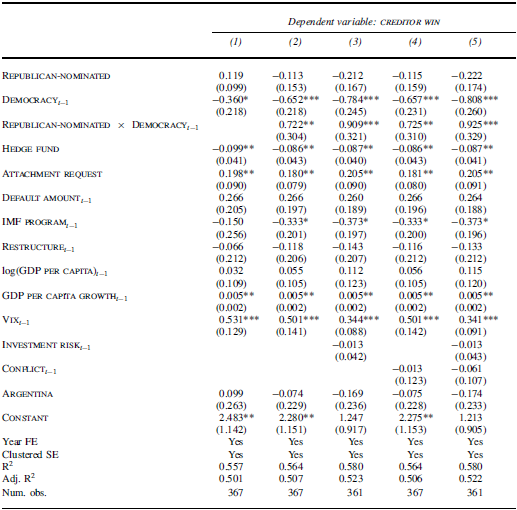
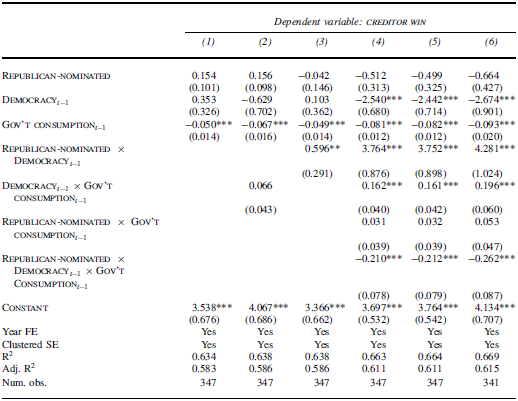
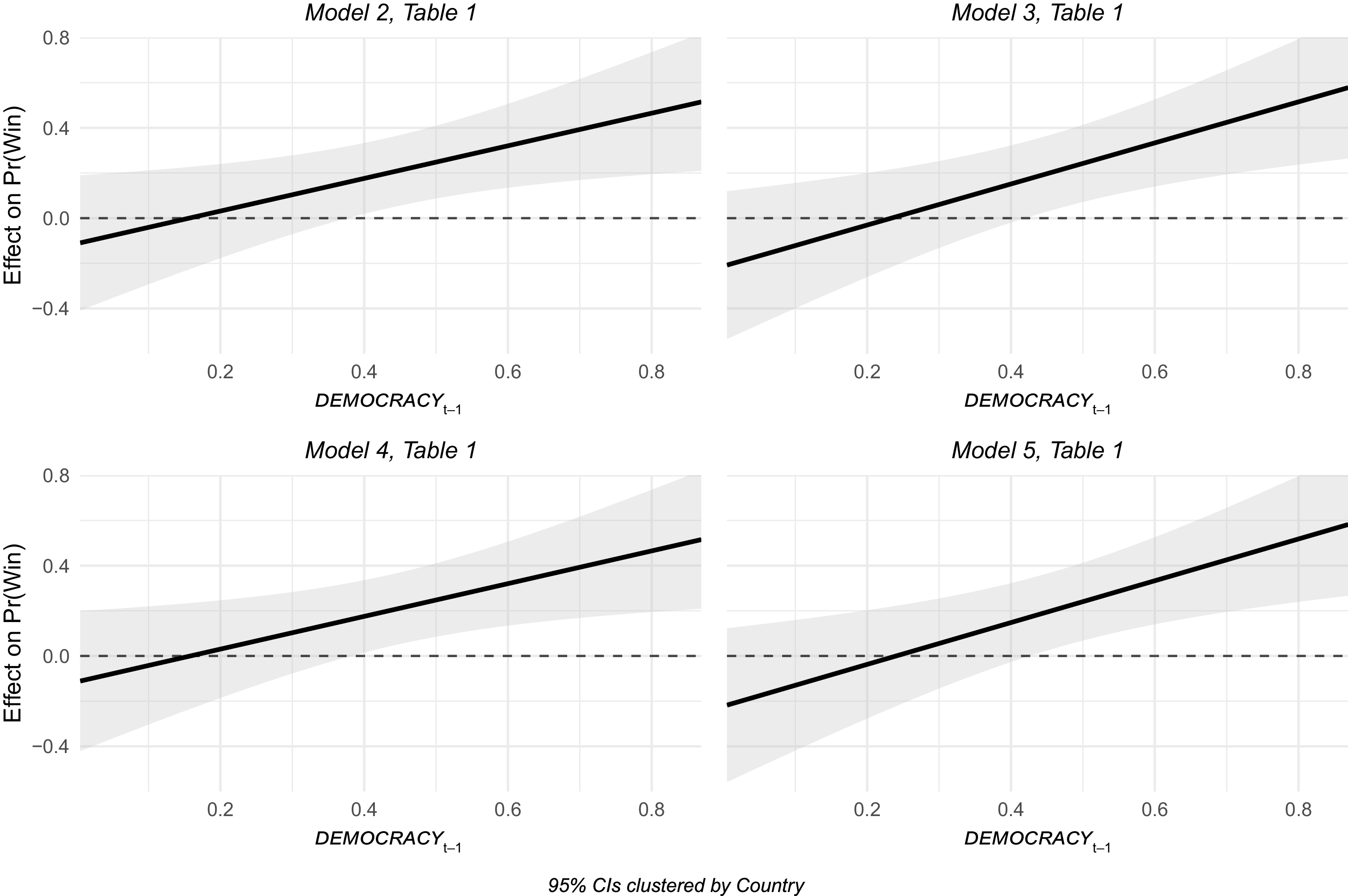
 t−1
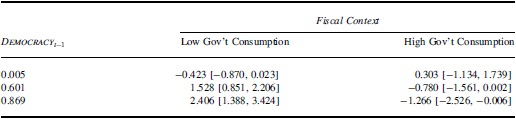
 t−1
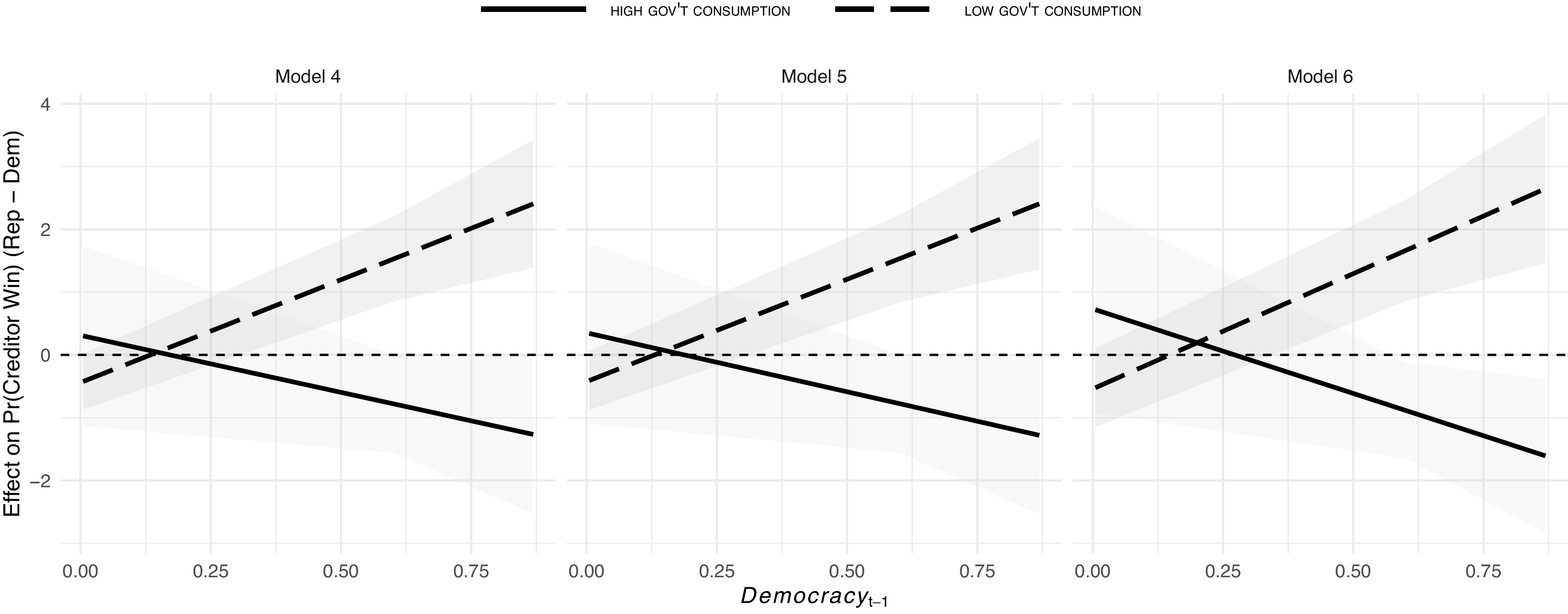
 t−1



