


Party identification is one of the most important concepts in political behavior. Voters who identify with a political party are more likely to be politically engaged and knowledgeable (Campbell et al., Reference Campbell, Converse, Miller and Stokes1960; Sniderman et al. Reference Sniderman, Brody and Tetlock1991; Green et al. Reference Green, Palmquist and Schickler2002). Party identification is also an important determinant of political participation (Verba et al. Reference Verba, Nie and Kim1978; Finkel and Opp Reference Finkel and Opp1991; Lewis-Beck et al. Reference Lewis-Beck, Jacoby, Norpoth and Weisberg2008; Huddy et al. 2014), and it contributes to the stability of the party system (Converse Reference Converse1969; Lijphart et al. Reference Lijphart, Rogowski, Kent Weaver and Bert1993; Dalton and Weldon Reference Dalton and Weldon2007).
It should not be surprising, then, to observe the pessimistic diagnoses about countries with low or declining levels of partisanship. In Latin America, for example, only about 25 percent of citizens identify with a political party, a decline from 35 percent a decade ago (Cohen et al. Reference Cohen, Lupu and Zechmeister2017, 25). These modest numbers have been explained as the result of the region’s economic policies and weak institutions (Hagopian Reference Hagopian, Agüero and Stark1998; Roberts 2004; Mainwaring and Zoco Reference Mainwaring and Zoco2007; Lupu 2016). Other works consider the low levels of partisanship a key input to understand the importance of candidates’ personal attributes, campaign dynamics, and clientelistic networks in the region (Main-waring and Scully Reference Mainwaring and Scully1995; Greene, 2011; Lupu et al. Reference Lupu, Oliveros, Schiumerini and Lupu2019). All these works share the assumption that voters with no partisan identification show more unstable attitudes and vulnerability to short-term forces when defining their vote choice.
This article explores an alternative, complementary perspective on voters’ partisan linkages in the region. We argue that the documented low levels of partisanship do not necessarily imply the irrelevance of party brands. In particular, we show that many voters who are hesitant to express their positive partisanship are able to identify a party they would never support. Consider, for example, the evidence from the 2019 LAPOP survey. By only including those individuals expressing a positive identification, the levels of partisan linkages in Chile and Ecuador are 18 percent and 22 percent, respectively.Footnote 1 Once we also consider the share of individuals who feel an aversion toward a party—referred to in the literature as negative partisanship—the levels of partisan linkages increase to 35 percent in Chile and 37 percent in Ecuador. Motivated by this overlooked type of partisan linkage, we explore how negative partisanship serves voters in the region as a reference point in the political arena.
We posit that negative partisanship is an important component of how voters relate to parties and the political system in Latin America. We do so in three ways. First, using an original conjoint experiment in Argentina and Mexico, we demonstrate that negative partisanship helps voters to distinguish themselves from nonpartisans. In fact, our results show that negative partisans are better able to do so than voters who have a positive partisanship. Our research design allows us to separate the effects driven by negative partisanship from other nonpolitical factors that might be correlated with it. Second, we take advantage of a panel survey from Brazil to compare the evolution of negative and positive partisanship at the individual level across time and show that negative partisanship is independent of its positive counterpart. Third, using data from the LAPOP survey in Chile and Ecuador, which includes a battery of questions measuring negative partisanship and political values, we distinguish negative partisanship from skeptical attitudes toward democracy.
This article relates to the emerging literature about negative partisanship (Caruana et al. Reference Caruana, Michael McGregor and Stephenson2015; Abramowitz and Webster Reference Abramowitz and Webster2016; Medeiros and Noël Reference Medeiros and Noël2014; Mayer Reference Mayer2017; Meléndez and Rovira Kaltwasser Reference Meléndez and Rovira Kaltwasser2017; Bankert, 2021). In particular, we build on Samuels and Zucco’s seminal study (2018) and provide new evidence about the relevance of this concept for distinguishing among different types of voters who do not necessarily feel close to any political party in Latin America. However, we depart from the aforementioned studies in two ways. First, we show the asymmetrical strength of positive and negative partisanship. In particular, our empirical analysis demonstrates that the affections of negative partisans are stronger predictors of perceived social similarity than those of positive partisans. Second, we emphasize that citizens’ negative affections toward parties do not necessarily extend to the entire political system. While negative partisans in Brazil are more skeptical about democracy (Samuels and Zucco Reference Samuels and Zucco2018), we argue that this is not necessarily the case for other countries in the region.
Negative Partisanship as a Way of Defining What Voters Are Not
Negative partisanship is generally defined as an adverse affection toward a political party. The works on this type of partisanship focus on the emotional component of this attitude, which is interpreted as a “negative evaluation” (Maggiotto and Piereson Reference Maggiotto and Piereson1977), an “affective repulsion” (Caruana et al. Reference Caruana, Michael McGregor and Stephenson2015), or the “repelling quality” of a party (Garry Reference Garry2007). While the original conception of party identification considered it as “positive or negative, of some degree of intensity” (Campbell et al. Reference Campbell, Converse, Miller and Stokes1960, 122), negative partisanship is frequently overlooked and relegated to be the flip side of its positive counterpart (Fiorina Reference Fiorina1981; Green and Citrin Reference Green and Citrin1994a).
This article considers negative partisanship as an example of disidentification, a concept coined in the literature on social and organizational psychology to explain how individuals can define themselves based on what they are not. Disidentification involves the explicit distancing of the individual from unwanted stereotypes or categorizations (Dukerich et al. Reference Dukerich, Kramer, McLean Parks, David and Paul1998, 245).Footnote 2 An important assumption of this concept is that ingroup preferences and outgroup prejudices are “two different constructs” (Brewer Reference Brewer, Paul and Van Lange2011, 83). This implies that disidentification with one group may occur independently of a change in the individual’s feeling of closeness to a different group (Elsbach Reference Elsbach, David and Paul1998). Such a distinction allows, for example, citizens to identify themselves as far away from the National Rifle Association even if they do not feel close to a specific gun control advocacy group (Elsbach and Bhattacharya Reference Elsbach and Bhattacharya2001).
The independence of positive and negative affections has been well documented in a variety of fields. Consumer research, for example, distinguishes between two types of behaviors: nonchoice and antichoice (Banister and Hogg Reference Banister and Hogg2001; Koenderink Reference Koenderink2014). While the former refers to the consumers’ disinterest, “antichoice” is their explicit decision not to purchase a product from a brand related to a stereotype they do not want to be associated with (Hogg and Banister Reference Banister and Hogg2001). Similarly, many accounts of humor and comedy avoid emphasizing a positive bias toward an ingroup and instead center on victimizing a character we do not identify with (Zillmann Reference Zillmann2000). Sports fans enjoy a victory for their team as much as a defeat of a hated rival (Wann et al. Reference Wann, Melnick, Russell and Pease2001; Cikara et al. Reference Cikara, Botvinich and Fiske2011), the latter being more relevant among fans of underperforming teams (Warner Reference Warner2009).
After having characterized negative partisanship, we can describe some of its properties as it relates to voters across the region. First of all, negative partisans will perceive themselves as socially distant from supporters of the party they dislike. This expectation is a corollary of optimal distinctiveness theory, which has demonstrated that individuals balance two powerful, opposing social motives: social inclusion and differentiation from others (Brewer Reference Brewer, Daniel, Susan and Gardner1998, 2011). A highly exclusive group satisfies individuals’ need for differentiation from others but activates their need for social inclusion. In contrast, and relevant to our argument, highly inclusive groups satisfy the need for assimilation but activate the need for differentiation from other group members. In the case of voters with no positive attachments to a party, they try to distinguish themselves from other “nonpartisans” by emphasizing their distance from the party they dislike the most. In other words, the heterogeneity of the nonpartisan category activates citizens’ need to distinguish themselves from other members by emphasizing the party they are the least likely to support.
Just as individuals classified as “nonreligious” often specify their opposition to a particular belief or religious organization (Baker and Smith Reference Baker and Smith2009), voters form a negative partisanship to distinguish themselves from other nonpartisans by building a negative attachment toward the party whose members are perceived as being very different. As a result, in their quest to distinguish themselves from other nonpartisans, negative partisans will perceive themselves as socially distant from supporters of the party they dislike.
Moreover, the sense of social distancing that negative partisanship produces should be stronger than the perceived resemblance that positive partisanship creates between supporters of the same party. Previous evidence demonstrates that negative emotions, interactions, and social perceptions tend to outweigh positive ones (Rozin and Royzman Reference Rozin and Royzman2001; Baumeister et al. Reference Baumeister, Bratslavsky, Finkenauer and Vohs2001; Vaish et al. Reference Vaish, Grossmann and Woodward2008). Such an asymmetry is also present among voters, who often privilege negative information and emotions over their positive counterparts (Kernell Reference Kernell1977; Lau Reference Lau1985; Goren Reference Goren2007; Soroka Reference Soroka2014). In particular, this negativity bias should be stronger among voters who do not feel close to any political party, for they will be unable to counteract their negative affections (Haselmayer et al. Reference Haselmayer, Hirsch and Jenny2020). Therefore, we expect that negative partisans’ perceived distance from a supporter of the party they dislike is larger than the perceived proximity between supporters of the same party.
We also expect that negative partisans do not require an ingroup reference to identify the party they do not belong to (Caruana et al. Reference Caruana, Michael McGregor and Stephenson2015; Samuels and Zucco Reference Samuels and Zucco2018). Previous works on political behavior suggest that positive and negative partisanships have different psychological origins and should be considered as different constructs (Maggiotto and Piereson Reference Maggiotto and Piereson1977; Green and Citrin Reference Green and Citrin1994b; Weisberg and Greene Reference Weisberg, Greene, Rabinowitz and Michael2003; Bankert Reference Bankert2021). Similarly, the literature on social and organizational psychology shows that outgroup antagonism is built independently of ingroup favoritism (Brewer Reference Brewer, Daniel, Susan and Gardner1998, 1999; Zhong et al. Reference Zhong, Phillips, Leonardelli and Galinsky2008). In our case, even when an individual cannot feel close to any party, that person may be able to notice which parties diverge the most from himself or herself. As a result, positive partisanship does not need to precede the individual’s negative identification with another party.
Furthermore, we distinguish negative partisanship from citizens’ perceptions about democracy. In particular, we claim that the negative affection toward a party does not extend to the entire political system. As discussed above, voters’ negative partisanship is part of their self-image, which centers on the rejection of the characteristics attached to an outgroup. If this is the case, negative party identification should be unrelated to individuals’ overall confidence in democracy as a political system. Recent works have already distinguished negative partisanship from other political attitudes, such as anti-establishment feelings (Meléndez and Rovira Kaltwasser Reference Meléndez and Rovira Kaltwasser2017) or political apathy by nonpartisans (Samuels and Zucco Reference Samuels and Zucco2018). We extend this proposition, arguing that negative partisanship differs from a general distrust or anger toward democracy and political disaffection more broadly. Therefore, citizens’ negative partisanship should not erode their attitudes toward democracy.
Empirical Analysis
While there is a growing literature on negative partisanship, the evidence on the topic is still scarce, particularly from cross-national comparative research. One of the main difficulties of studying negative partisanship using public opinion surveys is the lack of a consistent wording of survey questions that measure it. Some works identify negative partisans as those citizens rating a party on a feeling thermometer below an arbitrary threshold (Richardson Reference Richardson1991; Maggiotto and Piereson Reference Maggiotto and Piereson1977; Stanga and Sheffield Reference Stanga and Sheffield1987; Abramowitz and Webster Reference Abramowitz and Webster2016). Other works account for whether citizens can mention a party they “would never vote for” (Rose and Mishler Reference Rose and Mishler1998; Caruana et al. Reference Caruana, Michael McGregor and Stephenson2015; Meléndez and Rovira Kaltwasser Reference Meléndez and Rovira Kaltwasser2017).
Given the scant data on the topic in Latin America, we leverage different data sources and measures of negative partisanship. Such an approach follows a few of the seminal cross-national studies on the topic (Medeiros and Noël Reference Medeiros and Noël2014; Mayer Reference Mayer2017; Samuels and Zucco Reference Samuels and Zucco2018) and is validated by the high correlation between the affective and behavioral measurements for negative partisanship (Ridge Reference Ridge2020). On the other hand, we recognize the shortcomings that using these different measures impose on the generalizability of our findings. We explain the purposes of each data source below and provide a detailed description of each study and variable in the online appendix.
Negative Partisanship and Social (Dis)Similarity
We first examine the strength of negative partisanship as a source of social similarity. In particular, we want to determine its relative importance over positive partisanship. The main challenge to examine this empirically, however, is to separate the impact of negative partisanship from other nonpolitical factors that might be correlated with it (Shafranek Reference Shafranek2019). Without doing so, the results may overemphasize the importance of negative partisanship on social distancing.
To address this problem, we used an original conjoint experiment embedded in two online surveys in Argentina and Mexico during the summer of 2018.Footnote 3 Conjoint experiments are a common tool in marketing to examine the importance that different product attributes have on consumer preferences. The use of conjoint experiments in political science has been useful to disentangle preferences over policy alternatives (Bechtel et al. Reference Bechtel, Hainmueller and Margalit2017), immigration policies (Hainmueller and Hopkins Reference Hainmueller and Hopkins2015), and vote choice (Franchino and Zucchini Reference Franchino and Zucchini2015). To test our particular theoretical expectation, a conjoint experiment offers two main advantages. First, conjoints have been found to predict real-world behavior better than traditional survey experiments, such as vignettes (Hainmueller et al. Reference Hainmueller and Hopkins2015). Second, this design allows us to examine the relative influence that negative partisanship can have as a source of similarity to or difference from others with respect to positive partisanship (and other nonpolitical characteristics).
The first part of the survey included a battery of sociodemographic questions and inquired about the party voters identify with, as well as the political party they “would never vote for” (if any).Footnote 4 The estimated rates for positive and negative partisanship, respectively, were 31 percent and 86 percent in Argentina and 42 percent and 89 percent in Mexico.Footnote 5 For the conjoint part of the survey, respondents were presented with a pair of hypothetical citizens and asked to choose the one who “is more similar to you.”Footnote 6 We chose this paired profile with a forced-choice design, since it is known to outperform other designs (e.g., single-profile design) both in reflecting actual decisionmaking processes and in mirroring the substantive effects of attributes observed in the real world (Hainmueller et al. Reference Hainmueller and Hopkins2015).
The profiles of the hypothetical citizens included a random combination of political and nonpolitical attributes that could influence whether a respondent perceives others as more or less similar (e.g., Lazarsfeld et al. Reference Lazarsfeld, Berelson and Gaudent1944; Tajfel and Turner Reference Tajfel and Turner1979; Green et al. Reference Green, Palmquist and Schickler2002).Footnote 7 These attributes were party identification (the main treatment of interest); gender, occupation, religion, region of residence, ethnicity (for the Mexican survey); and perceived likeability.Footnote 8 Every respondent repeated this exercise for five hypothetical citizen pairs.Footnote 9
The goal of a conjoint analysis is to quantify the premium or the penalty that each attribute has for the individual to identify themself with the hypothetical subject. Specifically, we estimate the marginal effect of each attribute against a baseline, or the average marginal component effect (AMCE) (Hainmueller et al. Reference Hainmueller, Hopkins and Yamamoto2013). To obtain the AMCE, we regress the dependent variable—in this case, whether the hypothetical citizen was chosen as “more similar” to the respondent—on a battery of dummy variables, each of them representing a specific attribute level. The regression excludes the estimation of one level per attribute, which works as the baseline category. Since the attributes of each profile are fully randomized, the AMCE should be interpreted as the average difference in the probability that a profile is chosen when it includes the listed attribute value in comparison with the baseline attribute value.Footnote 10
We expect a negative and statistically significant value of the AMCE of the party attribute that matches the respondent’s negative partisanship. That is to say, respondents are less likely to find similarities with a hypothetical supporter of the party they dislike than with a hypothetical individual with no party identification (our baseline category). Moreover, the magnitude of the AMCE for negative partisanship should be larger than the one observed between a respondent and a hypothetical individual who supports the same party.
Figure 1 summarizes the AMCEs coming out of the different models for each subgroup of positive and negative identifiers of the three most popular parties in each country.Footnote 11 The plots show that for each subgroup of negative partisans, a hypothetical citizen’s identification with the party for which they have negative preferences decreases the probability that they consider that person more similar to themselves compared to a nonpartisan individual. In Argentina, the magnitude of the effect is about 0.30 across groups of negative partisans. In Mexico, the effect among groups of negative partisans varies from 0.20 for the PRI or PAN to about 0.30 for MORENA. Figure B8 in the appendix further suggests that for each subgroup of negative partisans, the magnitude of the effect for the partisan affiliation of the hypothetical individual exceeds the effect reported for any other attribute in the conjoint. In Argentina, for example, for all three groups of negative partisans, the effect of the party attribute that matches their negative preference is at least three times larger than the one corresponding to someone “hated by everyone.”
Negative and Positive Identifiers of Each Party, Argentina and Mexico
Notes: Average effects of the partisanship of a hypothetical citizen on the probability of considering him or her more similar to oneself. Each triangle indicates the party with which respondents negatively or positively identify. Each circle represents the estimated average marginal component effect (AMCE) of the level of the party attribute of that same party on a respondent’s probability of choosing a hypothetical individual containing that attribute level, compared with another individual with the baseline level for the same attribute. The horizontal bars represent 95 percent confidence intervals robust to clustering at the respondent level. The baseline level (“no party identification”) is not included in the figure. Models are run separately for each party’s negative and positive partisans.
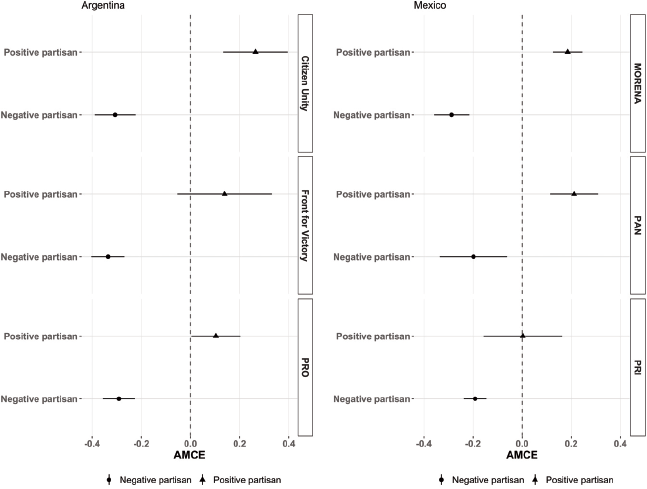
Furthermore, the negative AMCEs of each party level are higher than the positive AMCEs in both countries.Footnote 12 To illustrate this trend, consider the case of the PRI in Mexico in figure 1. PRI’s negative partisans are 20 percent less likely to find a resemblance between themselves and a PRI partisan in comparison to a nonpartisan individual. By contrast, among PRI’s positive partisans, there is no statistical difference between the perceived resemblance to a hypothetical PRI partisan and what is reported for a hypothetical nonpartisan. A similar situation appears for Argentina’s FPV. Changing the partisanship of a hypothetical individual from nonpartisan to FPV decreases the probability that they would choose the profile by 30 percent. By contrast, FPV’s positive partisans are equally likely to find a resemblance between themselves and another FPV supporter than between themselves and a nonpartisan. The exception to this trend is the effect of Mexico’s PAN, where their AMCEs denote similar magnitudes between negative and positive partisans (0.20).
An alternative explanation for our results might focus on the ideological location of the individuals rather than their dislike of certain parties. In other words, it could be the case that respondents view others as different from themselves because they are simply on the opposite side of the ideological or policy continuum rather than because of their partisanship. However, figures B9 and B10 in the appendix show that the results hold after grouping respondents according to their ideological position.Footnote 13
Also alternatively, our results could be driven by “hard-core respondents,” or those individuals having both positive and negative partisanship. If this is the case, our results could be masking an effect of positive partisanship: voters could be less likely to find similarities with a hypothetical supporter of a party not because they dislike this party but because they identify with another party whose supporters are very different from this hypothetical supporter. To verify this possibility, figure B11 in the appendix restricts the analysis to negative-only partisans. The results show that these respondents are still less likely to find a resemblance between themselves and supporters of the party they dislike. In Mexico, PRI has the highest effect among all party levels and attributes (0.15), followed by MORENA (0.10). In Argentina, FPV has the highest effect (0.21) among all party levels and attributes.
In sum, the findings of this conjoint study suggest that negative partisanship helps voters to distinguish themselves from other voters in the political arena to a greater extent than positive partisanship.
Negative Partisanship as an Independent Force
We now provide evidence against the conceptualization of negative partisanship as just the flip side of positive partisanship (Maggiotto and Piereson Reference Maggiotto and Piereson1977; Green and Citrin Reference Green and Citrin1994; Medeiros and Noël 2013). To demonstrate that both types of partisanship are independent of each other, we need to show that the probability of having a negative attachment is not preceded by a positive one. We do so using data from a four-wave panel survey in two Brazilian cities (Baker et al. Reference Baker and Barry Ames2016).Footnote 14 The advantage of using a panel for answering this question is that we can compare the evolution of partisanship at the individual level across time. This survey is, to the best of our knowledge, the only panel survey in Latin America that includes questions on both positive and negative partisanship.
We estimate the relationship between positive and negative partisanships using a cross-lagged structural equation to verify whether positive identification at t–1 precedes negative partisanship at t (Finkel Reference Finkel1995). In other words, having repeated answers for the same individuals over time allows us to check whether positive identification comes before a negative one for any given voter. This approach follows what Lupu (Reference Lupu, Ryan, Singer and Zechmeister2015) does with the same data to check the relationship between party identification and vote choice.
For this analysis, positive partisanship accounts for whether an individual reported being identified with a political party. To measure negative partisanship, we identify those responses on the parties’ feeling thermometers with a value equal to 0 on a 0–10 scale. This operationalization of negative partisanship is similar to that used in other works (Richardson Reference Richardson1991; Maggiotto and Piereson Reference Maggiotto and Piereson1977; Stanga and Sheffield Reference Stanga and Sheffield1987; Abramowitz and Webster Reference Abramowitz and Webster2016), and it is the only question offered by the survey to measure our main concept of interest. However, the main caveat of using this as a proxy for negative partisanship is the documented poor reliability of feeling thermometers when applied to ambiguous or not very salient issues (Lupton and Jacoby Reference Lupton and Jacoby2016). This concern is particularly relevant for studying partisanship in Latin America, where the thermometer answers for small or new parties are likely to contain a high level of noise. We also control for sociodemographic variables, such as the respondent’s education, residence, and race.Footnote 15
Table 1 shows the results of the structural equation model. The most relevant finding is that lagged positive partisanship does not increase the probability for the individual to report negative partisanship. If anything, the negative sign of this relationship suggests that having a positive party identification at time t-1 decreases the probability that an individual will report a negative one at time t. Table 1 also shows that individuals who have consistent party attachments and those with either positive or negative identification in the past are more likely to report the same type of identification in the present.
Positive and Negative Partisanship in Brazil
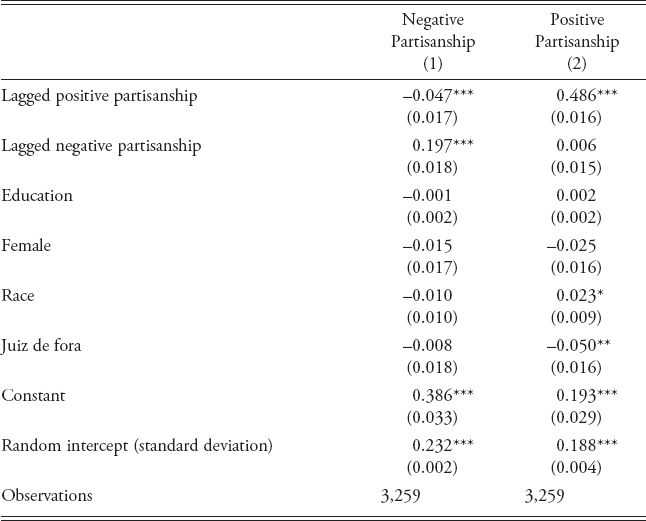
* p < 0.05, ** p < 0.01, *** p < 0.001
Standard errors in parentheses
Source: Brazil Two-City Panel Study, 2002–2006
Negative Partisanship and Antisystem Attitudes
Our last piece of evidence shows that negative partisanship is different from a general distrust of the democratic process or a symptom of political apathy. The conventional expectation is that negative partisans would be less committed to democracy than other voter groups. To verify this possibility, we used data from the last LAPOP wave in Chile and Ecuador, where the surveys included a measurement for negative partisanship (as shown in figure 1), along with a standard battery of questions to measure democratic values and attitudes.Footnote 16 These data allow us to check for negative partisanship’s relationship with respondents’ democratic values across two countries with very different levels of party system institutionalization and democratic performance (Mainwaring Reference Mainwaring2018).
Our dependent variable is Attitudes toward democracy, which measures respondents’ agreement (on a 1—7 scale) with the statement “Democracy may have problems, but it is better than any other form of government.” This question has been previously used to evaluate individuals’ preferences for a democratic regime despite its practical shortcomings (Rose and Mishler Reference Rose and Mishler1996; van Ham and Thomassen Reference Ham, van Ham, Aarts and Andeweg2017). If our expectation is correct, we should not find that negative partisanship negatively affects respondents’ attitudes toward democracy.
We openly acknowledge two potential shortcomings of this measurement. The first one is that since the question invites respondents to think about democracy in the abstract, it might overestimate their truthful level of support (Carlin and Singer Reference Carlin and Singer2011; Kiewet de Jonge Reference Kiewet de Jonge2016). While we have no theoretical reason to expect that negative partisans are more likely to overreport their support of democracy, we try to mitigate this concern with an alternative analysis that captures democratic attitudes in a less abstract way.
The second limitation is that the effect of negative partisanship on attitudes toward democracy might partially represent the overall effect generated by affective polarization, or citizens’ hostility toward opposite parties and their supporters, coupled with attachments to their own preferred party (Mason Reference Huddy, Mason and Aaroe2015; Gidron et al. Reference Gidron, Adams and Horne2020). The literature on US politics has shown how political polarization fuels distrust of the opposite party and its policies, diminishes trust in government, and ultimately erodes support for democracy (Hetherington and Rudolph Reference Hetherington and Rudolph2015; McCoy and Somer Reference McCoy2019). We verify this possibility by presenting additional models that sort respondents into the four groups defined by Samuels and Zucco (Reference Samuels and Zucco2018): hardcore, partisan-only, negative-only, and nonpartisans.
Our main independent variable is Negative partisanship, which indicates whether a respondent can mention a specific party he or she dislikes. The question available in the LAPOP survey is similar to previous efforts to operationalize negative partisanship (Samuels and Zucco 2018; Ridge 2020).Footnote 17 Our models include a battery of sociodemographic controls (education, age, gender), as well as other variables that might influence voters’ attitudes toward democracy and their party identification.
Following Samuels and Zucco (Reference Samuels and Zucco2018), we expect political interest to differ between negative partisans and nonpartisans, as well as to impact voters’ support for democracy (Booth and Seligson Reference Booth and Seligson2009). Political interest is a categorical variable that ranges from 1 to 4, for which higher values indicate a higher interest in politics. We also control for respondents’ Ideological extremism, as this has been found to affect voter partisanship across the region (Lupu 2015), as well as voter support for democracy (Dalton Reference Dalton2004; Seligson Reference Seligson2008). LAPOP asks respondents to place themselves on a ten-point, left-right scale. Ideological extremism is the absolute difference between a respondent’s ideology and the ideological center. The farther that respondents place themselves from the midpoint of the scale (5.5), the more extreme their ideology.
Table 2 shows the results of the analysis by country. In comparison to nonpartisan respondents, negative partisans seem to present similar levels of support for democracy. In addition, the results do not show any significant difference between nonpartisans and hardcore partisans (columns 2 and 4) in their levels of support for democracy. If anything, as column 2 shows, respondents in the negative only category appear to be more supportive of democracy, but the result is significant only at the 10 percent level. Altogether, these findings should ease concerns about our measure of negative partisanship capturing the effect of affective polarization on support for democracy. The results for our control variables follow the conventional expectation about support for democracy. That is, democracy is more likely to be supported among older, more educated, and informed respondents (Niemi and Junn Reference Niemi and Junn1998; Carlin Reference Carlin2006; Salinas and Booth Reference Salinas and Booth2011).
Attitudes Toward Democracy and Negative Partisanship
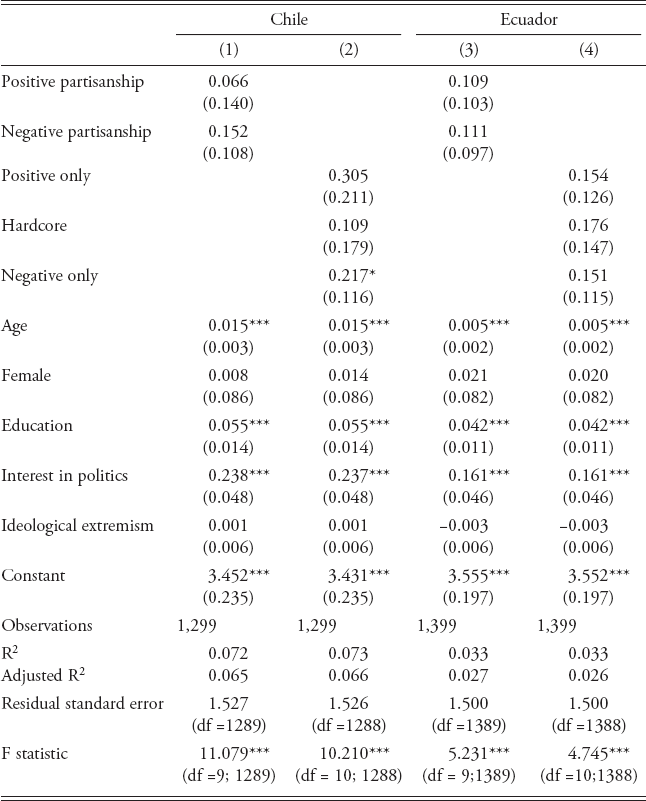
*p < 0.05, **p < 0.01, ***p < 0.001
Standard errors in parentheses
There is a possibility that this null effect is an artifact of lumping together different types of negative partisans. In particular, it could be the case that negative partisans of incumbent parties are less supportive of democracy than other negative partisans. To check for this possibility, table E1 in the online appendix separates negative partisans into two groups: those who have negative partisanship toward the incumbent party and those who have negative partisanship toward nonincumbent parties. The results show that neither type of negative partisan presents lower support for democracy than nonpartisans. In fact, Chilean negative partisans of incumbent parties present more positive attitudes toward democracy than nonpartisans.
Furthermore, to make sure that the null results are not a mere artifact of the survey question we used, table E2 in the appendix presents the analysis using as the dependent variable an additive index combining orientations to support a military coup, the dissolution of the Supreme Court of Justice, or the closure of the Legislative Assembly.Footnote 18 Answers were coded so that support for antidemocratic events received higher scores. The results again fail to show significant differences in democratic attitudes among partisan groups. If anything, and confirming the results from table 2, there seems to be a negative correlation between antidemocratic attitudes for negative partisans of the incumbent party in Chile. In sum, we have no strong evidence to support the claim that negative partisans and nonpartisans present significant differences in their support of democracy (Samuels and Zucco Reference Samuels and Zucco2018).
Conclusions
For Elie Wiesel (Reference Wiesel1986), indifference is not the middle ground between love and hate but the opposite of both of them. Echoing this idea, this article proposes that not having a positive identification does not necessarily mean political apathy or disengagement from the party system. Instead, voters can relate and identify themselves to parties by considering the party they dislike the most.
The findings of this study show that negative partisanship serves as an important notion for voters’ political identification. Our experimental evidence from Argentina and Mexico shows that this type of partisanship is stronger than its positive counterpart in helping voters distinguish themselves from others. Furthermore, the analysis from two other surveys demonstrates that negative identification is independent of positive partisanship and different from antisystem attitudes.
This study adds to the emerging literature on negative partisanship by providing more evidence about its relevance for voters. The findings suggest that links between parties and voters in Latin America are more extensive than has been traditionally assumed. By not taking into consideration the negative side of partisanship, we overlook an important way that parties are relevant in the minds of voters. In particular, this study advances the idea that the low rates of positive partisanship found in most countries do not indicate an unengaged and apathetic citizenry. This concept can thus condition the alleged vulnerability and malleability of voters in the region.
The findings of this article are limited to the attitudinal face of negative partisanship, complementing previous works suggesting their effect on vote choice and political participation (Medeiros and Noël Reference Medeiros and Noël2014; Abramowitz and Webster Reference Abramowitz and Webster2016; Mayer Reference Mayer2017; Samuels and Zucco Reference Samuels and Zucco2018). We suggest a few ways our analyses relate to important behavioral outcomes described in recent works. One of them has to do with the low levels of voters’ responsiveness to vote buying. As Greene (Reference Greene2021) shows, when parties distribute selective benefits, citizens consider not only the economic profits but also the symbolic value of exchanging their votes. In particular, targeted voters who initially dislike the clientelistic party ascribe malevolent motives to the benefit received and will be less likely to support it. This is a great example of how negative partisanship is important to distinguish opponents from indifferent voters and the different reactions that both groups can have.
A second implication has to do with voters’ behavior when facing electoral coalitions on the ballot. Previous work has shown that electoral coalitions dilute parties’ brands, weakening citizens’ partisan attachments (Lupu 2016). Our findings suggest that a citizen is less likely to support the party he or she identifies with if it is in a coalition with a party they negatively identify with. As Gandhi and Ong (2020) demonstrate, partisans are likely to abandon an electoral coalition if its victory might result in their least preferred policy outcome and if there is a closer alternative to their policy preferences outside the coalition. In other words, negative partisanship can help us evaluate the success of a coalition by taking into account partisans’ hostility toward other coalition members.
A third potential extension could explore the links between negative partisanship and satisfaction with democracy. While our research shows that negative partisans are as committed to democracy as other types of voters, they might be less satisfied with the way democracy functions where they live (Ridge Reference Ridge2020). This is an interesting tradeoff to explore in the future, and it opens the opportunity to test citizens’ commitment to democracy when they are not satisfied with the way it works in their country.
Finally, future research could also analyze other features of negative partisanship. A potential extension of this research agenda involves explaining interparty variation in negative identification. One way could involve understanding party-level characteristics, such as age, ideology, or incumbency status, that make parties more or less likely to have negative identifiers. A second potential extension could examine the strategies that political parties use to exploit negative partisanship against their rivals. This approach could be interesting in the context of multiparty competition and compulsory voting, such as in many Latin American countries. Future work could also dig deeper into the stability of negative partisanship over time, as well as changes or stability in the object of this negative affection. Our findings regarding the nonexistent relationship between support for democracy and negative partisanship in Chile and Ecuador could also be extended and explored in other Latin American countries.
Of course, one of the main limitations that scholars of the topic find nowadays is the lack of a systematic measurement for negative partisanship over time and across countries. We hope that this article serves as an invitation to pollsters and scholars to expand their measurements of partisan attitudes beyond positive identification.
Supporting Information
Additional supporting materials may be found with the online version of this article at the publisher’s website: Appendix.



