1. Korea's FTAs
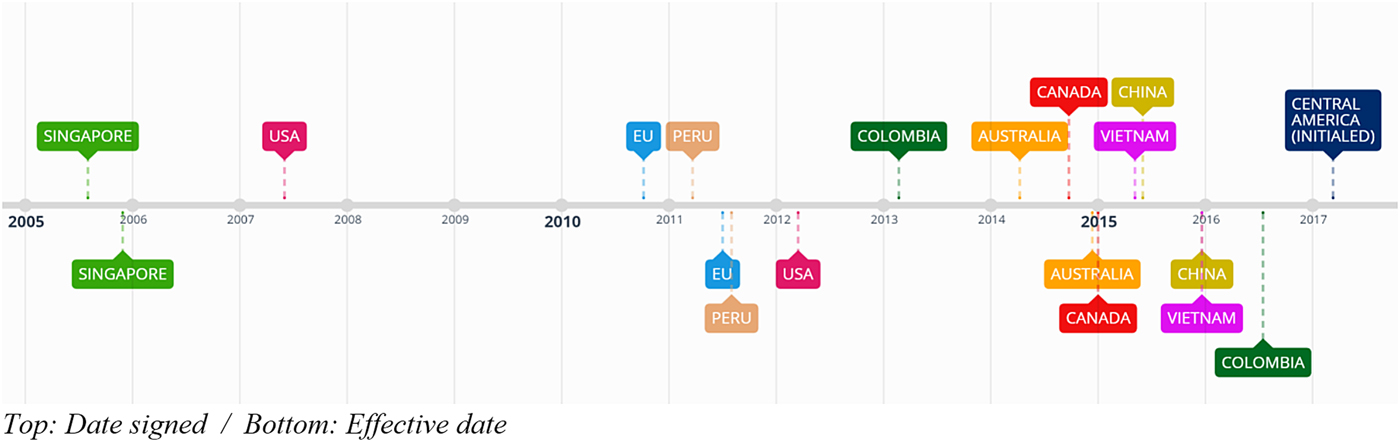
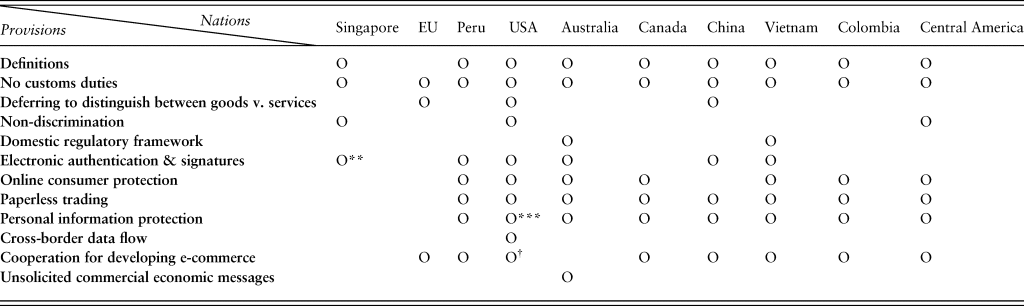
South Korea has signed 16 Free Trade Agreements (FTAs) as of December 2018, ten of which contain dedicated e-commerce chapters. As shown in the Figure 1 below, the content of each e-commerce chapter differs significantly because of parties’ varying interests and priorities, with no comprehensive WTO agreement currently in effect. The trend indicates that while Korea's e-commerce chapters cover many relevant issues, overall coverage has not increased over time. The US–Korea FTA, while widely known as containing one of the most ambitious e-commerce chapters, is in fact an older bilateral agreement signed by Korea. The three most recent FTAs that Korea is party to – signed with Vietnam, Colombia, and Central America – all provide less substantive coverage than the US–Korea FTA. In this respect, while substantive similarities and differences exist across the agreements, a pattern over time appears less discernible.
Timeline of Korea's FTAs with dedicated e-commerce chapters

Substantive coverage of Korea's e-commerce chapters*

Notes:
* The ten e-commerce chapters across South Korea's FTAs are: (i) Chapter 14, Singapore–Korea FTA; (ii) Chapter 7, EU–Korea FTA; (iii) Chapter 14, Peru–Korea FTA; (iv) Chapter 15, US–Korea FTA; (v) Chapter 15, Australia–Korea FTA; (vi) Chapter 13, Canada–Korea FTA; (vii) Chapter 13, China–Korea FTA; (viii) Chapter 10, Vietnam–Korea FTA; (ix) Chapter 12, Colombia–Korea FTA; and (x) Chapter 14, Central America–Korea FTA.
** The provisions are included in the FTA's Cooperation chapter. Art. 18.3, Singapore–Korea FTA.
*** The agreement does not include a dedicated section on personal information protection, but incorporates the principles into its section on cross-border data flow. Art. 15.8, US–Korea FTA.
† The agreement does not include a dedicated section on cooperation, but extensively recognizes the need for e-commerce development in a section on access to and use of the internet. Art. 15.7, US–Korea FTA.
2. Objectives and framer–follower distinction
To better capture the dynamics of bilateral negotiations in analyzing Korea's policy priorities, this paper introduces a new framework that classifies each party under either of the two categories: ‘framer’ or ‘follower’. The division between framer and follower exists if one of the parties in a bilateral negotiation has stronger incentives to include a particular provision in the final agreement. Here, the framer is the party pushing for inclusion, while the follower is the party conceding to the framer, often for strategic purposes.
The framer–follower distinction may indicate how much significance a country places on an issue. By observing how consistent a particular provision is across both party's FTA portfolio, we can guess – albeit imperfectly – who the framer is. In this light, a country's framer status indicates that it prioritized adding the provision to the final agreement. Its consistent presence throughout a country's FTA portfolio is thus a proof of priority, given the obvious pressures in a negotiation to bargain low-priority conditions away in exchange for more important ones.
This does not mean, however, that the distinction is applicable to all provisions. After all, there are possibly many cases where both parties actively support including a provision, making it difficult to identify who the framer versus the follower is. But the distinction acknowledges the realities of bilateral negotiations in which one party is often more willing than the other to push for particular provisions, while the final agreements do not readily reflect such originally skewed intentions. The initial disagreement between parties often results in a complete omission of the term, or an inclusion in exchange for some other consideration. Here, the framer–follower distinction captures the latter instances, providing a glimpse into (1) the e-commerce policy priorities of Korea and its counterparties in the context of bilateral agreements; and (2) the degree of consistency across Korea's e-commerce chapters. Ultimately, this paper aims to not only identify priorities and measure consistency, but also analyze their implications for Korea as an active participant of international trade.
3. Analysis
3.1 Classification of electronic transmission
A major debate in the WTO work program on e-commerce involves whether electronic transmissions involve a trade in goods or services. Korea has not specified its official position regarding this question, and its reservation is reflected in its e-commerce chapters. Korea is thus a follower in many provisions dealing with the definition of electronic transmission. Out of its ten relevant FTAs, six – signed with Singapore, Peru, the US, Canada, Colombia, and Central America – define or use the term ‘digital product’ to encompass electronic transmissions of various forms.Footnote 1 Among them, the US in particular has publicly specified its willingness to classify electronic transmissions under trade in goods. Therefore, the footnote in the Definitions of the US–Korea FTA, stating that the term ‘digital products should not be understood to reflect a Party's view on whether … electronic transmission should be categorized as trade in services or trade in goods’, is Korea's way of maintaining its reservations in this debate, despite having conceded to the US as to the actual wording of relevant provisions as a follower.Footnote 2 The fact that the US's FTAs are much more uniform in classifying electronic transmissions as ‘digital product’ lends more credibility to Korea's possible concession: all e-commerce chapters signed by the US specifically define or use the terminology in the body text.
In contrast, Korea's FTAs signed with the other four counterparties – the EU, Australia, China, and Vietnam – do not define or use the term ‘digital product’. Among them, the EU and China have supported electronic transmissions to be classified under trade in services, which explains why Korea, as in the US–Korea FTA, explicitly notes its reservations again through dedicated footnotes. Nonetheless, the usage of the terms ‘deliveries by electronic means’ in the EU–Korea FTA and ‘electronic transmissions’ in the China–Korea FTA reflects Korea's concession to the parties that have maintained stronger positions on this issue.Footnote 3
For Korea, such consecutive concessions have resulted in portfolio-wide inconsistencies as to the most basic term. Phrases including ‘digital products’,Footnote 4 ‘deliveries by electronic means’,Footnote 5 ‘electronic transmissions’,Footnote 6 ‘products delivered electronically’Footnote 7 are treated somewhat synonymously, while the use of ‘digital products’ differs in its scope across agreements. The FTAs signed with Singapore, the US, and Colombia, for example, specify that the definition is unaffected by whether the content is fixed on a carrier medium or transmitted electronically: an elaboration absent in other agreements that define ‘digital products’. Furthermore, Korea's FTAs signed with the US and Canada are the only ones limiting ‘digital products’ to content produced for commercial sale or distribution. The Colombia–Korea FTA, uniquely, does not define the term in its Definitions but nonetheless uses the word ‘product’ in the body text.
3.2 Non-discrimination
Only three of Korea's FTAs – signed with Singapore, the US, and Central America – contain non-discrimination provisions. Here, Korea was clearly reluctant to add non-discrimination principles to its e-commerce chapters, not only in light of the provisions' low representation across agreements but also because of Korea's role as a follower, apparent in the few FTAs that exceptionally contain the provisions. Singapore, for example, has non-discrimination principles enumerated in most of its other e-commerce chapters, including in FTAs signed with Turkey, Australia, Panama, and Costa Rica.Footnote 8 The US is similar to Singapore in this respect, with almost all of its e-commerce chapters containing non-discrimination principles.Footnote 9 This indicates Korea's relative reluctance concerning the inclusion of these provisions, on which its relevant domestic policies can shed more light. For many years, multiple government entities in Korea including the Ministry of Culture, Sports and Tourism (MCST), the Korea Communications Commission (KCC), and the Ministry of Trade, Industry and Energy (MTIE) have subsidized industries such as filming, broadcasting, music, software, and gaming that are all heavily dependent on e-commerce.Footnote 10 The country, therefore, has strong incentives to minimize its exposure to national treatment restrictions in order to maintain these programs.
Korea's such dilemma is also reflected in the US–Korea FTA, in which the national treatment provisions on e-commerce uniquely treat ‘subsidies or grants … including government-supported loans, guarantees, and insurance’ and ‘services supplied in the exercise of governmental authority’ as exceptions.Footnote 11 This suggests that Korea, as a follower in this case, catered to the US's preference by adding non-discrimination principles, but also successfully carved out exceptions to protect some of its interests.
Because the non-discrimination provisions in Korea's FTAs represent tailored concessions to the respective counterparties, their wording and scope are not uniform. The US–Korea FTA, for example, lays out both national treatment and MFN principles, with exceptions on investment, financial services, and government subsidies. The FTAs signed with Singapore and Central America, in contrast, include only national treatment principles with no exceptions carved out.
3.3 Domestic regulatory framework
In the context of domestic regulatory frameworks, it would be an exaggeration to perceive Korea as a framer. Only two nations agreed to include a relevant provision in their FTAs with Korea,Footnote 12 and it is also likely that they were the framers in these cases. First, Australia clearly was the framer of this provision in its agreement with Korea, as the country included nearly identical terms in eight of its other FTAs. The provisions in its Korea and China FTAs are also uniquely ‘worded in slightly firmer terms’ and take into account ‘other international standards, guidelines, and recommendations’ in addition to the UNCITRAL Model Law on Electronic Commerce.Footnote 13
The relevant provision in the Vietnam–Korea FTA – signed in 2015 – is identical to that of the TPP, to which Vietnam was party. Although it is difficult to pinpoint which of the two agreements first included this provision as their negotiating periods roughly coincide, it is clear that Vietnam, not Korea, framed this provision. The possibility of Korea as the framer can also be dismissed on grounds that its FTAs signed shortly before and after Vietnam – including those with Canada, China, Colombia, and Central America – all lack this provision.
3.4 Electronic authentication and signature
In Korea's e-commerce chapters, electronic authentication is another realm where discrepancy across provisions is notably large. Comparisons between Korea's and its counterparties’ FTA portfolios reveal that Korea considers this provision as a potential bargaining chip, sufficiently malleable to suit the counterparties’ preferences.
First, there are cases in which Korea clearly appears to have conceded to its counterparty. In the China–Korea FTA, the provision binding parties to ‘encourage the use of digital certificates in the business sector’Footnote 14 reappears in the subsequent China–Australia FTA, China's most recent FTA that was signed shortly after the former. Considering that neither Korea nor Australia recycled this phrase in any of its following RTAs, it appears that China framed this particular provision. Interestingly, the China–Korea FTA, among all RTAs, incorporates the largest number of specific provisions on electronic authentication,Footnote 15 some of which are put in uniquely strict terms. China, for example, even requires that authentication services ‘must be provided by a legally established authenticated service provider which shall be approved by an authority accredited in accordance with its domestic law’.Footnote 16 This is in contrast to Korea's relatively lax standards, which stipulate that authentication methods ‘may be required [to meet] certain performance standards or be certified by an authority accredited in accordance with [Korea's] domestic law’.Footnote 17 In this respect, the provision altogether suggests that China was seeking more specific requirements for electronic authentication, to which Korea likely conceded.
Uniquely in the US–Korea FTA, parties can have authentication methods meet ‘certain performance standards’ or be certified by ‘an authority accredited in accordance with [each party's] law’, provided the requirement (a) serves a legitimate government objective, and (b) is substantially related to achieving that objective. The fact that: (1) this agreement is the most recent bilateral FTA signed by the US, (2) Korea did not reuse this provision in any of its three subsequent FTAs that contain a dedicated section on electronic authentication,Footnote 18 and (3) the provision's two prongs are very similar to those that describe the US standard of judicial review for questions of constitutionality,Footnote 19 all imply that the US, not Korea, was the framer of this particular provision.
The Peru–Korea FTA is also unique because it contains the only existing provision among all RTAs that specifically commits parties to establish ‘cooperation mechanisms between the national accreditation and digital certification authorities for electronic transactions’.Footnote 20 Because it was never duplicated in other RTAs, identifying the framer is difficult, but the FTA as a whole and its negotiating history imply that both parties actively partook in giving birth to this provision. Negotiation history suggests that it was Peru's president who first suggested the idea of a FTA,Footnote 21 considering Korea's track record of actively establishing cooperation mechanisms with other Latin American countries, such as Brazil and Colombia, across various industries.Footnote 22 On the other hand, Korea had a strong interest in signing an FTA to secure favorable deals for Peru's natural resources and market access by Korean companies in Latin America.Footnote 23 In this light, this term on electronic authentication, along with other cooperation provisions that the Peru–Korea FTA emphasizes, was most likely included to stipulate an element of the multi-industry assistance package that Korea agreed to provide in exchange for its gains. Indeed, the Korean government in 2011 – concurrently with the FTA's inception – designated Peru as one of its Strategic Development Partner Countries (SDPCs), a small group of nations qualified to receive policy consultation through Korea's Knowledge Sharing Program.Footnote 24 One of the program's focuses was its extensive assistance with the Peruvian Digital Agenda and the Plan Nacional de Gobierno Electronico 2013–2017, state initiatives that sought to establish Peru's e-government infrastructure, including a comprehensive cybersecurity and data protection regime.Footnote 25
Despite the inconsistencies, common elements across Korea’ FTAs do exist. Although the degree of binding force arguably varies, all of Korea's agreements dealing with electronic authentication and signature – except that with the US – specify mutual recognition of electronic signatures or certificates as a desirable goal.Footnote 26 Although this might indicate Korea's emphasis on such requirement, it could also be interpreted as the parties’ following a global trend for RTAs – after all, such provision on mutual recognition is the third most common term enshrined in e-commerce chapters.Footnote 27 All FTAs except one also touch on the parties’ mutual determination of appropriate electronic signature and authentication methods.Footnote 28 Likewise, this provision is also common in RTAs,Footnote 29 making it difficult to conclude that Korea framed or even prioritized it during negotiations.
Korea's apparent flexibility towards electronic authentication and signature can be explained by the country's broad definition of these terms and lack of domestic restrictions on possible methods.Footnote 30 Because the South Korean digital market is relatively deregulated in this realm, showing flexibility in allowing for optimization – whether it be encouraging the interoperability of digital certificatesFootnote 31 or establishing cooperation mechanisms – and conceding to the counterparts’ preferences may have been strategically sound when it came to reaping benefits in other areas of trade.
3.5 Online consumer protection
On the consumer protection front, the relevant provisions in Korea's FTAs tend to be more consistent. The clause recognizing the importance of protection is the most common, included in all but one FTA with a section on consumer protection.Footnote 32 Although this is also the most commonly used clause in RTAs dealing with the issue,Footnote 33 no counterparty of Korea maintains this level of consistency when it comes to consumer protection. From its FTA with Peru and onwards, Korea has generally maintained similar provisions in Consumer Protection sections, with the exception of China–Korea FTA. There, Korea may have conceded to China's preferences on consumer protection.
Notable in this realm is Korea's apparent unwillingness to include a provision on exchanging information and experience in consumer protection, except in special circumstances. Out of Korea's seven FTAs that discuss consumer protection, only two – those with Peru and Canada – include the provision on information exchange. Both instances are unusual: the Peru–Korea FTA, as in the case of electronic authentication, is loaded with cooperation-related clauses because it was purposefully created, in part, for Korea to provide Peru with information and know-how about trade liberalization. Though it is tough to identify the framer, the provision on information sharing could be deemed an element of the broader assistance package that Korea promised to provide in exchange for other trade benefits. In the Australia–Korea FTA, the framer is clearly Australia, as the country included identical, or nearly identical, provisions in all four of the bilateral FTAs prior to its deal with Korea.Footnote 34 Such consistency indicates that Australia highly prioritized the provision. Apart from these two cases, all other Korean FTAs lack a provision on information exchange, in contrast with the global trend whereby the clause, along with that stressing the importance of protection, has been most frequently enshrined in all RTAs.Footnote 35 On its face, this omission suggests that Korea – despite the flexibility it showed with Peru and Canada – may have incentives not to include the provision in a FTA if the situation permits.
Though it is not dispositive, Korea's consumer protection landscape in electronic commerce can provide an explanation for the country's disincentive. The area has been ‘one of the top priorities’ in e-commerce legislation in Korea, thus resulting in robust protections for consumers engaged in digital transactions.Footnote 36 While the initial Framework Act on Electronic Commerce (ECA) in 1999 laid the groundwork, the Act on Consumer Protection in Electronic Commerce (E-Commerce Act) of 2002 is what distinguished Korea from other countries, providing ‘some of the best – if not the best – consumer protections for e-commerce transactions in the world’.Footnote 37 With a wide range of topics, including the duty to preserve transaction records, electronic error prevention, cooling-off period for e-consumers, and online payment insurance and guaranteed cover by the E-Commerce Act,Footnote 38 Korea arguably does not have much to gain by sharing information specifically pertaining to e-consumer protection. By this logic, the flexibility Korea displayed with Peru and Canada is possibly a sign of its use as a bargaining chip, in exchange for other economic benefits that Korea could potentially gain. The dearth of information exchange provisions thus implies the country's limited incentive to share know-how on consumer protection, doing so only in special circumstances.
3.6 Paperless trading
Paperless trading is a type of provision with the highest level of consistency across Korea's FTAs. Except for an additional provision in each of Korea's agreements with Australia and Vietnam, all eight FTAs that deal with paperless trading include clauses on publicizing trade administration documentsFootnote 39 and treating their electronic and paper versions as legal equivalents.Footnote 40 In line with the global trend, these two provisions are also the most commonly used in RTAs. An analysis of all counterparties’ FTA portfolios further reveals that Korea is the only country that maintains such a high level of consistency across its paperless trading sections, indicating that it was likely the framer of these two provisions during most, if not all, bilateral negotiations. Both of the additional provisions in Korea's FTAs with AustraliaFootnote 41 and VietnamFootnote 42 have the same origin: the ASEAN–Australia–New Zealand FTA (AANZFTA), signed before the two FTAs and to which both Australia and Vietnam were parties. This suggests that both Australia and Vietnam were framers of the respective addition to their FTAs with Korea. Moreover, Australia reused the same additional provision in its subsequent FTA with China, while Korea did not recycle the provision in any of its five subsequent FTAs: a further indication that it was likely Australia, not Korea, that prioritized the provision's inclusion during negotiations.
In light of the rapid development of paperless trading in Korea in recent years, the high number of paperless-trading-related provisions in the country's FTAs suggests that Korea highly prioritizes such clauses. Indeed, inserting them into trade agreements can further accelerate the society's transition to paperless trading,Footnote 43 complementing the ongoing development that domestic regulations already kick-started. Under the Framework Act on Electronic Commerce, first enacted in 1999,Footnote 44 electronic documents of any kind are by default legal equivalents of their paper versions, unless specified otherwise in a governing contract or law. The Korean government has also been encouraging the use of electronic documents for sustainability purposes since 2010, so the relevant FTA provisions lend additional support to the existing efforts.
3.7 Personal information protection
The substance of data protection terms is quite consistent across Korea's FTAs. Common provisions include parties’ recognizing the benefits of adopting or maintaining rules protecting personal data and the common goal to consider standards and criteria used by international organizations when developing protection measures. Because consumer protection is substantially related to personal data protection, all but one of Korea's FTAs that discuss the former also deal with the latter. However, the clauses regarding personal data are framed in much firmer terms than Korea's sections on online consumer protection. For the latter, whereas only the Australia–Korea FTA stresses its importance by stipulating that parties ‘shall adopt’ – not ‘endeavor to adopt’ – measures to protect consumers,Footnote 45 five FTAs employ the firmer term when dealing with personal data protection.Footnote 46
Although a provision on adopting and maintaining measures is very common in RTAs that cover personal information protection, the firmer terms exist almost exclusively in FTAs that Korea is party to.Footnote 47 In this respect, Korea could be deemed a framer of such language in its agreements with Peru, Canada, China, and Colombia, as the four countries do not use similarly firm language in their FTAs with other countries. But Australia is an exception, as the country uses this language in its other FTAs by specifying that ‘the parties shall consider or take into account the international standards and criteria of relevant international organizations in the development of personal data protection standards’.Footnote 48 Whether Korea was a framer of the firmer language in the Australia–Korea FTA, therefore, is less obvious: there may have been a meeting of the minds between the two countries to promote well-established data protection mechanisms.
Overall, Korea's emphasis on personal data protection is plausible given its experience with major breaches within the past decade. In 2011, personal information of more than half of Korea's population was exposed through the Korean social network Cyworld, followed shortly after by another breach from a telecom company affecting nearly a fifth of the population. The most recent breach came from the Korea Credit Bureau in 2014, during which almost half of all Koreans’ credit card details were stolen and sold to marketing firms.Footnote 49
3.8 Cooperation
Almost all of Korea's FTAs except two (Singapore and Australia) dedicate a section laying out cooperation in the e-commerce sector. These sections vary widely across Korea's FTAs, comparisons of which reveal largely two functions: (1) to address other issues without a dedicated section in their respective e-commerce chapters; and (2) to stress the significance of an issue for further elaboration. Because of the complementary role served by the Cooperation sections, the substantive consistency across agreements as well as the framer–follower framework are less applicable than for the issues above.
Generally, the less comprehensive e-commerce chapters tend to use this section to address issues omitted in the rest of the agreement. The EU–Korea FTA, which does not contain sections dedicated to electronic authentication, consumer protection, paperless trading, and unsolicited commercial economic messages, instead mentions these in its Cooperation section as issues on which further discussion is necessary. Other Korean FTAs, including those with Peru, Canada, Colombia, and Central America, similarly utilize the section as a complementary, albeit less comprehensive, gap-filler. The Peru and Canada agreements, inter alia, stress the importance of cross-border data flow as ‘an essential element in fostering a vibrant environment for electronic commerce’.Footnote 50 The Colombia and Central America FTAs note the treatment of unsolicited commercial electronic messages as a desirable cooperation mechanism that parties should pursue.Footnote 51 In this light, the brief mentioning of issues can also provide forward guidance as to what the parties may be open to discussing in the future. It may also indicate what the parties at the time disagreed on, in light of the fact that they never made it into their respective e-commerce chapters as dedicated sections.
Another function that Korea's Cooperation sections serve is elaborating on a particular issue through additional provisions: a pattern apparent among the FTAs with more comprehensive e-commerce chapters. The US–Korea FTA, for example, focuses on the issue of access to and use of the internet and is the only RTA to do so in its e-commerce chapter;Footnote 52 the agreement provides that consumers should be able to freely use digital products, services, and run applications, as well as have ‘the benefit of competition among network providers, application and service providers, and content providers’.Footnote 53 The China–Korea FTA highlights a different goal: cooperation between the two countries through various channels and means. Its Cooperation section mainly stipulates information and experience sharing, collaborative research and training activities, business exchanges, and joint e-commerce projects as possibilities. Moreover, the agreement uniquely stresses ‘active participation in regional and multilateral fora’ – a common provision among all RTAs – by framing it in firmer terms.Footnote 54
4. Implications
A comprehensive analysis of Korea's e-commerce chapters reveals that while provisions on consumer protection, paperless trading, and personal information protection show relatively high levels of substantive consistency, others on non-discrimination, defining ‘electronic transmissions’, domestic regulatory framework, and electronic authentication do not. More importantly, a comparison of the provisions in a larger context – across both Korea's and the counterparties’ FTA portfolios – suggests that the less consistent terms represent instances in which Korea acted as a follower, conceding to its counterparties who likely placed more emphasis on the particular issue. On the other hand, the more consistent sections touch on issues that Korea has historical or domestic policy-related reasons to prioritize. This leads to a possible generalization that at least in Korea's case, the more consistent a particular set of provisions is portfolio-wide, the more likely it was for Korea to have acted as a framer and to have pushed the inclusion of its preferred terms. But despite some degree of consistency, the e-commerce chapters of Korea's FTAs as a whole remain quite inconsistent, largely because the country more often acted as a follower than a framer during negotiations.
The lack of consistency across Korea's FTA portfolio can negatively impact Korea's interests in several ways. First, from a macroeconomic perspective, the growing complexity of e-commerce rules results in increased transaction costs, as any entity analyzing, utilizing, or enforcing such rules would face bigger administrative burdens. Second, the inconsistency may compromise Korea's bargaining power in future multilateral negotiations, as potential counterparties could develop expectations that the country will likely concede when it is sufficiently pressured or confronted. This can lead to even greater inconsistencies that may amplify other negative impacts on Korea's interests. Third, the continuous concessions in negotiations could undermine Korea's domestic sovereignty and shrink the room for adaptive legislations in the ever-developing realm of e-commerce. Evidenced by the national treatment carve-outs arranged for Korea's government subsidies in the US–Korea FTA, inconsistency may cause more frequent conflicts of interest between bilateral provisions and domestic policies. A possible consequence is the FTA rules clashing with new domestic policies enacted to address rapid developments in the e-commerce domain. Fourth, the substantive inconsistency across e-commerce chapters offers no sign of predictability whatsoever to international businesses, Korea's trade partners, and academics who would study the relevant rules. The lack of forward guidance for businesses, for example, may have a chilling effect on future investments in the Korean e-commerce space. Moreover, the inconsistency makes it more difficult for academics to isolate the effects of e-commerce provisions on the economy and provide useful insights into multilateral rulemaking in international trade.
For Korea to take full advantage of its e-commerce chapters, developing a substantive consistency across its FTAs is paramount. Two of Korea's FTA counterparties – the US and Australia – have been more successful in achieving this goal, thereby affording predictability to those analyzing and enforcing the rules as well as flexibility for their policymakers in both domestic and international arenas. Therefore, it appears desirable that Korea take stronger positions with regards to the goods versus services debate and other e-commerce issues on which the country has generally conceded during negotiations thus far.