During the last decade, conflicts between religious beliefs and democracy have attracted attention throughout the world. Confronted by religious protests after the Cold War, Samuel Huntington (Reference Huntington1996) assumes that the “clash of civilizations” between Christianity and Islam threatens to weaken democratic institutions. From his perspective, whereas contemporary Christianity supports the independence of religious institutions from the nation-state, Arab governments and mosques reveal a greater fusion of power. According to him, “The underlying problem for the West is not Islamic fundamentalism. It is Islam, a different civilization whose people are convinced of the superiority of their culture and are obsessed with the inferiority of their power” (Huntington Reference Huntington1996, 217). Yet Huntington underestimates both the degree of diversity within Islamic groups and the divergent conditions within different nations. Despite the religious violence among the Hausa-Fulani Muslim states of northern Nigeria, in Western Nigeria Yoruba Muslims, and Christians live under greater peace. Throughout Europe, Asia, and Africa, pluralist Muslims often contend with more orthodox Muslims committed to “one true” Islam. Among Middle Easterners, nationalism, Pan-Arabism, and Islam compete for supremacy as the dominant collective identity. Huntington also downplays the political conflicts of economic interests that split the Western industrialized world from the more underdeveloped Islamic societies — conflicts that result from the dysfunctional aspects of colonial modernization (Anderson Reference Anderson2004; Bottici and Challand Reference Bottici and Challand2006; Sen Reference Sen2006; Stepan Reference Stepan2000).
Ronald Inglehart and his associates have conducted the most extensive survey research on the way that religious cultures affect democratic political attitudes. Using the 1995–2001 World Values Survey and comparing several cultural regions, they found that Muslims and members from other religions give about the same support for democratic ideals and leadership. Yet Muslims show weaker enthusiasm for contemporary social issues such as gender equality, homosexual rights, abortion, and divorce. Greater differences among religions emerged for effective democratic performance, which combined Freedom House rankings of civil liberties with World Bank measures of corruption. On these indicators, Muslim societies, along with Vietnam, China, Russia, and the Ukraine, scored lower than nearly all West European countries (Inglehart and Welzel Reference Inglehart and Welzel2005, 245–284; Norris and Inglehart Reference Norris and Inglehart2004, 133–156).
To explore the links among spiritual values, religious practices, economic development, and democratic attitudes, this article uses the 1999–2001 World Values Survey/European Values Survey to investigate twenty societies in North America, South America, Europe, Asia, and Africa (see Inglehart et al. Reference Inglehart, Basáñez, Díez-Medrano, Halman and Luijkx2004). These include ten industrialized, fairly democratic nations — Austria, Canada, Denmark, France, Germany, Greece, Ireland, Italy, the Netherlands, and the United States. The developing societies comprise Argentina, Chile, Indonesia, Nigeria, Peru, the Philippines, South Africa, Tanzania, Turkey, and Vietnam. These countries are included in the analyses because as a group they have extensive religious and political diversity and because they contain the most inclusive survey data on the key variables examined in this study. Hence, I can compare not only regional differences between the industrialized and developing societies but also the individual attitudes held by Muslims, Catholics, Greek Orthodox, Protestants, and nonaffiliates.
THEORETICAL ASSUMPTIONS AND HYPOTHESES
What theoretical assumptions best explain support for democracy among these twenty nations? Individuals' attitudes are shaped and influenced by the macro historical context. According to Ronald Inglehart's “revised theory of modernization,” high socioeconomic development increases self-expression values such as individual autonomy, free choice, tolerance, popular participation, mutual trust, life satisfaction, and a skeptical view of authority. Then, these self-expression values reinforce the structural movement toward effective democratic institutions (Baker Reference Baker2005, 64–109; Inglehart and Welzel Reference Inglehart and Welzel2005, 15–37, 153–172, 230–271; Norris and Inglehart Reference Norris and Inglehart2004, 142–155; Welzel and Inglehart Reference Welzel and Inglehart2005). These values most widely prevail in modernized societies that show the strongest support for democracy.Footnote 1
At the micro individual level, spiritual values allegedly exert the greatest effect on political attitudes when they shape people's interpretation of the world, their evaluation of conditions, and their actions, such as church attendance. If people perceive beneficial outcomes of democratic processes, favorably evaluate their procedures, and actively participate in politics to strengthen democratic institutions, then these spiritual values will raise support for democratic attitudes (Bottici and Challand Reference Bottici and Challand2006, 322). Religious beliefs may bring major benefits to the individual. They can provide meaning to an ambiguous world, cement social solidarity, and defend the self against threats. If frequent church attendees attribute meaning to hostile, punitive forces, base their social solidarity on exclusivist ties with a homogeneous religious institution, and express highly defensive outlooks toward stigmatized groups, then prodemocratic attitudes seem less likely (Karner and Alridge Reference Karner and Aldridge2004).
Deriving specific hypotheses from these general theoretical assumptions, I will test the plausibility of the following hypotheses. First, religious commitments will reinforce democratic attitudes if individuals attend religious institutions that take a nondogmatic outlook toward theological beliefs and assume that several agencies, not just religious institutions, can effectively deal with people's problems. However, when individuals actively participate in churches or mosques that affirm a dogmatic theological orthodoxy and believe that only religious institutions can deal with all human problems, the prospects for prodemocratic attitudes grow less likely (Katnik Reference Katnik2002; McClosky and Brill Reference McClosky and Brill1983, 403–414; McClosky and Zaller Reference McClosky and Zaller1984, 25–36; Moore and Ovadia Reference Moore and Ovadia2006; Seligman Reference Seligman1999; Weber Reference Weber2003).
Second, culturally modern values linked to tolerance, postmaterialism, and parental stress on children's autonomy reinforce democratic support. If individuals feel highly defensive toward threats from out-groups, they will oppose democratic procedures. Both in the United States and overseas, fear of threats magnifies the perceived dangers from marginalized groups. Tolerance of intolerable groups seems irrational (Cohrs et al. Reference Cohrs, Moschner, Maes and Kielmann2005; Marcus et al. Reference Marcus, Sullivan, Theiss-Morse and Wood1995; Stenner Reference Stenner2005; Weldon Reference Weldon2006). Whereas “materialists” give higher precedence to order and economic security, “postmaterialists” uphold free speech and widespread popular political participation — values linked to effective democracies (Inglehart Reference Inglehart1997, 108–157, 389). As the research of George Lakoff (Reference Lakoff2002; Reference Lakoff2006) indicates, parents who adopt a nurturant position generate children who learn such prodemocratic values as cooperation, empathy, compromise, and independence. By contrast, if punitive parents focus on obedience, discipline, self-control, order, and ruthless competition, their children will more likely become adults who perceive a greater need for authoritarian procedures intended to maintain order and security (Barker and Tinnick Reference Barker and Tinnick2006; Stenner Reference Stenner2005, 91).
Third, political variables shape attitudes toward democracy. If people strongly identify with the ideological left and become active political participants, they will likely show a higher commitment to democracy than will right-wingers and politically passive individuals. Unlike rightists, who affirm the need for order, national security, unequal outcomes, hierarchy, and freedom for property-owners, left-wingers place a higher priority on opposition to authority, especially to corporations and the military, and on approval for government policies that expand egalitarian, universalist, inclusive social services benefiting unions, low-income consumers, and immigrant laborers (McDonald and Budge Reference McDonald and Budge2005, 36–37, 87; Semyonov, Raijman and Gorodzeisky Reference Semyonov, Raijman and Gorodzeisky2006; Weldon Reference Weldon2006). Rejecting rule by the armed forces, technocrats, and personal leaders, leftists prefer civilian institutions promoting widespread, inclusive, voluntary participation. Active political involvement, especially if it involves social contacts with diverse people, also enhances prodemocratic attitudes. As individuals become more engaged in the political process, they presumably learn democratic norms about civil liberties, tolerance of others' opinions, and the need for legal restraints on government officials' power (McClosky and Brill Reference McClosky and Brill1983; Weber Reference Weber2003).
Finally, certain demographic characteristics influence support for democracy. Linked to political involvement, knowledge, and cultural awareness, education will probably explain greater variance in democratic attitudes than will other demographic variables such as income, age, and especially gender. As individuals acquire more formal education, their democratic support will rise. This educational effect particularly occurs when they learn the values of diversity, complexity, pluralism, and tolerance of ambiguity, rather than uniformity, simplicity, monism, and the need for infallible answers to an uncertain world. University courses that teach social sciences and humanities stress these complex, diverse, pluralistic values as well as other requirements for effective democratic operations: alternative sources of information, citizens' skills, legal guarantees for all persons, and participation in the political process (Dahl Reference Dahl2005; Stenner Reference Stenner2005).
MEASUREMENT OF VARIABLES AND METHODS OF ANALYSIS
Based on the theoretical framework reviewed in the previous section, the model estimated in this article is summarized as follows: Support for democracy = f (religious commitment, cultural values, and political dimensions). To measure the variables, I use the following indicators specified in Appendix B. The dependent variable — support for democracy — means that individuals reject rule by a strong leader, experts, and the army. Instead, they assume that democratic processes of rule of law operate efficiently, can maintain order, and take decisive actions. Respondents approve the democratic system, believing that it is superior to any other government form.
Religious commitment includes three dimensions — theological orthodoxy, confidence in churches, and religious practices. Theological orthodoxy measures beliefs in heaven, hell, and eternal life. Confidence in churches indicates the degree to which respondents perceive that religious institutions can meet several needs: personal moral problems, family life problems, spiritual needs, and national social problems.Footnote 2 Religious practices refer to the frequency of attendance at religious services.
Culturally modern values — postmaterialism, children's autonomy, and perception of few group threats — affirm a humanistic, tolerant, empathetic orientation toward others. Postmaterialism ranks high when protecting free speech and participating in governmental processes take priority over maintaining order or fighting inflation. Children's autonomy refers to the parental stress on independence and determination, rather than on obedience and religious faith. Individuals who perceive few dangers from outgroups express no opposition to homosexuals, AIDS patients, drug addicts, immigrants, foreign workers, and people of a different race as neighbors.
Ideological self-identification and political involvement constitute two key political variables. Ideological identification ranges from 1 (most leftist) to 10 (most rightist). Political involvement focuses on the degree to which respondents show a strong interest in politics, regard politics as important in their lives, and frequently discuss political issues with friends.
To increase the reliability of these measures, I created five indices by combining multiple responses to questions that focus on democratic support, theological orthodoxy, confidence in churches, perceived group threats, and political involvement (see Appendices A and B). For example, the additive index for democratic support comprises eight questions. The scores are redistributed to a continuous, normal distribution that ranges from 0 to 1. Norris and Inglehart (Reference Norris and Inglehart2004, 179, 249–250, 276) and Weldon (Reference Weldon2006) adopt a similar coding scheme. Compared with a single question, indices facilitate higher reliability, validity, and precision. They extend the sample of information, combine responses about shared concepts from several questions, and decrease the variability of scores (Alm and Torgler Reference Alm and Torgler2006, 229–230). Each index secured a Cronbach α that ranges from .67 for perceived group threats to .84 for theological orthodoxy.
Because the dependent variable derives from survey questions with continuous responses, Ordinary Least Squares (OLS) regressions after standardizing each variable for comparability are used.Footnote 3 The following OLS equation is estimated.
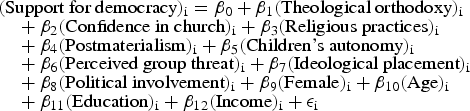
where β0 is the intercept, β1 through β12 are the regression coefficients for each variable, and εi is the stochastic error term.Footnote 4 To account for nonindependence and the possible bias resulting from ignoring within-country variation, cluster standard errors are used. Relying on these statistical methods, I compare the twenty countries and investigate the differences that separate the industrialized from the developing societies by the major religious groups: Catholics, Protestants, Orthodox, Muslims, and nonaffiliates.
RESULTS
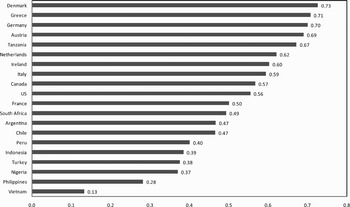
This article examines the variation and causal forces of democratic support in twenty developing and industrialized countries by four main religious denominations and nonmembers of religious groups. In the survey, respondents were asked, “[d]o you belong to a religious denomination?” If respondents said “yes” to the question, they were required to name their religious denomination, i.e., Catholic, Orthodox, Protestant, Muslims, etc. If they said “no” to the question, they were treated as nonmembers. Figure 1 shows the mean support for democracy in twenty countries. Support for democracy index ranges from 0 (least support) to 1 (most support). Countries are arranged from the highest mean to the lowest. On average, Danes display the highest support for democracy with a mean of .73. The communist state, Vietnam, has the lowest mean, −.13 — of the twenty countries. Generally, the overall mean of support for democracy in industrialized countries is higher than in developing countries.Footnote 5 Among the developing societies, Tanzania stands out as an outlying case with fairly high support for democracy. Three Latin American states with Catholic majority population — Argentina, Chile, and Peru — are grouped together with the mean around .4. Two Islamic states — Indonesia and Turkey — are next to each other with a mean of .37. In the middle of the figure, two North American states — the U.S. and Canada — are adjacent to each other with a mean of .56.
Mean support for democracy by country. Source: European Values and World Values Surveys 1999–2001. Notes: The analysis is weighted based on population 1,000 across countries. The mean support for democracy indices ranges from 0 (lowest support) to 1 (highest).

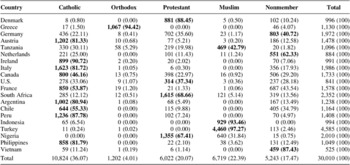
Table 1 shows the percentage of respondents in each country by four religious affiliations — Catholic, Orthodox, Protestant, and Muslim — and nonmembers. The countries are arranged from the highest mean support for democracy to the lowest from Figure 1 in order to see if there is any possible pattern between religious diversity and support for democracy. Denmark, Greece, Austria, Ireland, and Italy experience high religious homogeneity. Yet their residents favor democratic procedures, as do Canadians, Germans, Dutch, and Americans, who live under greater religious pluralism. Perhaps Tanzanian attitudes — the outlier of the mean comparison of support for democracy — partly derive from religious pluralism; here, Muslim, Roman Catholic, and Protestant churches contend for followers. In most cases, however, religious pluralism does not explain democratic attitudes.Footnote 6 The communist state, Vietnam, evidently has the highest percentage of nonmembers, 87 percent, followed by the Netherlands, 62 percent. Except for Tanzania and Vietnam, a majority of respondents from eight developing countries belong to a certain religious denomination — Protestants in South Africa and Nigeria, Catholics in Argentina, Chile, Peru and the Philippines, and Muslims in Indonesia and Turkey.
Distribution of religious affiliations in a country (%)

Source: European Values and World Values Surveys 1999–2001. Notes: Countries are arranged from the highest mean support to the lowest mean support from Figure 1. The modal category is bolded.
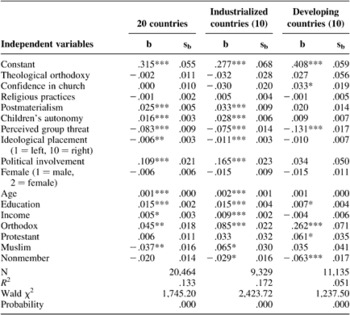
Table 2 reports the OLS result by industrialized and developing countries. Notably, spiritual variables — theological orthodoxy, confidence in church, and religious practice — have no or limited effect on democratic support. Among the three indicators of religious commitment, only confidence in a church among developing countries positively affects democratic beliefs. The measure of theological orthodoxy hardly provides information about the dogmatic qualities of spiritual beliefs. Frequency of attendance in religious institutions measures neither the attitudes of priests, ministers, and imams nor the social networks within a religious institution that shape members' opinions toward democratic politics. Although spiritual values may bring meaning and solidarity to an individual, they appear less important for producing democratic attitudes, especially in industrialized countries.
OLS results for support for democracy by industrialized and developing countries

Notes: Cluster standard errors are reported in parentheses. *p < .05, **p < .01, ***p < .001 in one-tailed test. Ten industrialized countries include Austria, Canada, Denmark, France, Germany, Greece, Ireland, Italy, the Netherlands, and the United States. The less modernized societies comprise Argentina, Chile, Indonesia, Nigeria, Peru, the Philippines, South Africa, Tanzania, Turkey, and Vietnam. Catholics are served as the baseline for the religion dummy variables.
The statistical results suggest the greater credibility of the second hypothesis about the impact of culturally modern, humanistic, tolerant values: postmaterialism, children's autonomy, and low defensiveness toward group threats. Among the twenty nations, the group threat orientation wields the strong effect, regardless of their industrialization stages. As perceived threats to the self, group, and nation decline, support for democracy rises. Particularly, the magnitude of the impact of the variable on support for democracy is greatest in developing countries (b = −.13). Children's autonomy and postmaterial values, generally associated with the level of economic well-being, are statistically significant only among industrialized countries: citizens in industrialized countries, who believe that children should learn independence and perseverance, rather than obedience or religious faith, express greater enthusiasm for democratic principles. Citizens in industrialized countries, who give priority to the values of free speech and civic participation, rather than security or order, are more likely to support democratic values.
Two political variables for the third hypothesis — ideological placement and political involvement — show a similar pattern. Both variables strongly affect support for democracy only in industrialized countries. As identification with leftist ideology grows stronger, so does a commitment to democratic institutions. Political involvement substantially enhances prodemocratic attitudes in industrialized countries. Individuals with higher political interest and frequency of political discussions with friends express greater enthusiasm for democracy. These explicitly political variables, rather than spiritual values, assume the main importance for generating democratic beliefs in industrialized countries, but not in developing countries.
Among the four demographic variables, higher education appears most conducive to democratic attitudes. As formal education increases, individuals become more exposed to democratic ideals and procedures. They learn the cognitive skills needed to comprehend the complexities of the political world. Information expands about divergent values, interests, and worldviews. All these qualities enhance support for democracy, not only in the industrialized nations but in developing societies as well. Older people and higher income groups express greater appreciation of democracy in industrialized countries, but not in developing countries. Throughout all twenty nations, gender does not have a significant impact on support for democracy.
What differences separate the ten industrialized societies from the other less modernized countries? As revealed in Table 2, the multiple regressions explain far lower variance in democratic support among the developing nations (R 2 = .05). Personal media of communication, limited university education, and weak political parties that exert little influence over the rural hinterlands impede responses to sample surveys. Researchers cannot always uncover the precise meanings that respondents ascribe to such vague concepts as democracy, freedom, equality, and even government, with its many diverse agencies. In these less modernized, less equal, and violence-prone societies, political life features weaker organizations than in more prosperous, industrialized nations of Western Europe and North America. Given this weakness of political parties and voluntary associations — crucial elements of representative government and a viable civil society — individual political attitudes remain less connected to other values and beliefs. Similar political concepts reveal divergent interpretations among people in the same nation.
Limited opportunities for public participation in the developing nations, combined with the dysfunctional features of modernization — poverty, income inequality, unemployment, and extensive political violence — produce a defensive stand toward threats, thereby reducing support for democratic principles. Although political involvement explains the greatest variance for democratic attitudes among the ten industrialized countries, it has little impact in the developing societies, where governments discourage widespread, voluntary political participation. A similar but weaker effect of leftist ideology also prevails in the industrialized nations, where the greater economic prosperity and political security enhance equality and decrease concern about perceived threats. Both education and income raise support for democracy by industrial citizens. Even if the same positive effect of education holds for the less modernized societies, higher or lower income there does not associate with democratic sentiments — a reflection of the unequal conditions affecting political attitudes.
Table 2 includes major religious affiliation dummy variables. The Catholic dummy variable serves as the baseline, and, thus, the coefficient for each religious affiliation variable should be added or subtracted from the constant in order to interpret the impact of each religious affiliation in developing and industrialized countries. The comparisons of the major religious affiliations and nonmembers shows some commonalities and differences toward democratic procedures. First, whereas the Orthodox laity, mainly in Greece, gives the strongest backing to democracy in both industrialized and developing countries, nonaffiliates have a consistently negative impact on support for democracy in both groups of countries. The magnitude of the impact is about twice stronger in developing countries than in industrialized countries. Faced with the growth of secularism across the globe, these nonaffiliates will have a greater impact on political attitudes and behavior during the next decades. Second, Muslim affiliation has a statistically significant and positive impact on support for democracy in industrialized countries, but not in developing countries. The opposite trend occurs among Protestants, who give greater support for democratic values in developing countries but not in industrialized societies. Besides, the magnitudes of the impact (the size of the coefficients) of the variables on support for democracy are almost identical, .06. Given the statistical significance of these findings for Protestants and Muslims, Huntington's assertion about the Muslim rejection of democratic beliefs remains unsupported by the survey data from these twenty countries. Neither religious values nor religious practices deeply shape support for democracy. Instead, other variables such as perceived group threats and political indicators (ideological self-placement and political involvement) wield the greater impact, particularly among industrialized societies.
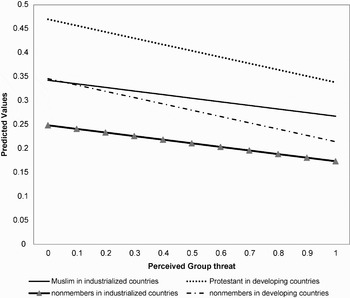
Figure 2 shows the predicted values of support for democracy when perceived group threat varies. Two solid lines come from industrialized countries: The upper solid line without marker represents the Muslim group and lower solid line with triangle markers represents the nonmembers. Two solid lines come from industrialized countries: The upper solid line without marker represents the Muslim group and lower solid line with triangle markers nonmembers. For developing countries, the upper dashed line represents the Protestant group and lower dashed line nonmembers.Footnote 7 Regardless of industrialization stages and (non)religious groups, the predicted values of support for democracy decline as the perceived group threat becomes more intense. Both Protestants and nonmembers of developing countries display steeper declines of support for democracy than Muslims and nonmembers of industrialized countries. In both industrialized and developing nations, as perceived group threat grows, nonmembers give lower support to democracy than do either Protestants or Muslims. Nonmembers in developing countries display less support for democracy than Muslims in industrialized countries as their perception of group threat grows.
Impact of Muslim, Protestant, and Nonmembers when perceived group threat varies. Note: The predicted values are calculated from the coefficients shown in Table 2.

CONCLUSION
As the preceding analyses have shown, extensive variations toward support for democracy prevail among the twenty nations. Focusing on the basic differences between Islam and Western Christianity, Samuel Huntington (Reference Huntington1996, 209–218) downplays not only the diversity within Christian and Muslim groups but also the similar values expounded by each religion and the far greater attitudinal differences among nations. According to the findings, Western, democratic developed societies value democracy more than people in the less democratic, less industrialized world. Particularly in West Europe and North America, most political conflicts revolve mainly around social and political differences, rather than polarized theological values. The majority of Muslims assume an accommodating stand toward religious tolerance and pluralism in industrialized countries.
Among these twenty countries, Northern Nigeria and the Philippines have faced the most severe religious violence putting Muslims against Christians, thereby impeding the consolidation of prodemocratic attitudes. Nevertheless, religious differences within the Muslim community have often also generated violent conflicts against Muslims perceived as heretics by the orthodox. For example, the Indonesian Council of Ulemas provoked arrests, prosecution, and violent attacks against Muslim “deviants” charged with defaming the purity of Islam by their unorthodox beliefs and ritual practices. Since the downfall of the Suharto military regime in 1998, the Indonesian government has taken stricter actions to enforce religious edicts of the orthodox Muslim scholars. Religious intolerance has escalated, thereby hindering the effective operation of democratic institutions (Ali Reference Ali2005; Human Rights Watch 2006). Among the developing countries, democratic norms and values are supported by the Protestant groups alongside with the spread of education. Unlike members of religious institutions, nonmembers who perceive powerful threats from other groups significantly disapprove of democracic values and oppose democracy as an ideal form of government.
In sum, spiritual values matter less than cultural and political variables. Unlike the industrialized societies, where political involvement, political ideology, postmaterialism, and children's autonomy enhance support for democracy, these variables have little influence in developing nations. One common hindrance for democracy in industrialized and developing countries arises when individuals perceive threats from others. As the perception of threat grows, support for democracy significantly lessens in both groups of nations.
The major limitations of this study revolve around the need to develop more complex, longitudinal, cross-national indicators explicitly linked to the political, economic, and cultural dimensions that promote democratic attitudes. Without time-series analyses, causal explorations of the impact of these three dimensions become problematic. Specific case studies of diverse nations over time would help substantiate the theoretical causal premises explored through quantitative studies of several countries. By highlighting the importance of a few causal variables, the case studies would clarify their interaction on such effects as democratic attitudes and performance (Achen Reference Achen2005; George and Bennett Reference George and Bennett2005; Mahoney and Goertz Reference Mahoney and Goertz2006).
By pursuing the following questions, researchers will help remedy some limitations of the present analysis. Over time, how does the interaction among cultural, political, and economic resources expand support for democracy? Under what societal conditions do spiritual values wield the greatest impact? Why do particular individuals attribute meaning, secure social solidarity, and seek defense against perceived threats from shared ideological values, rather than from religious beliefs? In what ways does involvement in religious networks shape political attitudes? Finally, how does the interaction linking macro national conditions to micro individual values explain the varying degrees of preference for democratic procedures? Future studies probing these questions will help expand our knowledge about the sources of support for democracy throughout the world.
APPENDIX A: DESCRIPTIVE STATISTICS

Notes: The appendix specifies the Cronbach α, a measure of reliability, for the variables that form the five indices based on responses to multiple questions in the survey. For the five indices, the appendix indicates the additive scores of these responses before standardization.
APPENDIX B: FORMATION OF VARIABLES AND INDICES
Support for Democracy
Cumulative score of evaluation of different ways to rule a country and agreement of different opinion about democracy:
Evaluation of different ways to rule a country: “I am going to describe various types of political systems and ask what you think about each as a way of governing this country. For each one, would you say it is a very good, fairly good, fairly bad or very bad way of governing this country? Political systems: Having a strong leader who does not have to bother with parliament and elections; Having experts, not government, make decisions according to what they think is best for the country; Having the army rule.” 1 = very good; 2 = fairly good; 3 = bad; 4 = very bad. “Political systems: Having a democratic political system.” 1 = very bad; 2 = bad; 3 = fairly good; 4 = very good.
Agreement of different opinions about democracy: “I am going to read off some things that people sometimes say about a democratic political system. Could you please tell me if you agree strongly, agree, disagree or disagree strongly, after I read each one of them? Agreement: In democracy, the economic system runs badly; Democracies are indecisive and have too much quibbling; Democracies are not good at maintaining order.” 1 = agree strongly; 2 = agree; 3 = disagree; 4 = strongly disagree. “Agreement: Democracy may have problems but it is better than any other form of government.” 1 = strongly disagree; 2 = disagree; 3 = agree; 4 = agree strongly.
Religious Commitment
Theological orthodoxy: Cumulative score of the following responses: “Which, if any, of the following do you believe in? Belief in life after death; belief in hell; belief in heaven.” 0 = no; 1 = yes.
Confidence in churches: Cumulative score of the following responses: “Generally speaking, do you think that [the churches] in your country are giving adequate answers to: The moral problems and needs of the individual; The problems of family life; People's spiritual needs; The social problems facing our country today.” 0 = no; 1 = yes. Note: In non-Christian countries, refer to “the religious authorities in your country” or “the religious leaders in your country,” instead of “the churches.”
Religious practice: “Apart from weddings, funerals and christenings, about how often do you attend religious services these days?” 1 = practically never; 2 = less often; 3 = once a year; 4 = other specific holy days; 5 = only on special holy days (e.g., Christmas or Easter); 6 = once a month; 7 = once a week; 8 = more than once a week.
Cultural Values
Children's autonomy: Autonomy index. “Here is a list of qualities that children can be encouraged to learn at home. Which, if any, do you consider to be especially important?” Child qualities: “[(Independence) + (Determination, perseverance)] — [(Religious faith) + (Obedience)].” 1 = stress on obedience and religious faith through 5 = stress on determination, perseverance and independence.
Postmaterialism: Materialism/Postmaterialism index. Materialism (stress on maintaining order and fighting inflation); postmaterialism (stress on protecting free speech and increasing popular participation in government decision-making). 1 = materialist; 2 = mixed; 3 = postmaterialist.
Perceived group threats: Cumulative score of responses to following groups that respondent would not like to have as neighbors: “On this list are various groups of people. Could you please sort out any that you would not like to have as neighbors? Neighbors: People of a different race; Immigrants; People who have AIDS; Drug addicts; Homosexuals.” 0 = not mentioned; 1 = mentioned.
Political Dimensions
Self-placed ideology: “In political matters, people talk of ‘the left’ and ‘the right.’ How would you place your views on this scale, generally speaking?” 1 = most left through 10 = most right.
Political involvement: Cumulative score of responses to the following questions: “How important is politics in your life?”; “How interested are you in politics?” 1 = not at all; 2 = not very; 3 = somewhat; 4 = very. “When you get together with your friends, would you say you discuss political matters frequently, occasionally or never?” 1 = never; 2 = occasionally; 3 = frequently.
Demographic Variables
Female: 1 = male; 2 = female.
Age: Number of years old.
Education: “What is the highest educational level that you have attained?” 1 = Inadequately completed elementary education, 2 = Completed (compulsory) elementary education, 3 = Incomplete secondary school: technical/vocational type/(Compulsory) elementary education and basic vocational qualification, 4 = Complete secondary school: technical/vocational type/Secondary, intermediate vocational qualification, 5 = Incomplete secondary: university-preparatory type/Secondary, intermediate general qualification, 6 = Complete secondary: university-preparatory type/Full secondary, maturity level certificate, 7 = Some university without degree/Higher education - lower-level tertiary certificate, 8 = University with degree/Higher education - upper-level tertiary certificate.
Income: “Here is a scale of incomes. We would like to know in what group your household is, counting all wages, salaries, pensions and other incomes that come in. Just give the letter of the goup your household falls into, before taxes and other deductions.” 1 = lowest decile through 10 = highest decile.
Religious denomination: “Do you belong to a religious denomination? If yes, which one?” If no, code 0.