Introduction
The rearing of triploid sterile fish is an interesting alternative to aquaculture (Piferrer et al., Reference Piferrer, Beaumont, Falguiere, Flajshans, Haffray and Colombo2009; Arai, Reference Arai2001), as the deleterious aspects of early maturation (e.g. decreased growth and survival) may be avoided (Taranger et al., Reference Taranger, Carrillo, Schulz, Fontaine, Zanuy, Felip, Weltzien, Dufour, Karlsen, Norberg, Andersson and Hausen2010). In sterile fish, the energy used for gonadal development in diploids (especially females) are deviated for somatic tissue in triploids, with increased growth and carcass yield (Dunham, Reference Dunham2004; Golpour et al., Reference Golpour, Siddique, Siqueira-Silva and Pšenicka2016; Nascimento et al., Reference Nascimento, Pereira-Santos, Piva, Manzini, Fujimoto, Senhorini, Yasui and Nakaghi2017). As the reproductive capacity of sterile triploids is extremely reduced, it also may reduce the impacts of accidental escapes into the wild population (Benfey, Reference Benfey2015). Additionally, the novel surrogate technologies, including germ-cell transplantation, requested a sterile host, and then triploid fish may be used (Yamaha et al., Reference Yamaha, Saito, Goto-Kazeto and Arai2007), as previously observed by the production of trout offspring from triploid salmon (Okutsu et al., Reference Okutsu, Shikina, Kanno, Takeuchi and Yoshizaki2007).
In the neotropical region, however, very few studies have focused on triploid induction in fish but some protocols exist like for the silver catfish Rhamdia quelen (Huergo & Zaniboni-Filho, Reference Huergo and Zaniboni-Filho2006) and the yellowtail tetra Astyanax altiparanae (Adamov et al., Reference Adamov, Nascimento, Maciel, Pereira-Santos, Senhorini, Nakaghi, Guerrero, Fujimoto and Yasui2016). Astyanax altiparanae is a small characin that presents intertidal spawning, bred throughout a year and presents early sexual maturity at approximately 4 months (Garutti, Reference Garutti2003; Porto-Foresti et al., Reference Porto-Foresti, Castilho-Almeida, Senhorini, Foresti, Baldisserotto and Gomes2010). Additionally, as it presents great importance to aquaculture, it becomes an interesting model for both basic and applied studies (de Siqueira-Silva et al., Reference de Siqueira-Silva, dos Santos Silva, Ninhaus-Silveira and Veríssimo-Silveira2015; Yasui et al., Reference Yasui, Santos, Nakaghi, Senhorini, Arias-Rodriguez, Fujimoto, Shimoda and Silva2015).
With this purpose, we first developed an in vitro fertilization (IVF) protocol (Yasui et al., Reference Yasui, Santos, Nakaghi, Senhorini, Arias-Rodriguez, Fujimoto, Shimoda and Silva2015) for A. altiparanae. The protocol supported important studies on early development such as the moment of the second-polar body extrusion (dos Santos et al., Reference dos Santos, Yasui, Xavier, de Macedo Adamov, do Nascimento, Fujimoto, Senhorini and Nakaghi2016), which made it possible to determine the adequate timing for subsequent induction of triploid individuals (Adamov et al., Reference Adamov, Nascimento, Maciel, Pereira-Santos, Senhorini, Nakaghi, Guerrero, Fujimoto and Yasui2016). Recently, Nascimento et al. (Reference Nascimento, Pereira-Santos, Piva, Manzini, Fujimoto, Senhorini, Yasui and Nakaghi2017) showed that triploid females are sterile and presents increased carcass yield. However, little difference was observed within males. Despite such work, the authors have performed histological analysis, as more detailed studies on gonad morphology are important for a better understanding of the biology and to confirm the sterility in triploid fish. Although previous works have also attempt to study to evaluate the reproductive biology in other related species (De Carvalho et al., Reference De Carvalho, Paschoalini, Santos, Rizzo and Bazzoli2009; Dala-Corte & Azevedo, Reference Dala-Corte and Azevedo2010; Galvão et al., Reference Galvão, Silva, Cardoso, da Silva Santos, Pereira and Ribeiro2016), there is not a reference in order to assess reproductive ability in this species. Additionally, the pattern of stereological observation within diploids and triploids may be an interesting approach to evaluate sterilization quantitatively in fish. Therefore, the aim of this study was to examine the gonad morphology of diploid and triploid fish through stereological analysis.
Materials and Methods
Ethics
All the procedures were performed in line with the Guide for the Care and Use of Laboratory Animals in São Paulo State University (UNESP/CEUA 07919/14).
Origin of broodstock and triploid induction
We used three separately couples of A. altiparanae provided from different ponds at the Instituto Chico Mendes de Conservação a Diversidade (ICMBio/CEPTA), Pirassununga City, São Paulo State, Brazil. The procedures of artificial fertilization were performed according to Yasui et al. (Reference Yasui, Santos, Nakaghi, Senhorini, Arias-Rodriguez, Fujimoto, Shimoda and Silva2015). Briefly, mature females and males were injected with a single dose of carp pituitary gland at 3 mg/kg for both males and females. Ten hours afterwards, fish were anesthetized in menthol (~100 mg l–1, Êxodo Científica, Brazil) and the semen was collected using a 1000 µl pipette (Eppendorf, Hamburg, Germany) and immediately transferred to a 1.5 ml tube containing 400 µl of modified Ringer solution (128.3 mM NaCl, 23.6 mM KCl, 3.6 mM CaCl2, 2.1 mM MgCl2), mixed by gently pipetting and stored at 2.5°C. Oocytes from females were stripped onto a Petri dish (90 mm diameter) covered by polyvinylidene chloride film (Saran wrap, Alpfilm, São Paulo, Brazil). For fertilization, 70 µl of the diluted semen was added on the oocytes and the gametes were activated by addition of 5 ml of water. This procedure was performed separately from each couple, generating three batches of eggs that was considered as replicates.
Triploid induction and rearing
Each fertilized group of eggs was divided into two aliquots. One was kept intact and served as a control group and the other was heat shocked to induce triploid at 40°C, for 2 min at 2 min post-fertilization (Adamov et al., Reference Adamov, Nascimento, Maciel, Pereira-Santos, Senhorini, Nakaghi, Guerrero, Fujimoto and Yasui2016). The eggs from each cross were incubated separately in six 40-l aquarium (three for diploids and three for triploids) for hatching and subsequent larval rearing. The resultant larvae were initially fed exclusively with Artemia franciscana nauplii until 30 days post-fertilization. At this moment, each group of fish were transferred to larger aquariums (125 L) in a recirculation system, with the temperature set at 28°C and 12 h of light. The stocking density was adjusted to 120 fishes per aquarium that were fed twice a day with a commercial pellet (1 mm) containing 45% of crude protein (until apparent satiation), until the end of the experiment.
Samples and histological analysis
At 83, 114, 144 and 175 days post-hatching (dph), 10 fish from each aquarium were randomly collected and euthanized in menthol (~100 mg l–1, Êxodo Científica, Brazil). The gonads were dissected, fixed in Bouin's fixative for 24 h and stored in 70% ethanol prior to histological processing. Samples were subsequently dehydrated trough increasing concentrations series of ethanol, cleared in xylene, embedded into paraffin blocks, sectioned at 5 µm on a microtome (Leica RM2235, Nussloch, Germany) equipped with steel blade (Leica 818, Nussloch, Germany), and sections were then stained with hematoxylin and eosin.
Stereological analysis
Stereological analyzes used an 825-intersection grid (ImageJ software) on a section from the midgonad region. Each grid was considered a field, and three fields (2475 points) were randomly selected and examined under ×200 magnification on a microscope (Nikon-Eclipse Ni, Tokyo, Japan) for each fish. Digital images were captured with a CCD camera (Nikon DSRi2, Nikon, Tokyo, Japan) and analyzed with NIS-Ar Elements software (Nikon, Tokyo, Japan). Spermatogonia, spermatocytes, spermatid, spermatozoa, interstitial tissue, and lumen without cells were counted for males. Oogonia, primary growth oocyte, secondary growth oocyte, vitellogenic oocyte, interstitial tissue and atresic oocyte were counted for females. Different cell types were identified based on the study by Schulz et al. (Reference Schulz, de Franca, Lareyre, LeGac, Chiarini-Garcia, Nobrega and Miura2010) for male and Quaggio-Grassiotto et al. (Reference Quagio-Grassiotto, Grier, Mazzoni, Nobrega and Amorim2011) for female.
Flow cytometry
Flow cytometric analysis from somatic tissue (dorsal fin) were performed in order to confirm the ploidy status of each individual. The relative DNA content and ploidy status of each fish was estimated by comparison with diploids controls, according to Nascimento et al. (Reference Nascimento, Pereira-Santos, Piva, Manzini, Fujimoto, Senhorini, Yasui and Nakaghi2017). The samples were placed into a 1.5 ml macrotube containing 100 µl of lysis solution (9.53 mM MgSO4.7H2O, 47.67 mM KCl, 15 mM Tris, 74 mM sucrose, 0.8% Triton X-100) for 10 min, and then stained using 800 µl of 4´,6-diamidino-2-phenylindole dihydrochloride-DAPI (1 µg ml–1 of DAPI in Dulbecco's phosphate buffered saline). The samples were filtered through 30-µm nylon mesh and analyzed by flow cytometry (CyFlow Ploidy Analyzer, Partec, GMBh, Germany).
Statistical analysis
The results are expressed as mean ± standard error. Data were checked for normality using the Lilliefors test (5%). Data expressed as percentages were transformed in order to fit the assumptions of statistical variance homogeneity using the Levene test (Brown & Forsythe, Reference Brown and Forsythe1974) and then compared by paired t-test (5%), considering the effect of ploidy in each time separately. Analysis was performed using the software STATISTICA (Version 10.0, Statsoft, Tulsa, USA).
Results
Females
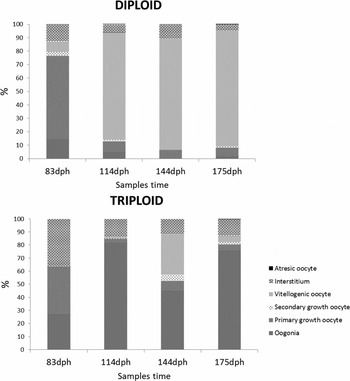
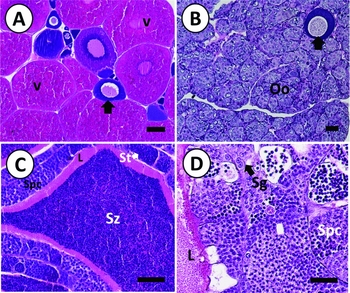
As expected, diploid females presented normal oogenesis during all the experimental period (Figs 1 and 2 A). However, triploid females presented impaired gonads (Figs 1 and 2 B). Triploid females present greater numbers of oogonia at 83 dph (P = 0.0436; 27.88 ± 22.88%), 114 dph (P = 0.0000; 82.32 ± 1.79%), 144 dph (P = 0.0000; 45.65 ± 8.82%) and 175 dph (P = 0.0000; 76.42 ± 5.78%); when compared with diploids (14.61 ± 5.39%, 4.95 ± 5.51%, 0% and 1.86 ± 1.17%, respectively). The numbers of oocytes in primary growth were significantly higher in diploid females at 83 dph (P = 0.0000; 61.99 ± 5.39%) and 114 dph (P = 0.0013; 7.83 ± 1.78%); when compared with triploid fish (36.01 ± 52.49% and 2.27 ± 0.77%, respectively). Diploid females present higher percentages of secondary growth oocytes at 83 dph (P = 0.0266; 2.92 ± 0.94%) than that observed for triploid fish (0%). Vitellogenic oocytes numbers were significantly higher in diploid females at 83 dph (P = 0.0133; 7.54 ± 2.69%), 114 dph (P = 0.0000; 79.61 ± 5.66%), 144 dph (P = 0.0000; 83.04 ± 3.50%) and 175 dph (P = 0.0000; 86.07 ± 3.93%); when compared with triploid fish (0%, 1.14 ± 0.97%, 31.16 ± 8.66% and 5.04 ± 3.64%, respectively). Triploid females present higher area occupied by interstitium at 83 dph (P = 0.0000; 36.12 ± 24.19%), 114 dph (P = 0.0000; 13.50 ± 1.46%), 144 dph (P = 0.0180; 11.46 ± 1.84%) and 175 dph (P = 0.0000; 12.51 ± 2.27%); when compared with diploid fish (12.94 ± 2.35%, 6.04 ± 0.97%, 10.52 ± 2.42% and 4.59 ± 0.70%, respectively). Besides the prevalence of oogonia, four triploid females presented sporadic vitellogenic oocytes.
Stereological analysis of A. altiparanae ovarium from diploid (2n) and triploid (3n) fish. Triploid females showed impaired gonad development with prevalence of oogonia.

Ovarian and testis histology of diploid and triploid Astyanax altiparanae at 175 dph. (A) Mature ovaries from diploid females. (B) Ovaries from triploid females. (C) Testis of diploid males. (D) Testis of triploid males. Oo: oogonia nests; arrows: pre-vitellogenic oocytes; v: vitellogenic oocytes. Sg: spermatogonia; Spc: spermatocytes; St: spermatids; Sz: spermatozoa. Scale bars (A, C, D) 100 µm; (B) 40 µm.

Males
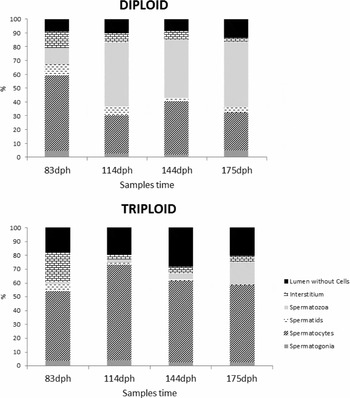
While diploid males presented a regular spermatogenesis (Figs 2 C and 3), triploid males present an impaired gonad development (Figs 2 D and 3). The numbers of spermatogonia were significantly higher in diploid males at 175 dph (P = 0.0005; 5 ± 0.58%) than that observed for triploid fish (2.30 ± 0.27%). Triploid males present significantly higher amounts of spermatocytes at 114 dph (P = 0.0000; 69.36 ± 1.71%), 144 dph (P = 0.0062; 59.05 ± 3.86%) and 175 dph (55.87 ± 3.51%); when compared with diploid fish (27.54 ± 38.66; 5.23% and 28 ± 2.45%). Spermatid cells were significantly greater in diploid males at 114 dph (P = 0.0000; 6.43 ± 0.68%), 144 dph (P = 0.0002; 2.49 ± 0.50%) and 175 dph (P = 0.0000; 4 ± 0.38%); in comparison with triploid fish (1.05 ± 0.30%; 0.99 ± 0.25% and 0.52 ± 0.13%). Diploid males present significantly increased area occupied by spermatozoa at 83 dph (P = 0.0000; 12.22 ± 2.22%), 114 dph (P = 0.0000; 46.38 ± 3.57%), 144dph (P = 0.0000; 42.29 ± 5.30%) and 175 dph (P = 0.0000; 47 ± 3.60%); when compared with triploid fish (1.44 ± 0.45%; 2.80 ± 1.16%; 4.34 ± 2.20% and 16.33 ± 4.53%). Increased area occupied by interstitium were observed for diploid males at 114 dph (P = 0.0012; 6.72 ± 1.24%) than that verified in triploid fish (3.55 ± 0.38%). However, at 175 dph, triploid males present higher area occupied by interstitium (P = 0.0000; 4.42 ± 0.39%) when compared with diploid fish (3.00 ± 0.24). Triploid males present higher percentages of luminal area at 114 dph (P = 0.0000; 19.48 ± 1.17%), 144 dph (P = 0.0000; 28.70 ± 3.73%) and 175 dph (P = 0.0015; 20.55 ± 2.07%); when compared with diploid fish (10.20 ± 0.88%, 8.74 ± 2.60% and 13 ± 1.38%). Besides the impaired gonad development, seven triploids males present identical histology compared with diploid fish, with the full of spermatozoa in the lumen.
Stereological analysis of A. altiparanae testis from diploid (2n) and triploid (3n) fish. Triploid males showed impaired gonad development with prevalence of spermatocytes.

Discussion
In this study we have shown that triploidy impaired gonadal development in both A. altiparanae females and males. In triploid fish, sterility is more evident in females (Piferrer et al., Reference Piferrer, Beaumont, Falguiere, Flajshans, Haffray and Colombo2009), as observed for Atlantic cod (Gadus morhua; Feindel et al., Reference Feindel, Benfey and Trippel2011), grass puffer (Takifugu niphobles; Hamasaki et al., Reference Hamasaki, Takeuchi, Miyaki and Yoshizaki2013) and rainbow trout (Oncorhynchus mykiss; Han et al., Reference Han, Liu, Lan Zhang, Simpson and Xue Zhang2010). In A. altiparanae, the gonads from triploid females were immature and full of oogonia, therefore we proposed that this stage may be used as a reference to assume sterility in the yellowtail tetra. A few sporadic vitellogenic oocytes were verified in gonads of some females, such conditions do not ensure subsequent ovulation and reproduction, therefore we confirmed that triploid females were then sterile as stated by Nascimento et al. (Reference Nascimento, Pereira-Santos, Piva, Manzini, Fujimoto, Senhorini, Yasui and Nakaghi2017). Additionally, such oocytes are probably aneuploid (Piferrer et al., Reference Piferrer, Beaumont, Falguiere, Flajshans, Haffray and Colombo2009) and non-viable, as observed for grass puffer (Takifugu niphobles) (Hamasaki et al., Reference Hamasaki, Takeuchi, Miyaki and Yoshizaki2013).
In triploid males, we observed a strong impairment of gonad development, with the prevalence of lumen and spermatocyte cells. Similar results were observed in Heteropneustes fossilis (Tiwary et al., Reference Tiwary, Kirubagaran and Ray2000) and sea bass Dicentrarchus labrax (Felip et al., Reference Felip, Piferrer, Carrillo and Zanuy2001). In males of sea bass Dicentrarchus labrax (Felip et al., Reference Felip, Piferrer, Carrillo and Zanuy2001) and seabream Sparus aurata (Haffray et al., Reference Haffray, Bruant, Facqueur and Fostier2005), triploidy severely affect meiosis II, when the secondary spermatocytes differentiate into spermatids. It is probable that the same process occurs in A. altiparanae, because most triploid males showed prevalence of spermatocytes, which is the last diploid germ-cell lineage during spermatogenesis.
Some triploid males presented with the same morphology of diploids, with large amounts of spermatozoa, as observed in other species of teleost such as Tinca tinca (Linhart et al., Reference Linhart, Rodina, Flajshans, Mavrodiev, Nebesarova, Gela and Kocour2006) and Misgurnus anguillicaudatus (Fujimoto et al., Reference Fujimoto, Yasui, Yoshikawa, Yamaha and Arai2008). The spermatozoa of triploid males are generally aneuploid and non-motile (Peruzzi et al., Reference Peruzzi, Rudolfsen, Primicerio, Frantzen and Kauric2009; Feindel et al., Reference Feindel, Benfey and Trippel2010). Further studies are necessary to evaluate the ploidy status and fertility capacity of triploid males. Therefore, contrary with the results from females, the sterility of A. altiparanae triploid males could not be confirmed.
Sterile fish might be used as the host in germ-cell transplantation approaches, as shown by Okutsu et al. (Reference Okutsu, Shikina, Kanno, Takeuchi and Yoshizaki2007), by successful production of rainbow trout offspring from sterile triploid salmon. Our results indicated that triploid female A. altiparanae fish may be used in such types of experiments. Additionally, due to the increased carcass yield (Nascimento et al., Reference Nascimento, Pereira-Santos, Piva, Manzini, Fujimoto, Senhorini, Yasui and Nakaghi2017), triploid fish could be interesting for use in aquaculture and will also guarantee a more sustainable production, as the effects of fish escaping are reduced. Therefore, as females are sterile and males present with reduced gonad development, we concluded that the A. altiparanae triploid fish is an interesting alternative choice for aquaculture production and germ-cell transplant experiments.
Moreover, considering that A. altiparanae females are larger than males and present increased growth performance, the production of monosex sterile triploid female will be a useful procedure for aquaculture. In conclusion, an effective method that confirms the sterility in A. altiparanae females was developed in this study. The applicability of this technique for both basic and applied sciences needs to be considered in future studies.
Acknowledgements
The authors thank the Conselho Nacional de Desenvolvimento Científico e Tecnológico (CNPq 130417/2013–0) for the Master's scholarship; the Centro de Aquicultura da UNESP (CAUNESP), FAPESP (JP-FAPESP 2010/17429–1), CEPTA/ICMBio for providing the fish; and the FCAV/UNESP (Faculdade de Ciências Agrárias e Veterinárias) for assistance with the histological analysis.