




No CrossRef data available.
Article contents
Context-specific memory and apolipoprotein E (ApoE) ε4: Cognitive evidence from the NIMH prospective study of risk for Alzheimer's disease
Published online by Cambridge University Press: 01 May 2004
Abstract
The aim of the study was to determine whether the ε4 allele of the apolipoprotein E (ApoE) gene was associated primarily with context-specific memory among individuals at genetic risk for developing Alzheimer's disease. The effect of ApoE status on comprehensive neuropsychological results was examined in 176 healthy adults during baseline cognitive testing in the NIMH Prospective Study of Biomarkers for Older Controls at Risk for Alzheimer's Disease (NIMH Prospective BIOCARD Study). The presence of the ε4 allele was associated with significantly lower total scores on the Logical Memory II subtest of the Wechsler Memory Scale–Revised and percent of information retained after delay. Further analysis indicated the prose recall and retention effect was partially explained by a small subgroup of ε4 homozygotes, suggesting a gradually progressive process that may be presaged with specific cognitive measures. The current results may represent an ε4-associated breakdown between gist-related information and context-bound veridical recall. This relative disconnection may be understood in light of putative ε4-related preclinical accumulation of Alzheimer pathology (tangles and plaques) in the entorhinal cortex (EC) and among frontal networks, as well as the possibility of less-efficient compensatory strategies. (JINS, 2004, 10, 362–370.)
Information
- Type
- Research Article
- Information
- Journal of the International Neuropsychological Society , Volume 10 , Issue 3 , May 2004 , pp. 362 - 370
- Copyright
- © 2004 The International Neuropsychological Society
INTRODUCTION
The ε4 isoform of the apolipoprotein E (ApoE) gene is a well-established risk factor for early development of Alzheimer's disease (AD; Blacker et al., 1997; Corder et al., 1993; Farrer et al., 1997; Saunders et al., 1993; Strittmatter et al., 1993). Although a recent meta-analysis has established an association between relatively deficient new learning ability and the ε4 allele in healthy older individuals (B.J. Small et al., 2003), the qualitative nature of this association remains unspecified. A useful phenomenological distinction in memory research is between content or actual item information and associated source or contextual material (Van Petten et al., 2000). In general, healthy older adults are able to process context-related aspects of learning as effectively as younger adults; however, older persons require increased cognitive support when content and context are not intrinsically related (Gilsky et al., 2001; Spencer & Raz, 1995). In marked contrast, AD patients do not benefit from the inherent coupling of content and context on tasks of episodic and incidental learning (Balota et al., 1999; Simon et al., 1994; J.A. Smith & Knight, 2002). Is there a similar dissociation between content and intrinsic context in healthy older adults at risk for AD by virtue of the presence of the ε4 allele? This question has not been explored systematically in the extant literature.
Before examining the relevant findings in some detail, another content versus context dichotomy is that of gist-based learning and veridical response, which respectively are defined as abstract representation of semantic content and actual recall or recognition that preserves surface detail (Brainerd & Reyna, 1990). Standardized neuropsychological measures of learning and memory use material that vary in the amount of inherent gist information, from narrative prose and semantically organizable word lists to lists of unrelated words and some visual stimuli (i.e., those that can be reasonably associated with semantics, such as recognizable faces). Because most stories in western cultures are organized around a central theme, measures of prose recall are arguably among the most context-bound of standardized neuropsychological measures. However, most neuropsychological tests of learning and memory require verbatim recall. Consequently, standardized measures of semantic learning and memory may assess a hybrid of veridical process and gist-based representation, which may confer greater sensitivity for detecting an ε4-related effect. For the purposes of the current study, context-specific memory is defined as veridical recall or recognition of material with inherent gist.
A review of the neuropsychology literature suggests that the ApoE ε4 allele primarily impedes the learning of context-specific information among healthy older adults at genetic risk for AD. For instance, whereas there is little or no relationship between the ε4 allele and memorization of abstract designs in at-risk individuals (e.g., Bondi et al., 1999), there is longitudinal evidence of a relationship between the ε4 allele and a reduced ability to discriminate pictorial information (i.e., faces of famous persons) that is context driven (B.J. Small et al., 1998). Similarly, no connection has been found between learning semantically unrelated words and presence of the ε4 allele in healthy adults (Berr et al., 1996; Bookheimer et al., 2000; Caselli et al., 1999, 2001; Dik et al., 2000; Kantarci et al., 2002; G.E. Smith et al., 1998). In contrast, individuals possessing at least one ε4 allele perform worse when learning and recalling items from word lists that can be actively organized by semantic categories, when studied either cross sectionally (Bondi et al., 1995, 1999; J.G. Chen et al., 2002) or longitudinally (de Leon et al., 2001; B.J. Small et al., 1998), (although cf. B.J. Small et al., 2000).
Diminished prose recall associated with ε4 among healthy older adults has been documented in cross-sectional studies (Bookheimer et al., 2000; Schmidt et al., 1996; Schiffman et al., 2002; Wilson et al., 2002) and in one longitudinal study (O'Hara et al., 1998). Delayed prose recall also differentiates between controls and AD patients (Howieson et al., 1997; Marquis et al., 2002; Rubin et al., 1998; Storandt et al., 1984; Storandt & Hill, 1989). In addition, there is evidence that context-specific memory might decline early in the AD prodrome (Albert et al., 2001; Elias et al., 2000; Lange et al., 2002; Linn et al., 1995). For example, story recall has been shown to discriminate between preclinical AD and non-dementing controls, whereas prose recall was not able to differentiate between eventual AD converters and full-blown Alzheimer's disease (P. Chen et al., 2001). Moreover, Lange et al. (2002) found that the absence of the ε4 allele was associated with better recall (immediate and delayed) of prose material as compared with a categorical word list in a subgroup of individuals who subsequently developed AD, suggesting that story learning might be particularly sensitive to the presence of at least one ε4 isoform.
Additionally, ε4 presence is associated with lower scores on tasks of rote learning by selective reminding in healthy older persons (Helkala et al., 1995, 1996; Mayeux et al., 2001; O'Hara et al., 1998). Because selective reminding typically uses semantically unrelated words, the relationship between selective reminding and ε4 appears more attributable to attentional and executive problems than contextual factors. For example, the presence of the ε4 allele has been shown to be associated with relative decrements on standard neuropsychological measures of processing speed, attention, and executive functioning (e.g., Yaffe et al., 1997) as well as on cognitive paradigms of visuospatial attention and working memory (Greenwood et al., 2000; Parasuraman et al., 2002; Rosen et al., 2002).
The current study reports on data at baseline from the NIMH Study of Biomarkers in Older Controls at Risk for Alzheimer's Disease (NIMH Prospective BIOCARD study). Baseline cognitive data were examined to determine whether a relationship exists between the presence of the ApoE ε4 allele and context-specific learning in asymptomatic older adults. Genetic risk for Alzheimer's disease was defined as possession of at least one ApoE ε4 allele. A comprehensive neuropsychological battery was used, including measures of episodic learning, language functioning, and visuospatial ability. Tasks employing stories, a list of unrelated words (on which selective reminding was used), and designs constituted episodic learning. Because of the unique gist-related nature of the story learning task in our testing battery, we expected to find an association between presence of the ε4 allele and reduced prose recall, but not with design recall or noncategorical word-list learning. Although measures of language and visuospatial ability are predictive of conversion to AD (Arnaiz et al., 2001; Bozoki et al., 2001), these neurocognitive domains were not expected to be effected early in the disease process, especially as accumulation of neurofibrillary tangles is largely confined to medial temporal lobe structures in the earliest stages (Braak & Braak, 1991).
METHOD
Research Participants
The entire group of participants consisted of 176 persons with a mean age of 59 years (SD = 8.6) with a range of 42–86 years. The group was further subdivided into 115 without the ε4 allele (ε4-absent) and 61 with the ε4 allele (ε4-present). For the overall group and genetic subgroups, mean age, years of education, estimated verbal intelligence quotient (IQ) on the National Adult Reading Test (NART; Blair & Spreen, 1989), and gender distribution are shown in Table 1. As expected, ApoE allele groups did not different significantly by age (p = .93), education (p = .87), NART IQ (p = .24), or by gender, χ2 = 1.90, p = .17. In addition, 10 individuals from the ε4-present group were homozygotes; neither age, education, nor NART IQ scores differed as a function of the number of ε4 alleles (0,1,2).
Participant characteristics (means + standard deviations) for the entire sample and ApoE genotype subgroups

These 176 volunteer participants were evaluated as part of a longitudinal study of people at risk for developing AD by virtue of genetics, age, or positive family history. All participants were community-dwelling residents who responded to either printed advertisements in local media or national media sources, informational lectures, or word-of-mouth recruitment by friends or family members. For the purposes of the present study, genetic risk of Alzheimer's disease was defined as the presence of at least one ε4 isoform. The majority of participants (79%) had a positive family history of AD, which was documented by careful review of the medical records of the first-degree relative with the illness.a
Participants with a positive family history of AD were on average significantly older as compared with individuals without a known family history of AD (p < .001). However after covarying for age, family history of AD was not related to any of the neuropsychological measures.
Clinical Evaluation
The NIMH Geriatric Psychiatry Branch (GPB) evaluated participants during a brief inpatient stay at the NIH Clinical Center. The evaluation included a thorough medical screening, neurocognitive profiling, neuroimaging, ApoE genotyping, collection of biologic samples (cerebrospinal fluid, blood, and plasma), and behavioral observations. Medical evaluations consisted of a physical examination, electrocardiograph, and routine blood tests to eliminate other known contributors to memory and general cognitive impairment. Routine magnetic resonance imaging (MRI) or computer tomography (CT) scan was obtained and blood tests assessed venereal disease research laboratory (VDRL), complete blood count (CBC), Vitamin B12 level, thyroid function, and ApoE genotype.
Measures
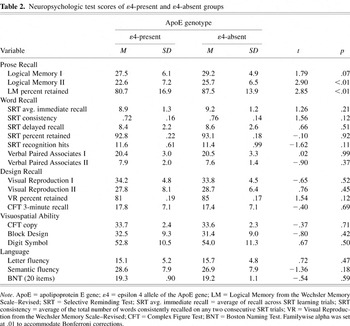
Neuropsychological functioning was assessed across five domains: story learning, word learning, design learning, language, and visuospatial functioning. Story learning was assessed with the Logical Memory I & II subsets from the Wechsler Memory Scale–Revised (WMS–R; Wechsler, 1987). Word learning was assessed with the Selective Reminding Test (SRT; Buschke, 1973) and Verbal Paired Associations I & II subtests from the WMS–R. Tests of design learning consisted of WMS–R Visual Reproduction I & II subtests and 3-min recall from the Complex Figure Test (CFT; Meyers & Meyers, 1995). For logical memory, visual reproduction, and the SRT, percent of information retained from immediate to delayed recall was determined; percent retained was calculated by dividing the delayed recall score by the immediate recall score. Language testing included letter fluency (either A or C), category fluency (body parts or countries; Batting & Montague, 1969), and a modified version of the Boston Naming Test (BNT; Kaplan et al., 1983). Three 20-item versions were created by starting with pictures one, two, or three and then using every third item in sequence. Participants were administered one of the three versions. Measures of visuospatial functioning were the copy phase of the CFT and the Block Design as well as Digit Symbol subtests of the Wechsler Adult Intelligence Scale–Revised (WAIS–R; Wechsler, 1981).
Procedure
The majority of participants enrolled in the NIMH Prospective BIOCARD Study were admitted to the GPB inpatient unit for a two-night stay at baseline. Medical procedures and biologic measures were performed upon waking on days 2 and 3. Cognitive testing was administered in 1.0–1.5 hr sessions over the entire admission and generally was conducted in a combination of late morning and early- to mid-afternoon sessions.
ApoE genotyping was done by one of two assaying methods, either polymerase chain reaction (PCR) or fragment length polymorphism (RFLP) by gel electrophoresis. In PCR, restriction endonuclease digestion was employed (performed by Athena Diagnostics, Worcester, MA). RFLP involved quantitation of restriction endonuclease patterns with image analysis (Wu et al., 2000).
Data Analyses
Two-tailed unpaired t tests were used to determine statistical significance between groups (ε4-present vs. ε4-absent). Bonferroni corrections were used to preserve familywise alpha across the five-neurocognitive domains at p < .01. Although multiple measures were administered within each domain, within domain measures were highly intracorrelated, thereby reducing the need for further correction. Satterthwaite adjusted t test and degrees of freedom are reported when the group variances were unequal (Winer, 1991). Significant t-test results were followed with one-way ANOVA (number of ε4 alleles: 0,1,2) and pair-wise Bonferroni comparisons. In addition for significant interdomain findings between the ε4 absent and present groups, linear regression was conducted to determine if demographic variables (age, education, gender, and estimated IQ) mediated putative association between cognition and ApoE ε4 status.
RESULTS
ε4 Presence Versus Absence
Mean values on all neuropsychological measures as a function of ε4 allele status are shown in Table 2. Participants with the ε4 allele recalled significantly fewer story elements after a 30-min delay on Logical Memory II (M = 22.6, SD = 7.2) as compared with the ε4-absent group (M = 25.7, SD = 6.5), t (174) = 2.90, p < .01 (see Figure 1). Correspondingly, the amount of story information retained from Logical Memory after the delay interval was approximately 10% lower for ε4-present individuals, t (174) = 2.85, p < .01. Of note, measures of word and design learning were not influenced by presence of the ε4 allele. Additionally, the groups did not differ on measures of language and visuospatial ability.
Neuropsychologic test scores of ε4-present and ε4-absent groups


Scatter plot of delayed story recall (raw score from Logical Memory II) across apolipoprotein E ε4 status. ε4-present = presence of the ε4 allele (n = 61). ε4-absent = absence of the ε4 allele (n = 115). ε4 Homozygotes = individuals with two ε4 alleles (n = 10). ε4 Heterozygotes = individuals with one ε4 allele (n = 51). Lines represent mean values ± one standard deviation.
The distribution of Logical Memory II scores met the assumptions of homogeneity of variance between groups and that of normality across groups, W = .99, p < .07. However, because the assumption for the normal distribution of prose recall scores was relatively marginal, one-sided nonparametric testing of Logical Memory II (ε4 presence vs. absence) was conducted and was confirmatory, z = −2.63, p < .01. In contrast, Logical Memory percent retained scores deviated significantly from a normal distribution as most participants exhibited consistent levels of recall between immediate and delayed recall, W = .93, p < .01. However, one-sided nonparametric testing of Logical Memory percent retained also was supportive of the parametric result, z = −2.28, p < .05.
Number of ε4 Alleles
The overall effect of the ε4 allele was significant on Logical Memory II, F = 6.24, p < .01. Even though the only significant post-hoc comparison was between ε4 homozygotes and the ε4-absent group, t(173) = 3.17, p < .01, there was a clear downward trend in scores between absence of the ε4 allele (M = 25.6), ε4 heterozygotes (M = 23.3), and ε4 homozygotes (M = 18.6), as depicted for all participants in Figure 1. The omnibus allele effect for Logical Memory percent retained also was significant, F = 7.37, p < .001. In contrast with delayed prose recall, retention of story information for the ε4-absent group (M = .87) as compared with ε4 heterozygotes (M = .83) was significant, t(173) = 2.58, p < .05, as was the contrast between the ε4-absent group and ε4 homozygotes (M = .70), t(173) = 3.63, p < .01, suggesting that some but not all of the ε4-related effect on prose learning is due to a double ε4 dose.
Linear Modeling of Context-Specific Memory
The presence of the ApoE ε4 allele emerged as the primary predictor of reduced Logical Memory II scores (r = −.24, p < .01) in the overall linear model of prose retention, R2 = .10. Neither age, education, nor gender was significantly related to delayed prose recall. In contrast, estimated verbal IQ was significantly related to prose recall in a positive direction (r = .17, p < .05), which follows from the established relationship between generalized verbal ability and related areas, such as verbal learning. Although the model predicted a relatively small amount of the variance in delayed story recall, the presence of the ε4 allele nonetheless accounted for twice the amount of variance as compared with generalized verbal ability (5.6% vs. 2.8%).
DISCUSSION
As predicted, we noted a statistically significant ε4 allele effect at baseline only on delayed prose recall and retention in the NIMH Prospective Study of Biomarkers for Older Controls at Risk for Alzheimer's Disease. This finding corroborates previously published data on the effects of ε4 in at-risk populations on contextual learning assessed either by recall of story material (e.g., Schmidt et al., 1996) or semantically organizable word lists (e.g., Bondi et al., 1999). It should be noted, however, that although participants possessing at least one ε4 allele scored significantly lower on prose recall and retention, their scores were well within the range of normal functioning; in fact, a young adult (between the ages of 20 and 30) with the same score as the mean of our ε4-present group would be within normal limits on prose recall. Hence, the effect of ε4 on context-bound learning and memory is subtle and likely is undetectable on the vast majority of daily tasks and interactions. Even so, the ε4-related reduction in context-specific memory is possibly suggestive of a biology-driven behavioral decrement. In addition, our finding of reduced story recall and retention in the ε4-present group might be consistent with findings that Logical Memory has greater power to predict conversion from cognitively intact to mild cognitive impairment (MCI) than from MCI to AD (e.g., Tierney et al., 1996).
A small group of ε4 homozygotes explained some but not all of the ApoE ε4 effect on delayed prose recall and retention. As shown in Figure 1, ε4 homozygotes were clustered in three groups within the overall ε4-present group, including three individuals between the mean and one standard deviation above the mean, four individuals between the mean and one standard deviation below the mean, and three individuals less than one standard deviation below the mean. This spread in the distribution of ε4 homozygotes may represent a cross-sectional snapshot of a longitudinal process. However, interpretation of putative ε4 dose-dependent effects is limited by the relatively small number of ε4 homozygotes in the current participant sample.
The best explanation for the observed reduction in contextual memory may be an ε4-associated relative dissociation between gist and verbatim recall, wherein gist is a type of context defined as abstract representation of semantic content. There is evidence of intact recall of gist information (for prose) in the normal aging process (B.J. Small et al., 1999) and in AD (Johnson et al., 2003). However, gist does not facilitate recall for AD patients to the same degree as for older controls (cf. Budson et al., 2000 vs. Tun et al., 1998). We believe that gist and nonsemantic contextual information in general also provide less support during episodic learning tasks for older controls at genetic risk of AD by possession of the ε4 allele. Moreover, the variability in the existing literature on the effect of ε4 on learning among healthy controls may be largely attributable to whether or not contextual learning paradigms were used (cf. Bondi et al., 1995 vs. G.E. Smith et al., 1998). Accordingly in our study, the ApoE ε4 allele may have partially blocked the integration of gist (context) and veridical recall (content) for prose material that is inherently contextual in nature, whereas learning of noncontextual material (i.e., noncategorical word lists and abstract designs) was not affected by the ε4 allele.
The interaction between the ε4 allele and the pathogenesis of AD may help explain the hypothesized disconnection between gist and recall of story details. More specifically, the ε4 effect on context-specific memory might result from a relationship between the allele and extensive damage to the EC among medial temporal lobe structures that occurs relatively early in the AD prodrome (Braak & Braak, 1991; de Leon et al., 2001; De Santi et al., 2001; Gomez-Isla et al., 1996; Hyman et al., 1984, 1986; Killiany et al., 2000, 2002; Kordower et al., 2001) and a more direct association between the ApoE ε4 allele and EC pathology (Ghebremedhin et al., 1998; Juottonen et al., 1998). In addition, nascent findings on the functional role of the EC relative to the hippocampus from animal paradigms (Frank et al., 2000; Suzuki et al., 1997) and functional neuroimaging studies on humans (Fernandez et al., 1999; Haist et al., 2001) suggest that the EC may play a specialized role in learning and consolidating information that can be organized based on prior learning. Consequently, putative ε4-related damage to the EC might interfere with the bi-directional flow of information between neocortical association cortex (fund of gist-related knowledge) and the hippocampus (item-specific encoding and consolidation).
In addition to serving as a repository for contextual information, frontal networks (i.e., the frontal lobes and fronto-cortical as well as fronto-subcortical pathways) in particular play an active role in integrating content with context during encoding and retrieval processes (Gilsky et al., 2001; Janowsky et al., 1989; Van Petten et al., 2000). Similar to the effect of the ε4 on contextual episodic learning, recent data suggest that the ε4 allele also has an adverse impact on frontally mediated executive functions, such as working memory (Parasuraman et al., 2002; Rosen et al., 2002). Bolstering these behavioral findings, studies of resting glucose metabolism in older controls possessing the ε4 allele have indicated reduced metabolic rate in similar prefrontal and cingulate areas as observed in AD (Reiman et al., 1996, 2001; G.W. Small et al., 2000). Though interestingly when cognitive processes are imaged in vivo, increased signal intensity has been detected in frontal areas (Bookheimer et al., 2000) and among putative frontal connections (Bondi et al., 2003; C.D. Smith et al., 1999). As these fMRI findings were based on relatively basic measures of learning and recall, increased signal intensity in cortical areas beyond the medial temporal lobes (MTL) may be a biological correlate of behavioral compensation as a result of degraded MTL functioning. Yet because frontal networks also appear to be compromised by the presence of the ε4 allele, recruitment of frontally mediated compensatory strategies may further compound the effects of damage to the EC. Consequently, ε4-mediated degradation of frontal networks (diffuse accumulation of neuritic plaques) and to the EC (focal deposition of plaques and neurofibrillary tangles) may have interacted in the present study to result in relatively defective integration of gist (context) and veridical story recall and retention (content).
In conclusion, the presence of the ApoE ε4 allele was associated with decreased recall and retention of context-specific prose among healthy older participants at genetic risk for Alzheimer's disease. Although it is theoretically plausible that this effect is due to extensive and selective damage to the EC early in the AD prodrome and exacerbated by more diffuse damage to frontal networks, verification with prospective follow-up data and functional imaging (and other developing in vivo techniques) is still necessary. Nonetheless, the current study may have clinical applications especially as more is learned about the pathogenesis of Alzheimer's disease and new pharmacological interventions are designed to arrest the disease process as early in the prodrome as possible. Therefore it is important to understand the qualitative nature of progressive memory impairment. For instance, mnemonic aides such as rehearsal and repetition that are of limited utility in Alzheimer cases would be expected to be helpful and at least partially restorative in this hypothetical preclinical stage (Backman & Small, 1998). Although contextual learning is less efficient in a hypothetical phase prior to extant memory impairment, context-specific memory is still intact and contextual memory aids (e.g., semantic or thematic cueing) would be of expected benefit. In addition, it remains to be determined if the reported effect of the ε4 allele on context-specific memory in healthy at-risk individuals is also related to the development of objective memory impairment and DAT conversion (see Lange et al., 2002). These and other related questions are being explored in the longitudinal cognitive platform of the NIMH Prospective BIOCARD Study.
ACKNOWLEDGMENTS
These data were presented at the 31st annual meeting of the International Neuropsychological Society in Honolulu, HI in February 2003.
References
REFERENCES
Albert, M.S.,
Moss, M.B.,
Tanzi, R., &
Jones, K.
(2001).
Preclinical prediction of AD using neuropsychological tests.
Journal of the International Neuropsychological Society,
7,
631–639.Google Scholar
Arnaiz, E.,
Jelic, V.,
Almkvist, O.,
Wahlund, L.-O.,
Winblad, B.,
Valind, S., &
Nordberg, A.
(2001).
Impaired cerebral glucose metabolism and cognitive functioning
predict deterioration in mild cognitive impairment.
NeuroReport,
12,
851–855.Google Scholar
Backman, L. &
Small, B.J.
(1998).
Influences of cognitive support on episodic remembering: Tracing
the process of loss from normal aging to Alzheimer's disease.
Psychology and Aging,
13,
267–276.Google Scholar
Balota, D.A.,
Watson, J.M.,
Duchek, J.M., &
Ferraro, F.R.
(1999).
Cross-modal semantic and homograph priming in healthy young,
healthy old, and in Alzheimer's disease individuals.
Journal of the International Neuropsychological Society,
5,
626–640.Google Scholar
Batting, W.F. &
Montague, W.E.
(1969).
Category norms for verbal items in 56 categories: A replication and
extension of the Connecticut category norms.
Journal of Experimental Psychology Monograph,
80,
1–46.Google Scholar
Berr, C.,
Dufouil, C.,
Brousseau, T.,
Richard, F.,
Amouyel, P.,
Marceteau, E., &
Alperovitch, A.
(1996).
Early effect of ApoE-E4 allele on cognitive results in a group of
highly performing subjects: The EVA study.
Neuroscience Letters,
218,
9–12.Google Scholar
Blacker, D.,
Haines, J.L.,
Rodes, L.,
Terwedow, H.,
Go, R.C.P.,
Harrell, L.E.,
Perry, R.T.,
Bassett, S.S.,
Chase, G.,
Meyers, D.,
Albert, M.S., &
Tanzi, R.
(1997).
ApoE–4 and age of onset of Alzheimer's disease: The NIMH
genetics initiative.
Neurology,
48,
139–147.Google Scholar
Blair, J.R. &
Spreen, O.
(1989).
Predicting premorbid IQ: A revision of the National Adult Reading
Test.
Clinical Neuropsychologist,
3,
129–136.Google Scholar
Bondi, M.W.,
Salmon, D.P.,
Monsch, A.U.,
Galasko, D.,
Butters, N.,
Klauber, M.R.,
Thal, L.J., &
Saitoh, T.
(1995).
Episodic memory changes are associated with the APOE-E4 allele in
nondemented older adults.
Neurology,
45,
2203–2206.Google Scholar
Bondi, M.W.,
Salmon, D.P.,
Galasko, D.,
Thomas, R.G., &
Thal, L.J.
(1999).
Neuropsychological function and apolipoprotein E genotype in the
preclinical detection of Alzheimer's disease.
Psychology and Aging,
14,
295–303.CrossRefGoogle Scholar
Bondi, M.W.,
Lange, K.L.,
Salmon, D.P., &
Delis, D.C.
(2003).
Verbal memory during the preclinical period of Alzheimer's
disease: Influence of APOE genotype.
Journal of the International Neuropsychological Society,
9,
153.Google Scholar
Bookheimer, S.Y.,
Strojwas, M.H.,
Cohen, M.S.,
Saunders, A.M.,
Pericak-Vance, M.A.,
Mazziotta, J., &
Small, G.W.
(2000).
Patterns of brain activation in people at risk for Alzheimer's
disease.
New England Journal of Medicine,
343,
450–456.Google Scholar
Bozoki, A.,
Giordani, B.,
Heidebrink, J.L.,
Berent, S., &
Foster, N.L.
(2001).
Mild cognitive impairments predict dementia in nondemented elderly
patients with memory loss.
Archives of Neurology,
58,
411–416.Google Scholar
Braak, H. &
Braak, E.
(1991).
Neuropathological stageing of Alzheimer-related changes.
Acta Neuropathologica,
82,
239–259.Google Scholar
Brainerd, C.J. &
Reyna, V.F.
(1990).
Gist is the grist: Fuzzy-trace theory and the intuitionism.
Developmental Review,
10,
3–47.Google Scholar
Budson, A.E.,
Daffner, K.R.,
Desikan, R., &
Schacter, D.L.
(2000).
When false recognition is unopposed by true recognition: Gist-based
memory distortion in Alzheimer's disease.
Neuropsychology,
14,
277–287.Google Scholar
Buschke, H.
(1973).
Selective reminding for analysis of memory and learning.
Journal of Verbal Learning and Verbal Behavior,
12,
43–50.Google Scholar
Caselli, R.J.,
Graff-Radford, N.R.,
Reiman, E.M.,
Weaver, A.,
Osborne, D.,
Lucas, J.,
Uecker, A., &
Thibodeau, S.N.
(1999).
Preclinical memory decline in cognitively normal apolipoprotein
E-E4 homozygotes.
Neurology,
53,
201–207.CrossRefGoogle Scholar
Caselli, R.J.,
Osborne, D.,
Reiman, E.M.,
Hentz, J.G.,
Barbieri, C.J.,
Saunders, A.M.,
Hardy, J.,
Graff-Radford, N.R.,
Hall, G.R., &
Alexander, G.E.
(2001).
Preclinical cognitive decline in late middle-aged asymptomatic
apolipoprotein E-e4/4 homozygotes: A replication study.
Journal of the Neurological Sciences,
189,
93–98.Google Scholar
Chen, J.G.,
Edwards, C.L.,
Vidyarthi, S.,
Pitchumoni, S.,
Tabrizi, S.,
Barboriak, D.,
Charles, H.C., &
Doraiswamy, P.M.
(2002).
Learning and recall in subjects at genetic risk for
Alzheimer's disease.
Journal of Neuropsychiatry and Clinical Neurosciences,
14,
58–63.Google Scholar
Chen, P.,
Ratcliff, G.,
Belle, S.H.,
Cauley, J.A.,
DeKosky, S.T., &
Ganguli, M.
(2001).
Patterns of cognitive decline in presymptomatic Alzheimer disease.
Archives of General Psychiatry,
58,
853–858.Google Scholar
Corder, E.H.,
Saunders, A.M.,
Strittmatter, W.J.,
Schmechel, D.E.,
Gaskell, P.C.,
Small, G.W.,
Roses, A.D.,
Haines, J.L., &
Pericak-Vance, M.A.
(1993).
Gene dose of apolipoprotein E type 4 allele and the risk of
Alzheimer's disease in late onset families.
Science,
261,
921–923.CrossRefGoogle Scholar
de Leon, M.J.,
Convit, A.,
Wolf, O.T.,
Tarshish, C.Y.,
DeSanti, S.,
Rusinek, H.,
Tsai, W.,
Kandil, E.,
Scherer, A.J.,
Roche, A.,
Imossi, A.,
Thorn, E.,
Bobinski, M.,
Caraos, C.,
Lesbre, P.,
Schlyer, D.,
Poirier, J.,
Reisberg, B., &
Fowler, J.
(2001).
Prediction of cognitive decline in normal elderly subjects with
2-[18F]fluoro-2-deoxy-D-glucose/positron-emission
tomography (FDG/PET).
Proceedings of the National Academy of Sciences,
98,
10966–10971.Google Scholar
De Santi, S.,
de Leon, M.J.,
Rusinek, H.,
Convit, A.,
Tarshish, C.Y.,
Roche, A.,
Tsai, W.H.,
Kandil, E.,
Boppana, M.,
Daisley, K.,
Wang, G.J.,
Schlyer, R., &
Fowler, J.
(2001).
Hippocampal formation glucose metabolism and volume losses in MCI
and AD.
Neurobiology of Aging,
22,
529–539.CrossRefGoogle Scholar
Dik, M.G.,
Jonker, C.,
Bouter, L.M.,
Geerlings, M.I.,
van Kamp, G.J., &
Deeg, D.J.H.
(2000).
APOE-E4 is associated with memory decline in cognitively impaired
elderly.
Neurology,
54,
1492–1497.CrossRefGoogle Scholar
Elias, M.F.,
Beiser, A.,
Wolf, P.A.,
Au., R.,
White, R.F., &
D'Agostino, R.B.
(2000).
The preclinical phase of Alzheimer disease: A 22-year prospective
of the Framingham cohort.
Archives of Neurology,
57,
808–813.Google Scholar
Farrer, L.A.,
Cupples, A.,
Haines, J.L.,
Hyman, B.,
Kukull, W.A.,
Mayeux, R.,
Myers, R.H.,
Pericak-Vance, M.A.,
Risch, N., &
van Duijn, C.M.
(1997).
Effects of age, sex, and ethnicity on the association between
apolipoprotein E genotype and Alzheimer disease.
Journal of the American Medical Association,
278,
1349–1356.Google Scholar
Fernandez, G.,
Brewer, J.B.,
Zhao, Z.,
Glover, G.H., &
Gabrieli, J.D.E.
(1999).
Level of sustained entorhinal activity at study correlates with
subsequent cued-recall performance: A functional magnetic resonance
imaging study with high acquisition rate.
Hippocampus,
9,
35–44.Google Scholar
Frank, L.M.,
Brown, E.N., &
Wilson, M.
(2000).
Trajectory encoding in the hippocampus and entorhinal cortex.
Neuron,
27,
169–178.Google Scholar
Ghebremedhin, E.,
Schultz, C.,
Braak, E., &
Braak, H.
(1998).
High frequency of apolipoprotein E E4 allele in young individuals
with very mild Alzheimer's disease-related neurofibrillary
changes.
Experimental Neurology,
153,
152–155.Google Scholar
Gilsky, E.L.,
Rubin, S.R., &
Davidson, P.S.R.
(2001).
Source memory in older adults: An encoding or retrieval problem?
Journal of Experimental Psychology: Learning, Memory, and Cognition,
27,
1131–1146.Google Scholar
Gomez-Isla, T.,
Price, J.L.,
McKeel Jr., D.W.,
Morris, J.C.,
Growdon, J.H., &
Hyman, B.T.
(1996).
Profound loss of layer II entorhinal cortex neurons occurs in very
mild Alzheimer's disease.
Journal of Neuroscience,
16,
4491–4500.Google Scholar
Greenwood, P.M.,
Sunderland, T.,
Friz, J.L., &
Parasuraman, R.
(2000).
Genetics and visual attention: Selective deficits in healthy adult
carriers of the E4 allele of the apolipoprotein E gene.
Proceedings of the National Academy of Sciences,
97,
11661–11666.Google Scholar
Haist, F.,
Gore, J.B., &
Mao, H.
(2001).
Consolidation of human memory over decades revealed by functional
magnetic resonance imaging.
Nature Neuroscience,
4,
1139–1145.Google Scholar
Helkala, E.-L.,
Kovisto, K.,
Hanninen, T.,
Vanhanen, M.,
Kervinen, K.,
Kuusisto, J.,
Mykkanen, L.,
Kesaniemi, Y.A.,
Laakso, M., &
Riekkinen, P., Sr.
(1995).
The association of apolipoprotein E polymorphism with memory: A
population based study.
Neuroscience Letters,
191,
141–144.Google Scholar
Helkala, E.-L.,
Kovisto, K.,
Hanninen, T.,
Vanhanen, M.,
Kervinen, K.,
Kuusisto, J.,
Mykkanen, L.,
Kesaniemi, Y.A.,
Laakso, M., &
Riekkinan, P., Sr.
(1996).
Memory functions in human subjects with different apolipoprotein E
phenotypes during a 3-year population-based follow-up study.
Neuroscience Letters,
204,
177–180.Google Scholar
Howieson, D.B.,
Dame, A.,
Camicioli, R.,
Sexton, G.,
Payami, H., &
Kaye, J.A.
(1997).
Cognitive markers preceding Alzheimer's dementia in the
healthy oldest old.
Journal of the American Geriatric Society,
45,
584–589.Google Scholar
Hyman, B.T.,
Van Hoesen, G.W.,
Damasio, A.R., &
Barnes, C.L.
(1984).
Alzheimer's disease: Cell-specific pathology isolates the
hippocampal formation.
Science,
14,
1168–1170.Google Scholar
Hyman, B.T.,
Van Hoesen, G.W.,
Kromer, L.J., &
Damasio, A.R.
(1986).
Preforant pathway changes and the memory impairment of
Alzheimer's disease.
Annals of Neurology,
20,
472–481.CrossRefGoogle Scholar
Janowsky, J.S.,
Shimamura, A.P., &
Squire, L.R.
(1989).
Source memory impairment in patients with frontal lobe lesions.
Neuropsychologia,
27,
1043–1056Google Scholar
Johnson, D.K.,
Storandt, M., &
Balota, D.A.
(2003).
A discourse analysis of logical memory recall in normal aging and
dementia of the Alzheimer type.
Neuropsychology,
17,
82–92.Google Scholar
Juottonen, K.,
Lehtovirta, M.,
Helisalmi, S.,
Riekkinen, P.J., &
Soininen, H.
(1998).
Major decrease in the volume of the entorhinal cortex in patients
with Alzheimer's disease carrying the apolipoprotein E E4
allele.
Journal of Neurology, Neurosurgery, and Psychiatry,
65,
322–327.Google Scholar
Kantarci, K.,
Smith, G.E.,
Ivnik, R.J.,
Petersen, R.C.,
Boeve, B.F.,
Knopman, D.S.,
Tangalos, E.G., &
Jack, C.R., Jr.
(2002).
1H magnetic resonance spectroscopy, cognitive function,
and apolipoprotein E genotype in normal aging, mild cognitive
impairment and Alzheimer's disease.
Journal of the International Neuropsychological Society,
8,
934–942.Google Scholar
Kaplan, E.F.,
Goodglass, H., &
Weintraub, S.
(1983).
The Boston Naming Test.
Philadelphia, Pennsylvania:
Lea & Febiger.
Killiany, R.J.,
Gomez-Isla, T.,
Moss, M.,
Kikinis, R.,
Sandor, T.,
Jolesz, F.,
Tanzi, R.,
Jones, K.,
Hyman, B.T., &
Albert, M.S.
(2000).
Use of structural magnetic resonance imaging to predict who will
get Alzheimer's disease.
Annals of Neurology,
47,
430–439.Google Scholar
Killiany, R.J.,
Hyman, B.T.,
Gomez-Isla, T.,
Moss, M.B.,
Kikinis, R.,
Jolesz, F.,
Tanzi, R.,
Jones, K., &
Albert, M.S.
(2002).
MRI measures of entorhinal cortex vs. hippocampus in
preclinical AD.
Neurology,
58,
1188–1196.Google Scholar
Kordower, J.H.,
Chu, Y.,
Stebbins, G.T.,
DeKoksy, S.T.,
Cochran, E.J.,
Bennett, D., &
Mufson, E.J.
(2001).
Loss and atrophy of layer II entorhinal cortex neurons in elderly
people with mild cognitive impairment.
Annals of Neurology,
49,
202–213.Google Scholar
Lange, K.L.,
Bondi, M.W.,
Salmon, D.P.,
Galasko, D.,
Delis, D.C.,
Thomas, R.G., &
Thal, L.J.
(2002).
Decline in verbal memory during preclinical Alzheimer's
disease: Examination of the effect of APOE genotype.
Journal of the International Neuropsychological Society,
8,
943–955.Google Scholar
Linn, R.T.,
Wolf, P.A.,
Bachman, D.L.,
Knoefel, J.E.,
Cobb, J.L.,
Belanger, A.J.,
Kaplan, E.F., &
D'Agostino, R.B.
(1995).
The ‘preclinical phase’ of probable Alzheimer's
disease: A 13-year prospective study of the Framingham cohort.
Archives of Neurology,
52,
485–490.Google Scholar
Marquis, S.,
Moore, M.M.,
Howieson, D.B.,
Sexton, G.,
Payami, H.,
Kaye, J.A., &
Camicioli, R.
(2002).
Independent predictors of cognitive decline in healthy elderly
persons.
Archives of Neurology,
59,
601–606.CrossRefGoogle Scholar
Mayeux, R.,
Small, S.A.,
Tang, M.-X.,
Tycko, B., &
Stern, Y.
(2001).
Memory performance in healthy elderly without Alzheimer's
disease: Effects of time and apolipoprotein-E.
Neurobiology of Aging,
22,
683–689.Google Scholar
Meyers, J. &
Meyers, K.
(1995).
The Meyers Scoring System for the Rey Complex Figure and the
recognition trial: Professional manual.
Odessa, Florida:
Psychological Assessment Resources.
O'Hara, R.,
Yesavage, J.A.,
Kraemer, H.C.,
Mauricio, M.,
Friedman, L.F., &
Murphy, G.M.
(1998).
The APOE E4 allele is associated with decline on delayed recall
performance in community-dwelling older adults.
Journal of the American Geriatric Society,
46,
1493–1498.Google Scholar
Parasuraman, R.,
Greenwood, P.M., &
Sunderland, T.
(2002).
The Apolipoprotein E gene, attention, and brain function.
Neuropsychology,
16,
254–274.Google Scholar
Reiman, E.M.,
Caselli, R.J.,
Yun, L.S.,
Chen, K.,
Bandy, D.,
Minoshima, S.,
Thibodeau, S.N., &
Osborne, D.
(1996).
Preclinical evidence of Alzheimer's disease in persons
homozygous for the ε4 allele for apolipoprotein E.
New England Journal of Medicine,
334,
752–758.Google Scholar
Reiman, E.M.,
Caselli, R.J.,
Chen, K.,
Alexander, G.E.,
Bandy, D., &
Frost, J.
(2001).
Declining brain activity in cognitively normal apolipoprotein E
ε4 heterozygotes: A foundation for using positron emission
tomography to efficiently test treatments to prevent Alzheimer's
disease.
Proceedings of the National Academy of Sciences,
98,
3334–3339.CrossRefGoogle Scholar
Rosen, V.M.,
Bergeson, J.L.,
Putnam, K.,
Harwell, A., &
Sunderland, T.
(2002).
Working memory and apolipoprotein E: What's the connection?
Neuropsychologia,
40,
2226–2233.Google Scholar
Rubin, E.H.,
Storandt, M.,
Miller, J.P.,
Kinscherf, D.A.,
Grant, E.A.,
Morris, J.C., &
Berg, L.
(1998).
A prospective study of cognitive function and onset of dementia in
cognitively healthy elders.
Archives of Neurology,
55,
395–401.CrossRefGoogle Scholar
Saunders, A.M.,
Strittmatter, W.J.,
Schmechel, D.,
St. George-Hyslop, P.H.,
Pericak-Vance, M.A.,
Joo, S.H.,
Rosi, B.L.,
Gusella, J.F.,
Crapper-MacLachlan, D.R.,
Alberts, M.J.,
Hulette, C.,
Crain, B.,
Goldgaber, D., &
Roses, A.D.
(1993).
Association of apolipoprotein E allele E4 with late-onset familial
and sporadic Alzheimer's disease.
Neurology,
43,
1467–1472.Google Scholar
Schiffman, S.S.,
Graham, B.G.,
Sattely-Miller, E.A.,
Zervakis, J., &
Welsh-Bohmer, K.
(2002).
Taste, smell and neuropsychological performance of individuals at
familial risk for Alzheimer's disease.
Neurobiology of Aging,
23,
397–404.Google Scholar
Schmidt, H.,
Schmidt, R.,
Fazekas, F.,
Semmler, J.,
Kapeller, P.,
Reinhart, B., &
Kostner, G.M.
(1996).
Apolipoprotein E E4 allele in the normal elderly: Neuropsychologic
and brain MRI correlates.
Clinical Genetics,
50,
293–299.Google Scholar
Simon, E.,
Leach, L.,
Winocur, G., &
Moscovitch, M.
(1994).
Intact primary memory in mild to moderate Alzheimer disease:
Indices from the California Verbal Learning Test.
Journal of Clinical and Experimental Neuropsychology,
16,
414–422.Google Scholar
Small, B.J.,
Basun, H., &
Backman, L.
(1998).
Three-year changes in cognitive performance as a function of
apolipoprotein E genotype: Evidence from very old adults without
dementia.
Psychology and Aging,
13,
80–87.Google Scholar
Small, B.J.,
Dixon, R.A.,
Hultsch, D.F., &
Hertzog, C.
(1999).
Longitudinal changes in quantitative and qualitative indicators of
word and story recall in young-old and old-old adults.
Journal of Gerontology: Psychological Sciences,
54B,
P107–P115.Google Scholar
Small, B.J.,
Graves, A.B.,
McEvoy, C.L.,
Crawford, F.C.,
Mullan, M., &
Mortimer, J.A.
(2000).
Is APOE-ε4 a risk factor for cognitive impairment in normal
aging?
Neurology,
54,
2082–2088.Google Scholar
Small, B.J.,
Rosnick, C.,
Fratiglioni, L., &
Backman, L.
(2003).
Apolipoprotein E genotype and cognitive performance in normal
aging: A quantitative review.
Journal of the International Neuropsychological Society,
9,
153.Google Scholar
Small, G.W.,
Ercoli, L.M.,
Silverman, D.H.S.,
Huang, S.-C.,
Komo, S.,
Bookheimer, S.Y.,
Lavrotsky, H.,
Miller, K.,
Siddarth, P.,
Rasgon, N.L.,
Mazziotta, J.C.,
Saxena, S.,
Wu, H.M.,
Mega, M.S.,
Cummings, J.L.,
Saunders, A.M.,
Pericak-Vance, M.A.,
Roses, A.D.,
Barrio, J.R., &
Phelps, M.E.
(2000).
Cerebral metabolic and cognitive decline in persons at genetic risk
for Alzheimer's disease.
Proceedings of the National Academy of Sciences,
97,
6037–6042.Google Scholar
Smith, C.D.,
Anderson, A.H.,
Kryscio, R.J.,
Schmitt, F.A.,
Kindy, M.S.,
Blonder, L.X., &
Avison, M.J.
(1999).
Altered brain activation in cognitively intact individuals at high
risk for Alzheimer's disease.
Neurology,
53,
1391–1396.Google Scholar
Smith, G.E.,
Bohac, D.L.,
Waring, S.C.,
Kokmen, E.,
Tangalos, E.G.,
Ivnik, R.J., &
Petersen, R.C.
(1998).
Apolipoprotein E genotype influences cognitive
‘phenotype’ in patients with Alzheimer's disease but
not in healthy control subjects.
Neurology,
50,
355–362.Google Scholar
Smith, J.A. &
Knight, R.G.
(2002).
Memory processing in Alzheimer's disease.
Neuropsychologia,
40,
666–682.Google Scholar
Spencer, W.D. &
Raz, N.
(1995).
Differential effects of aging on memory for content and context: A
meta-analysis.
Psychology and Aging,
10,
527–539.Google Scholar
Storandt, M. &
Hill, R.D.
(1989).
Very mild senile dementia of the Alzheimer type: II. Psychometric
test performance.
Archives of Neurology,
46,
383–386.Google Scholar
Storandt, M.,
Botwinick, J.,
Danzinger, W.L.,
Berg, L., &
Hughes, C.P.
(1984).
Psychometric differentiation of mild senile dementia of the
Alzheimer type.
Archives of Neurology,
41,
477–499.Google Scholar
Strittmatter, W.J.,
Saunders, A.M.,
Schmechel, D.,
Pericak-Vance, M.,
Enghild, J.,
Salvesen, G.S., &
Roses, A.D.
(1993).
Apolipoprotein E: High-avidity binding to B-amyloid and increased
frequency of type 4 allele in late-onset familial Alzheimer
disease.
Proceedings of the National Academy of Sciences,
90,
1977–1981.Google Scholar
Suzuki, W.A.,
Miller, E.K., &
Desimone, R.
(1997).
Object and place memory in the macaque entorhinal cortex.
Journal of Neurophysiology,
78,
1062–1081.Google Scholar
Tierney, M.C.,
Szalai, J.P.,
Snow, W.G.,
Fisher, R.H.,
Tsuda, T.,
Chi, H.,
MacLachlan, D.R., &
St. George-Hyslop, P.H.
(1996).
A prospective study of the clinical utility of ApoE genotype in the
prediction of outcome in patients with memory impairment.
Neurology,
46,
149–154.Google Scholar
Tun, P.A.,
Wingfield, A.,
Rosen, M.J., &
Blanchard, C.
(1998).
Response latencies for false memories: Gist-based processes in
normal aging.
Psychology and Aging,
13,
230–241.CrossRefGoogle Scholar
Van Petten, C.,
Senkfor, A.J., &
Newberg, W.M.
(2000).
Memory for drawings in locations: Spatial source memory and
event-related potentials.
Psychophysiology,
37,
551–564.Google Scholar
Wechsler, D.
(1981).
Wechsler Adult Intelligence Scale–Revised: Manual.
New York:
Psychological Corporation.
Wechsler, D.
(1987).
Wechsler Memory Scale–Revised: Manual.
New York:
Psychological Corporation.
Wilson, R.S.,
Schneider, J.A.,
Barnes, L.L.,
Beckett, L.A.,
Aggarwal, N.T.,
Cochran, E.J.,
Beiry-Kravis, E.,
Bach, J.,
Fox, J.H.,
Evans, D.A., &
Bennett, D.A.
(2002).
The apolipoprotein E E4 allele and decline in different cognitive
systems during a 6-year period.
Archives of Neurology,
59,
1154–1160.Google Scholar
Winer, B.J.
(1991).
Statistical principles in experimental design
(3rd ed.).
New York:
McGraw-Hill.
Wu, Y.-Y.,
Delgado, R.,
Costello, R.,
Sunderland, T.,
Dukoff, R., &
Csako, G.
(2000).
Quantitative assessment of apolipoprotein E genotypes by image
analysis of PCR-RFLP fragments.
Clinica Chimica Acta,
293,
213–221.CrossRefGoogle Scholar
Yaffe, K.,
Cauley, J.,
Sands, L., &
Browner, W.
(1997).
Apolipoprotein E phenotype and cognitive decline in a prospective
study of elderly community women.
Archives of Neurology,
54,
1110–1114.Google Scholar

Participant characteristics (means + standard deviations) for the entire sample and ApoE genotype subgroups
Neuropsychologic test scores of ε4-present and ε4-absent groups

Scatter plot of delayed story recall (raw score from Logical Memory II) across apolipoprotein E ε4 status. ε4-present = presence of the ε4 allele (n = 61). ε4-absent = absence of the ε4 allele (n = 115). ε4 Homozygotes = individuals with two ε4 alleles (n = 10). ε4 Heterozygotes = individuals with one ε4 allele (n = 51). Lines represent mean values ± one standard deviation.
 You have
Access
- 37
- Cited by