




No CrossRef data available.
Article contents
Mentoring a developing health technology assessment initiative in Romania: An example for countries with limited experience of assessing health technology
Published online by Cambridge University Press: 25 October 2005
Abstract
Objectives: The aim of this study was to assist and facilitate introduction and development of a health technology assessment (HTA) program in Romania.
Methods: Mentoring of an initiative group in Romania was provided by an HTA program in Canada. Mentoring activities included provision of HTA materials, participation in local seminars, facilitating contact with HTA and funding organizations, and in-house training of a professional from Romania.
Results: Since 1998, when the relationship was initiated, the Romanian group has been successful in developing an understanding of HTA and awareness of its utility among various decision-makers in the health system. Currently, although the need for HTA in Romania exists and interest in developing this activity has been officially expressed, HTA is still early in its development phase. The mentoring support helped to identify and define the need for HTA in Romania. Continuation of the existing relationship can be expected to strengthen the expertise in this country. However, while mentoring has been a valuable activity, it is not, by itself, sufficient to ensure development of an HTA program in Romania. The actions and decisions that could lead to implementing HTA in Romania depend on the local context.
Conclusions: Mentoring services assisted the initiative group in promoting HTA in Romania. The implementation of HTA in Romania has not happened yet, and efforts need to continue to sustain the existing momentum. However, success in implementing an HTA program will depend on essential factors such as local political, economical, and educational support for this initiative and others like it.
Information
- Type
- RESEARCH REPORTS
- Information
- International Journal of Technology Assessment in Health Care , Volume 21 , Issue 4 , October 2005 , pp. 522 - 525
- Copyright
- © 2005 Cambridge University Press
Use of information from health technology assessment (HTA) is becoming more widespread. There are now thirty-nine agencies in the International Network of Agencies for Health Technology Assessment in twenty-one countries. Despite this growth, there are many countries in which HTA has been applied only in a limited manner or not at all.
There have been many proposals for implementing and promoting HTA in health systems that do not have the benefit of this sort of advice, going back to suggestions made in the 1980s (1). There have been useful initiatives, through provision of seminars and training, but in many regions, difficulties remain and progress is slow. Challenges in furthering the use of HTA in countries or regions that do not have such programs in place include the short-term nature of most educational and other initiatives, limited local resources, change in governmental leadership, and lack of commitment and infrastructure within policy areas. In this article, we describe our experience with an initiative to assist the development of an HTA program in Romania, using a mentoring approach provided through an HTA agency in Canada.
Romania has a health-care system that is still undergoing rapid change, following the reforms that came about after centralized governmental control was ended. There is also a high demand for health services, including new technologies, due to better access to information for both health professionals and the general public and to the aging of the population. The need for developing HTA in Romania was identified in 1992, by a study supported by the World Bank. This study identified a lack of investment in health technologies and the unequal distribution and utilization of those health technologies that were available. Development of HTA activity at the national level was suggested, but this proposal was not taken up due to a combination of political, organizational, and financial factors (3).
The catalyst for the mentoring initiative described here was the contact and discussion at an International Society of Technology Assessment in Health Care (ISTAHC) training course held near Budapest in late 1998 between Romanian delegates and a faculty member from the Alberta Heritage Foundation for Medical Research (AHFMR), Canada. AHFMR had been given responsibility for the provincial HTA program by the Alberta government and there was interest expressed in obtaining its reports and further information on how HTA might be implemented and applied.
Subsequently, HTA promotion activities in Romania were taken forward by an initiative group from the Department of Public Health and Management (DPHM), University of Medicine and Pharmacy “Carol Davila” Bucharest. The contact person for the initiative group received support from the head of the department and the chair of the College of Physicians in Bucharest. At AHFMR, liaison and mentoring activities were channeled through a member of the Health Technology Assessment Unit who was fluent in Romanian. Support was provided by other unit members and by the chief executive officer of AHFMR.
MENTORING APPROACH
The initiative group had the task of raising awareness and understanding of HTA and of its necessity and utility in Romania. Services initially provided by the AHFMR as the mentoring agency to help achieve this goal included preparation of HTA orientation packages; provision of feedback on materials prepared for distribution in Romania; provision of input in the organization and preparation of seminars and workshops on HTA; assistance in preparation of a glossary of HTA concepts and terms translated into Romanian; and collaboration in developing a Web page about HTA. Contact was frequent and most commonly by e-mail and telephone. The mentoring agency also facilitated inclusion of the initiative group on the mailing lists of several HTA agencies; provided guidance in finding sources of information on the HTA process and HTA findings; and assisted the initiative group in establishing contacts within the HTA community.
The AHFMR liaison person later participated in two seminars held in Bucharest. These were held to introduce participants to the HTA process and issues associated with it; to emphasize its role in the decision-making process; and to discuss the necessity and utility of developing HTA in Romania.
As the mentor organization, AHFMR also provided support aimed at increasing the initiative group's capacity to assist its efforts in establishing a HTA function in Romania. There was collaboration in a study that used SWOT (strengths, weaknesses, opportunities, and threats) analysis following a model previously developed (2), as a tool to identify the actionable steps that may be taken in the context of future establishment of HTA in Romania (3).
There was also collaboration on a survey to identify the opinion of a group of Romanian health policy and clinical decision-makers regarding HTA need and utility, criteria for defining technology status, and criteria for funding technologies (3). AHFMR provided input to a project designed to customize HTA methodology for the Romanian context, including development of course curriculums on this topic. The contact person for the Romanian initiative group had an opportunity for placement at the mentoring agency as part of an internship to provide training in HTA.
RESULTS
The seminars held in Bucharest were well attended, with strong involvement of participants in the discussions that followed the presentations (3). Participants included physicians, health economists, biomedical engineers, and other professionals from clinics, hospitals, the Health Ministry, the Institute of Public Health, and the National Health Insurance House. The presence at the seminars of the contact person for the AHFMR, who presented materials on HTA and answered questions about the process in Romanian language, increased the participants' involvement and receptiveness.
After these seminars, there were small-group discussions on HTA, its role in policy decision making, and the utility and necessity of developing an HTA program in Romania. Involved in the discussions were decision-makers at various levels in the Romanian health system as well as a representative from the World Bank team in Romania. The participants concluded that there was a need to develop, promote, and sustain an HTA activity in Romania and establish collaboration with HTA agencies from other countries, particularly from the Central and Eastern European countries.
The opinions that emerged in the seminars were confirmed by the results from a survey of middle level decision-makers from the Romanian health-care system (3). Ninety-eight percent of the respondents considered it would be an opportune time to start HTA in Romania. The responses regarding advantages and limitations of using HTA in Romania and factors that might influence HTA implementation in this country pointed to aspects similar to those identified through the SWOT analysis (3). The survey results also suggested that the mentoring—a linked initiative—had helped to develop increased recognition that HTA can be a valuable tool for the decision-making process.
The results from both the survey and the SWOT analysis suggested improvement in efficiency of resource allocation, increased effectiveness and quality of health services, and informed decision making would be advantages arising from use of HTA in Romania (3). Barriers to using HTA included the lack of financial resources, limited political interest, absence of criteria or best practice for the decision-making process for implementing health technologies, and lack of experts trained in HTA. Economic, political, and educational factors were identified as the most important factors that might influence success in implementing an institutionalized HTA body.
Presentation at international events of the results obtained from these two studies brought Romania to the attention of the HTA community. It also provided an opportunity for the Romanian proponent to be involved in the networking at the international meetings.
A Web page on HTA is currently hosted by the Web site of the College of Physicians from Bucharest. It contains a brief about HTA, a glossary of HTA concepts and terms, information about HTA programs/agencies worldwide, a description of the Romanian initiative, and a list of HTA reports available in the resource center created by the initiative group. All the information is presented in Romanian.
DISCUSSION
Overall, mentoring by an established HTA program was a useful tool for this initiative in Romania, and the process was considered successful based on the feedback received. The establishment of an HTA program in Romania has not yet occurred. However, the initiative promoted HTA in Romania, and its actions were part of the efforts that led to the official recognition and endorsement of HTA in this country (3). The initiative was successful in creating awareness of HTA, and its necessity and utility in Romania. It provided an opportunity for developing an understanding of the HTA process and methods for various decision-makers in the health-care system. Linkages within the HTA community were established for the initiative group, and some contacts with potential funding agencies such as the World Bank were also initiated and encouraged.
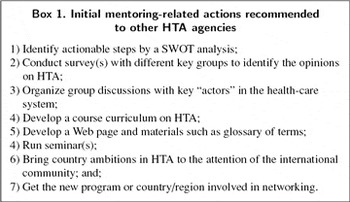
The type of mentoring following directly from this experience (see Box 1) may be useful for other HTA agencies interested in assisting countries like Romania in their efforts for implementing institutionalized HTA. This type of mentoring could also be useful for developing countries. However, the mentors and mentees should be aware that the mentoring actions need to be matched by local political and professional developments to ensure that the new HTA efforts are nurtured and sustained.
The link between Alberta and Romania evolved from initial contact at an international meeting followed by a willingness to take advantage of the opportunity to promote HTA in a country where it had not been introduced. The roles and responsibilities assumed by the Romanian initiative group and the Canadian HTA program were not based on a formal agreement. However, they emerged and were sustained without difficulties, based on the high motivation and commitment from both partners.
Several features of this mentoring process contributed to its success. Information and materials on HTA were provided free of charge and in a timely manner. Liaison and communication from the mentoring agency was coordinated by a person who was fluent in Romanian and had a clear understanding of the economic, social, and political conditions in the country. The relationship has been long-term, with collaboration now extending over several years. There has been continuous provision of reinforcement and encouragement for moving ahead.
A further feature was the experience by the AHFMR program in preparing various educational publications related to HTA and in providing hands-on experience in HTA for visitors from several countries. Through the Skills Development Program, the HTA Unit provides a 6-month professional development opportunity for professionals interested in learning about HTA process and methods, and those who want to become HTA producers and/or make HTA their careers (4;5).
The contact person for the Romanian initiative group obtained an extended placement at AHFMR (for a period greater than 6 months) and gained essential HTA knowledge and skills. The lack of progress in establishing an HTA presence in Romania has caused the individual to look to other places to apply the skills learned during the hands-on training in HTA. This finding raises a question with respect to the unrealistic raising of expectations of professionals in HTA through mentoring, which surpass the capacity or capability of the country to respond with a formal HTA program.
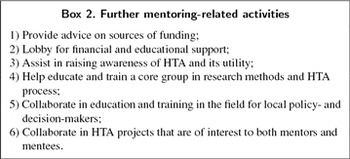
Despite this lack of progress, there is a need to continue the efforts to maintain the existing momentum and generate further momentum by developing actions and decisions that could shape and guide the future directions of HTA in Romania. Several mentoring-related services were identified as needed in the future to support the process of developing institutionalized HTA in this country (see Box 2).
Policy Implications
As a result of this mentoring process, there is now an increased opportunity to inform policy on health care in Romania through provision of advice formulated on the basis of HTAs undertaken within the country and appropriate information on health technologies from other nations. The need for HTA exists, and interest for developing a professional institution for this activity has been officially expressed. However, HTA in Romania is still early in its development process, and the efforts for developing institutionalized HTA in this country need to continue before it can be independently sustained.
Whereas mentoring has been a valuable initiative, it is not of itself sufficient to ensure successful provision of HTA in Romania on a sustainable and systematic basis. Other key requirements are the commitment toward HTA at the political level and the establishment of appropriate embedded organizational mechanisms and processes to inform decisions by government and other parties on the appropriate support and use of health-care technologies. These steps will need to be undertaken by those within Romania and informed by awareness of the context of the challenges facing the health system within the country.
The academic and applied research communities should be attracted and involved in the actions and decisions that could lead to implementing HTA in Romania. Once involved, they need to be provided with adequate encouragement and stimulation to maintain their commitment. If the pace of change becomes intractably slow, however, researchers and academics with essential skills and knowledge may lose their interest in the project and look for alternative satisfying opportunities.
CONTACT INFORMATION
Paula Corabian, BSc, MPH (Paula.Corabian@ahfmr.ab.ca), Health Technology Assessment Unit, Alberta Heritage Foundation for Medical Research, Suite 1500, 10104–103 Avenue, Edmonton, Alberta T5J 4A7, Canada
David Hailey, PhD (dhailey@ozemail.com.au), Adjunct Professor, Department of Public Health Science, University of Alberta, 13-130 Clinical Sciences Building, Edmonton, Alberta T6G 2G3; Senior Advisor, Health Technology Assessment Unit, Alberta Heritage Foundation for Medical Research, 10104–103 Avenue, Suite 1500, Edmonton, Alberta T5J 4A7, Canada
Christa Harstall, BSc, MLS, MHSA (Christa.Harstall@ahfmr.ab.ca), Assistant Director, Don Juzwishin, BA, MHSA (Don.Juzwishin@ahfmr.ab.ca), Director Carmen Moga, MD (Carmen.Moga@ahfmr.ab.ca), Research Associate, Health Technology Assessment Unit, Alberta Heritage Foundation for Medical Research, 10104–103 Avenue, Suite 1500, Edmonton, Alberta T5J 4A7, Canada
We thank the following individuals for their assistance and support in the various activities that have been made possible by their involvement: Romania: Dr. Dan Enachescu, Department of Public Health and Management, University of Medicine and Pharmacy “Carol Davila”, Bucharest; Dr. Sorin Oprescu, College of Physicians, Bucharest; Dr. Tiberiu Stania, College of Physicians, Bucharest; Dr. Emanuil Stoicescu, College of Physicians, Bucharest. International: Ms. Liza Chan, Librarian, Alberta Heritage Foundation for Medical Research, Edmonton, Canada; Dr. Devidas Menon, Public Health Sciences, University of Alberta, Edmonton, Canada; Ms. Leigh-Ann Topfer, Canadian Coordinating Office for Health Technology Assessment, Ottawa, Canada. The Health Technology Assessment Unit at the Alberta Heritage Foundation for Medical Research is funded by Alberta Health and Wellness through a health research collaboration agreement.
References
Attinger EO,
Panerai RB.
1988
Transferability of health technology Assessment with particular emphasis on developing countries.
Int J Technol Assess Health Care.
4:
545–
554.Google Scholar
Gibis B,
Artiles J,
Corabian P, et al.
2001
Application of strengths, weaknesses, opportunities and threats analysis in the development of a technology assessment program.
Health Policy.
58:
27–
35.Google Scholar
Moga C,
Corabian P,
Harstall C, et al.
2003
Developing health technology assessment in Romania.
Eurohealth.
9:
30–
34.Google Scholar
Wanke M.
2003
Review of health technology assessment skills development program.
HTA initiative #12. Alberta, Canada:
Alberta Heritage Foundation for Medical Research;
December
Wanke M,
Juzwishin D.
2005
International comparison and review of a health technology assessment skills program.
Int J Technol Assess Health Care.
21:
253–
262.Google Scholar
Initial mentoring-related actions recommended to other HTA agencies
Further mentoring-related activities
 You have
Access
- 9
- Cited by