Implications
Food Harvest 2020, the sectoral development plan for Irish agriculture, proposes substantial increases in output in the period 2015 to 2020. This includes a 50% increase in dairy output and 20% increase in beef value. In the same time frame, there is a national objective to reduce greenhouse gas emissions. For these two objectives to be compatible, there is a need to achieve significant reductions in the carbon intensity at farm level. The Carbon Navigator is a decision support system designed to engage farmers in improving production efficiency, improving carbon efficiency and increasing income.
Introduction
Arguably, the greatest challenge faced by ruminant agriculture throughout the world is how to reduce its greenhouse gas (GHG) emissions. Globally, agriculture is responsible for 13.5% of the total anthropogenic GHG emissions (Pachauri and Reisinger, Reference Pachauri and Reisinger2007). In Ireland, the contribution of agriculture is higher than this, representing 29.7% of the emissions from the non-emission-traded sector (Duffy et al., Reference Duffy, Hanley, Hyde, O'Brien, Ponzi, Cotter and Black2012). In recent years, researchers have made significant progress in identifying and quantifying the sources of GHG emissions in agriculture and in understanding the complex biological and chemical pathways and interactions involved. This knowledge is being used to assist in identifying potential technologies and practices that are implementable at farm level to mitigate GHG emissions. Complex though it may be, the generation of this knowledge may prove to be the easier part of the task of achieving increases in the carbon efficiency of our food products. Achieving technology uptake at farm level is required to translate these scientific insights into reduced emissions from the agricultural sector. The Carbon Navigator is an online decision support system to assist farmers in assessing their current performance in relation to GHG mitigation and to chart a pathway to lower emissions.
In a report commissioned by the Irish Minister for Environment, Heritage and Local Authorities, the National Economic and Social Council (NESC) outlines its vision:
That Ireland will be a carbon-neutral society by 2050, based on an approach to economic development that is socially and environmentally sustainable (National Economic and Social Council, 2012).
To achieve that vision, the report looks towards a ‘Carbon-neutral Agriculture’:
A world-class agri-food sector working within a carbon-neutral system of agriculture, forestry and land use … achieved by pushing scientific research and probing farming practice to identify further means of reducing emissions.
This vision gives a clear mandate to a twin-track approach in agriculture of developing the technologies and knowledge required to reduce GHG emissions and ensuring that those technologies are adopted by farmers. It is now recognised at the European level that the performance of our agricultural knowledge and innovation systems have been strong in relation to the generation of basic science, but less successful in ensuring the adoption of that knowledge by ensuring that knowledge is tailored to the needs of the farming sector, fully incorporated into viable production systems and supported effectively (Gaudin et al., Reference Gaudin, Cassingena-Harper, Anania, Cuhls, Downey, Leyten, Olesen, Schenkel, Walls and Raspor2007). There is now a requirement to use the knowledge that has been generated to achieve a lowering of the carbon intensity of out-agricultural output. This is particularly important in the Irish context where the sectoral development initiative ‘Food Harvest 2020’, with its objectives of ‘Smart Green Growth’, aims to grow agricultural output in a verifiably sustainable manner (Department of Agriculture Fisheries and Food, 2010).
The Carbon Navigator has been developed to promote the uptake of carbon-efficient farming and has emerged from a collaboration between Teagasc (The Agriculture and Food Development Authority, responsible for agriculture and food research, extension and training in Ireland) and Bord Bia (The Irish Food Board, responsible for the export marketing of Irish food). A substantial body of scientific work has been carried out by Teagasc and other national and international researchers in relation to GHG emissions from Irish Agricultural systems. Foley et al. (Reference Foley, Crosson, Lovett, Boland, O'Mara and Kenny2011) point out that Irish beef, sheep and dairy production systems differ from most other countries with respect to their utilisation of grass (including grass conserved as hay or silage), which amounts to about 90% of the annual feed budget. As a result, there was a need to develop models for GHG emissions from Irish systems of production. To this end, Crosson et al. (Reference Crosson, Shalloo, O'Brien, Lanigan, Foley, Boland and Kenny2011) undertook and published a review of whole-farm system models of GHG emissions from beef and dairy cattle production systems.
The case for adopting a whole-farm approach is strongly made by Crosson et al. (Reference Crosson, Shalloo, O'Brien, Lanigan, Foley, Boland and Kenny2011). Intergovernmental Panel on Climate Change (IPCC) reporting protocols include GHG emissions that arise in agricultural systems in three IPCC sectors, namely, agriculture, land-use change and forestry and energy (IPCC, 1997). Furthermore, indirect emissions may also arise in the industrial processes and waste categories and may be generated outside of the national boundaries and therefore not included. Because of limitations of the IPCC methodology for representing farm-level emissions, a whole-farm modelling approach is widely used. Crosson et al. (Reference Crosson, Shalloo, O'Brien, Lanigan, Foley, Boland and Kenny2011) concluded that, although guidelines developed and published by IPCC will continue to be the primary methodology for reporting national emissions, there are a number of shortcomings with the IPCC methodology with regard to modelling whole-farm systems. In developing and assessing and implementing mitigation policies to reduce GHG emissions from livestock systems, whole-farm modelling provides a most robust and comprehensive framework to policymakers and other stakeholders.
Foley et al. (Reference Foley, Crosson, Lovett, Boland, O'Mara and Kenny2011) presented results that demonstrated a substantial difference in GHG emissions between average farm conditions (National Farm Survey scenario) and research farm conditions in Ireland. On a per unit area basis, higher levels of production and associated inputs result in much greater emissions for the research farm scenarios. However, when expressed per kg beef carcass weight, the research farm scenarios have much lower emissions, in the order of 15% to 18% for steer and bull systems, respectively. These reductions are brought about by increased animal performance and increased fertiliser use efficiency. These findings present a dilemma for national policymakers seeking to meet targets for the reduction of national emissions. They present an alternative approach to GHG mitigation, which focuses on efficiency as opposed to one that reduces agricultural output. Policies and efforts to incentivise abatement of GHG emissions should ensure that efforts to reduce national GHG emissions from agriculture do not lead to an inadvertent increase in global GHG emissions through carbon leakage (Schulte et al., Reference Schulte, Lanigan, Donnellan, Crosson, Shalloo, O'Brien, Farrelly, Finnan, Gibson, Boland, Boyle, Carton, Caslin, Culleton, Fealy, Fitzgerald, Hanrahan, Humphreys, Hyde, Kelly, Lalor, Maher, Murphy, Ni Fhlatharta, O'Donoghue, O'Kiely, O'Mara, Richards, Ryan and Spink2011). The impact of rising food demand means, other things being equal, that a reduction in food production in Ireland to meet national GHG reduction targets would result in increased food production elsewhere. This can result in a net increase in global GHG emissions, if the countries expanding food production were unable to produce food with an emission intensity that is as low as in Ireland.
Mitigation strategies for Irish agriculture
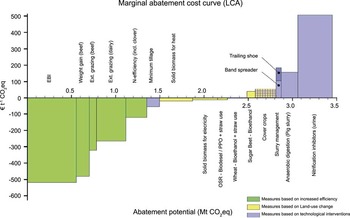
There is a significant challenge in achieving reductions in the emissions of the main GHGs associated with ruminant agriculture, namely, methane (CH4), nitrous oxide (N2O) and, to a lesser extent, carbon dioxide (CO2). A marginal abatement cost curve (MACC) for the ruminant-dominated Irish agriculture was prepared by Schulte et al. (Reference Schulte, Crosson, Donnellan, Farrelly, Finnan, Lalor, Lanigan, O'Brien, Shalloo and Thorne2012), focusing on the biophysical abatement potential of a range of potential measures (Figure 1). It highlights three categories of mitigation measures: (a) Measures based on efficiency improvements, (b) measures based on land-use change and (c) measures based on technology intervention. It was found that the achievable efficiency measures had a capacity to deliver 1.35 Mt carbon dioxide equivalents (CO2e) on a substantially cost-negative basis, land-use change had a potential to deliver a further 1.0 Mt CO2e in a range from a slight negative to neutral cost and a further 0.3 Mt CO2e within the uncertainty range of the projected 2020 international market price of carbon credits. Finally, ∼0.6 Mt CO2e was accounted for by technological intervention measures considered to be cost prohibitive.
Marginal abatement cost curve for Irish agriculture, using LCA analysis. Colours indicate measures on the basis of efficiency land-use change and technological interventions. Source: (Schulte et al., Reference Schulte, Crosson, Donnellan, Farrelly, Finnan, Lalor, Lanigan, O'Brien, Shalloo and Thorne2012). LCA = Life Cycle Assessment.

Having identified the potential mitigation options for Irish agriculture, the emphasis needs to shift to how these mitigation options can be ‘implemented’ to achieve the potential abatement. Lovett et al. (Reference Lovett, Shalloo, Dillon and O'Mara2006) noted that controlling GHG emissions from livestock production enterprises will prove difficult unless one of two scenarios exists. Either financial incentives are provided by national governments to support and encourage change, or there is a capability to display that adjustment within the present management system can not only reduce the amount of GHG emissions produced but will also increase farm profitability. Applying this observation to the potential technologies that can deliver emission reduction in Irish agriculture can give some direction to the policies and actions required to achieve outcomes.
To date, policymakers have used a mixture of regulation and incentivisation to achieve environmental outcomes in agriculture. The main actions include the development of a body of EU directives, which are supported by national policy instruments, the establishment of cross-compliance to link environmental compliance to the entitlement for direct payments and the implementation of agri-environmental measures designed to encourage farmers to protect and enhance the environment on their farmland to deliver environmental services above that required by legislation in return for financial reward (European Commission, 2005). Currently, the statutory management requirements and good agricultural and environmental condition provisions of cross-compliance do not contain any provisions, specifically relating to gaseous emissions. Climate protection is not an objective of the current cross-compliance policy, although several cross-compliance standards have the potential to affect GHG emissions through reducing N losses or increasing the function of soils as sinks for carbon (Osterburg et al., Reference Osterburg, Nitsch, Laggner, Wagner and von Thünen2008). The proposed ‘Greening Measures’ (Ecological Focus Area, Crop Diversification and Permanent Grassland) under consideration, as part of the review of the Common Agricultural Policy (CAP), focus to some degree on reducing GHG emissions by limiting the conversion of permanent grasslands to arable land, and thus reducing soil carbon (C) losses. However, van Zeijts et al. (Reference van Zeijts, Overmars, van der Bilt, Schulp, Notenboom, Westhoek, Helming, Terluin and Janssen2011) predict that, across the 27 EU member states, a 1.6% reduction in agricultural GHGs will be achieved as a result of the greening measures, but will lead to reductions in output ranging from 0.2% for milk, 4% for cereals and 5% for oilseeds. Broadly, in agreement with this, Westhoek et al. (Reference Westhoek, van Zeijts, Witmer, van den Berg, Overmars, van der Esch and van der Bilt2012) predict that greening measures may lead to a reduction of 2% in EU agricultural GHG emissions, but to an increase in these emissions outside the EU because of imports.
Pillar 2 measures of the CAP including agri-environmental schemes that have also had marginal impact with respect to reducing emissions. Potential future agri-environmental schemes have little prospect of delivering significant outcomes without a very fundamental change in the principles governing agri-environmental schemes. A guiding principle of EU-funded schemes is that the calculation of premia is based on the cost incurred and income foregone by the farmer for participating in the agri-environmental measure (European Commission, 2005). That report conceded that, with regard to incentive measures, there is a lack of more flexible mechanisms aimed at increasing efficiency of agricultural production. For example, the efficiency measures identified in the MACC curve are presently excluded from agri-environmental scheme supports.
The exploitation of the efficiency measures will therefore be largely on the basis of the adoption by farmers of these measures in order to achieve the additional income earning capacity that they provide. However, the availability of scientific knowledge is not, on its own, a sufficient prerequisite to ensuring the uptake of appropriate technologies at farm level. This was pointed out by Standing Committee on Agricultural Research (SCAR, European Union; Gaudin et al., Reference Gaudin, Cassingena-Harper, Anania, Cuhls, Downey, Leyten, Olesen, Schenkel, Walls and Raspor2007) who observed that there is a need to invest more seriously in knowledge transfer (KT) and knowledge exchange measures to ensure that knowledge exchange forms an integral part of research activity and that research results are translated into useful, easy-to-understand and easy-to-apply knowledge for the end users, namely, farmers and rural communities and the public at large. The Carbon Navigator has been developed as a tool to be used as part of the KT activities of Teagasc to improve the uptake by farmers of a series of technologies, which will improve efficiency and income, while at the same time reducing GHG emission intensity. The challenge for policymakers is to ensure that support is given to KT systems and initiatives to accelerate the uptake of efficient, profitable carbon-mitigating technologies.
The need to develop the Carbon Navigator
A recent study by the EU commission (Leip et al., Reference Leip, Weiss, Wasenaar, Perez, Fellmann, Loudjami, Tuiello, Grandgirard, Monni and Biala2010) highlighted the GHG efficiency of Irish agricultural products. The report rated Irish milk as the most carbon efficient and Irish beef as the fifth most efficient in the EU using Life Cycle Assessment (LCA) methodology (British Standards Institution (BSI), 2008). This efficiency is because of Ireland's temperate grass-based production systems. Irish products also compare favourably on a worldwide basis (FAO, 2010). There is, however, an awareness of the challenges ahead. Ireland is committed to a 20% reduction in GHG emissions from the non-emission-traded sectors, which include agriculture. Agricultural emissions account for ∼30% of Ireland's non-traded emissions. At the same time, ‘Food Harvest 2020’ (Department of Agriculture Fisheries and Food, 2010) sets out ambitious growth targets for the agri-food sector, particularly for the dairy sector after the abolition of milk quotas in 2015. Meeting these growth targets, while at the same time reducing Ireland's agricultural carbon footprint (a measure of the exclusive total amount of CO2 emissions that is directly and indirectly caused by an activity or is accumulated over the life stages of a product (Wiedmann and Minx, Reference Wiedmann and Minx2008)), in the context of emerging national and international policy and regulations, will require a coordinated effort across the industry.
Ireland, as a significant exporter of agricultural products, is also subject to the requirements of international markets that increasingly require that food is produced sustainably. A key measure of this relates to its carbon footprint. Processors have been responding to this challenge by initiating projects to measure the carbon footprint of Irish food products and examining ways in which it could be reduced, particularly at farm level. Demonstrably improving the carbon efficiency of our food products is seen as essential, if Ireland is to maintain and enhance its green image and capitalise on the potential for improving returns from the marketplace. This is emphasised by many of the major international buyers:
This agenda of sustainability and corporate responsibility is not only central to business strategy but will increasingly become a critical driver of business growth. Patrick Cescau, CEO of Unilever (Epstein, Reference Epstein2008)
The Carbon Navigator was developed as a joint initiative between Teagasc and Bord Bia. It is a tool with a simple objective and modus operandi. It is designed to assess the level of adoption of technologies that have been proven to reduce GHG emissions on farms, to communicate with the farmer how he/she is performing and to give clear targets for future improvement. The Carbon Navigator differs from a number of other systems such as HOLOS in Canada and Overseer in New Zealand, in that it does not attempt to provide an overall calculation of GHG emissions on the farm. Full emission calculations would substantially increase the complexity of tool, increase the data requirements to carry out the analysis in general and render it too cumbersome and bureaucratic to be a widely used and effective in respect of its primary objectives of KT and promoting practice adoption. Instead, it focuses on ‘distance to target’ by assessing current performance, comparing that performance with average and best performing farmers operating under similar geo-environmental conditions and setting practice adoption and efficiency targets to be achieved over a 3-year period.
The collaborative approach in developing the Carbon Navigator was adopted for pragmatic reasons, on the basis of the strengths of both organisations to bring key components of the overall system together.
• Teagasc has been working with Bord Bia to develop whole-farm system carbon audit programmes to estimate the GHG emissions of Irish dairy and beef enterprises. These programmes have been developed on the basis of previously constructed models of GHG emissions from Irish beef (Foley et al., Reference Foley, Crosson, Lovett, Boland, O'Mara and Kenny2011) and dairy (O'Brien et al., Reference O'Brien, Shalloo, Buckley, Horan, Grainger and Wallace2011) production systems, and the overall approach has been accredited by Carbon Trust UK according to British Standard PAS (Publicly Available Specification) 2050.
• Teagasc has a significant research programme on measuring sources and evaluating potential GHG mitigation options on Irish Farms and has adopted lead roles in international initiatives such as the Global Research Alliance on Agricultural Greenhouse Gases and the Agriculture, Food Security and Climate Change, Joint Programming Initiative.
• Teagasc provides a comprehensive KT support to Irish farmers, particularly the more commercially focused sector of the primary agricultural industry and has the capacity to integrate the Carbon Navigator with existing programmes.
• Bord Bia has developed a database infrastructure for the operation of its quality assurance (QA) systems, which is derived from the data collection for QA and linkages to other national databases. This provides the database for the delivery of the Carbon Navigator.
• Bord Bia, through its marketing activity, provides a capability to capitalise on the improvements in terms of market returns to farmers and, in doing so, provides a collective and individual incentive for farmers to engage.
The synergies between the two organisations in relation to resources and competencies have facilitated the development of the Carbon Navigator as a decision support system, which can be extremely efficient in terms of data collection and utilisation, while having a capacity for widespread utilisation.
Data collection and utilisation
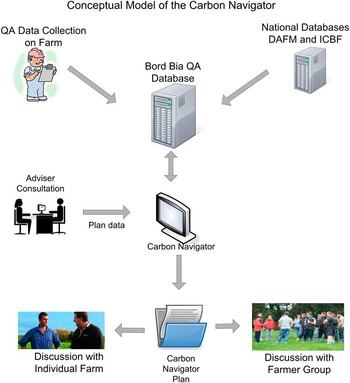
Bord Bia has developed and operates QA schemes for all the major farm enterprises in Ireland, into which it has integrated a sustainability component. It has developed a comprehensive data collection process, secured access to key national databases, Animal Identification and Movement System (AIM) from Department of Agriculture Food and the Marine (DAFM), and the animal genetic and breeding information from the Irish Cattle Breeding Federation (ICBF), and developed an IT infrastructure to support these schemes. The Carbon Navigator has been developed as an extension to this infrastructure. The data collection for the QA schemes is carried out by a team of farm auditors visiting each farm at a maximum interval of 18 months. The auditor gathers core food assurance, sustainability and animal health and nutrition information and now, additionally, captures data specifically relating to the Carbon Navigator. The system has access to comprehensive data on land use, animal breeding and animal movement through DAFM and ICBF databases. These data provide the basis for the computation of the performance of the farmer in relation to each criterion. The system is accessed online by the farmer and his/her adviser/consultant in an exercise, focusing on assessing the potential of the farm to improve technical performance, establishing the targets for planned improvements and computing the potential outcomes in terms of reducing emission intensity and improving financial performance. Figure 2 outlines the data and knowledge flows involved in the operation of the Carbon Navigator.
Conceptual model of the Carbon Navigator. ICBF = Irish Cattle Breeding Federation; QA = quality assurance.

Criteria included in the Carbon Navigator
The Carbon Navigator is a KT tool aimed at improving the carbon efficiency of Irish agricultural output and improving the sustainability credentials of produce. Importantly, the tool does not count the overall level of emissions associated with a farm for two reasons:
1. The effort involved in farm carbon counting would be substantial.
2. The presentation of a carbon footprint figure for beef and milk produced on Irish farms would have little impact in achieving adoption of those technologies that have a capacity to reduce emissions.
Instead, the approach taken in the Carbon Navigator is to provide an analysis of performance relative to peers, with regard to a relatively small number of key performance indicators, to provide an opportunity to set targets for improvement in these indicators and to incentivise the achievement of these targets by demonstrating the combined benefits in terms of emission reductions and improvement in financial outcomes. This ‘distance to target’ approach is adopted to incentivise the achievement of outcomes. The interaction of the farmer with the system takes place in conjunction with the broader KT process aimed at improving technical and financial performance and as such acts to reinforce existing objectives. The assessment of emission reduction within the system is based on reduction in the emission intensity of agricultural output, rather than on reduction of the overall emissions from the farm. The metrics used are kg CO2e/kg beef live weight and kg CO2e/kg milk solids (fat and protein).
The selection of measures to be used in the navigator is based on a series of criteria. These are:
• Measures lead to scientifically verifiable reductions in GHG emission intensities.
• A preference was given to measures that reduce national emissions, which can be included in current IPCC-based national inventory accounting.
• Measures can be easily adopted by farmers.
• Measures provide an economic benefit to farmers.
• Measures are compatible with existing enterprise KT priorities.
• Measures have to be quantifiable with respect to the degree of practice adoption and the impact of the adoption on GHG emissions.
The Carbon Navigator is based on a body of science that relates to Irish circumstances, has been peer reviewed and represents the current best knowledge on the relationships between farm practice and GHG emissions. The Carbon Navigator is designed on a modular basis with a flexible interface, which facilitates the updating of emission criteria, and the inclusion in the future of additional measures, which are supported scientifically. Two versions of the programme have been developed in the initial phase, the Beef Carbon Navigator and the Dairy Carbon Navigator. The Carbon Navigator focuses on the following technologies to mitigate emissions at farm level.
• Grazing season length – beef and dairy
• Calving rate – beef
• Economic Breeding Index (EBI) – dairy
• Live-weight gain – beef
• Age at first calving for replacement heifers – beef
• Nitrogen use efficiency – beef and dairy
• Slurry application – beef and dairy
• Electricity use – dairy
In an Irish context, increasing the grazing season length lowers GHG emissions through two main mechanisms. Firstly, grass grazed in situ in the early and late grazing season is a higher-quality more digestible feed than the grass silage, which is the main feed, once animals are housed. The higher digestible feed leads to improvements in animal productivity as well as reductions in the proportion of dietary energy lost as methane and a reduction in methane per unit of output (O'Neill et al., Reference O'Neill, Deighton, O'Loughlin, Mulligan, Boland, O'Donovan and Lewis2011). The shorter housing season also leads to reduced slurry methane (CH4) and nitrous oxide (N2O) emissions from storage, as quantities stored will be lower. Fuel emissions are lower as a result of reduced forage harvesting, lower feeding out requirements and lower fuel usage in organic manure application. These reductions are partly offset by higher pasture, paddock and range emissions from direct deposition during grazing. (Schulte et al., Reference Schulte, Crosson, Donnellan, Farrelly, Finnan, Lalor, Lanigan, O'Brien, Shalloo and Thorne2012). O'Brien et al. (Reference O'Brien, Shalloo, Patton, Buckley, Grainger and Wallace2012) qualify that the GHG emission computation per unit of product using the IPCC method indicated that the grass system had higher emissions, but that under the LCA computation approach, which includes emissions generated outside the jurisdiction, the grass system had lower emissions used in the Carbon Navigator. The overall estimate for reductions in GHG emissions in beef systems related to increased grazing season length is 0.09%/kg beef carcass per additional day (Foley et al., Reference Foley, Crosson, Lovett, Boland, O'Mara and Kenny2011). In dairy systems, the reduction is estimated at 0.17% (Lovett et al., Reference Lovett, Shalloo, Dillon and O'Mara2008). The economic impact is estimated at €1.54 and €0.095 per day per livestock unit for suckler cows and followers, respectively (Crosson et al., Reference Crosson, McGee and Drennan2009a and Reference Crosson, McGee and Drennan2009b), and €2.70 per cow per day in dairy (Dillon, Reference Dillon2006).
On a significant number of Irish farms, there is a scope for improvement in the performance with respect to calving rate. Figures from the ICBF indicate that the average calving rate on recorded Irish suckler herds is 0.84 calves per cow per year, with the top 10% recording a rate of 0.93. Given that the suckler cow is a significant environmental ‘overhead’ (in the order of 70 to 80 kg methane per annum), higher calving rates will reduce the GHG emissions burden per kg beef produced. The BeefGEM model (Foley et al., Reference Foley, Crosson, Lovett, Boland, O'Mara and Kenny2011) indicates a GHG emission reduction factor of 0.8%/kg beef carcass per percentage unit increase in calving rate. The economic impact is €8.60 per Livestock unit per 1% increase in calving rate (Crosson and McGee, Reference Crosson and McGee2012).
EBI is the Irish Economic Breeding Index, a ‘single figure profit index’ aimed at helping dairy farmers to identify the most profitable bulls and cows for breeding herd replacements. It comprises information on sub-indexes related to profitable milk production in an Irish context. Increasing genetic merit via EBI has the capacity to reduce emission intensities through four mechanisms (O'Brien et al., Reference O'Brien, Shalloo, Buckley, Horan, Grainger and Wallace2011). Improving fertility reduces calving intervals and replacement rates, thus reducing enteric CH4 emissions per unit of product. Increasing milk yield per unit of grazed grass and improving milk composition increases the efficiency of production, which decreases emissions. Earlier calving increases the proportion of grazed grass in the diet and reduces culling and replacement rates. Improved survival and health reduces deaths and disease incidences, reduces replacement rates and emissions. The GHG model results (O'Brien et al., Reference O'Brien, Shalloo, Buckley, Horan, Grainger and Wallace2011) showed that GHG emissions per unit of product are reduced by 2% for every €10 increase in EBI. By definition, improving the EBI by €1 increases the profitability per dairy cow by €1.
Achieving improved live-weight gain for Irish beef production systems was found by Casey and Holden (Reference Casey and Holden2006) and Foley et al. (Reference Foley, Crosson, Lovett, Boland, O'Mara and Kenny2011) to be an important strategy for reducing GHG emission per kg of beef produced. The impact of improved average lifetime daily gain for beef production systems is to dilute the GHG emission association with production. Absolute GHG emissions, which are related to enteric fermentation, feed provision and manure management, increase on a per animal basis, as the quantities of feed consumed and manure produced are greater. However, GHG emissions per unit of beef produced are reduced, as the greater quantities of beef produced more than offset the increase in GHG emissions. The impact of increased weight gain on GHG emissions is estimated at 0.01% per kg beef carcass per g increase in lifetime average daily gain for beef cattle systems, whereas the economic impact is estimated at €0.63 per g per day (Schulte et al., Reference Schulte, Crosson, Donnellan, Farrelly, Finnan, Lalor, Lanigan, O'Brien, Shalloo and Thorne2012).
The average age at first calving for replacement heifers on Irish suckler herds is 30.5 months, whereas the top 10% of herds achieve an average figure of 26 months. Higher age at first calving increases the lifetime emission burden of the cow and, correspondingly, the emissions per kg of beef produced through enteric fermentation, feed energy and manure management emissions. It is estimated that the impact of age at first calving is to increase GHG emissions by 0.01%/kg beef carcass for each day that first calving is greater than 24 months of age where the baseline replacement rate is 20% (Foley et al., Reference Foley, Crosson, Lovett, Boland, O'Mara and Kenny2011). The economic impact is estimated at €1.65 per day per suckler cow in the herd (ICBF, 2012)
Nitrogen use efficiency is derived from a number of measures including the use of clover in swards, better nutrient management planning, improvements in the timing and application of fertiliser nitrogen and the application of the most appropriate N-fertiliser type for the prevailing conditions. The potential GHG abatement derives from reduced N2O emissions and also from reduced energy use in the production, transportation and application of chemical fertiliser (Schulte et al., Reference Schulte, Crosson, Donnellan, Farrelly, Finnan, Lalor, Lanigan, O'Brien, Shalloo and Thorne2012). The impact of nitrogen efficiency in the Carbon Navigator is based on a computation of output per kg of nitrogen fertiliser used on the farm and the relative proportions of calcium ammonium nitrate and urea in the fertiliser use mix. The computation is based on LCA figure including emissions related to both the manufacture of Nitrogen and emissions on application and amount to 8.57 and 12.18 kg CO2 eq/kg N for Urea and calcium ammonium nitrate, respectively (Foley et al., Reference Foley, Crosson, Lovett, Boland, O'Mara and Kenny2011) (Wood and Cowie, Reference Wood and Cowie2004). The economic benefit is based on the reduction in chemical N usage corrected for feed-N usage and live-weight output.
Improving manure management can reduce the GHG emissions associated with manure through a transition from summer application to spring application of manure and the use of low-emission application methods. Spring application reduces NH3 emissions following land spreading owing to the more favourable weather conditions at that time of the year. Storage losses are also reduced because of the shorter storage period (Lalor and Lanigan, Reference Lalor and Lanigan2010). The reduced NH3 losses also increases the fertiliser replacement value of slurry, and therefore reduces the total fertiliser-N inputs and reduces associated NH3 emissions from soil and CO2 emissions from fertiliser manufacture (accounted for in chemical-N usage). Low emission application technologies such as the band-spreader or trailing shoe also leads to reduced NH3 losses and increases the fertiliser replacement value of slurry (Dowling et al., Reference Dowling, Hyde, Carton, Curran and Lanigan2013). The computation of potential emission reduction is based on a calculation of the reduction in storage losses plus application losses on the basis of spring application combined with any reduction associated with the use of low emissions spreading technology. The economic benefit is computed on the basis of the additional replacement value of organic manure valued at chemical N-fertiliser cost.
Energy usage accounts for a relatively small amount of total system emissions on dairy farms. However, they can be significantly reduced, thereby reducing system emissions. In a detailed examination of 21 farms, Teagasc research found that electricity consumption ranged from 53 to 108 W/l produced and cost from 0.23 to 0.76 cent/l produced. Three key areas were identified as having significant potential to reduce energy costs and energy-related emissions. These were the effective pre-cooling in a plate heat exchanger, the use of variable speed drive vacuum pumps and the presence of energy-efficient water heating systems. Emission reductions and costs are computed on the basis of energy savings.
Some of the criteria outlined above are interdependent. For example, one of the impacts of extending the grazing season is a reduction in the volume of slurry reduced and thereby a reduction in the emissions related to slurry storage and application. However, in such cases, the reduction is related to the causal factor, that is, extended grazing season and not included in the computation related to slurry storage and application. The impact of some mitigation options are complex and influence a variety of emissions pathways, some positively and others negatively. In the studies, on which the Carbon Navigator is based, the complexity of these pathways is considered and the net impact computed and utilised. The potential interactions between multiple mitigation actions are not fully accounted for in the model unless these interactions are significant.
Knowledge transfer
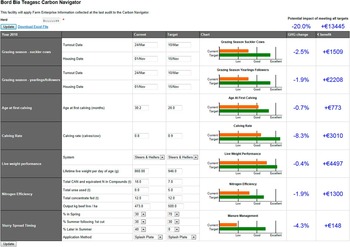
The Carbon Navigator is a KT tool. Each mitigation measure is assessed and a common approach is used to present the information to the farmer. The objective of the output is to communicate to the farmer that, by improving performance or adopting a technology, GHG emissions can be reduced and profitability increased for the farm enterprise under analysis. Figure 3 displays the key components of the output. Current performance and targets for future performance are presented in both numeric and graphic forms, with the emphasis on comparison with peers and on demonstrating the scope for emission mitigation and improved financial outcomes through improved performance. This highlights scope for change at farm level. The combined emissions and financial impact are also presented. This summary page brings the outputs of the component technologies together in a single output. A more detailed output is available for download. This provides a more comprehensive overview of the data set and of the computations (Supplementary Figure S1).
Example of a Carbon Navigator output screen.

Uptake of the system and subsequent adoption of the measures outlined will be the key indicators of success of the Carbon Navigator. The utilisation of the Carbon Navigator will primarily be achieved through introducing it into the Famer Discussion Groups operated by Teagasc and other farm consultants in Ireland. The discussion group is the primary methodology used by Teagasc to transfer knowledge to farmers. A recent study showed that participation in dairy discussion groups had a positive impact on technical and financial management. (Teagasc, 2013). The potential impact of discussion groups has been recognised by policymakers. Increased involvement by farmers in discussion groups is being supported through the implementation of three schemes by the Department of Agriculture, Food and the Marine: the Dairy Expansion Programme (DEP), the Beef Technology Adoption Programme (BTAP) and the Sheep Technology Adoption Programme (STAP). These schemes have led to a more than doubling of discussion group membership to ∼16 000 farmers. The Carbon Navigator has been incorporated into the BTAP scheme as one of the KT project options to be undertaken by each participant and has been established as a key activity for dairy groups. The discussion groups provide an effective format to raise the awareness of farmers of the importance of emission reduction and of the mitigation potential of each member farm.
Given that the Carbon Navigator planning data will be stored in a single database, along with a considerable volume of technical and social date, there will be an opportunity for advisers and researchers to interrogate the data over a period to provide insights into practice at farm level.
Conclusion
Agriculture is the biggest sectoral contributor to GHG emissions in Ireland. The likely emergence of more stringent-binding international obligations, combined with the increasing demand from food purchasers to lower the carbon footprint of the product they buy, make it imperative that Irish farmers become more carbon efficient. This is a significant challenge for a sector that is dominated by ruminant agriculture. EU agricultural and environmental policy has, for the most part, failed to address the issue of reducing agricultural emissions, and the imminent reform of the Common Agriculture Policy is unlikely to substantially change this. Research has identified substantial mitigation potential and continues to increase the allocation of resources to research on verifiable reduction in emissions. It is essential that the uptake of these mitigation technologies at farm level is maximised through the implementation of effective policy to support KT and adoption of best practice, through the development of effective KT decision support systems and through ensuring that sufficient resources are put in place to assist farmers in developing the required knowledge and skills.
The Carbon Navigator is designed to support the uptake of emission reduction practices and technologies at farm level. It is designed to be used both with individual farmers and as a tool to support farm discussion groups. It is relatively simple to use to provide pointers to farmers on how they might improve their emission intensities, while at the same time improving their income. In the context of its use with farmer discussion groups, it is designed to play a part in raising the awareness of farmers about the issue of GHG emissions and to educate them on potential pathways to achieve reductions.
Acknowledgements
This paper was published as part of a supplement to animal, publication of which was supported by the Greenhouse Gases & Animal Agriculture Conference 2013. The papers included in this supplement were invited by the Guest Editors and have undergone the standard journal formal review process. They may be cited. The Guest Editors appointed to this supplement are R. J. Dewhurst, D. R. Chadwick, E. Charmley, N. M. Holden, D. A. Kenny, G. Lanigan, D. Moran, C. J. Newbold, P. O'Kiely and T. Yan. The Guest Editors declare no conflict of interest.