INTRODUCTION
Selection of food items by herbivorous mammals is influenced by a number of factors, including resource availability (Oates Reference OATES1978, Vedder Reference VEDDER1984), feeding competition (Illius & Gordon Reference ILLIUS and GORDON1992, Janson Reference JANSON1988), body size (Belovsky Reference BELOVSKY1997, Hanley Reference HANLEY1982, Illius & Gordon Reference ILLIUS and GORDON1992, Nakagawa Reference NAKAGAWA2003), digestive physiology (Hume Reference HUME1999, Milton Reference MILTON1998), energy requirements (DaSilva Reference DASILVA1992, Torres-Contreras & Bozinovic Reference TORRES-CONTRERAS and BOZINOVIC1997) and nutritional composition (Chapman & Chapman Reference CHAPMAN and Chapman2002, Fashing et al. Reference FASHING, DIERNFELD and MOWRY2007, Ganas et al. Reference GANAS, ORTMANN and ROBBINS2009, Kavanagh & Lambert Reference KAVANAGH and LAMBERT1990, Milton Reference MILTON1979, Silver et al. Reference SILVER, OSTRO, YEAGER and DIERENFELD2000, Willig & Lacher Reference WILLIG and LACHER1991, Yeager et al. Reference YEAGER, SILVER and DIERENFELD1997). However, as the plant foods consumed by folivores rarely contain all of the essential nutrients required for survival and reproduction, nutritional composition is of particular importance (Milton Reference MILTON1980). For folivorous marsupials, food selection has been tied to the avoidance of plant secondary metabolites (Kavanagh & Lambert Reference KAVANAGH and LAMBERT1990, Lawler et al. Reference LAWLER, FOLEY, ESCHLER, PASS and HANDASYDE1998). Folivorous primates, however, tend to select foods that maximize protein and limit fibre intake. Foods high in non-digestible fibre slow digestion and decrease protein uptake, making foods with high protein-to-fibre (P : F) values, such as young leaves, more desirable than items with low P : F values, such as mature leaves (Milton Reference MILTON1979, Oates et al. Reference OATES, WATERMAN and CHOO1980). As a result, mature leaves are typically relied on only as fallback foods during times of preferred food scarcity (Colobus guereza, Chapman & Chapman Reference CHAPMAN and Chapman2002, Fashing et al. Reference FASHING, DIERNFELD and MOWRY2007, Gorilla gorilla beringei, Ganas et al. Reference GANAS, ORTMANN and ROBBINS2009, Lemur spp., Ganzhorn Reference GANZHORN1992, Presbytis pileata, Stanford Reference STANFORD1991, Piliocolobus rufomitratus, Wasserman & Chapman Reference WASSERMAN and CHAPMAN2003, Nasalis larvatus, Yeager et al. Reference YEAGER, SILVER and DIERENFELD1997).
In terms of leaf consumption, folivorous howler monkeys also selectively feed on leaves with high P : F values, relying on mature leaves only as fallback foods (Estrada et al. Reference ESTRADA, ANZURES and COATES-ESTRADA1999, Julliot & Sabatier Reference JULLIOT and SABATIER1993, Milton Reference MILTON1979, Neves & Rylands Reference NEVES and RYLANDS1991, Silver et al. Reference SILVER, OSTRO, YOUNG and HORWICH1998). However, the black howler has also been described as being as frugivorous as possible, preferentially ingesting fruit when available (Silver et al. Reference SILVER, OSTRO, YOUNG and HORWICH1998). Thus, following a severe hurricane in Monkey River, Belize in 2001, we expected fruit and young leaves to be consumed if available, and mature leaves to fill in when these were scarce. Fruit was not produced in the forest for the first 18 mo after the storm, but as fruit reappeared in the forest it also reappeared in the diet (Pavelka & Behie Reference PAVELKA and BEHIE2005). However, with the exception of the first post-hurricane year when the only food available was young leaves, the Monkey River black howler population ate mature leaves (in accordance with their availability) more often than young leaves, despite the fact that young leaves were widely available (Behie, unpubl. data), suggesting that unlike other folivores, mature leaves were not simply being used as fallback foods.
While the hypothesis that folivorous primates preferentially ingest high P : F foods to maximize protein intake has been supported by past research, recent studies have highlighted the importance of nutrient balancing rather than nutrient maximization for wild primates (Felton et al. Reference FELTON, FELTON, WOOD, FOLEY, RAUBENHEIMER, WALLIS and LINDENMAYER2009a). For example, despite its consumption of large quantities of soluble carbohydrates, it has been found that what drives the diet of the Peruvian spider monkey (Ateles chamek) is the need to find food sources that contain adequate amounts of protein to balance both energy and protein intake (Felton et al. Reference FELTON, FELTON, WOOD, FOLEY, RAUBENHEIMER, WALLIS and LINDENMAYER2009a, Reference FELTON, FELTON, RAUBENHEIMER, SIMPSON, FOLEY, WOOD, WALLIS and LINDENMAYER2009b). Similarly, it is possible that rather than maximizing protein intake, the howler population at Monkey River was attempting to balance nutrient intake and that the high consumption of mature leaves reflects this strategy. If this is the case, then we expect mature leaves to be offering a nutritional benefit that is not being met by other food items.
In this paper, we describe the nutritional composition of the Monkey River food supply after the hurricane and test the hypothesis that at Monkey River mature leaves are not fallback foods, but are allowing for the balancing of nutrient intake. After controlling for the availability of each plant part in the forest, we investigate how the water content, lipid, simple sugar, neutral detergent fibre (NDF), acid detergent fibre (ADF), lignin and protein concentrations were related to the selection and consumption of young leaves, mature leaves, fruit and flowers.
METHODS
Study site
Research was conducted at an 86-ha study site in southern Belize that is part of the larger (9600 ha) Monkey River Watershed (16°21′N, 88°29′W; see Pavelka et al. Reference PAVELKA, BRUSSELERS, NOWAK and BEHIE2003 for map). Approximately 4570 mm of rain falls annually in this part of Belize, most of it during the July–December rainy season. The behavioural ecology of this monkey population has been studied since 1999.
Collection of behavioural data
Behavioural data were collected from four groups of monkeys from 2002–2006. Each monkey group was observed for 3 d mo−1 and data were collected following a systematic rotation among all group members using 10-min focal animal samples (Altmann Reference ALTMANN1974). When feeding, the plant part and species ingested were recorded. This information was then used to calculate diet budgets by plant part and plant species.
Food availability
To calculate food availability, 48 20 × 20-m vegetation plots were completed in May of each year. Within each plot all trees with a diameter at breast height (dbh) > 10 cm were counted, measured and identified to species. These data provided a relative density of each tree species in the study area. To measure temporal changes in plant part availability, phenology surveys were done every 2 wk to estimate the crown coverage of each plant part on a sample of 200 trees from the top 12 species in the diet of the monkeys. During each survey, crown coverage in fruit, flowers, young leaves and mature leaves were each estimated as 0%, 25%, 50%, 75% or 100%. A food availability index was then calculated by multiplying the relative density of each species by the average monthly plant part coverage score for that species, and summing the scores for each plant part. Leaves were considered young from bud emergence until they had expanded fully and acquired adult colouring and size. Mature leaves were dark green in colour and fully expanded (Coley Reference COLEY1983).
Collection of nutritional data
Using a tree pruning pole, samples of food items were collected from trees on the same day that the monkeys were observed feeding in them (2004–2006). Samples were collected immediately following major feeding bouts, thus were collected either at 9h00–11h or 14h00–16h00. An attempt was also made to collect samples as close as possible to those that were ingested (i.e. from the same part of the crown, with similar exposure to sunlight). For each sample, at least 100 g wet weight was collected and dried to a constant weight in a food dehydrator, sealed in plastic bags and stored out of direct sunlight until they could be transported for analysis. All plant samples were divided and one half was taken to the Department of Agriculture, Nutrition and Food Sciences at the University of Alberta for protein, fibre and lipid analysis. The other half was sent to Dairy One Inc. in Ithaca, New York, USA, for non-structural carbohydrate analysis.
At the University of Alberta, samples were ground to a powder and 32 food items from 18 plant species were analysed in triplicate (N = 96). Nitrogen concentration was determined by burning samples at a high temperature in pure oxygen in a LECO FP-428 Nitrogen/Protein Determinator. This value was then multiplied by the standard conversion factor of 6.25 to determine protein concentration. Detergent fibre analysis was done following the procedure of Van Soest (Reference VAN SOEST1963) with neutral detergent fibre (NDF), acid detergent fibre (ADF) and lignin being determined sequentially from each sample using an Ankom Filter Bag technique. Lipids were extracted using petroleum ether in a Goldfisch Extraction Apparatus. At Dairy One Inc., samples were analysed for water-soluble carbohydrates (simple sugars and fructan) and ethanol-soluble carbohydrates (simple sugars). However, in order to more accurately assess the effect of only simple sugars on leaf selection, only simple sugars were used for analysis. Samples were shaken with 80% ethanol to extract simple sugars and were then determined colorimetrically using a phenol-sulphuric acid reaction following the protocol of Hall et al. (Reference HALL, HOOVER, JENNINGS and MILLER1999).
Data analysis
An ANOVA with a post hoc Tukey test compared nutrients in different plant part categories and paired t-tests were done to compare the nutritional values of young leaves and mature leaves from the same tree species. To investigate food selection, a hierarchical multiple regression was used to control for availability of food items. The food availability index score was entered into the model first, thus it was the first factor tested against the dependent variable (food item consumption). The nutritional variables (moisture, lipids, simple sugar, NDF, ADF, lignin and protein) were then added, and with the effect of food availability already accounted for, remaining variation in plant part consumption was attributed to nutrients.
RESULTS
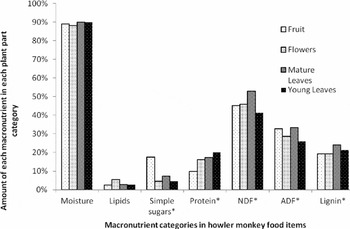
There were no differences among plant parts for lipid or moisture content (ANOVA: df = 95; F = 1.00; P = 0.402 and F = 1.13; P = 0.354). As expected, fruit was significantly higher in simple sugar concentration than all other plant parts (Figure 1), ranging from 5.3% to 47.5% with a mean value of 17.4%. Mature leaves (range: 2–12.4%; mean: 7.2% ± 2.7%) were significantly higher in simple sugar than young leaves (range: 0.4–8.7%; mean: 4.4% ± 2.3%) (df = 95; F = 5.21; P < 0.003). Mature leaves were significantly higher in all forms of fibre (NDF, ADF and lignin) than all other plant parts (ANOVA: NDF, df = 95; F = 4.37; P = 0.006; ADF, df = 95; F = 4.85; P = 0.004; lignin, df = 95; F = 4.47; P = 0.006) while young leaves were significantly higher in protein (range: 13–28.9%; mean: 20.5% ± 5.2%) (df = 95; F = 33.8; P = 0.001) than other plant parts including mature leaves (range: 11.6–24%; mean: 16.4% ± 3.8%). This led to a lower P : ADF value for mature leaves (P : F: 0.48) compared with young leaves (P :F : 0.81).
Average percentage of macronutrients in the plant parts consumed by the black howler monkey population (Alouatta pigra) in Monkey River, Belize. Nutrients were averaged across all collected samples for each plant part category (fruit, flowers, mature leaves, young leaves) to assess nutrient intake by the animals. Differences in nutritional variables among plant parts were tested using an ANOVA and a Tukey post hoc test. All nutrients labelled with an asterisk show statistical differences among plant parts (P < 0.05).

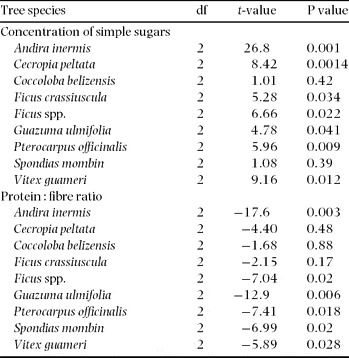
Results of paired t-tests (Table 1) from nine species, from which both young leaves and mature leaves were eaten, revealed that in all species mature leaves contained a higher concentration of simple sugar than young leaves and for seven of these, the difference was significant. Conversely, in all cases mature leaves had lower P : F ratios than young leaves of the same species and for six of them the P : ADF was significantly lower.
Results of paired t-tests comparing the average concentration of simple sugar and the protein : fibre ratio of mature leaves and young leaves from the same tree species in the Monkey River Forest, Belize. All species represent those from which both the mature leaves and young leaves were ingested by the study animals during the study period (2002–2006). A positive t-value indicates that the mean value was higher in mature leaves, whereas a negative t-value indicates the mean value was higher in young leaves. Results were statistically significant at P < 0.05.

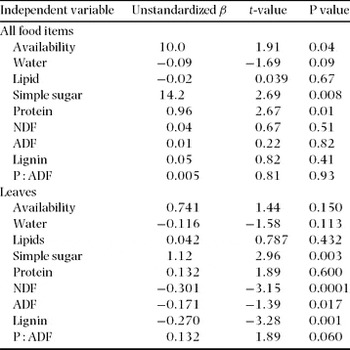
Results of the hierarchical regression indicated that nutritional factors were influencing selection for plant parts independent of their availability (R2 for availability = 0.144; R2 for availability and nutrients = 0.318). When considering all plant parts consumed, the only nutrients found to significantly influence overall food choice were simple sugar and protein (Table 2). When considering only leaves, consumption was not influenced by leaf availability but was influenced by nutritional factors (R2 = 0.215) including high simple sugar and low fibre concentrations.
Results of two hierarchical regressions, which examined the influence of nutrients on food selection in a population of black howler monkey (Alouatta pigra) in Southern Belize from 2002–2006. In both models food availability was entered first allowing for the influence of nutrients to be examined independent of availability. In the first model, all food items consumed were included and in the second model only the leaves consumed were examined. Both models were significant indicating that nutrients were influencing food choice independent of food availability. Results were statistically significant at P < 0.05.

DISCUSSION
Our first goal was to describe the nutritional content of the food supply of the Monkey River population of black howlers. Not surprisingly, fruit was significantly higher in simple sugar concentration than all other plant parts, which supports the idea that it is the main source of readily available energy for howler monkeys (Milton Reference MILTON1979). Mature leaves were significantly higher in the concentration of sugar than young leaves and were the second-best source of sugar in the diet. While folivorous Old World monkeys, such as colobines, increase energy intake through the ingestion of seeds (DaSilva Reference DASILVA1992), A. pigra eats the fleshy pulp of the fruit and either spits out the seeds or passes them through the digestive tract (pers. obs.). Without the addition of seeds to the diet, mature leaves probably represent the best alternative source of energy.
The higher sugar concentration in mature leaves at Monkey River was unexpected, as mature leaves typically do not store non-structural carbohydrates. However, mature leaves are known to actively engage in photosynthesis during the day, thus may be accumulating sugars as a result. This pattern of higher sugar concentrations in mature leaves was also found in a study of howler food items at the Cockscomb Basin Wildlife Sanctuary (CBWS) in central Belize, which was devastated by a hurricane in 1961 (Silver et al. Reference SILVER, OSTRO, YEAGER and DIERENFELD2000). It is possible that forests located in hurricane belts that are more often affected by major hurricanes have phytochemical responses that cause differences in the storage of non-structural carbohydrates, like sugars. One possible reason for this may be increases in light intensity and exposure of leaves to sunlight following disturbances that result in large forest gaps. Studies have found that the activity of sucrose phosphate synthetase (an enzyme that acts to increase sucrose production in leaves) is higher in mature leaves exposed to higher levels of sunlight (Pollock & Housley Reference POLLOCK and HOUSELY1985).
As expected, mature leaves were significantly higher in fibre concentrations and lower in protein than young leaves, resulting in lower P : F values for mature leaves. To meet protein requirements, it is hypothesized that howlers require leaves that contain between 10% and 14% protein per unit dry weight (Milton Reference MILTON, Leigh, Rand and Windsor1982). The mature leaves at this site ranged between 12% and 22% protein, and the mature leaves of commonly ingested species ranged between 16% and 22%, which is more than minimum requirements. While this number represents crude protein, not all of which is available for use because some is tied to fibre and secondary compounds (Rothman et al. Reference ROTHMAN, CHAPMAN and PELL2008), a study of A. pigra in Northern Belize found that approximately 80% of the crude protein in leaves is available for use (Silver et al. Reference SILVER, OSTRO, YEAGER and DIERENFELD2000). Using that number, the available protein of all mature leaves in Monkey River would still be between 10.2–17.6% and that in commonly ingested species between 12.8% and 17.6%, still above minimal requirements. Additionally, it has been documented that the mantled howler is able to remove 89% of the protein from leaf matter during transit through the digestive tract (Milton Reference MILTON1980), which would provide even higher estimates of available protein. When overall energy intake is low, as was likely the case following Hurricane Iris, overall protein demands may increase as the body starts to use its protein sources for energy. However, even if the protein demands of the monkey increased following the hurricane, the amount of protein in mature leaves could still have been high enough to meet these minimum requirements.
In an environment where both mature and young leaves offer adequate protein, it is likely that the need to select food items that can balance energy intake rather than maximize protein becomes more important. Thus, it may be that it is the high sugar concentration of mature leaves that is driving their elevated consumption by the study monkeys despite the availability of higher protein young leaves. Following Hurricane Iris, fruit production ceased for 18 mo after which it was only produced in small amounts for another 18 mo before it began to approach pre-hurricane levels. In this fruit-limited environment, the monkeys may have benefited from ingesting items higher in sugar concentration that would have helped to balance nutrient intake rather than to ingest items high in digestible protein. In this view, the monkey diet does reflect a need to balance overall nutrient intake rather than simply maximize protein (Felton et al. Reference FELTON, FELTON, RAUBENHEIMER, SIMPSON, FOLEY, WOOD, WALLIS and LINDENMAYER2009b, Lambert Reference LAMBERT, Campbell, Fuentes, Mackinnon, Panger and Bearder2011). This may also explain why a black howler population living in CBWS in Central Belize also ingests mature leaves more frequently during times of year when fruit production is limited (Silver et al. Reference SILVER, OSTRO, YEAGER and DIERENFELD2000).
It is possible that this unusually high level of mature leaf consumption by the black howler populations in both Monkey River and CBWS is related to changes in forest composition and/or plant chemistry following hurricanes. Pioneer species are common at both sites, as is consumption of Cecropia leaves. Because pioneer species grow quickly, they invest little energy in chemical defences resulting in leaves with lower concentrations of fibre, toxins and tannins (Coley Reference COLEY1987). Therefore, when given the choice, folivores are expected to prefer the mature leaves of fast-growing pioneer species over those of slow-growing trees (Coley Reference COLEY1987). Following Hurricane Iris, the density of pioneer species increased in the Monkey River forest, increasing the availability of these higher-quality mature leaves. Thus, in this hurricane-damaged forest, the nutritional profile of mature leaves was likely different from that of a forest dominated by slow-growing trees.
Secondary compounds were not measured in this study, but it is possible that they had an effect on food choice. Trees that grow in harsh environments or in habitats that are frequently affected by severe disturbance may increase chemical defences as a means to limit leaf predation. Following Hurricane Opal in North Carolina, young leaves of both red oak (Quercus rubra) and red maple (Acer rubrum) trees had higher tannin concentrations than mature leaves (Hunter & Forkner Reference HUNTER and FORKNER1999). Increased chemical defence following disturbance may be a means by which a tree can avoid predation on young leaves, which are required for tree survival after severe defoliation. However, increased concentration of secondary compounds following disturbance may also be a response to increased exposure to sunlight resulting from the creation of forest gaps. In a study on a common Central American tree species (Inga oerstediana) it was found that condensed tannin concentrations were much higher in young leaves exposed to direct sunlight than those growing in shaded areas (Nichols-Orians Reference NICHOLS-ORIANS1987). Thus, one possibility is that the monkeys are selecting mature leaves due to their higher sugar concentration. Another is that they may be avoiding young leaves due to potentially high levels of secondary compounds in the post-hurricane environment at Monkey River. Further research is needed to answer this question.
Regardless of whether mature leaves were selected for or young leaves were selected against, this study suggests that in this post-hurricane environment mature leaves were not simply fallback food items, but were the best source of available energy, thus were likely ingested to balance energy and protein intake. Similar results were found in a gorilla population where herb selection was positively correlated with sugar and negatively correlated with protein, possibly because herbs were protein-rich, making it more advantageous to select for sugar to maintain energy balance (Ganas et al. Reference GANAS, ORTMANN and ROBBINS2009). Similarly, in Northern Belize, during times of year when fruit is not produced, mature leaves of Cecropia and Celtis species, which are both high in sugar, make up a substantial part of the black howler monkey diet (Silver et al. Reference SILVER, OSTRO, YEAGER and DIERENFELD2000). Given the low availability of high-energy foods after the hurricane in Monkey River, mature leaves, which are adequate in protein, relatively high in sugars and widely available, would have been a relatively high-quality resource allowing this black howler population to balance overall nutrient intake.
ACKNOWLEDGEMENTS
We wish to thank two anonymous reviewers for very helpful feedback that greatly improved the presentation of these data. We also thank the Belize Government for granting us permission to conduct this research and the Village of Monkey River for general support and the assistance of highly knowledgeable forest guides and research assistants. We are also indebted to Tracy Wyman for assistance with data analysis and preparation. Financial support for this research was received from the Natural Sciences and Engineering Research Council of Canada (NSERC), National Geographic, The International Primatological Society, Sigma Xi, and The Department of Anthropology, Faculty of Social Sciences and Faculty of Graduate Studies at the University of Calgary.
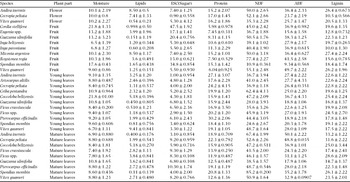
Average macronutrient composition of plant items ingested for more than 1% of feeding time by a population of black howler monkey (Alouatta pigra) at Monkey River, Belize. For each species, samples were taken from three separate trees and the average results are presented here. All numbers represent % dry matter. Nomenclature follows Balick et al. (Reference BALICK, NEE and ATHA2000).