Introduction
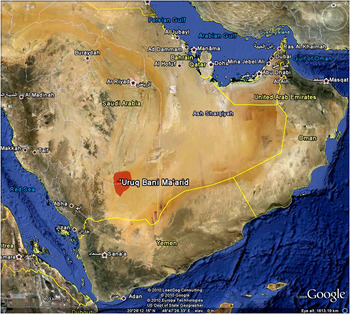
‘Uruq Bani Ma‘arid is situated along the western edge of the Rub’ al-Khali, the only major sand desert in tropical Asia and one of the largest continuous sand seas on Earth. ‘Uruq Bani Ma‘arid is administered by the Saudi Wildlife Commission (SWC) as a protected area, covering 12,658 km2 of the Empty Quarter directly to the east of the Tuwayq escarpment. The protected area is centred on 19°20′N and 45°30′E (Fig. 1) and is divided into three zones: a core nature reserve of 2400 km2, a managed grazing zone and a wider controlled hunting zone which forms the southernmost part of the protected area and the lower dunes of the eastern area.
The ‘Uruq Bani Ma‘arid protected area covers 12,658 km2 of the Empty Quarter.

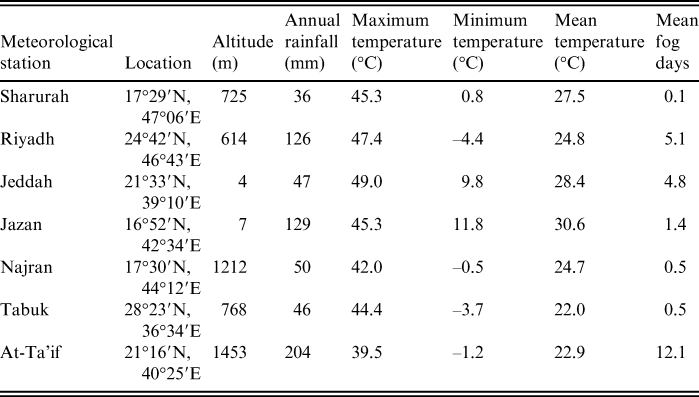
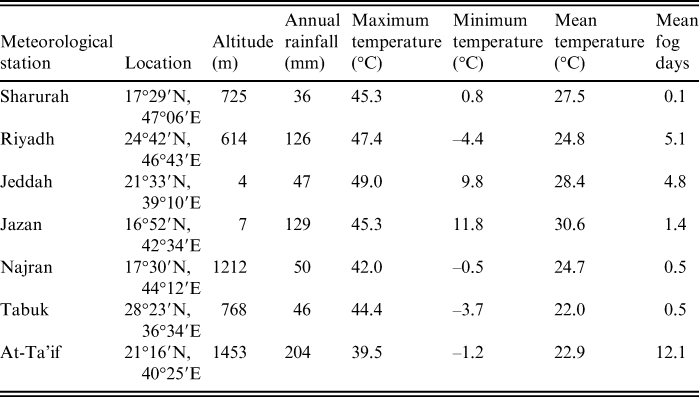
Geologically the site is composed mainly of the Quaternary aeolian sands of the Rub’ al-Khali overlying the cuesta of Tuwayq mountain limestone. At the west of the site, the Tuwayq escarpment (running north–south) terminates a narrow limestone plateau which is dissected by numerous eastward-draining wadis. To the east of this plateau, parallel linear dunes of mobile red sand up to 165 m high separate the interdune corridors which are filled with sand, silt or gravels. The altitude of the site ranges from 1099 m on the dunes of the ‘Irq al-Khisbi near the escarpment in the southwest to 640 m in the interdune corridors of the northeast. The climate of ‘Uruq Bani Ma‘arid is arid and hot. There is no permanent meteorological station in the protected area, but the nearest weather station at Sharurah records an annual mean temperature of 27.5°C and a mean annual rainfall of 36 mm (Table 1).
Comparative measurements from seven major meteorological stations in Saudi Arabia. The nearest station to ‘Uruq Bani Ma‘arid is Sharurah. Data adapted from Ghazanfar & Fisher (Reference Ghazanfar and Fisher1998)
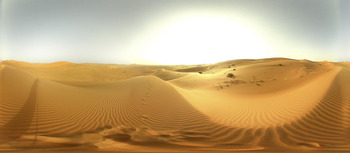
‘Uruq Bani Ma‘arid contains some of the Earth’s most spectacular desert landscapes (Fig. 2) and the highest known level of plant diversity in the Empty Quarter. Mandaville (Reference Mandaville1986) recorded 37 plant species in the Rub’ al-Khali from an area of 500,000 km2. Robinson & Al-Harbi (Reference Robinson and Al-Harbi2004) recorded 25 plant species from 277 survey sites in the eastern Rub’ al-Khali. The checklist of vascular plants from ‘Uruq Bani Ma‘arid in Appendix 1 contains 112 recorded plant species.
The dune areas of ‘Uruq Bani Ma‘arid provide some of the most dramatic desert landscapes in the world, representing a significant eco-tourism opportunity for the area. This image is a 360° panorama of an area in the upper dunes.

Methodology
The most recent botanical surveys of ‘Uruq Bani Ma‘arid were conducted for the Arabian Peninsula Important Plant Area (IPA) programme in May 2009. Survey methodology involved recording the presence of all vascular plant species at 11 selected waypoints during three days of surveying accompanied by the SWC rangers stationed at ‘Uruq Bani Ma‘arid. Vegetation in the Rub’ al-Khali is generally very sparse, but the May 2009 IPA surveys followed good spring rains. Waypoints were selected in areas of good vegetation within the three main topographical ‘zones’ in ‘Uruq Bani Ma‘arid: the limestone plateau, the high sand dunes and the interdune corridors. Voucher herbarium specimens and field photographs were collected and deposited at the Royal Botanic Garden Edinburgh (E). A further set of voucher specimens were deposited at the Saudi Wildlife Commission, Riyadh.
Results
From these surveys and from data in NCWCD (1987), 112 species have been recorded from the area. Phytogeographically, the flora of ‘Uruq Bani Ma‘arid has affinities with the Arabian regional subzone of the Saharo-Sindian regional zone (Ghazanfar & Fisher, Reference Ghazanfar and Fisher1998). However, Mandaville (Reference Mandaville1986) treats the flora of the Rub’ al-Khali as part of Sudanian floristic territory. Although the flora of the western Rub’ al-Khali is relatively species poor, ‘Uruq Bani Ma‘arid is an important location for a number of endemic plant taxa. Using the data gathered during the IPA surveys in May 2009, the following descriptions detail the vegetation of the three major topographical zones in ‘Uruq Bani Ma‘arid.
Limestone plateau
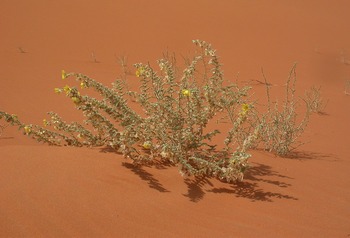
In the absence of rain, large areas of the limestone plateau (the highest elevation on the escarpment is 1062 m) appear barren. However, after rains in areas where sufficient groundwater collects, interesting patches of vegetation occur. In the incised wadis and sandy plains, a sparse Acacia woodland predominates, with Acacia tortilis, A. oerfota, A. ehrenbergiana and A. hamulosa all present (for species' authors see Appendix 1). Other notable tree species in the wadis include Ziziphus spina-christi and Maerua crassifolia as well as single stands of Moringa peregrina and Commiphora myrrha, respectively. In such areas of the plateau are found the shrub species Leptadenia pyrotechnica, Haloxylon salicornicum, Ephedra foliata and herbaceous species such as Haplophyllum tuberculatum, Dipterygium glaucum, Leucas inflata, Fagonia indica, Limeum arabicum and Tribulus macropterus var. arabicus (Fig. 3) as well as perennial grass species including Panicum turgidum. Although Ghazanfar & Fisher (Reference Ghazanfar and Fisher1998) state that annual plants are relatively unimportant in ‘Uruq Bani Ma‘arid, after rains the sandy plains overlying the limestone are covered in a sward of annual species including Monsonia nivea, Astragalus hauarensis, Cleome amblyocarpa, Polygala erioptera and Fagonia indica as well as annual grass species such as Aristida adscensionis.
Tribulus macropterus var. arabicus is one of a number of endemic plant taxa in the Empty Quarter.

In the red sands overlying limestone at the junction of the Rub’ al-Khali sands and the Tuwayq escarpment there are areas of very open Acacia woodland comprised of Acacia tortilis and A. oerfota. Also present are Haloxylon salicornicum, Rhazya stricta, Tribulus macropterus var. arabicus, Dipterygium glaucum, Farsetia burtoniae and the perennial grass species Panicum turgidum and Lasiurus scindicus.
Rare plant taxa
A number of rare and endemic plant taxa occur on the limestone plateau in ‘Uruq Bani Ma‘arid. Limeum arabicum and Tribulus macropterus var. arabicus are Arabian endemics known from Saudi Arabia, Yemen, Oman and the United Arab Emirates.
Sand dunes
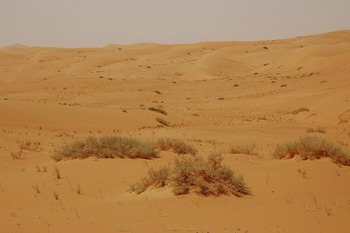
Covering approximately 60% of ‘Uruq Bani Ma‘arid, the parallel high sand dunes represent the largest plant habitat in the protected area. The plant communities of the red dunes are typical of the Rub’ al-Khali. The woody shrub Calligonum crinitum subsp. arabicum occupies the unstable sand habitats in the crests of the high dunes, producing a community of very widely spaced shrubs (see Fig. 4). On the lower slopes of the dunes a sparse herbaceous community occurs with a number of species including Cornulaca arabica, Limeum arabicum, Moltkiopsis ciliata, Neurada procumbens, Dipterygium glaucum, Corbichonia decumbens, Tephrosia uniflora, Farsetia longisiliqua and Farsetia burtoniae. Common grasses include Panicum turgidum and Lasiurus scindicus along with Centropodia fragilis and Stipagrostis drarii which are rarely found growing on the dunes in the other areas of the Rub’ al-Khali.
The woody shrub Calligonum crinitum subsp. arabicum occupies the unstable sand habitats in the crests of the high dunes, producing a community of very widely spaced shrubs.

In the sands, Tribulus macropterus var. arabicus and Cyperus macrorrhizus often dominate large areas within the sparse herbaceous communities. The latter species, a drought-adapted sedge, is one of the most important biomass producers in the Rub’ al-Khali. On the western edge of the sands in Wadi Ghudayy there is an extensive stand of Haloxylon persicum.
Rare plant taxa
Calligonum crinitum subsp. arabicum, Cornulaca arabica, Tribulus macropterus var. arabicus and Limeum arabicum are all Arabian endemics.
Interdune corridors
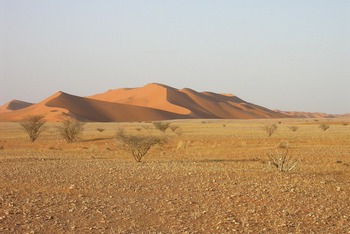
The vegetation of the interdune corridors has much in common with that of the limestone plateau and the lower sand dunes. On the sands and gravels between the towering red sand dunes the vegetation is very sparse and scattered individuals of Acacia tortilis form the dominant tree flora (Fig. 5). In the surveyed areas in the west of ‘Uruq Bani Ma‘arid, the dwarf shrub layer is composed of sparsely distributed Haloxylon salicornicum along with woody-based herbaceous species Dipterygium glaucum, Limeum arabicum, Fagonia indica and Tribulus macropterus var. arabicus and the grass species Panicum turgidum and Stipagrostis spp.
On the sands and gravels between the towering red sand dunes the vegetation is very sparse, with scattered individuals of Acacia tortilis forming the only tree cover.

Rare plant taxa
Tribulus macropterus var. arabicus and Limeum arabicum both occur in this habitat.
IPA Assessment
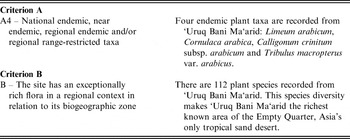
‘Uruq Bani Ma‘arid is an important site for wild plant conservation. Using the Important Plant Area criteria which have been adapted for the Arabian Peninsula (Al-Abbasi et al., Reference Al-Abbasi, Al-Farhan, Al-Khulaidi, Hall, Llewellyn, Miller and Patzelt2010) ‘Uruq Bani Ma‘arid qualifies as an IPA under criteria A and B (see Table 2).
‘Uruq Bani Ma‘arid qualifies as an IPA under criteria A (4) and B

Other Taxa
Perhaps the most significant animal species in the protected area is the Arabian oryx (Oryx leucoryx Pallas), which was successfully reintroduced into ‘Uruq Bani Ma‘arid in 1995 along with the Arabian sand gazelle (reem) (Gazella subgutturosa marica Güldenstädt) and mountain gazelle (idmi) (Gazella gazella Pallas) (Dunham et al., Reference Dunham, Williamson, Joubert, Mallon and Kingswood2001). Other prominent mammals include the sand cat (Felis margarita harrisoni Hemmer, Grubb & Groves), the Rub al-Khali hare (Lepus capensis arabicus Ehrenberg) and the Arabian wolf (Canis lupus arabs Pocock) which intermittently enters the rocky western part of the reserve. Around 16 bird species are considered resident in ‘Uruq Bani Ma‘arid, including brown necked raven (Corvus ruficollis Lesson), sand partridge (Ammoperdix heyi Temminck), trumpeter finch (Bucanetes githagineus Lichtenstein), Egyptian vulture (Neophron percnopterus L.) and Barbary falcon (Falco pelegrinoides Temminck) (Jennings, Reference Jennings2010). There are also populations of globally threatened bird species including the lappet faced vulture (Torgos tracheliotus Forster) which is listed as Vulnerable on the IUCN Red List (IUCN, 2009).
Socio-Economic Issues
The protected area lies within the traditional tribal territories of the Yam in its southern parts, and in its northern parts, the Dawasir. The main resource use in the area is the grazing of domestic livestock (camels and sheep) by the nomadic herdspeople who live within the area. In addition, dead trees and shrubs are used as firewood. No traditional himas have been recorded in the ‘Uruq Bani Ma‘arid area (Llewellyn, in press). The ‘Uruq Bani Ma‘arid protected area is divided into management zones, with a strictly protected core area occupying approximately 2400 km2, an area designated for managed grazing (although grazing management has not yet begun), and in the south and east, a zone in which SWC management is restricted to the control of hunting.
More than any other biotope, the large sand seas of the Empty Quarter represent the wilderness of Arabia in the eyes of the world. With iconic animal species and landscapes, ‘Uruq Bani Ma‘arid potentially has a high value for nature-based tourism and recreation activities such as wildlife viewing and wilderness camping. Under the current management strategy of the protected area such activities would be outside the core zone. ‘Uruq Bani Ma‘arid also contains sites of archaeological and cultural interest, including cairns, standing stones, and lines of rocks overlooking the ruins of the ancient city of Al-Faw which lie close to the northwestern edge of the protected area. The development of low-impact nature-based tourism in ‘Uruq Bani Ma‘arid has the potential to benefit local communities and provide incentives for increased local participation in conservation activities (Irani & Johnson, Reference Irani and Johnson2000). The dramatic landscapes of ‘Uruq Bani Ma‘arid will be attractive not only to foreign tourists, but also to people from throughout Saudi Arabia and the Gulf countries, including locals from the nearby city of Najran (within 200 km).
Threats to Conservation
There are a number of existing and potential threats to the conservation of ‘Uruq Bani Ma‘arid as an Important Plant Area and as a protected area for biodiversity conservation. Moderate threats to the area include overgrazing in the grazing zones of the reserve, encroachment of livestock into the non-grazing zones of the reserve and disturbances associated with increased tourist activity such as increased off-road driving. Local people have expressed the need for more grazing opportunities in the ‘Ushayran area in spring, and grazing access issues are likely to become increasingly important with the onset of climatic changes. Other threats to conservation include poaching, disturbance of ungulates, off-road driving, and litter throughout the reserve, as well as rubbish dumps, road construction, settlement and agricultural expansion below the escarpment.
Further Research
The predicted climatic changes of reduced precipitation and increased temperatures (Dawson, Reference Dawson2007) are likely to have a significant impact on all plant communities in the Arabian Peninsula. An important line of future research in ‘Uruq Bani Ma‘arid will be to model the impact of global climatic change on the distribution of key plant species such as the endemic (and dominant) dune species Calligonum crinitum subsp. arabicum and Tribulus macropterus var. arabicus. Such studies will be critically important for the development of a long-term management strategy for protecting the plants, the animals, and the people of this hyper-arid area. Socio-economic research should be directed towards establishing local income generation in this wilderness area. Key issues in this regard will be establishing an ecologically sensitive, low-impact tourism strategy for ‘Uruq Bani Ma‘arid and exploring the nomination of ‘Uruq Bani Ma‘arid as a UNESCO Natural World Heritage Site under criteria VII–X.
Acknowledgements
We are grateful to our colleagues at the Saudi Wildlife Commission for their support and assistance during this research, and give particular thanks to the SWC rangers at ‘Uruq Bani Ma‘arid for hosting us during the IPA surveys. We are also extremely grateful to Ollie Collier for assistance with creating the 360° panorama of ‘Uruq Bani Ma‘arid.
Appendix 1
Checklist of plant taxa from ‘Uruq Bani Ma‘arid. Family delimitation follows APG II (Angiosperm Phylogeny Group, 2003)
This checklist is compiled from survey data, literature sources and herbarium specimens. The principal source for each record is noted in superscript next to each name.
1 – IPA survey data, May 2009
2 – Collenette & Tsagarakis (Reference Collenette and Tsagarakis2001)
3 – NCWCD (1987)
4 – Llewellyn (in press)
5 – Strauss (Reference Strauss1995)
Acanthaceae
Blepharis ciliaris (L.) B.L.Burtt1
Amaranthaceae
Aerva javanica (Burm.f.) Juss. ex Schult.2
Anabasis setifera Moq. (syn. Hammada scoparia sensu Collenette3)
Cornulaca arabica Botsch.1
Halothamnus bottae Jaub. & Spach2
Haloxylon persicum Bunge ex Boiss. & Buhse3
Haloxylon salicornicum (Moq.) Bunge ex Boiss.1
Salsola sp.2 (Collenette & Tsagarakis (Reference Collenette and Tsagarakis2001) record a Salsola spinescens?)
Apocynaceae
Glossonema varians (Stocks) Hook.f.2
Leptadenia pyrotechnica (Forssk.) Decne.1
Pergularia tomentosa L.3
Rhazya stricta Decne.1
Boraginaceae
Anchusa hispida Forssk. (syn. Gastrocotyle hispida (Forssk.) Bunge2)
Arnebia hispidissima (Sieber ex Lehm.) A.DC.1
Echium sp.3
Heliotropium crispum Desf. (syn. Heliotropium ramosissimum (Lehm.) DC.2)
Heliotropium digynum (Forssk.) C.Chr.1
Heliotropium rariflorum Stocks2
Moltkiopsis ciliata (Forssk.) I.M.Johnst.3
Trichodesma africanum (L.) Sm.2
Brassicaceae
Eremobium aegyptiacum (Spreng.) Asch. & Schweinf. ex Boiss.2
Farsetia burtoniae Oliv.1
Farsetia sp. aff. burtoniae/Farsetia sp. aff. dhofarica 1 (see Miller & Cope (Reference Miller and Cope1996: 423))
Farsetia longisiliqua Decne.1
Farsetia stylosa R.Br.1
Morettia parviflora Boiss.1
Burseraceae
Commiphora myrrha (Nees) Engl.4
Capparaceae
Capparis spinosa L. (syn. Capparis sinaica Veill. ex Duhamel2)
Dipterygium glaucum Decne.1
Maerua crassifolia Forssk.3
Caryophyllaceae
Polycarpaea repens (Forssk.) Asch. & Schweinf.1
Sclerocephalus sp.2 (Collenette & Tsagarakis (Reference Collenette and Tsagarakis2001) record a Sclerocephalus arabicus?)
Cleomaceae
Cleome amblyocarpa Barratte & Murb.1
Compositae (Asteraceae)
Atractylis carduus (Forssk.) C.Chr.2
Centaurea pseudosinaica Czerep.1
Iphiona scabra DC.2
Launaea mucronata (Forssk.) Muschl.1
Pulicaria glutinosa (Boiss.) Jaub. & Spach2
Pulicaria undulata (L.) C.A.Mey. (syn. Pulicaria crispa (Forssk.) Benth. ex Oliv.2)
Rhanterium epapposum Oliv.3
Scorzonera tortuosissima Boiss.2
Convolvulaceae
Convolvulus asyrensis Kotschy2
Convolvulus auricomus (A.Rich.) Bhandari var. auricomus 2
Convolvulus buschiricus Bornm.5
Cucurbitaceae
Citrullus colocynthis (L.) Schrad.1
Cynomoriaceae
Cynomorium coccineum L.2
Cyperaceae
Cyperus macrorrhizus Nees.1
Collenette & Tsagarakis (2001) record Cyperus aucheri Jaub. & Spach (syn. Cyperus conglomeratus var. aucheri (Jaub. & Spach) C.B.Clarke), a misidentification of the species above.
Ephedraceae
Ephedra foliata Boiss. ex C.A.Mey.1
Euphorbiaceae
Chrozophora oblongifolia (Delile) A.Juss. ex Spreng.3 (A possible misidentification for the species below)
Chrozophora tinctoria (L.) A.Juss.1
Geraniaceae
Monsonia nivea (Decne.) Decne. ex Webb1
Gisekiaceae
Gisekia pharnaceoides L.1
Gramineae (Poaceae)
Aristida adscensionis L.1
Cenchrus ciliaris L.2
Centropodia forskaolii (Vahl) Cope2
Centropodia fragilis (P.Guinet & Sauvage) Cope1
Chrysopogon plumulosus Hochst.2
Dichanthium foveolatum (Delile) Roberty1
Echinochloa sp.5
Enneapogon desvauxii P.Beauv.2
Lasiurus scindicus Henrard1
Panicum turgidum Forssk.1
Pennisetum divisum (J.F.Gmel.) Henrard1
Stipa sp.2,3 (Collenette & Tsagarakis (Reference Collenette and Tsagarakis2001) suggest that their record may be Stipa hohenackeriana Trin. & Rupr.)
Stipagrostis drarii (Tackh.) De Winter3
Stipagrostis foëxiana (Maire & Wilczek) De Winter2
Stipagrostis obtusa (Delile) Nees3
Stipagrostis sp.1,2
Tragus racemosus (L.) All.1
Hyacinthaceae
Dipcadi erythraeum Webb & Berthel. (syn. Dipcadi unicolor (Stocks) Baker2)
Labiatae (Lamiaceae)
Leucas inflata Benth.1
Salvia aegyptiaca L.2
Leguminosae
Acacia ehrenbergiana Hayne1
Acacia hamulosa Benth.1
Acacia oerfota (Forssk.) Schweinf.1
Acacia tortilis (Forssk.) Hayne1
Astragalus hauarensis Boiss.1
Astragalus spinosus (Forssk.) Muschl.2
Astragalus tribuloides Delile5
Astragalus vogelii (Webb) Bornm.1
Crotalaria aegyptiaca Benth.2
Crotalaria sp. aff. leptocarpa Balf.f.1
Indigofera spinosa Forssk.1
Rhynchosia pulverulenta Stocks2
Rhynchosia schimperi Hochst. ex Boiss.2
Senna holosericea (Fresen.) Greuter1
Senna italica Mill.3
Tephrosia uniflora Pers.1 (Tephrosia sp. recorded by SWC field study is likely to be Tephrosia uniflora)
Menispermaceae
Cocculus pendulus (J.R.Forst. & G.Forst.) Diels2
Molluginaceae
Corbichonia decumbens (Forssk.) Exell1
Limeum arabicum Friedrich1
Moringaceae
Moringa peregrina (Forssk.) Fiori2
Neuradaceae
Neurada procumbens L.1
Nyctaginaceae
Boerhavia elegans Choisy1
Orobanchaceae
Cistanche phelypaea (L.) Cout.2
Polygalaceae
Polygala erioptera DC.1
Polygala irregularis Boiss.2
Polygonaceae
Calligonum crinitum Boiss. subsp. arabicum (Soskov) Soskov1
Resedaceae
Ochradenus baccatus Delile1
Reseda muricata C.Presl3
Rhamnaceae
Ziziphus spina-christi (L.) Desf.1
Rubiaceae
Kohautia caespitosa Schnizl.2
Rutaceae
Haplophyllum tuberculatum (Forssk.) A.Juss.1
Solanaceae
Lycium shawii Roem. & Schult.3
Zygophyllaceae
Fagonia indica Burm.f.1
Fagonia schweinfurthii (Hadidi) M.Hall1Footnote *
Seetzenia lanata (Willd.) Bullock2
Tetraena simplex (L.) Beier & Thulin5
Tetraena sp.2 (Collenette & Tsagarakis (Reference Collenette and Tsagarakis2001) record a Zygophyllum hamiense?)
Tribulus macropterus Boiss. var. arabicus (Hosni) F.Al-Hemaid & Jacob Thomas1 (syn. Tribulus arabicus Hosni)
Tribulus pentandrus Forssk.1