Introduction
It has long been known that head size and height are positively related to intelligence. This relationship was noted for head size in the nineteenth century by the French physician Paul Broca (Reference Broca1873), who measured the external and internal skull dimensions of brains at autopsy and observed that skilled workers had a larger average brain size than the unskilled, and eminent individuals averaged a larger brain than the less eminent. An early report of a positive association between head size and intelligence was published by Galton (Reference Galton1888) in a study of students at the University of Cambridge in which it was found that head size measured as circumference was greater by 2.5 to 5% in those who obtained top degrees, taken as a measure of higher intelligence, than in those who obtained less good degrees. Later in the nineteenth century, the relation between educational attainment (an approximate proxy for intelligence) and height was reported in a study of 33,500 American school students by Porter (Reference Porter1892).
Since these early reports, numerous studies have confirmed the positive relation between head size and intelligence. This positive association has been confirmed in numerous subsequent studies showing that head size is positively correlated with intelligence measured by intelligence tests, summarized by Lynn (Reference Lynn1994) and Rushton (Reference Rushton2000, p. 37), who reported results from 32 studies with an average correlation of 0.23. In another study, Rushton and Ankney (Reference Rushton and Ankney2009) summarized the results of 59 studies that reported the relation between external head measures and IQ for which the average correlation was 0.20. They also summarized the results of 28 studies that reported the relation between brain size measured by brain imaging and IQ, for which the average correlation was 0.40. The reason that the correlation was higher when brain imaging was used to measure brain size is that it is much more accurate than external head measures. In these studies head size was adopted as a proxy for brain size and it was argued that larger brains conferred greater cognitive ability. In more recent studies brain size has been measured directly by magnetic resonance imaging (rather than being inferred from head size) and was shown to be positively associated with intelligence with a correlation of 0.40 in a meta-analysis by Vernon et al. (Reference Vernon, Wickett, Bazana and Stelmack2000, p. 248). In an updated meta-analysis of associations between human brain volume and intelligence differences a correlation of 0.24 has been reported by Pietschnig et al. (Reference Pietschnig, Penke, Wicherts, Zeiler and Voracek2015).
There have also been a number of studies reporting a positive relation between height and intelligence, e.g. Wilson et al. (Reference Wilson, Hammer and Duncan1986), Walker et al. (Reference Walker, Grantham-McGregor, Powell and Chang2000) and Gale (Reference Gale2005). These studies have typically shown correlations between height and IQ of around 0.25. For example, in a large sample of 11-year-olds in Scotland the correlations were 0.24 for boys and 0.25 for girls (Deary et al. Reference Deary, Whalley and Starr2009, p. 24).
These studies of the association between intelligence with head size and height have nearly all been made on samples in Europe and North America. This study reports two studies designed to ascertain whether this relation holds for samples in Saudi Arabia.
Methods
Study I
Sample I consisted of 1591 school students (609 boys and 982 girls) aged 6–12 years (mean 9.5 years) attending state schools in Riyadh, the capital of Saudi Arabia. Intelligence was measured using the Standard Progressive Matrices Plus (SPM+)–a non-verbal reasoning test that has been widely used in many countries (Raven, Reference Raven2008). Head size was measured as the circumference at its maximum just above the ears. Head circumference has been used as an approximate estimate of head size and brain size in numerous studies, as reviewed by Rushton and Ankney (Reference Rushton and Ankney2009). Height was measured without shoes.
Study II
Sample II consisted of 221 boys aged 6–12 years (mean 8.6 years) with learning disabilities (a condition with reduced ability to understand new or complex information or to learn new skills) attending schools in Riyadh. Intelligence was measured using the Standard Progressive Matrices (SPM) (Raven et al., Reference Raven, Raven and Court2000). Head circumference was measured at its maximum just above the ears and height was measured without shoes.
Results
Study I
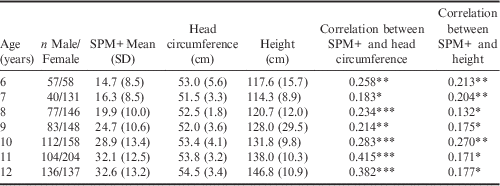
The results for Sample I are given in Table 1. The table shows the means and SDs for SPM+, head circumference and height, and the correlations between SPM+ and head circumference and between SPM+ and height, for each age group. For the total sample, the mean SPM+ score was 25.9 (SD=13.2), the mean head circumference was 53.1 cm (SD=3.7) and the mean height was 130.6 cm (SD=18.5). Cronbach’s alpha coefficient for the SPM+ was 0.86.
Standard Progressive Matrices Plus (SPM+) score, head circumference and height in Study I and the correlations between SPM+ and head circumference, and between SPM+ and height by age group, N=1591

*p<0.05; **p<0.01; ***p<0.001.
The correlation between SPM+ and head circumference for the total sample was r=0.350 (p<0.001). After controlling for sex and age, the correlation was r=0.249 (p<0.001). The correlation between SPM+ and height for the total sample was r=0.271 (p<0.001). After controlling for sex and age, the correlation was r=0.177 (p<0.001).
Study II
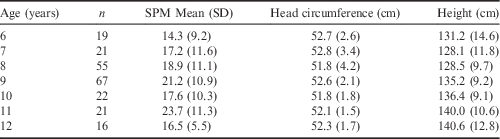
Table 2 shows the means and SDs of the Standard Progressive Matrices (SPM) for Sample II for each age group. The sample obtained a mean score on the SPM of 19.2 (SD 10.8), a mean head circumference of 52.3 cm (SD=2.9) and a mean height of 133.5 cm (SD=11.2). Cronbach’s alpha coefficient for the SPM was 0.89.
Standard Progressive Matrices (SPM) score, head circumference and height in Study II by age group, N=221

As each age group is relatively small, correlation analysis was conducted using the total sample. The correlation between SPM and head circumference was r=0.168 (p<0.05). After controlling for age, the correlation was r=0.173 (p<0.01). The correlation between SPM and height was r=0.178 (p<0.05). After controlling for age, the correlation was r=0.151 (p<0.05).
Discussion
There are four points of interest in the study. First, the results show that for both studies there are statistically significant correlations between intelligence and head size and intelligence and height. The correlations for intelligence and head size for the total sample are 0.350 in Study I and 0.168 in Study II. The correlations for intelligence and height are 0.271 in Study I and 0.178 in Study II. These correlations are of approximately the same size as those that have been obtained in European populations noted in the Introduction.
Second, the likely explanation for the positive correlation between intelligence and head size is that a larger brain contains more neurons and therefore has more processing power, proposed by Vernon et al. (Reference Vernon, Wickett, Bazana and Stelmack2000), analogous to a larger computer possessing more processing power than a smaller computer. Further evidence is shown in a recent quantitative meta-analysis conducted by Basten et al. (Reference Basten, Hilger and Fiebach2015) on functional and structural brain imaging studies on intelligence. It is further supported by the findings of another recent study (Ritchie et al., Reference Ritchie, Booth, Valdés Hernández, Corley, Maniega, Gow and Deary2015), which showed that among six brain variables (brain volume, cortical thickness, white matter structure, white matter hyper-intensity load, iron deposits and micro bleeds), brain volume accounted for the largest portion of variance of g and fluid intelligence.
Third, it is improbable that there is any causal relationship between height and intelligence. Wilson et al. (Reference Wilson, Hammer and Duncan1986) found no evidence that an increase in height caused a rise in intelligence in a study of 2177 children studied longitudinally in the American National Health Examination Survey, in which changes in height between the ages of 8 and 13 years were not found to be related to changes in scores on tests of intelligence or academic achievement. The most likely explanation for the positive correlation between intelligence and height is that the quality of nutrition obtained by the fetus and by babies affects the development of both height and the brain, bringing the two into positive correlation. This is suggested by studies showing that intelligence and height have increased since the 1920s in many economically developed nations as a result of improvements in nutrition (Lynn, Reference Lynn1990).
Fourth, the practical implication of this research is that governments could probably improve the intelligence of children by ensuring that pregnant women, infants and children have the best nutrition by taking nutritional supplements. Evidence for the positive effect of nutritional supplements on intelligence has been reported by Lynn and Harland (Reference Lynn and Harland1998).
Acknowledgment
This is a research project that was supported by a grant from the Research Center for the Humanities, Deanship of Scientific Research at King Saud University.