


1 Introduction
This article is devoted to the study of mappings with bounded and finite distortion, see, e.g., [Reference CristeaCr], [Reference Martio, Rickman and VäisäläMRV1
], [Reference Martio, Ryazanov, Srebro and YakubovMRSY1
]–[Reference Martio, Ryazanov, Srebro and YakubovMRSY2
], [Reference Petkov, Salimov and StefanchukPSS], [Reference Ryazanov and VolkovRV], [Reference Salimov and StefanchukSalSt], [Reference VuorinenVu] and [Reference VäisäläVa]. Observe that, the most of known results concerning the continuous boundary extension of mappings use the assumption of boundary preservation under the mapping. Given a mapping between domains D and
 $D^{\,\prime }$
in
 ${\Bbb R}^n,$
it means that
 $C(f, \partial D)\subset \partial D^{\,\prime },$
where
 $C(f, \partial D)$
is a cluster set of f at
 $\partial D.$
Exceptions from this rule are, say, theorems on continuous extension to an isolated point of the boundary, or to sets of “small measure”, see e.g., [Reference Martio, Rickman and VäisäläMRV1
, Theorem 4.1], [Reference Koskela and MartioKM, Theorem 4.1], [Reference Martio, Ryazanov, Srebro and YakubovMRSY1
, Theorem 4.5] and [Reference RajalaRa, Theorem 3.7]. In other cases, mappings are either assumed to be homeomorphisms (and therefore preserve the boundary), or open, discrete and closed, which also implies the boundary preservation. In this regard, we point out publications [Reference CristeaCr], [Reference Gutlyanskii, Ryazanov, Srebro and YakubovGRSY], [Reference Martio, Ryazanov, Srebro and YakubovMRSY2
], [Reference NäkkiNa1
]–[Reference NäkkiNa2
], [Reference Sevost’yanov, Skvortsov and DovhopiatyiSSD], [Reference SmolovayaSm], [Reference SrebroSr] and [Reference VuorinenVu], as well as many others from the same series. The theory of boundary behavior of mappings that do not preserve the boundary seems not to have been constructed even in the quasiregular case, and this manuscript contains some studies in this direction.
From this position, it should be said that the (conditional) majority of known mappings, including analytic functions, are not closed, and the study of their boundary behavior may turn out to be more important than the study of homeomorphisms or (more general) closed mappings. For example, an analytic function
 $f(z)=z^4,$
on the complex plane is a closed mapping in
 ${\Bbb D}=\{z\in {\Bbb C}: |z|<1\}$
but in the disk
 $B(1, 1)=\{z\in {\Bbb C}: |z-1|<1\}$
it is no longer such. Due to the well-known theorems of Casorati-Weierstrass or Picard, even an isolated singularity of an analytic function will be its essential singularity only in the case when the mapping is not closed (closed mappings, in particular, preserve the boundary of the domain, and, at the same time, the cluster set of an analytic function with an essential singularity is the entire extended complex plane).
Given some known results in the context of this manuscript, the following results are valid.
Theorem A Suppose that
 $f:D\rightarrow D^{\,\prime }$
is a quasiconformal mapping and that D has property
 $P_1$
at
 $b\in \partial D.$
Then
 $C(f , b)$
contains at most one point at which
 $D^{\,\prime }$
is finitely connected (see [Reference VäisäläVa, Theorem 17.13]).
Here we should explain a little the meaning of the property
 $P_1,$
see [Reference VäisäläVa, Definition 17.5]. Let D be a domain in
 $\overline {{\Bbb R}^n}$
and let
 $b\in \partial D.$
Then D has property
 $P_1$
at b if the following condition is satisfied: If E and F are connected subsets of D such that
 then
 $M(\Gamma (E, F, D))=\infty ,$
where M denotes the (conformal) modulus of families of paths in
 ${\Bbb R}^n$
(see the definition below), and
 $\Gamma (E, F, D)$
is a family of paths joining E and F in
 $D.$
An analog of Theorem A was also obtained for quasiregular mappings (which, in particular, are not homeomorphisms; see, for example, [Reference SrebroSr, Theorem 4.2], cf. [Reference VuorinenVu, Theorem 4.2]).
Theorem B Let
 $f:D\rightarrow {\Bbb R}^n$
be quasiregular mapping with
 $C(f, \partial D)\subset \partial f(D).$
If D is locally connected at a point
 $b\in \partial D$
and
 $D^{\,\prime }=f(D)$
is qc accessible at some point
 $y\in C(f, b),$
then
 $C(f, b)=\{y\}.$
Subsequent studies are related to the concept of the modulus of families of paths, the definition of which is given below. A Borel function
 $\rho :{\Bbb R}^n\,\rightarrow [0,\infty ] $
is called admissible for the family
 $\Gamma $
of paths
 $\gamma $
in
 ${\Bbb R}^n,$
if the relation
 $$ \begin{align*} \int\limits_{\gamma}\rho (x)\, |dx|\geqslant 1 \end{align*} $$
holds for all (locally rectifiable) paths
 $ \gamma \in \Gamma .$
In this case, we write:
 $\rho \in \mathrm {adm} \,\Gamma .$
Let
 $p\geqslant 1,$
then p-modulus of
 $\Gamma $
is defined by the equality
 $$ \begin{align*} M_p(\Gamma)=\inf\limits_{\rho \in \,\mathrm{adm}\,\Gamma} \int\limits_{{\Bbb R}^n} \rho^p (x)\,dm(x)\,. \end{align*} $$
We set
 $M(\Gamma ):=M_n(\Gamma ).$
The Poletsky classical inequality is the inequality

where
 $K\geqslant 1$
is some constant, and
 $\Gamma $
is an arbitrary family of paths in
 $D.$
It was obtained by E. Poletsky in the early 70s last century, see [Reference PoleckiiPol, Theorem 1]. Our further research is related to the fact that we are considering mappings of a more general nature, see below. Let
 $x_0\in {\Bbb R}^n,$
 $0<r_1<r_2<\infty ,$
 $$ \begin{align} \,\,\,\,S(x_0,r) = \{ x\,\in\,{\Bbb R}^n : |x-x_0|=r\}\,, \quad B(x_0, r)=\{ x\,\in\,{\Bbb R}^n : |x-x_0|<r\} \end{align} $$
and
 $$ \begin{align} A=A(x_0, r_1,r_2)=\left\{x\,\in\,{\Bbb R}^n: r_1<|x-x_0|<r_2\right\}\,.\end{align} $$
Given sets
 $E, F\subset \overline {{\Bbb R}^n}$
and a domain
 $D\subset {\Bbb R}^n$
we denote by
 $\Gamma (E,F,D)$
a family of all paths
 $\gamma :[a,b]\rightarrow \overline {{\Bbb R}^n}$
such that
 $\gamma (a)\in E,\gamma (b)\in \,F $
and
 $\gamma (t)\in D$
for
 $t \in (a, b).$
Let
 $S_i=S(x_0, r_i), i=1,2,$
where spheres
 $S(x_0, r_i)$
centered at
 $x_0$
of the radius
 $r_i$
are defined in (1.2). Let
 $Q:{\Bbb R}^n\rightarrow {\Bbb R}$
be a Lebesgue measurable function satisfying the condition
 $Q(x)\equiv 0$
for
 $x\in {\Bbb R}^n\,\backslash\, D.$
Let
 $p\geqslant 1.$
A mapping
 $f:D\rightarrow \overline {{\Bbb R}^n}$
is called a ring Q-mapping at the point
 $x_0\in \overline {D}\,\backslash\, \{\infty \}$
with respect to p-modulus, if the condition

holds for some
 $r_0(x_0)>0,$
all
 $0<r_1<r_2<r_0$
and all Lebesgue measurable functions
 $\eta :(r_1, r_2)\rightarrow [0, \infty ]$
such that
 $$ \begin{align} \int\limits_{r_1}^{r_2}\eta(r)\,dr\geqslant 1\,. \end{align} $$
Note that, (1.1) implies (1.4)–(1.5) whenever
 $p=n$
and
 $Q(x)\equiv K.$
So, (1.4) may be interpreted as Poletsky weighed inequality with the weight
 $Q(x).$
Remark 1.1 Note that all quasiregular mappings
 $f:D\rightarrow {\Bbb R}^n$
satisfy the condition

at each point
 $x_0\in \overline {D}\,\backslash\, \{\infty \}$
with some constant
 $K_I=K_I(f)\geqslant 1$
and an arbitrary Lebesgue-dimensional function
 $\eta : (r_1,r_2)\rightarrow [0,\infty ],$
which satisfies condition (1.5). Indeed, quasiregular mappings satisfy the condition

for an arbitrary function
 $\rho \in \mathrm {adm}\, \Gamma (S_1, S_2, D),$
see [Reference RickmanRi, Theorem 8.1.II]. Put
 $\rho (x):=\eta (|x-x_0|)$
for
 and
 $\rho (x)=0$
otherwise. By Luzin theorem, we may assume that the function
 $\rho $
is Borel measurable (see, e.g., [Reference FedererFe, Section 2.3.6]). Due to [Reference VäisäläVa, Theorem 5.7],
 $$ \begin{align*} \int\limits_{\gamma}\rho(x)\,|dx|\geqslant \int\limits_{r_1}^{r_2}\eta(r)\,dr\geqslant 1\end{align*} $$
for each (locally rectifiable) path
 $\gamma $
in
 $\Gamma (S(x_0, r_1), S(x_0, r_2), A(x_0, r_1, r_2)).$
By substituting the function
 $\rho $
mentioned above into (1.7), we obtain the desired ratio (1.6).
Recall that a mapping
 $f:D\rightarrow {\Bbb R}^n$
is called discrete if the pre-image
 $\{f^{-1}\left (y\right )\}$
of each point
 $y\,\in \,{\Bbb R}^n$
consists of isolated points, and is open if the image of any open set
 $U\subset D$
is an open set in
 ${\Bbb R}^n.$
Later, in the extended space
 we use the spherical (chordal) metric
 $h(x,y)=|\pi (x)-\pi (y)|,$
where
 $\pi $
is a stereographic projection
 $\overline {{{\Bbb R}}^n}$
onto the sphere
 $S^n(\frac {1}{2}e_{n+1},\frac {1}{2})$
in
 ${{\Bbb R}}^{n+1},$
namely,
 $$ \begin{align*} h(x,\infty)=\frac{1}{\sqrt{1+{|x|}^2}}\,,\quad h(x,y)=\frac{|x-y|}{\sqrt{1+{|x|}^2} \sqrt{1+{|y|}^2}}\,, \quad x\ne \infty\ne y \end{align*} $$
(see [Reference VäisäläVa, Definition 12.1]). Further, the closure
 $\overline {A}$
and the boundary
 $\partial A$
of the set
 $A\subset \overline {{\Bbb R}^n}$
we understand relative to the chordal metric h in
 $\overline {{\Bbb R}^n}.$
Given a mapping
 $f:D\rightarrow {\Bbb R}^n$
, we denote
 $$ \begin{align*} C(f, x):=\{y\in \overline{{\Bbb R}^n}:\exists\,x_k\in D: x_k\rightarrow x, f(x_k) \rightarrow y, k\rightarrow\infty\} \end{align*} $$
and
 $$ \begin{align*} C(f, \partial D)=\bigcup\limits_{x\in \partial D}C(f, x)\,. \end{align*} $$
In what follows,
 $\mathrm {Int\,}A$
denotes the set of inner points of the set
 $A\subset \overline {{\Bbb R}^n}.$
Recall that the set
 $U\subset \overline {{\Bbb R}^n}$
is neighborhood of the point
 $z_0,$
if
 $z_0\in \mathrm {Int\,}A.$
Due to [Reference Ignat’ev and RyazanovIR], we say that a function
 ${\varphi }:D\rightarrow {\Bbb R}$
has a finite mean oscillation at a point
 $x_0\in D,$
write
 $\varphi \in FMO(x_0),$
if
 $$ \begin{align*} \limsup\limits_{\varepsilon\rightarrow 0}\frac{1}{\Omega_n\varepsilon^n}\int\limits_{B( x_0,\,\varepsilon)} |{\varphi}(x)-\overline{{\varphi}}_{\varepsilon}|\ dm(x)<\infty\,, \end{align*} $$
where
 $$ \begin{align*}\overline{{\varphi}}_{\varepsilon}=\frac{1} {\Omega_n\varepsilon^n}\int\limits_{B(x_0,\,\varepsilon)} {\varphi}(x) dm(x)\,.\end{align*} $$
Let
 $Q:{\Bbb R}^n\rightarrow [0,\infty ]$
be a Lebesgue measurable function. We set
 $$ \begin{align*}Q^{\,\prime}(x)=\left\{ \begin{array}{rr} Q(x), & Q(x)\geqslant 1\,, \\ 1, & Q(x)<1\,. \end{array} \right.\end{align*} $$
Denote by
 $q^{\,\prime }_{x_0}$
the mean value of
 $Q^{\,\prime }(x)$
over the sphere
 $|x-x_0|=r$
, that means,
 $$ \begin{align} q^{\,\prime}_{x_0}(r):=\frac{1}{\omega_{n-1}r^{n-1}} \int\limits_{|x-x_0|=r}Q^{\,\prime}(x)\,d{\mathcal H}^{n-1}\,. \end{align} $$
Note that, using the inversion
 $\psi (x)=\frac {x}{|x|^2},$
we may give the definition of
 $FMO$
as well as the quantity in (1.8) for
 $x_0=\infty .$
We say that the boundary
 $\partial D$
of a domain D in
 ${\Bbb R}^n, n\geqslant 2,$
is strongly accessible at a point
 $x_0\in \partial D$
with respect to the p-modulus if for each neighborhood U of
 $x_0$
there exist a compact set
 $E\subset D$
, a neighborhood
 $V\subset U$
of
 $x_0$
and
 $\delta>0$
such that
 $$ \begin{align} M_p(\Gamma(E,F, D))\geqslant \delta \end{align} $$
for each continuum F in D that intersects
 $\partial U$
and
 $\partial V$
. When
 $p=n$
, we will usually drop the prefix in the “p-modulus” when speaking about (1.9).
Some analogs of the following result were established for the case of homeomorphisms in [Reference Martio, Ryazanov, Srebro and YakubovMRSY1 , Lemma 5.20, Corollary 5.23], [Reference Ryazanov and SalimovRS, Lemma 6.1, Theorem 6.1] and [Reference SmolovayaSm, Lemma 5, Theorem 3]. For open discrete and closed mappings, see, e.g., in [Reference Sevost’yanov, Skvortsov and DovhopiatyiSSD], [Reference Sevost’yanovSev1 ] and [Reference Sevost’yanovSev2 ].
Theorem 1.1 Let
 $p\geqslant 1,$
let D and
 $D^{\,\prime }$
be domains in
 ${\Bbb R}^n, n\geqslant 2, f:D\rightarrow D^{\,\prime }$
be an open discrete mapping satisfying relations (1.4)–(1.5) at the point
 $b\in \partial D$
with respect to p-modulus,
 $f(D)=D^{\,\prime }.$
In addition, assume that
1) the set
 $$ \begin{align*}E:=f^{\,-1}(C(f, \partial D))\end{align*} $$
is nowhere dense in D and D is finitely connected on
 $E,$
i.e., for any
 $z_0\in E$
and any neighborhood
 $\widetilde {U}$
of
 $z_0$
there is a neighborhood
 $\widetilde {V}\subset \widetilde {U}$
of
 $z_0$
such that
 consists of finite number of components.
2) for any neighborhood U of b there is a neighborhood
 $V\subset U$
of b such that:
2a)  is connected,
2b)  consists at most of m components,
 $1\leqslant m<\infty ,$
3)
 $D^{\,\prime }\,\backslash\, C(f, \partial D)$
consists of finite components, each of them has a strongly accessible boundary with respect to p-modulus.
Suppose that at least one of the following conditions is satisfied:
 $4_1)$
a function Q has a finite mean oscillation at the point
 $b; 4_2)$
 $q_{b}(r)\,=\,O\left (\left [\log {\frac 1r}\right ]^{n-1}\right )$
as
 $r\rightarrow 0; 4_3)$
the condition
 $$ \begin{align} \int\limits_{0}^{\delta(b)}\frac{dt}{t^{\frac{n-1}{p-1}} q_{b}^{\,\prime\,\frac{1}{p-1}}(t)}=\infty \end{align} $$
holds for some
 $\delta (b)>0.$
Then f has a continuous extension to
 $b.$
If the above is true for any point
 $b\in \partial D,$
the mapping f has a continuous extension
 $\overline {f}:\overline {D}\rightarrow \overline {D^{\,\prime }},$
moreover,
 $\overline {f}(\overline {D})=\overline {D^{\,\prime }}.$
Further in the text we will construct relevant examples that show how important it is that there is no requirement to preserve the boundary in a mapping. It should be understood that conditions 1), 2b) and 3) always hold for homeomorphisms, as well as open discrete and closed mappings. In addition, conditions
 $4_1)$
–
 $4_3)$
hold for quasiregular mappings. Thus, Theorem 1.1 implies the following important consequence.
Corollary 1.1 Let D and
 $D^{\,\prime }$
be domains in
 ${\Bbb R}^n,$
 $n\geqslant 2, f:D\rightarrow D^{\,\prime }$
be a quasiregular mapping such that
 $f(D)=D^{\,\prime }.$
In addition, assume that the conditions 1)–3) from Theorem 1.1 hold for
 $p=n.$
Then f has a continuous extension to
 $b.$
If the above is true for any point
 $b\in \partial D,$
the mapping f has a continuous extension
 $\overline {f}:\overline {D}\rightarrow \overline {D^{\,\prime }},$
moreover,
 $\overline {f}(\overline {D})=\overline {D^{\,\prime }}.$
2 Lemma on paths
Lemma 2.1 Let D be a domain in
 ${\Bbb R}^n, n\geqslant 2,$
and let
 $x_0\in \partial D.$
Assume that E is closed and nowhere dense in
 $D,$
and D is finitely connected on
 $E,$
i.e., for any
 $z_0\in E$
and any neighborhood
 $\widetilde {U}$
of
 $z_0$
there is a neighborhood
 $\widetilde {V}\subset \widetilde {U}$
of
 $z_0$
such that
 consists of finite number of components.
In addition, assume that the following condition holds: for any neighborhood U of
 $x_0$
there is a neighborhood
 $V\subset U$
of
 $x_0$
such that:
a)  is connected,
b)  consists at most of m components,
 $1\leqslant m<\infty .$
Let
 $x_k, y_k\in D\,\backslash\, E, k=1,2,\ldots ,$
be a sequences converging to
 $x_0$
as
 $k\rightarrow \infty .$
Then there are subsequences
 $x_{k_l}$
and
 $y_{k_l}, l=1,2,\ldots ,$
belonging to some sequence of neighborhoods
 $V_l, l=1,2,\ldots ,$
of the point
 $x_0$
such that
 $V_l\subset B(x_0, 2^{\,-l}), l=1,2,\ldots ,$
and, in addition, any pair
 $x_{k_l}$
and
 $y_{k_l}$
may be joined by a path
 $\gamma _l$
in
 where
 $\gamma _l$
contains at most
 $m-1$
points in
 $E.$
Proof From the conditions of the lemma it follows that there exists a sequence of neighborhoods
 $V_k\subset B(x_0, 2^{\,-k}),$
 $k=1,2,\ldots ,$
such that
 is connected and
 consists at most of m components,
 $1\leqslant m<\infty .$
Now, there are subsequences
 $x_{k_l}$
and
 $y_{k_l}$
which belong to
 To simplify the notation, we will assume that the sequences
 $x_k$
and
 $y_k$
themselves satisfy this condition, i.e.,
 $x_k, y_k\in V_k, k=1,2,\ldots .$
Since
 is connected, there is a path
 $\gamma _k:[0, 1]\rightarrow V_k$
such that
 $\gamma _k(0)=x_k$
and
 $\gamma _k(1)=y_k.$
Let
 $K_1$
be a component of
 containing
 $x_k.$
If
 $y_k\subset K_1,$
the proof is complete. In the contrary case,
 Let us to show that, in this case,

Indeed, since  there is a component
 $K_*$
of
 such that
 $y_k\in K_*.$
Observe that
 $y_k\not \in \overline {K_1}.$
Indeed, in the contrary case there is a sequence
 $z_s\in K_1, s=1,2,\ldots ,$
such that
 $z_s\rightarrow y_k$
as
 $s\rightarrow \infty .$
But all components of
 are closed in
 and disjoint (see, e.g., [Reference KuratowskiKu, Theorem 1.5.III]). Thus
 $y_k\in K_1,$
as well. It is possible only if
 $K_1=K_*,$
that contradicts the assumption mentioned above. Therefore, the relation (2.1) holds, as required.
By (2.1), there is
 $t_1\in (0, 1)$
such that
 $$ \begin{align} t_1=\sup\limits_{t\geqslant 0: \gamma_k(t)\in \overline{K_1}}t\,. \end{align} $$
Set

Observe that
 $z_1\in E.$
Indeed, in the contrary case there is a component
 $K_{**}$
of
 such that
 $z_1\in K_{**}.$
Since
 $K_1$
is closed,
 $K_{**}=K_1.$
Since
 $K_1$
is open set (see [Reference KuratowskiKu, Theorem 4.6.II]), there is
 $t^{\,*}_{1}>t_1$
such that a path
 $\gamma _k|_{[t_1, t^{\,*}_{1}]}$
belongs to
 $K_1$
yet. But this contradicts with the definition of
 $t_1$
in (2.2).
Let us to show that, there is another component
 $K_2$
of
 such that
 $z_1\in \partial K_2.$
Indeed, the points
 $\gamma _k(t), t>t_1,$
do not belong to
 $\overline {K_1},$
so that there is a sequence

 $l=1,2\ldots ,$
such that
 $z^l_1\rightarrow z_1$
as
 $l\rightarrow \infty .$
Since E is nowhere dense in
 is open and
 we may consider that
 for any
 $l\in {\Bbb N}.$
Since there are m components of
 we may choose a component
 $K_2$
of them which contains infinitely many elements of the sequence
 $z^l_1.$
Without loss of generality, passing to a subsequence, if need, we may consider that all elements
 $z^l_1\in K_2, l=1,2,\ldots .$
Thus,
 $z_1\in \partial K_2,$
as required.
Observe that, any component K of  is finitely connected at any point
 $z_0\in \partial K.$
Indeed, since D is finitely connected on
 $E,$
for any neighborhood
 $\widetilde {U}$
of
 $z_0$
there is a neighborhood
 $\widetilde {V}\subset \widetilde {U}$
of
 $z_0$
such that
 consists of finite number of components. Now,
 consists of finite number of components, as well.
Now, due to [Reference VuorinenVu, Lemma 3.10] we may replace
 $\gamma _k|_{[0, t_1]}$
by a path belonging to
 $K_1$
for any
 $t\in [0, t_1)$
and tending to
 $z_1$
as
 $t\rightarrow t_1-0.$
(Here
 $z_1$
is defined in (2.3)). In order to simplify the notation, without limiting the generality of the reasoning, we may assume that the path
 $\gamma _k|_{[0, t_1]}$
already has the indicated property. Now, there are two cases:
a)
 $y_k\in K_2.$
Then we join the points
 $y_k$
and
 $z_1$
by a path
 $\alpha _1:(t_1, 1]\rightarrow K_2$
belonging to
 $K_2$
and tending to
 $z_1$
as
 $t\rightarrow t_1+0.$
This is possible due to finitely connectedness of
 $K_2$
proved above and by [Reference VuorinenVu, Lemma 3.10]. Uniting paths
 $\gamma _k|_{[0, t_1]}$
and
 $\alpha _1,$
we obtain the desired path. In particular, only one point
 $z_1$
belonging to this path also belongs to
 $E.$
b)
 $y_k\not \in K_2.$
Arguing similarly to mentioned above, we may prove that there is
 $t_2\in (t_1, 1)$
such that
 $$ \begin{align} t_2=\sup\limits_{t\geqslant t_1: \gamma_k(t)\in \overline{K_2}}t\,. \end{align} $$
Reasoning similarly to the case with point
 $t_1,$
we may show that:

 $(b_2)$
there is another component
 $K_3$
of
 such that
 $z_2\in \partial K_3,$
 $(b_3)$
due to [Reference VuorinenVu, Lemma 3.10] we may replace
 $\gamma _k|_{[t_1, t_2]}$
by a path belonging to
 $K_2$
for any
 $t\in (t_1, t_2),$
tending to
 $z_1$
as
 $t\rightarrow t_1+0$
and tending to
 $z_2$
as
 $t\rightarrow t_2-0.$
In order to simplify the notation, without limiting the generality of the reasoning, we may assume that the path
 $\gamma _k|_{[t_1, t_2]}$
already has the indicated property.
Now, there are two cases:
a)
 $y_k\in K_3.$
Then we join the points
 $y_k$
and
 $z_3$
by a path
 $\alpha _2:(t_2, 1]\rightarrow K_3$
belonging to
 $K_3$
and tending to
 $z_2$
as
 $t\rightarrow t_2+0.$
This is possible due to finitely connectedness of
 $K_3$
proved above and by[Reference VuorinenVu, Lemma 3.10]. Uniting paths
 $\gamma _k|_{[0, t_2]}$
and
 $\alpha _2,$
we obtain the desired path. In particular, precisely two points
 $z_1$
and
 $z_2$
belonging to this path also belong to
 $E.$
b)
 $y_k\not \in K_2.$
Arguing similarly to mentioned above, we may prove that there is
 $t_3\in (t_2, 1)$
such that
 $$ \begin{align} t_3=\sup\limits_{t\geqslant t_2: \gamma_k(t)\in \overline{K_3}}t\,. \end{align} $$
And so on. Continuing this process, we will obtain a certain number of points
 $z_1=\gamma _k(t_1), z_2=\gamma _k(t_2), z_3=\gamma _k(t_3),\ldots , z_{k_{\widetilde {p}-1}}=\gamma _k(t_{\widetilde {p}-1})$
in E and a certain number of components
 $K_1, K_2, \ldots , K_{\widetilde {p}}$
in
 The corresponding path
 $\gamma _k|_{[0, t_{\widetilde {p}-1}]}$
is a part of a path
 $\gamma _k$
which joins the point
 $x_k$
and
 $z_{k_{\widetilde {p}-1}}\in \partial K_{\widetilde {p}}$
in
 and such that

Since at each step the remaining part of the path does not belong to the union of the closures of the previous components
 $K_1, K_2, \ldots , K_{\widetilde {p}-1},$
and there are only a finite number of these components does not exceed
 $m,$
then
 $y_k\in K_{\widetilde {p}}$
for some
 $1\leqslant \widetilde {p}\leqslant m.$
Then we join the points
 $y_k$
and
 $z_{\widetilde {p}-1}$
by a path
 $\alpha _{\widetilde {p}-1}:(t_{\widetilde {p}-1}, 1]\rightarrow K_{\widetilde {p}}$
belonging to
 $K_{\widetilde {p}}$
and tending to
 $z_{\widetilde {p}-1}$
as
 $t\rightarrow t_{\widetilde {p}-1}+0.$
This is possible due to finitely connectedness of
 $K_{\widetilde {p}}$
proved above and by [Reference VuorinenVu, Lemma 3.10. Uniting paths
 $\gamma _k|_{[0, t_{\widetilde {p}-1}]}$
and
 $\alpha _{\widetilde {p}-1},$
we obtain the desired path. In particular, only the points
 $z_1, z_2,\ldots , z_{\widetilde {p}-1}$
belonging to this path also belongs to
 $E.$
The number of these points does not exceed
 $m-1.$
Lemma is proved.
3 Main lemma
Let
 $D\subset {\Bbb R}^n, f:D\rightarrow {\Bbb R}^n$
be a discrete open mapping,
 $\beta : [a,\,b)\rightarrow {\Bbb R}^n$
be a path, and
 $x\in \,f^{\,-1}(\beta (a)).$
A path
 $\alpha : [a,\,c)\rightarrow D$
is called a maximal f-lifting of
 $\beta $
starting at
 $x,$
if

 $(3)$
for
 $c<c^{\prime }\leqslant b,$
there is no a path
 $\alpha ^{\prime }: [a,\,c^{\prime })\rightarrow D$
such that
 $\alpha =\alpha ^{\prime }|_{[a,\,c)}$
and
 Here and in the following we say that a path
 $\beta :[a, b)\rightarrow \overline {{\Bbb R}^n}$
converges to the set
 $C\subset \overline {{\Bbb R}^n}$
as
 $t\rightarrow b,$
if
 $h(\beta (t), C)=\sup \limits _{x\in C}h(\beta (t), C)\rightarrow 0$
at
 $t\rightarrow b.$
The following is true (see [Reference Martio, Rickman and VäisäläMRV2, Lemma 3.12]).
Proposition 3.1 Let
 $f:D\rightarrow {\Bbb R}^n, n\geqslant 2,$
be an open discrete mapping, let
 $x_0\in D,$
and let
 $\beta : [a,\,b)\rightarrow {\Bbb R}^n$
be a path such that
 $\beta (a)=f(x_0)$
and such that either
 $\lim \limits _{t\rightarrow b}\beta (t)$
exists, or
 $\beta (t)\rightarrow \partial f(D)$
as
 $t\rightarrow b.$
Then
 $\beta $
has a maximal f-lifting
 $\alpha : [a,\,c)\rightarrow D$
starting at
 $x_0.$
If
 $\alpha (t)\rightarrow x_1\in D$
as
 $t\rightarrow c,$
then
 $c=b$
and
 $f(x_1)=\lim \limits _{t\rightarrow b}\beta (t).$
Otherwise
 $\alpha (t)\rightarrow \partial D$
as
 $t\rightarrow c.$
Versions of the following lemma have been repeatedly proven by different authors, including the second co-author of this work in the situation where the maps are homeomorphisms or open discrete closed maps, see, for example, [Reference Ignat’ev and RyazanovIR, Lemma 2.1], [Reference Martio, Ryazanov, Srebro and YakubovMRSY1 , Lemma 5.16], [Reference Martio, Ryazanov, Srebro and YakubovMRSY2 , Theorems 4.6 and 13.1], [Reference Ryazanov and SalimovRS, Theorem 5.1], [Reference Sevost’yanovSev3 ] and [Reference SmolovayaSm, Theorem 1]. For quasiconformal mappings, results of this kind were proved in [Reference VäisäläVa, Theorem 17.15] and [Reference NäkkiNa1 , Section 3]. For closed quasiregular mappings it was proved by Vuorinen and Srebro with some differences in the formulation, see, for example, [Reference VuorinenVu, Theorem 4.10.II] and cf. [Reference SrebroSr, Theorem 4.2]. Apparently, in the situation where the mappings are not closed, this lemma is published for the first time, even for quasiregular mappings.
Lemma 3.1 Let
 $p\geqslant 1,$
Let D and
 $D^{\,\prime }$
be domains in
 ${\Bbb R}^n, n\geqslant 2, f:D\rightarrow D^{\,\prime }$
be an open discrete mapping satisfying relations (1.4)–(1.5) at the point
 $b\in \partial D, b\ne \infty ,$
with respect to p-modulus,
 $f(D)=D^{\,\prime }.$
In addition, assume that
1) the set
 $$ \begin{align*}E:=f^{\,-1}(C(f, \partial D))\end{align*} $$
is nowhere dense in D and D is finitely connected on
 $E;$
2) for any neighborhood U of b there is a neighborhood
 $V\subset U$
of b such that:
2a)  is connected,
2b)  consists at most of m components,
 $1\leqslant m<\infty ,$
3)
 $D^{\,\prime }\,\backslash\, C(f, \partial D)$
consists of finite components, each of them has a strongly accessible boundary with respect to p-modulus.
Suppose that there is
 $\varepsilon _0=\varepsilon _0(b)>0$
and some positive measurable function
 $\psi :(0, \varepsilon _0)\rightarrow (0,\infty )$
such that
 $$ \begin{align} 0<I(\varepsilon, \varepsilon_0)=\int\limits_{\varepsilon}^{\varepsilon_0}\psi(t)\,dt < \infty \end{align} $$
for sufficiently small
 $\varepsilon \in (0, \varepsilon _0)$
and, in addition,

where
 $A:=A(b, \varepsilon , \varepsilon _0)$
is defined in (1.3). Then f has a continuous extension to
 $b.$
Proof Suppose the opposite. Due to the compactness of
 $\overline {{\Bbb R}^n},$
then there are at least two sequences
 $x_k, y_k\in D,$
 $k=1,2,\ldots ,$
such that
 $x_k, y_k\in D, x_k\rightarrow b,$
 $y_k\rightarrow b$
as
 $k\rightarrow \infty ,$
and
 $f(x_k)\rightarrow y, f(y_k)\rightarrow y^{\,\prime }$
as
 $k\rightarrow \infty ,$
while
 $y^{\,\prime }\ne y,$
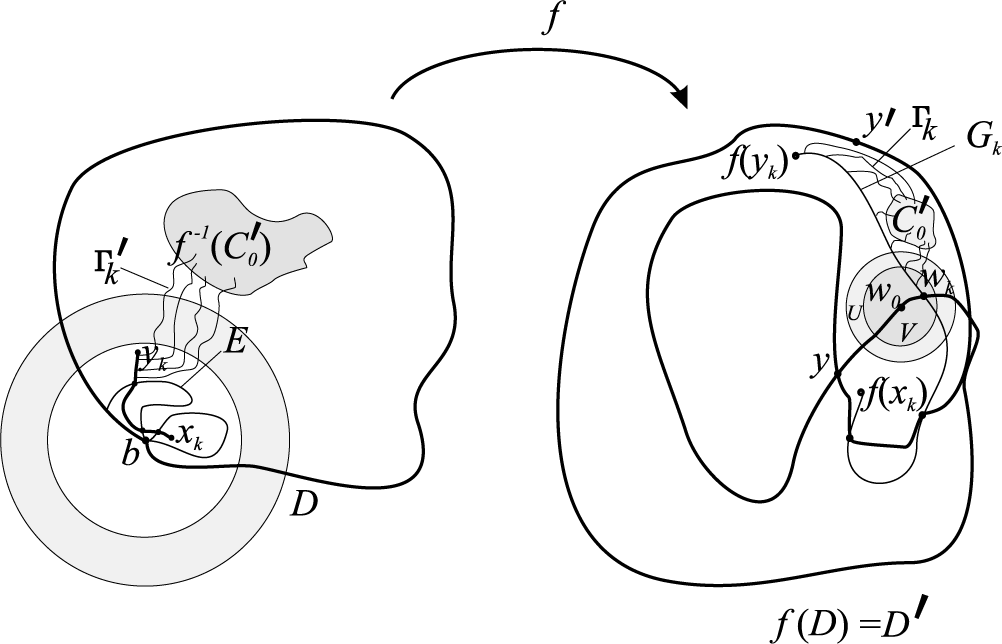
see Figure 1.
To the proof of Theorem 1.1.

In particular,
 $$ \begin{align} h(f(x_k), f(y_k))\geqslant \delta>0 \end{align} $$
for some
 $\delta>0$
and all
 $k\in {\Bbb N},$
where h is chordal (spherical) metric. By the assumption 2), there exists a sequence of neighborhoods
 $V_k\subset B(b, 2^{\,-k}), k=1,2,\ldots ,$
such that
 is connected and
 consists at most of m components,
 $1\leqslant m<\infty .$
We note that the points
 $x_k$
and
 $y_k, k=1,2,\ldots , $
may be chosen such that
 $x_k, y_k\not \in E.$
Indeed, since under condition 1) the set E is nowhere dense in
 $D,$
there exists a sequence
 $x_{ki}\in D\,\backslash\, E, i=1,2,\ldots ,$
such that
 $x_{ki}\rightarrow x_k$
as
 $i\rightarrow \infty .$
Put
 $\varepsilon>0.$
Due to the continuity of the mapping f at the point
 $x_k,$
for the number
 $k\in {\Bbb N}$
there is a number
 $i_k\in {\Bbb N}$
such that
 $h(f(x_{ki_k}), f(x_k))<\frac {1}{2^k}.$
So, by the triangle inequality
 $$ \begin{align*}h(f(x_{ki_k}), y)\leqslant h(f(x_{ki_k}), f(x_k))+ h(f(x_k), y)\leqslant \frac{1}{2^k}+\varepsilon\,,\end{align*} $$
 $k\geqslant k_0=k_0(\varepsilon ),$
since
 $f(x_k)\rightarrow y$
as
 $k\rightarrow \infty $
and by the choice of
 $x_k$
and
 $y.$
Therefore,
 $x_k\in D$
may be replaced by
 $x_{ki_k}\in D\,\backslash\, E,$
as required. We may reason similarly for the sequence
 $y_k.$
Now, by Lemma 2.1 there are subsequences
 $x_{k_l}$
and
 $y_{k_l}, l=1,2,\ldots ,$
belonging to some sequence of neighborhoods
 $V_l, l=1,2,\ldots ,$
of the point
 $x_0$
such that
 $\mathrm {diam\,}V_l\rightarrow 0$
as
 $l\rightarrow \infty $
and, in addition, any pair
 $x_{k_l}$
and
 $y_{k_l}$
may be joined by a path
 $\gamma _l$
in
 where
 $\gamma _l$
contains at most
 $m-1$
points in
 $E.$
Without loss of generality, we may assume that the same sequences
 $x_k$
and
 $y_k$
satisfy properties mentioned above. Let
 $\gamma _k:[0, 1]\rightarrow D, \gamma _k(0)=x_k$
and
 $\gamma _k(1)=y_k, k=1,2,\ldots .$
Observe that, the path
 $f(\gamma _k)$
contains not more than
 $m-1$
points in
 $C(f, \partial D).$
In the contrary case, there are at least m such points
 But now the points
 $a_{1}=\gamma _k(t_1), a_{2}=\gamma _k(t_2),\ldots , a_m=\gamma _k(t_m)$
are in
 $E=f^{\,-1}(C(f, \partial D))$
and simultaneously belong to
 $\gamma _k.$
This contradicts the definition of
 $\gamma _k.$
Let
 $$ \begin{align*}b_{1}=f(\gamma_k(t_1)),\, b_{2}=f(\gamma_k(t_2))\quad,\ldots,\quad b_l=f(\gamma_k(t_l))\,,\end{align*} $$
 $$ \begin{align*}0:=t_0\leqslant t_1\leqslant t_2\leqslant \ldots\leqslant t_l\leqslant 1:= t_{l+1},\qquad 1\leqslant l\leqslant m-1\,,\end{align*} $$
be points in  By the relation (3.3) and due to the triangle inequality,
 $$ \begin{align} \delta\leqslant h(f(x_k), f(y_k))\leqslant\sum\limits_{r=0}^{l} h(f(\gamma_k(t_r)), f(\gamma_k(t_{r+1}))\,. \end{align} $$
It follows from (3.4) that, there is
 $0\leqslant r=r(k)\leqslant m$
such that such that
 $$ \begin{align} h(f(\gamma_k(t_{r(k)})), f(\gamma_k(t_{r(k)+1}))\geqslant \delta/(l+1)\geqslant \delta/m\,. \end{align} $$
Observe that, the set
 $G_k:=|\gamma _k|_{(t_{r(k)}, t_{r(k)+1})}|$
belongs to
 $D^{\,\prime }\,\backslash\, C(f, \partial D),$
because it does not contain any point in
 $E.$
Since
 $D^{\,\prime }\,\backslash\, C(f, \partial D)$
consists only of finite components, there exists at least one a component of
 $D^{\,\prime }\,\backslash\, C(f, \partial D),$
containing infinitely many components of
 $G_k.$
Without loss of generality, going to a subsequence, if need, we may assume that all
 $G_k$
belong to one component K of
 $D^{\,\prime }\,\backslash\, C(f, \partial D).$
Due to the compactness of
 $\overline {{\Bbb R}^n},$
we may assume that the sequence
 $w_k:=f(\gamma _k(t_{r(k)})), k=1,2,\ldots , $
converges to some a point
 $w_0\in \overline {D^{\,\prime }}.$
Let us to show that
 $w_0\in C(f, \partial D).$
Indeed, there are two cases: either
 $w_k=f(\gamma _k(t_{r(k)}))\in C(f, \partial D)$
for infinitely many
 $k,$
or
 $w_k\not \in E$
for infinitely many
 $k\in {\Bbb N}.$
In the first case, the inclusion
 $w_0\in C(f, \partial D)$
is obvious, because
 $C(f, \partial D)$
is closed. In the second case, obviously,
 $w_k=f(x_k),$
but this sequence converges to
 $y\in C(f, \partial D)$
by the assumption.
By the assumption, each component of the set
 $D^{\,\prime }\,\backslash\, C(f, \partial D)$
has a strongly accessible boundary with respect to p-modulus. In this case, for any neighborhood U of the point
 $w_0\in \partial K$
there is a compact set
 $C_0^{\,\prime }\subset D^{\,\prime },$
a neighborhood V of a point
 $w_0, V\subset U,$
and a number
 $P>0$
such that
 $$ \begin{align} M_p(\Gamma(C_0^{\,\prime}, F, K))\geqslant P>0 \end{align} $$
for any continuous
 $F,$
intersecting
 $\partial U$
and
 $\partial V.$
Choose a neighborhood U of
 $w_0$
with
 $h(U)< \delta /2m,$
where
 $\delta $
is from (3.3). Let
 $C_0^{\,\prime }$
and V be a compact set and a neighborhood corresponding to
 $w_0.$
Observe that,
 $G_k$
contains some a continuum
 $\widetilde {G}_k$
in K intersecting
 $\partial U$
and
 $\partial V$
for sufficiently large
 $k.$
Indeed, by the construction of
 $G_k,$
there is a sequence of points
 $a_{s, k}:=f(\gamma _k(p_s))\rightarrow w_k:=f(\gamma _k(t_{r(k)}))$
as
 $s\rightarrow \infty $
and
 $b_{s, k}=f(\gamma _k(q_s))\rightarrow f(\gamma _k(t_{r(k)+1}))$
as
 $s\rightarrow \infty ,$
where
 $t_{r(k)}< p_s<q_s<t_{r(k)+1}$
and
 $a_{s, k}, b_{s, k}\in K.$
By the triangle inequality and by (3.5)
 $$ \begin{align*}h(a_{s, k}, b_{s, k})\geqslant h(b_{s, k}, w_k)-h(w_k, a_{s, k})\geqslant \end{align*} $$
 $$ \begin{align} h(f(\gamma_k(t_{r(k)+1})), w_k)-h(f(\gamma_k(t_{r(k)+1})), b_{s, k})-h(w_k, a_{s, k})\geqslant \end{align} $$
 $$ \begin{align*}\delta/m-h(f(\gamma_k(t_{r(k)+1}), b_{s, k}))-h(w_k, a_{s, k})\,.\end{align*} $$
Since
 $a_{s, k}:=f(\gamma _k(p_s))\rightarrow w_k:=f(\gamma _k(t_{r(k)}))$
as
 $s\rightarrow \infty $
and
 $b_{s, k}=f(\gamma _k(q_s))\rightarrow f(\gamma _k(t_{r(k)+1}))$
as
 $s\rightarrow \infty ,$
it follows from the last inequality that there is
 $s=s(k)\in {\Bbb N}$
such that
 $$ \begin{align} h(a_{s(k), k}, b_{s(k), k})\geqslant\delta/(2m)\,. \end{align} $$
Since V is open, there is some neighborhood
 $U_k$
of
 $w_k$
such
 $U_k\subset V.$
Since
 $a_{s, k}\rightarrow w_k:=f(\gamma _k(t_{r(k)}))$
as
 $s\rightarrow \infty ,$
we may assume that
 $a_{s(k), k}\in V.$
Now, we set
 $$ \begin{align*}\widetilde{G}_k:=f(\gamma_k)|_{[p_{s(k)}, q_{s(k)}]}\,.\end{align*} $$
In other words,
 $\widetilde {G}_k$
is a part of the path
 $f(\gamma _k)$
between points
 $a_{s(k), k}$
and
 $b_{s(k), k}.$
Let us to show that
 $\widetilde {G}_k$
intersects
 $\partial U$
and
 $\partial V.$
Indeed, by the mentioned above,
 $a_{s(k), k}\subset V,$
so that
 In particular,
 because
 $V\subset U.$
On the other hand, by (3.8)
 $h(\widetilde {G}_k)\geqslant \delta /2m,$
however,
 $h(U)< \delta /2m$
by the choice of
 $U.$
In particular,
 $h(V)<\delta /2m.$
It follows from this that

Now, by [Reference KuratowskiKu, Theorem 1.I.5, Section 46]

as required. Now, by (3.6),
 $$ \begin{align} M_p(\Gamma(\widetilde{G}_k, C^{\,\prime}_0, K))\geqslant P>0\,, \qquad k=1,2,\ldots\,. \end{align} $$
Let us to show that, the relation (3.9) contradicts with the definition of f in (1.4) together with the conditions (3.1)–(3.2). Indeed, let us denote by
 $\Gamma _k$
the family of all half-open paths
 $\beta _k:[a, b)\rightarrow \overline {{\Bbb R}^n}$
such that
 $\beta _k(a)\in \widetilde {G}_k, \beta _k(t)\in K$
for all
 $t\in [a, b)$
and, moreover,
 $\lim \limits _{t\rightarrow b-0}\beta _k(t):=B_k\in C_0^{\,\prime }.$
Obviously, by (3.9)
 $$ \begin{align} M_p(\Gamma_k)=M_p(\Gamma(\widetilde{G}_k, C^{\,\prime}_0, K))\geqslant P>0\,, \qquad k=1,2,\ldots\,. \end{align} $$
Consider the family
 $\Gamma _k^{\,\prime }$
of maximal f-liftings
 $\alpha _k:[a, c)\rightarrow D$
of the family
 $\Gamma _k$
starting at
 $|\gamma _k|;$
such a family exists by Proposition 3.1.
Observe that, the situation when
 $\alpha _k\rightarrow \partial D$
as
 $k\rightarrow \infty $
is impossible. Suppose the opposite: let
 $\alpha _k(t)\rightarrow \partial D$
as
 $t\rightarrow c.$
Let us choose an arbitrary sequence
 $\varphi _m\in [0, c)$
such that
 $\varphi _m\rightarrow c-0$
as
 $m\rightarrow \infty .$
Since the space
 $\overline {{\Bbb R}^n}$
is compact, the boundary
 $\partial D$
is also compact as a closed subset of the compact space. Then there exists
 $w_m\in \partial D$
such that
 $$ \begin{align} h(\alpha_k(\varphi_m), \partial D)=h(\alpha_k(\varphi_m), w_m) \rightarrow 0\,,\qquad m\rightarrow \infty\,. \end{align} $$
Due to the compactness of
 $\partial D$
, we may assume that
 $w_m\rightarrow w_0\in \partial D$
as
 $m\rightarrow \infty .$
Therefore, by the relation (3.11) and by the triangle inequality
 $$ \begin{align}\,\,\,\,\, h(\alpha_k(\varphi_m), w_0)\leqslant h(\alpha_k(\varphi_m), w_m)+h(w_m, w_0)\rightarrow 0\,,\qquad m\rightarrow \infty\,. \end{align} $$
On the other hand,
 $$ \begin{align} f(\alpha_k(\varphi_m))=\beta_k(\varphi_m)\rightarrow \beta(c) \,,\quad m\rightarrow\infty\,, \end{align} $$
because by the construction, the path
 $\beta _k(t), t\in [a, b],$
lies in
 $K\subset D^{\,\prime }\,\backslash\, C(f, \partial D)$
together with its finite ones points. At the same time, by (3.12) and (3.13) we have that
 $\beta _k(c)\in C(f, \partial D).$
The inclusions
 $\beta _k\subset D^{\,\prime }\,\backslash\, C(f, \partial D)$
and
 $\beta _k(c)\in C(f, \partial D)$
contradict each other.
Therefore, by Proposition 3.1
 $\alpha _k\rightarrow x_1\in D$
as
 $t\rightarrow c-0,$
and
 $c=b$
and
 $f(\alpha _k(b))=f(x_1).$
In other words, the f-lifting
 $\alpha _k$
is complete, i.e.,
 $\alpha _k:[a, b]\rightarrow D.$
Besides that, it follows from that
 $\alpha _k(b)\in f^{\,-1}(C^{\,\prime }_0).$
Observe that, there is
 $r_0>0$
such that
 $$ \begin{align} h(f^{\,-1}(C^{\,\prime}_0), \partial D)\geqslant r_0>0\,. \end{align} $$
In the contrary case, there is
 $z_k\in f^{\,-1}(C^{\,\prime }_0)$
such that
 $z_k\rightarrow z_0\in \partial D$
as
 $k\rightarrow \infty .$
Now, due to the compactness of
 $\overline {{\Bbb R}^n}$
the sequence
 $f(z_k)$
converges to some
 $\omega _0$
as
 $k\rightarrow \infty .$
But, in this case,
 $\omega _0$
in
 $C(f, \partial D)$
and simultaneously
 $\omega _0\in K\subset D^{\,\prime }\,\backslash\, C(f, \partial D)$
because
 $f(z_k)\in C^{\,\prime }_0\subset K$
and
 $C^{\,\prime }_0$
is closed. We have obtained a contradiction, so that the relation (3.14) holds.
Since
 $b\ne \infty ,$
it follows from (3.14) that
 $$ \begin{align} f^{\,-1}(C^{\,\prime}_0)\subset D\,\backslash\, B(b, r_0)\,. \end{align} $$
Let k be such that
 $2^{\,-k}<\varepsilon _0.$
We may consider that
 $\varepsilon _0<r_0.$
Due to (3.15), we may show that
 $$ \begin{align} \Gamma_k^{\,\prime}>\Gamma(S(b, 2^{\,-k}), S(b, \varepsilon_0), D) \end{align} $$
(see [Reference KuratowskiKu, Theorem 1.I.5, Section 46]). Observe that the function
 $$ \begin{align*}\eta(t)=\left\{ \begin{array}{@{}rr} \psi(t)/I(2^{\,-k}, \varepsilon_0), & t\in (2^{\,-k}, \varepsilon_0),\\ 0, & t\in {\Bbb R}\,\backslash\, (2^{\,-k}, \varepsilon_0)\,, \end{array} \right.\end{align*} $$
where
 $I(2^{\,-k}, \varepsilon _0)$
is defined in (3.1), satisfies (1.5) for
 $r_1:=2^{\,-k}, r_2:=\varepsilon _0.$
Therefore, by the definition of the mapping in (1.4) and by (3.16) we obtain that
 $$ \begin{align} M_p(f(\Gamma^{\,\prime}_k))\leqslant \Delta(k)\,, \end{align} $$
where
 $\Delta (k)\rightarrow 0$
as
 $k\rightarrow \infty .$
However,
 $\Gamma _k=f(\Gamma _k^{\,\prime }).$
Thus, by (3.17) and (3.1)–(3.2) we obtain that
 $$ \begin{align} M_p(\Gamma_k)= M_p(f(\Gamma_k^{\,\prime}))\leqslant \Delta(k)\rightarrow 0 \end{align} $$
as
 $k\rightarrow \infty .$
However, the relation (3.18) together with the inequality (3.10) contradict each other, which proves the lemma.
The proof of the following statement may be found in [Reference Sevost’yanovSev4 , Lemmas 1.3 and 1.4].
Lemma 3.2 Let
 $Q:{\Bbb R}^n\rightarrow [0,\infty ], n\geqslant 2,$
be a Lebesgue measurable function and let
 $x_0\in {\Bbb R}^n.$
Let
 $0<p\leqslant n.$
Assume that either of the following conditions holds
(a)
 $Q\in FMO(x_0),$
(b)
 $q_{x_0}(r)\,=\,O\left (\left [\log {\frac 1r}\right ]^{n-1}\right )$
as
 $r\rightarrow 0,$
(c) for some small
 $\delta _0=\delta _0(x_0)>0$
we have the relations
 $$ \begin{align*} \int\limits_{\delta}^{\delta_0}\frac{dt}{t^{\frac{n-1}{p-1}} q_{x_0}^{\frac{1}{p-1}}(t)}<\infty,\qquad 0<\delta<\delta_0, \end{align*} $$
and
 $$ \begin{align*} \int\limits_{0}^{\delta_0}\frac{dt} {t^{\frac{n-1}{p-1}}q_{x_0}^{\frac{1}{p-1}}(t)}=\infty\,. \end{align*} $$
Then there exist a number
 $\varepsilon _0\in (0,1)$
and a function
 $\psi (t)\geqslant 0$
such that the relation

holds as
 $\varepsilon \rightarrow 0,$
where
 $\psi :(0, \varepsilon _0)\rightarrow [0, \infty )$
is some function such that, for some
 $0<\varepsilon _1<\varepsilon _0,$
 $$ \begin{align*} 0<I(\varepsilon, \varepsilon_0) =\int\limits_{\varepsilon}^{\varepsilon_0}\psi(t)\,dt < \infty \qquad \forall\quad\varepsilon \in(0, \varepsilon_1)\,. \end{align*} $$
Proof of Theorem 1.1
immediately follows by Lemmas 3.1 and 3.2. Let us to prove the equality
 $f(\overline {D})=\overline {D^{\,\prime }},$
cf. the last part of the proof of Theorem 3.1 in [Reference Sevost’yanov, Skvortsov and DovhopiatyiSSD]. Indeed, obviously,
 $\overline {f}(\overline {D})\subset \overline {D^{\,\prime }}.$
Let us to show that,
 $\overline {D^{\,\prime }}\subset \overline {f}(\overline {D}).$
Indeed, let
 $y_0\in \overline {D^{\,\prime }}.$
Then either
 $y_0\in D^{\,\prime },$
or
 $y_0\in \partial D^{\,\prime }.$
If
 $y_0\in D^{\,\prime },$
then
 $y_0=f(x_0)$
and
 $y_0\in \overline {f}(\overline {D}),$
because f maps D onto
 $D^{\,\prime }$
by the assumption. Finally, let
 $y_0\in \partial D^{\,\prime }.$
Then there is a sequence
 $y_k\in D^{\,\prime }$
such that
 $y_k=f(x_k)\rightarrow y_0$
as
 $k\rightarrow \infty $
and
 $x_k\in D.$
Since
 $\overline {{\Bbb R}^n}$
is a compact space, we may consider that
 $x_k\rightarrow x_0,$
where
 $x_0\in \overline {D}.$
Observe that,
 $x_0\in \partial D,$
because f is open. Then
 $f(x_0)=y_0\in \overline {f}(\partial D)\subset \overline {f}(\overline {D}).$
Theorem is completely proved.
4 Some remarks on uniform domains
A domain
 $D\subset {\Bbb R}^n, n\geqslant 2,$
is called a uniform domain with respect to p-modulus,
 $p\geqslant 1,$
if, for each
 $r>0,$
there is
 $\delta>0$
such that
 $M_{p}(\Gamma (F, F^{\,*}, D))\geqslant \delta $
whenever F and
 $F^{\,*}$
are continuous of D with
 $h(F)\geqslant r$
and
 $h(F^{\,*})\geqslant r.$
Let I be some set of indices. Domains
 $D_i, i\in I,$
are said to be equi-uniform domains with respect to p-modulus, if, for
 $r>0,$
the modulus condition above is satisfied by each
 $D_i$
with the same number
 $\delta .$
It should be noted that the proposed concept of a uniform domain has, generally speaking, no relation to definition, introduced for the uniform domain in Martio-Sarvas sense [Reference Martio and SarvasMSa]. Note that, uniform domains with respect to p-modulus have strongly accessible boundaries with respect to p-modulus, see [Reference Sevost’yanov and SkvortsovSevSkv1
, Remark 1].
Remark 4.1 The statement of Lemma 3.1 remains true if condition 3) in this lemma is replaced by the conditions:
(
 $3_{\mathbf {a}}$
) the family of components of
 $D^{\,\prime }\,\backslash\, C(f, \partial D)$
is equi-uniform with respect to p-modulus and, besides that,
(
 $3_{\mathbf {b}}$
) there is
 $\delta _*>0$
such that for each component K of
 $D^{\,\prime }\,\backslash\, C(f, \partial D)$
there is a nondegenerate continuum
 $F\subset K$
such that
 $h(F)\geqslant \delta _*$
and
 $h(f^{\,-1}(F), \partial D)\geqslant \delta _*>0.$
Indeed, just as in the proof of Lemma 3.1, we will prove this statement by contradiction. The proof up to relation (3.5) is repeated verbatim. Further, just as in the proof of relations (3.7)–(3.8), it may be shown that there is a subcontinuum
 $\widetilde {G}_k$
in
 $G_k$
such that
 $h(\widetilde {G}_k)\geqslant \delta /2m.$
Let
 $K_k$
be a component of
 $D^{\,\prime }\,\backslash\, C(f, \partial D)$
containing
 $\widetilde {G}_k,$
and let
 $F_k:=F$
be compactum in
 $K_k$
from the condition
 $3_{\mathbf {b}}.$
Due to the equi-uniformity of
 $K_k$
(see the condition
 $3_{\mathbf {b}}$
), there exists
 $P>0$
such that
 $$ \begin{align} M_p(\Gamma_k)=M_p(\Gamma(\widetilde{G}_k, F_k, K_k))\geqslant P>0\,, \qquad k=1,2,\ldots\,. \end{align} $$
Here
 $\Gamma _k$
denotes the family of all half-open paths
 $\beta _k:[a, b)\rightarrow \overline {{\Bbb R}^n}$
such that
 $\beta _k(a)\in \widetilde {G}_k \beta _k(t)\in K_k$
for all
 $t\in [a, b)$
and, moreover,
 $\lim \limits _{t\rightarrow b-0}\beta _k(t):=B_k\in F_k.$
Consider the family
 $\Gamma _k^{\,\prime }$
of maximal f-liftings
 $\alpha _k:[a, c)\rightarrow D$
of the family
 $\Gamma _k$
starting at
 $|\gamma _k|;$
such a family exists by Proposition 3.1. Similarly to the proof of Lemma 3.1 we may prove that all these liftings are complete, i.e., any path
 $\alpha _k:[a, c)\rightarrow D$
is such that
 $c=b, \alpha _k(b)\in f^{\,-1}(F_k).$
Due to the condition
 $3_{\textbf {b}}$
,
 $$ \begin{align*} f^{\,-1}(K_k)\subset D\,\backslash\, B(b, r_0)\,. \end{align*} $$
Arguing further in a similar way to the rest of the proof of Lemma 3.1, we arrive at the relation
 $$ \begin{align} M_p(\Gamma_k)= M_p(f(\Gamma_k^{\,\prime}))\leqslant \Delta(k)\rightarrow 0 \end{align} $$
as
 $k\rightarrow \infty .$
The relations (4.1) and (4.2) contradict each other. The desired statement is proved.
5 Some examples
Example 1 Let
 $p=n=2.$
Consider the disk
 $D=B(1, 1)=\{z\in {\Bbb C}: |z-1|<1\}$
on the complex plane. Let us define a mapping
 $f:D\rightarrow {\Bbb C}$
as follows:
 $f(z)=z^4.$
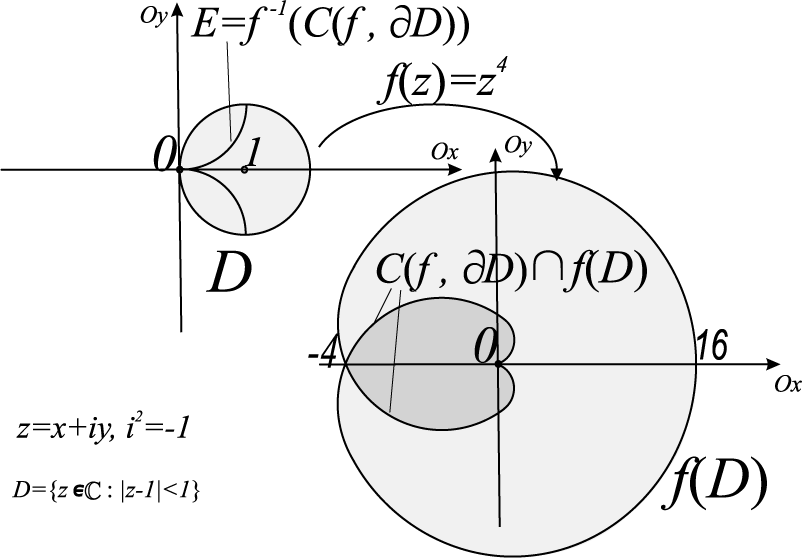
The Figure 2 schematically shows the image of the domain D under the mapping
 $f;$
the complete image is marked in gray, the domain that is mapped twice in the disk
 $B(1, 1)$
is marked in a darker color.
An open quasiregular mapping that satisfies conditions of Theorem 1.1.

The image of the boundary of the domain D has one point of self-intersection
 $w=(-4, 0).$
Paths

 $\frac {\pi }{4}<\varphi \leqslant \frac {\pi }{2},$
and

 $-\frac {\pi }{2}\leqslant \varphi <-\frac {\pi }{4},$
is a part of the image of the boundary of D that lies inside the mapped domain. It is not difficult to see that, the complete pre-image in D of this paths consists of two paths
 and

 $-\frac {\pi }{2}\leqslant \varphi <-\frac {\pi }{4},$
and there are no others.
Note that, the mapping f satisfies all conditions of Theorem 1.1. Indeed, the set
 $E:=f^{\,-1}(C(f, \partial D))$
is nowhere dense in
 $D,$
because E consists only on paths
 $\widetilde {z_1}(\varphi )$
and
 $\widetilde {z_2}(\varphi )$
mentioned above. Also, D is finitely connected on
 $E,$
because D is two-connected at any inner point of D which belong to the paths
 $\widetilde {z_1}(\varphi )$
and
 $\widetilde {z_2}(\varphi ).$
Obviously, D is locally connected at any point of
 $\partial D,$
while it is three-connected with respect to E at the origin, two-connected with respect to E at the points
 $1\pm i$
and locally connected with respect to E at the rest points. In addition,
 $f(D)\,\backslash\, C(f, \partial D)$
consists of two components each of them is strongly accessible because it is uniform (see comments made before Remark 4.1). The uniformity of these components follows from the fact that, each plane domain having a finite number of components, which is finitely connected on the boundary is uniform (see [Reference NäkkiNa3, Corollary 6.8]). Finally,
 $f(z)=z^4$
is a quasiregular mapping, therefore satisfies the relation (1.4) for the function
 $Q(y)\equiv 1$
(see, e.g., [Reference RickmanRi, Theorem 8.1.II]. Observe that,
 $Q(x)\equiv 1$
satisfies simultaneously the conditions
 $Q\in FMO(x_0)$
at any
 $x_0\in {\Bbb R}^n$
and (1.10), as well.
Example 2 It is not difficult to construct a similar mapping with some unbounded function Q in (1.4). For this purpose, let D and f be a domain and a mapping from the previous example, correspondingly. Let us consider an arbitrary point
 $z_0\in D\,\backslash\, E,$
where
 $E:=f^{\,-1}(C(f, \partial D)),$
and let
 $0<r_0<\min \{\mathrm {dist\,}(z_0, \partial D), \mathrm {dist\,}(z_0, E)\}.$
Put
 $$ \begin{align*}h(z)=\frac{r_0(z-z_0)}{|z-z_0|\log\frac{r_0e}{|(z-z_0)|}}+z_0,\qquad h(z_0)=z_0\,.\end{align*} $$
Reasoning similarly to [Reference Martio, Ryazanov, Srebro and YakubovMRSY2
, Proposition 6.3], we may show that h satisfies the relations (1.4)–(1.5) in each point
 $b\in \partial D$
for
 $Q=Q(z)=\log \left (\frac {r_0e}{|z-z_0|}\right )$
with
 $p=2.$
Put

Since f satisfies the relations (1.4)–(1.5) with
 $Q\equiv 1,$
the mapping F satisfies the relations (1.4)–(1.5) in each point
 $b\in \partial D$
for
 $Q=Q(x)=\log \left (\frac {e}{|x|}\right )$
with
 $p=2.$
Note that, Q satisfies the condition (1.10) for any point
 $b\in \partial D,$
because Q is locally bounded in
 $\partial D.$
Observe that, the mapping
 $F:D\rightarrow {\Bbb C}$
satisfies all conditions of Theorem 1.1. In particular, F is constructed so that it does not change the geometry of
 $D.$
Besides that, F is open and discrete as a superposition of a homeomorphism g with some quasiregular mapping. Now, by Theorem 1.1 F has a continuous extension to any point
 $b\in \partial D.$
All conditions regarding the geometry of a domain are also hold, see Example 1.
6 On the equicontinuity of families in the closure of a domain
For mappings with branching satisfying (1.4)–(1.5), we have obtained several different theorems on the equicontinuity of families of mappings in the closure of a domain. In particular, in [Reference Sevost’yanov and SkvortsovSevSkv1 ] we are talking about families of mappings with a certain condition on the pre-image of a continuum, the diameter of which does not decrease, and in [Reference Sevost’yanov and SkvortsovSevSkv2 ] we assumed the presence of one normalization condition. In these papers, the mappings were assumed to be closed (=boundary preserving). Now we extend these results to mappings that are not closed.
Following to [Reference RickmanRi], a condenser in
 ${\Bbb R}^n$
is a pair
 $E=(A, C),$
where A is open in
 ${\Bbb R}^n$
and
 $C\ne \varnothing $
is a compact subset of
 $A.$
If
 $1\leqslant p <\infty ,$
the p-capacity of E is defined by
 $$ \begin{align*}\mathrm{cap}_p E =\inf\limits_{u} \int\limits_A |\nabla u|^p\,dm\,,\end{align*} $$
where the infimum is taken over all nonnegative functions u in
 $\mathrm {ACL}^p(A)$
with compact support in A and
 $u|_C \geqslant 1.$
Let F be a compact set in
 ${\Bbb R}^n.$
We say that F is of p-capacity zero if
 $\mathrm {cap}_p\,(A, F)=0$
for some (and hence for all) bounded open set
 $A\supset F.$
An arbitrary set
 $E\subset {\Bbb R}^n$
is of p-capacity zero if the same is true for every compact subset of
 $E.$
In this case we write
 $\mathrm {cap}_p\,E = 0$
(
 $\mathrm {cap}\, E=0$
if
 $p=n$
), otherwise
 $\mathrm {cap}_p E> 0.$
Given
 $p\geqslant 1, \delta>0,$
closed sets
 $E, E_*, F$
in
 $\overline {{\Bbb R}^n}, n\geqslant 2,$
a domain
 $D\subset {\Bbb R}^n$
and a Lebesgue measurable function
 $Q:D\rightarrow [0, \infty ]$
let us denote by
 $\frak {R}^{E_*, E, F}_{Q, \delta , p}(D)$
the family of all open discrete mappings
 $f:D\rightarrow \overline {{\Bbb R}^n}\,\backslash\, F$
satisfying the conditions (1.4)–(1.5) at the point
 $x_0\in \overline {D}$
such that:
1)
 $C(f, \partial D)\subset E_*,$
2) for each component K of
 $D^{\,\prime }_f\,\backslash\, E_*,$
 $D^{\,\prime }_f:=f(D),$
there is a continuum
 $K_f\subset K$
such that
 $h(K_f)\geqslant \delta $
and
 $h(f^{\,-1}(K_f), \partial D)\geqslant \delta>0,$
3)
 $f^{\,-1}(E_*)\subset E.$
Theorem 6.1 Let
 $p\geqslant 1,$
let D be a domain in
 ${\Bbb R}^n, n\geqslant 2.$
Assume that:
1) the set E is nowhere dense in
 $D,$
and D is finitely connected on
 $E,$
i.e., for any
 $z_0\in E$
and any neighborhood
 $\widetilde {U}$
of
 $z_0$
there is a neighborhood
 $\widetilde {V}\subset \widetilde {U}$
of
 $z_0$
such that
 consists of finite number of components;
2) for any
 $x_0\in \partial D$
there is
 $m=m(x_0)\in {\Bbb N},$
 $1\leqslant m<\infty $
such that the following is true: for any neighborhood U of
 $x_0$
there is a neighborhood
 $V\subset U$
of
 $x_0$
and such that:
2a)  is connected,
2b)  consists at most of m components.
Let for
 $p=n$
the set F have positive capacity, and for
 $n-1<p<n$
it is an arbitrary closed set.
Suppose that, for any
 $x_0\in \partial D$
at least one of the following conditions is satisfied:
 $3_1)$
a function Q has a finite mean oscillation at
 $x_0; 3_2)$
 $q_{x_0}(r)\,=\,O\left (\left [\log {\frac 1r}\right ]^{n-1}\right )$
as
 $r\rightarrow 0; 3_3)$
the condition
 $$ \begin{align*} \int\limits_{0}^{\delta(x_0)}\frac{dt}{t^{\frac{n-1}{p-1}} q_{x_0}^{\,\prime\,\frac{1}{p-1}}(t)}=\infty \end{align*} $$
holds for some
 $\delta (x_0)>0,$
where
 $q_{x_0}^{\,\prime }(t)$
is defined in (1.8).
Let the family of all components of
 $D^{\,\prime }_f\,\backslash\, E_*$
is equi-uniform over
 $f\in \frak {R}^{E_*, E, F}_{Q, \delta , p}(D)$
with respect to p-modulus. Then every
 $f\in \frak {R}^{E_*, E, F}_{Q, \delta , p}(D)$
has a continuous extension to
 $\partial D$
and the family
 $\frak {R}^{E_*, E, F}_{Q, \delta , p}(\overline {D}),$
consisting of all extended mappings
 $\overline {f}: \overline {D}\rightarrow \overline {{\Bbb R}^n},$
is equicontinuous in
 $\overline {D}.$
The proof of Theorem 1.1 is based on the following lemma.
Lemma 6.1 Assume that, under conditions of Theorem 6.1 we replace the assumptions
 $3_1)$
–
 $3_3)$
by the following assumption: Suppose that, for any
 $x_0\in \partial D$
there is
 $\varepsilon _0=\varepsilon _0(x_0)>0$
and some positive measurable function
 $\psi :(0, \varepsilon _0)\rightarrow (0,\infty )$
such that
 $$ \begin{align} 0<I(\varepsilon, \varepsilon_0)=\int\limits_{\varepsilon}^{\varepsilon_0}\psi(t)\,dt < \infty \end{align} $$
for sufficiently small
 $\varepsilon \in (0, \varepsilon _0)$
and, in addition,

where
 $A:=A(x_0, \varepsilon , \varepsilon _0)$
is defined in (1.3).
Let the family of all components of
 $D^{\,\prime }_f\,\backslash\, E_*$
is equi-uniform over
 $f\in \frak {R}^{E_*, E, F}_{Q, \delta , p}(D)$
with respect to p-modulus. Then every
 $f\in \frak {R}^{E_*, E, F}_{Q, \delta , p}(D)$
has a continuous extension to
 $\partial D$
and the family
 $\frak {R}^{E_*, E, F}_{Q, \delta , p}(\overline {D}),$
consisting of all extended mappings
 $\overline {f}: \overline {D}\rightarrow \overline {{\Bbb R}^n},$
is equicontinuous in
 $\overline {D}.$
Proof The equicontinuity of
 $\frak {R}^{E_*, E, F}_{Q, \delta , p}(D)$
in D follows by [Reference Salimov and Sevost’yanovSalSev, Lemma 4.2] for the case of
 $p=n$
and [Reference Golberg, Salimov and Sevost’yanovGSS, Lemma 2.4] for
 $n-1<p< n.$
Since any component of
 $D^{\,\prime }_f\,\backslash\, E_*$
is uniform with respect to p-modulus, it has strongly accessible boundary with respect to p-modulus (see [Reference Sevost’yanov and SkvortsovSevSkv1
, Remark 1]). Now the possibility of continuous extension of any
 $f\in \frak {R}^{E_*, E, F}_{Q, \delta , p}(D)$
to
 $\partial D$
follows from Lemma 3.1 and Remark 4.1. It remains to prove the equicontinuity of the extended family
 $\frak {R}^{E_*, E, F}_{Q, \delta , p}(\overline {D})$
in
 $\partial D.$
Suppose the opposite. Then there is
 $x_0\in \partial D,$
 $\varepsilon _0>0,$
a sequence
 $x_k\rightarrow x_0,$
 $x_k\in \overline {D},$
and
 $f_k\in \frak {R}^{E_*, E, F}_{Q, \delta , p}(\overline {D})$
such that
 $$ \begin{align} h(f_k(x_k), f_k(x_0))\geqslant \varepsilon_0\,. \end{align} $$
Since
 $f_k$
has a continuous extension to
 $\partial D,$
we may consider that
 $x_k\in D.$
In addition, it follows from (6.3) that we may find a sequence
 $x^{\,\prime }_k\in D, k=1,2,\ldots ,$
such that
 $x^{\,\prime }_k\rightarrow x_0$
and
 $$ \begin{align} h(f_k(x_k), f_k(x^{\,\prime}_k))\geqslant \varepsilon_0/2\,. \end{align} $$
By the assumption 2), there exists a sequence of neighborhoods
 $V_k\subset B(x_0, 2^{\,-k}), k=1,2,\ldots ,$
such that
 is connected and
 consists of m components,
 $1\leqslant m<\infty .$
We note that the points
 $x_k$
and
 $x^{\,\prime }_k, k=1,2,\ldots , $
may be chosen such that
 $x_k, x^{\,\prime }_k\not \in E.$
Indeed, since under condition 1) the set E is nowhere dense in
 $D,$
there exists a sequence
 $x_{ki}\in D\,\backslash\, E, i=1,2,\ldots ,$
such that
 $x_{ki}\rightarrow x_k$
as
 $i\rightarrow \infty .$
Put
 $\varepsilon>0.$
Due to the continuity of the mapping
 $f_k$
at the points
 $x_k$
and
 $x^{\,\prime }_k,$
for the number
 $k\in {\Bbb N}$
there are numbers
 $i_k, j_k\in {\Bbb N}$
such that
 $h(f_k(x_{ki_k}), f_k(x_k))<\frac {1}{2^k}$
and
 $h(f_k(x^{\,\prime }_{kj_k}), f_k(x^{\,\prime }_k))<\frac {1}{2^k}.$
Now, by (6.4) and by the triangle inequality,
 $$ \begin{align} & h(f_k(x_{ki_k}), f_k(x^{\,\prime}_{kj_k})) \geqslant h(f_k(x^{\,\prime}_k), f_k(x_{ki_k}))-h(f_k(x^{\,\prime}_k), f_k(x^{\,\prime}_{kj_k})) \nonumber \\ &\quad \geqslant h(f_k(x_k), f_k(x^{\,\prime}_k))-h(f_k(x_k), f_k(x_{ki_k}))-h(f_k(x^{\,\prime}_k), f_k(x^{\,\prime}_{kj_k}))\nonumber \\ & \quad\geqslant\varepsilon_0/2-\frac{2}{2^k}\geqslant \varepsilon_0/4 \end{align} $$
for sufficiently large
 $k.$
Due to (6.5), we may assume that
 $x_k, x^{\,\prime }_k\not \in E,$
as required.
Now, by Lemma 3.1 there are subsequences
 $x_{k_l}$
and
 $x^{\,\prime }_{k_l}, l=1,2,\ldots ,$
belonging to some sequence of neighborhoods
 $V_l, l=1,2,\ldots ,$
of the point
 $x_0$
such that
 $\mathrm {diam\,}V_l\rightarrow 0$
as
 $l\rightarrow \infty $
and, in addition, any pair
 $x_{k_l}$
and
 $x^{\,\prime }_{k_l}$
may be joined by a path
 $\gamma _l$
in
 where
 $\gamma _l$
contains at most
 $m-1$
points in
 $E.$
Without loss of generality, we may assume that the same sequences
 $x_k$
and
 $y_k$
satisfy properties mentioned above. Let
 $\gamma _k:[0, 1]\rightarrow D, \gamma _k(0)=x_k$
and
 $\gamma _k(1)=y_k, k=1,2,\ldots .$
Observe that, the path
 $f_k(\gamma _k)$
contains not more than
 $m-1$
points in
 $E_*.$
In the contrary case, there are at least m such points
 But now the points
 $a_{1}=\gamma _k(t_1), a_{2}=\gamma _k(t_2),\ldots , a_m=\gamma _k(t_m)$
are in
 $E=f^{\,-1}(E_*)$
and simultaneously belong to
 $\gamma _k.$
This contradicts the definition of
 $\gamma _k.$
Let
 $$ \begin{align*}b_{1}=f_k(\gamma_k(t_1)), b_{2}=f_k(\gamma_k(t_2))\quad,\ldots,\quad b_l=f_k(\gamma_k(t_l))\,,\end{align*} $$
 $$ \begin{align*}t_0:=0\leqslant t_1\leqslant t_2\leqslant \ldots\leqslant t_l\leqslant 1=t_{l+1},\qquad 0\leqslant l\leqslant m-1\,,\end{align*} $$
be points in  By the relation (6.4) and due to the triangle inequality,
 $$ \begin{align} \varepsilon_0/2\leqslant h(f_k(x_k), f_k(y_k))\leqslant\sum\limits_{r=0}^{l} h(f_k(\gamma_k(t_r)), f_k(\gamma_k(t_{r+1}))\,. \end{align} $$
It follows from (6.6) that, there is
 $1\leqslant r=r(k)\leqslant m-1$
such that such that
 $$ \begin{align} h(f(\gamma_k(t_{r(k)})), f_k(\gamma_k(t_{r(k)+1})))\geqslant \varepsilon_0/(2(l+1))\geqslant \varepsilon_0/(2m)\,. \end{align} $$
Observe that, the set
 $G_k:=|\gamma _k|_{(t_{r(k)}, t_{r(k)+1})}|$
belongs to
 $D^{\,\prime }\,\backslash\, E.$
Observe that,
 $G_k$
contains some a continuum
 $\widetilde {G}_k$
with
 $h(\widetilde {G}_k)\geqslant \varepsilon _0/4m$
for any
 $k\in {\Bbb N}.$
Indeed, by the construction of
 $G_k,$
there is a sequence of points
 $a_{s, k}:=f_k(\gamma _k(p_s))\rightarrow w_k:=f(\gamma _k(t_{r(k)}))$
as
 $s\rightarrow \infty $
and
 $b_{s, k}=f_k(\gamma _k(q_s))\rightarrow f(\gamma _k(t_{r(k)+1}))$
as
 $s\rightarrow \infty ,$
where
 $t_{r(k)}< p_s<q_s<t_{r(k)+1}$
and
 $a_{s, k}, b_{s, k}\in G_k.$
By the triangle inequality and by (6.7)
 $$ \begin{align*}h(a_{s, k}, b_{s, k})\geqslant h(b_{s, k}, w_k)-h(w_k, a_{s, k})\geqslant \end{align*} $$
 $$ \begin{align*} h(f_k(\gamma_k(t_{r(k)+1})), w_k)-h(f_k(\gamma_k(t_{r(k)+1})), b_{s, k})-h(w_k, a_{s, k})\geqslant \end{align*} $$
 $$ \begin{align*}\varepsilon_0/(2m)-h(f_k(\gamma_k(t_{r(k)+1}), b_{s, k}))-h(w_k, a_{s, k})\,.\end{align*} $$
Since
 $a_{s, k}:=f_k(\gamma _k(p_s))\rightarrow w_k:=f_k(\gamma _k(t_{r(k)}))$
as
 $s\rightarrow \infty $
and
 $b_{s, k}=f_k(\gamma _k(q_s))\rightarrow f_k(\gamma _k(t_{r(k)+1}))$
as
 $s\rightarrow \infty ,$
it follows from the last inequality that there is
 $s=s(k)\in {\Bbb N}$
such that
 $$ \begin{align*} h(a_{s(k), k}, b_{s(k), k})\geqslant\varepsilon_0/(4m)\,. \end{align*} $$
Now, we set
 $$ \begin{align*}\widetilde{G}_k:=f_k(\gamma_k)|_{[p_{s(k)}, q_{s(k)}]}\,.\end{align*} $$
In other words,
 $\widetilde {G}_k$
is a part of the path
 $f_k(\gamma _k)$
between points
 $a_{s(k), k}$
and
 $b_{s(k), k}.$
Since
 $\widetilde {G}_k$
is a continuum in
 $D^{\,\prime }_{f_k}\,\backslash\, E_*,$
there is a component
 $K_k$
of
 $D^{\,\prime }_{f_k}\,\backslash\, E_*,$
containing
 $K_k.$
Let us apply the definition of equi-uniformity for he sets
 $\widetilde {G}_k$
and
 $K_{f_k}$
in
 $K_k$
(here
 $K_{f_k}$
is a continuum from the definition of the class
 $\frak {R}^{E_*, E, F}_{Q, \delta , p}(D)$
, in particular,
 $h(K_{f_k})\geqslant \delta $
). Due to this definition, for the number
 $\delta _*:=\min \{\delta , \varepsilon /4m\}>0$
there is
 $P>0$
such that
 $$ \begin{align} M_p(\Gamma(\widetilde{G}_k, K_{f_k}, K_k))\geqslant P>0\,, \qquad k=1,2,\ldots\,. \end{align} $$
Let us to show that, the relation (6.8) contradicts with the definition of f in (1.4) together with the conditions (6.1)–(6.2). Indeed, let us denote by
 $\Gamma _k$
the family of all half-open paths
 $\beta _k:[a, b)\rightarrow \overline {{\Bbb R}^n}$
such that
 $\beta _k(a)\in \widetilde {G}_k, \beta _k(t)\in K_k$
for all
 $t\in [a, b)$
and, moreover,
 $\lim \limits _{t\rightarrow b-0}\beta _k(t):=B_k\in K_{f_k}.$
Obviously, by (6.8)
 $$ \begin{align} M_p(\Gamma_k)=M_p(\Gamma(\widetilde{G}_k, K_{f_k}, K_k))\geqslant P>0\,, \qquad k=1,2,\ldots\,. \end{align} $$
Consider the family
 $\Gamma _k^{\,\prime }$
of all maximal
 $f_k$
-liftings
 $\alpha _k:[a, c)\rightarrow D$
of the family
 $\Gamma _k$
starting at
 $|\gamma _k|;$
such a family exists by Proposition 3.1.
Observe that, the situation when
 $\alpha _k\rightarrow \partial D$
as
 $k\rightarrow \infty $
is impossible. Suppose the opposite: let
 $\alpha _k(t)\rightarrow \partial D$
as
 $t\rightarrow c.$
Let us choose an arbitrary sequence
 $\varphi _m\in [0, c)$
such that
 $\varphi _m\rightarrow c-0$
as
 $m\rightarrow \infty .$
Since the space
 $\overline {{\Bbb R}^n}$
is compact, the boundary
 $\partial D$
is also compact as a closed subset of the compact space. Then there exists
 $w_m\in \partial D$
such that
 $$ \begin{align} h(\alpha_k(\varphi_m), \partial D)=h(\alpha_k(\varphi_m), w_m) \rightarrow 0\,,\qquad m\rightarrow \infty\,. \end{align} $$
Due to the compactness of
 $\partial D$
, we may assume that
 $w_m\rightarrow w_0\in \partial D$
as
 $m\rightarrow \infty .$
Therefore, by the relation (6.10) and by the triangle inequality
 $$ \begin{align} h(\alpha_k(\varphi_m), w_0)\leqslant h(\alpha_k(\varphi_m), w_m)+h(w_m, w_0)\rightarrow 0\,,\qquad m\rightarrow \infty\,. \end{align} $$
On the other hand,
 $$ \begin{align} f_k(\alpha_k(\varphi_m))=\beta_k(\varphi_m)\rightarrow \beta(c) \,,\quad m\rightarrow\infty\,, \end{align} $$
because by the construction the path
 $\beta _k(t), t\in [a, b],$
lies in
 $K_k\subset D^{\,\prime }_{f_k}\,\backslash\, E_*$
together with its finite ones points. At the same time, by (6.11) and (6.12) we have that
 $\beta _k(c)\in C(f_k, \partial D)\subset E_*$
by the definition of the class
 $\frak {R}^{E_*, E, F}_{Q, \delta , p}(D).$
The inclusions
 $\beta _k\subset D^{\,\prime }\,\backslash\, E_*$
and
 $\beta _k(c)\in E_*$
contradict each other.
Therefore, by Proposition 3.1
 $\alpha _k\rightarrow x_1\in D$
as
 $t\rightarrow c-0,$
and
 $c_b$
and
 $f_k(\alpha _k(b))=f_k(x_1).$
In other words, the
 $f_k$
-lifting
 $\alpha _k$
is complete, i.e.,
 $\alpha _k:[a, b]\rightarrow D.$
Besides that, it follows from that
 $\alpha _k(b)\in f_k^{\,-1}(K_{f_k}).$
Again, by the definition of the class
 $\frak {R}^{E_*, E, F}_{Q, \delta , p}(D),$
 $$ \begin{align} h(f_k^{\,-1}(K_{f_k}), \partial D)\geqslant \delta>0\,. \end{align} $$
Since
 $x_0\ne \infty ,$
it follows from (6.13) that
 $$ \begin{align} f_k^{\,-1}(K_{f_k})\subset D\,\backslash\, B(x_0, r_0) \end{align} $$
for any
 $k\in {\Bbb N}$
and some
 $r_0>0.$
Let k be such that
 $2^{\,-k}<\varepsilon _0.$
We may consider that
 $\varepsilon _0<r_0.$
Due to (6.14), we may show that
 $$ \begin{align} \Gamma_k^{\,\prime}>\Gamma(S(x_0, 2^{\,-k}), S(x_0, \varepsilon_0), D) \end{align} $$
(see [Reference KuratowskiKu, Theorem 1.I.5, Section 46]). Observe that the function
 $$ \begin{align*}\eta_k(t)=\left\{ \begin{array}{@{}rr} \psi(t)/I(2^{\,-k}, \varepsilon_0), & t\in (2^{\,-k}, \varepsilon_0),\\ 0, & t\in {\Bbb R}\,\backslash\, (2^{\,-k}, \varepsilon_0)\,, \end{array} \right.\end{align*} $$
where
 $I(2^{\,-k}, \varepsilon _0)$
is defined in (3.1), satisfies (1.5) for
 $r_1:=2^{\,-k}, r_2:=\varepsilon _0.$
Therefore, by the definition of the mapping in (1.4) and by (6.15) we obtain that
 $$ \begin{align} M_p(f(\Gamma^{\,\prime}_k))\leqslant \Delta(k)\,, \end{align} $$
where
 $\Delta (k)\rightarrow 0$
as
 $k\rightarrow \infty .$
However,
 $\Gamma _k=f_k(\Gamma _k^{\,\prime }).$
Thus, by (6.16), (6.1)–(6.2) we obtain that
 $$ \begin{align} M_p(\Gamma_k)= M_p(f_k(\Gamma_k^{\,\prime}))\leqslant \Delta(k)\rightarrow 0 \end{align} $$
as
 $k\rightarrow \infty .$
However, the relation (6.17) together with the inequality (6.9) contradict each other, which proves the lemma.