Introduction
‘Law is a popular subject on American television. The Court TV network provides continuing coverage of interesting legal cases, while judicial television celebrities like Judge Wapner, Judge Judy, and Judge Amy decide matters in formats specifically designed to be entertaining. Fictional courtroom and law-firm dramas are also popular.’
This extract from the web-guide to American life for immigrants and Americans, Life in the USA, is refreshingly understated.Footnote 1 In fact, it is not just in America that law is a popular subject. TV itself is everywhere. TV justice also appears to be ubiquitous. It provides a compelling narrative account of how crucial social phenomena like the justice system operate. Given the very different approaches to securing justice in different jurisdictions, it has the potential to alter the priorities and perceptions of citizens as to how the system works. There is anecdotal evidence that TV programmes can affect the operation of the justice system.Footnote 2 The law operates in a social context. Legislators may be affected and respond to the agenda of fictional work.Footnote 3 Jurors are assumed by practitioners to be conditioned by their expectations of the justice process which they have seen in popular culture.Footnote 4 In June 2005 concern was expressed that the impact of the television programme CSI was having a distorting impact on the kind of proof required to convict. DNA and fingerprint evidence was expected.Footnote 5 At a broader level, Richard Sherwin has argued that there is routine inter-penetration beneath the fictional image of law and practice and that TV is heavily implicated in this process.Footnote 6 Given that TV lawyers are a standard and extensive feature of TV scheduling, it looks as if there may be something worth investigating here. Hitherto, TV justice in general and lawyers in particular, have received, as indicated below, limited attention. This article seeks to provide an account of this relative neglect, remedy it and explore some of the potential that emerges from looking at TV lawyers in some detail.
A. Survey of scholarship on lawyers on TV
The early work on law and television was focused on appreciating culture as a source for understanding the zeitgeist within which law operates. Two writers expressed this in a potent way in the 1980s. Stewart Macaulay took as his departure point for his Presidential Address to the Law and Society Association in 1986 the idea that popular culture was a valuable lens through which we might appreciate the contingent nature of law.Footnote 7 Macaulay covered TV, film, education and spectator sports. He explored how it is that people derive their knowledge and understanding of law. He suggested the above sources of values need to be assessed in addition to traditional family and religious ones. Amongst the less obvious sources, he cited television. He noted that these were aimed to entertain rather than social science:
‘Television also offers a number of false or doubtful propositions. For example, it tells us that criminals are white males between the ages of twenty and fifty, that bad guys usually are businessmen or professional criminals, and that crime is almost always unsuccessful in the end.’Footnote 8
There was also a life of constant action for police and lawyers like Perry Mason – and he could have added, in Petrocelli. They were portrayed atypically:
‘Mason doesn’t get his client acquitted by showing the prosecutor failed to carry the burden of proof. Instead, he proves his client’s innocence by exposing the real killer. Surprise witnesses appear at the last minute, just before it is too late. After Mason’s cross-examination, prosecution witnesses break down on the stand. As far as we can tell, Mason has never represented a guilty client or engaged in plea bargaining.’Footnote 9
Civil rights were presented, according to Macaulay, as a hindrance to the forces of law and order, allowing the guilty to go free on technicalities. LA Law, which had been recently screened, was described as offering ‘a great deal of fantasy and some plain error’. Of course, as MacaulayFootnote 10 pointed out in the context of films, ‘audiences can interpret films…in many ways’. His overall conclusion was:
‘While we may learn something about law, lawyers and the legal system from these sources, they seldom offer an accurate view of how the system works and what is unusual and what is typical.’Footnote 11
The traditional interest in courtrooms and the expansion beyond this forum for justice was examined by Steven Stark. His major premise was that ‘[p]rime time television drama has the power to change – and has in fact changed – the public’s perception of lawyers, the police, and the legal system’Footnote 12. He noted that between 1958 and 1986 almost one third of all prime-time entertainment shows had concerned law enforcement and crime. To this could be added ‘real court shows’ so that, ‘[by] the time the average American child is eighteen, he or she will see more than 18,000 murders depicted on television dramas’.Footnote 13
The picture that emerged in general was a distorted one, highlighting murder and depicting constitutional limitations on law enforcement like search warrants and Miranda rights as unnecessary hindrances to justice.Footnote 14 He concluded that:
‘On television, lawyers have almost always been portrayed as criminal lawyers; their role has been not to prosecute or defend clients, but to aid or prevent the solution of crimes. They do essentially the same things as policemen or criminals, only in different ways and with more status and income.’Footnote 15
Crime dramas had tended to be deeply conservative and any anti-establishment message vanishes. More, however, than merely making the police into heroes, they have ‘conveyed the message that the criminal justice system works well, since on the screen, virtually all crimes end in arrest, or better yet, the death of the suspect’.Footnote 16
The impact of the programme LA Law was a mini-theme in an issue of the Yale Law Journal.Footnote 17 Gillers looked at the criticisms which were made of the show by practitioners.Footnote 18 These were that LA Law makes lawyers’ cases seem a good deal more significant that they are, that LA Law did not accurately recognise or describe the ethical issues lawyers face, and finally that LA Law made the work tasks of lawyers seem a good deal more exciting than they were. He noted the uneven quality of the show in the way it shifted from crude stereotypes in some stories and subtle challenging issues in others – sometimes within a single episode. He attributed this to the internal struggle between the impulse towards cheap and easy entertainment and the ambitions of the show’s producers to say something more weighty. This conflict between what pays the bills and lofty ideals is part, he suggested, of the life of lawyers:
‘New lawyers discover that market forces and the traditions of practice, not their private hopes and visions, govern the course and content of their work.’Footnote 19
He ended by suggesting that it is necessary to take LA Law seriously because it merits being taken seriously in a way which the other seminal work, Perry Mason, did not. Since its producers took it more seriously, this implied a level of accurate depiction, he also noted:
‘Perry Mason was singularly less informative about law and lawyers’ work. Indeed, it was misleading, a joke, beneath serious criticism, and it got none. By contrast, we criticize L.A. Law because we take it more seriously and we do that because it takes itself more seriously.’Footnote 20
Rosenberg gave a professional ‘insider’ input and took (mild) issue with Gillers.Footnote 21 He suggested that the show was about drama rather than about lawyers and that he saw it as evolutionary rather than revolutionary. As to his first point, as an ‘insider’ (i.e. one of the legal advisers to the show) he suggested that the writers ‘saw LA Law primarily as a drama about interesting people’, rather than an attempt to ‘influence how people feel about the law or lawyers’.Footnote 22 He saw the show as part of a long tradition of portraying lawyers as dramatic figures.
Richard Rosen took up this theme in his examination of LA Law elsewhere.Footnote 23 His interest stemmed from the fact that it ‘brings law into the consciousness and understanding of the public at large’.Footnote 24 He was concerned to examine the account of legal ethics which LA Law brings to the public. Within this he found a ‘cultural critique of legal ethics’.Footnote 25 He pointed out that LA Law was not a legal procedural and that it did not portray what actually happened in legal practice.Footnote 26 This concern with ethics stemmed from LA Law’s success:
‘LA Law overcomes the basis of public hostility to lawyers by depicting lawyers who do not separate what they do from who they are. By portraying lawyers freed from material constraints, who face ethical dilemmas which demand only the display of one’s character, LA Law overcomes student cynicism.’Footnote 27
Thus Rosen looked at the series for ethics ‘teaching-hypotheticals’ as well as the importance of character in the soap formula in his study of moral dilemmas. It fitted in with his pedagogical concern in ‘professional ethics [which] included convincing students that they had characters that led them to comply with the demands of legal ethics’.Footnote 28
More recently, Mona Harrington looked at women lawyers in the media generally which involved looking at TV.Footnote 29 She looked at women lawyers on TV and in the movies. She started from the position that media representations both reflect social attitudes as well as shaping them:
‘Quietly, covertly, media images teach young women entering the law – and practicing lawyers too – what kind of behavior is acceptable, what manner, what speech, what dress…to the extent that they ratify the social conventions that have confined women to the private sphere…the images undermine women’s claim to full authority in the law.’Footnote 30
From her survey, which covered such TV lawyers as LA Law, The Trials of Rosie O’Neill, Civil Wars and Reasonable Doubts, she drew little comfort. In addition to pointing out that the ‘emotional lives of the women on LA Law are constantly troubled’,Footnote 31 she noted the blatant warning that ‘excessive use of mind will curdle their womanhood and make monsters of them was delivered by LA Law in the story of Rosalind Shays’. She saved the firm, split the firm, fell for Leland McKenzie, was rejected by him and plunged to her death down an empty lift shaft:
‘The message seems clear. Women who enter the world of men, follow male rules, and win male rewards in power and money are somehow monstrous. They deserve to lose their positions. They do not deserve love. And they deserve to die horribly.’Footnote 32
She concluded that the new ranks of the women screen lawyer did not include dissident lawyers and that the challenge of the film Adam’s Rib’s Amanda Bonner, that laws behind the laws too often compromise equal justice for women, was still relevant at this time. A further look at the gender aspect of this series was undertaken in Kamir’s perceptive examination of the women characters.Footnote 33 Finally, one examination of the reality shows People’s Court and Judge Judy claims to identify a shift from a liberal model of law emphasising individual rights in the former to an emphasis on individual self-responsibility in the latter.Footnote 34
As a whole, however, the focus of most published work on popular culture has been on film and literature rather than on the small screen. At the International Law and Popular Culture meeting held in London in June 2003, in addition to the papers on fiction and film, only three specifically provide any mention of television programmes.Footnote 35 Paul Bergman argued that the development of paramedic services in California in the 1970s was stimulated by the airing of the TV series Emergency!Footnote 36 Jenni Millbank looked at three distinct narratives of transgressive lesbian desire. These appeared in two novels and one TV series, Bad Girls.Footnote 37 In his examination of military justice, Matthias Kuzina looked principally at films like Paths of Glory and The Caine Mutiny as well making brief reference to a handful of TVMs, Star Trek: the Next Generation and the long-running TV series JAG.Footnote 38
There is also a marked contrast in the quantity of books devoted to film and law as opposed to TV. There are some ten books which focus on law and film.Footnote 39 As far as television is concerned, there is only one English language publication from 2003. This provides a brief look at American fictional TV lawyers. The principal focus is on a spirited account of the impact of Court TV and of the shift rightwards of the series of the new millennium like Law and Order and the CSI products.Footnote 40 Villez also focuses on the United States but includes significant coverage of French TV series.Footnote 41 The one book specifically on Law and Popular Culture by Asimow and Mader devotes 12 chapters to different films and one chapter to law on television. It places the selected viewing in its context. It locates the emergence of LA Law in the context of workplace dramas as distinct from professional dramas.Footnote 42 When one adds the wealth of published articles and edited collections on law and film, it is clear that television lawyers merit some attention.Footnote 43
B. Analytical schemes
1. Introduction
Programme makers and viewers know what they are getting with a fictional television lawyer series. More than the portrayal of law in filmFootnote 44 we are centred on the trial. Nowhere is the pursuit of truth and justice more vividly exemplified than in this arena. Legal drama is quite distinct from other law-related programming like the police series or the private eye series.
The elements in the repertoire which Fiske suggests are of assistance in determining a television genre are all quite distinctive.Footnote 45 Thus we can examine conventions, character types, setting, iconography, narrative and style and conclude without difficulty that there is a clear and identifiable genre, lawyer shows. There is a special dress. There is a special place within which the drama is played out. From the gavel, wigs, and tomes of legal books in barristers’ chambers to the plush wood furnishings, we have a recognisable iconography. This is the comfortable – albeit often threatening – world of powerful people deciding the futures of other people’s lives. No plastic chairs or formica tables here, except when the lawyers venture into the world of those whose destiny they shape. The case format dominates (almost) every lawyer centred series. Out of the 40 series on law produced in Britain from 1950 onwards there are only three lawyer-focused series where the courtroom is not fundamental to the series. In This Life the law is peripheral to the narrative thrust. It is the contrast, rather, between the unregulated and unconstrained lives of the protagonists and their daily living in the legal world of regulation and constraint which provides the paradoxical core theme. In both instances of the legal comedies where law is not the comedic driver, it would have been possible to locate these into an alternative bureaucratic setting such as an accountant’s office.Footnote 46
In a range of different ways, normally, however, we have a dramatic conflict set up with the legal problem unfolding. There may be context depending on which part of the genre this consists of. In all cases, though, following some moments of indecision clear closure will emerge. Apart from the imported Perry Mason show, we do not know if the process will achieve the truth and whether justice will be served. There is nonetheless always narrative resolution, if not always closure.Footnote 47 With these features present in all the programmes made over the years it is possible without undue cynicism to predict roughly what kinds of characters and stories are going to emerge when a new legal drama series is announced. As we shall see, the precise aspects of the mix have altered over the years with changes in the make-up of the population. Women and minority ethnic lawyers will feature just as they have altered police and hospital dramas.Footnote 48 Nonetheless, the central blocks of the genre remain intact and as we shall see attract continued interest from programme makers and audiences. Schedulers, advertisers and sponsors know what they are getting and what we the audience are likely to tune in. Fiske suggests that whilst genres come in and out of fashion, they are popular when their conventions bear a close relationship to the dominant ideology of the time.Footnote 49 This a theme which has been touched on in the American work but which seems to have less purchase in relation to British TV lawyers.Footnote 50 Whether or not this notion can be sustained in relation to lawyer shows, the production of law series continues unabated on British TV.Footnote 51
2. Periodisation and politics
As indicated, there has been a paucity of work providing overviews of television’s representation of law and lawyers. The work which has been produced from the United States has been characterised by a content analytical approach. The writers focus on periodisation and political congruence.
Rapping is particularly exercised by the relationship between politics and the TV image of law. She looks at fictional series in her overview of the different ways justice has been portrayed in American television. She also notes shifts in the style of shows. Her perspective is based, though, on the congruence she sees between the altered concerns of the televisual justice system of law and order which is her focus. What she sees is a shift in the ways in which legal phenomena are cultural products which reflect the shift to the right in American politics in the 1990s.Footnote 52 This has led, according to Rapping, to a very different kind of focus. Not only are the lawyer shows much more ‘law and order’ but so is the whole context and approach to crime. Footnote 53
In Series Tele: Visions de la justice,Footnote 54 Villez focuses rather on the dominant styles which have developed in US drama series. She notes that between 1948 and 2004 three-quarters of legally centred series were dramatic.Footnote 55 Half of them involved lawyers defending citizens accused of committing crimes. There are also shows which reflect the experience of those working on behalf of the public in the justice system whether as judges, public prosecutors or public defenders. She identifies only four series that deal with civil law non-criminal issues as well as some highly specialised series, like JAG, looking at military justice. Fewer than a one in five of the series were comedies, although there were some that she calls ‘dramedies’ like Ally McBeal. Footnote 56 In the 1950s, 60s and 70s the numbers of shows mainly on the three channels, NBC, CBS and ABC were fairly constant. The numbers fell significantly in the 1980s, when broadly business-based series like Dallas, Dynasty and Falcon Crest dominated the prime-time schedules. The 1990s saw a strong revival with some 30 legally based dramas produced in the United States. Footnote 57
Villez provides a typology of American legal series. Her first group she describes as the lawyer as ‘Guardian Angel of the Law’.Footnote 58 The classic example here is Perry Mason, along with the liberal crusading series, The Defenders. Here the trial is everything. The lawyers are two-dimensional mouthpieces, albeit on the side of decency and truth. The next development in the 1980s was telefilms and LA Law.Footnote 59 With the advent of LA Law, we moved into the focus on the running of the office and the interactions between a range of lawyers, paralegals and to a lesser extent their clients. This is the model of later shows like The Practice, too. It is worth noting a sense of throwback in the Law and Order series from 1990 onwards where, as Asimow and Mader point out, we are here concerned with the cases rather the lawyers’ professional and personal interactions.Footnote 60
Finally, Villez talks of a ‘third generation of television lawyer’.Footnote 61 These centre around female lawyers and their lives – personal and professional. The focus is on an individual within the legal system and how that individual develops and interacts. Thus far, this has been seen in Ally McBeal and Judging Amy.
Looking at British TV, neither Villez’ nor Rapping’s periodisation and political congruence seem accurately to describe what has occurred this side of the Atlantic. At first blush, at least, the styles and issues which have exercised the British TV lawyers have been relatively consistent from the 1950s through to the twenty-first century. Class, gender and the impact of race are consistent themes in Britain. There is no obvious law and order agenda emerging in the later British material. The portrayal of the British system in British legal dramas has always tended towards the sceptical and critical, as is noted below. The major difference between series like Boyd Q.C. in the 1960s, Law and Order in the 1970s and Outlaws in 2005 is the visual style. The early work was theatrical. The series were restricted by cumbersome equipment and cost. A couple of studio sets was the order of the day – barrister’s chambers and the court. As technology developed, the action moved outdoors and allowed for a more obviously ‘realist’ style. In the 1970s this was achieved by background noise, location shooting and gloomy lighting. By 2005, we have handheld cameras, jumpcuts, wipe fades and use of ambient music reflecting a new kind of modern ‘realism’ borrowed from the changes in cop show portrayals.Footnote 62
The pattern, though, is not consistent. The barrister dramas tend to be visually part of what has been described as ‘heritage TV’.Footnote 63 These ventures into the courtroom appear to feature consistently high production values. The prosaic and formal style found in Justice and Rumpole of the Bailey in the 1970s and 1980s is replicated in the 1990s in Kavanagh Q.C. and in the new millennium in Judge John Deed and The Brief. Long lingering shots in the majestic courtroom, witness close-ups during cross-examination, thoughtful juries and chamber music have always been the staple of the British lawyer drama. The cameras are a little less static, to reflect the busy urban mood, but it would be hard to place these dramas in time from their visual style. The clue to the times comes more from the architecture of the urban landscape in series like Channel 5’s Wing and a Prayer. Reflecting glass towers give the clue to the fact that we are in the Britain of the 1990s. This link with tradition and the unchanging nature of legal business is underscored in North Square, where two of the principal characters mock the fossilised nature of their peers and their surroundings as they change from the time-warp wigs and gowns of their day clothes into their leisure wear – to an appropriately alternative soundtrack.Footnote 64
As for legal procedural series like Crown Court and The Courtroom,Footnote 65 these have shown almost no changes in either visual style or political content from the earliest years. They have employed minimal cameras with a single fixed set and feature a mix of assaults, dangerous working practices and domestic disputes. Visually and textually they have been static.
3. Towards a taxonomy of the small screen lawyer
One thing which neither Rapping nor Villez examine in any detail is how the different kinds of format relate to each other. Asimow and Mader look only at the range of lawyer-centred dramas – Perry Mason, The Defenders through LA Law to The Practice.Footnote 66 They suggest a way of seeing the development of the major legal dramas like LA Law, The Practice and Night Court as part of a move away from the four pre-1980s categories of anthology programmes (Studio One) family-centred dramas (The Waltons; Little House on the Prairie), male-orientated detective, Western or action-orientated shows (Kojak; $6m Man) and professional dramas (Marcus Welby MD).Footnote 67 Whilst this locates the changes in the drama aspects of the sub-genre within broader programming developments, it fails to give proper regard to the different formats of law show. It is worthwhile drawing distinctions between the very different programmes in relation to the presentation of law and lawyers on TV. The nearest we have to the potential classification in the world of filmic lawyers is between the legal drama and the comic lawyer. In terms of television formats, there are four principal types of programmes which have featured over the years on – legal procedurals, legal dramas, legal comedies and legal reality shows.Footnote 68 For the sake of completeness, it is also worth noting that news programmes feature lawyers and law cases. The limitations imposed by the notion of pre-trial prejudice mean that this a feature which is encountered rather less in British TV as compared with that, for instance, of the United States. In addition, the practical/logical problems involved in such an expansion to include news coverage are considerable and better suited to a snapshot methodology.
The value of the taxonomy is marked when we look at British TV lawyers. All the decades since the 1950s and the start of television as a mass medium in Britain have seen each programme format. All have portrayed lawyers and their business and have contributed in some way to the popular cultural take on law and the legal profession. All have their own conventions and can usefully be regarded as sub-groups within the broader drama sub-genre of the small screen or television lawyer.
The schedules have always included courtroom-centred programmes. In these legal procedurals we do not stray beyond the court. We have here the pure distilled forensic experience. The evidence is presented as it would be heard by the jury. For the most part, we have no knowledge of any context of the principal participants. There is a clear contrast with legal dramas with their focus on the legal actors and usually development of a fleshed – out character. In the legal procedural our position as viewer is simply as additional jurors. The judges who hear the cases and the barristers who question and cross-examine are simply doing a job, usually anonymously. They are not concerned with the pursuit of justice or the vindication of the innocent except insofar as this is a by-product of their professionalism. We see, by contrast, in the legal drama how the passion for justice and fairness is affected by the in-fighting of the lawyers and the impact on their decisions of personal views and their own problems. These are human beings capable of making human errors. For the most part, it is their relationships which suffer as they struggle to balance a Herculean workload with difficult family demands. The general trope is that, whatever the personal situation may be, the job and the client come first.Footnote 69 This same kind of guarantee of justice triumphing is encountered in legal comedies. Here the focus is rather less on the case in hand than on the comic possibilities it offers. Liberty is seldom at risk. Crime is not the order of the day here. That said, whilst the issues are lighter they can be seen as both instructive and educational as where we see in Brothers in Law that the art of cross-examination is about asking the right question.Footnote 70
As far as legal comedies are concerned, it is arguable that one could exclude comedies from any consideration of the nature and impact of screen portrayal of lawyers. If the focus is on what kinds of role models are provided for potential lawyers or on what the public might take lawyerly practice to be then the sitcom does not seem an immediately promising site. This is premised on the assumption that viewers make a clear distinction between real life and TV models for which there is some evidence.Footnote 71 Drawing the line is, however, problematic. Outlaws, for instance, has been billed in TV listings sometimes as a drama and in other locations a comedy. It contains serious critiques of the legal system played out in a realist aesthetic and never descends to any improbable sitcom deus ex machina. Footnote 72
In addition, we have legal reality shows in two modes. First, we have formal legal reality programmes where the setting and the participants are part of the actual justice system. They are merely being filmed for the education and edification of the public. A variant on this is the informal reality show, where all the participants are appearing in a dispute adapted for the television format. These differences obviously have an effect on the nature of issues which are ‘privatised’ for entertainment as opposed to the educational function assumed for Court TV. Legal disputes are transmogrified into a commodity for the titillation of the public rather than for their ability to inform. There is a Jerry Springer-like quality to these tales of inadequacy and inarticulacy. At the time of writing, legal reality shows, both imported and domestically produced, have been very limited on the British screen.
Finally, how law and lawyers are reported in the everyday news can be seen as further distinct category for analysis. Factoring in this coverage becomes methodologically feasible when one adopts the kind of procedure which Machura and Ulbrich adopted in their look at the level of law programming on German TV.Footnote 73 For the purposes of the present study laying out the groundwork of TV lawyers since 1950 it is not possible to add this in as a meaningful category in this study. In subsequent in-depth analysis such coverage would enrich the picture we obtain of the TV lawyer.
C. Overview of British TV lawyers
1. The British television context
The context in which these various TV lawyer programmes have been produced requires to be outlined, as well as a fleshing-out of the principal components of these typologies. British television started as far back as 1936. By 1947, however, in a population of 50 million, only 15,000 households had TV sets.Footnote 74 Until 1955 there was a single channel for black and white television in Britain – the British Broadcasting Corporation. This was a non-commercial station financed by a licence fee. During this era, television ownership was extremely limited. The televising of the Coronation of 1953 was credited with boosting the numbers of television sets owned and by 1954 some 4.5 million British households had access to TV.Footnote 75
A second channel was inaugurated in 1955. This was financed by advertisements between the programmes. A second non-commercial station was opened in 1964, BBC 2, which, freed from the competition for audience share, offered the opportunity for an alternative for greater diversity producing the only series to date with a minority ethnic major protagonist.Footnote 76 The next structural change in the British television world was the arrival of a second commercial channel, Channel 4, in 1982. Finally, a third commercial channel, Channel 5, came on air in 1997. All these channels are available without restriction to licence payers.Footnote 77 Colour TV arrived in Britain in 1967 and by 2003 there were some 25 million television sets in Britain.Footnote 78 Penetration of terrestrial TV had reached 99% of the British population.Footnote 79 Satellite offerings and cable TV available on a subscription basis started in 1990s.Footnote 80 By 2003 the level of penetration had reached some 21%.Footnote 81
2. British small screen lawyers
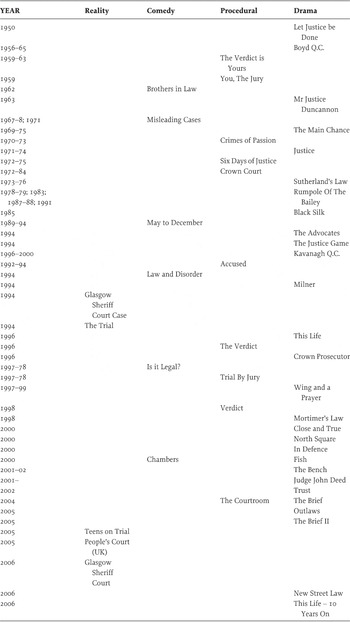
The first attempt at portraying lawyers and the legal system on British television was a series, Let Justice be Done, produced in 1950 on the operation of the juvenile justice system. These programmes were designed to educate the public by the then single non-commercial channel in Britain, the BBC. They showed fictionalised encounters between a range of recalcitrant youths and the authorities. The dilemmas faced by the professionals in the system and the problem of such issues as juror service were covered in five one-hour programmes. They were described on the scripts at the time as ‘drama documentaries’.Footnote 82
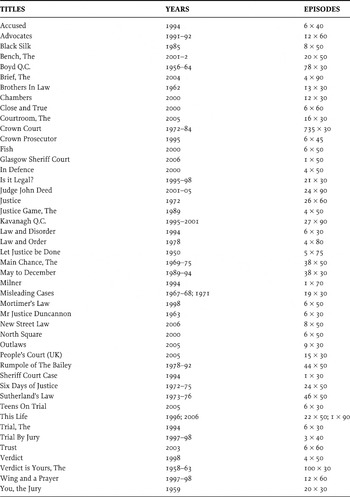
Subsequently, since Let Justice be Done, there have been over 40 further lawyer-centred series on British TV between 1956 and 2005.Footnote 83 As the table in the Appendix to this article indicates, there have been only three yearsFootnote 84 in which no new British programme was produced, and in the past decade there have been no fewer than 20 programmes. As indicated, the principal programmes comprise four distinct formats – legal procedurals, dramas, comedies and reality shows.
3. Legal procedurals
These involve, as we have noted, solely the forensic experience and the viewer is located into the role of juror. There was a hiatus of some six years from Let Justice be Done until we once again find the business of the courts occupying centre stage in an adaptation of an American format. Borrowing from the similarly titled US series, one of the earliest offerings of the new commercial channel, Independent Television, was The Verdict is Yours. This was based on real or fictional court cases in which witnesses were briefed on their character, life and history and part in the story. They were shown over two evenings. The filming was then done without a script but with a real jury who gave their decision after the final commercial break on the second night.Footnote 85 Initially local, this was extended nationwide when viewing figures were found to be healthy.
This format has been used frequently through the years including the long-running Crown Court, which was on air between 1972 and 1984. Anonymous lawyers are seen prosecuting someone. All we, as the audience, are provided with is the details of the dispute as they appear in the evidence. Again, a jury of ordinary members of the public made the guilty/not guilty decision. This involvement with an actual jury of ordinary people deciding upon the forensic abilities and credibility of a cast of actors was used in a range of series throughout the 1960s, 1970s, 1980s and 1990s. The concept was revived in 2005. The emphasis and style can be gleaned from the title – The Courtroom. The only change was a recognition of the need for speed and closure in a single half-hour episode in the 2005 revival.
4. Legal dramas
The dominant format for presenting legal issues has been the legal drama. There have been no fewer than 24 series between 1956 and 2005. These have provided a varying image of the British lawyer. There has been a perceptible shift in the focus of the material towards inclusion of the personal travails of the lawyer protagonist. This shift, however, occurred in Britain much earlier than Villez notes for the United States.
The first British TV lawyer, Boyd Q.C., whose methods mirror those of Erle Stanley Gardner’s Perry Mason, appeared on commercial television before the US series was transmitted on the BBC. Here we have a lone barrister, aided only by his trusty clerk, uncovering injustice and righting wrongs in and out of court – all in the space of 30 minutes – weekly for some nine series and 75 episodes.Footnote 86
Other earlier dramas include a brash unconventional solicitor in The Main Chance. David Main was thorn in the side of the legal establishment. His buccaneering style involved him in challenging such matters as the conveyancing monopoly and sharp business practices. There was a gender breakthrough early on with a series with a woman protagonist, the barrister Harriet Peterson in Justice. It is easy to forget that, at the time of writing, the extent of female participation in the profession was not simply low but somehow worthy of attention. In 1958, Judge Henry LeonFootnote 87 had written:
‘There is still almost overwhelming prejudice against woman both at the Bar itself and among solicitors and among the public. In consequence, it is extremely difficult for a woman to find a vacancy in chambers. It is difficult enough for a man, but far worse for a woman. Moreover, on the whole solicitors do not care to brief women, and the public still appears shy of entrusting its fate to a woman.’
We find accompanying the listing for the fourth programme in the first series a small cartoon appears a caricatured burglar watching a TV set with a picture of a lady barrister’s head in profile on it. Female presence in the courts was not only worth watching but also required explanation. The writer John Malcolm explained in the TV Times the context of the series:
‘Another issue was to determine Harriet’s character. Why would a woman choose the Bar as a career?’
Thirty-odd years later on this is not a question one imagines that the writers of television law series would ask – although they might note that only one woman has figured as the main protagonist in a drama seriesFootnote 88 and the rest appear as faithful supporting cast in most subsequent dramas – in some of these they do not even manage this.Footnote 89
The discussion of how women were making their way in the legal world in 1971 was conducted in tones which are a fascinating insight into perceptions of women’s role in law at this time in these comments from a barrister:
‘Harrier Peterson has at least one thing in common with most true-life women barristers. She is darned attractive. I don’t know why, but it always seems that the prettiest girls opt for the Bar. With crisp white wig perched on top of their hair, pert figures and well-shaped legs, they make going to court a visual pleasure. And, these days, there quite a few of them. Of 2,584 barristers in practice, 147 are women. The vast majority of them are young, eager and decidedly glamorous.’Footnote 90
These two series, along with the experiences of a Scottish public prosecutor, the Procurator Fiscal John Sutherland, all ran to several series and many episodes.Footnote 91 This latter had the benefit, as with Perry Mason, of allowing the Fiscal to pursue a broader detective role since the remit of the Fiscal in Scotland involves both investigation as well as prosecution. In reality, the former role has atrophied and is largely undertaken by the police and has not been a part of the day-to-day work of the Fiscal for the past century.Footnote 92
There are four lawyer portrayals to date which have been preserved beyond their normal shelf life on television through the medium of videos and DVDs. The first of these and best known internationally is the bewigged ‘Old Bailey hack’ Horace Rumpole. From the beginning up to the time of writing he seems to be remembered with a mixture of affection and exasperation. In the early days some appreciated the complex rounded character that was Rumpole:
‘There is more than a hint of WC Fields in McKern’s playing and the manner in which he delivers his lines…No matter whether the attacks come from members of his own chambers, the judges, or his wife…Rumpole will not go down in defeat. He is victorious in and out of court, his own man both in the legal profession and in the cozy confines of his home or Pomeroy’s wine bar…’Footnote 93
Not everyone was so keen, though, with one commentator finding the retreat into poetry and comedy outweighing the serious aspects raised in the series:
‘…Rumpole of the Bailey is too jolly and complacent for its own good, toying with topical issues before retreating into prittle-prattle nonsense.’Footnote 94
More recently, legal writer Marcel Berlins accuses him of performing ‘a great disservice by portraying the British legal system as cosy and comic’:
‘Mortimer has a lot to answer for. Clearly, in terms of sales and television adaptations, his Rumpole stories have made him the most successful British lawyer writing about other lawyers…But, marvellously entertaining though he has been for so long, Horace Rumpole has performed one great disservice. Millions of readers and television viewers all over the world believe that our lawyers, our judges and our legal system have been accurately portrayed in the Rumpole series. Alas the reality is not as cosy or comic.’Footnote 95
This seems to be a serious, if understandable, misreading of Rumpole as he appeared in some 42 episodes of the one-hour drama between 1975 and 1992. The cases do not appear trivial and light in the way that the issues which Henry Cecil and A. P. Herbert portrayed were light.Footnote 96 Part of the assessment is that it relies on both the more recent series as encapsulating Rumpole as well as taking the assessment of the author himself at face value. Footnote 97
The author explained that there was a triple structure to the Rumpole programmes – the case in hand, the usually Machiavellian machinations at Chambers and the comic goings on in the Rumpole household.Footnote 98 As we shall see this structure is less evident in the early series. Insofar as it does describe the programme content accurately, it applies from the fourth series onwards. Chambers business and family fun occupies a less obtrusive role in series 1, 2 and 3. There is, then, in the portrayal of Rumpole a considerable variation of tone and style. Issues of gender, race and class permeate the legal world of Horace Rumpole, including as far back as 1978 the double ordeal of rape victims in the trial process.Footnote 99 The joshing of Phyllida Trant and Ms Liz Probert by Rumpole are there to highlight the sexism of the legal world a decade after Harriet Peterson. They are not attitudes Rumpole himself actually shares, as we can see from looking at his actions:
‘…he does say a good many of the things I think and if I said them they might sound rather leftish and off-putting, but when given voice by Rumpole they become crusty, conservative and much more appealing…’Footnote 100
The cases Rumpole is involved in are principally criminal.Footnote 101 Civil matters emerge rarely.Footnote 102 In addition to the 44 stories which have been televised there were eight stories written in 1981 which were not televised. Since the end of the series in 1992 John Mortimer has continued to publish Rumpole stories and in 2005 was hoping that the character would emerge again on TV – only this time a little younger.Footnote 103
The lawyer who appears to have taken over from Horace Rumpole in the minds of the younger British publicFootnote 104 as the TV lawyer they have heard of most frequently is Kavanagh Q.C.Footnote 105 The series brought together again the producer of the long-running and highly successful series The Sweeney,Footnote 106 Ted Childs and the star of that police show, John Thaw. In between these two series, he had successfully established himself in another series which Childs had a production role. Thaw played the crusty real-ale quaffing opera fan, Inspector Endeavour Morse.Footnote 107 As James Kavanagh, to some extent, his new character is the slightly more cheery Northern brother of the dour policeman. Kavanagh Q.C. ran for five series and was aired between January 1995 and March 1999 with a special final episode shown in April 2001. A further series had been in discussion prior to the death of John Thaw, with the character having been elevated to the Bench, an idea which bore fruition in Judge John Deed in 2001.
The cases in the 27 episodesFootnote 108 of Kavanagh Q.C. are by and large concerned with charges of murder. This appears in no fewer than 20 of the episodes as the issue where Kavanagh is defending or – on two occasions – prosecuting. The rest of the fare ranges from manslaughter (twice), rape and indecent assault (twice) to a child custody, an arson charge and a personal injury case.
The pattern for the series was set in this first episode and remained unchanged throughout the six years Kavanagh appeared on TV. There was a single case with which James Kavanagh was concerned. These were very much courtroom dramas, following the visual, oral and narrative conventions identified in relation to films.Footnote 109 Intertwined with this we have, rather like Rumpole, two other elements – the life of Chambers where Kavanagh works and the life at home, where we have a man with two neglected teenage children and wife. The tone is more sombre than that of Rumpole. He is, however, surrounded by minor characters, in the same way as Rumpole, who have varying degrees of competence and commitment. The series then adapted the office interplay/home/case triple formula which we saw in Rumpole in the 1970s and 1980s and in a rather different way the successful American series from the 1980s LA Law.
It is too early to judge at the time of writing whether the exploits of the crusading Judge John Deed in the eponymous series will achieve the same kind of status and commercial success as Rumpole and Kavanagh. At the time of writing it has run to three series and was released on DVD in October 2006. The focus on the private lives of the legal protagonists is something which we can see both with John Deed and another series which has extended beyond a single series, The Brief. Here the team which brought John Thaw to the screen as Kavanagh Q.C. rely on the popular actor/comedian Alan Davies as professionally successful barrister Henry Farmer. His private life is in chaos due to his gambling problems and we encounter him at the start of the second series homeless, bankrupt and wigless. Successfully fighting for justice is what he does well. Living in the ordinary world is a lot trickier.
In contrast to these pedigree legal ‘thoroughbreds’ comes Phil Daniels’ down-at-heel legal aid lawyer Bruce Dunbar. In Outlaws we have someone seeking to survive on a diet of mad, bad and sad clients who people the Northern magistrates’ court where he plies his trade. Consigned to changing late night slots in 2005 on Sunday nights BBC2 this gem of a series suffered two bizarre and contradictory fates. The series was released on DVD but a second series was not commissioned.Footnote 110
5. Legal comedies
The stuff of British legal comedies, as we have noted, has been the lighter side of law, with the emphasis on a particularly English style of ‘muddling through’ to some form of justice despite the personnel and complexity of the system. There have been two quite distinct styles within the area of comedy. The majority of the legal comedies which have appeared on television are comedies about the law. They focus on its absurdities and the humour to be derived from seeking to regulate human behaviour by means of formal rules. Within this framework it is also, of course, possible that audiences will reflect on human nature and the social functions of such regulations. Within this category of programmes one would include Brothers in Law, Misleading Cases and Chambers. Brothers in Law first appeared as a book in 1955. It tells the story of the first year in practice of a fledgling barrister making his way in the arcane world of law at a time when training methods were limited to watching one’s elders perform, copying them and hoping for the best. The book followed the success which serving judge Henry Cecil Leon had enjoyed with his 1950s legally centred light comedies.Footnote 111 Writing long before John Mortimer turned his attention to the British justice system or John Grisham started his US-based novels, these were commercially successful. Brothers in Law was originally adapted for the radio as a stand-alone play in 1955Footnote 112 then for the stage in the same year. A film version appeared two years later and was successful in capturing the inexperience and naivety of Thursby, along with his essential decency.
There is another group where the legal setting is peripheral to the subject of the comedy and where it would have been possible to locate the action in any kind of office. The point here is that what is crucial is the character of the protagonists and their interaction with each other. In this category, for instance we have May to December. This involves a romance between a middle-aged solicitor and a woman some 25 years younger. The comedy derives from their different expectations and approaches to life as determined by age rather than their professional experiences as a solicitor and a teacher. Similarly, the attempt to capitalise on Penelope Keith’s Margot LeadbetterFootnote 113/Audrey fforbes-HamiltonFootnote 114 character was encountered in Law and Disorder. This derives it humour not from the law as such but from Keith’s ability to convince as a domineering woman in the style of Margaret Thatcher and achieve comic effect from her pigheadedness. Finally, the dysfunctional staff at Lotus, Spackman and Phelps in Is it Legal? are never actually concerned with the stuff of the law. Clients do not appear and the courts do not feature.Footnote 115 This is about how three bone-idle people and two neurotics co-exist along with an immature fantasist. It is set in non-descript Hounslow. It could as easily be set in Swindon, Strabane, Swansea, Sunderland or Stirling. It does, however, feature angst as an aspect of legal life.
6. Legal reality shows
As indicated above, there are two kinds of programmes which we can dub reality shows. The first and most well known in Britain are informal reality shows. In these a real dispute is determined before a real judge outwith the legal system. The ratings depend on the protagonists, including the judge, providing a degree of entertainment. Taking evidence and the decision-making process is firmly fixed to the requirements of scheduling. Only simple disputes about credibility of evidence are covered. The issues are minor disputes about property. Prior to 2005, these had only figured in Britain through imports like Judge Judy. Britain had six weeks of People’s Court (UK), transmitted in the mornings on one of the terrestrial commercial channels in that year.Footnote 116 The cases which were seen in this series ranged from a man being sued for being a ‘disappointing’ father, to two drag queens in a frock ownership fracas.
A subsequent format borrowed from the United States was a British version of Teens on Trial.Footnote 117 In these a young person is ‘tried’ by a jury of their own peers. The lawyers are also young people who have undergone a weekend training programme covering procedure, etiquette, interviewing techniques, formulating an argument, public speaking and case presentation and sentencing considerations. The issues covered in the first series aired in 2005 were shoplifting, truancy, aggressive behaviour, grafitti, underage binge drinking and dope smoking. They were targeted at school curricula in relation to citizenship and PSE (personal and social education).
Starting in 1994, the United States has had actual ‘reality’ through the medium of Court TV. Elayne Rapping considered this to be of crucial significance in shaping the way the politics of law and order developed in the subsequent decade.Footnote 118 There has been no equivalent of formal reality TV in Britain. The nearest that has been produced here are three offerings produced on the distinctive Scottish legal system. In Scotland, in addition to the decisions Guilty and Not Guilty, an accused may walk free if the charge is found Not Proven. In the first programme, aired in 1994, we have an edited version of a single criminal trial in the Sheriff Court concerning the alleged theft of a bus.Footnote 119 In 1994 cameras were also allowed into other Scottish criminal courts to look at a range of issues. The final result was an edited series of six programmes covering all levels of Scottish criminal legal business from the District Court, Sheriff Court and High Court. Brief extracts from actual trials were shown, as well as interviews with judges, prosecutors and practising lawyers. Finally, a one hour programme in 2006 showed the workings of Europe’s busiest criminal court, Glasgow Sheriff Court. The issues featured were the staple of the justice system – petty crime and disorder. In addition, viewers had the opportunity of blurring reality and entertainment with the sight of one of the judges from People’s Court (UK), solicitor Rhonda Anderson, appearing on behalf of members of the public, as a defence lawyer rather than a judge.
There has been no equivalent of the German RTL channel TV programmes Das Familiengericht and Das Jugendgericht, which feature non-retired judges – on sabbatical leave – operating the court as if it were a real court and not constrained by the need to provide any particular level of entertainment. That said, the actors in these scenarios take it as their duty to interrupt, lose their tempers, collapse in tears etc. to bring these shows to life and the producers are keen that the judges ‘spice things up’ with dramatic outbursts. Like Court TV, their genesis was the desire to connect the public with the legal system by seeing how it worked in a fact-based set-up.Footnote 120 There do not seem to be any Spanish, Portuguese or Italian equivalents but Austrian TV does produce a programme using the Familiengericht format, as does Germany’s SAT.1 with both Richterin Barbara Salesch and Richter Alexander Hold.Footnote 121
D. TV in context
The long-running series allows those issues which have featured in law and film scholarship to be explored in some depth.Footnote 122 Issues like the decline in the probity of lawyers, gender and ethnicity and sexuality appear in a less tokenist form. It is worth going beyond noting the contrast between the content and format of TV lawyers and those of their cinematic counterparts. There are other issues which need to be taken into account in seeking to assess the developments of televisual lawyers. In the first place, the experience of watching TV is rather different from that of seeing films in the cinema. The kinds of programmes which can get into production and the whole process of making series means that a simple comparison between film lawyers and their TV counterparts may be misleading. Finally, this production process links into the distribution mechanisms available even with the emergence of DVDs.
One reason why the cinematic experience has been valued over that of television is the very way film has traditionally been consumed. Attending the cinema was and remains an ‘event’. It is always a replication of the long tradition of live theatre, in that it involves watching in public without pauses or interruptions as part of a group audience. Films are consumed how directors intended, although of course their meaning may be radically reconstructed.Footnote 123 It is a shared cultural experience.Footnote 124 Television, on the other hand, is a more private experience. It has hitherto been a family experience. Whilst the number of UK television sets is 40 million,Footnote 125 there is extensive multiple ownership.Footnote 126 This suggests that extensive individual watching has replaced ‘family viewing’. There are also suggestions that the concepts of schedules and simultaneous viewing are likely to be disappear with new technological developments.Footnote 127
Programmes incorporate breaks for adverts on a significant scale during their running. The doorbell and phone are complemented by very frequent breaks for adverts. The majority of the new channels are commercial rather than the four channels of the advert-free public service BBC. Even in Britain with its modest penetration of commercial breaks 20% of viewing time is ‘lost’ to adverts. A 50-minute programme or series episode in Britain takes 60 minutes to screen.Footnote 128 Research suggests that people graze and watch a good deal more casually than when they watch in the cinema.Footnote 129 Television is often described by those involved in the administrative justice system as mere background to the process of living. The TV is ‘just on’. It is not actively watched most of the time.Footnote 130
Whilst this might indicate that television then has a limited impact on people’s perceptions and ideas of law and justice, there are other factors which suggest this very pervasive ordinariness has its own cultural potential. The limited empirical work carried out on lawyer programmes suggests that they provide a significant source for people’s knowledge of the legal system.Footnote 131 There is, however, a recognition that there is a difference between TV lawyering and reality.Footnote 132
Television in Britain has, from the emergence of a public service/commercial dichotomy in 1955, offered a quicker route into production for programmes than films. Television as the ‘junior’ art form has provided a stepping stone to the world of film for both actors, writers and directors. It was the medium in which such film luminaries as Ken Loach, Sidney Lumet and Alan Parker first worked. The multi-channel world of cable and satellite seems to offer more possibilities of outlets for television than modern technology offers for the cinema. The cinema remains what it has been for the past century – a pre-timed showing of a film in a public location on a pay-as-you-go basis. The flexibility and comfort of pre-paid home entertainment viewing has offered serious competition to ‘going to the pictures’. Under pressure from first television, then the video and DVD, film has suffered over the years in a number of ways.
During the period 1950–85 the number of cinema visits per head of population in Britain fell dramatically from 28.67 to 1.25.Footnote 133 More importantly, even the number of screens plummeted from 4,583 to 1,311.Footnote 134 This decline has been reversed with the arrival of multiplexes and the number of screens had reached almost 3,000 by 2000. The modern cinema multiplex experience, however, does not seem to have extended the number of offerings which are available to the average viewer.Footnote 135 Hollywood ‘blockbusters’ continue to dominate.Footnote 136 The new setup offers more opportunities to see a narrow, and possibly even narrower range of films rather than a significantly extended choice between various independent and mainstream offerings. This process is not in any way part of ‘natural selection’ but a result of the system whereby the cinema pays on a standard rate for films hired.Footnote 137 Multi-screens actually exacerbate the dominance of blockbusters with several screens given over to the ‘must see’ films of the week. Films doing limited business disappear rapidly. UK films which are widely distributed in the first place form less than 30% of films made. As well as films which enjoyed only limited release, between 55% and 70% of films from 1996 to 2002 secured no release within a year of production.Footnote 138 This fate has not affected television in the same way. Businesses respond by showing the films that attract the biggest audiences. It may be that replacing the use, at the time of writing, of 35mm prints of films by digital projectors and use of secure fibre networks may provide an opportunity for lower budget independent films to secure distribution.Footnote 139
The rise of first video and, since 1996, DVDs as a significant way of consuming culture has affected the film production process. This has become a valuable resource for the film production industry since, whilst people may wish to watch in their own homes, what they actually want to watch is often film. In 2004 the viewing patterns of British audiences revealed a heavy consumption of films by the young.

Source: CAVIAR and Quarterly ReportsFootnote 140
Not surprisingly, then, with sales and rentals of DVDs bringing in some £3bn in 2003,Footnote 141 these have been seen as a lifeline for the film industry. Whilst producers have indicated that the potential ‘spin off’ of DVD sales have not hitherto affected television production decisions,Footnote 142 the creation of a fresh and extended life for TV shows beyond initial transmission has this potential. The exploitation of television back catalogues has thus far been relatively modest and very limited in the field of TV lawyers.Footnote 143
Since there are significant differences between the contexts in which they appear and the ways in which these are consumed, some care needs to be taken in trying to assess the different kinds of representations encapsulated by filmic and small screen lawyers. Simply taking British filmic lawyers like Peter Tanner,Footnote 144 Melville FarrFootnote 145 and Gareth PeirceFootnote 146 and comparing them with Horace Rumpole, Harriet Peterson and James Kavanagh misses out on the potential of the extended televisual experience. Film captures these lawyers at one crucial moment in their lives. We may imagine how they might respond to a range of moral and professional dilemmas. Television series allow us to trace how these characters develop over a period of years. This affords the opportunity for a more nuanced approach to both the issues and how the world in which the professional operates responds to changing pressures. Tracing this is a challenge for scholarship in this area. How, for instance, we might calibrate the fate of civil liberties and human rights at the hands of successive British governments with shifts in the kinds of issues presented in TV lawyer series is a project that might well produce some interesting results.
E. TV lawyers’ relationship to broader concerns
In addition to forming a part of the burgeoning literature on law and popular culture, examining TV lawyers has wider potential. There is a range of distinct academic concerns where an examination of the nature and development of how lawyers have been and are portrayed on television might well contribute to issues within globalisation, legal education, legal consciousness and the legal profession. These benefits complement the contribution garnered for the emerging distinctive area of law and popular culture which is the context in which this work was originally conceived.
The worldwide reach of some TV programmes like LA Law, Ally McBeal and Rumpole of the Bailey, as well as of some reality and legal procedural formats would seem to have the potential to provide a version of the justice process which reflects the Anglo-American system’s cultural hegemony. It may be that the mere showing of extensive amounts of TV lawyer shows or formats based on the adversarial model has no major significance in different, well established legal cultures. The potential for these having an impact, though, needs to be explored rather than assumed to exist or not. There has already been some empirical work conducted on how consumption of popular culture might affect the views of the next generation of lawyers.Footnote 147 Both of these studies looked at both film and televisual lawyers. The work and analysis of Rapping and Villez and the limited applicability of their categories of analysis outwith the United States suggest that casual assumptions about the impact of globalisation need to be scrutinised carefully. This initial look at the British experience suggests that there is a need for national context to be more fully explicated. Some of the work from Germany suggests that the information which is gleaned from television shows is culture-neutral. That is to say that no matter whether the legal content of programmes is ‘accurate’ or not, the viewers will absorb broad concepts of institutional arrangements – namely that the signifiers of justice are a jury, a bewigged judge and a gavel.Footnote 148 On the other hand, the recognition by American law students that the television version of legal practice was not as it is experienced on a day-to-day basis suggests that care needs to be taken in assuming a linear media effect.Footnote 149
A development in the socio-legal literature in the new millennium has been a return to one of the themes of the 1970s phase of scholarship, namely the significance of legal consciousness.Footnote 150 Work in this field has developed using the notions outlined by Ewick and Silbey of legal consciousness as an aspect of cultural practice. That is to say it is neither a determinant of socio-political policy, nor a mere by-product of social relations. Consciousness is, rather than attitudinal or structural, a part of a reciprocal process in which the meanings individuals give to their world become part of the discussion and debate on the meaning of that world.Footnote 151 They are neither the decisive element in how that world operates nor are they merely reflections of other ‘real’ factors. Working within these parameters the relationships between media coverage of social issues and people’s first-hand experience of legal phenomena have been examined.Footnote 152 The extent to which popular culture and media express particular perspectives on law and order or engender debate and reflection is an area which can contribute to this discussion. The spread of television into every homeFootnote 153 and its high level of consumptionFootnote 154 is the single most significant development in the history of media in the past 60 years. Hence, an examination of the products of television would seem to be worthwhile. Legal consciousness and the link to the impact of TV suggests the need for detailed empirical studies of the significance of both home-produced and imported material rather than the assumption that there is a simple and consistent effect. Whether or not we as conscious individuals are able to identify and trace the sources of our understanding of legal and justice issues is a potential agent of empirical paralysis. The dangers of misattribution and misidentification of influences are manifold.
Some writers have even suggested that the task is too difficult. Steven Stark indicate back in 1987:
‘…assessing the effects of television on our society is a bit like calibrating the impact of water or the air. Television is so pervasive and taken for granted that it is difficult to imagine – much less measure – what things would be like without it. What is your control group? How do you calibrate empirically the effect of a Perry Mason or a Batman?’Footnote 155
More recently, Sheila Brown, looking at the politically sensitive area of the impact of violence in the media, suggests that the pursuit of such explicit links fails to recognise that the media is not a separate set of institutions apart from society. In a media-saturated world, the possibility of assessing the effect of violence and the media, she argues, is doomed to failure since crime, law and the media form an invisible network.Footnote 156 Direct effects, indeed, may be hard to assess, but the attempt to trace changes in broad trends in types of cultural representation of legal personnel still seems worth pursuing even if it would be naïve to expect research results indicating some kind of simple cause and effect.
The relationship between theory and practice continues to loom large as a core point of division in legal education.Footnote 157 In debates on the changes in the curriculum of the Law School and the politics of these developments the shift to an expanded role for law and popular culture has been an issue.Footnote 158 Bradney characterises the situation at the start of the new millennium still within the law school as ‘too much technical training and too little a liberal education’.Footnote 159 The challenge to the ‘black-letter tradition’ which Osborn talks of is given further impetus by looking at television in an age where it is argued that television is the dominant force creating the culture in which we live. The porous nature of law Footnote 160 and the element of interpenetration between legal and cultural practice Footnote 161 has produced a situation where, even more than could be argued with film, the law on the small screen is taken to be as real as that in the halls of justice. Such is the pervasiveness and realness of TV that is not indulging in hyperbole to suggest that Judges Judy and Amy are more likely to be known and accepted as players in the juridical scene than Justice Sandra Day O’Connor or Lord Phillips of Worth Matravers. It is fair to say that these are not concerns which have been uppermost in the minds of those writing about developments in legal education. Here important themes of gender, multi-disciplinary partnerships and the role of the profession have been the mainstay of academic debate in the past few years. Part of this comes from the profound changes in the nature of universities, as well as the demands of the profession in a world with different kinds of globalised mega-firms.Footnote 162
Finally, a major related area into which work on popular culture has fed is the interest in the image of the legal profession and the development of notions of professionalism and their significance.Footnote 163 Lawyers have long been concerned as to how they are perceived.Footnote 164 Filmic lawyers have ranged from the heroic to the meretricious.Footnote 165 The separation of the filmic and televisual image is one which subsequent empirical studies would do well to take into account. These, then, are themes which merit investigation.
F. Concluding remarks
TV lawyers have played a very minor part in the concerns of those working on law and popular culture. A number of clear theoretical frameworks have been advanced for future analysis in law and film which could usefully inform work on TV lawyers.Footnote 166 SherwinFootnote 167 and MeyerFootnote 168 draw heavily on Baudrillard in their work on cultural interpenetration. There is some anecdotal evidence to suggest that no distinction is drawn by professionals or public between filmic and televisual lawyer models.Footnote 169 Further work is required to test out these notions more rigorously. It has also been suggested that we can obtain a rich appreciation of the impact of filmic lawyers drawing on the traditions of Gramsci as well as of Adorno and Horkheimer.Footnote 170 The same could be said of looking at the burgeoning world of TV. The concerns of the Frankfurt School about popular culture were not just centred on the way in which mass culture provided mere entertainment but rather emphasised simplistic individualised solutions. Cinema has tended to lionise lawyers.Footnote 171 TV appears to have done this to an even greater degree, but in a slightly different way, through emphasising the struggle for justice – and having more space to emphasise the material and status rewards.
The justice agenda, though, dominates. TV lawyers challenge the malpractices of the system. A group of fighters for justice may legitimise the whole socio-economic system with their apparent demonstration that day in, day out, the individual has his or her day in court. The dominant ethos of the vast majority of the material has been essentially reflective rather than refractive.Footnote 172 The focus on the individual and the local hides what is happening at a structural level. The poor are not being enfranchised through court actions.Footnote 173 Systemic institutional racism is not declining through the legal process.Footnote 174 Solutions to the abuse of women are emerging from extra-legal organisation and actions like the refuge movement. Trusting in the legal system’s remedies as shown on screen is comforting but involves a misplacing of trust. Given the continued high status and heroic proportions of TV lawyers from Boyd Q.C. through Rumpole of the Bailey and Kavanagh Q.C. to Judge John Deed, then the very specific lure of the law is maintained for both neophyte lawyers and those attracted to the drama of the law. The result may not always be a naïve faith in the skills of James Kavanagh or Henry Farmer but an acceptance that at least law gives people a chance to shake their fist at the system.
Even when the world of law is exposed as at best a series of compromises and foul-ups, the spirit of Bruce Dunbar encapsulates an alternative to dewy-eyed trust in the system in a world in which great ideological narratives may be hard to sustain with conviction. Dunbar outlines his weltanschauung in conversation with the CPS solicitor after being badgered by a district judge into introducing a specious defence for his client. The client has run over someone in a fit of road rage. Dunbar suggests that she may suffer from a disease stemming from her cat. The case is adjourned for enquiries freeing Dunbar’s client – at least temporarily:
- ‘CPS
I’m not going to let you get away with that.
- BD
Why not?
- CPS
Because it makes a mockery of the whole system.
- BD
It don’t need me to do that you Blunkett.Footnote 175
- CPS
She runs over a guy and you want to blame her cat.
- BD
Look, I take my car to the carwash, there’s a sign on the wall saying “At your own risk”. I park in a multistorey car park. Not their responsibility. I take this suit to the drycleaners. Same story. You invade a country for reasons you now can’t find. An honest mistake. Everywhere I look people ain’t responsible for anything. So why should criminals be any different? Look, my clients are scum, so they give me scummy excuses. I just dress ’em up a bit. It’s called the English legal system. It’s been around a few hundred years. You may have heard of it.’Footnote 176
Whether this is communitarianism, anarchism, nihilism, simple despair or something else is for others to interpret. It is at least a slap in the face to naïve idealism and may mark a shift in the portrayal of the TV lawyers.Footnote 177 If not, the disjunction between lived experience and the televisual version has the potential to contribute to further destabilisation of the solid social order which the lawyers on British TV seem traditionally to personify, albeit in a number of guises.
Appendix