Introduction
The development of predictive models for plant assemblages is one of the main goals of community ecologists, who often use species or community-level descriptors as response variables. In the case of Mediterranean grasslands, species composition is well correlated to environmental gradients such as climate, soils, landforms, microtopography, grazing pressure, successional stage and disturbance occurrence (Sterling et al., Reference Sterling, Peco, Casado, Galiano and Pineda1983; Noy-Meir et al., Reference Noy-Meir, Gutman and Kaplan1989; Figueroa and Davy, Reference Figueroa and Davy1991; Peco and Espigares, Reference Peco and Espigares1994). The use of species does, however, have certain limitations, such as the difficulty of extrapolating predictions to different biogeographical regions. More synthetic indicators such as diversity, richness and productivity have also been modelled (de Pablo et al., Reference de Pablo, Peco, Galiano, Nicolás and Pineda1982; Seligman and Vankeulen, Reference Seligman and Vankeulen1989; Montalvo et al., Reference Montalvo, Casado, Levassor and Pineda1993), and generally yield interpretations that have high transferability, although the underlying mechanisms are sometimes difficult to understand. More recently, researchers have focused on form and functional traits (Lavorel et al., Reference Lavorel, Rochette and Lebreton1999; Sternberg et al., Reference Sternberg, Gutman, Perevolotsky, Ungar and Kigel2000; Peco et al., Reference Peco, Traba, Levassor, Sánchez and Azcárate2003, Reference Peco, de Pablos, Traba and Levassor2005; Diaz et al., Reference Diaz, Lavorel, Mcintyre, Falczuk, Casanoves, Milchunas, Skarpe, Rusch, Sternberg, Noy-Meir, Landsberg, Zhang, Clark and Campbell2007; Acosta et al., Reference Acosta, Sánchez-Jardon, Del Pozo, Garcia-Ibañez, Casado, Montalvo and Pineda2008), a more helpful approach to understanding ecological mechanisms that shape communities which is also suitable for predictions applied to different floras or regions. Studies on functional traits are based both on individual attributes of the species and synthetic values (e.g. mean or variance) obtained from groups of species (Ackerly et al., Reference Ackerly, Knight, Weiss, Barton and Starmer2002).
In this context, seed size (usually measured as seed mass) has been proposed as a key trait in plant strategies (Westoby, Reference Westoby1998) and its importance has also been highlighted for Mediterranean grasslands (Azcárate et al., Reference Azcárate, Sánchez, Arqueros and Peco2002; Peco et al., Reference Peco, Traba, Levassor, Sánchez and Azcárate2003, Reference Peco, Rico and Azcárate2009). Annual species are overwhelmingly predominant in this type of vegetation, making all processes that affect seed banks and seedling emergence and growth particularly relevant. Previous research has shown that seed size is affected by, or affects, persistence in the soil (Thompson et al., Reference Thompson, Band and Hodgson1993), herbivory (Osem et al., Reference Osem, Perevolotsky and Kigel2006), seed predation (Azcárate and Peco, Reference Azcárate and Peco2006), endozoochory (Pakeman et al., Reference Pakeman, Digneffe and Small2002; Mouissie et al., Reference Mouissie, Van Der Veen, Veen and Van Diggelen2005), epizoochory (Römermann et al., Reference Römermann, Tackenberg and Poschlod2005), dyszoochory (Azcárate and Peco, Reference Azcárate and Peco2007), germination (Kahmen and Poschlod, Reference Kahmen and Poschlod2008a) and seedling growth and survival (Moles and Westoby, Reference Moles and Westoby2004). These processes are highly variable, and depend on both abiotic (climate, soil properties) and biotic factors (e.g. abundance and type of herbivores, seed predators and seed dispersers). Hence, a certain seed size implies costs or benefits for a given situation, and we can expect communities to differ in the range of seed sizes shown by the dominant annuals. For the particular case of Mediterranean annual grasslands, current knowledge leads to some predictions on the adaptive value of having either a large or a small seed for at least four factors: climate, soil fertility, grazing pressure and intensity of seed predation by ants.
In the first place, a more arid climate should favour large-seeded annuals. In general, large seeds show greater survival when emergence is affected by water stress (Leishman and Westoby, Reference Leishman and Westoby1994; Veenendaal et al., Reference Veenendaal, Ernst and Modise1996; Westoby et al., Reference Westoby, Leishman and Lord1996; Kos and Poschlod, Reference Kos and Poschlod2008). Although in Mediterranean grasslands there are no studies comparing seed sizes between areas with different climates, Peco et al. (Reference Peco, Rico and Azcárate2009) found an increase in the abundance of large-seeded species in years with dry autumns. This result suggests that Mediterranean species follow the general pattern, and large-seeded species survive better in situations of drought. It is therefore expected that Mediterranean grasslands affected by a drier climate show a greater proportion of large-seeded species in their floristic composition.
Secondly, larger-seeded annuals should be more abundant in more-fertile soils. This prediction is mainly based on the experimental study with Mediterranean species by Marañón and Grubb (Reference Marañón and Grubb1993). These authors concluded that smaller-seeded species should occupy soils with poorer nutrient supply and water retention capacity, as a consequence of their higher relative growth rates. This prediction is not universal, as shown by other contradictory results. For Australian species, Jurado and Westoby (Reference Jurado and Westoby1992) reported that seedlings of heavier-seeded species tend to survive longer than seedlings from lighter-seeded species when grown in the absence of mineral nutrients. Milberg and Lamont (Reference Milberg and Lamont1997) and Milberg et al. (Reference Milberg, Perez-Fernandez and Lamont1998) have proposed that large seeds might be an adaptation for enhancing establishment in nutrient-poor soils, although this hypothesis is by no means generally accepted. Pakeman et al. (Reference Pakeman, Garnier, Lavorel, Ansquer, Castro, Cruz, Dolezal, Eriksson, Freitas, Golodets, Kigel, Kleyer, Leps, Meier, Papadimitriou, Papanastasis, Quested, Quetier, Rusch, Sternberg, Theau, Thebault and Vile2008), studying 12 sites across Europe, found no relationship between fertility and seed size, and Hanley et al. (Reference Hanley, Cordier, May and Kelly2007) observed that the seed size of different floras responds in different ways to nutrient-deficient treatments, apparently confirming that the relationship between seed size and soil fertility is heavily dependent on floras or biomes.
Thirdly, small-seeded species should be promoted by increasing grazing pressure. Studies in different parts of the world have found that grazing is normally associated with an increase in small-seeded species in both seed banks and vegetation (McIntyre and Lavorel, Reference McIntyre and Lavorel2001; Peco et al., Reference Peco, de Pablos, Traba and Levassor2005; Osem et al., Reference Osem, Perevolotsky and Kigel2006; Diaz et al., Reference Diaz, Lavorel, Mcintyre, Falczuk, Casanoves, Milchunas, Skarpe, Rusch, Sternberg, Noy-Meir, Landsberg, Zhang, Clark and Campbell2007; Kahmen and Poschlod, Reference Kahmen and Poschlod2008b). These findings are congruent with the effects of grazers, some of which directly involve seeds. For example, most studies analysing endozoochory report that more viable seeds are in grazer dung in the case of small seeds (Russi et al., Reference Russi, Cocks and Roberts1992; Pakeman et al., Reference Pakeman, Digneffe and Small2002; Mouissie et al., Reference Mouissie, Van Der Veen, Veen and Van Diggelen2005). This has often been interpreted in terms of higher chewing and gut passage survival for small seeds, although Peco et al. (Reference Peco, Lopez-Merino and Alvir2006) and Bruun and Poschlod (Reference Bruun and Poschlod2006) explain it as a consequence of the larger numbers of seeds produced by small-seeded plants. Other studies analysing epizoochory (seeds attached to animal skins) have also detected that light seeds are best retained (Römermann et al., Reference Römermann, Tackenberg and Poschlod2005; de Pablos and Peco, Reference de Pablos and Peco2007), and hence are more capable of dispersal in grazed grasslands. Grazing also affects vegetation by promoting annual species, small-sized plants and certain growth forms (Noy-Meir et al., Reference Noy-Meir, Gutman and Kaplan1989; Belsky, Reference Belsky1992; Diaz et al., Reference Diaz, Lavorel, Mcintyre, Falczuk, Casanoves, Milchunas, Skarpe, Rusch, Sternberg, Noy-Meir, Landsberg, Zhang, Clark and Campbell2007). Some of these effects can also imply an increase in small-seeded species, since plant and seed size are often correlated (Aarssen and Jordan, Reference Aarssen and Jordan2001; Peco et al., Reference Peco, Rico and Azcárate2009) and a reduction of the abundance of the perennials relaxes competition at the moment of emergence (Jurjavcic et al., Reference Jurjavcic, Harrison and Wolf2002; Zeiter et al., Reference Zeiter, Stampfli and Newbery2006), which probably benefits plants producing large numbers of small seeds.
Finally, seed predation by harvester ants should penalize large seeds, and hence indirectly favour small-seeded annuals. Previous research has shown that granivores often select certain seed sizes (Crist and MacMahon, Reference Crist and MacMahon1992; Willott et al., Reference Willott, Compton and Incoll2000a), and exclusion experiments have produced effects on vegetation that are attributable to seed-size selection by granivores (Davidson et al., Reference Davidson, Inouye and Brown1984). In Mediterranean grasslands, where Messor ants are the main seed predators, diet studies have revealed that ants select relatively large seeds, possibly because of their higher detectability (Detrain and Pasteels, Reference Detrain and Pasteels2000; Azcárate et al., Reference Azcárate, Arqueros, Sánchez and Peco2005). This fact could indirectly favour the seed banks of small-seeded species, as confirmed in at least one experimental study (Azcárate and Peco, Reference Azcárate and Peco2006). However, the effect of harvester ants is not restricted to seed predation. Ants can also act as secondary dispersers (Wolff and Debussche, Reference Wolff and Debussche1999; Retana et al., Reference Retana, Pico and Rodrigo2004; Sánchez et al., Reference Sánchez, Azcárate and Peco2006), and middens and other nest-related structures are often favourable microsites for certain seedling types (Dean and Yeaton, Reference Dean and Yeaton1992; Azcárate and Peco, Reference Azcárate and Peco2007). In the case of Mediterranean grasslands, Azcárate and Peco (Reference Azcárate and Peco2007) found greater success of large-seeded species on Messor barbarus middens. This means that although seed predation by ants might affect the abundance of large-seeded species, their presence in the community may be guaranteed by their ability to colonize ant structures.
To date, no study has analysed these predictions together, considering the natural variability of Mediterranean annual grasslands at the regional scale. In this study, we test the validity of seed size as a predictable trait of Mediterranean grassland communities varying in climate, grazing pressure, intensity of seed predation by ants and soil fertility. We predict that communities should show larger-seeded annuals in (1) more-arid grasslands; (2) more-fertile soils; (3) less-grazed grasslands; and (4) grasslands with lower intensities of seed predation by ants.
Materials and methods
Study area and sampling units
The study was conducted at the foot of the Guadarrama Mountains (Madrid Region, Central Spain). We defined a study area of roughly 1000 km2, bounded by the Manzanares River to the west, the Albalá and Guadalix rivers to the east, the 1500 m contour line to the north and the 650 m contour line and Madrid metropolitan area to the south. The selected area shows a continental Mediterranean climate, with a harsh summer drought and large thermal contrasts between winter and summer. Mean annual temperature and precipitation vary with altitude, ranging from 9°C to 14°C and 500–800 mm, respectively (Ninyerola et al., Reference Ninyerola, Pons and Roure2005). The substrate is acidic, mainly composed of Carboniferous granite and Precambrian gneiss. On the southern border, igneous and metamorphic rock is covered by Miocenic sedimentary arkoses. Soils are shallow, and in general can be classified as dystric and eutric cambisols, although there are other types linked to particular landforms (Monturiol and Alcalá del Olmo, Reference Monturiol and Alcalá del Olmo1990). There are no biogeographical barriers in the study site, which is regarded as a floristic unit (Rivas-Martínez, Reference Rivas-Martínez1987).
Most of the land has been used traditionally for sheep, goat and cattle grazing. As a result, the original Mediterranean forest has been transformed into a savanna-like landscape (dehesa) consisting of a grassland dominated by annuals with some scattered trees. Quercus ilex subsp. ballota is the predominant tree up to 1000–1200 m, Q. pyrenaica occurs at higher altitudes and Fraxinus angustifolia is frequent on most humid soils. Tree cover is usually lower than 50%, but it can be higher on abandoned land and game reserves. Agriculture is now almost non-existent, although in the past some fields were ploughed for barley and other cereals. Grazing pressure now varies considerably. Abandonment and grazing pressure reduction is sometimes explained by differences in productivity, but it is often simply a consequence of the distance from villages or roads.
Twenty-nine 50 m × 50 m sampling units were distributed in this study area. Although randomly selected, they had to meet four conditions: (1) annual-dominated grassland; (2) units in a continuous, homogeneous system of at least 1 ha; (3) valley floors and slopes with a>10% gradient were avoided, in order to include only soils without excessive erosive or sedimentary processes; and (4) unchanged land use over at least the past 10 years. This latter condition was checked using owner interviews and aerial photographs.
Independent variables
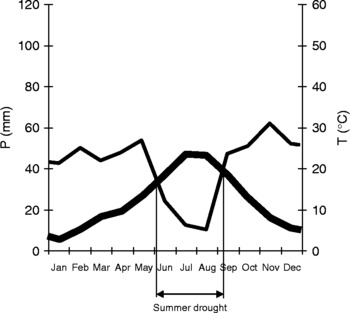
Sampling units were characterized according to their climate, soil fertility, grazing pressure and intensity of seed predation by ants. Climate was described primarily by mean annual temperature (T) and mean annual precipitation (P). Autumn precipitation (Pa, precipitation recorded from September to November) was also included due to its influence on seedling emergence and survival. Two other aridity-related climate indices were also considered: annual water balance (WB) and length of the summer drought (D). WB was calculated as the difference between mean annual precipitation and annual potential evapotranspiration (Thornthwaite, Reference Thornthwaite1948). D was calculated according to Walter–Gaussen ombrothermic diagrams (Gaussen, Reference Gaussen1955): we plotted the diagram corresponding to each sampling unit and estimated the dates when temperature and precipitation curves crossed. We then calculated the length of the summer drought in days (Fig. 1). Climate variables were obtained from Ninyerola et al. (Reference Ninyerola, Pons and Roure2005) – a 200 m resolution digital climatic map of the Iberian Peninsula, based on meteorological stations with time series of at least 15 years.
Walter–Gaussen diagram of one sampling unit. The diagram shows mean monthly precipitation, temperature and length of summer drought.

Soil fertility was estimated using a bioassay. We used barley, a cereal commonly selected for bioassays in soils of the Mediterranean area (Moro et al., Reference Moro, Pugnaire, Haase and Puigdefabregas1997; Willott et al., Reference Willott, Miller, Incoll and Compton2000b). In summer 2006, we collected ten soil cores from each sampling unit using a 4 cm width × 5 cm height cylindrical device. Sampling points were distributed at random, avoiding areas affected by trees. Each soil sample was then placed in a 4 cm wide × 5 cm tall pot, and sown with six barley seeds per pot. The pots were watered moderately in greenhouse conditions to maintain moisture. Only four seedlings were left in each pot after germination. Plants were cut 45 d after sowing, aerial biomass dry weight was measured after 48 h of oven drying at 75°C, using a 0.1 mg precision balance to measure all four plants in each pot together, and, finally, the average value of the ten soil samples collected in each sampling unit was defined for use as an index of soil fertility.
Grazing pressure was estimated from the presence of dung in the sampling units. In summer 2005, a grid of 2 m × 2 m cells was set in each plot to record presence/absence of dung in each cell. Tree-influenced areas were not taken into account. The proportion of cells containing dung of any grazer was adopted as a proxy for grazing pressure. Cattle were by far the most abundant grazers in the study area, with sheep, horse, rabbit and roe deer dung also occasionally found.
Intensity of ant seed predation was estimated using canary seed bait (Phalaris canariensis) in a 5-cm diameter Petri dish containing 3 g of seeds with a 4 mm steel mesh to exclude vertebrates and two 1 cm wide entrances to facilitate ant access. In August 2005, six baits were randomly distributed in each sampling unit, avoiding sites influenced by tree shade or litter. Baits were examined 48 h later, and we recorded the number discovered and depleted by ants. Messor harvester ants collect all seeds in a dish within a few minutes of its discovery. The likelihood of a bait being found was assumed to be a good index of the real seed harvesting intensity in the field. See Azcárate and Peco (Reference Azcárate and Peco2003) for a discussion of the suitability of this method for the study site.
Vegetation and seed-size descriptors
Vegetation was recorded in spring 2006. Ten 20 cm × 20 cm quadrats were set in each sampling unit, avoiding areas affected by tree shade or litter, and presence/absence data of all species was recorded. Annual species were characterized by their seed mass, used as a proxy for seed size. The term ‘seed’ is used here in a broad sense, following Bekker et al. (Reference Bekker, Bakker, Grandin, Kalamees, Milberg, Poschlod, Thompson and Willems1998). In most cases, seed mass was obtained from Azcárate et al. (Reference Azcárate, Sánchez, Arqueros and Peco2002, Reference Azcárate, Arqueros, Sánchez and Peco2005), Sánchez et al. (Reference Sánchez, Azcárate, Arqueros and Peco2002), and Azcárate and Peco (Reference Azcárate and Peco2006, Reference Azcárate and Peco2007), all focusing on the same study area. For species not included in these studies, we followed the guidelines in Azcárate et al. (Reference Azcárate, Sánchez, Arqueros and Peco2002), which require the collection of at least 20 seeds from as many individuals as possible. For very small-seeded species, it is necessary to weigh seeds in groups, and hence it is necessary to collect a considerably higher amount of seeds. This procedure is extremely time-consuming for rare species, to the point of being virtually impossible in some cases. We therefore focused our efforts on the common species (defined as those present in more than four quadrats per sampling unit), completing the data set with as many rare species as possible.
We then divided the set of annuals into three seed-size classes: small-seeded species ( < 0.1 mg), medium-seeded species and large-seeded species (>1 mg). Thresholds between classes were defined after dividing the natural-log-transformed range of seed size into three equivalent segments. Finally, seed size at the community level was described using six variables: (1) mean seed mass; (2) standard deviation of the seed mass; (3) weighted mean seed mass (weighting by the species frequencies); (4) proportion of small-seeded annuals; (5) proportion of medium-seeded annuals; and (6) proportion of large-seeded annuals.
Statistical analysis
Prior to analysis, dependent variables were natural-log transformed for homoscedasticity and linearity in all parameters. The relationship between seed-size descriptors (6) and independent variables (8) was first analysed using Pearson's correlation indices, which were considered significant when P < 0.05. However, the probability of obtaining spurious significant results when analysing a multiple-correlation table (48 cells, in our case) is greater than the significance level (alpha inflation). Hitherto, there has been no consensus on a standardized approach to deal with this problem, and proposals range from the conservative sequential Bonferroni (Rice, Reference Rice1989) to the use of no alpha-inflation correction procedure at all (Moran, Reference Moran2003). In this paper, we report both the initial and the final post-correction significance following the false discovery rate (FDR) method. This procedure is based on the control of the proportion of erroneously rejected null hypotheses instead of the control of the family-wise error rate (FWER), first proposed by Benjamini and Hochberg (Reference Benjamini and Hochberg1995) and later by García (Reference García2003) for ecological studies.
We also estimated multiple regression models for seed-size descriptors, including the independent variables and their interactions. A backward elimination procedure was used to select independent variables. After the model estimations, normality in the distribution of residuals was examined graphically. All analyses were performed with Statistica version 6 (2002; StatSoft Inc., Tulsa, Oklahoma, USA).
Results
Sampling yielded 209 species, consisting of 155 annuals (74%) and 54 biennials or perennials. The mean proportion of annuals was 84.7% at the sampling unit scale (range 71.1–93.3%) and 87.4% at the quadrat scale (range 78.4–95.1%). Seed size was defined for 88 annuals (ranging from Crassula tillaea, 0.011 mg, to Avena sterilis, 9.045 mg), enough to characterize all the common annuals, and a mean of 92% of the annuals found per 20 cm × 20 cm quadrat. The impact of rare species without seed mass data in the estimation of the mean seed size at the community level was presumably low, as this value remained almost stable well before considering all the species for which we had available data.
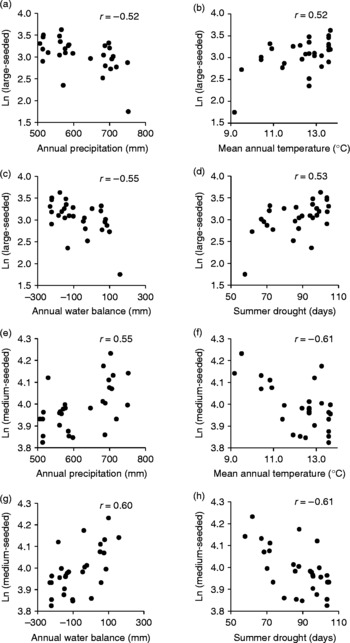
Considering the initial P values, 15 significant correlations between seed-size descriptors and independent variables were found, involving climatic variables, grazing pressure and intensity of seed predation by ants. However, only eight correlation indices remained significant after the FDR correction (Fig. 2). Proportion of large-seeded annuals positively correlated with mean annual temperature (r = 0.52; P = 0.0041) and length of the summer drought (r = 0.53; P = 0.0031), and negatively correlated with mean annual precipitation (r = − 0.52; P = 0.0039) and water balance (r = − 0.55; P = 0.0022). Proportion of medium-seeded annuals showed the opposite correlations with the same climatic variables (mean annual temperature, r = − 0.61; P = 0.0005; summer drought, r = − 0.61; P = 0.0005; mean annual precipitation, r = 0.55; P = 0.0019; water balance r = 0.60; P = 0.0006). Seven correlation indices showed initial significant P values, but were rejected after the FDR correction: mean annual temperature versus mean seed size (r = 0.42; P = 0.0252); mean annual temperature versus standard deviation of the mean (r = 0.38; P = 0.0397); autumn precipitation versus proportion of medium-seeded annuals (r = 0.46; P = 0.0127); autumn precipitation versus proportion of large-seeded annuals (r = − 0.46; P = 0.0120); length of the summer drought versus mean seed size (r = 0.38; P = 0.0444); grazing pressure versus weighted mean seed size (r = − 0.44; P = 0.0166) and intensity of seed predation by ants versus standard deviation of the mean (r = 0.38; P = 0.0426). Soil fertility was the only independent variable showing no significant relationship with any seed-size descriptor.
Significant relationships between climate descriptors and seed-size variables. Significance of the Pearson correlation indices were corrected using the false discovery rate (FDR) method (P < 0.05).

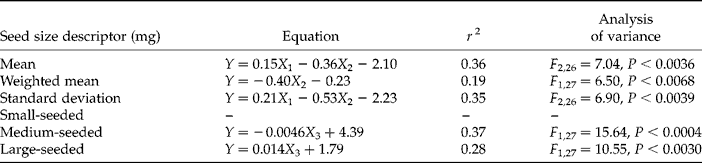
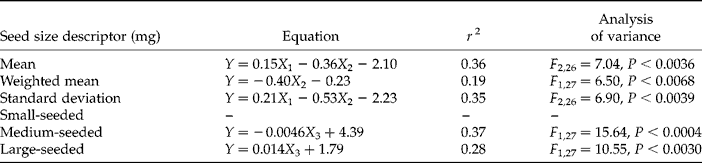
Significant multiple regression models were obtained for five out of the six descriptors of community seed size (Table 1). No significant model could be obtained for the proportion of small-seeded annuals. Two seed-size descriptors (mean seed size and standard deviation of seed size) were dependent on two independent variables, mean annual temperature (positively) and grazing pressure (negatively). In both cases, temperature exerted more influence on the dependent variable. For the other seed-size descriptors, only one independent variable was accepted by the models.
Stepwise multiple regression models of natural-log-transformed seed-size descriptors at the community level for the whole set of annuals. X 1, Mean annual temperature (°C); X 2, grazing pressure (proportion of 2 m×2 m cells containing dung); X 3, summer drought (days)
Discussion
The results support two out of the four hypotheses tested in this study. The multiple regression models showed that mean seed size at the community level increased with mean annual temperature and decreased with grazing pressure. We also found several significant correlations between climate variables and seed-size descriptors, confirming that more-arid communities show a higher proportion of large-seeded species. Conversely, hypotheses concerning soil fertility and seed predation by ants were not supported by our results.
Correlations showed that large-seeded annuals increase in warmer and more arid grasslands, at the expense of the medium-seeded species. This effect is congruent with the increased abundance of large-seeded species in years with dry autumns found by Peco et al. (Reference Peco, Rico and Azcárate2009). Other authors have documented greater survival of large seeds when emergence is affected by water stress (Leishman and Westoby, Reference Leishman and Westoby1994; Veenendaal et al., Reference Veenendaal, Ernst and Modise1996; Westoby et al., Reference Westoby, Leishman and Lord1996; Kos and Poschlod, Reference Kos and Poschlod2008). Increases in the proportion of large-seeded species are at the expense of decreases in the proportion of medium-seeded species, but, interestingly, do not alter the proportion of small-seeded species. The independence between the proportion of small-seeded species and climate is perhaps a consequence of the higher amount of seeds produced by these species (Fenner and Thompson, Reference Fenner and Thompson2005). A high seed production increases the likelihood of finding a ‘safe site’ in the regeneration phase, which makes it unlikely that these species would disappear from the community even when the general conditions are unfavourable.
Climatic indices (WB, D) showed higher correlations with seed-size descriptors than mean annual precipitation and autumn precipitation (in the latter case, correlations were rejected after FDR correction). However, mean annual temperature behaved similarly to climatic indices, suggesting that temperature is a better descriptor than rainfall. The literature contains few precedents supporting a major role of temperature in determining seed size at the community level. For 12 sites across Europe, Pakeman et al. (Reference Pakeman, Garnier, Lavorel, Ansquer, Castro, Cruz, Dolezal, Eriksson, Freitas, Golodets, Kigel, Kleyer, Leps, Meier, Papadimitriou, Papanastasis, Quested, Quetier, Rusch, Sternberg, Theau, Thebault and Vile2008) found that temperature was more correlated with seed mass than variables based on water availability and, in Australia, Murray et al. (Reference Murray, Brown, Dickman and Crowther2004) found that seed size was larger at low latitudes and inland areas, explained as a consequence of higher metabolic costs at high temperatures. One possible explanation for our results is that the rainfall gradient tested in this work (506–758 mm) was too narrow to exert more clear effects. Another possibility is that average values of precipitation are not the best indicators of aridity in Mediterranean systems. Variability is one of the main traits of Mediterranean climate, in the sense that rainfall is distributed irregularly both between and within years. Copious rainfall does not imply more water resources for plants, since excess water runs off after saturating the soil, while drought periods within the growing season can heavily influence vegetation (Peco et al., Reference Peco, Rico and Azcárate2009). The effects of these dry events are probably mediated by temperature, causing more harm in warmer locations. If this is the case, temperature could be a better proxy than precipitation for water shortage propensity or aridity, at least for the range of climate conditions included in our study.
We obtained a significant regression model for mean seed size as a function of mean annual temperature and grazing pressure, and also obtained a significant correlation index between grazing pressure and weighted mean seed mass, although it was rejected after the FDR correction. These results suggest that grazing tends to reduce seed size at the community level, but the effect is probably lower and subordinate to climate. Grazing can reduce community seed size, either favouring small seeds (e.g. endozoochory or epizoochory: Russi et al., Reference Russi, Cocks and Roberts1992; Pakeman et al., Reference Pakeman, Digneffe and Small2002; Mouissie et al., Reference Mouissie, Van Der Veen, Veen and Van Diggelen2005; Peco et al., Reference Peco, de Pablos, Traba and Levassor2005; de Pablos and Peco, Reference de Pablos and Peco2007) or small plants (Noy-Meir et al., Reference Noy-Meir, Gutman and Kaplan1989; Belsky, Reference Belsky1992; Diaz et al., Reference Diaz, Lavorel, Mcintyre, Falczuk, Casanoves, Milchunas, Skarpe, Rusch, Sternberg, Noy-Meir, Landsberg, Zhang, Clark and Campbell2007), and hence indirectly promoting small seeds. Grazing also reduces competition levels by opening gaps and eliminating perennial species (Jurjavcic et al., Reference Jurjavcic, Harrison and Wolf2002; Zeiter et al., Reference Zeiter, Stampfli and Newbery2006; Diaz et al., Reference Diaz, Lavorel, Mcintyre, Falczuk, Casanoves, Milchunas, Skarpe, Rusch, Sternberg, Noy-Meir, Landsberg, Zhang, Clark and Campbell2007), which also benefits strategies aimed at the production of large numbers of small seeds. Standard deviation of seed mass is also dependent on mean annual temperature and grazing pressure. One possible interpretation is that, often, standard deviation scales with the mean, and hence similar relationships should be expected. In any case, the results also indicate that warmer and less-grazed communities contain a higher variability of seed sizes, which is consistent with the idea that changes in the community mainly affect large-seeded species.
Intensity of seed predation by ants only showed one significant correlation with seed-size descriptors (standard deviation); however, this was rejected after the FDR correction. The effect (if any) of ants on community seed size must be small, as otherwise this factor should be included in the models. It has been shown that large seeds are selected by ants in Mediterranean grasslands (Detrain and Pasteels, Reference Detrain and Pasteels2000; Azcárate et al., Reference Azcárate, Arqueros, Sánchez and Peco2005) and the effect of this process is visible in the seed banks (Azcárate and Peco, Reference Azcárate and Peco2006). Furthermore, in this study we do not find any displacement of the community towards smaller seed sizes when ant granivory is intense. One possibility is that the influence of predation is overcompensated by a higher success of large seeds on ant middens (Azcárate and Peco, Reference Azcárate and Peco2007). In any case, seed harvesting by ants is the only one of the four studied factors that could be driven by the vegetation rather than determining it. Some authors have shown a clear effect of structural factors such as vegetation density or biomass on ants (López et al., Reference López, Acosta and Serrano2000; Azcárate and Peco, Reference Azcárate and Peco2004). Nevertheless, no data have been found to date to support a hypothetical dependence of Messor ants on vegetation composition.
Soil fertility does not predict seed size. One possible explanation is that soils of the 29 plots were too similar to exert different effects on vegetation, since we selected sites on similar geological substrata and landforms in order to avoid perennial-dominated grasslands. However, we recorded large differences in the barley biomass yielded by the soils from different plots (range: 0.191–0.381 g; F 28,261 = 7.57; P < 0.0001), confirming that annual-dominated grasslands grow in a variety of soils, and that the sampling recorded a substantial part of this variety. The effect of soil fertility on seed size has been widely reported, but its sense is not consistent in the literature (Marañón and Grubb, Reference Marañón and Grubb1993; Milberg and Lamont, Reference Milberg and Lamont1997; Milberg et al., Reference Milberg, Perez-Fernandez and Lamont1998). Some studies have observed that different floras respond in different ways to nutrient-deficient treatments (Hanley et al., Reference Hanley, Cordier, May and Kelly2007). In the Mediterranean, Marañón and Grubb (Reference Marañón and Grubb1993) suggested that species that tolerate soils with a poorer nutrient supply have smaller seeds and higher relative growth rate, but this experimental study was not accompanied by data showing that real communities followed this pattern. The simplest explanation for our results is that Mediterranean grasslands do not show a clear response to fertility, or that the effect is so small that more decisive factors such as climate and grazing make it irrelevant. Coinciding with our results, Pakeman et al. (Reference Pakeman, Garnier, Lavorel, Ansquer, Castro, Cruz, Dolezal, Eriksson, Freitas, Golodets, Kigel, Kleyer, Leps, Meier, Papadimitriou, Papanastasis, Quested, Quetier, Rusch, Sternberg, Theau, Thebault and Vile2008) found no relationship between fertility and large-seeded plants when considering a large range of sites across Europe.
In conclusion, the results confirm our predictions for climate and grazing, perhaps the main factors driving Mediterranean grasslands, while soil fertility and seed predation intensity seem to be less relevant in terms of predicting community seed size. The use of seed size facilitates the interpretation of the patterns found for grazing and climate, and makes them testable in other regions with different floras. Future research on Mediterranean grasslands should include other grazing-dependent plant traits, apart from seed size (Diaz et al., Reference Diaz, Lavorel, Mcintyre, Falczuk, Casanoves, Milchunas, Skarpe, Rusch, Sternberg, Noy-Meir, Landsberg, Zhang, Clark and Campbell2007) and combine spatial variability with interannual variability, since interannual climatic fluctuations, and not only average values, have been linked to seed size in these communities (Peco et al., Reference Peco, Rico and Azcárate2009).
Acknowledgements
We are grateful to Elisa Oteros, Lucía Galeán, Ana Crespo, Cristina Montero, Carla Huete, Sabina Pérez Rimedio, Lucía Sáez, and Javier Seoane for their help in the field work. This study was funded by the I+D programme of the Spanish Ministry of Science and Technology (projects REN-2003-01562 and CGL-2007-63382) and the Remedinal network (S-0505 / AMB 000335).