In June 1835, Michael Chandler, an Irish-American entrepreneur, arrived in the Mormon capital of Kirtland, Ohio, to meet Joseph Smith, the Latter-day Saint founder and, according to an 1830 revelation, “a seer, a translator, a prophet, an apostle of Jesus Christ.”Footnote 2 Visiting nearby Cleveland with an exhibit of road-weary Theban mummies and their funeral papyri, Chandler had caught word of Smith's notoriety as a translator of hieroglyphs. Although the showman probably recognized that the mummies were unlikely to survive further travel and hoped to dispose of them profitably, he may have been genuinely curious to hear what the New York prophet had to say about his charges. In any event, Chandler did not leave Kirtland disappointed. After issuing a certificate of Smith's skill with hieroglyphs, he sold the Mormon founder four of his “posthumous travelers” and their attached papyri for the formidable sum of $2,400 (five times the annual income of a typical family farm in the area).Footnote 3
Smith soon announced that the mummies were Egyptian royalty, and their papyri contained the writings of the patriarchs Joseph and Abraham. He and his spirited amanuensis and sometime ghostwriter, William Phelps, almost immediately began attempts to decode their hieroglyphic message.Footnote 4 The better-known product of Smith's encounter with the papyri, published in the American and British church organs in 1842, is the Book of Abraham, an Apocryphal-sounding account of terrestrial creation and cosmology narrated by Abraham himself.Footnote 5 Less known is the record Smith and Phelps left of their initial interactions with the papyri, a collection of ostensibly grammatical documents later titled the Kirtland Egyptian Papers (KEP).Footnote 6
The KEP, when situated culturally, confirm and expand several aspects of Smith's religion making and its close relationship to language. First, Smith believed that human language was irreparably damaged by the biblical confounding of tongues at Babel. Second, he believed that ancient records and their constitutive hieroglyphs, typified by the Egyptian, provided a key to recovering the language of primitive humanity spoken in the Garden of Eden and the sacred names by which language first touched creation. Third, this quest for language clarifies Smith's primitivism as an attempt to create relationships with past generations in anticipation of a united human family after Christ's return. Smith grounded this project in direct, genealogical bonds to Adam and Eve, a point central to the meaning of the KEP and the broader religious sensibilities of early Mormonism. Permuting mystical currents from his youthful engagements with folk magic and themes generally labeled hermetic, Smith led his followers to a celestial society.
In this vast human family possessed of a single heavenly language, Smith answered the plural and divisive voices of American religion as well as the social disruption of the new American republic. The society around him emphasized freedom from tradition alongside the power of the individual; in politics, party controversies predominated, while in religion denominations multiplied.Footnote 7 These sometimes strident diversities threatened the family harmony Smith sought. By discovering the pure language, Smith saw his way to a restoration of a united world free of sectarian strife.Footnote 8 Though he echoed his broader culture, which agreed that human language was corrupt (primarily as an indictment of Calvinist and Catholic theology), Smith took his theology of language much further, deep into an Edenic primitivism fraught with distinctive genealogical themes. Through Smith's hieroglyphic projects, early Latter-day Saints enjoyed his apparently miraculous facility with ancient languages. More significantly, though, they discovered sacred access to humanity's origin and future. In an important sense, these hieroglyphic projects served, as his published scriptures, to allow “the living to hear from the dead,” to create genealogical and eschatological relationships with them.Footnote 9
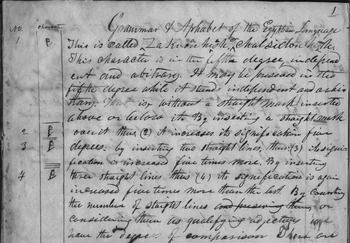
The work of Phelps and Smith, with minor input from others, the KEP comprise philological exercises (KEPE) and manuscripts of the published Book of Abraham (KEPA).Footnote 10 The major portion of KEPE is a bound notebook whose spine reads “Egyptian Alphabet,” and whose title page declares it a “Grammar and A[l]phabet of the Egyptian Language” (hereafter GAEL) (fig. 1).Footnote 11 Divided into two sequential “parts” of five “degrees” each, GAEL contains parallel lists of glyphs, transcriptions, and glosses designed to decipher the contents of the Chandler papyri. Within a “part” each glyph is carried through all five “degrees” of related meaning, like a dictionary repeated five times, each definition an expansion of the prior one. (A variety of similar but much shorter documents are often designated KEPE 2–5.)Footnote 12
Title page of GAEL, outlining the method for understanding grammatical “degrees” (horizontal lines) within the lexicon. Courtesy Church History Library, © IRI.

As with many of Smith's later projects, the nature of the involvement of his associates—“scribes” or “clerks” in early Mormon parlance—in the production of the KEP is complex. Smith, as Mormonism's translator and seer, superintended the project and provided its animating vision, while Phelps, a newspaperman and self-styled linguist who claimed knowledge of more than a dozen languages, provided much of the purported grammatical expertise.Footnote 13 Oliver Cowdery, Smith's major scribe for the 1830 Book of Mormon, provided publicity for the Egyptian project but little direct input on the grammars, while a temporary scribe named Warren Parrish seems to have been least involved. If Phelps worked entirely without Smith's input, as some writers have suggested, he proved a remarkably perceptive student of his prophet: the KEP faithfully reflect and amplify Smith's broader religion-making projects. In any case Smith was involved: he mentioned his work on the grammar in his official diary and left a brief document among the KEP in his own handwriting.Footnote 14 As with many other writing projects under his name, Smith likely oversaw and directed the efforts of his scribes, guiding their work while he learned from them in an intellectual and religious symbiosis.Footnote 15 Ultimately, although Phelps likely affected Smith's approach and the details of the final product, the Mormon founder's vision is clear in the outlines and scope of the Egyptian grammar project. Owing to turmoil within the Latter-day Saint movement, Smith and Phelps stopped work on the project by 1837. They made plans to return to it in 1843, but Smith died before completing the Egyptian Grammar. Though the KEP remain unfinished, these philological exercises provide a dramatic and important window into Smith's religious and social vision and the broader context of hieroglyphic culture in which he operated.
The KEP have proved controversial—the documents contain no recognizable Egyptian words and are often maintained to be the source of the published Book of Abraham, thereby proving both fraudulent.Footnote 16 This is the thrust of the disclaimer in a polemical reprinting of GAEL: “Note: This is not an authentic Grammar and Alphabet of the Egyptian language. It does not contain any grammar or any genuine or reliable analysis of the Egyptian language.”Footnote 17 The polemics surrounding the KEP have deflected attention from their meaning as religious documents per se. That these documents are not Egyptian according to any standard linguistic metric is beside the point. The KEP are not a grammar of hieroglyphs; they are themselves a hieroglyphic grammar. These manuscripts point beyond themselves to a place and time, imminently to be repeated, where the confusion of language could no longer tear the human family apart.
I. The Curse of Babel
The enemy Smith battled with his hieroglyphic translations was Babel. According to antebellum understandings of the biblical narrative (Gen. 11:1–9), an arrogant attempt to build a tower on the plain of Shinar to reach the heavens resulted in the “confusion of the ancient language,” or the “confound[ing of] the language of men.”Footnote 18 Though many saw Babel primarily as a morality tale about pride or the explanation for present linguistic diversity, others sought more specific insights about language and society from the Genesis account.
Some saw Babel as the root cause of the limitations of human communication. William Phelps emphasized these failings in 1832 in a devotional essay on letter writing later attributed to Smith. “We can hardly find a language, written or spoken, on earth, at this time, that will convey the true meaning of the heart to the understanding of another,” he announced, a point he reiterated in an 1833 statement to the Mormon diaspora.Footnote 19 Occasionally Phelps got specific: in an 1833 explanation of the polemic uses of “civilized” and “savage,” he cautioned “as to the meaning of words, we are sensible, many contradictions in terms exist, and will till wickedness is destroyed, and the Pure Language returned.”Footnote 20 Adam Clarke's popular Methodist Bible commentary had made much the same argument, while a Mormon editorialist later complained that “language has become confounded, corrupted, changed, mixed and adulterated, so that words are very unintelligible signs of ideas.”Footnote 21 A mythic narrative of the source of linguistic diversity came to stand for the basic problem of human communication. Babel not only separated Greek from Latin or English; it also left all language unable to support pure communication.
Throughout his career Smith demonstrated his concern with the problems of language and languages. Having grappled with the inconstancy of English in his 1830–1833 revision and amplification of the King James Bible (the “Inspired Version” or “Joseph Smith Translation”), he confronted early the problem of Babel.Footnote 22 As he transitioned from the Noachian flood narrative of Genesis 6–10, Smith told the story of the tower on the plain of Shinar with brief but significant modifications. Where the biblical narrative proposed a limit on human autonomy and left punishment for pride as an implicit theme, Smith added two clauses to emphasize that the confusion of languages was a direct punishment for sin. The sin was disobedience, as the people “hearkened not unto the Lord,” and the loss of “the same language” for all humanity occurred “because the Lord was displeased with their works.”Footnote 23 Smith felt the effects of this curse at a personal level. During the period of his Bible revisions, he prayed in an otherwise exultant letter to Phelps, “Oh Lord God deliver us in thy due time from the little narrow prison almost as it were totel darkness of paper pen and ink and a crooked broken scattered and imperfect language.”Footnote 24 Even after mystically translating the Book of Mormon and revising the Bible, Smith continued to plead with God for deliverance from fallen language.Footnote 25 Six months into the KEP project, the day before his thirtieth birthday, Smith continued the theme, writing in his official diary, “O may God give me learning even Language and indo[w] me with qualifycations to magnify his name.”Footnote 26 A few months later he wrote, “My Soul delights in reading the word of the Lord in the original and I am determined to persue the study of languages untill I shall become master of them if I am permitted to live long enough. [Or] at any rate, so long as I do live, I am determined to make this my object and with the blessing of God I shall succe[e]d to my sattisfaction.”Footnote 27 Smith invested considerable emotional resources in grappling with the limits of human language. He was determined to overcome them. The Latter-day Saints joined with and supported their prophet in the struggle, proudly taking collections to support his translation activity.Footnote 28 Many Saints personally embraced the pursuit of sacred language: inclusion in Smith's Kirtland Hebrew school was a badge of honor, and even itinerant elders enthusiastically carried Hebrew primers on their missionary travels.Footnote 29 Some even tried their hand at translations of Bible texts.Footnote 30 This focus attracted proselytes and amused learned observers. The Anglican scholar Henry Caswall emblematically observed, with thinly veiled condescension, that the Mormons “consider the study of the Hebrew language to be a religious duty.”Footnote 31
Early Latter-day Saints enjoyed a natural fraternity with the prophets of their Book of Mormon in their concerns over fallen language. The first author, Nephi, lamented his “weakness” in language, his failure to be “mighty in writing.” Moroni, the final writer, worried in an apostrophe to God that outsiders would “mock” the American scripture because “thou hast not made us mighty in writing.”Footnote 32 Beyond such personal asides, Smith's first scripture contained a powerful direct witness to the power of Babel. In Smith's phrase, the Book of Mormon told the story of America's “first settlement by a colony that came from the tower of Babel, at the confusion of languages.”Footnote 33 Recounted in the Book of Ether, this epic narrative of the only people to escape Babel's curse chronicles the history of the Jaredites “from the tower down until they were destroyed.”Footnote 34 In this account, the eponymous patriarch Jared pleaded with his prophetic brother Moriancumer to “cry unto the Lord, that he will not confound us that we may not understand our words,” a wish God granted to this Moses for the New World, who according to Ether was the first person faithful enough to see the actual, physical hand of God. In the odd and multivalent phrase of Smith's scripture, “Jared and his brother were not confounded,” and they migrated to America, their language intact.Footnote 35 In fact, this Moriancumer had a supernatural ability, apparently related to God's protection from Babel's curse: in Moroni's apostrophe to the Creator lamenting his weakness in writing, he said of the Jaredite prophet, “thou madest him that the things which he wrote were mighty even as thou art, unto the overpowering of man to read them.”Footnote 36 For Moriancumer freedom from Babel imparted to his words a supernatural force, one he could use to maintain his ethnic community and overpower his readers.
Beyond the Jaredites, the quest for linguistic purity represented a significant motif in the overall Book of Mormon narrative, from its characterization of mainline Christianity as the corrupter of the “plain and pure” language of the Bible that went “forth from the Jews in purity” to Apocalyptic writings sealed to “come forth in their purity” free from human corruption, to a sacred compass that would issue messages in “writing, which was plain to be read” if the Nephites were sufficiently faithful.Footnote 37 The American scripture even seems to have sanctioned murder to the end of preserving ancient language in its pure state. Early in the story, the prophet-hero Nephi obeyed a divine command to murder his kinsman Laban, a powerful and inebriated merchant, in order to recover the “brass plates,” the ancient records of his people, “that we may preserve unto our children the language of our fathers.” The dutiful Nephi decapitated Laban, and the Nephite people maintained their language for a millennium.Footnote 38 This point bears emphasizing: the concluding author Moroni compiled but did not need to translate the writings of the first author Nephi, despite ten centuries separating them, because the prophets taught the people in “all the language of [their] fathers,” which was the “language of the Egyptians.”Footnote 39 The Mulekites, a third civilization in the New World that migrated when Nephi and his family did, demonstrated the risks of losing such ancestral records. According to the Book of Mormon, “their language had become corrupted” because they lacked records—they knew nothing of God and could not understand Nephite language despite a shared culture three or four centuries earlier.Footnote 40 Though the brass plates Nephi stole from Laban filled other needs, the emphasis on the intrinsic importance of comprehensible, unadulterated language is striking.
In his Old Testament revisions, Smith provided the ancient exemplar for such language-preserving records. In the text now termed the Book of Moses, Father Adam kept a “book of remembrance” that was “recorded in the language of Adam, for it was given unto as many as called upon God.” This first human scripture was used to teach children “to read and write, having a language which was pure and undefiled.” Adam's book would be cherished generations later for imparting knowledge of lost ancestors: in the words of Enoch, “even the first of all we know, even Adam. For a book of remembrance we have written among us, according to the pattern given by the finger of God.”Footnote 41 Sacred records encoded in the language of the Garden of Eden connected humanity to its first parent, emphasizing the familial and social scope of pure language.
This emphasis on the capacity of language to tie the present to the past strongly frames the KEP. Though generally more implicit, in the GAEL interpretation of the character they called Zool, Phelps and Smith posited that the glyph hearkened “back to the beginning of Creation,” by a power invoked in a later “degree” as “the denomination of language.”Footnote 42 In the sparse phrasing of GAEL, language mediated the connection to the beginning times. The same type of narrative surfaced in the canonized Egyptian scripture. Abraham there stated that certain “records have come into my hands,” much like an Adamic book of remembrance, “a chronology running back from myself to the beginning of the creation.”Footnote 43 Essentially all the righteous peoples in Smith's scriptures possessed such linguistic ties to those who had come before. Smith's disciples would also have the opportunity to create Books of Remembrance of their own. From a church ledger recording their “patriarchal blessings” to Smith's “Book of the Law of the Lord” to their temple records and official ecclesiastical history, Mormons created sacred records for their own progeny to read. Rank-and-file Mormons cherished this participation in the ancient tradition of memorials and the power of the written word. In this textual mimesis, they created for themselves a space in the flow of human history and safe passage to heavenly glory.Footnote 44
Smith and Phelps were far from alone in their concern over the degradation of human language, though contemporary thinkers tended to have a more explicitly theological problem in mind.Footnote 45 The strident restorationist Alexander Campbell (1788–1866) sought the “pure language” of Canaan, in contrast to the fallen language of Ashdod (the capital of biblical Philistine), a position he maintained throughout his career. For Campbell, “modern ecclesiastic and sectarian terminology” for Bible teachings and texts represented Ashdod, while intelligible, atheological language was the modern language of Canaan. (He was protesting Catholic and Calvinist theology, which he had earlier described as “the Babylonish or corrupt phraseology of the dark ages.”) In Campbell's view, only by “calling Bible things by Bible words” could the truth of scripture find its way to the believing soul. The “supernatural ideas” of the biblical revelation, those unknowable by human experience, could never reach the believer's soul without a reformation of theological language.Footnote 46 To this end, Campbell revised and reprinted a composite edition of the New Testament from the independent translations of three Scottish scholars in 1826. Employing ideas similar to those espoused in Smith's Book of Mormon, Campbell justified this new translation (to which he made brief but significant emendations and adjustments) by arguing that “a living language is continually changing,” and even authoritative, familiar texts are prone to “the cankering hand of time,” which “moulders” them “away.” Invoking the providence of God in making Hebrew and Greek “dead” to protect them from corruption, Campbell announced that “we have, in writing, all the Hebrew and Greek that is necessary to perpetuate to the end of time.” In the battle over the meaning and mutability of language, Campbell used his reverential view of the original writings of “the sacred penmen” to reject the King James Version, heavily contaminated in his view by formal theology.Footnote 47 He proposed these textual renovations of the English Bible, in his phrase, to “heal divisions and prevent debate among Christians.” Footnote 48
In his New Testament translation project, Campbell created a space for himself within a broader tradition of rejecting elite theology on the grounds that theologians had relied too much on isolated, ambiguous, or anachronistic words and phrases. Several of his peers took the suspicion of language's corruption still further. Andrews Norton (1786–1853) related in his 1833 Unitarian manifesto that important spiritual “truths cannot be expressed in human language.”Footnote 49 Using the trope of superhuman beings to frame his concerns in a perhaps unwitting echo of Emanuel Swedenborg, Norton wrote that those concepts “with which the human understanding is conversant are all that can be expressed by words. If an angel have faculties of a different nature from those which we possess, he can make no use of our language to convey to our minds the results of their exercise.”Footnote 50 Though Norton intended primarily to dispute Trinitarianism, he specifically chose to emphasize that reliance on the intricacies of language was doomed to failure. Human language, mired in human experience, would not permit comprehension of the eternal.Footnote 51
Liberal Congregationalist Horace Bushnell (1802–1876) introduced his 1849 collection of three discourses (God in Christ) with a “Preliminary Dissertation on the Nature of Language as Related to Thought and Spirit.” He prefaced the sermons by commenting that “in the misuse or abuse of this instrument [language], a great part of our religious difficulties have their spring.” According to Bushnell, the error of believing that this “instrument” was “infallible” or even “sufficient” underlay many errors of theology. Though he doubted whether pure human language had ever existed, Bushnell claimed regardless that the “history of Babel and the dispersion” proved “the virtual destruction of the one language of the race by a miracle.” This confounding curse was so central that Bushnell indicted the quest for a mother language as an attempt “to prove the Bible untrue,” a rejection of the permanence of the Babel miracle. Whatever else it taught, the Bible revealed the inherent fracture of language. After a prolonged historical review of scholarship on the origins of language, including that of his Yale tutor, Josiah Gibbs, Bushnell made his critical claim that philological theology, conducted by “one-word professor” theologians, was a doomed enterprise. The dependence of language on the internal states and personal histories of speakers and listeners ultimately precluded any conclusions of more than tentative significance.Footnote 52
The philosopher-critic Ralph Waldo Emerson (1803–1882) expressed his own sensibilities about the limits of human language in his renowned first book Nature (1836), invoking general human frailty rather than Babel as the cause. “The corruption of man is followed by the corruption of language … old words are perverted to stand for things which are not,” he wrote. In this fallen state, “words lose all power to stimulate the understanding or the affections.”Footnote 53 While Emerson intended to indict secular as well as religious thinkers in his naturophilic essay, he grounded this criticism in the drift of language from its original state of purity. (In a more religious vein, Emerson's occasional muse Emanuel Swedenborg had famously announced that “human language … cannot be the vehicle of the Word of God.”Footnote 54) Still further outside the mainstream, the United Society of Believers (Shakers) would reject the possibility that human words could communicate truth. Rejecting a Biblicism bereft of Spirit, Shaker leader Benjamin Seth Youngs (1774–1855) claimed that the Bible was “composed of letters, and letters are no more than signs, marks, or shadows of things, and not the very substance of the things which they signify.”Footnote 55 While Emerson honored a language born of Nature and Youngs one of the Spirit, they could agree that ordinary words failed to communicate higher truths. Human language kept aspiring believers from eternal truth.
The purported consequences of Babel's curse varied sharply among these early American thinkers. For Norton, Bushnell, Youngs, and to a lesser extent Emerson, whatever the specifics of their religious affiliations, fallen language falsely supported the theology of orthodox Calvinism and estranged believers from spiritual truth. For Campbell, only the providentially dead Hebrew and Greek were spared language's curse. This chorus of voices, however divergent in its conclusions, was clear: human language was imperfect, even irreparably damaged. Few believed pure language could be recovered; the differences generally rested in their approaches to circumventing its failings, whether poetry and Nature (Emerson), common-sense translation (Campbell), or ecstatic experience (Youngs).
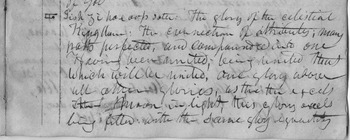
For some observers, the problem of fallen language not only muddied theology and divinity, it also supported the divisions of sectarianism, impeding both knowledge and human community. Bushnell blamed misuse of fallen language for “the infinite multiplications of opinion, the errors and sects and strifes of the Christian world,” much as did Alexander Campbell or Adam Clarke.Footnote 56 Because language could not communicate spiritual truths certainly, many different views and denominations could arise, resulting in what Campbell's associate Barton Stone referred to as the “Babel of confusion” of American Protestantism.Footnote 57 Smith and his followers, ever attuned to interdenominational discord as a sign of God's disfavor, agreed. Mormon writer Parley Pratt, in a military metaphor, referred to the Protestant world as “the plains of Babel.”Footnote 58 Elder Erastus Snow wrote in the church organ that, as a consequence of Babel, “different nations sprang up in Idolatry, speaking different dialects, and as they had a partial knowledge of the true worship of God, which was had among the posterity of Shem in their native land; they, in their idolatrous condition counterfeited the true priesthood, and the religion of heaven.”Footnote 59 This “counterfeit” religion was more generally a Mormon term for established Christianity. Snow here recapitulated the argument of the Book of Mormon: when language was lost, nations lapsed into religious apostasy and sectarianism. For Mormons, Babel stood for the bewildering pluralism of early national America, the disputing voices of American Protestantism. They did not have to look far for its effects—the early American Republic represented to many who lived within it a surfeit of change, disruption, and plural voices.Footnote 60 The Latter-day Saints sought the contrary, a perfect unity, a quest reflected in the KEP. In the GAEL glyph meant to describe the celestial kingdom of heaven, Phelps and Smith proclaimed “the connection of attributes; many parts perfected, and compounded into one[.] Having been united; being united that which will be united.” Reflecting their integrative impulse, this glyph is a composite of Lish [supreme glory or divinity], Zi [woman or queen], ho e oop [prince], and Iota [seeing/eye] (fig. 2). In this pictogram of a royal couple seen (or seeing) together in divine glory was the unity, couched in familial-genealogical terms, that Smith and his followers earnestly sought.Footnote 61 In fighting Babel, Smith struggled against its effects—a language that hindered communication and a religious landscape marred by disunion.
Gloss for Lish Zi ho e oop Iota, a composite glyph representing heaven as a royal couple in the presence of God. Courtesy Church History Library, © IRI.

II. Hieroglyphs and the Quest for Pure Language
For Smith the antidote to Babel's curse lay in part in his gift with the records of the ancient dead, encoded in their sacred script, hieroglyphs. The timing of Chandler's visit could not have been more opportune for Mormonism's translator and seer. A student of folk magic—with its talismans, parchments, and codes—in childhood and early adolescence, Smith had been acutely concerned with ancient Egyptiana since at least the 1820s, when he prepared his signature Book of Mormon, translated from gold plates “filled with engravings, in Egyptian characters” that Latter-day Saints denominated “Reformed” or “short-hand” Egyptian.Footnote 62 This American scripture revealed that Smith was the prophetic namesake of the biblical patriarch Joseph of Egypt, a connection he strengthened by assuming Joseph's Egyptian title—Zaphnathpaaneah—as an occasional nom-de-plume.Footnote 63 Though he had completed the Book of Mormon and Bible by June 1835, Smith had not yet learned Hebrew or Greek. Of his gold plates only a small transcript of hieroglyphs now termed the Caractors document remained.Footnote 64 In Chandler's papyri Smith finally possessed an artifact of uncontested Egyptian hieroglyphs, one he proudly displayed and studied up until his death, filling at least in part the lacuna left by the missing gold plates.Footnote 65 The continuity between the missing and the new hieroglyphic relics comes clear in Oliver Cowdery's proud announcement that certain Book of Mormon “characters” (presumably the Caractors document) were “like those of the writings” on the funerary papyri. In broad agreement with Cowdery, Phelps announced in an 1835 letter to his wife that the papyri would “make a good witness for the Book of Mormon.”Footnote 66 As Smith and his followers moved beyond folk magic, stung by the stigmatization of the occult by neighbors and critics, the papyri imparted substance to their religion making, even as they opened new metaphysical vistas. The papyri and their glyphs would become important marks of continuity in the development of Smith's religion.
The national origin of these papyri mattered a great deal. Though images of Egypt occasionally appeared on the biblical stage of colonial America (often as the enemy—Benjamin Franklin declared English rule “Egyptian Slavery”), American fascination with Egypt expanded considerably in the aftermath of Napoleon's looting of Egyptian antiquities (1798–1801). Antebellum America at times seemed to hum with Egyptomania—mummy teas and medicinal nostrums, fictional treatments of resurrected mummies, touring mummy exhibits, the metaphysical weight of the Rosetta stone, omnipresent images of the Nile, even an imaginative situation for race and slavery all partook of this fascination with things Egyptian.Footnote 67 For many nineteenth-century Americans, Egypt represented a crucial source of human culture and civilization, particularly though not exclusively in its intersections with ancient biblical culture. Egypt was the source of writing, the arts, astronomy, and magic.Footnote 68 Masons and others sought wisdom from the priest-god Hermes (Thoth), while various writers saw Egypt as one important source of ancient American civilization, citing Native mummies, Mesoamerican petroglyphs, and other artifacts that seemed reminiscent of Egypt.Footnote 69 Applying humanity's beginnings to their individual ends, antebellum Americans modeled their death culture on Egypt, claiming that its death emphasis, indeed its dead themselves (the astonishingly preserved mummies that began to arrive in the 1820s), represented humanity's ancient response to the eternal problem. America's cemeteries, particularly in the rural movement of the 1830s and 1840s, made this claim explicit. The contemporary historian of the Forest Hills cemetery reported that “Egyptian architecture is essentially the architecture of the grave … it seems particularly adapted to the abode of the dead.”Footnote 70
In antebellum America, Egypt (Ah meh strah according to the KEP) commanded interest for its mummies and towering funerary monuments. The language of Egypt would for some eclipse even those impressive monuments of ancient civilization.Footnote 71 Egyptian was central to Smith's and Phelps's quest for pure language and the broader context of the philological exertions of the KEP. Though Jean-Francois Champollion (1790–1832) had deciphered the Rosetta stone by 1822, culture changed slowly, and the mystique of those inscrutable pictograms persisted—if increasingly metaphorically—inspiring the literati of the American Renaissance, Emerson and his Transcendentalist peers, and a host of other observers. Champollion's phonetic Egyptian was slow to find traction because hieroglyphs had so long been understood to function as secret pictographic codes rather than an alphabetic system.Footnote 72 Though often attributed to the German Jesuit Johannes Kircher (1602–1680), by the nineteenth century this belief had moved well beyond the esoteric literature from which it sprang.Footnote 73 Noah Webster (1758–1843), defining the term for his compatriots in 1828, explained:
In antiquity, a sacred character; a mystical character or symbol, used in writings and inscriptions, particularly by the Egyptians, as signs of sacred, divine, or supernatural things. The hieroglyphics were figures of animals, parts of the human body, mechanical instruments, &c., which contained a meaning known only to kings and priests. It is supposed they were used to vail morality, politics, &c., from vulgar eyes.Footnote 74
William Phelps among others imbibed this tradition of hieroglyphs as secret code as early as an Independence Day celebration two years before the mummies arrived. Phelps then claimed that the “Egyptians could astonish the universe … concealing their arts in mystical characters or hieroglyphics,” a position Cowdery also publicly espoused.Footnote 75 Few voices disputed the general wisdom that hieroglyphs concealed ancient mysteries. In this tradition an aspect of the esoteric quests of hermeticism entered the mainstream as accepted truth. Without ever opening the Kabbalistic Zohar or the hermetic Divine Pymander, the devoted student could, through Egyptian hieroglyphs, approximate the awesome power of holy words.Footnote 76 Through general hieroglyphic culture, untrained believers could participate in the popular and influential themes of metaphysical correspondence and the mystical power of language that animated their more learned and esoteric compatriots.Footnote 77 Though only the very rare Mormon was an actual Kabbalist, most of them saw hieroglyphs as confirmation of the ancient mysteries Smith could discover, wedded to the records of the dead.Footnote 78 Wilford Woodruff, touring the British Museum on an evangelizing mission in 1840, emblematically admired the papyrus collection “more … than any thing” else, realizing that they contained “many glorious things Sacred & historical concerning the early ages of the world Abram & the Prophets &c.,” if only they could be “translated.”Footnote 79
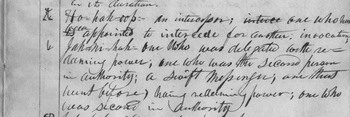
Central to the mystique of hieroglyphs was their pictographic nature. As no phonetic language could, these signs represented actual objects in Nature.Footnote 80 Understanding hieroglyphs as pictographic ciphers for the mysteries of human origin and religion provides the most immediate context for understanding Phelps's and Smith's Egyptian grammar project. The KEP nearly overflow with creative pictographic interpretations of Egyptian characters. As the simplest example, a dot represents the human eye (Iota, “the eye or to see or sight”), while similar references to vision in association with dots or circles are scattered throughout the manuscripts, and a “compound” of Iota looks like an eye with a horizontal lash.Footnote 81 Geographic interpretations are also represented in a convex arc translated as the earth's horizon (Sue, “the whole earth” and by extension “the whole of anything”) or a concave arc as its antipodes (Toan tau ee tahee tahee toues, “under the sun; under heaven; downward … going down into the grave; going down into misery = even Hell”).Footnote 82 Many of the KEP glyphs are semantic and syntactic composites of simpler glyphs, evincing a combinative pictography. A stick figure (Ho hah oop) represents Jesus, an “intercessor”; his left leg is the glyph for delegation (Jah-ni-hah) (fig. 3), anticipating the Abraham account of a Jesus chosen as God's legate to earth in the cosmological drama.Footnote 83 The glyph for Kiahbroam appears to be a combination of the character for Zub Zool oan (“first man or father of fathers”) with the eye (ki) and a horizon-determining Sue. Thus the composite glyph meant “a father of many nations.” There seems to be implicit within this gloss the image of Abraham seeing his posterity and thereby comprehending the earth.Footnote 84
Gloss for Ho hah oop and its constituent glyph Jah ni hah (left leg of the stick figure), representing Christ the “intercessor” as God's legate. Courtesy Church History Library, ©IRI.

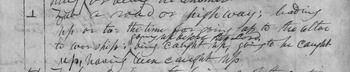
In many cases, Phelps's and Smith's interpretations combined physical and metaphorical meanings, as the glyph Zi, which means both “upright” (it looks like an upside-down “T”) and “modest and chaste being taught most perfectly.”Footnote 85 The identical glyph is later transcribed as Zub, extending another pictographic interpretation, this time vertical ascent: “leading up or to: the time for going up to the altar to worship; going up before the Lord[;] being caught up” (fig. 4).Footnote 86
Gloss for Zub, a metaphorical reading of the vertical line as heaven-directed worship. Courtesy Church History Library, ©IRI.

The funerary vignettes within the Chandler papyri confirmed the connection between pictures and objects. Smith offered interpretations of these vignettes, published in the church organ as “Fac-similes” (the name by which modern Latter-day Saints know them), similar to the approach within the KEP. Circulating in some respects as published predecessors to the anticipated Egyptian Grammar, these vignettes spanned the hieroglyphic project and the ultimate Book of Abraham. These vignettes—“the figures at the beginning” of the official Book of Abraham—were the very definition of hieroglyphs, pictures telling sacred stories.Footnote 87 In support of this project, the Book of Abraham would reveal an ancient name—Rahleenos—for hieroglyphs themselves.Footnote 88 The Latter-day Saints delighted in the circulation of these facsimiles within the exchange papers, even as they battled with critics who mocked their prophet's interpretations.Footnote 89 In their visual, material interpretations of the glyphs on their papyri, Phelps and Smith emphasized the strict correspondence of primal languages and objects in Nature, mediated through their conception of ancient pictography. In this respect they differed little from Bushnell and particularly Emerson, who enthusiastically appropriated hieroglyphs as figures for primal language.Footnote 90 In Nature, Emerson argued that
the use of natural history is to give us aid in supernatural history: the use of the outer creation, to give us language for the beings and changes of the inward creation. Every word which is used to express a moral or intellectual fact, if traced to its root, is found to be borrowed from some material appearance.Footnote 91
Though Emerson had a broader project in mind, he was proposing something about language as well as about Nature.Footnote 92 Words in their originals, the “roots” extending into “outer creation,” held the secrets to inner states, supernatural wisdom and, perhaps, the origins of humanity. In the same essay, Emerson argued, “As we go back in history, language becomes more picturesque, until its infancy, when it is all poetry; or all spiritual facts are represented by natural symbols. The same symbols are found to make the original elements of all languages.”Footnote 93 Though Emerson's sensibilities about art affected his phrasing, he believed that physical artifacts and natural phenomena provided the necessary context for pictograms, the “original elements” from which language later fell into corruption. Elsewhere Emerson had shown his intellectual debt to the French Catholic Swedenborgian Guillaume Oegger, reprinting his claim that “material objects are necessarily kinds of scoriae of the substantial thoughts of the Creator, which must always preserve an exact relation to their first origin; in other words, visible nature must have a spiritual and a moral side.”Footnote 94 By conflating idealized words with the bare essence of physical existence, Emerson proposed a transformative language based in deep reality. Something like this is the implicit argument of Phelps and Smith in the KEP.
Horace Bushnell, more concerned with spoken than written language, believed as early as 1839 that “the whole outward world” was “analogical to thought and truth,” an idea he extended in 1849 and 1851, claiming that “all the terms in language, which are devoted to spiritual and intellectual uses, have a physical or outward sign underlying their import.” In his wide-ranging “Dissertation on Language,” Bushnell argued that language, including both words and grammar broadly conceived, derived from sensation, the body, and space.Footnote 95
Less rigorous thinkers agreed that hieroglyphs, as pictograms, provided the correlation between object and word. Scottish minister Michael Russell, whose popular history of Egypt made its way into the library near Joseph Smith's New York home, wrote at length on the nature of hieroglyphs as the first correspondence between language and nature. He argued that though Egyptian writing seemed inferior to classical Greek poetry, it presented a special gift to nineteenth-century Christians—the system of hieroglyphs. Russell maintained that such glyphs were “common to the whole human race,” explaining that “in the infancy of society, all communication not strictly verbal is carried on through the medium of picture-writing.”Footnote 96 The more plebeian Josiah Priest—a consistent favorite of Mormons and their neighbors—advertised a similar belief in his fanciful and popular treatment of American antiquities. Priest reprinted in reverential terms Constantine Rafinesque's (1783–1840) description of Mesoamerican glyphs: “these physical emblems are so natural and obvious, that they are sometimes found among many of the ancient alphabets.”Footnote 97 Priest's major goal was to prove a Near Eastern origin for America's ancient culture. In the pictographic and universalizing power of glyphs he found the evidence he needed.
Hieroglyphs promised one probable answer to the antebellum quest for the origins of language, a fascination that extended from the common public to some practitioners of the nascent scholarship of historical linguistics. Though a variety of scholars (and their academic societies) had cooled in their pursuit of the Ur-language by the nineteenth century, others continued to pursue scientific and religious evidence of the original language.Footnote 98 Bushnell, siding with the majority of scholars, found the pursuit absurd, though he based his argument on the biblical authority of the curse of Babel. On the other hand, Presbyterian Samuel Miller (1769–1850), in his pious Brief Retrospect of the Eighteenth Century, proudly hailed James Burnett, Lord Monboddo's (1714–1799) somewhat mystical conclusion that all languages derived from Egyptian, of which Sanskrit was the purest modern remnant.Footnote 99
Phelps and Smith clearly added their voices to a broader chorus. By imagining new pictograms in Egyptian characters, these founding Mormons thereby maintained that they had gained direct access to primal language. The Chandler papyri provided for them a view of the time when words possessed an almost physical substance. This was the power Phelps and Smith had publicly sought for years. Unsullied by Babel, such a language could unlock the mysteries of the ages and, perhaps, even transform society on the basis of a pure and reliable language for humanity.Footnote 100 The hieroglyphic hermeneutic is critical to comprehending what Phelps and Smith understood of their Egyptian project and points to the mystical correspondence that supported the harmonies Smith sought.Footnote 101
Smith's quest had repercussions for his followers. Papyri and mummies, the remains of those who had lived and breathed in the time of the patriarchs, validated the Mormon quest to recover ancient Christianity as it extended to them the respectability of classical scholarship. While it made Smith's prophethood more real for his followers, it also provided a compelling proof they could display to outsiders.Footnote 102 Wilford Woodruff, on returning to Kirtland after a proselytizing tour, visited the new temple, where he “visited the upper rooms & there viewed four Egyptian Mumies & also the Book of Abram Written by his own hand & not ownly the hieroglyphicks but also many figures that this precious treasure Contains are Calculated to make a lasting impression upon the mind which is not to be erased.”Footnote 103 As the Book of Abraham was being prepared for publication a half-decade later, Woodruff announced with great pride, “Truly the Lord has raised up Joseph the Seer of the seed of Abraham out of the loins of ancient Joseph, & is now clothing him with mighty power & wisdom & knowledge… . The Lord is Blessing Joseph with Power to reveal the mysteries of the kingdom of God; to translate through the urim & Thummim Ancient records & Hyeroglyphics as old as Abraham or Adam.”Footnote 104 An encounter with an outsider helps to frame the Mormon experience of their prophet-translator. In 1842 Henry Caswall, the Anglican scholar who had watched Mormonism for several years, traveled to Nauvoo with an antique Greek Psalter intending to dupe Smith. On his arrival, a Latter-day Saint informed Caswall that he “had brought it to the right place to get it interpreted, for that none on earth but the Lord's prophet could explain it, or unfold its real antiquity and value.” Another described for him Smith's “remarkable Egyptian curiosities” and urged the learned visitor to inspect them. When Caswall informed Mormons of his plans to take the Psalter to outside scholars, one “answered with a sneer, that the Lord had chosen the weak things of the world to confound the mighty; that he had made foolish the wisdom of this world; and that I ought to thank Providence for having brought me to Nauvoo, where the hidden things of darkness could be revealed by divine power.”Footnote 105 The hieroglyphic project boosted Mormon pride as it reassured them that their access to ancient texts was more secure than that of scholars. Ultimately, in Smith's revelation by “divine power” of “hidden things,” mystical harmonies would come to encompass far more than the language beyond language.
III. Primordial Eden and the Future Paradise
For many students of language's history, the primal language of Eden lurked behind Egyptian hieroglyphs. For these thinkers, Adam's naming of animals at Eden (Genesis 2:19–20) represented both the creation of language and the archetype of the sacred correspondence between divine language and physical reality.Footnote 106 Merging the spoken word with the pictogram, Josiah Priest claimed that the names bestowed by Adam on animals arose necessarily from their physical appearance.Footnote 107 Adam Clarke had argued in a similar vein that Adam's names arose from “an intimate knowledge of the nature and properties of each creature.”Footnote 108 Even Horace Bushnell left open the possibility that such names could in fact reflect the central reality of a being.Footnote 109 Less wedded than his peers to biblical texts, Emerson replaced Adam's archetypal words in the Garden with his pictograms and poetic words in primal Nature.
Where others invoked snippets of Bible text, increasingly obsolescent scholarship, and commonplaces about pictograms in their pursuit of language's origins, Joseph Smith actually believed he could recover the language of Eden. When his earliest disciples performed the ecstatic act of glossolalia, he often told them they were speaking the “pure Adamic language, that which was spoken in the garden of Eden.”Footnote 110 The Latter-day Saints did not hide this belief from outsiders. According to their notorious critic Eber D. Howe, the early Mormons “professed to believe that these ‘tongues’ were the same which were ‘confounded’ at the building of Babel.”Footnote 111 Where others (like some early Methodists, Quakers, Shakers, and a few Scottish Presbyterian revivalists) saw the recapitulation of a New Testament miracle of Pentecost, in Mormon glossolalia Smith espied further connection to the language spoken by the first humans.Footnote 112 In the efflorescence of religious power he superintended, a familiar biblical charisma became a conduit to the primordium. In their interpretations (English-language exhortations or hymns pronounced by another believer after an act of glossolalia) of the ecstatic syllables, his followers could miraculously decode that first language, much as their prophet and seer. On a more personal level they could transform themselves through this language beyond languages.Footnote 113
Smith actually employed this Adamic language on several occasions to reveal sacred place names on the American frontier (Adam-ondi-Ahman, Zomar), new names for God, and a sacred name for seerstones (Gazelem), one he drew reflexively to himself as the American Seer.Footnote 114 In a little-known revelation, Smith identified the Adamic name for angels (Anglo-man), as well as God (Ahman), Jesus (Son-Ahman), and humans (Sons-Ahman).Footnote 115 Tying Adam's language into his own religion-making activity, Smith emphasized that the “first word Adam spoke” was brought to the first father via the Urim and Thummim seer stones, the central relic in Smith's early prophetic activity. These stones, the Jaredite prophet Ether had revealed, were created by God to preserve the Adamic language for future generations. As Moriancumer prepared his people for their escape from Babel, he saw God's finger transform a collection of white stones into sacred lanterns and “interpreters” because “the [Adamic] language which ye shall write I have confounded.” The lanterns preserved the Jaredites in their transoceanic flight from Babel, while the interpreter stones made their way slowly to Joseph Smith, Jr., by way of his prophets Mosiah and Moroni, uniting his mystical translation and hieroglyphs in the making of scripture.Footnote 116 Using the stones that revealed language to Adam and guided the Jaredites to linguistic purity, Smith translated the Book of Mormon and parts of the Book of Abraham.Footnote 117 These stones, relics of America's Adamic past, spanned the gap between artefactual objects and language. Called variously Gazelem or Urim and Thummim, Smith discovered in Revelation 2:17 that these white stones contained a “new name” or “key word” for the Latter-day Saints.Footnote 118 Smith announced that all worthy Saints would receive such stones and sacred names. They would be following the example of Adam, who discovered his own name in just such a stone. In the Eden-emphatic temple rites, these names would occupy center stage. Adopting a name in the Adamic language from “some Ancient man,” worshipers in the temple were “enabled to ask for present future & past,” to “address the th[ro]ne to enquire after Ancient things.”Footnote 119 These names derived naturally from hieroglyphs—ancient pictograms were not simply words, they were names. Language, after all, began with Adam's naming the animal creation, the final scene of the published Book of Abraham.
Merging his translations with temple names in his April 1844 King Follett sermon, Smith announced proudly, holding aloft a quadrilingual New Testament, that the text “talks about Yachaubon [Iakobos] the son of Zebedee—means Jacob.” By comparison, the King James version of “the N[ew] T[estament] says James—now if Jacob had the keys you might talk about James and never get the keys.” These “keys” were passwords, secret knowledge obtained from the temple using the new names. Failure to obtain such keys could threaten even salvation. Smith asked, “How can we escape the damnation of hell unless God be with us—Men bind us with chains—Read from the Hebrew Yingacoub—Jacob. Greek Ichobon—Jacob.”Footnote 120 In the phrase of another transcript of the sermon, “you may talk about James thro all Eternity” and still not “escape the d[amnatio]n. of hell.”Footnote 121 Simply put, keys could only come when true names were known. To outsiders this sermon demonstrated Smith's confidence in his abilities as a translator, the glorying of an autodidact at his knowledge of the difference between Jacob and James. To those within the inner circle, though, Smith was clearly alluding to his temple and its holy use of language, Adamic as refracted through biblical Hebrew. In these mystical names, the quest for pure language affected Mormon liturgy directly.
The KEP grammars contain words that Smith and Phelps understood to be the language of Eden merged into and modulated by the ancient languages of Christian scripture that Campbell and others held sacred. Such was the power of pictographic representations—they could unite languages as seemingly diverse as Egyptian, Hebrew, New Testament Greek, and Adamic through the immutable association of objects and their names. Hebrew, whose pictographic alphabet Phelps and Smith studied in their 1836 Hebrew School, competed with Egyptian for primacy, even as the languages melded into each other. Phelps had claimed as early as 1832 that “the sacred poets came nearer the standard of truth … because the Hebrew, in which they wrote, was nearer the pure language, with which Adam gave names, than any other since used by man.”Footnote 122 In this respect, he differed little from the preferred theological dictionary of Mormons and evangelicals.Footnote 123 Cowdery, in a statement later attributed to Smith, claimed that “many characters or letters [on the papyri are] exactly like the present, (though probably not quite so square,) form of the Hebrew without points.”Footnote 124 Edenic pictograms echoed through the generations in Egyptian and Hebrew; the languages could be difficult to disentangle.Footnote 125
Many KEP transcriptions sound Hebrew, though only a handful are identifiably so; several Hebrew letters are invoked in the KEP as names for glyphs, including aleph, beth, and gimel.Footnote 126 New Testament Greek terms and phrases also appear. Alpha and Omega are merged as Ahmeos, a letter rather like a capital alpha that means “God without beginning or end.”Footnote 127 Hades appears in several permutations involving Hahdees, a glyph like the lowercase Greek lambda referring to the “kingdom of wickedness.”Footnote 128 Much as Michael Russell before him, Phelps even proposed that Arabic numerals derived from the Egytian. In the manuscript KEPE 2, “Egyptian Counting,” essentially all the numbers from 1–9 are matched with a similar-appearing Egyptian character.Footnote 129 The intermixing of ancient languages was unlikely to be accidental, as both Phelps and Smith recognized Hebrew and Greek words; during the project they studied Hebrew particularly intensively. Rather, the merger reflects a belief in the unity of scriptural languages at their pictographic beginnings. What is often seen as a novice mistake in Smith's Egyptian project (his published Book of Abraham also contains Hebrew words) is actually evidence of his belief that sacred languages retained fragments of the original language.Footnote 130 Smith's famous and idiosyncratic 1843 etymology of Mormon, largely ghostwritten by Phelps, demonstrates their continued belief that languages contained fossilized fragments of ancient predecessors. In this etymology, Phelps and Smith claimed that mon was the Egyptian equivalent of Hebrew tob or Greek kalos, and that by combining mon with the English word “more,” the name Mormon was created, signifying “more good.”Footnote 131 For Phelps and Smith, Egyptian imperiled the divisions of Babel's plurality of languages. Under the right type of scrutiny, languages would begin to show their shared roots.
The unity of sacred languages in their hieroglyphic origins was not the funeral scrolls' only connection to the world's beginnings. The papyri did more than reify Smith's access to Eden's language: the early Latter-day Saints understood them as an independent witness to the Bible. In those funerary pictograms and vignettes, the Latter-day Saints found confirmation of the sacred Garden. Oliver Cowdery's most ecstatic exclamation regarding the relics was his certainty that they “were written by persons acquainted with the history of the creation, the fall of man” because their images seemed to relate familiar narratives. Such ancient proof of the existence of Eden made Cowdery positively giddy.
The serpent represented as walking, or formed in a manner to be able to walk, standing in front of, and near a female figure, is to me, one of the greatest representations I have ever seen upon paper, or a writing substance; and must go so far towards convincing the rational mind of the correctness and divine authority of the holy scriptures, and especially that part which has ever been assailed by the infidel community, as being a fiction, as to carry away, with one mighty sweep, the whole atheistical fabric, without leaving a vestige sufficient for a foundation stone.Footnote 132
Though Cowdery's published writing often tends to the hyperbolic, the power of the papyri as proof of Eden's existence remains remarkable. The memory of Eve and the serpent in Egyptian ink on funeral papyri proved to Smith's followers the reality of the sacred garden and by extension the existence of God and the validity of the (revised) Bible. To these early Mormons, Egyptian pictograms clutched by mummified pharaohs demonstrated conclusively that humanity had arisen with Eve and Adam in this world's first paradise. As few of their contemporary primitivists, these Mormons held fragments of the primordium in their hands.
The KEP themselves reflect a strong attachment to the Garden. Phelps and Smith identified an Egyptian glyph on which they bestowed the Hebrew letter-pictogram for house (beth), designating it “the place appointed of God for the residence of Adam; Adam ondi = Ahman).”Footnote 133 This reflex of beth referred to the Adamic name for the location of humanity's birth. Smith had conceptually identified this Adam-ondi-Ahman in 1832, returning to it in March 1835, a few months before Chandler arrived in Kirtland. He ultimately attached it to a new Mormon settlement in a valley on Missouri's Grand River in 1837–1838, particularly emphasizing apparent Native ruins on two adjacent prominences dubbed Spring and Tower hills by the Latter-day Saints.Footnote 134 The Mormon prophet reported that Adam had inhabited the holy valley after the Fall and assembled all his living offspring there at the end of his life. At this site, Adam “called his progeny together” to give them his “final blessing,” a gesture that an antebellum audience would have immediately recognized as a deathbed farewell scene.Footnote 135 The tradition regarding the deathbed near Eden was so strong that several of Smith's followers reported that their prophet had in fact discovered Adam's grave marker at Adam-ondi-Ahman among the ruins on Spring Hill, a point that delighted outside observers.Footnote 136 In the imaginative association of the KEP—the Hebrew pictographic letter for “home” attached to an Egyptian glyph and given an Adamic name—the mummies' papyri pointed back to the corpse of the first father, the archetypal ancestral grave.Footnote 137
Others in early America sought Eden, though usually as an expression of the majesty of apparently uncultivated land, American exceptionalism, or frontier boosterism.Footnote 138 The review in Charles Buck's Theological Dictionary mocked prevalent beliefs that Eden “has been placed in the third heaven, in the orb of the moon, in the moon itself, in the middle region of the earth, above the earth, under the earth, in the place possessed by the Caspian sea, and under the arctic pole.” Footnote 139 The last designation, merging with traditions about the location of Israel's Ten Tribes in the “north countries,” had ostensibly scientific support, as Samuel Miller reported in his Retrospect.Footnote 140 Ultimately the conservative Buck, representing the evangelical establishment, urged circumspection, suggesting that major geographic shifts may even have obliterated the original Eden.Footnote 141 Primitivists looked much harder for Eden than those in the mainstream, though none—with the notable exception of the later spiritualist colony at Mountain Cove, Virginia—with the literal ardor of Smith and his followers.Footnote 142 In this respect Smith moved well beyond other writers concerned with pure language. Linguistic tools pointed him toward the grander project of discovering Adam, his birth place, and his final resting place.
The story does not end with an ambitious geographic primitivism, though. For Smith, Eden was not merely a paradisiacal garden, it was the home of humanity's first parents. Adam, the “first man” and “Kingly power” known in KEP as Phah eh, stands at the beginning of human history, the origin of human language, and pure religion. This “first king” occupied center stage in Smith's anthropology and cosmology, a point strongly emphasized in the KEP.Footnote 143 (Little wonder that Smith's successor Brigham Young would later teach that Adam was in fact God the Father.Footnote 144) It is in the creation of family relationships, flowing from Father Adam, that the idiosyncratic grammar of the KEP comes into clearest focus. In their very structure, the grammar documents emphasize this point. “Degree,” a term Smith's copy of Webster's Dictionary situated within hierarchies and grammatical comparisons, possesses a strongly genealogical valence in the KEP.Footnote 145 Where Bushnell believed grammar arose from physics and space, the correlation of objects and movement, Phelps and Smith seem to have believed that grammar arose from genealogical relationships.Footnote 146
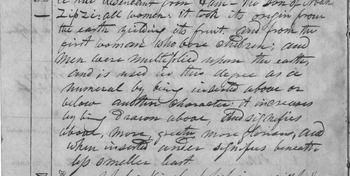
The preface to the GAEL document refers to “degrees of comparison” or “connecting parts of speech” that increase in their “signification.” Such an amplification was in fact obligatory: “in translating this character, the subject must be continued until there are as many of these connecting parts of speech used as there are connections or connecting points found in the character.”Footnote 147 Through this transformation every glyph held the potential to ramify meaning exponentially like a pedigree. Indeed, the glyph translated as “degree” (Zip Zi) refers to “all women: it took its origin from the earth yielding its fruit. And from the first woman who bore children; and men were multiplied upon the earth” (fig. 5).Footnote 148 Phelps's and Smith's interpretation of “degree,” the main actual grammatical construct of the KEP, explicitly tied it to the primal parent of the Genesis creation narrative. Signification and connection arose as metaphors for human reproduction; the precepts of grammar derived from the natality of Eve and Adam.
Gloss for Zip Zi, the glyph representing “degree,” which demonstrates its heavily genealogical character. Courtesy Church History Library, ©IRI.

The glosses for the heavily maritalized Ho oop hah best exemplify the genealogical hermeneutic of the KEP. The first degree represents “Crown of a princes[s], or unmarried queen,” while the second degree denotes a “married Queen,” the third a “widowed queen,” and the fourth a “queen who has been married the second time.” These successive stages in a princess's marital life advance toward a dramatic conclusion. In the expansive and personalized fifth degree, the authors revealed the full meaning of the glyph, which referred to
Queen Kahtoumun, a daughter of Royal female lineage or descent from her [by] whom Egypt was discovered while it was under water, who was the daughter of Ham in lineage with whom a record of the fathers was intrusted by the tradition of Ham and according to the tradition of their elders by whom also the tradition of the art of embalming was kept.Footnote 149
The glyph achieved its full scope as it tracked Kahtoumun from her status as a maiden princess, to a twice-married queen, to her full glory in the fifth degree as a corpse bearing an ancient record. (Smith elsewhere identified her as one of the mummies he purchased from Chandler.)Footnote 150 This dizzy rush of images of Eden, Egypt, family, Adam, reproduction, corpses, and ancient records describes Smith's vision of a united human family extending backward to the beginning of time. The more staid glyph Zool confirmed the genealogical extent of the KEP, directing readers of the grammar “from Abraham back to his father and from Abraham's father back to his father and so on back through the line of his progenitors.”Footnote 151 Smith and Phelps emphatically focused their attention on modes of connecting to long-dead ancestors, as exemplified by Adam and Abraham.Footnote 152
Smith's hieroglyphic journey comprehended the primordium within the ancient family, but his pure language was not solely retrospective. By returning to Eden—humanity's first parents, home, and language—the early Mormons prepared themselves for the eternities. A popular prophecy from Zephaniah (3:9) proved critical in the exegesis of this connection between Eden and the Millennium. More conservative authors like Adam Clarke saw it as a statement about orthodox religion, while Campbell saw this prediction as the promise that his new readings of scripture would overcome sectarian controversy and restore the primitive church.Footnote 153 The noted Edwardsian theologian Samuel Hopkins also believed in a common language for humanity in preparation for Christ's return as the fulfillment of Zephaniah's prophecy.Footnote 154 Swedenborg, for his part, looked forward to an angelic idiom that would replace human language in the millennial age.Footnote 155 Mormons saw the prophecy that God would “turn to the people a pure language, that they may call upon the name of the Lord” as a claim about the return of Adamic at the Millennium.Footnote 156
In an extended treatment for the church organ in 1834, Cowdery posed the question in simple terms: “Suppose that a Greek, a Roman, a Frenchman, a Spanyard, a German, an Englishman, and an Arab were to be saved by listening to the gospel of Christ; when they arrived in heaven could they understand each other? Or would the Lord have a school where they would all be taught to speak one language? And if so, what language would it be?” Reasoning from the necessity of a single language in heaven, Cowdery continued, “If then, God has power to cause all nations and languages to speak the same language, when in heaven, what is the reason that he has not power to cause the same on earth?” Specifically, Cowdery maintained that the primal language proved that God could unite humanity linguistically in the coming age, asking, “if we believe that all the earth once spoke the same language, and that was confounded by the power of God, why not believe that God has power to cause the earth to speak one language again?”Footnote 157 The Mormon evangelist Parley Pratt used the same image to proclaim the millennial freedom of Native peoples from their babel of mutually unintelligible languages.Footnote 158 Phelps placed a similar sentiment in an 1834 hymn, in which he predicted, borrowing biblical terminology, that “kindreds, tongues, and nations all” would “combine to make their numbers full” during the coming Millennium.Footnote 159 The KEP confirmed this theme, promising a message that would encompass “all the kindreds of the earth.”Footnote 160
The association of Eden's pure language with the coming age was more than simply a millenarian interpretation of a passage from Zephaniah. The Mormons believed that something sacred had happened near Eden and needed to be revisited. In an 1833 editorial, Phelps had announced that “the Spirit of God upon all flesh, will cause all to fill the place of its creation, as in the day when all was named by Adam in the garden of Eden.”Footnote 161 Eden connected believers directly to the afterlife, a point emphasized in the KEP. In an extension of beth as E beth ku ain tri eth, Phelps and Smith proclaimed Eden “a future place of existence, a place of residence beyond this earth” or “the earth in its most sanctified state as it shall be—eternity.”Footnote 162 The primordial was to be the post-mortal paradise. Eden showed the path to heaven.
Eden, broadly represented in Adam-ondi-Ahman, also signaled the familial valences of the Mormon eschaton. In the Grand River Valley, Smith revealed in a creative exegesis of Daniel's apocalyptic prophecy (Daniel 7:9–27), Adam, as the Ancient of Days, would assemble all of humanity at the site of his former deathbed to present them as a united family to the returning Messiah. Many early Latter-day Saints made explicit plans to participate in this gathering at Adam-ondi-Ahman; Smith would use this image to describe his own father's deathbed.Footnote 163 Many seized on the image of Father Adam as the Ancient of Days—several Mormons even claimed direct visits from him.Footnote 164 Over the ensuing 170 years, this image, both primordial and millennial, would focus the Saints on sanctified land, the place whose name they knew in the pure language, lending to both the distant past and anticipated future an almost physical immediacy.Footnote 165 The connection of the Millennium with Adam's return to Adam-ondi-Ahman as the father of the human family is clear in the 1836 phrase of Cowdery's brother Warren: “the period is fast approaching when time itself shall be swallowed up or as the revelator expresses it, should be no longer, when Adam and his youngest son will be contemporaries.”Footnote 166 This image of Adam standing with the most modern of his offspring is central to Smith's notion of the unified family. Father Adam would hold in his arms a nineteenth-century child, and they would be united by both common blood and language. Beside Adam's grave near the primordial garden, believers would reunite to speak together Zephaniah's pure language and embrace the coming Christ. In the Egyptian project, an Adam-obsessed grammar of pure language, Smith provided potent symbols and concepts to prepare his people for this dramatic event. Then the sectarian babel of religious pluralism would give way to domestic unity in humanity's first home. Drawing on traditions about Egypt, mummies, Eden, and hieroglyphs, Smith demonstrated to his followers the shape of things to come. Smith's mysticism, exemplified by this hieroglyphic quest, was fundamentally a form of connection, not to a community of esoteric practitioners—Smith never described any debt to hermetic predecessors—but to a human family united by language and mutual awareness, one whose members called each other by sacred and ancient names. There was simultaneously in Smith's mysticism the willful gravity of the autodidact and the confidence of the visionary. For his Egyptian project, he consulted Webster's Dictionary and standard Hebrew primers rather than philological, biblical, or classical scholarship. In the search for names, signs, and keys in the pure language, he also ignored the esoteric manuals of his European predecessors and learned peers. Instead he took in hand his Jaredites' Gazelem seerstone interpreters, his prophesied gift of seeing, and a collection of ancient papyri; and he saw.
IV. Conclusion
Though it is tempting to dismiss them as the speculative ramblings of visionary autodidacts from Western New York's burned-over district, the Kirtland Egyptian Papers both illustrate and extend familiar concepts from antebellum culture. Expressing a robust primitivism, these documents represent one attempt to unify a fractured world by deciphering the language of the Garden of Eden. This project rejected pluralism, expressing in its place a hunger to create a human family that would speak the same language in the Millennium. In simple terms, Joseph Smith wanted to know that when he and his followers met Adam, they would greet their first father in his native tongue.
In retrospect, Egyptian funeral papyri were a logical vessel for such a revelation from Smith and Phelps. Whatever his motives, the showman Chandler delivered to Latter-day Saint Kirtland relics pregnant with the mysteries of life and death, earth and heaven, origin and ending. Egypt possessed the mysteries of humanity's beginning and its transcendence of mortality; Egypt's writing system instantiated the very essence of primal language. Through this fortuitous access to a culture long associated with biblical and even human cultural origins, early Mormons found powerful symbols for their religious quest for the family of Eden, sacred names that allowed them to address the cosmos, and reassuring evidence of the magnitude of their prophet's power.
Human language, hopelessly maimed by the curse of Babel, represented a mere echo of the holy pictographic language of Adam. Without divine intervention, such language could not communicate the truths of salvation; nor could it support the society of heaven. Where more educated minds urged the abandonment of such aspirations or used the insight primarily to attack orthodox theology, Smith and Phelps pressed on. For the Latter-day Saints, the pure language, once recovered, would ground humanity in a familial web of association that extended backward to the first king and queen in Eden and forward to the coming Kingdom of Heaven, a chain of belonging created in their temples.
When the KEP are situated within American hieroglyphic culture, their religious valence becomes much clearer. The Egyptian grammar documents as an exercise are not translation in any traditional or scholarly sense. These documents are instead a hieroglyphic grammar, a prophetic, religion-making act, the metaphysical amplification of the intense meaning of Egyptian hieroglyphs per se. Poring over the tiny pictures once clutched tight to the exemplars of humanity's corpse, Phelps and Smith saw the past and future of all humankind, united in perfect harmony.