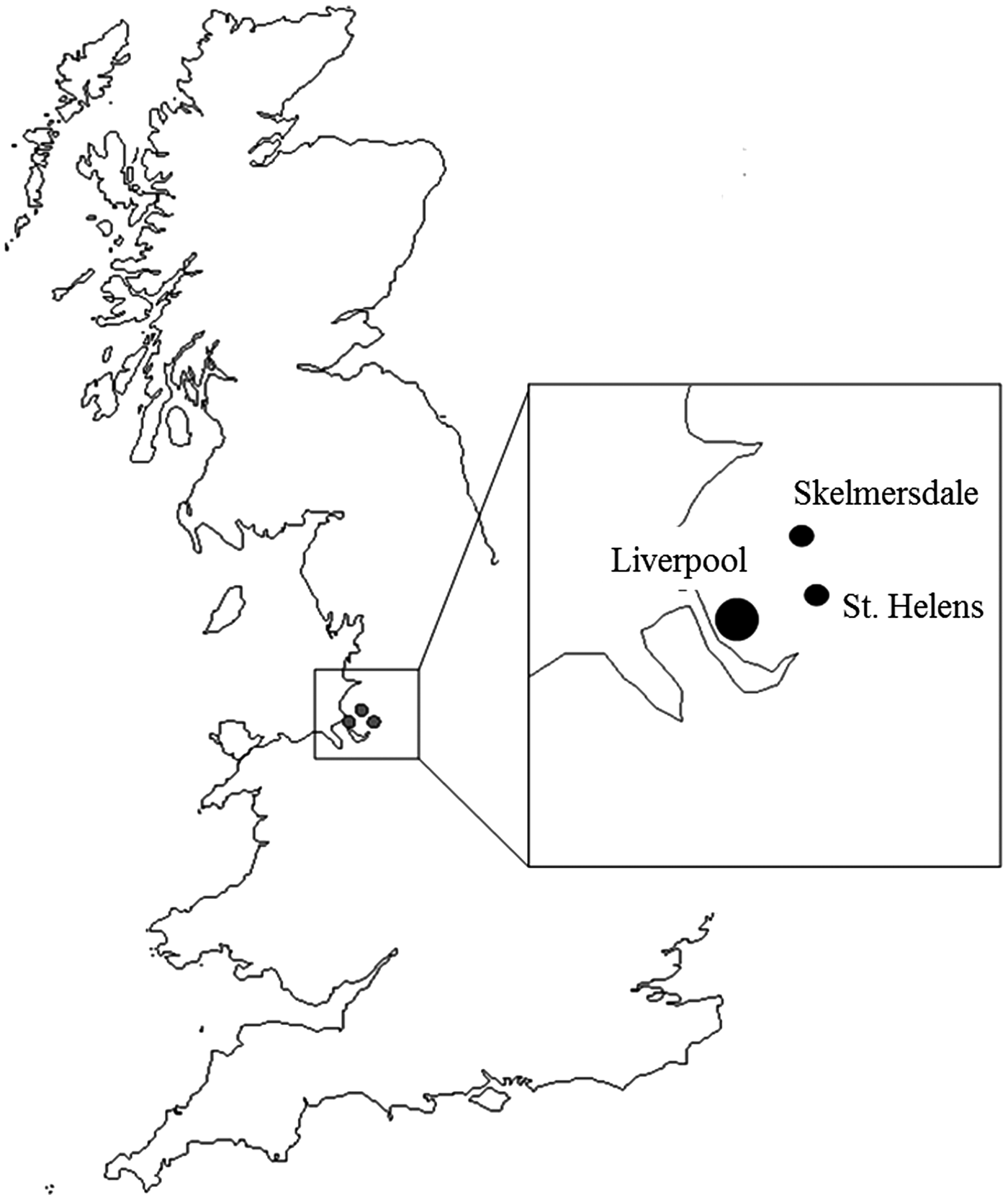
Much variationist sociolinguistic work in Britain has focused on leveling and geographical diffusion, showing, respectively, that socially and/or geographically marked features have been replaced by more unmarked forms (Trudgill, Reference Trudgill1986) and that linguistic features have spread over geographical space, typically from higher to lower population density areas (Britain, Reference Britain, Llamas and Watt2010, Reference Britain, Schreier and Hundt2013). Phonological leveling is well attested across the United Kingdom (e.g., see many of the contributions in Foulkes and Docherty [Reference Foulkes and Docherty1999]), and there have been relatively few examples of the opposite, phonological divergence from supralocal norms. One locality that has been cited as a counterexample to leveling is Liverpool (Watson, Reference Watson2006), a large urban center with a population of approximately 450,000 in the northwest of England. However, while there have been variationist sociolinguistic studies of nearby localities (e.g., West Wirral, Newbrook [Reference Newbrook1986]; Southport and Ormskirk, West [Reference West2015]) there has been as yet no large-scale variationist examination of the city of Liverpool itself. In this paper we focus on Liverpool and two smaller localities in its hinterland: Skelmersdale and St. Helens (see Figure 1). Skelmersdale, with a population of around 40,000, is located 15 miles northeast of Liverpool and is part of the neighboring county of Lancashire. It was originally an agricultural village, which grew to the size of a small town (around 6000 people) during the 19th and early 20th centuries as the coal mining industry grew. In 1961, it was selected as a site for one of the United Kingdom's New Towns, established to rehouse people from inner city Liverpool who were living in slum conditions. During the 1960s and 1970s, Skelmersdale's population increased considerably due to an influx of new residents, mainly from Liverpool. St. Helens, a medium-sized town with a population of around 100,000, is located 13 miles east of Liverpool. St. Helens is historically part of Lancashire, but it became part of Merseyside, the same county as Liverpool, in 1974, although this did not result in mass migration from Liverpool.
Location of Liverpool, St. Helens, and Skelmersdale.

The phonological characteristics of Liverpool English and the social history of these localities make this part of England a fruitful site in which to explore leveling and geographical diffusion. Liverpool English has several phonological features that are regionally restricted and socially marked, making them prime candidates for leveling. One of these features, which is the focus of this paper, is /t/ lenition. Liverpool English /t/ has a wide range of realizational variability, particularly in utterance-final position, where the following variants are possible: [t, tθ̳, θ̳, h, ʔ] (Watson, Reference Watson2007).Footnote 1 Previous small-scale studies have shown that these variants are not all equally common: Watson (Reference Watson2006, Reference Watson2007) focused on Liverpool adolescent speech and found that /t/ glottaling is infrequent, unlike elsewhere in the country where it has expanded rapidly, and instead found considerable use of [h] (e.g., ‘what’ [wɒh], ‘that’ [ðah]), a local, regionally restricted form. It is on this basis that Watson (Reference Watson2006) argued that Liverpool English is diverging from supralocal norms, but a more detailed examination of change over time is needed to confirm this. Our first question in this paper, then, is: Is Liverpool English /t/ leveling or diverging away from supralocal norms?
Some existing models of geographical diffusion (e.g., see Trudgill, Reference Trudgill1986) would predict that Liverpool features are likely to spread to Skelmersdale and St. Helens, and, at least in the case of Skelmersdale, this is likely to be facilitated by the high level of contact with Liverpool migrants in the 1960/1970s. However, in both Skelmersdale and St. Helens, the adoption of Liverpool's linguistic features may be hindered by the fact that Liverpool's accent is one of the United Kingdom's most stigmatized (e.g., see Coupland & Bishop, Reference Coupland and Bishop2007; Montgomery, Reference Montgomery2007). Our second question in this paper is: To what extent are Liverpool variants of /t/ expanding into neighboring Skelmersdale and St. Helens?
Our final question concerns whether /t/ lenition is being used in the same way as it spreads over time and across geographical space. This is an important issue, particularly when evaluating geographical diffusion, because, as Meyerhoff and Niedzielski (Reference Meyerhoff and Niedzielski2003:544) noted, before we can say that a feature has spread from place X to place Y, we need to decide whether we are truly dealing with the “same variable” in each place. To help make such a decision, the principles of comparative sociolinguistics (Tagliamonte, Reference Tagliamonte, Chambers, Trudgill and Schilling-Estes2002) are sometimes invoked, in which, for a particular feature across two or more localities, similarities or differences in the behavior of the constraints are taken as evidence for or against the feature having spread from one place to the other (Buchstaller & D'Arcy, Reference Buchstaller and D'Arcy2009; Meyerhoff Reference Meyerhoff2009). We focus on the [h] variant of /t/, because it has the most complex linguistic conditioning, and, taking our lead from Meyerhoff and Niezielski (Reference Meyerhoff and Niedzielski2003) and Britain (Reference Britain2005:996), we ask: Are the constraints operating on /t/ → [h] identical in each of our three localities?
Our questions connect to Labov's (Reference Labov2007) division between linguistic changes that are driven by transmission and those driven by diffusion. Change by transmission, according to Labov (Reference Labov2007:346), occurs between generations of the same speech community, when children “advance the change beyond the level of their caretakers and role models, and in the same direction over many generations.” With a change by transmission, a linguistic feature is expected to be reproduced in all of its structural complexity by the next generation of speakers. Change by diffusion, on the other hand, is said to be the result of contact between speech communities and the transfer of linguistic features from one community to another. As this sort of contact typically takes place between adults, Labov (Reference Labov2007:383) predicted that in cases of diffusion, “the results of language contact will be slower, less regular, and less governed by structural constraints” than in cases of change by transmission. For the localities under investigation here, this means, broadly, that in Liverpool, if /t/ lenition is increasing, via transmission, we would expect the linguistic constraints operating on it to be consistent across generations of speakers. However, if Liverpool /t/ lenition is spreading outward from Liverpool to the hinterland localities, via diffusion, we would expect the linguistic constraints to simplify in some way “en route.” We will explore these predictions further.
The paper is structured as follows. We begin by elaborating on Labov's (Reference Labov2007) division between transmission and diffusion and suggest that it would benefit from further empirical exploration. Next we show why /t/ lenition in Liverpool and its hinterland is a useful variable with which to explore phonological leveling and diffusion and Labov's claims. After describing our data, we approach it in two ways. First, we examine phonological change in Liverpool itself, addressing our first question, and, second, we examine the two hinterland localities, addressing our second question. As well as asking whether the frequency of /t/ lenition has changed both within and beyond Liverpool, we investigate whether the constraints operating on it have changed over time and/or over geographical space, addressing our third and final question.
LABOV'S (Reference Labov2007) “TRANSMISSION” AND “DIFFUSION”
Robust generalizations about how linguistic changes are transmitted from speaker to speaker, from generation to generation, and from community to community have proven somewhat elusive, partly because different changes spread in different ways. In working toward a generalization, and positing the general split between changes that progress via transmission and those that progress via diffusion, Labov (Reference Labov2007) explored two complex changes in American English: the spread of the New York City (NYC) “short-a” (or the trap vowel, to use Wells's [Reference Wells1982] lexical set terminology) and the spread of the Northern Cities Shift (NCS).
The tensing of short-a is constrained primarily by following phonological environment, with tensing before voiceless fricatives, voiced plosives, and front nasals. Added to this are a number of additional constraints: function words with simple codas are lax and content words are tense (with the exception of the lexical item can't, which is also tense); there is tensing in open syllables and no tensing in word-initial position (except in high frequency words); abbreviations usually remain lax and there are a number of further lexical exceptions that are not governed by rules. To understand what happens to the constraints operating on this change as it progresses, Labov (Reference Labov2007) first explored the diffusion of the NYC short-a system to Northern New Jersey, Albany, Cincinnati, and New Orleans, and he argued that as the change diffuses to these new communities, the complex constraints operating on it become simpler than in NYC. The following phonetic environment remains an important factor as the change diffuses to other communities, but the function word/content word constraint and the open syllable constraint are lost. This, then, is what happens during a change by diffusion: the constraints operating on a variable are simplified as it is adopted in new localities.
The NCS is complex not because it is governed by lexical and grammatical factors, but because of the intricate relationship that exists between a series of vowels that are simultaneously part of a shifting system. Labov (Reference Labov2007) argued that despite covering a huge geographical area, the constraints surrounding this shift do not change; rather the NCS seems to be the result of the incrementation of chain shifts across successive generations of speakers, all moving steadily in the same direction (Labov, Reference Labov2001). This, then, is what happens during a change by transmission: children advance the change in the same direction over many generations, with the structural complexity of the variable remaining intact.
Labov's arguments are compelling but further empirical testing would be valuable, partly because the data on which these claims are based come from the Atlas of North American English (ANAE; Labov, Ash, & Boberg, Reference Labov, Ash and Boberg2006), which sampled the speech of only two speakers from many communities. If the purpose of the exercise is simply to describe these varieties, as was the case in ANAE, then this small data pool is unproblematic. However, if the data is to be used to test claims about the diffusion of language change, we must assume that the patterns displayed by these speakers are representative of the rest of the speech community. Labov (Reference Labov2007:347) made this assumption explicit: “the view I present … is dependent upon the concept of a speech community with well-defined limits, a common structural base and a unified set of sociolinguistic norms.” One question, then, is whether Labov's claims about transmission and diffusion are supported in a larger dataset with a greater number of speakers and tokens.
Furthermore, if Labov's (Reference Labov2007) claims are robust, they should be generalizable to other linguistic changes and other communities. Labov suggested that this may be difficult because his arguments rely on exploring a sound change that is highly constrained by internal linguistic factors (Labov, Reference Labov2007:349). Next, we discuss one set of processes in the northwest of England that are indeed conditioned by a range of internal factors.
T-LENITION IN LIVERPOOL ENGLISH
Lenition is a cover term given to a set of phonological processes that, among other things, turn phonological plosives into affricates, oral fricatives, glottal fricatives, or glottal stops. Plosive lenition in Liverpool English has been reasonably well documented. The earliest account, and the first serious study of Liverpool English, is Knowles (Reference Knowles1973), which provides an overview of many of the segmental and prosodic features that characterize the Liverpool accent. Later work (Honeybone, Reference Honeybone2001; Watson, Reference Watson2007) has focused exclusively on plosive lenition in the variety. Watson (Reference Watson2007) showed that plosive lenition is more frequent for /t, d, k/ than for /p, b, g/, and that it is /t/ that has the widest range of realizations. The word but, for example, can be realized in the following ways: [bʊt, bʊtθ̳, bʊθ̳, bʊh, bʊʔ]. These variants are not all equally common, and they are also governed by different linguistic constraints. [t] and [tθ̳] occur across the board in word-initial, -medial, and -final positions; [θ̳] occurs in word-medial and -final positions; and [h] is restricted to absolute final, or prepausal, position. There are further restrictions on where [h] can occur. Knowles (Reference Knowles1973:233–234) observed that [h] was a possible variant of /t/ in a “small class of words including get, got, bit, what, that, it, not,” which has been interpreted to mean that the process is common in function words with short vowels. There has been some support for this claim, but Watson (Reference Watson2006, Reference Watson2007) showed that for adolescent speakers, [h] also occurs in polysyllabic words with an unstressed final syllable (i.e., [h] is possible in market, bucket, certificate, aggregate, but not in reset, acrobat, internet, cigarette; Watson (Reference Watson2006) also reported that [h] is possible in forgot, which has final-syllable stress). Watson (Reference Watson2006) said that this not only represents an increase in the frequency of this variant, but also an extension of the set of phonological constraints that operate on this variable for younger speakers. However, Watson and Clark (forthcoming) examined data from Liverpool speakers born at the turn of the 20th century and found a few [h] variants of /t/ in polysyllabic words, suggesting that perhaps the constraints may not have changed in the way previously reported. What is clear from the small-scale studies reported so far is that [h] seems to be constrained by a range of internal and external factors, including (1) speaker age (young speakers have been reported to use [h] more often than older speakers), (2) utterance position ([h] has been said to occur only in prepausal position), (3) lexical frequency (high-frequency words have been said to favor [h]), (4) vowel length (in monosyllabic words, [h] is more common following a short vowel than a long vowel), and (5) vowel stress (in polysyllabic words, [h] is more common following an unstressed vowel).
/t/ lenition is a useful variable for examining claims about phonological leveling in the region. The [tθ̳, θ̳, h] variants of /t/ are prime candidates for leveling: Liverpool English has low prestige overall, and these lenited variants are said to be used more by working-class than middle-class speakers (Knowles, Reference Knowles1973), indicating they have the potential to be socially marked. In addition, they are rarely reported to occur outside of Liverpool, so they are also regionally marked. Labov's distinction between linguistic changes that spread by transmission and those that spread by diffusion can be usefully explored by focusing on the [h] realization of /t/, because it is governed by a complex suite of internal and external factors. If the [h] variant is increasing in Liverpool, as has been suggested in previous work, then we would expect the constraints operating on this feature to remain stable over time, in line with Labov's predictions about changes by transmission. If the [h] variant is spreading from Liverpool to neighboring localities, as we can predict if changes spread from higher to lower population density areas, then we would expect the constraints to simplify, in line with Labov's predictions about changes by diffusion.
THE ORIGINS OF LIVERPOOL ENGLISH CORPUS
OLIVE
The data analyzed in this paper comes from the Origins of Liverpool English corpus (OLIVE; see Watson & Clark, Reference Watson, Clark and Hickeyforthcoming), which is a fully time-aligned collection of recordings of speakers from Liverpool, Skelmersdale, and St. Helens. There are three age cohorts for each locality in the corpus, split into subcorpora: the “Archive” subcorpus has speakers born between 1890 and 1943, the “Older” subcorpus has speakers born between 1918 and 1945, and the “Younger” subcorpus has speakers born between 1992 and 1994. This means that OLIVE contains speech data spanning over 100 years of apparent time. The archive subcorpus consists of oral history recordings, while the older and younger subcorpora consist of conversational data obtained using a sociolinguistic interview methodology and read speech from an elicitation task in which speakers read aloud a series of passages containing dialect words, before commenting on their familiarity with the words.
Identifying /t/ lenition in OLIVE
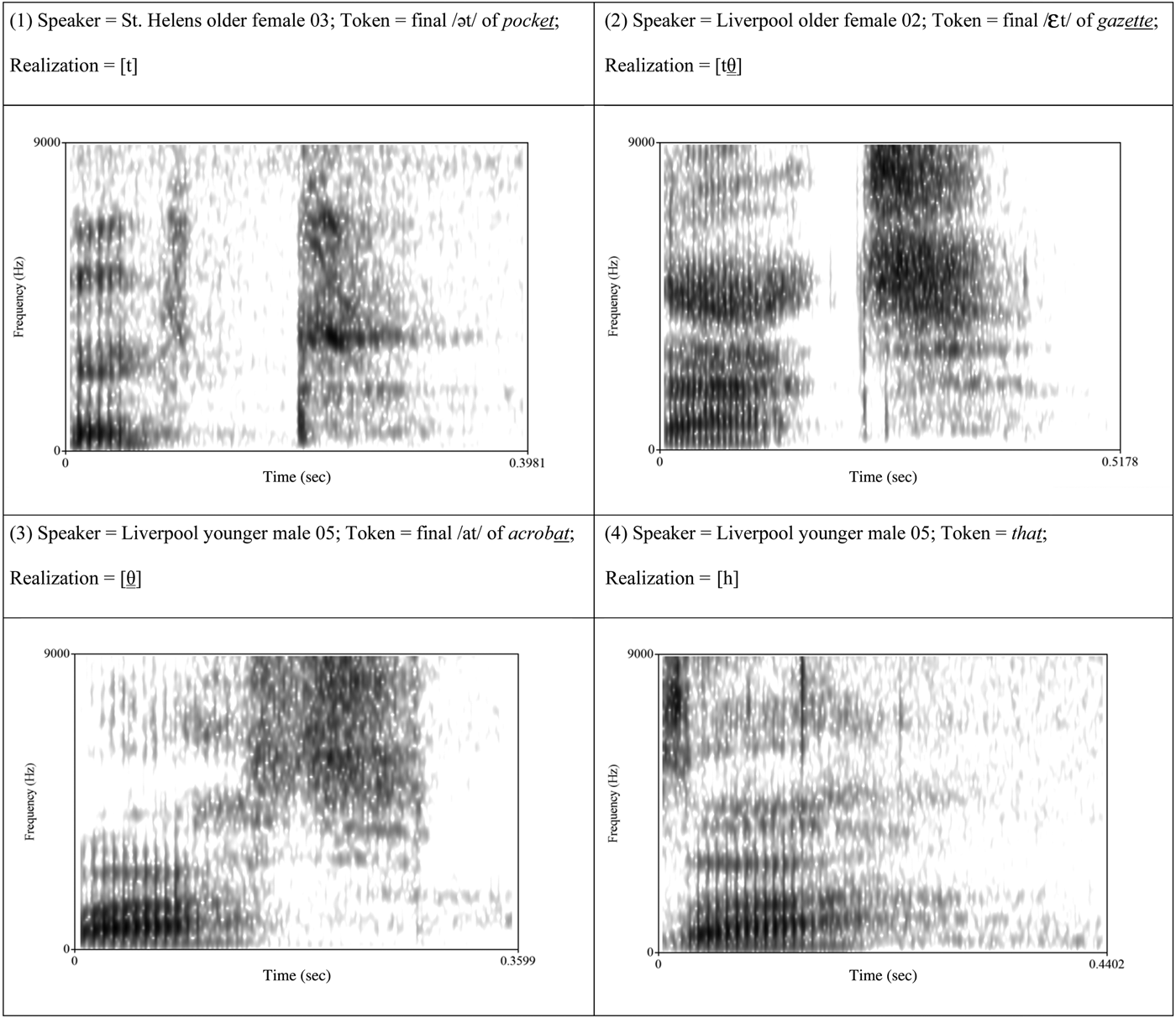
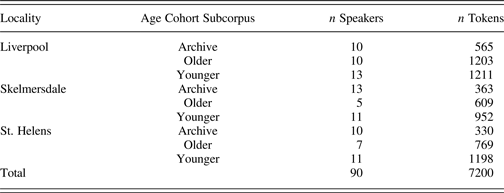
All instances of postvocalic, prepausal /t/ were extracted from OLIVE and coded by hand as one of the following realizations: [t], [tθ̳], [θ̳], [h], or [ʔ]. Coding decisions were based on an auditory analysis that was verified by visually inspecting the spectrogram of each token. A token was coded as [t] if it had a visible closure period and release burst (Figure 2, example (1)), and as [tθ̳] if an extended period of oral friction was present, following the stop gap (Figure 2, example (2)). A token was coded as [θ̳] if there was no stop gap but clear aperiodic noise in the higher frequency range (Figure 2, example (3)), and as [h] if periodic noise was present but more diffuse (Figure 2, example (4)). For [ʔ], there is a wide range of realizational variation (see Docherty & Foulkes, Reference Docherty and Foulkes1999) and no single acoustic signature pattern. A typical pattern for [ʔ] was a period of creaky voice. A token was coded as [ʔ] if there was no indication of oral release (i.e., high frequency noise representing aspiration or friction near the alveolar ridge) and no sign of glottal friction. Canonical tokens for [t, tθ̳, θ̳, h] are shown in Figure 2. Problematic tokens (e.g., situations with a high level of background noise) were selected for special attention and if both authors disagreed on the realization of the variant, the token was discarded from the analysis. This resulted in a data set of 7200 tokens of postvocalic, prepausal /t/ from three age groups across the three communities (see Table 1).
Canonical tokens of (1) [t], (2) [tθ̳], (3) [θ̳], and (4) [h].
Number of speakers and tokens of postvocalic, prepausal /t/ from each subcorpus
/t/ lenition in liverpool and its hinterland
Change over time in Liverpool English
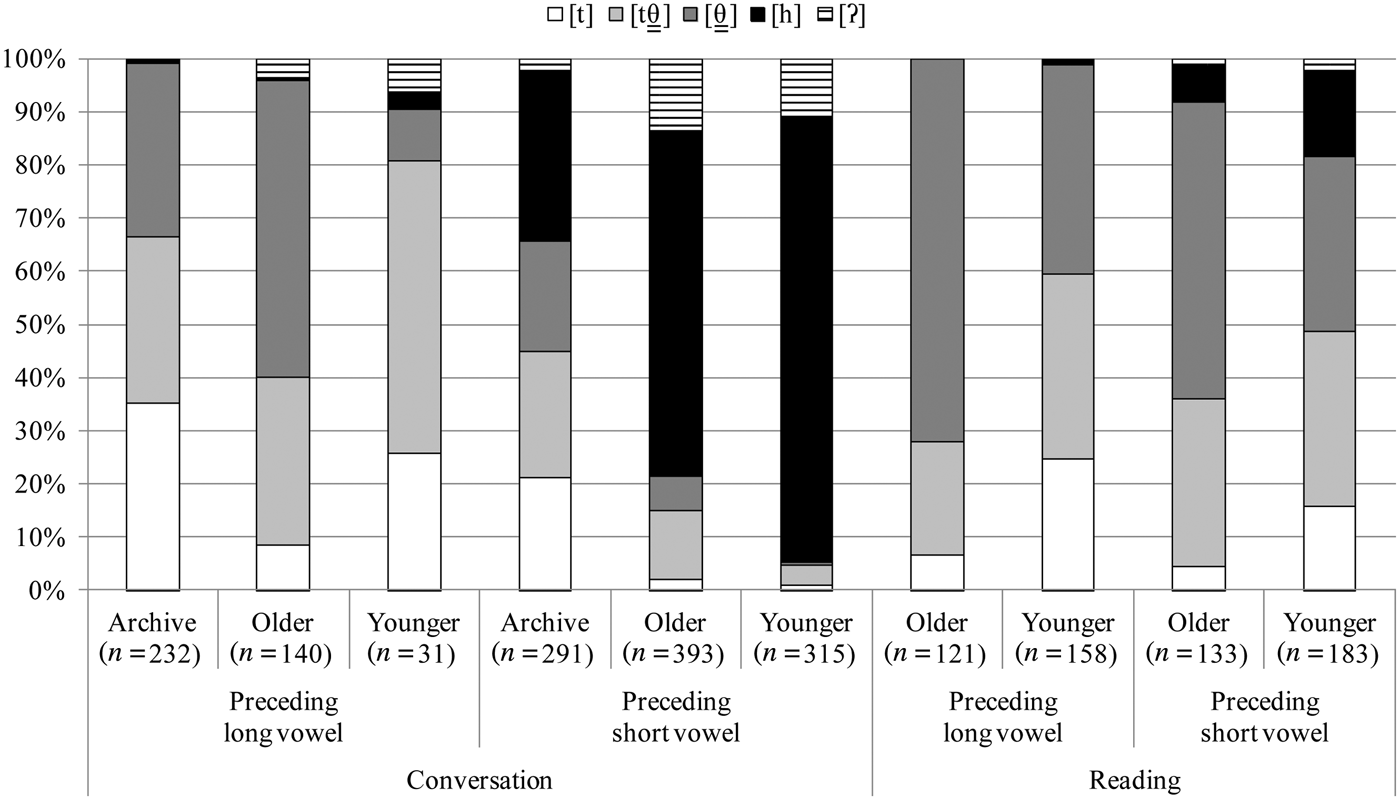
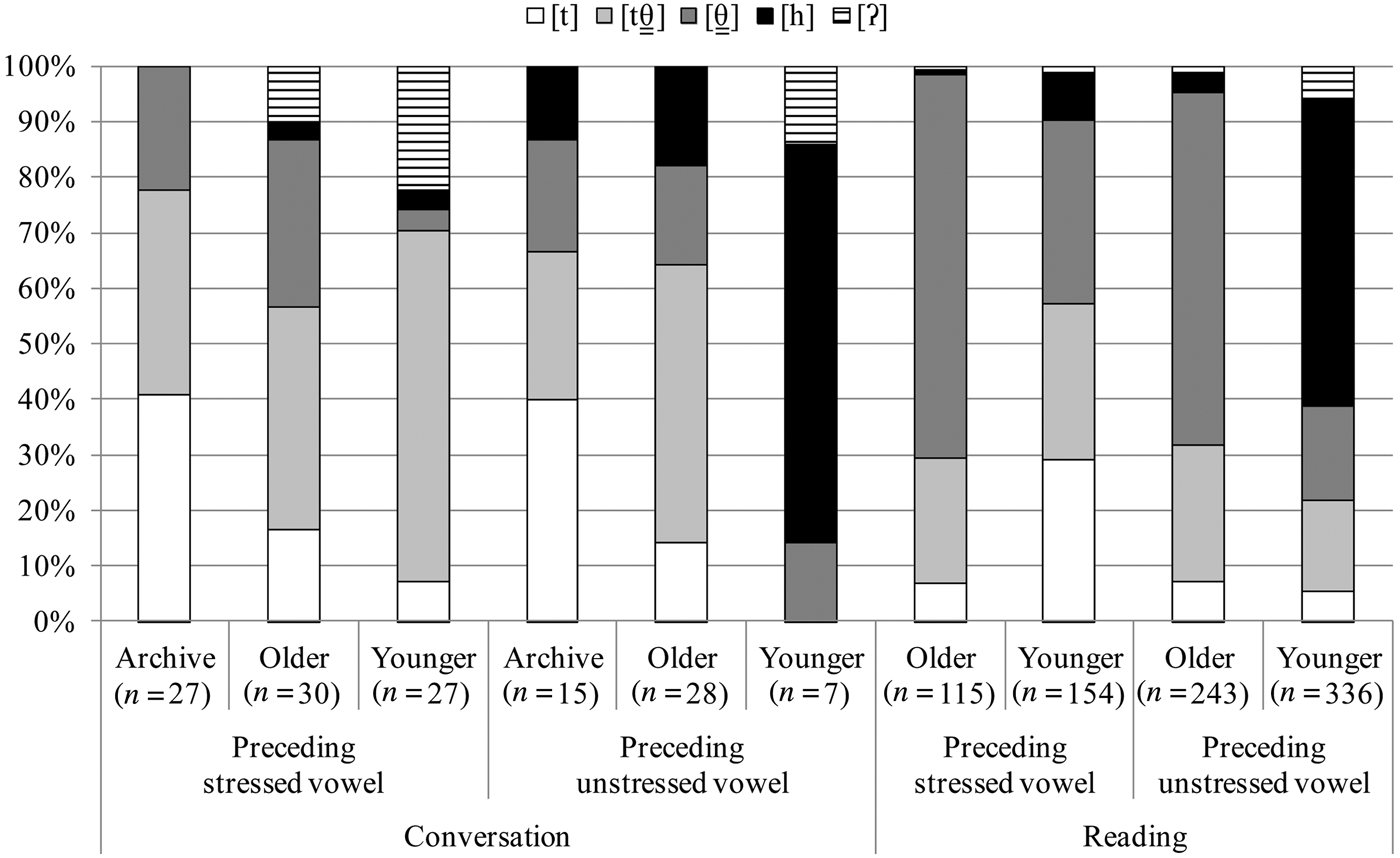
Our first question is: Is Liverpool English /t/ leveling or diverging away from supralocal norms? Figure 3 charts the variants of postvocalic, prepausal /t/ in monosyllabic words in Liverpool over the three different generations in OLIVE, in conversational and read speech. Supporting the observations of Knowles (Reference Knowles1973), the [h] variant is almost completely absent in monosyllabic words with long vowels. In monosyllabic words with short vowels, [h] appears to have increased over time, particularly between the archive and older age groups, and is much more common in conversational than read speech. The [tθ̳] and [θ̳] variants are not subject to the same constraints as [h]: they appear following long and short vowels and are not disfavored in read speech. Variants [tθ̳] and [θ̳] have reduced over time in the environment following a short vowel, where [h] has increased. In the contexts where [h] is less likely—following a long vowel and in read speech—[tθ̳] and [θ̳] are used frequently across the age groups. The [ʔ] variant is more common than reported in Watson (Reference Watson2006), but remains infrequent.
Variants of postvocalic, prepausal /t/ in monosyllabic words in Liverpool,n = 1997.
Polysyllabic words are plotted separately, in Figure 4, both for clarity and because they are reported to be conditioned by slightly different constraints. Supporting the observations of Watson (Reference Watson2006), the [h] variant is almost entirely prohibited in words with a final stressed syllable, but it is possible in unstressed syllables. There is also evidence of change over time, with the younger age group using [h] more frequently than the archive and older groups. However, while younger speakers use [h] more often than previous generations, it seems to be conditioned by stress in the same way over time.
Variants of postvocalic, prepausal /t/ in polysyllabic words in Liverpool, n = 982.
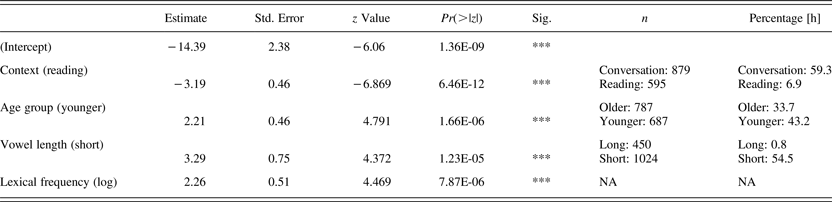
In order to fully understand the constraints operating on the [h] realization of /t/ in Liverpool, and the extent to which they have changed or remained stable over time, we fit binomial mixed effects regression models to the data by hand using the lme4 package in R (Baayen, Davidson, & Bates, Reference Baayen, Davidson and Bates2008). The dependent variable was /t/ realized as [h] (compared with other variants combined, i.e., “not [h]”). All models included the following fixed effects: the log lexical frequency of the token in which /t/ was present, speech style (conversation, reading), speaker sex (male, female), and speaker age group (archive, older, younger). In models that included speech style, it was not possible to include the archive speaker group because there is no read speech in the archive subcorpus. Separate models were fit to monosyllabic and polysyllabic words, because overlapping but ultimately slightly different fixed effects were required, in addition to those mentioned. Models for polysyllabic words included a fixed effect for the stress of vowel preceding the /t/ (stressed and unstressed, distinguishing between words such as reset and market, respectively), because of the previous observations, and the results in Figure 4, that [h] has increased in polysyllabic words with an unstressed final syllable. As monosyllabic words are all lexically stressed, they were instead coded for the length of the vowel that preceded the /t/ (long and short, distinguishing between words such as quite and what, respectively), because of the long-standing observation, and the results in Figure 3, that in monosyllabic words, [h] is more common following a short vowel. We began with models that included speaker and word as random intercepts (see Johnson, Reference Johnson2009), and each of the previously mentioned factors as fixed effects. Interactions between the fixed effects were also tested. When speech style or any of the linguistic factors were included in a model as fixed effects, they were also included as random slopes for speaker, which allows fixed effects to vary by individual (see Barr, Levey, Scheepers, & Tily, Reference Barr, Levy, Scheepers and Tily2013). Fixed effects/interactions that failed to reach significance were removed both as a fixed effect and random slope and the model was rerun. When a factor was removed, the model with its presence was compared with the model with its absence, using Akaike information criterion, Bayesian information criteria, and analysis of variance. The better or simpler model was kept.
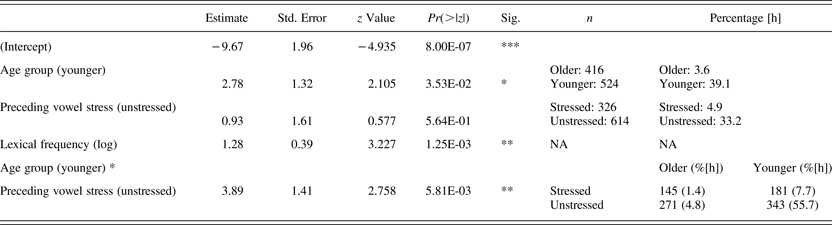
First, we examine the Liverpool data, using mixed-effects regression models to test for an interaction between the linguistic factors mentioned and speaker age group. This allows us to explore whether the constraints operating on [h] are consistent over time in this locality. If the constraints behave in the same way over time, as predicted by Labov's account of changes by transmission, we expect to find either no significant interaction between the linguistic factors in the model and speaker age group, or a significant interaction in which the direction of the effect is the same but the size of the effect is different. We fit mixed-effects regression models to the conversation and reading data combined and excluded the archive speakers.Footnote 2 The results are presented in Table 2 (for monosyllabic words) and Table 3 (for polysyllabic words).
Fixed effects for final model of monosyllabic words in Liverpool conversational and read speech in two age groups (older and younger speakers), n = 1474
Fixed effects for final model of polysyllabic words in Liverpool conversational and read speech in two age groups (older and younger speakers), n = 940
Table 2 presents the significant fixed effects that were retained in the final model of monosyllabic words.Footnote 3 The negative value in the estimate column for speech style indicates that the [h] variant of /t/ is less likely to occur in read speech than in conversational speech, and the positive estimates for age group, preceding vowel, and lexical frequency indicate that [h] is more likely in younger speakers than in older speakers, in monosyllabic words with a short vowel than in those with a long vowel, and in words of higher lexical frequency. Speaker sex was not significant. Although age group was a significant main effect and so is retained in the final model, there was no significant interaction between age group and any of the other factors. This suggests that the behavior of the linguistic constraints operating on [h] in monosyllabic words is consistent over time in Liverpool.
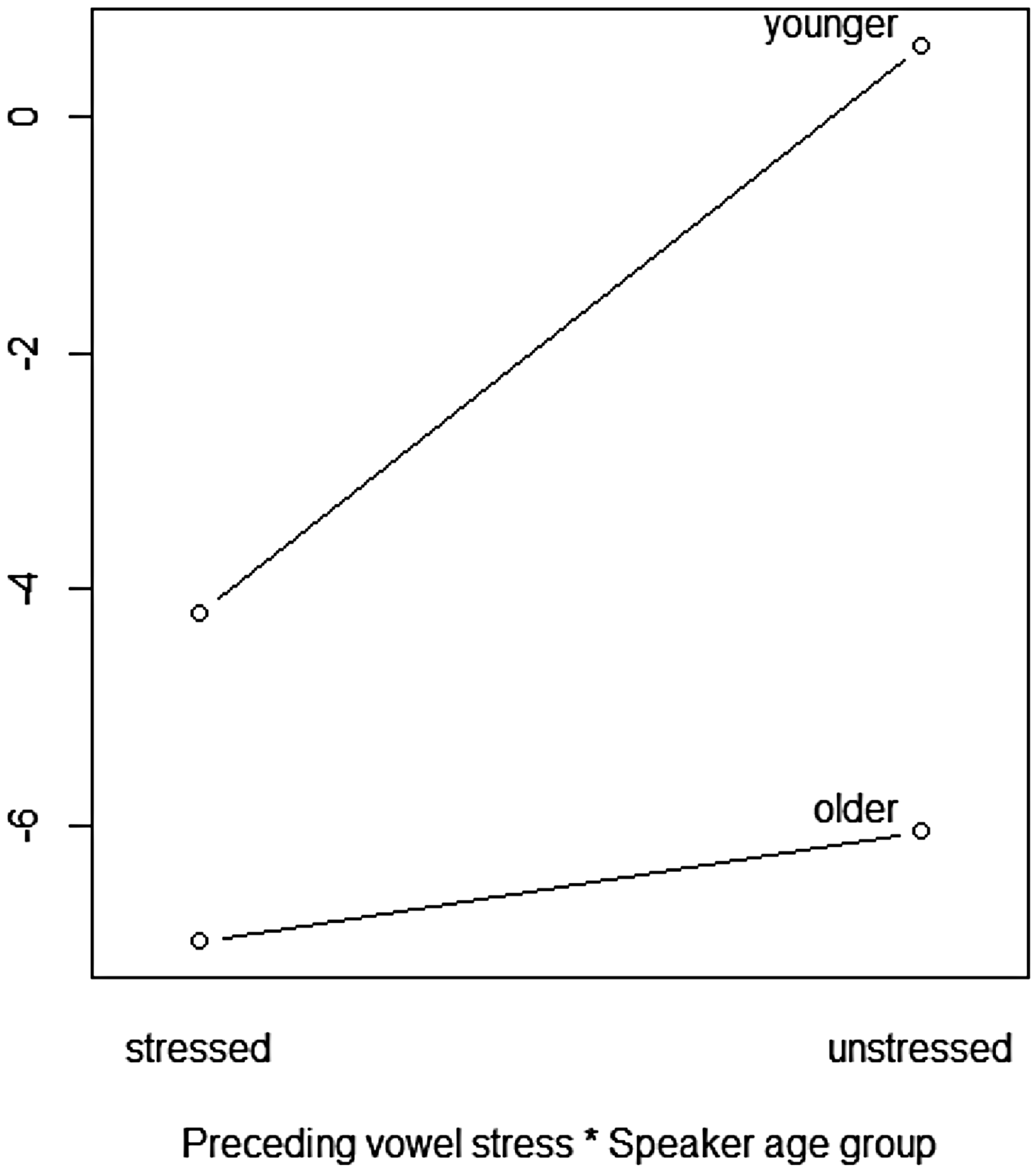
Table 3 presents the significant fixed effects that were retained in the final model of polysyllabic words. Like with monosyllabic words, the [h] variant of /t/ is more likely to occur in younger speakers than in older speakers, and in words of higher lexical frequency, as shown by the positive estimates for these factors. There was a significant interaction between age group and the stress of the preceding vowel, which is plotted in Figure 5. It shows that the effect works in the same direction for both older and younger speakers: [h] is more common following an unstressed vowel (e.g., market) than following a stressed vowel (e.g., reset). The effect is larger for younger speakers than for older speakers. As for monosyllabic words, then, the constraints on [h] in polysyllabic words are operating in the same way over time.
The models' predictions of the interaction between speaker age group and the stress of the preceding vowel (stressed vs. unstressed, as in, e.g., reset vs. market, respectively). This plot comes from the model presented in Table 3.
In the Liverpool dataset, then, there is little evidence of the phonological leveling of regionally restricted variants of utterance-final /t/, or of the adoption of other supralocal variants: [tθ̳] and [θ̳] are robustly present across the dataset, and the use of the glottal stop is vanishingly low. For [h], the results support the claims in the literature: this variant is conditioned by lexical frequency, by vowel length in monosyllabic words, and by syllable stress in polysyllabic words. It is also increasing over time, again suggesting that leveling is not underway. As the constraints operating on [h] are consistent over time, the results also support Labov's (Reference Labov2007) claims about the transmission of linguistic changes through a speech community.
Change over time in Skelmersdale and St. Helens
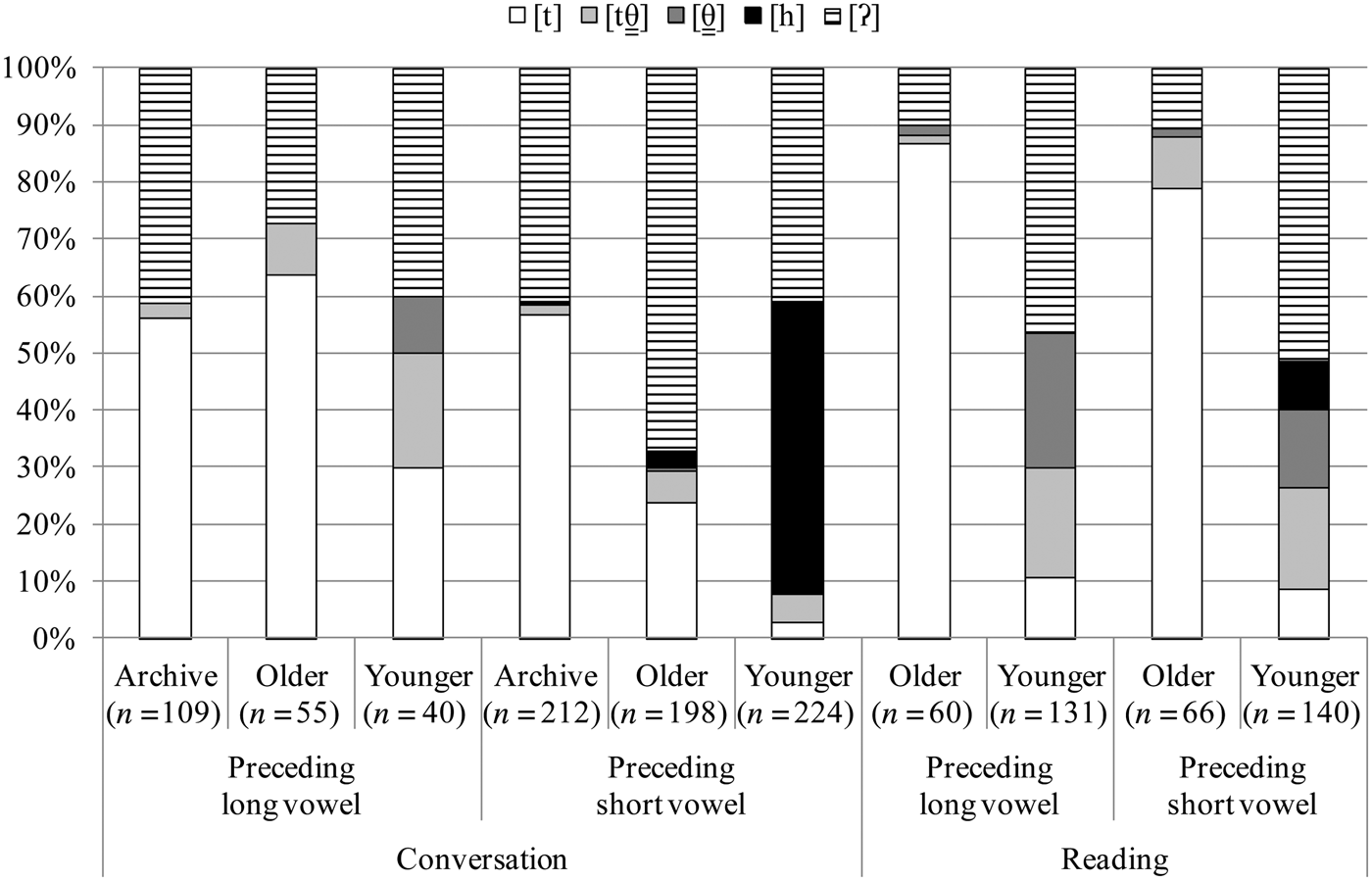
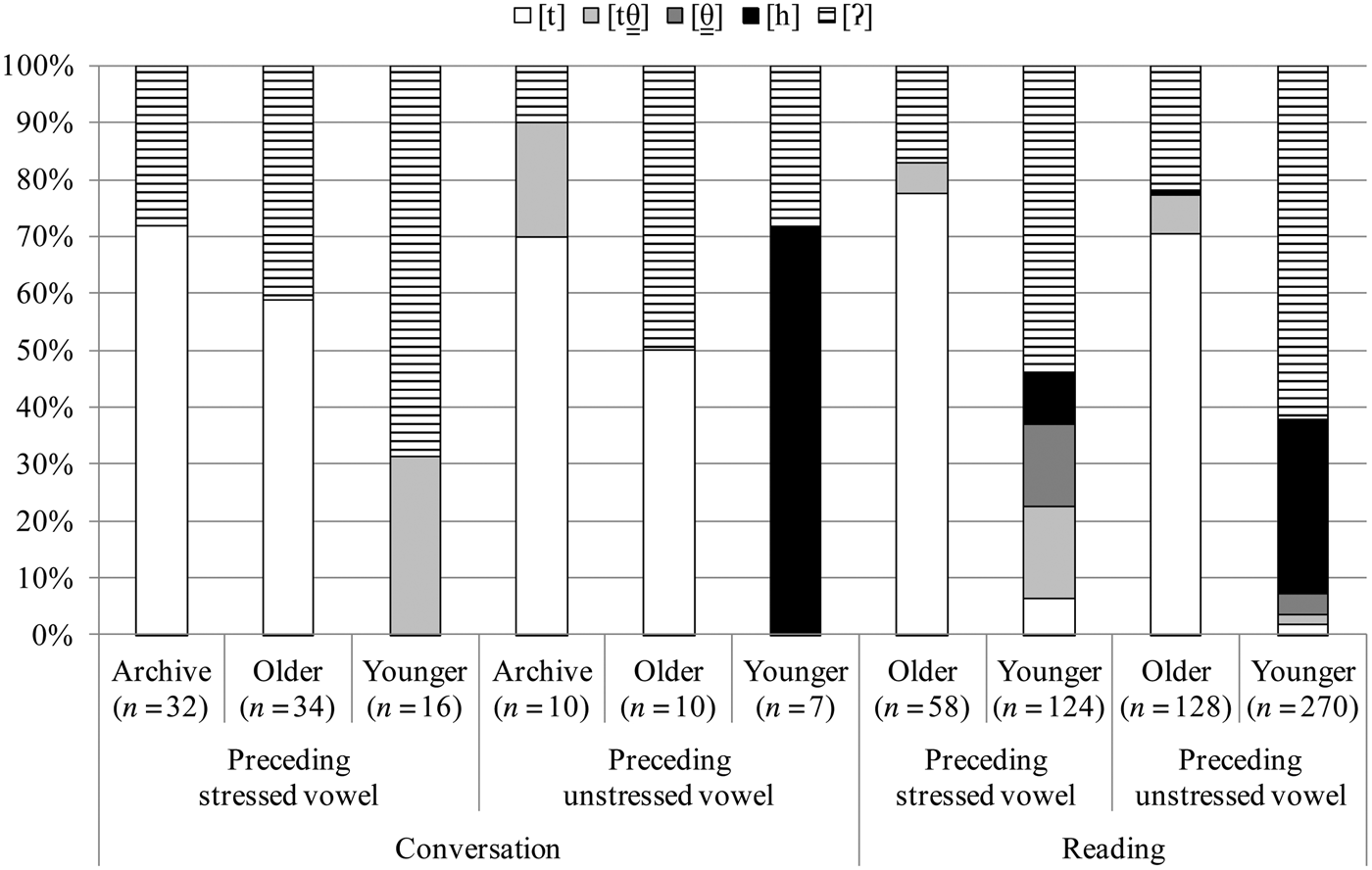
Our second question is: To what extent are Liverpool variants of /t/ expanding into neighboring Skelmersdale and St. Helens? Figures 6 and 7 chart the variants of postvocalic, prepausal /t/ in monosyllabic and polysyllabic words, respectively, in Skelmersdale over the three generations in OLIVE. One clear difference between the realization of utterance final /t/ in Skelmersdale and Liverpool is the high frequency of occurrence of the glottal stop in Skelmersdale. This is consistent with what we know about the increase of the glottal stop elsewhere in Britain, although in Skelmersdale the glottal stop is attested even in the archive speakers, so it does not seem to be a recent innovation. However, with the other variants there is a more abrupt change: the younger speakers use a much greater range of lenited variants, particularly [h]. Recall that Skelmersdale experienced an influx of settlers from Liverpool in the 1960s. The oldest Skelmersdale speaker in the Older subcorpus was born in 1945 and would have been a young adult at the time of the arrival of people from Liverpool. Before this, there is little evidence of Liverpool features in Skelmersdale. The frequent occurrence of these forms in the younger speakers is thus not a gradual change over several generations as it is in Liverpool, but instead in Skelmersdale, [h] seems to have been adopted within a single generation as a result of dialect contact.
Variants of postvocalic, prepausal /t/ in monosyllabic words in Skelmersdale, n = 1235.
Variants of postvocalic, prepausal /t/ in polysyllabic words in Skelmersdale, n = 689.
It is not only the frequency of lenited variants of /t/ which means that on average the Skelmersdale younger speakers align more closely with Liverpool speakers than with older speakers from their own community. The [h] variant of /t/ in Skelmersdale also seems to be constrained in the same way as in Liverpool: in monosyllabic words it is more likely following a short than a long vowel, and in polysyllabic words it is more likely following an unstressed than a stressed vowel, although the low token numbers here, particularly in the conversational speech, must be acknowledged.
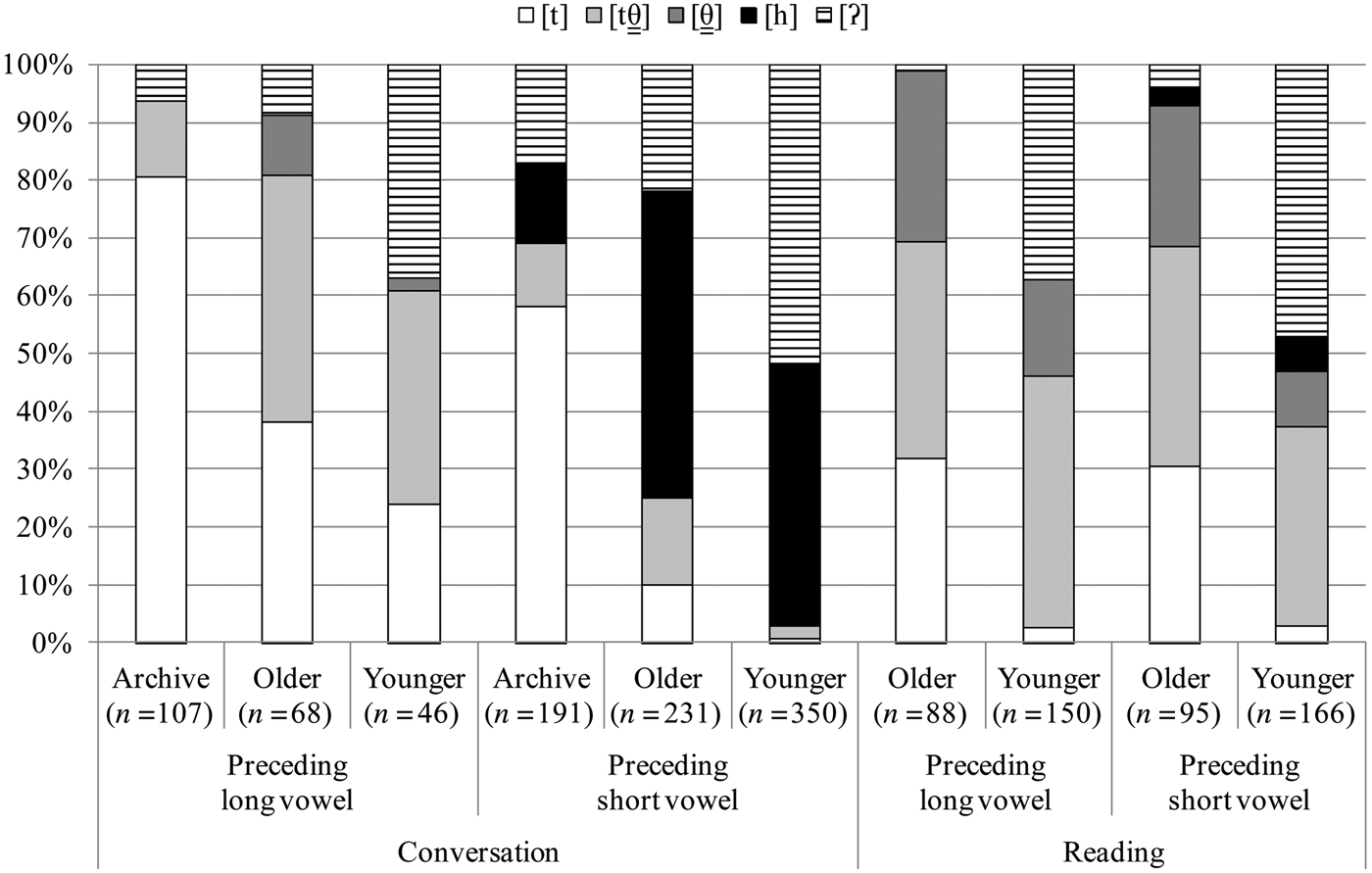
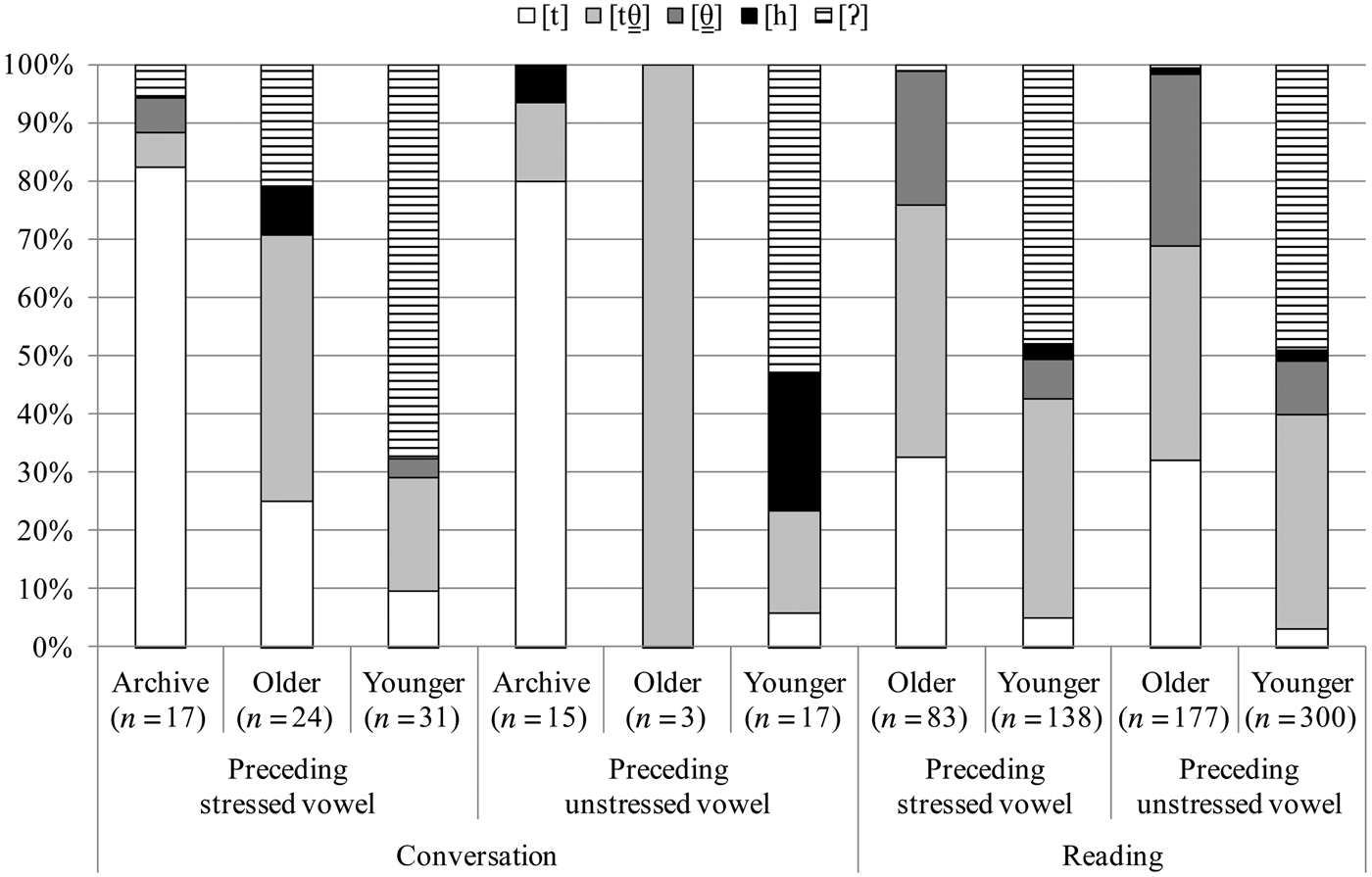
Figures 8 and 9 chart the variants of postvocalic, prepausal /t/ in monosyllabic and polysyllabic words, respectively, in St. Helens. As in Skelmersdale, we see the glottal stop being used much more frequently in St. Helens than in Liverpool. The other lenited variants are more frequent in the archive and older groups in St. Helens than in Skelmersdale, but, unlike in Skelmersdale, appear to be recessive in the St. Helens younger speakers, as they are replaced by the glottal stop. The [h] variant seems to be conditioned in the same way in St. Helens as in the other localities: in monosyllabic words it is more common following a short vowel, and in polysyllabic words it is more common following an unstressed vowel, although again the problem of low token numbers for polysyllabic words should be acknowledged. The token number problem is more severe for St. Helens than for Skelmersdale, because in St. Helens there are hardly any tokens of [h] at all in the reading style, considerably reducing the size of the dataset.
Variants of postvocalic, prepausal /t/ in monosyllabic words in St. Helens, n = 1492.
Variants of postvocalic, prepausal /t/ in polysyllabic words in St. Helens, n = 805.
In summary, Skelmersdale and St. Helens do have features typically considered to be characteristic of Liverpool, but to varying degrees. The Liverpool variants [tθ̳, θ̳, h] are longer established in St. Helens, where they are present across our age cohorts, than in Skelmersdale, where they appear only in younger speakers. The glottal stop is more frequent in the archive and older speakers in Skelmersdale than in St. Helens, but the younger speakers in each locality are more similar to each other because while the glottal stop in St. Helens continues to increase in frequency over time, in Skelmersdale it is slowed down by younger speakers' use of [h]. As far as leveling and geographical diffusion are concerned, these patterns are somewhat complex. In St. Helens the variants [tθ̳, θ̳, h] are present in the archive and older speakers, meaning that if they did diffuse from Liverpool, it happened a reasonably long time ago and is not a recent innovation. Moreover, the increase of the glottal stop in St. Helens, presumably via geographical diffusion from a different direction (i.e., not Liverpool), is leading to the leveling of the other lenited variants. In Skelmersdale we see the presence of the glottal stop for a reasonably long time, which reduces in frequency in the speech of the young, at the same time as the appearance of Liverpool features driven by dialect contact.
Focusing on /t/ to [h]
Our third question is: Are the constraints operating on /t/ → [h] identical in each of our three localities? We focus on [h] because it is the most complex variant in terms of its linguistic conditioning. So far we have been somewhat tentative in saying that [h] behaves in the same way in each locality. In order to examine this more systematically, we attempted to fit binomial mixed-effects models to monosyllabic words and polysyllabic words and tested for an interaction between locality and each of the other factors mentioned. Generating full models that reached convergence was not always possible, typically because of the unbalanced distribution of [h] tokens across the localities and age groups. As we showed, in Liverpool and St. Helens, [h] is present across the age groups to a reasonable extent: Liverpool: 879 [h] tokens, with 11% from the archive speakers, 32% from the older speakers, and 57% from the younger speakers; St. Helens: 339 [h] tokens, with 8% from the archive speakers, 38% from the older speakers, and 54% from the younger speakers. But in Skelmersdale, [h] tokens appear almost exclusively in one age group (232 [h] tokens, with 97% from the younger speakers). It therefore makes little sense to ask whether the constraints on [h] are consistent over time in Skelmersdale, so instead we examine whether the younger speakers in each of the three localities use [h] in a similar way.
Table 4 presents the model's predictions for monosyllabic words. Locality was not significant, so it was removed from the final model. The significant fixed effects were in line with those discussed for Liverpool, from the model presented in Table 2: [h] is disfavored in read speech, and is favored following a short vowel and in high frequency words. This shows that, for monosyllabic words, [h] is constrained in the same way in each of our three localities.
Fixed effects for final model of monosyllabic words in younger speakers in Liverpool, Skelmersdale, and St. Helens, n = 1934
Fitting a model to polysyllabic words was more challenging, because of the low token numbers overall, and the particularly low numbers of [h] in St. Helens (Liverpool: 524 tokens in total, 39% [h]; Skelmersdale: 417 tokens in total, 24% [h]; St. Helens: 486 tokens in total, 3% [h]). A model of the data from younger speakers from each of the three localities, which included an interaction between locality and the fixed effects, did converge, but the predictions for St. Helens are nevertheless still based on just 14 tokens of [h], which is too low to make confident generalizations. For this reason, we excluded St. Helens and fit a model to the Liverpool and Skelmersdale data.
Table 5 presents the significant fixed effects that were retained in the final model of polysyllabic words. The positive estimates for preceding vowel stress and lexical frequency show that [h] is more likely in words with unstressed final syllables and in high frequency words. Locality was not significant either as a main effect or as an interaction with any of the other factors in the model, indicating that overall there is no difference between Liverpool and Skelmersdale in terms of how [h] operates in the speech of the young. As with the monosyllabic words across all three localities, polysyllabic words are constrained in the same way, overall, in Liverpool and Skelmersdale.
Fixed effects for final model of polysyllabic words in younger speakers in Liverpool and Skelmersdale, n = 941
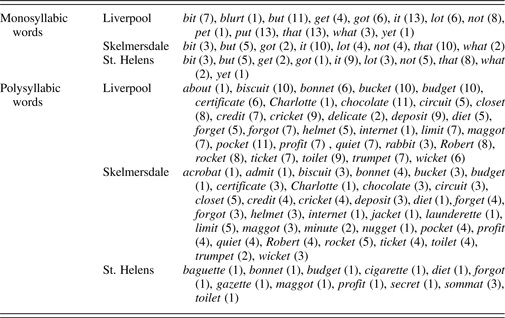
To understand more about the patterns in St. Helens, outside of regression modeling, we examined the individual lexical items in which [h] occurred, which are listed in Table 6 along with those words from the other localities. A word is included in Table 6 if it was used with [h] by at least one speaker at least once, although many of the words occurred multiple times. The number in brackets following each word is the number of speakers who used [h] in the word at least once.
The lexical items in which [h] occurs in Liverpool, Skelmersdale, and St. Helens
The monosyllabic words are clearly very similar in each of the three localities—every monosyllabic word that occurs with [h] in either Skelmersdale or St. Helens also occurs with [h] in Liverpool. The effect of vowel length, where [h] is favored following a short vowel, as shown in the regression models, is also evident in Table 6: all but one of the monosyllabic words have short vowels, and the one that does not (blurt; a Liverpool word meaning “fool”) is spoken by just one speaker (and in fact there is just one single token in the whole dataset). We can be confident, then, that [h] is a possible variant of /t/ in a very similar set of monosyllabic words in Liverpool, Skelmersdale, and St. Helens.
There is less consistency with the polysyllabic words. There are fewer word types with [h] in St. Helens than in Skelmersdale or Liverpool, as was likely given the lower number of [h] tokens. Where [h] does occur, the constraint whereby it is more likely following an unstressed vowel, shown herein to be statistically significant in Liverpool and Skelmersdale, does not seem to be particularly clear in St. Helens: a third of the words which allow [h] in St. Helens have primary stress on the final syllable (baguette, cigarette, forgot, gazette), and only one of these (forgot) appears with [h] in Liverpool. So, although St. Helens could not be included in our regression model of polysyllabic words, there is evidence to suggest that [h] behaves differently here than in Liverpool, certainly with respect to frequency of occurrence—[h] is now much less common in St. Helens—but also, more tentatively, in terms of the constraints operating on it. In Skelmersdale the number of word types with [h] are similar to Liverpool (Skelmersdale: 34; Liverpool: 31), and the tendency for these words to have unstressed final syllables is clearer than it is in St. Helens, although the effect is not categorical as [h] does occur in words with primary or secondary stress on the final syllable (in 6 words: acrobat, admit, forget, forgot, internet, launderette). Three of these words occur with [h] in Liverpool—two regularly (forget, forgot) and one less often (internet). The three words that appear with [h] in Skelmersdale but not in Liverpool (acrobat, admit, launderette) are spoken by the same Skelmersdale speaker. So, while it is no surprise that the regression model does not find a significant difference between Liverpool and Skelmersdale in how preceding stress conditions [h] overall, there is an intriguing indication that some speakers may have different constraints on [h], even if that difference is not widespread enough across the Skelmersdale dataset to mean locality is a significant fixed effect in our models.
To summarize, the results from the regression models suggest that [h] is used in the same way across localities. That is, the constraints are consistent over geographical space and do not simplify, as Labov (Reference Labov2007) hypothesized. However, a close examination of the polysyllabic words used with [h] suggested there may be differences between individual speakers that are not clearly identified by the statistical models. Before we revisit Labov's hypothesis about geographical diffusion, we will explore the individual speaker patterns further.
INDIVIDUAL SPEAKERS AND /t/ to [h]
Typically in variationist sociolinguistics the emphasis has been placed on understanding patterns of variation and change at the community level, partly because “it is often assumed, tacitly if not explicitly, that the individual and the group are one and the same … under this assumption, data are presented for a set of speakers as if they were a homogeneous group” (Wolfram & Thomas, Reference Wolfram and Thomas2002:161). A recent approach to exploring individual speaker variation is to inspect a speaker's random intercept from a mixed-effects regression model (Drager & Hay, Reference Drager and Hay2012). When speaker is included as a random effect in a model, as is the case in all the models presented in this paper, each individual is assigned a value (the random intercept) that is based on how much unexplained variance there is for that speaker in the model. A positive value for a particular speaker would indicate they are more likely to use the variant than is being predicted for them by the model, while a negative value would indicate they are less likely to use the variant. Drager and Hay (Reference Drager and Hay2012) argued that it can be useful to inspect these values because they can help us to identify which speakers are deviating from the model's predictions, and so can be used as a window on the relationship between the individuals and the group. Drager and Hay (Reference Drager and Hay2012) showed that individual speakers with the lowest intercepts (i.e., those who are less likely to use a particular variant than others in the community) were more likely to demonstrate a rejection of the social norms of the group in sociolinguistic interviews, while those with the highest intercepts were more likely to be those who contributed to the construction of those norms. This is an interesting approach because the model takes into account the included fixed effects and calculates the speaker's intercept above and beyond this information (see also Johnson, Reference Johnson2014).
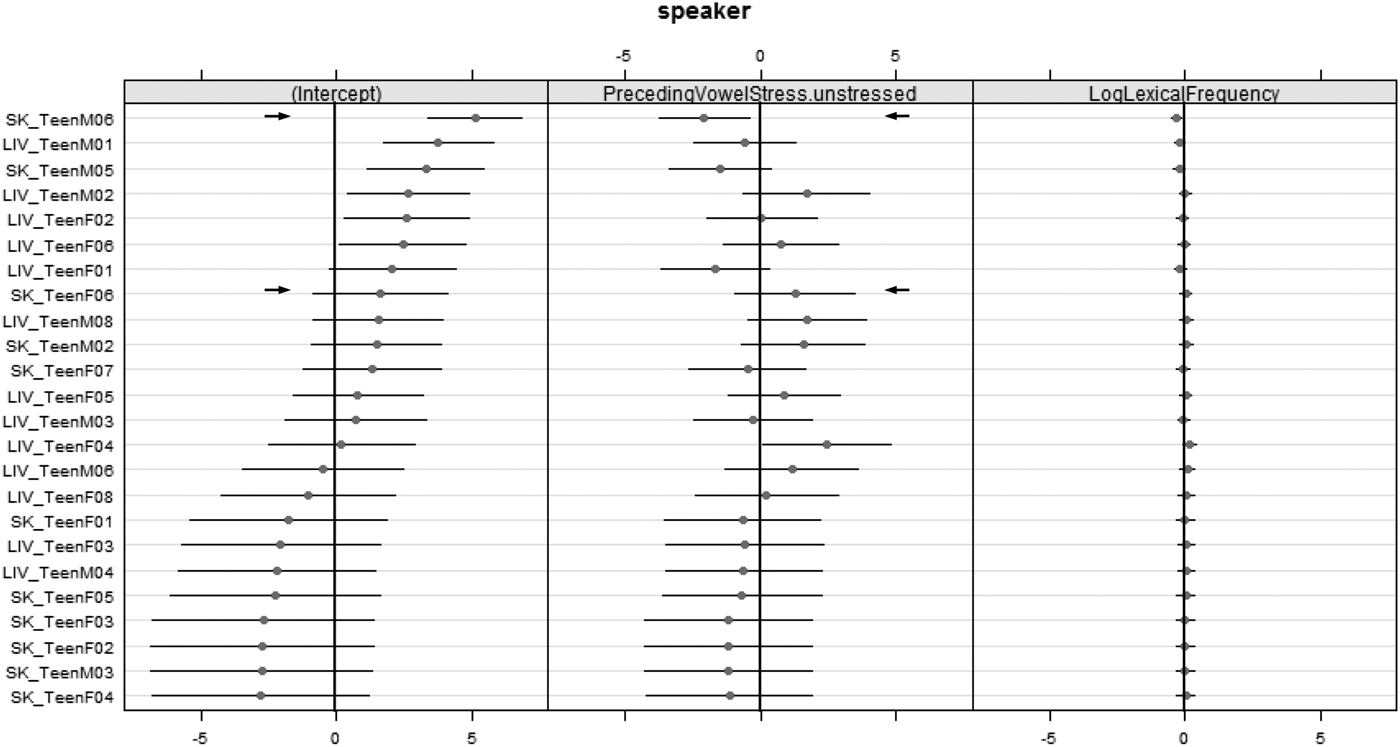
To explore individual speaker behavior in our data, we explore the speakers' random intercepts and the by-speaker random slopes. A random slope for speaker allows individuals to vary in relation to the fixed effects in the model. Figure 10 plots the random intercepts for speaker from the model presented in Table 5, of polysyllabic words for younger speakers in Liverpool and Skelmersdale, and the by-speaker slopes for the two fixed effects. In Figure 10, points to the left of the vertical line in the center of each pane represent negative values, and points to the right represent positive values. The line itself highlights the position of zero. The pane headed “(Intercept)” is the random intercept for each speaker and represents the individual adjustments made for each speaker in the model. A negative value here indicates that a speaker used [h] less often than would be predicted, all things being equal, and a high value here indicates that a speaker uses [h] more often than would be predicted. The pane headed “LogLexicalFrequency” is the by-speaker slope for the effect of the lexical frequency of the word. The value for each speaker is very close to zero, which indicates that individual speakers do not diverge from the model predictions in relation to lexical frequency. That is, all speakers follow the same pattern of being more likely to use [h] in higher frequency words. The pane headed “PrecedingVowelStress.unstressed” is the by-speaker slope for the effect of preceding vowel stress. Recall from the model that overall [h] is favored in unstressed syllables over stressed syllables. Positive values in this pane, to the right of the vertical line, indicate the model's prediction that a speaker is likely to have [h] in an unstressed position, when compared to the model average. Negative values in this pane, to the left of the vertical line, indicate the model's prediction that a speaker is likely to have [h] following stressed syllables, when compared to the model average. As an illustration, we compare speakers SK_TeenM06 and SK_TeenF06, who are marked in Figure 10 with arrows. In the (Intercept) pane, these speakers have a positive estimate, indicating that they use [h] more often than would be predicted by the model. However, the negative value for SK_TeenM06 in the PrecedingVowelStress.unstressed pane indicates that this speaker is more likely to have [h] in stressed syllables than speaker SK_TeenF06. Recall from Table 6 that one Skelmersdale speaker had [h] in words such as acrobat and admit—this speaker was SK_TeenM06. This supports the qualitative picture presented herein and shows that the syllable stress constraint does not seem to be working in the same way for each of these speakers, even though they are from the same locality. Importantly, this is not simply the result of wildly different token numbers: SK_TeenM06 = 81 tokens, 54% [h]; SK_TeenF06 = 88 tokens, 44% [h].
The random intercepts for speaker (left), and by speaker slopes for preceding vowel stress (center), and word frequency (right).
Figure 10 explains why locality is not returned as a significant effect in the regression model—speakers from Liverpool and Skelmersdale do not cluster together in Figure 10 in any obvious way. There are some other noteworthy patterns. For example, 70% of the Liverpool speakers but just 45% of the Skelmersdale speakers have positive intercepts, showing that they use [h] more often than predicted by the model. This is unsurprising given [h] is longer established in Liverpool and is widely considered to be a Liverpool variant. Of the Liverpool speakers with positive intercepts, most (55%) also have positive slopes for vowel stress, showing that [h] is more likely in words with final unstressed syllables, and others (33%) hover close to zero, showing that the stress effect behaves as expected by the model. The one Liverpool speaker with the largest negative slope is LIV_TeenF01, who has [h] in some words with stressed final syllables, but a closer inspection of these words reveals [h] only occurs in forget and forgot, which have long been known to be possible sites for [h] in Liverpool. For the Skelmersdale speakers with positive intercepts, two have positive slopes for vowel stress, two have negative slopes, and one speaker hovers close to zero. This means that two Skelmersdale speakers (SK_TeenF06 and SK_TeenM02) pattern with most of the Liverpool speakers, having [h] more often following an unstressed vowel, and two speakers (SK_TeenM06 and SK_TeenM05), have [h] to a greater extent following a stressed vowel than would be predicted by the model, therefore diverging from the typical Liverpool pattern. This analysis suggests that the constraints operating on the [h] variant of /t/ may not be homogeneous across the speech community, but that some individuals from Skelmersdale may be following the “Liverpool pattern” more closely than others. In the following section we explore these patterns in light of attitudes displayed toward Liverpool in sociolinguistic interviews.
Attitudes toward Liverpool
In discussions of dialect leveling and the geographical diffusion of linguistic features, it is common to invoke speakers' attitudes toward a particular locality or linguistic variety as an explanation for why certain features increase or recede over time (e.g., Llamas, Reference Llamas2007; Watt & Milroy, Reference Watt, Milroy, Foulkes and Docherty1999). Typically, speakers' attitudes are gleaned qualitatively from sociolinguistic interviews, and extracts from those interviews are presented as evidence for their orientations toward or away from particular localities. This may leave the argument somewhat open to the accusation of cherry picking, but recent work by Haddican, Hughes, Richards, and Foulkes (Reference Haddican, Hughes, Richards and Foulkes2013) showed that information gleaned from qualitative interviews correlates with quantitative measures, and, crucially, these measures systematically predict linguistic behavior, providing evidence of the “critical contribution of social forces in shaping the outcomes of change” (Haddican et al., Reference Haddican, Hughes, Richards and Foulkes2013:397).
We are not in a position to make strong claims about the relationship between speakers' attitudes and their adoption of the [h] realization of /t/, but we do offer some tentative observations on the matter. As we mentioned, Liverpool's English, as well as the city itself, is highly stigmatized. While there is a degree of covert prestige toward the accent in Liverpool, the variety is not viewed favorably by outsiders (Montgomery, Reference Montgomery2007). Views along these lines are very common in our interviews. Extracts 1–4 present parts of conversations recorded during sociolinguistic interviews. The teenagers in Extracts 1 and 2 report regular contact with Liverpool speakers, as would be the case for most people in Skelmersdale, and F01's parents both moved from Liverpool to Skelmersdale during the development of the new town. However, speakers F01 and F02 demonstrate a “pro-Skelmersdale” attitude, reporting that they feel safer in Skelmersdale than Liverpool, that they enjoy living in Skelmersdale and that if they were offered a job in Liverpool, they would choose to continue to live in Skelmersdale. Speaker M06, in Extract 2, says that despite visiting Liverpool “every weekend” and having friends from the city, he does not like being called a “Scouser” (the colloquial term for someone from the Liverpool area) because he is “not one.” Rather than a pro-Skelmersdale attitude, this speaker demonstrates an “anti-Liverpool” attitude.
Extract 1: Interview with Skelmersdale teenagers F01 and F02
LC: do you like Skem?
F01: yeah
F02: I love Skem
LC: yeah?
F02: a lot of people hate it but
LC: why?
F02: don't know, I mean a lot of people our generation, our age, are like “oh I can't wait to get out of Skem” but I actually do like it, there's not a lot to do
LC: so what do you like about it then?
F01: quiet, it's quiet compared to like Manchester and Liverpool
F02: yeah I know there's— there's some trouble but I feel safe in Skem. I feel safe. I feel like I could walk around and be safe
LC: ok
F02: whereas if I was in Liverpool or Manchester— 'cos you see things on the news
LC: yeah
F02: I would feel less safe
***
LC: so if you got a job in Liverpool— would you move to Liverpool or would you stay here?
F01: I'd probably stay here
F02: yeah I'd stay here
(“Skem” is the colloquial name for Skelmersdale.)
Extract 2: Interview with Skelmersdale teenager M06
LC: I guess what I'm asking is like do you feel kind of like you would like to live in Liverpool?
M06: no, no …
LC: what's wrong with Liverpool?
M06: don't know … I'm there every weekend like …
LC: erm, so have you got friends who are from Liverpool?
M06: yeah
LC: do you feel like you're from Skem or do you feel like you're from Liverpool?
M06: from Skem. I don't like being classed as a Scouser cos we're not
While the views illustrated in Extracts 1 and 2 are common, they are not the only views attested in our interviews. In Extract 3, Skelmersdale teenager F06 explains that she is keen to move to Liverpool and lists the positive reasons why she wants to live in the city, demonstrating a pro-Liverpool attitude. Even when the interviewer asks about the negative aspects of living in Liverpool, F06 continues to find positive things to say. In Extract 4, teenager M02 demonstrates something of an anti-Skelmersdale view rather than a pro-Liverpool view, but nevertheless reports that he “wouldn't mind” living in Liverpool, which is a markedly different stance from those teenagers who actively demonstrate an anti-Liverpool point of view.
Extract 3: Interview with Skelmersdale teenager F06
LC: so do you want to live in Skem for the rest of your life?
F06: no I'm moving to Liverpool
LC: yeah?
F06: next year with my boyfriend
LC: why Liverpool?
F06: cos my boyfriend's getting a flat in Liverpool, and I like it there. It's bigger, more pla— more things to do
LC: but it's rougher as well no, isn't it? There are— I mean— there's really bad bits in Liverpool
F06: there's really bad areas but then, like, my— some of my family are from Liverpool so I've got family from Toxie and that, and Toxie's a rough area so I've— I already know what it's like up there, do you know what I mean? I like it.
***
LC: how would you feel if people— how does it make you feel when people think you're from Liverpool?
F06: happier than thinking I'm from Skem, like
(“Toxie” ([tɒki]) is the local name for Toxteth, a part of Liverpool.)
Extract 4: Interview with Skelmersdale teenager M02
LC: where do you want to live?
M02: anywhere apart from here— anywhere apart from here I want to live
LC: What about Liverpool?
M02: that'll do
LC: you'd like to live in Liverpool
M02: oh I wouldn't mind it like
If we assume the [h] variant of /t/ indexes Liverpool for these speakers (as seems likely, given its long-standing presence in Liverpool and its much lower frequency in other nearby accents, at least until recently), the attitudes demonstrated here are compatible with the quantitative results presented in Figure 10. Speakers F01 and F02 display pro-Skelmersdale attitudes and distance themselves from Liverpool. The random intercepts for these speakers are situated in the lower half of the left-most panel, showing they are less likely to use [h] than many of the other Skelmersdale teenagers are. Speaker M06 displayed an anti-Liverpool attitude. He has a positive random intercept but the largest negative slope for vowel stress, showing that he is more likely to use [h] following stressed vowels, unlike many of the other speakers. Each of these—either not using [h] much at all, or using [h] differently to the expected patterns in Liverpool—are both ways of not sounding “Scouse.” The only two Skelmersdale teenagers who have positive intercepts and positive slopes for vowel stress—the “Liverpool pattern”—are F06 and M02, which is in line with their positive views toward the city. We think this relationship is unlikely to be a coincidence. Further work on attitudes and identities in this region of England is needed, along the lines of Haddican et al. (Reference Haddican, Hughes, Richards and Foulkes2013) before we can be sure that speakers' orientation toward or away from these localities is a driving force behind these patterns.
DISCUSSION
In this paper we asked three questions, to which we now return. First, we asked:
1. Is Liverpool English /t/ leveling or diverging away from supralocal norms? And
2. To what extent are Liverpool variants of /t/ expanding into neighboring Skelmersdale and St. Helens?
Liverpool is resisting the supralocal glottal stop and retaining its suite of other lenited variants. Rather than leveling, the most regionally restricted variant, [h], is increasing in Liverpool. On the other hand, St. Helens is demonstrating the typical leveling/geographical diffusion pattern: [tθ̳, θ̳, h] are reducing over time, being replaced by [ʔ], while Skelmersdale seems to begin along a trajectory similar to St. Helens, with an early increase of [ʔ], but this has slowed down in the younger speakers, presumably due to the introduction of [tθ̳, θ̳, h]. These patterns can be explained by the social histories of the localities. St. Helens is much smaller than Liverpool, and although the two localities were connected administratively in 1974, as a result of county boundary changes, this did not result in increased contact between speakers. Indeed, at the time, many people from St. Helens were against the new affiliation with Liverpool, because of the negative stereotypes associated with the city (Williams, Reference Williams2012). Another likely contributing factor is the fact that St. Helens is equidistant between Liverpool and Manchester, the other urban center in the region, which unlike Liverpool has been increasing in “cultural prominence” over the last few decades (Montgomery, Reference Montgomery2012). The glottal stop has been more frequently attested for a longer period of time in Manchester than in Liverpool (Baranowski & Turton, Reference Baranowski, Turton and Hickey2015) so it is possible that the increase of the glottal stop in St. Helens is due to its geographical diffusion from Manchester. We might expect that Skelmersdale, our smallest locality, would pattern with St. Helens, but there is one key difference—the large-scale migration of people from Liverpool to Skelmersdale in the 1960s. This and the ongoing contact between Skelmersdale and Liverpool speakers is why we see the sudden appearance of [tθ̳, θ̳, h]—Liverpool variants—in many of the younger Skelmersdale speakers.
Finally, we asked:
3. Are the constraints operating on /t/ → [h] identical in each of our three localities?
We first showed that for both monosyllabic words and polysyllabic words, the constraints operating on [h] were consistent over time in Liverpool. That is, although the frequency of [h] has increased, it behaves in the same way in each age group. This supports Labov's (Reference Labov2007) observation about changes that progress within a speech community via transmission, which are acquired in all their structural detail. Our regression models indicated that the constraints were also behaving the same way across each locality. This was strongly the case for monosyllabic words, where we found no statistically significant difference between localities and where the qualitative analysis revealed that [h] appeared in exactly the same set of words. This appears to go against Labov's (Reference Labov2007) prediction that changes which progress via diffusion are likely to simplify in some way “en route.” However, in the case of St. Helens, we cannot be certain we are actually witnessing diffusion from Liverpool, as the [h] variant of /t/ was present in monosyllabic words even in the St. Helens archive subcorpus. If [h] did diffuse from Liverpool at some point, our dataset has missed the point at which this began. In Skelmersdale, [h] has been adopted more recently than in St. Helens, coinciding with increased contact with Liverpool speakers, but it is not at all clear that this case represents an example of the sort of contact between adults that Labov describes for a number of localities involved in the spread of the NYC short-a pattern. For one of these localities, Cincinnati, for example, Labov (Reference Labov2007:363) described the patterns of contact as follows: “People moved as individuals or in small groups, occasionally returning, and often married outside of their groups of common origin.” In Skelmersdale, we see much more large-scale population movement, during a period of community migration rather than individual migration. In 1961, the population of Skelmersdale was 10,344, according to census records (General Register Office, England and Wales County Report, 1967:1) but by 1971 the population was 30,582 (Office of Population Censuses and Surveys, England and Wales Census, 1971:4), an increase that was primarily due to the influx of Liverpool speakers. This led to something akin to a “swamping” effect (Lass, Reference Lass, Adamson, Law, Vincent and Wright1990), where one variety has the potential to overtake another, if migration numbers are large enough. This has likely facilitated the faithful reproduction of the Liverpool /t/ → [h] pattern in monosyllabic words in Skelmersdale.
Although our regression model of polysyllabic words did not find a statistically significant difference between Liverpool and Skelmersdale as a whole, when we identified the words in which [h] occurs and further explored individual speaker differences by examining the random intercepts and slopes from the regression model, we argued that although there is a high degree of consistency overall, there are differences between some speakers, not just in how often [h] occurs, but also in terms of the constraints operating on it. Some speakers have adopted the same set of constraints as in the original variety but other speakers have adopted a different, arguably more simplified, system. This pattern is compatible with Labov's prediction about diffusion and the simplification of constraints. Why is such a difference not apparent for monosyllabic words? At least part of the answer likely lies in the fact that in the Liverpool English of the 1960s—the variety that was transported to Skelmersdale, represented best by our older Liverpool subcorpus—[h] was very frequent in monosyllabic words, but [h] in polysyllabic words is a much more recent innovation so did not travel to Skelmersdale in the same way. The use of [h] in polysyllabic words in Skelmersdale, then, arose either due to an independent development in that locality, or as a result of more recent contact with Liverpool, of a fundamentally different sort to the earlier large-scale community migration (see Britain [2013] on the role of “mundane mobilities” in language contact).
We tentatively proposed that ideological factors may be behind the differences we see between individual speakers in Skelmersdale. As we showed, this is not a new suggestion (e.g., Llamas, Reference Llamas2007), but often the differences between speakers are due to differing rates of use of a particular variant. Here we see evidence for the different operation of linguistic constraints—some Skelmersdale speakers seem to demonstrate a Liverpool pattern yet others display a slightly different system. This raises interesting implications for sociolinguistic theory and the relationship between the individual and the group, especially the assumption of the homogeneity of constraints across the community. Labov (Reference Labov1966:5) famously stated that “the language of individuals cannot be understood without knowledge of the community of which they are members.” This is an important long-standing position in sociolinguistics, but it has sometimes been taken to suggest that individual speakers are unimportant and that the community is the primary unit of investigation (Gordon, Reference Gordon2006:341). We have shown that when communities are explored in tandem with their individual speakers, patterns of systematic variability at the individual level are revealed which would otherwise be hidden.