The British Victorian city, maintaining in conditions of unprecedented health and general well being an urban population that grew more than threefold between 1841 and 1901, was a colossal achievement of technology and human organization. It was also, as has long been recognized, a political and a cultural artifact. Municipal reform had transferred power from landed patrons and oligarchic corporations to elected councils. With hindsight, these new governing bodies, chosen on a restricted franchise and dominated by the leaders of local commerce and industry, can be seen as a new form of class power.Footnote 1 But the development during the mid- and late nineteenth century of a body of increasingly elaborate civic ritual has been taken as evidence that the members of this ‘urban squirearchy’ succeeded, for a time at least, in projecting themselves as the representatives of a new imagined community, and as the spokesmen for a new vision of the potential of urban living.Footnote 2 In the colourful, if perhaps slightly tongue-in-cheek, words of David Cannadine: ‘From Bournemouth to Birmingham, Cardiff to Cambridge, there was the same self-conscious efflorescence of civic religion, with equivalent temples constructed, saints discovered, priests officiating, vestments embroidered, liturgies recited and pageants staged.’Footnote 3
To this narrative of a golden age of the British city there is one major apparent exception. Belfast was, by any standards, a striking example of nineteenth-century urban growth. In 1800, it was a provincial centre with 20,000 inhabitants. By 1911, with a population of 387,000, it was the United Kingdom's eighth largest urban centre, the site of what was reputedly the world's largest shipyard and the centre of Europe's largest linen-producing region. In terms of cultural and political development, on the other hand, Belfast seems at first sight to offer few points of contact with Cannadine's ‘efflorescence of civic religion’. In place of the construction of an imagined urban community, it had by the late nineteenth century become a city dominated by deep political and confessional divisions; its equivalent to the public ceremonial used elsewhere to promote civic pride and social cohesion was the annual 12 July parades, a triumphalist celebration of sectarian inequalities that repeatedly ended in widespread communal violence.Footnote 4 Yet it is important, as always, not to read history backwards. If Belfast was in the long term to exclude itself from full participation in what is now recognized as the great age of provincial municipal culture, this does not necessarily mean that its development lies wholly outside that broader narrative. An examination of one episode, the visit of Queen Victoria in August 1849, offers a more complex, less linear picture of the development of a distinctive urban identity.
‘The Liverpool and Manchester of Ireland’
The inclusion of Belfast in Queen Victoria's Irish progress was the accidental consequence of a series of calculations. The purpose of the journey was political. Following the Young Ireland rebellion of 1848, and the disastrous multiple failures of the potato crop, the queen's visit was intended to mark the symbolic end of a period of crisis, to cultivate allegiance to the crown and to help promote Ireland as a suitable place for badly needed British investment.Footnote 5 At the same time, Victoria and the Prince Consort were clear from the start that they were not willing either to bear the costs of a formal state visit, or to face the scrutiny of their affairs that would arise from an application for parliamentary funding. Instead, the visit was to be ‘one having more the character of a yachting excursion’.Footnote 6
What this meant in practice was that the focus of the visit was on the recently disaffected and famine-ravaged south, with visits to Cork on 2–4 August and Dublin on 5–10 August. At the same time, the fiction of a yachting expedition made it necessary to use Belfast Lough as a convenient resting place on the voyage between Dublin and Glasgow, the queen's next destination. However, there was initially no assumption that the town itself necessarily merited a visit. Instead, the suggestion was that the queen ‘might drive to any point in the neighbourhood from which any remarkable view of the country or anything of that kind might be seen’.Footnote 7 Lord Londonderry, the most prominent local magnate, quickly took up the idea, offering to have his carriage ready at Belfast to convey the queen through the town and on to his house at Mountstewart 10 miles away, giving her and the prince ‘an opportunity of seeing something of the country in that neighbourhood’. The Arctic explorer Captain Frederick William Beechey, who was to act as the queen's pilot during the Irish part of her voyage, also suggested by-passing Belfast, instead taking the railway to Lisburn, ‘where the great linen manufactories are situated’, or alternatively visiting those of Ardoyne, at that point still a separate district to the west of the town.Footnote 8
These behind the scenes discussions testify to the ambiguous place of Belfast, as a new industrial town, both in the Irish urban hierarchy and in the British official mind. By 1851, it was Ireland's second largest urban centre, with a population of 98,000, as compared to 247,000 in Dublin and 82,000 in Cork. Since the late 1820s, moreover, a successful transfer from cotton to linen spinning, where Ulster enjoyed a competitive advantage, had secured its future as the country's only significant centre of factory-based manufacturing industry. There was some interest, as Beechey's recommendation made clear, in the new technology of mass production. But the town itself was not seen as having any pressing claim on royal attention. It was left to the lord lieutenant, the earl of Clarendon, more attuned to local political sensibilities, to insist that the queen must visit Belfast, where ‘the whole of the north’ would be represented. Moreover, ‘there is a great deal to be seen, it is the Liverpool and Manchester of Ireland’.Footnote 9 Even after the visit had been agreed, one well-connected local observer, the MP for County Londonderry, remained privately dismissive: ‘She has nothing to see in Belfast, but a thriving town, which she daily sees in any part of England, but she will be received with great enthusiasm.’Footnote 10
A similar ambivalence was evident in official attitudes to the new urban elite with whom the queen was to come in contact. The Irish Municipal Reform Act of 1840 had been less far reaching than its English counterpart, preferring to abolish the existing unsatisfactory corporations rather than to make them representative. But in the 10 largest centres, elected mayors and corporations now controlled municipal affairs. In the case of Belfast, the institutional change brought about by municipal reform was reinforced by local developments. The town's last major civic occasion, the visit of the lord lieutenant Lord Hardwicke in 1804, had been wholly managed by its proprietor, the second marquis of Donegall. The sovereign and corporation, all of them nominees of Donegall, had been able to present their dutiful address to the viceroy only on the fourth complete day of the visit, interrupting what was otherwise a round of aristocratic sociability.Footnote 11 In 1822, however, the heavily indebted second marquis had surrendered his position as lord of the soil by a wholesale grant of leases in perpetuity, and by 1849, his heir, the third marquis, was struggling with the huge liabilities he had inherited. Against this background, Donegall initially proposed to avoid the royal visit, which he described as ‘a bore’, pleading illness.Footnote 12 In the event, he did attend, but only in his capacity as chairman of the Harbour Commissioners. Earlier, the court had politely refused what was presumably a token offer to put his carriage at the disposal of the queen, noting privately that acceptance ‘must have put him to an expense he could ill afford’.Footnote 13 Londonderry's proposal to carry the queen off to Mountstewart might be seen as an attempt to keep the management of the visit in an alternative set of aristocratic hands. The rejection of his overture, however, left the council firmly in control.
In public, the government accepted these new political realities. The home secretary, in advance of the visit, noted that the lord mayor of Dublin would have to be given a baronetcy, and that the mayors of Cork and Belfast, despite the ‘inconvenient precedent’ thus created, should be knighted.Footnote 14 Privately, however, Clarendon regarded the corporations of the southern towns, dominated as they were by followers of Daniel O'Connell, with a mixture of political and social distaste. The lord mayor of Dublin, Timothy O'Brien, was in his view ‘a vulgar, uneducated little man’, while the corporation ‘consists of some of the lowest and worst folks in Dublin’. The aldermen of Cork, meanwhile, ‘are the most notorious ruffians in Ireland, worse even than their brethren of Dublin’. The corporation of Belfast, drawn as it was from the Protestant commercial and business elite, was clearly more politically acceptable. Indeed, the home secretary commented that the mayor, William Gilliland Johnson, ‘seems a sensible gentlemanly man’.Footnote 15 Yet, a hint of condescension remained. Clarendon commented sardonically on the elaborate corporate uniforms devised for the occasion: ‘The Belfast corporation have devised a fancy dress for themselves, half naval and half clerical, with white neckties and polished boots, and have sent up to know whether it may be used before the queen.’Footnote 16 When the lord lieutenant contemplated a journey of his own to the north-east soon after the royal visit, Londonderry wrote to warn of the ‘siege’ he could expect as ‘the newly created Sir William Johnson’ importuned him to partake of some form of civic ceremony.Footnote 17
Provincial diffidence and civic pride
During the first weeks of July, the people of Belfast anxiously followed what they could learn of the behind the scenes discussions of the queen's plans.Footnote 18 Once it was clear that she would in fact visit the town, preparations for her reception moved with impressive speed. A town meeting on 25 July appointed a committee to draw up a loyal address on behalf of the inhabitants and to co-operate with the council and other public bodies in managing the visit. The town council commissioned the elaborate corporate uniforms, scarlet gowns trimmed with ermine, worn over blue dress coats with velvet collars and buttons bearing the town's crest, that gave rise to Clarendon's mild derision.Footnote 19 Meanwhile, workmen constructed the scenery for an elaborate piece of outdoor theatre: a specially constructed staircase leading from the quay where the queen would land, a decorated, slate-roofed pavilion, with a raised dais and a state chair, where the royal party could receive a formal welcome, and a triumphal arch 32 feet in height under which her carriage would pass as it made its way up High Street. Further up the street, a series of wooden galleries provided accommodation for a reported 4,000 spectators. Private enterprise was also at work, as almost every house along the street received a fresh coat of paint, and was decorated with flags and banners.Footnote 20
The royal yacht left Dublin on the evening of Friday 10 August, and reached Belfast Lough at four o'clock the following morning. The queen received representatives of the harbour commissioners, the town council and other dignitaries on board the yacht, before boarding a smaller steam tender to carry her to the quayside at half past one. Shopkeepers and factory owners in adjacent towns had announced a one day holiday for the Saturday of the visit, and the three railway companies serving the town laid on special trains, so that the streets were crammed with spectators. Dense crowds gathered on the quayside, some from as early as 4 am, despite a constant downpour that cleared just before the landing, more than 10 hours later.Footnote 21 There was a momentary awkwardness when the ‘portcullis or swinging platform’ intended to serve as a gangway proved too large for the tender, but soon after 2 pm the queen made her way up the ornamental staircase, now resting on some hastily procured planks, before proceeding into the pavilion, under the triumphal arch, and up the length of High Street.Footnote 22
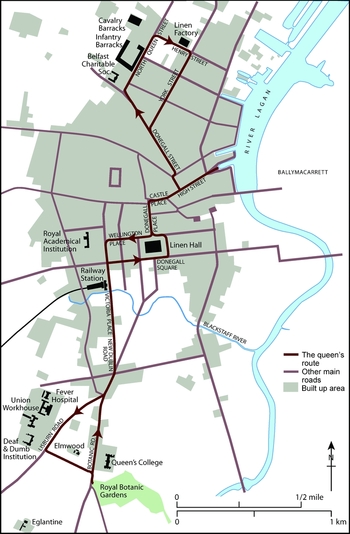
The progress that followed was almost an inventory of the characteristics of the developing nineteenth-century industrial town (Figure 1). High Street was Belfast's historic centre and still its main commercial thoroughfare. Donegall Place, by contrast, had been laid out in the 1780s as the town's most exclusive residential address, ‘the St James's of Belfast’, but by 1849, the expansion of the commercial centre meant that merchants and traders had begun to displace its genteel inhabitants.Footnote 23 At its head, providing the procession's first stop, stood the Linen Hall, constructed in 1785 as part of Belfast's successful drive to supplant its main rival, Newry, as the centre of Ulster's expanding linen trade. The marquis of Downshire, president of the Royal Flax Improvement Society, along with other dignitaries, conducted the queen through a succession of rooms displaying the different stages of the production process, from raw flax to finished specimens of fine linen. From here, the procession moved on to more recently developed districts. Victoria Place and the New Dublin Road (later to be renamed Great Victoria Street) carried the queen past the terminus of the Ulster railway, opened in 1839 and now in the last stages of completing the connection to Dublin. Beyond, lay Belfast's most developed suburb, where the Malone Ridge rose above the waterlogged low ground immediately south of the town centre. Here, the queen drove past the huge Tudor-style Institute for the Deaf and Dumb, opened in 1845, and the adjacent workhouse, erected following the introduction of an Irish Poor Law in 1838, before passing through the Botanical Gardens established in 1828, and then stopping briefly at the newly opened Queen's College.Footnote 24
Belfast in 1849, showing the queen's route through the town.

Finally, the procession doubled back on itself for a shorter and more selective passage through the more plebeian district created by the northwards expansion of the town. In North Queen Street the queen actually passed through the heart of the red light district that had grown up around the military barracks. However, the late Georgian Poor House of the Belfast Charitable Society, constructed in 1774, provided an acceptable focal point. The district's other main thoroughfare, York Street, though lined at the end nearest the town centre by large private houses, ran through an area of mills and poor working-class streets.Footnote 25 However, a short drive along its lowest, most salubrious part was sufficient to take the queen past the jewel in Belfast's industrial crown, the extensive Mulholland's Mills, where the introduction in 1830 of the machine spinning of linen had secured the town's future as a manufacturing centre. There was no attempt to visit the older industrial district to the west, where the Farset and Blackstaff rivers provided water power for the town's largest concentration of mills. The News Letter regretted that this omission would deprive the queen of the sight of two further prestigious buildings, the court house and prison, newly erected, in classic Foucauldian fashion, at the heart of these working-class residential districts.Footnote 26
The Belfast to which Queen Victoria briefly came in August 1849 was a town undergoing a significant transition, in terms both of appearance and of self-image. Late Georgian Belfast, benefiting from a programme of urban improvement sponsored by the first marquis of Donegall, as well as a proliferation of voluntary societies devoted to cultural and scientific enquiry, had boasted of giving Ireland its own ‘northern Athens’. By 1849, on the other hand, the genteel commercial centre had become a sprawling manufacturing town, with a population (98,000 in 1851) close to five times what it had been half a century earlier. Yet, observers were agreed that this expansion had been at the expense of architectural grace. An otherwise approving Scottish visitor, writing in 1834, complained of ‘unbroken lines of buildings, uniform in height, and unrelieved by the least architectural ornament’, and over the following decade residents too began to bemoan the lack of buildings of distinction.Footnote 27 By the time of the queen's visit, definite improvements were under way. The News Letter, in December 1847, declared its confidence that recent commercial and ecclesiastical buildings constituted ‘a foretaste of the future architectural distinction of Belfast’, and pointed to current construction work on the town's two railway stations, the Queen's College, and a set of new premises for public markets.Footnote 28 Meanwhile, an improvement act of 1845 had permitted the council to undertake its first major venture in urban planning, the construction of a broad commercial street, designed to cater for traffic crossing the newly erected Queen's Bridge over the River Lagan, but also involving the clearing of ‘three or four wretched cross streets containing above a thousand houses’.Footnote 29 But all of this was work in progress in a town whose inhabitants had come to realize that its physical appearance fell far short of its commercial and industrial importance.
Against this background, Belfast responded to the queen's visit with a mixture of pride and diffidence. The Northern Whig worried openly that the town ‘has little of architectural ornament’, and that ‘we cannot expect to make much display’. Instead, what it had to offer was ‘a busy, industrious and independent population’, and a staple manufacture, linen, that offered ‘if not a showy, at least a graceful and impressive evidence of the industry, taste and enterprise of the North’.Footnote 30 The News Letter, describing the visit to the Linen Hall, struck a similar tone, noting that ‘although we could not present to her Majesty . . . splendid and antique buildings, or magnificent and time worn edifices, we could exhibit that which was more characteristic of national greatness and prosperity’. Yet, elsewhere in the same report, its correspondent took refuge instead in a curious flight of fancy, suggesting that
the lengthened vista of High Street and Castle Place, fading into indistinctness in the distance, opened before the gaze of the royal visitors with something of the tone which characterizes an old cathedral city, from the quaint irregularity of the houses, the multitude of banners floating from the roofs and upper windows, many of them of immense size, and the extraordinary profusion of evergreens which, as if with a mantle of ivy, garlanded the eaves, windows and architectural projections of almost every building.Footnote 31
By 1849, there was a definite pride in the manufacturing success that set Belfast apart from other Irish towns. But there was also, it seems clear, a lingering sense that factory chimneys and railways did not confer the prestige that came with the visible signs of antiquity and long-established urban dignity.
Internal divisions and a show of unity
Belfast in 1849 was a divided town. Rivalry between Liberals and Conservatives had begun with the first election following the Reform Act. It intensified with the creation of an elected town council in 1842, when astute manipulation of the electoral register by John Bates, who combined the role of town clerk and town solicitor, gave the Conservatives control of all 40 seats. Their monopoly, preserved in subsequent elections, gave an edge of real hostility to normal party divisions.Footnote 32 Convention required that animosities be set aside for the duration of the queen's visit. However, the Liberal Northern Whig took evident pleasure in reporting that the mayor, representing the detested Tory corporation, had presented himself on the royal yacht too early, and had been forced to withdraw while Donegall, as president of the Liberal-dominated harbour commissioners, submitted an address and was favoured with ‘an interview of some duration’. The paper also accused the mayor of a breach of protocol for failing to hand stewardship of the procession, at the point where it crossed the town boundary at the Botanic Gardens, over to the county authorities, thus allegedly disrupting the arrangements made by the legitimate organizers of this part of the visit.Footnote 33
What concerned the court and ministers, however, was not Belfast's party animosities, but its even fiercer sectarian antagonisms. ‘The Protestants and Roman Catholics’, the queen herself noted in her diary on the evening following her visit, ‘are nearly equally divided in Belfast, and religious hatred and party feeling run very high.’Footnote 34 Tensions between the town's Protestant majority and the growing Catholic minority that had been drawn in from the surrounding countryside by expanding employment opportunities had been evident for at least three decades. There had been serious outbreaks of violence in 1825, 1832, 1835 and 1842, as well as numerous lesser incidents. In 1849, the celebration of 12 July was regarded as having passed off quietly by Belfast standards: the evening before, two navvies had been fatally hurt after they and others attacked the drivers of two carts who had arrayed their horses in Orange lilies and ribbons, while on the day itself shots had been fired and stones thrown late in the evening, after the local Orange lodges had returned from the main assembly in Antrim town.Footnote 35 Since then, however, the town's newspapers had been full of conflicting versions of the 12 July violence at Dolly's Brae in rural County Down, when Orangemen marching through a Catholic village had come under attack and had retaliated by killing an estimated 30 of their opponents.Footnote 36 Earlier in the year, leading Belfast Catholics had petitioned the lord lieutenant in protest at a whispering campaign, allegedly encouraged by the municipal authorities, that had sought to present a spate of arson attacks as the work of an organized Catholic conspiracy.Footnote 37
Against this background, the queen's visit to Belfast stood out as a display of unwonted communal harmony. Those invited to the town meeting to begin discussing arrangements for the visit included not just the Church of Ireland bishop of Down and Connor and a representative of the Presbyterian General Assembly, but also the Catholic bishop, Cornelius Denvir. Denvir was duly included, under his ecclesiastical title ‘the Right Reverend Doctor Denvir’, as a member of the organizing committee. Later, he appeared on the royal yacht, immediately after the representatives of the two other main denominations, to present a declaration of loyalty on behalf of himself and the clergy of his diocese. Not everyone was completely satisfied. The Dublin-based Freeman's Journal, principal organ of the Catholic middle classes of the south, complained that a platform erected in front of one of the two Church of Ireland churches in the town, St George's in High Street, displayed a blue flag with the inscription, in large white letters, ‘Church and State’.Footnote 38 Overall, however, Clarendon concluded from reports by the stipendiary magistrate on the spot that the visit ‘seems to have gone off to our heart's desire’. The queen's presence ‘has united all classes and parties in a manner incredible to those who know the distance at which they have hitherto been kept asunder’.Footnote 39
In adopting this stance of ostentatious religious neutrality, the Belfast municipal authorities were conforming to clear official guidelines.Footnote 40 The decision to extend this policy to Belfast, however, did not go uncontested. At the town meeting of 25 July, the Rev. Thomas Drew intervened to ask why the Church of Ireland primate and archbishop of Armagh, ‘who resided within little more than an hour's drive from Belfast’, had not also been invited. He went on to object to the proposed inclusion on the queen's itinerary of the newly opened Queen's College, one of the three non-denominational institutions created to give Catholics and Presbyterians an alternative to the Anglican Trinity College, Dublin.Footnote 41 When he failed to gain support at the meeting, Drew addressed a public letter to the home secretary objecting to ‘the sight of a sworn Protestant monarch entering into the godless Colleges to which the honoured name of “queen” has been improperly prefixed’. He also introduced a more directly sectarian note, complaining of what he called the ‘debasement’ of the clergy of the established church at the hands of the Whig government and its ‘pope honouring lord lieutenant’.Footnote 42 Even after the visit had taken place, he reportedly wound up a Sunday sermon ‘with a tirade about the queen going to the new college’ and seemed to at least one hearer to be ‘a little beside himself on this point’.Footnote 43
Drew's intervention was significant. As curate of Christ Church, erected in 1833 in the new industrial district growing up to the west of the town centre, he was much praised for his vigorous evangelical mission to the Protestant working classes.Footnote 44 He was also a committed anti-Catholic polemicist. Only eight years later, in 1857, his public preaching against popery was partly responsible for some of the most violent rioting that Belfast had so far experienced.Footnote 45 On that occasion, his actions won widespread support. In 1849, on the other hand, he found himself wholly out of tune with his fellow citizens. A speaker who condemned his attempt to dictate where the queen should go, and called on him to withdraw his remarks, was greeted with applause. Even the Conservative and firmly Protestant News Letter reported his intervention as provoking ‘murmurs’, developing into ‘increased signs of disapprobation’. Later, a proposal that, in order to act ‘with the strictest impartiality’, the committee to be appointed should include no clergymen at all, but ‘practical men only’, won some support, although it was not in the end adopted.Footnote 46
The importance of these exchanges should not be underestimated. It has long been recognized that Protestant politics in Belfast, at least up to the Home Rule crisis of the 1880s, cannot be analysed solely in terms of a monolithic anti-Catholic unionism. Most of this work, however, has concentrated on the dwindling tradition of Presbyterian radicalism, or on a handful of carefully selected spokesmen for a progressive and non-sectarian unionism.Footnote 47 In 1849, however, it was the exclusively Conservative and militantly Protestant town council that temporarily adopted the rhetoric of communal harmony. In particular, it was John Bates, the solicitor normally seen as the evil genius of this spirit of sectarian exclusiveness, who took the lead in slapping down Drew, announcing to cheers that ‘in this meeting, consisting of various parties, of various religious and political complexions, there is but one strong and ardent feeling of personal attachment to the Queen’.Footnote 48
Despite these good intentions, it proved impossible to avoid all religious controversy. The mayor's proclamation setting out details of the queen's progress had included a visit to the Institution for the Deaf, Dumb and Blind, recently relocated from the town centre to the grand new building near the Queen's College. In the event, the procession merely passed by the entrance. Word quickly spread that the Institution had been snubbed because it accepted only Protestant children, and private government correspondence confirms that this was in fact the case.Footnote 49 Even here, however, both the mayor and the Institute itself sought to limit the damage by claiming that there had been no definite commitment to visit, and that the queen had always intended to make only one stop on this part of her progress. The News Letter eagerly announced that their statement ‘most satisfactorily explains the apparent slight shown by her Majesty to the committee of this institution’.Footnote 50 However, a subsequent decision to exclude it, on the same grounds, from a share in a donation that the queen had left for distribution to local charities perpetuated what Clarendon described as ‘a terrible row’.Footnote 51
If Belfast's Protestant elite were on their best behaviour, the Catholic minority fully reciprocated. Bishop Denvir, whom the queen described as ‘an excellent and moderate man’, was in some respects a special case.Footnote 52 A mild and scholarly figure, one-time professor of philosophy at Maynooth and a keen amateur scientist, he was noted for his conciliatory attitude to the town's Protestant elite, as well as for his support, in opposition to most other Catholic bishops, for non-denominational education. In this case, however, his ostentatious display of loyalty found echoes lower down the social scale. There had been support for the repeal movement in Catholic Belfast during the 1840s. But the loyalty of the majority was firmly to the Old Ireland of Daniel O'Connell rather than to more militant alternatives. This was made clear in 1847, when attempts by the rival Young Ireland group to hold a public meeting in the town were violently disrupted by a hostile crowd dominated by the proverbially aggressive butchers of Hercules Street.Footnote 53 The same group now came forward in a different guise. The Northern Whig noted with approval that Hercules Street had ‘contributed its quota of honours to the royal visit’, in the shape of banners and ‘a very tasteful arch’ erected by the Butcher's Total Abstinence Society.Footnote 54
One further aspect of Belfast's welcome caught the queen's attention: ‘the favourite motto written up everywhere on most of the arches & in every place was “Cead Mille failte”, which means “a hundred thousand welcomes” in Irish, which is very like [Scots] Gaelic & is in fact the national language’.Footnote 55 A London newspaper likewise noted the harps and shamrocks appearing on the triumphal arch in High Street, alongside the conventional symbols of British loyalism, such as the union jack, the cross of St George and banners proclaiming ‘God Save the Queen’. ‘The northerns’, it noted, had earlier firmly resisted proposals to levy an additional ‘rate-in-aid’ to support bankrupt poor law unions in the south. Now, however, they ‘became quite Milesian in the moment of enthusiasm and loyalty’.Footnote 56 The News Letter also noted several instances of the greeting Céad Míle Fáilte, one of them outside its own offices, where it appeared alongside the royal arms and the letters V and A. Meanwhile, the bookseller William McComb had commissioned a painting of an Irish harper, ‘in true Hibernian costume’, with the motto cushla machree (beat of my heart). The Northern Whig singled out as particularly appropriate a flag displayed outside another High Street premises, belonging to the draper Thomas Hardy, with a union jack and a harp mounted against a green background, along with a crown in orange, ‘thus exhibiting, in gay and picturesque relief, the two colours under which Irishmen have, since the strife at Aughrim, unfortunately arrayed themselves in antagonistic lines’. A different symbol of national identity appeared over the Malone Turnpike, near the Botanic Gardens, where a triumphal arch constructed from potatoes reportedly moved the queen to good-natured laughter.Footnote 57
This willingness to herald the royal visit in the language, not just of British loyalism but of a sentimental Irish patriotism, should not surprise. It has long been recognized that an interest in Gaelic culture remained, for most of the nineteenth century, largely detached from political nationalism. One historian has even referred to ‘that unspoken covenant, coming to full flower in the Victorian period, by which Catholics took up political nationalism and Protestants cultural nationalism’.Footnote 58 There was thus no contradiction between the strong opposition of Belfast Protestants to any weakening of the union of Great Britain and Ireland and a continued interest in Irish language and antiquities. William McComb, for example, was the author both of a volume of poetry celebrating Brian Boru and other legendary figures from the Gaelic past and of a pamphlet celebrating the ignominious failure of O'Connell's attempt in 1841 to hold a repeal meeting in the town.Footnote 59 In addition to his shop window display, he published, a week after the visit, a poem saluting the queen with the titles a grá (beloved) and cushla machree, from an Ireland whose daughters welcomed her with the cry Erin go Bragh (Ireland forever). There was even an implied comparison with the queen's more favoured Celtic destination.
At one level, then, the willingness of Belfast Protestants to welcome their queen with harps, green banners or scraps of Irish phrasing was evidence of nothing more than the same combination of British unionism and national cultural patriotism that was to be seen in contemporary Scotland and Wales. There was also, however, the emerging issue of Belfast's relationship to other parts of Ireland. The majority Protestant population had declared their separate political identity when they had refused O'Connell a hearing in 1841. More recently, in the months preceding the queen's visit, the Belfast poor law board had taken a leading part in resistance to the rate-in-aid.Footnote 61 In welcoming the queen, on the other hand, the town's leading citizens fell back on the conventional symbolism of Irishness. The resulting contradictions between rhetoric and political reality are particularly apparent in another poem, the work of an unnamed ‘respected citizen’, that in 1850 received the prize at the first in a planned series of annual fetes commemorating the royal visit. The locale is clearly identified as Belfast: dark clouds hang over the nearby Cavehill on the Antrim plateau, then disperse just as the queen arrives to wield her olive branch wand ‘o'er the green fields of Ulster – our dear fatherland’. Thereafter, however, this local specificity dissolves into a generalized Hibernianism:
The stereotype of the wayward but big-hearted Paddy, whose foolish and impractical enthusiasm for self-government had to be set against his good-natured deference to his natural superiors, was a familiar rhetorical device, acknowledging while at the same time neutralizing Ireland's anomalous status within the United Kingdom. Here, however, it was being extended to the mainly Protestant and firmly anti-repeal Belfast, in a poem composed by one of its citizens and awarded a prize by others. This, it seems clear, was a town that was beginning to be aware that it stood apart from other Irish centres, but that was as yet far from clear exactly in what ways it did so.
Aftermath
Immediately after the queen's visit, the Northern Whig, looking back with satisfaction on all that had taken place, confessed to some earlier misgivings: ‘Our fellow citizens are far from excitable, and it was to be apprehended that they would hardly turn from their industrial occupations to devote themselves with the requisite ardour to the work of paying due honour to Her Majesty.’ In the event, it believed, ‘any northern coldness’ had vanished once it became certain that the queen would indeed visit.Footnote 63 A London newspaper, deploying what was clearly already a well-established regional stereotype, commented in similar terms: ‘Even the canny inhabitants of the black north have caught the frenzy, and are, and have been, all the week straining every nerve and exercising every ingenuity to give their royal mistress a suitable reception.’Footnote 64
The queen herself took a slightly different view. Belfast, she wrote to her uncle, King Leopold of Belgium, was ‘a pretty town & a commercial and manufacturing one’, and the visit had gone off as well as the other stops on her Irish tour. In her diary, on the other hand, she noted that ‘the reception was as hearty, though I thought not quite as enthusiastic as in Dublin, I mean not quite so typically Irish’. In the south, she had found the people ‘noisy & excitable beyond belief, talking, jumping & shrieking instead of cheering’, and she had also commented on the remarkable beauty of the women, ‘such beautiful dark eyes & hair and such fine teeth’. In Belfast, on the other hand, ‘the Irish shriek was no longer to be heard, & the female beauty had disappeared’.Footnote 65 Her comments found a striking echo in those of the correspondent for one London newspaper, the Morning Chronicle, who found Belfast ‘the least Irish city I have seen’, lacking ‘the fun – the vivacity – the careless good humour’ to be found elsewhere, and displaying instead ‘a sour, cantankerous look’. He also recorded more disturbing impressions:
Besides I have seen more drunken men here – drunk at a very early hour in the day – than I noted during a fortnight's stay in the south. In clearing the streets the police did their duty with something which I am strongly tempted to call brutality; . . . All day long batons and switches were falling upon the shoulders and faces of sturdy struggling malcontents.Footnote 66
Here, it is necessary to make allowance for possible national prejudice. But the likelihood is that an outsider's frankness lifts the curtain on a grimmer underside not acknowledged in other, more celebratory, accounts of the royal visit. The queen herself, in fact, noted that ‘things were not so well managed as in Dublin, & there was a constant moving crowd walking with us, which prevented others from seeing & caused a great crush’.Footnote 67
Happily unaware of the queen's private sentiments (although the Morning Chronicle's article drew angry complaints),Footnote 68 the leading citizens of Belfast celebrated what they saw as the triumph of the visit. The queen had been in the town for just five hours, as compared to twenty-four hours in Cork and six days in Dublin. Yet, there was no indication that anyone felt slighted by the brevity of her stay. As the royal party returned to spend the night on her yacht, anchored in Belfast Lough, the streets remained crowded with onlookers. Since the monarch was no longer in sight of the town, the council had agreed not to order a general illumination. However, some owners of private houses and proprietors of commercial premises set up elaborate displays of lights. An exhibition of fireworks outside one business in High Street lasted until midnight, while bonfires blazed on hilltops in the surrounding countryside. Meanwhile, diners at a banquet organized by the mayor heard the marquis of Londonderry assure them that the queen's reception had been ‘far more enthusiastic and heartfelt than in Dublin’. In the aftermath of the visit, the council named the street recently constructed under the 1845 Improvement Act Victoria Street, while two newly created squares were named Queen's Square and Albert Square. The island created out of waste from the recent cutting of a new harbour channel, formerly called Dargan's Island after the contractor responsible, became the Queen's Island, and for several years was the site of a commemorative fete.Footnote 69
The quite impressive display of religious harmony inspired by the queen's visit did not long survive it. How far the controversy over the Deaf and Dumb Institution revived old animosities and insecurities remains unclear. But the same issue of the News Letter that joined in seeking to explain away the queen's failure to visit contained a vitriolic attack on the home secretary, whom it blamed for the ‘insouciance and unmeaning vagueness’ with which the queen had supposedly responded to the address of the Presbyterian General Assembly. This contrasted with the ‘more than usual cordiality’ accorded to what the paper presented as the half-hearted declaration of loyalty presented on behalf of the Catholic hierarchy: ‘the Romish church in Ireland, in short, came to the foot of the throne, like a paralytic cripple – one half of the body showing a sickly vitality, and the other half morally and physically dead’.Footnote 70 In the years that followed, sectarian violence reappeared, with particularly violent outbreaks in 1852 and again in 1857. Meanwhile, in another indication of changing times, Bishop Denvir began to come under attack for what his parishioners saw as an undue timidity in the face of a hostile Protestant establishment, reflected in his failure to expand the Catholic church establishment in line with increasing numbers. He was forced to accept a coadjutor in 1860, and to resign as bishop five years later.Footnote 71
What, then, was the significance of Queen Victoria's visit to Belfast in 1849? In the first place, it confirms the relevance, even in the somewhat different context of Ireland's only great industrial centre, of the themes of civic pride and a new confidence in the potential of urban living that have preoccupied historians of the British Victorian city. Faced with the opportunity to present themselves to a wider world, the leading citizens of Belfast turned to the ceremonies and symbolism of the newly created municipal institutions, and put on show their factories, their railway station and the other symbols of their industrial success. At the same time, the visit also serves as a reminder that this vision of the city was not born overnight. Pride in the town's recent achievements sat alongside a definite uneasiness at its lack of a historic past, and the absence within it of buildings of distinction. This was a fledgling industrial centre that liked to think that, in the right light, it could be mistaken for an old cathedral city. The official reaction to Belfast's efforts, likewise, combined traditional prejudices with a developing awareness of new social and economic realities. The comments of Clarendon and others on Belfast's bourgeois corporation retained a hint of condescension, while the confused discussion that preceded its inclusion on the royal itinerary revealed a continued ambivalence towards the industrial town. In the end, however, the members of Belfast's civic elite, resplendent in their corporate uniforms, were allowed their moment of glory.
Where Belfast itself is concerned, what emerges is a picture of a town still in the process of inventing itself. It was an urban centre aware of its growing economic importance, yet grateful to be taken seriously by the outside world. It was aware of the extent to which its successful industrialization set it apart from other parts of Ireland, but remained torn between the assertion of a distinctive identity and conformity to a broad national stereotype. It was also a town already on the way to developing the deep sectarian and political divisions that were to set it apart from the other urban centres of the United Kingdom. For the moment, however, there was a willingness to assume the appearance of a united community. To return to David Cannadine's metaphor, Belfast did not yet have anything impressive enough to be called a temple of the new civic religion. But the vestments and the pageantry, and the urge to assert a new corporate identity of which these were a reflection, were already on display in 1849. By the time the temples were completed – a town hall in 1871, superseded from 1906 by a far more grandiose construction – the religion they served was to be a narrower and more exclusive one than existed in other cities. In 1849, however, this was not yet the face that Belfast assumed as it prepared to welcome visiting royalty.