INTRODUCTION
In the sociolinguistics literature, Urdu and Hindi are considered to be quintessential examples of digraphia—a linguistic situation in which varieties of the same language are written using different writing systems. In ordinary conversational registers, Urdu and Hindi are largely mutually intelligible. Therefore, it is the choice of script that plays a crucial role in making them distinct. Urdu has traditionally been written in the Arabic script, whereas Hindi is written in Devanagari. Socially, the digraphic situation is related to the religious identities of Muslims and Hindus and their social desire for linguistic differentiation. Scholars argue that the Arabic script, because of its association with the Holy Quran, symbolizes Muslim identity, whereas Devanagari, because of its relationship with Hindu scriptures written in Sanskrit, represents Hindu identity (e.g. Kelkar Reference Kelkar1968; Dale Reference Dale1980; C. R. King Reference King1994; R. D. King Reference King2001).
Analyzing the recent orthographic practices of writing Urdu in Devanagari (henceforth also Ur-Nag), this article challenges the traditional ideology that the choice of script is crucial in differentiating Urdu and Hindi. Drawing on published written data, interviews, surveys, and ethnographic observations, I show that Muslims in India no longer view the Arabic script as a necessary, let alone defining, element of Urdu, nor do they believe that Devanagari is completely antithetical to Urdu and their Muslim identity. By analyzing Ur-Nag texts, I show that while some features of Urdu are being lost, many are being preserved. Using the strategies of phonetic and orthographic transliteration (Androutsopoulos Reference Androutsopoulos, Georgakopoulou and Silk2009), Muslims are making Urdu-in-Devanagari different from Hindi, although the difference is much more subtle and nuanced. Theoretically, this study suggests that the social symbolic meanings of writing systems do not stem from the writing systems themselves but are produced and maintained through the orthographic practices in which users of the writing systems engage.
This article further suggests that the structure of a writing system—its graphemes and the rules that govern how they combine with each other, that is, its graphotactics—are not a mere technical matter of representing sounds on paper. I argue that the structure of a writing system is in part constituted by social and cultural factors that involve issues of identity. I show that Muslims are modifying the structure of Devanagari by introducing a diacritic called a bindi to represent the distinctive Urdu phonemes. They are also trying to preserve purely orthographic features of Urdu in Devanagari, for example, the “silent” consonant letter ain, <ﻉ>, which is actually phonemically empty.Footnote 1 They use the schwa-grapheme <अ> to represent ain. In standard Devanagari, schwa is never written after a consonant because it is assumed to be part of it, for example, the grapheme <क> represents the two phonemes /k/ and /ə/. In Ur-Nag texts, however, this rule is flouted in order to ensure that the silent Urdu letter ain is represented.
This radical change in the orthographic practices of Muslims is reflective and simultaneously constitutive of a constellation of changes in the social, political, and educational contexts. First, Urdu in postcolonial discourse became associated with Pakistan and Muslim separatism.Footnote 2 Second, in Old Delhi, Urdu also became stigmatized as the language of the poor, uneducated, and ghettoized Muslim community. Third, although Urdu is recognized in the Constitution of India as one of the twenty-two scheduled languages, due to the distorted implementation of the language policy, opportunities to learn Urdu in government schools in North India are almost nonexistent (Sachar Reference Sachar2006). Finally, literacy practices involving Devanagari are viewed as patriotic and nationalistic since it is associated with Hindi.
In this article I first give a short sociolinguistic background on Urdu and Hindi, followed by a discussion of the theoretical framework and data. Next, I discuss the social context of the changing literacy practices among Muslims. Then I examine Ur-Nag texts and discuss the features that are being lost and those that are being preserved. I also discuss the transformation in the ideologies that link the Arabic script and Urdu. Finally, I summarize the results of my study in the last section.
Background on Urdu and Hindi
Urdu and Hindi belong to the Indo-Aryan subbranch of the Indo-European language family. On the spoken level, the relationship between them is comparable to that between two varieties of English. In ordinary conversational registers, Urdu and Hindi speakers understand each other pretty well.Footnote 3 This is because Urdu and Hindi are marked by what Woolard (Reference Woolard1998a) calls bivalency—the use of linguistic elements that could simultaneously belong to more than one language. Bivalency between Urdu and Hindi permeates all levels of the linguistic systems—phonological, morphological, lexical, and syntactic.
Urdu and Hindi, however, are written in different scripts. Urdu employs a modified version of the Arabic script. The modification involved creating graphemes for Indic phonemes such as breathy stops, for which the Arabic script did not have symbols. A consequence of adopting the Arabic script is that in the Urdu alphabet, for one and the same phoneme, there is more than one grapheme. For example, the phoneme /s/ is represented by three graphemes <ﺱ>, <ﺙ>, and <ﺹ>. The graphemes <ﺙ> and <ﺹ>, which in Arabic stand for the phonemes /θ/ and pharyngealized /s/, are phonemically empty in Urdu. Other phonemically empty graphemes in the Urdu alphabet are: <ﺡ>, <ﺬ>, <ﺽ>, <ﻁ>, <ﻈ>, and <ﻉ>. Urdu has also borrowed the phonemes /f/, /z/, /x/, /ʁ/ , and /q/ from Arabic and Persian and has preserved them. These phonemes are quite crucial in differentiating Urdu from Hindi.Footnote 4
Hindi, by contrast, is written in the Devanagari script—the script used to write Sanskrit, the sacred language of Hindus.Footnote 5 Another point of distinction is that although Hindi has also borrowed words from Persian and Arabic—much less than Urdu, however—the above phonemes have been nativized in Hindi. So, for example, the word for ‘pen’, a loanword from Arabic, is pronounced as /qələm/ in Urdu but /kələm/ in Hindi. The borrowed phoneme /q/ has been preserved in Urdu but nativized as /k/ in Hindi.
Politically, script has been a contentious factor. Muslims and Hindus have fought battles for the official recognition of their respective languages and scripts (C. R. King Reference King and Freitag1989, Reference King and Jones1992, Reference King1994; Ahmad Reference Ahmad2008a). The struggle for Hindi has been extensively studied as part of the Hindu nationalism (van der Veer Reference van der Veer1994; Dalmia Reference Dalmia1997; Zavos Reference Zavos2000; Orsini Reference Orsini2002). I, however, argue that these studies do not go beyond the nineteenth-century contexts and cannot account for the transformations in the orthographic practices of Muslims. Moreover, a study of Urdu-in-Devanagari sheds light on how speakers construct and respond to postcolonial realities.
THEORETICAL FRAMEWORK
Making a departure from traditional approaches to the study of literacy as a socially neutral, technological skill, recent studies locate literacy practices in a sociocultural context informed by relations of power and ideology (e.g. Street Reference Street1995). Drawing upon this approach, recent sociolinguistic research treats orthographic choices as sociocultural practices and a means of social positioning. (e.g. B. Brown Reference Brown1993; Schieffelin & Charlier Doucet Reference Schieffelin and Doucet1994; Balhorn Reference Balhorn1998; Sebba Reference Sebba1998a, Reference Sebba2006, Reference Sebba2007; Androutsopoulos Reference Androutsopoulos2000, Reference Androutsopoulos, Georgakopoulou and Silk2009; Jaffe & Walton Reference Jaffe and Walton2000). In this body of literature, writing systems and orthography are treated as ways of constituting and representing (and often contesting) different identities.
Balhorn (Reference Balhorn1998), for example, argues that nonstandard spellings used to represent African-American English in literature derive their meaning from their opposition to the standard orthography. Similarly, Sebba (Reference Sebba1998a) shows that Creole writers choose spelling conventions that show difference and distance from British English, even in words that are not pronounced very differently in Creole, for example, yuh ‘you’, duh ‘do’, and tuff ‘tough’. Another good example of how orthography is employed for identity work is the use of <k> for the standard <c>, or <qu> in the Spanish subculture as a means of symbolic opposition and resistance to the mainstream culture (Sebba Reference Sebba2007).
Data
This article is based on an analysis of a variety of data sources. While written-language data constitutes the bulk of the study, I also include interviews, surveys, and ethnographic observations. The written data come from two sources—Mahakta Anchal (henceforth Anchal), and Muntakhab Ahadis (henceforth Ahadis).Footnote 6Anchal, launched in 1993 in Delhi, is a general-interest, popular, family magazine. In its format, it is modeled on the magazine Pakiza Anchal, published in the Arabic script, which has been in print for a much longer time. The two magazines do not publish the same set of articles in the Arabic and the Devanagari versions. However, both are published by the same publishing house and some authors write for both, which suggests that they may recycle some of their material in different issues of the magazines.
The editorial of the magazine starts with a translation (and transliteration into Devanagari) of the Islamic phrase “In the name of Allah, the most Benevolent, the most Merciful!” This line functions as a framing device for the magazine; it makes it clear that the contents of the magazine are targeted to a Muslim audience. All writers of the articles are Muslim, except occasional contributions by Hindu readers.Footnote 7 Most issues of Anchal contain fiction, especially short stories and novelettes. They also contain Urdu poetry, articles on health and beauty, matrimonial advertisements, and quotations, and stories from the Quran and Hadith.Footnote 8 Some issues of the magazine also carry a column called zəban (Urdu) sʊdharẽ ‘Improve your (Urdu) language’. The name of the column suggests that the producers of the magazine believe that the text of the magazine is Urdu despite the fact that it is written in Devanagari. I return to this issue later.
Ahadis is a religious book containing narrations of Prophet Mohammad, published originally in the Arabic script, which has recently been transliterated into Devanagari.Footnote 9 The transliterated version is extremely popular among the younger generation of Muslims. During my fieldwork, I discovered that many bookstores in Old Delhi carry both Arabic and Devanagari versions. I also noticed that many mosques in Old Delhi have copies of the book in both scripts.
In addition to these sources, I also analyze some data from online Hindi newspapers to show the contrast in the representation of the distinctive Urdu phonemes. The textual and quantitative data is supplemented with observations and insights gained from an ethnographic study that I conducted in 2005 and 2006. I also include some interviews with participants who produce and use Urdu-in-Devanagari texts. Also included is a survey examining the attitudes of speakers and writers of Hindi regarding the spelling innovations introduced by Muslims in the structure of Devanagari.
SOCIOLINGUISTIC TRANSFORMATION OF OLD DELHI
Four major factors are relevant to understanding the transformation of the orthographic practices of Muslims. First, after the Partition of India and the creation of the Muslim state of Pakistan in 1947, Urdu became stigmatized in India as the language of Muslim separatism. Urdu, before the Partition, was not categorically indexical of any ethnic identities; it indexed a broader urban, educated, middle class identity. Second, in Old Delhi, because of the mass migration of middle-class Muslims to Pakistan, Urdu began to be seen as the language of poor, uneducated, ghettoized Muslims. Third, Urdu is not available in most government schools, which makes it difficult for Muslim students who might be interested to learn it. Finally, since Devanagari is the official script for writing Hindi, literacy involving Devanagari is often viewed as patriotic.
The Partition brought about two important changes related to the symbolic meanings of Urdu. First, on the national level, in the postcolonial discourse, Hindus began to see Urdu as the language of Muslims and often as the language of separatism associated with Pakistan. Purushottam Das Tandon, a leader of the Congress party remarked in 1948:
The Muslims must stop talking about a culture and civilization foreign to our culture and genius. They should accept Indian culture. One culture and one language will pave the way for real unity. Urdu symbolizes a foreign culture. Hindi alone can be the unifying factor for all the diverse forces in the country. (Khalidi Reference Khalidi1995:138, emphasis mine)
Here one can see the establishment of the iconization of Urdu with lack of patriotism and foreignness and Hindi as the language of nation-building. Metcalf (Reference Metcalf and Farouqui2006:66) notes the consequences of the Partition for Urdu in India: “In any case, the fact that Urdu then became the national language of Pakistan, a country established on the grounds of the religion of the population, made the position of Urdu in its own homeland even more difficult.”
The local impact of the Partition on Old Delhi was that, because of the mass migration of the middle-class Muslims, the city was reduced to a ghetto community of poor and uneducated Muslims. According to Pandey (Reference Pandey2001:124), by the end of October 1947 about 350,000 Muslims, which was 70% of the total Muslim population, had left Delhi. As a result, the proportion of Muslims to the total population of Delhi dropped from 32% in 1931 to 6% in 1951 (Bakhshi & Sharma Reference Bakhshi and Sharma1995:121). Scholars believe that a majority of Muslims who migrated to Pakistan belonged to the middle class. Singh (Reference Singh and Farouqi2006:39) notes, “Partition depleted the Muslim community of a major segment of the middle classes, elite, professionals, and enterprising population, and left the community impoverished in economic and social terms.”
Consequently, in the postcolonial imaginary of Hindus, Muslims of Old Delhi stood for poverty, backwardness, and lack of education. Many Muslim research participants shared with me the embarrassment they often felt telling outsiders that they were from Old Delhi. They told me that they would often lie to outsiders about their residence. These factors combined to create a condition where young Muslims feel ashamed of their identity and its linguistic expression through Urdu. Since the Muslim youth does not have a command of the Urdu alphabet, Urdu-in-Devanagari texts are created for them by the older generation Muslims, who know both the Arabic and Devanagari scripts. The Ur-Nag texts therefore cannot be described as subcultural youth vernacular.
The Arabic script: The crumbling shibboleth
The Arabic script was the most critical element in differentiating Urdu from Hindi. Although some scattered attempts were made in the past to write Urdu in the Roman script, it has mostly been written in the Arabic script. The use of the Roman script was championed by British missionaries and colonial officers. In the first half of the nineteenth century, some missionaries translated the Bible into “Roman Urdu”. According to G. Brown (Reference Brown1854), editions of the Bible were printed in Roman Urdu in the nineteenth century. Later, British civil servants encouraged its use, and some pedagogical books were written using the Roman script.Footnote 10 Urdu speakers themselves, however, have not used the Roman script because of the social values attached to the Arabic and Roman scripts. Note also that during the entire Muslim rule, the official language of India was Persian written in the Arabic script. So, literacy in the Arabic script was socially quite valued.
After the Independence of India in 1947, Hindi written in Devanagari became an official language. Since Urdu and Hindi are quite similar languages, Devanagari has been presented as an alternative to the existing Arabic script. Suggestions have come from both within the Muslim community and from without. Rahi Masum Raza, a noted Urdu novelist, argued in an interview in 1990 that unless the Urdu classics were converted into Devanagari, they would become inaccessible to the future generation. He also suggested that Urdu speakers should adopt Devanagari for writing Urdu (Russell Reference Russell1999).Footnote 11
However, Muslims have resisted Devanagari not because of the pragmatic difficulties that the switch might involve, but because they believe that this would mean suspending the distinctions between Urdu and Hindi (Dalvi Reference Dalvi and Dalvi1971; Khan Reference Khan1997; Moghni Reference Moghni1998; Sahar Reference Sahar2001). Dalvi argues:
These days, proposals are being made to change the script of Urdu, because it is being described as a non-scientific script. … Although Turkish, Indonesian and Malay have abandoned their scripts…, the same will be detrimental to Urdu. The languages that have changed scripts are isolated languages of the region, and therefore they do not risk being merged into other languages. The ecology of Urdu is completely different from those languages. If the script of Urdu were to change, Urdu would not only lose its distinct identity by merging into Hindi, but the whole literature spanning several centuries would go to waste. (1971:364, emphasis mine)Footnote 12
A more recent voice of opposition to the proposal comes from Faruqi (Reference Faruqi2006). According to him, the boundary between Urdu and Hindi cannot be maintained without the Arabic script.
The situation today is that, in practical terms, it is only the script that separates Urdu from Hindi… If Urdu adopts the Nagari script, it would immediately lose its identity. Hindi would soon absorb Urdu into itself… The magnificent literary treasure of Urdu will have been reduced, through the conversion of these glorious classical treasures, into Hindi literature within no time…. Soon, this treasure will be beyond the reach of those Urdu people who are not familiar with the Nagari script. (Faruqi Reference Faruqi2006:137–38, emphasis mine)
During my fieldwork, I met with a retired professor of Urdu who lives behind the Grand Mosque in Old Delhi. While discussing the issue of Urdu in general and the script in particular, he told me how furious he was during the annual Hajj pilgrimage in Mecca when he saw a fellow Muslim pilgrim holding a book of supplication written in Devanagari. He told me that he felt like saying ‘əllah ki lanət ho tʊm pər’ ‘May the curse of God fall upon you!’. For this Urdu speaker, it was almost blasphemous for a Muslim to read Urdu in Devanagari.
Since the issue of script has been quite crucial for Urdu speakers, it was discussed at the fourth International Urdu Conference held in London in June 2006. The panel that discussed the issue of script unanimously agreed that the adoption of a new script would be detrimental to Urdu (Senrai Reference Senrai2006). This shows that there exists a wide rift between the ideologies and practices of the older generation Urdu-speaking elite and the younger generation of ordinary Muslims. Despite such a strong opposition from scholars, writers, and poets, many Urdu speakers have already started to use Devanagari.
URDU IN DEVANAGARI
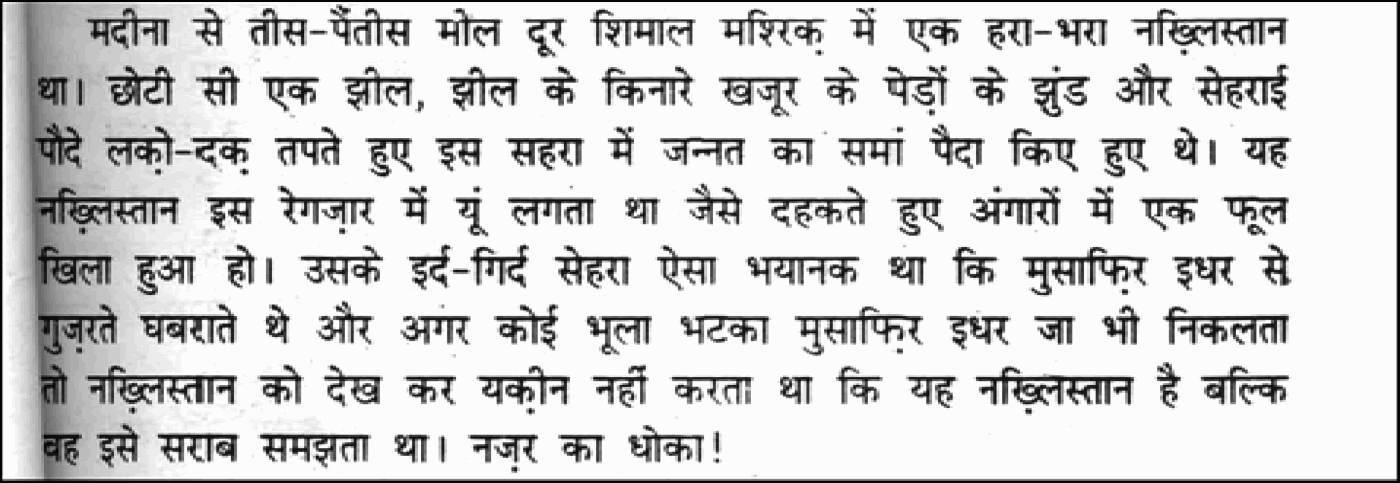
The adoption of Devanagari for Urdu has the potential to obliterate the distinctions between Urdu and Hindi. On the surface level, while Urdu-in-Devanagari looks completely different from Urdu in the Arabic script, it looks quite similar to Hindi. In this section, I discuss the strategies that Muslims are adopting to make Urdu-in-Devanagari different from Hindi. However, a terminological clarification is in order. Ur-Nag texts are not translation from Urdu into Hindi but rather transliteration (Androutsopoulos Reference Androutsopoulos, Georgakopoulou and Silk2009) from the Arabic into Devanagari script.Footnote 13 Below is a paragraph in Urdu in the Arabic script and in the Devanagari script, followed by a transliteration and English translation in (1).
(1) mədina se tis p
 tɪs mil dur ʃɪmal məʃrɪq mẽ həra bhəra nəxlɪstan tha. ʧhoʈisi ek ʤhil, ʤhil ke kɪnare khaʤuɽ ke peɽõ kā ʤhunɖ aur səhrai paude ləq-o-dəq təpte huwe ɪs səhra mẽ ʤənnat ka səmã paida kɪye huwe the. ye nəxlistan ɪs regzar mẽ yũ ləgta tha ʤæse dəhəkte huwe əngarõ mẽ ek phul khɪla huwa ho. (Altamash Reference Altamash2005:3)
‘About thirty to thirty-five miles North East of Madinah, there was a fertile oasis. A small pond, a group of date palm trees on the banks of the pond, and other desert plants had created a semblance of the Heaven in the scorching desert. This oasis in the desert looked like a flower that had blossomed in a sea of flames.’

The above extract is from the novel hejaz ki ãd hi ‘The storm of Hejaz’ by Enayatullah Altamash. It is clear from the example that the Devanagari version is not a translation from Urdu into Hindi. No words or phrases of the original Urdu have been translated; in a typical translation, Urdu words (shown in bold above) such as ʃɪmāl ‘north’, mə ʃrɪq ‘east’, nəxlɪstan ‘oasis’, səhrai ‘desert-like’, and regzar ‘desert’ will be replaced with their Hindi equivalents. In some Ur-Nag texts, however, some minor changes are often made, which involve replacing obscure and archaic words with common Urdu words.
Lost in transliteration
An analysis of the Ur-Nag texts shows that there are two processes of transliteration at work—phonetic and orthographic (Androutsopoulos Reference Androutsopoulos, Georgakopoulou and Silk2009). While the phonetic transliteration allows Muslims to represent in Devanagari the phonemes that make Urdu distinct from Hindi (see the next section), it also results in the loss of historical Urdu spellings containing the phonemically empty graphemes <ﺙ>, <ﺡ>, <ذ>, <ﺹ>, <ﺽ>, <ﻁ>, <ﻈ>, and <ﻉ> (see Background on Urdu and Hindi).Footnote 14 Many advocates of script reform including Khan (Reference Khan and Dalvi1971), who calls these graphemes “dead corpses,” have argued in the past that in order to make the Urdu alphabet more “scientific,” they should be discarded from the Urdu alphabet. These suggestions, however, have never been implemented. The Urdu Script Reform Committee, which was constituted in 1973 to look into the Urdu orthography noted:
The different letters that correspond to the same phoneme [phonemically empty graphemes] have become part of our linguistic inheritance. It is by virtue of these [graphemes] that we have received thousands of valuable words, which are an integral component of our language. (Narang Reference Narang1974:26, emphasis mine)
The Committee's view clearly indicates that although these graphemes may be phonemically empty to script reformers, they are pregnant with meanings to Urdu speakers. The Committee values these graphemes as part of the linguistic inheritance and thus worthy of maintenance. This again provides a good example of the need for an ideological model of orthography, which goes beyond the technical aspects of writing systems and incorporates the social and cultural practices within which they are embedded.
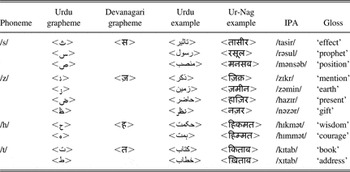
However, this “linguistic inheritance” is not preserved in Urdu-in-Devanagari (see The representation of the Urdu graphemes for two notable exceptions <ﺡ> and <ﻉ>). In both Anchal and Ahadis, for example, all three graphemes of standard Urdu orthography <ﺙ, ﺱ, ﺹ> that stand for the phoneme /s/ are represented by one single Devanagari grapheme <स>. The same holds true of the graphemes <ﺫ, ﺽ, ﻈ, ﺯ>, which stand for the phoneme /z/. The result is that the orthographic difference in standard Urdu orthography between the words <ﻧﻈﺮ> <nəzər> ‘sight’ and <نذر> <nəzər> ‘gift’ has been neutralized in Devanagari as <नज़र>.Footnote 15
Table 1 gives examples that show the loss of these graphemes in Urdu-in-Devanagari. A possible reason for the nonrepresentation of these graphemes could be that the writers may not have access to the original Arabic orthography if they do not know the Arabic script already. I return to this in a later section and explain some of the variation in Urdu-in-Devanagari. The principle of phonetic transliteration is more robustly visible in the representation of the distinctive Urdu phonemes, which contributes to making Urdu-in-Devanagari distinct from Hindi.
Non-representation of Urdu graphemes in Devanagari.

Representation of the distinctive Urdu phonemes
As discussed above, in addition to script, Urdu is distinguished from Hindi by the phonemes /f/, /z/, /x/, /ʁ/, and /q/ borrowed from Arabic. These phonemes are seen as the defining features of Urdu on the spoken level. Khan (Reference Khan1997:245) underscores the significance of these phonemes by noting that “on the spoken level, Urdu can be identified by the following borrowed phonemes from Arabic and Persian: qaf, fe, ze, Ʒe, xe, and ʁain.” Khan here refers to the phonemes by the names of their letters, qaf, fe, and so on, in the Urdu alphabet.
These phonemes are socially quite salient. Knowledge of Urdu is often measured in terms of their correct pronunciation. If someone does not pronounce these phonemes correctly, other Urdu speakers often comment that they have not gotten their ʃin and qaf correct—referring to two of the letters of the Urdu alphabet. In fact, the correct pronunciation of these sounds is so iconic of the “authentic” Urdu speaker that even Mohammad Iqbal (1877–1938), who is considered to be one of the tallest figures of Urdu poetry, was ridiculed by Urdu speakers for not being able to pronounce them correctly. Iqbal was from the province of the Punjab and, like most Punjabi-Urdu speakers, pronounced qaf, the phoneme /q/, as kaf, /k/.
During my fieldwork, I came across some articles in Urdu newspapers that lament the loss of the phonemes among young Urdu speakers and equate it with the loss of the Urdu language. In an article published in the Rashtriya Sahara, one writer gives specific examples of how the Urdu phonemes /q/ in words such as /dɪqqət/ ‘trouble’ and /x/ as in /xərʧa/ ‘expenditure,’ are being pronounced incorrectly as [dɪkkət] and [kʰərʧa] by the younger generation (W. Rahman Reference Rahman2006). He appeals to Urdu speakers to make sure that they pronounce them correctly.
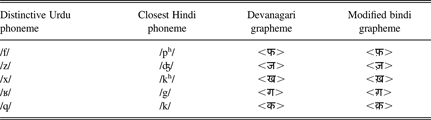
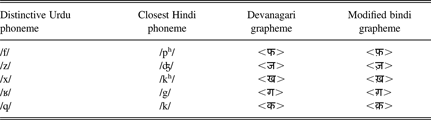
Since these phonemes are not Indic, Devanagari does not have graphemes for them. In Urdu-in-Devanagari they are represented with a diacritic dot—a bindi—placed under Devanagari graphemes. For example, a bindi is placed under the Hindi grapheme <फ> <ph>, which stands for the phoneme /ph/ to represent the Urdu phoneme /f/. Table 2 below shows the original Devanagari graphemes and the modified ones to represent the distinctive Urdu phonemes.
Devanagari graphemes and their modifications.
Although the use of the bindi for representing the distinctive Urdu phonemes has been available since the nineteenth century, it has been historically contested. In 1930, Madan Mohan Malaviya, a very prominent Hindu leader and a staunch supporter of Hindi, wrote an editorial in his weekly newspaper Abhyudaya entitled “hɪndi mẽ bɪndi kyõ?” ‘Why use bindi in Hindi?’, arguing against the use of the diacritic in Hindi for the distinctive Urdu phonemes (Mehrotra Reference Mehrotra2005). In practice also, the bindi diacritic is not used in Hindi publications.
It is interesting to note that in Hindi the bindi is used over some graphemes to represent nasal consonants and nasalized vowels, for example, <चंद्र> [ʧəndr] ‘moon’ and <माँ> [mã] ‘mother’. The diacritic is also used underneath some graphemes to represent retroflex sounds, for example, <ड़>, /ɽ/ and <ढ़> /ɽh/. So the issue is more ideological than technological. Shahid Amin, a renowned Muslim historian, describes his frustration with Hindi publishers regarding the use of the bindi: “I have written a little bit in Hindi and every time it [the manuscript] comes back from the publisher all the bindis have systematically been taken off” (Mehrotra Reference Mehrotra2005:189). Many of my Muslim research participants were unhappy that their Hindu friends did not place a bindi under the Hindi graphemes for the distinctive Urdu phonemes in their names.
The practice of not using bindis for the distinctive Urdu phonemes can be seen in Hindi books, magazines, and newspapers published from India. None of the most widely read Hindi newspapers use a bindi for these phonemes. I studied five online newspapers published from North India, including Dainik Jagran and Dainik Bhaskar, which, according to the 2006 report of the National Readership Studies Council, recorded the highest readership among all newspapers published in India. Dainik Jagran and Dainik Bhaskar, published simultaneously from several cities in North India have a readership of 21.2 and 21 million respectively.Footnote 16
The following extract from Dainik Jagran shows that although the newspaper uses some words containing these phonemes, the bindi is not used to represent them.Footnote 17 The phonemes /x/, /z/, /f/, and /q/ in the words <खालिदा> <khalɪda> , <जिया> <ʤɪya>, <माफी> <mafi>, and <तारिक> <tarɪk> are not marked with the bindi diacritic. To help the reader identify these graphemes, the words containing them are bolded in the example below.
(2) खालिदा जिया के बेटे ने आरोप स्वीकारा
ढाका। हिरासत में रखे गए बांग्लादेश की पूर्व प्रधानमंत्री खालिदा जिया के बड़े बेटे तारिक रहमान ने भ्रष्टाचार में शामिल होने की बात स्वीकार करते हुए इसके लिए माफी मांगी है। … रहमान खालिदा की बांग्लादेश नेशनलिस्ट पार्टी (बीएनपी) के संयुक्त महासचिव हैं। उन्हें ढाका छावनी इलाके में स्थित उनकी मां के घर से गिरफ्तार किया गया था। बाद में उन्हें खुफिया एजेंसियों के हवाले कर दिया गया।.Footnote 18
In contrast to the convention prevalent in Hindi language newspapers, publications in Urdu-in-Devanagari represent the distinctive Urdu phonemes with the bindi diacritic quite religiously. Both Anchal and Ahadis are categorical in the representation of the distinctive Urdu phonemes using the bindi diacritic. Given below is the contents page of the July 2005 issue of Anchal.
Each line in the extract contains the distinctive phonemes represented by the bindi diacritic, circled above for better visual clarity. For example, the very first line below the heading contains two distinctive Urdu phonemes /q/ and /z/ in the words <मुक़ाबला> <muqabla> ‘competition’ and <ज़बान> <zəban> ‘tongue’, and both have been marked with the bindi diacritic. Other examples are /f/ in the word <अफ़साने> <əfsane> ‘stories’, /z/ in <ज़ायक़े> <zaeqa> ‘taste’, /x/ in the word <ख़ास> <xas> ‘special’, <ʁ> in the word <ʁəzlẽ> <ग़ज़लें> ‘poetry’, and /q/ in <qimət> <क़ीमत> ‘value’.
The use of the bindi diacritic makes Ur-Nag texts visually distinguishable from Hindi texts. I argue that in the absence of the Arabic script, the bindi serves as an orthographic contextualization cue for readers that the text in question is Urdu and not Hindi; the bindi has now become invested with the meaning that was indicated by the Arabic script before.
The representation of the Urdu graphemes baRi he <ﺡ> and ain <ﻉ>
The principle of orthographic transliteration to create distance and distinctions from Hindi is evidenced in the representation of two Urdu graphemes baRi he <ﺡ> and ain <ﻉ>. These are two of the phonemically empty graphemes of the Urdu alphabet. Since these graphemes do not have corresponding phonemes, there do not seem to be any linguistic reasons why they should be represented. However, my data shows that they are represented in Devanagari, although not as categorically as the distinctive phonemes.
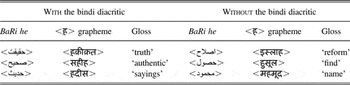
As shown in Table 1, the Urdu phoneme /h/ is represented by the grapheme baRi he <ﺡ> and chhoTi he <ﻩ>, which stand for /ħ/ and /h/ in Arabic. Since Urdu does not make a phonemic distinction between /ħ/ and /h/, baRi he is not pronounced, although it is preserved in Urdu orthography. In Urdu-in-Devanagari, both of these graphemes are represented generally by the grapheme <ह>. In some texts, however, baRi he is represented differently from chhoTi he by placing the bindi diacritic underneath <ह़>. Table 3 gives examples of words containing baRi he with and without the bindi diacritic.
Variation in the representation of baRi he <ﺡ>.

The variation in the representation of baRi he is related to the genre of the text. In Anchal, which largely contains secular texts, baRi he is never represented with the bindi diacritic. In Ahadis, which is a religious text, however, words containing baRi he are often written with the bindi diacritic, although with some variation. This suggests that the ideologies of the people involved in the process of transliteration of religious texts are more conservative. This may be motivated by their desire to preserve in Devanagari, as much as possible, the Urdu-ness of the original text. This could also be a strategy to command religious credibility and authority of the Devanagari texts. Since the difference between these graphemes is not phonemic, only people of religious learning have access to the historical spelling of words containing baRi he. Here one can see the use of orthographic transliteration as a resource to construct authority and credibility.
Another example of the use of orthographic transliteration to create distinctions and distance is the representation of ain <ﻉ> in Devanagari. The letter ain in Arabic stands for the pharyngeal fricative consonant /ʕ/. In Urdu, ain does not have a corresponding phoneme; in some contexts, however, it influences the pronunciation of the preceding vowel. Muslims have chosen the Devanagari schwa-grapheme <अ> to represent ain. Before discussing the innovation and the impact it has on the graphotactics of Devanagari, I give some possible reasons why <अ>, a vowel-grapheme, has been chosen for ain, which is a consonant.
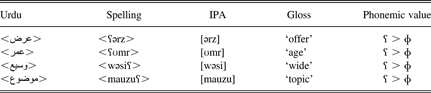
Unlike Arabic, the letter ain is not pronounced in Urdu in word-initial and word-final positions. Many old manuscripts, written in the Arabic script from as late as the seventeenth century, show spellings in which word-final ain is dropped. In his classic book Sabras Mulla Wajhi, a seventeenth century Urdu poet from Deccan, spells words such as <وضع> <wəzaʕ> ‘look’ and <نفع> <nəfaʕ> ‘benefit’ without the final ain (Shirani Reference Shirani1966:260–61). In later developments of Urdu, the letter ain in such words was restored in order to conform to the original Arabic spellings. The data in Table 4 show the zero pronunciation of ain in word-initial and word-final positions.
Zero pronunciation of ain.
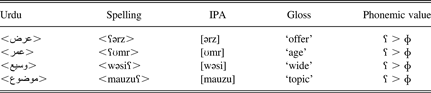
In word-medial positions, however, although ain is not pronounced, it impacts the pronunciation of the preceding vowel by making it long. This is similar to the well-known linguistic phenomenon of compensatory lengthening, as shown in Table 5.
Compensatory lengthening of vowels due to ain.

This may give a false impression that ain is vowel-like. This probably is the reason why Urdu speakers have chosen <अ> to represent the consonant ain. This additional use of the schwa-grapheme, in addition to its normal use as schwa, however, conflict with each other. In order to understand the conflict, it is necessary to discuss briefly some properties of Devanagari.
Devanagari alphabet
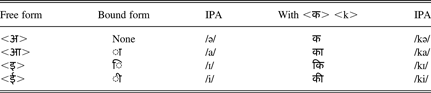
An important feature of the Devanagari writing system is that all consonant-graphemes have an inherent schwa in them, and therefore there is no need to write it separately from the consonants. For example, the grapheme <क> stands for /kə/, the consonant /k/, and the schwa /ə/. A consequence of this is that the schwa-vowel <अ> is written only word-initially, for example in words such as <अचेत> [əʧet] ‘unconscious’, <अकाल> [əkal] ‘famine’. All other vowels have two allographs, positional variants—one is free and the other is bound. The free allograph is only used in word-initial positions; the bound one, which must occur with a consonant, is used word-medially and word-finally.
Table 6 gives examples of some Hindi vowels and their positional variants with the consonant <क> <kə>, as an example. Notice that there is no bound form for the schwa-grapheme <अ> (since it is assumed to be part of consonant graphemes). This feature of Devanagari allows one to write many words of Hindi without writing vowels overtly, for example, the word [kəməl] ‘flower’ can be written just by writing the consonant graphemes <क>, <म>, and <ल>, one after another as <कमल>. This is of course not possible if the word contains vowels other than schwa.
Positional variants of some Devanagari vowels.
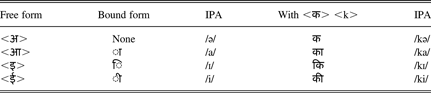
The use of the schwa-grapheme <अ> to represent the Urdu letter ain <ﻉ> conflicts with its original use as a symbol for the vowel schwa /ə/. I mentioned above that the distribution of the schwa-grapheme <अ> in Devanagari is limited to the word-initial position. The Urdu letter ain <ﻉ>, however, is not restricted; it occurs in all positions, for example, <عمر> <ʕʊmr> ‘age’, <نعت> <nəʕt> ‘eulogy’, and <وسیع>, <wəsiʕ> ‘wide’. The word-initial ain fits well with the occurrence restriction of <अ> in Devanagari, and therefore it is written like other words. The ain in word-medial and word-final positions however does not agree with the distributional restriction of <अ>, which is that it can only occur word-initially.
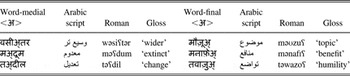
However, this rule of standard Devanagari is flouted by writers of Urdu-in-Devanagari in order to ensure that ain is represented. Table 7 shows examples of words taken from Anchal and Ahadis containing the schwa-grapheme <अ> in word-medial and word-final positions, shown in columns 2 and 5 respectively. Both the word-medial and word-final occurrences of <अ> are unlicensed because a schwa-grapheme is never written word-medially or word-finally in standard Devanagari orthography.
Word-medial and word-final use of <अ>.

However, for Urdu-in-Devanagari writers, the schwa-looking grapheme in Table 7 is not the regular (Hindi) schwa but the Urdu consonant ain. Urdu speakers have reanalyzed <अ> as a symbol for both the schwa-vowel and the consonant ain.
In order to ascertain that the use of the schwa-grapheme in word-medial and word-final positions indeed violates the basic properties of standard Devanagari, I conducted research among Hindi speakers, all of whom were Hindu except one. I administered a survey to nineteen students doing their Master's degree in the Hindi language and literature at Jawaharlal Nehru University, New Delhi. The reason for selecting graduate students was that writing is a learned skill, and therefore students studying Hindi are more likely to be aware of the writing conventions than ordinary speakers of Hindi.
The goal of the survey was to understand how the innovations introduced into Devanagari by Urdu speakers are perceived by Hindi speakers. One of the questions in the survey was whether they had seen words containing the schwa-grapheme word-medially and word-finally, such as <नअत> and <वसीअ>, in print before. The result of the survey shows that 75% or more of the respondents had not seen such words before. This suggests that Hindi speakers are not aware of the innovations introduced by Muslims in the Devanagari script.
The second question was if the spellings of the Urdu-in-Devanagari words containing word-medial and word-final schwa were correct according to standard Devanagari conventions. A majority of the respondents judged such words to be incorrect. In response to the question why they thought the word was written incorrectly, most respondents wrote that in Hindi <अ> is never written after a consonant. Vikas, one of the respondents expressed this convention very clearly: “In the Devanagari script, a vowel is not written in an independent form in the middle of consonants. The vowel <अ> is already inherent in consonants, and therefore there is no need to write it separately.”
It is worth pointing out that this unlicensed use of ain makes the pronunciation of such words abstruse to Hindi speakers, because of the “awkward” graphemic clusters. In such cases, it becomes impossible for them to predict the pronunciation based on the written representation. I asked the participants how they would pronounce the words containing the schwa-grapheme in word-medial and word-final positions. For the word <नअत> <nəʕt> , which is pronounced in Urdu as /nat/, a one-syllable word, taking a cue from the orthography, a majority of them said that they would pronounce it as /nə.ət/, as if it had two syllables. Some of them also said that they did not know how to pronounce it at all. Similarly, for the word <vəsiʕ>, a two-syllable word, which is pronounced in Urdu as /və.si/, a majority of them indicated that they would pronounce it as /və.si.ə/ as if it were a three-syllable word.
The data discussed above suggest that Urdu speakers and writers violate the orthographic constraints of Devanagari in order to preserve the orthographic features of Urdu. Although the letter ain is not pronounced in Urdu in many positions, Urdu speakers still wish to represent it because they would like to transfer the orthographic features of Urdu into Devanagari regardless of their phonemic significance or lack of it. Motivated by the desire to preserve the orthographic integrity of the Urdu language, Urdu speakers have reanalyzed the Devanagari schwa-grapheme in such a way that it stands for both the schwa-vowel and the Urdu consonant ain. In other words, Muslims have turned the schwa-grapheme into a homograph—two graphemes that have the same orthographic shape. If we adopt this hypothesis, then what appears to be a violation of standard Devanagari conventions no longer remains so.
The evidence in support of the claim comes from the practice of using hal/viram, the “vowel killer” diacritic. A hal is used in Devanagari to eliminate the schwa-vowel inherent in each consonant grapheme. For example, the grapheme <क> stands for [kə], but if a hal is placed under it, as in <क्>, the schwa is eliminated; it now stands only for the consonant [k]. If Urdu speakers have reanalyzed the schwa-grapheme as a symbol for the consonant ain, then we should find instances where a hal is placed on <अ>. This indeed is the case. The examples in Table 8 taken from Ahadis support this. Column 1 shows words containing <अ> word-medially with a hal underneath it. Column 4 shows words containing <अ> word-finally with a hal undeneath it.
<अ> with hal.

The use of hal clearly suggests that this <अ> is not the schwa grapheme; it is the consonant grapheme ain. So, if <अ> is replaced with any consonant grapheme in the above examples, the resulting words would be correct graphotactically. Another reason why <अ> in the above examples must be a consonant grapheme is that hal is not used on the schwa-grapheme. It won't make sense to write a schwa-vowel and then get rid of it by placing a hal—vowel-killer—on it.
The representation of ain, unlike the distinctive phonemes discussed above shows some variations. Two of them are worth noting. For example, the word <دعوت> <dəʕwət> ‘invitation’, which contains the letter ain, should have been written like <दअवत> with the schwa in the middle for ain, but it is written like any other Hindi word with a long vowel <दावत>. This means that authors use the orthographic and phonetic transliterations inconsistently in representing the letter ain. This variation is typical of any emerging, yet-to-stabilize orthographic practice (see e.g. Palfreyman & al-Khalil Reference Palfreyman and Muhamed al-Khalil2003; Androutsopoulos Reference Androutsopoulos, Georgakopoulou and Silk2009).
The second variation is more interesting because it is related to the genre of the text. In Ahadis, which is a religious text, the schwa-grapheme for ain is marked with an additional bindi diacritic underneath, similar to the representation of baRi he, to distinguish it from <अ>, the vowel-grapheme. Remember that in Urdu-in-Devanagari in general, the schwa-grapheme is a homograph for the schwa and the consonant ain. In Anchal, for example, the word-initial occurrence of ain <अ> is not different from the schwa-vowel occurence. In Ahadis many occurences of the letter ain are additionally marked with the bindi diacritic under <अ>. Table 9 gives some examples comparing Anchal and Ahadis. Notice that column 1 has <अ> without the bindi, whereas column 2 has bindi-modified <अ़>.
Variation in the representation of ain.

The above examples suggest that religious texts reveal a more conservative approach to transliteration than secular ones. Like baRi he, this may be a strategy to command religious credibility and authority of the Devanagari texts. Remember that Devanagari traditionally has been associated with Hinduism and therefore the writers of Urdu-in-Devanagari must feel the pressure to make it look different from Hindi and assert that the text in Devanagari is as credible as the one written in the Arabic script. Again, the orthographic transliteration is used as a resource to construct authority and credibility.
To sum up, it is clear from this discussion that Urdu speakers are innovating strategies to mark Urdu-in-Devanagari as distinct from Hindi. I discussed two such major strategies: (i) the use of phonetic transliteration as a strategy to represent the distinctive Urdu phonemes, and (ii) the use of orthographic transliteration as a means of representing the Urdu letter ain and baRi he. If my claim about Urdu-in-Devangari as being distinct from Hindi is valid, then we should find evidence from those who are involved in the production and consumption of Urdu-in-Devanagari texts.
Data from Anchal suggests that the readers and publishers both believe that the language of the magazine is indeed Urdu. The co-editor of the magazine, Talib Rampuri, writes a column entitled zəban (Urdu) sʊdʰarẽ ‘Improve your language (Urdu)’ quite frequently. This column publishes a list of “mispronounced” or “misspelled” Urdu words with their correct pronunciation or spelling and meanings provided by the editor. Obviously, the Urdu words and their meanings are all written in Devanagari, but the assumption of the editors, indicated by the title, is that through that column, readers can improve their knowledge of Urdu. In fact, many readers in their letters to the editor acknowledge that they are either learning Urdu by reading the magazine or that their knowledge of Urdu is improving. Vasant Kumar, a reader from Munger in the state of Bihar who is most likely to be a Hindi speaker, writes, ‘Sister! I love poetry, and that is why in order to learn Urdu and improve my language, I have been regularly reading Mahakta Anchal and Khubsurat Andaz for many years. My problem is that none of my ghazals have been selected for publication…’ (Kumar Reference Kumar2005:76). Similarly, another reader, Malti Devi, in the April 2006 issue wrote to the editor that she is learning Urdu by reading Anchal.
In fact, the editors of the magazine suggest that those who are interested in learning Urdu correctly should benefit from the magazine. In response to an angry letter from a reader who was disappointed with the use of the Urdu plural markers /ẽ/ and /õ/ on the English loanword ‘letter’, the editor explains the reason for the use of Urdu suffixes on English loanword by arguing that the beauty of Urdu lies in the diversity of its words and phrases. She further argues that Urdu is quite generous and welcomes words and expressions from other languages, and then she suggests that those who are interested in learning Urdu should read Mahakta Anchal regularly.
Another piece of evidence comes from Sukaina, a young woman from Old Delhi, who reads Fazael-e-Amal, another religious book transliterated into Devanagari.Footnote 19 She represents the younger generation of Muslims who disaffiliate from Urdu and the symbolic meaning it carries. In an interview, when I asked her about the language of the transliterated version of Fazael-e-Amal, she said, “bolne mẽ to wo Ʊrdu hi hæ, lekɪn dekʰne mẽ hɪndi hai” ‘it is Urdu when you speak it, but it looks Hindi [on paper]’. To Sukaina, despite the change of scripts, the language of the book remains Urdu.
The last piece of evidence that supports my claim comes from Mohammad Suhaib, a middle-aged man who was born and raised in Old Delhi. He is self-employed as a publisher of Urdu books. When his publishing work is dull, he also does transliteration from the Arabic script into Devanagari. He has transliterated many literary works including a number of novels based on Islamic history such as The storm of Hejaz, from which I give an extract in Figs. 1 and 2 and in (1). Our conversation about the language of the transliterated novel is shown below in (3).
(3)
MS: Mohammad Suhaib, RA: author
MS: to Ʊsko sirf convert kɪya hæ hɪndi mẽ.
‘So, (we) have just converted it into Hindi.’
RA: əʧʰa.
‘OK.’
MS: ɪs mẽ koi changing nəhĩ ki hæ həm ne.
‘We have not made any changes to it.’
RA: əʧʰa koi changing nəhĩ ki hæ?
‘You have not made any changes?’
MS: koi changing nəhĩ ki hæ ɪs mẽ!
‘We have not made any changes to it!’
Suhaib believes that in doing the transliteration, all he has done is change scripts. Other features of Urdu—for example, the words or the distinctive phonemes—which to him are arguably more critical than the script, have been preserved in Devanagari. He therefore has no doubts that the language of the text in Devanagari is Urdu. Notice that he holds on to his position even after I turned his statement into a question. His ideology about what defines Urdu is drastically different from the traditional view that equates Urdu with the Arabic script.
Urdu in the Arabic script.

Urdu in Devanagari.
Contents page of Mahakta Anchal, July 2005.

SUMMARY AND DISCUSSION
In this article, I have demonstrated that the adoption of the Devanagari script by Muslims for writing Urdu, which has been written in the Arabic script for several centuries, challenges the traditional view that the choice of script is critical in differentiating Urdu and Hindi. Analyzing the recent orthographic practices of writing Urdu in Devanagari, I show that Muslims in India no longer view the Arabic script as a necessary, let alone defining, element of Urdu, nor do they believe that Devanagari is completely antithetical to Urdu and their Muslim identity. In addition, while Muslims have adopted Devanagari, they have not suspended the difference between Urdu and Hindi. Using the strategies of phonetic and orthographic transliterations, Muslims are making Urdu-in-Devanagari different from Hindi, although the difference is much more subtle and nuanced.
The adoption of Devanagari for writing Urdu clearly demonstrates that the ideologies about the Urdu language and its traditional Arabic script are also undergoing a major transformation. The Arabic script, which hitherto was believed to be the differentiating element between Urdu and Hindi on the written level, is no longer ideologized as such. The changed socio-political contexts of postcolonial India have contributed to a re-evaluation and revision of what defines the Urdu language. The innovations introduced by Muslims into Urdu-in-Devanagari allow them to rationalize that the text written in Devanagari still remains sufficiently distinct from Hindi. I show that the consistent use of the bindi diacritic and the novel use of the schwa-grapheme as a symbol for the Urdu consonant letter ain make Urdu-in-Devanagari distinct from Hindi.
This article further suggests that the structure of a writing system—its graphemes and the rules that govern how they combine with each other, that is, its graphotactics—are not a mere technical matter of representation of sounds on paper. I argue that the structure of a writing system is in part constituted by social and cultural factors that involve issues of identity. I show that Muslims are modifying the structure of Devanagari by introducing a diacritic called the bindi to represent distinctive Urdu phonemes. They are also trying to preserve orthographic features of Urdu in Devanagari, for example, the “silent” consonant letter ain <ﻉ>, which is actually phonemically empty. Although the choice of <अ> for representing ain results in unlicensed graphemic clusters in Urdu-in-Devanagari, Muslims still use it in order to ensure that the silent Urdu letter ain is represented.
The emergence of Urdu-in-Devanagari raises an interesting question. Is this a subcultural phenomenon taking place on the margins of the Muslim society? Will the phenomenon fade away with time or will it stabilize? Linguists do not like to make predictions, especially about sociolinguistic situations. Based on the current practices, however, I strongly believe that the phenomenon will stabilize and Urdu will acquire a new outfit in the form of Devanagari. It, however, will undergo a makeover to suit the sociolinguistic needs of Muslims. I further believe that the phenomenon is not marginal because, although Urdu-in-Devanagari is being produced for the Muslim youth, others, especially the middle-generation, is involved in the process of transliteration because they master both the Arabic and Devanagari scripts. In addition, by looking at Urdu-in-Devanagari publications, it is clear that both secular and religious texts are being transliterated. In fact, a large number of them are religious texts, including Muntakhab Ahadis and Fazael-e-Amal. The goal of such books is to bring the youth closer to the Muslim culture and heritage at a time when many older Muslims believe that the youth are drifting away from their values and traditions. Urdu-in-Devanagari is thus a means to inculcate compliance to the cultural norms and values rather than their subversion.
Finally, a word about the macro social and political contexts within which the orthographic practices discussed above are taking place is in order. The Indian Constitution not only gives minorities the right to maintain their languages and scripts but also obligates the states and local authorities to provide the necessary support and institutional structure for their maintenance and growth. These constitutional provisions notwithstanding, the Indian government has failed to create conditions—social, political, and educational—in which the language and script of the Muslim minority can survive and flourish. This gap between the beautiful constitutional provisions and the pathetic educational and linguistic realities on the ground clearly indicates that minority languages and scripts can become marginalized and eventually die out in the shadows of the very constitutions that claim to sustain them.
APPENDIX