Coronary artery bypass graft (CABG) surgery, angioplasty, and non-invasive pharmacological and lifestyle interventions are effective options to improve cardiac blood flow. CABG is the most invasive form of revascularization and requires a lengthy recovery. Patient sex and disease severity affect the choice of cardiac procedure and the achievable benefits (Humphries et al., Reference Humphries, Izadnegadar, Sedlak, Saw, Johnston, Schenck-Gustafsson and Bairey Merz2017; Nielsen et al., Reference Nielsen, Giang, Wallinder, Rosengren, Pivodic, Jeppsson and Karlsson2019). Furthermore, because less research has been conducted with sex-balanced samples in this population, little is known to what degree psychosocial factors affect long-term outcomes for men relative to women (Nielsen et al., Reference Nielsen, Giang, Wallinder, Rosengren, Pivodic, Jeppsson and Karlsson2019).
Behavioral and psychological factors in cardiology
Given over 90% of patients who make it to hospital survive their first MI (Goodman et al., Reference Goodman, Huang, Yan, Budaj, Kennelly, Gore and Anderson2009) and fatal outcomes from the CABG procedures are rare (Keogh & Kinsman, Reference Keogh and Kinsman2004), clinical practice and research increasingly focus on rehabilitation and adjustment, aiming to restore function and quality of life (QOL). Most patients will return to work and most readopt family roles, hobbies and/or social activities within a few months but a substantial subgroup continues to struggle emotionally which in turn may interfere with needed helpful lifestyle changes (Schrader, Cheok, Hordacre, & Guiver, Reference Schrader, Cheok, Hordacre and Guiver2004; Schrader, Cheok, Hordacre, & Marker, Reference Schrader, Cheok, Hordacre and Marker2006). Moreover, associations of outcomes with psychosocial factors remain unclear. In Schrader et al. (Reference Schrader, Cheok, Hordacre and Guiver2004)’ sample, approximately one-third of patients initially depressed after a cardiac hospitalization moved to non-depressed status by 12 months, whereas another third of patients initially non-depressed, who seemingly adjusted well initially, developed signs of depression later in the first year after cardiac hospitalization.
There is extensive research on recovery and adjustment early after CABG surgery but less research delineating knowledge about long-term function, psychological coping trajectories, and their respective associations with subsequent morbidity and mortality. Given some known predictors of poor outcome are not controllable (i.e. genetics, sex, age) it makes sense to focus on risk factors that can be effectively addressed, namely psychosocial variables and health behaviors.
Psychosocial factors, in particular depression, perceived social support, marital status, level of functioning, and household responsibilities, are associated with overall QoL, participation in cardiac rehabilitation, and mortality post-CABG (Goyal, Idler, Krause, & Contrada, Reference Goyal, Idler, Krause and Contrada2005; Jackson, Leclerc, Erskine, & Linden, Reference Jackson, Leclerc, Erskine and Linden2005; King & Reis, Reference King and Reis2012). Over 40% of patients continue to have cardiac symptoms at follow-up, and post-CABG depression is associated with two times greater mortality risk (Blumenthal et al., Reference Blumenthal, Lett, Babyak, White, Smith, Mark and Newman2003). In terms of mechanisms, depression may raise cardiac risk through increased inflammation, endothelial, autonomic and hypothalamic-pituitary-adrenal axis dysfunction, by impairing post-operative self-management, and/or reducing medication adherence (Chen et al., Reference Chen, Zhang, Zhang, Song, Zhang, Liu and Liv2013; Fredericks, Lapum, & Lo, Reference Fredericks, Lapum and Lo2012; Khoueiry et al., Reference Khoueiry, Flory, Abi Rafeh, Zgheib, Goldman, Abdallah and McGinn2011).
While depression is the most studied psychological risk factor in CAD and CABG, low social support is also associated with increased post-CABG mortality (Herlitz et al., Reference Herlitz, Wiklund, Caidahl, Hartford, Haglid, Karlsson and Karlsson1998; Nielsen et al., Reference Nielsen, Giang, Wallinder, Rosengren, Pivodic, Jeppsson and Karlsson2019). Also relevant is the pain experience in recovery from CABG. Significant post-surgical pain affects 25% of patients even 9 weeks after surgery, with more women (36 v.13%) reporting pain with movement (Parry et al., Reference Parry, Watt-Watson, Hodnett, Tranmer, Dennis and Brooks2010). Post-CABG pain may interact with depression and social factors to reduce function in many domains.
In summary, both social support and depressed affect are related to cardiac outcomes in CAD but research has not yet clarified how depression and social support interact to predict their relation to long-term CABG morbidity and mortality outcomes. Given sex differences and lack of previous research including women, there is a benefit to investigating this interaction in a sex-balanced sample.
Sex differences
Research supports that the prevalence of psychosocial risk factors for deleterious cardiac outcomes differs by sex. Clinical depression and depression symptoms are elevated surrounding CABG surgery (~10–40%; Blumenthal et al. Reference Blumenthal, Lett, Babyak, White, Smith, Mark and Newman2003; Humphries et al. Reference Humphries, Izadnegadar, Sedlak, Saw, Johnston, Schenck-Gustafsson and Bairey Merz2017) and depression is diagnosed twice as often in women (Blumenthal et al., Reference Blumenthal, Lett, Babyak, White, Smith, Mark and Newman2003; Nielsen et al., Reference Nielsen, Giang, Wallinder, Rosengren, Pivodic, Jeppsson and Karlsson2019). Of course, patient sex is not a modifiable risk factor but deserves attention because of its differential impact on aetiology, diagnosis, treatment choice and response, as well as engagement in, and success of, cardiac rehabilitation (Bugiardini, Estrada, Nikus, Hall, & Manfrini, Reference Bugiardini, Estrada, Nikus, Hall and Manfrini2010; Humphries et al., Reference Humphries, Izadnegadar, Sedlak, Saw, Johnston, Schenck-Gustafsson and Bairey Merz2017; Jackson et al., Reference Jackson, Leclerc, Erskine and Linden2005). Men are more likely to receive diagnostic angiograms and aggressive medical therapy (Bugiardini et al., Reference Bugiardini, Estrada, Nikus, Hall and Manfrini2010) following CABG, whereas women experience poorer prognosis, higher mortality, and more complications with 61% of the sex-associated variance in early mortality due to differences in age and functional status (Lehmkuhl et al., Reference Lehmkuhl, Kendel, Gelbrich, Dunkel, Oertelt-Prigione, Babitsch and Regitz-Zagrosek2012). Also, women experience more long-term post-CABG pain and physical impairment (Tamis-Holland et al., Reference Tamis-Holland, Lu, Korytkowski, Magee, Rogers, Lopes and Jacobs2013) and despite known benefits of rehabilitation, the drop-out rate of women is 2.5 times that the rate of men (Jackson et al., Reference Jackson, Leclerc, Erskine and Linden2005). Physical activity and roles in the home differ considerably by sex; women spend more time on household activities after CABG surgery and experience greater stress due to these activities (Kendel et al., Reference Kendel, Dunkel, Muller-Tasch, Steinberg, Lehmkuhl, Hetzer and Regitz-Zagrosek2011). Finally, despite known sex differences surrounding CABG, sex-specific analyses are rarely undertaken (Blauwet, Hayes, McManus, Redberg, & Walsh, Reference Blauwet, Hayes, McManus, Redberg and Walsh2007) in part because fewer women undergo CABG. In a very large sample of CABG patients, for example, only 21.3% were women (Nielsen et al., Reference Nielsen, Giang, Wallinder, Rosengren, Pivodic, Jeppsson and Karlsson2019). Given the noted sex differences, medical and psychosocial characteristics need to be studied in a sample with a reasonably balanced number of women and men for adequate statistical power.
Study rationale
The rationale for this study and a previous 1-year follow-up of the same sample (Young et al., Reference Young, Linden, Ignaszewski, Con, Terhaag and Campbell2019) was to investigate psychosocial factors in relation to both short- and long-term CABG outcomes in women and men. Rehabilitation from CABG has at least two distinguishable phases which we somewhat arbitrarily divide into the first year and thereafter (Lear et al., Reference Lear, Ignaszewski, Linden, Brozic, Kiess, Spinelli and Frohlich2003). This first year encompasses medical emergency and hospitalization, revascularization, physical recovery, pain, adjustment to medication-taking and accepting life-style changes (Jackson et al., Reference Jackson, Leclerc, Erskine and Linden2005).
When studying the impact of depression on heart disease, studies on early outcomes following CABG can be difficult to correctly interpret because symptoms of depression surrounding an MI or cardiac surgery may reflect a pre-existing depression or a transient reaction (e.g. reduced physical activity and/or presence of symptoms) that are endemic to cardiac disease or surgery sequelae (Freedland & Carney, Reference Freedland and Carney2013; Lichtman et al., Reference Lichtman, Froelicher, Blumenthal, Carney, Doering and Frasure-Smith2014). To determine whether or not depression has deleterious long-term effects, time and association of symptoms with the disease need to be considered. Following CABG, a negative emotional disposition has to be stable over time and not confounded by the physical symptoms of heart disease itself which will have weakened after 1 year when our assessment was repeated. Research to clarify the role of depression in CABG outcomes is important given the possibility that successful treatment of depression in CABG patients is associated with mortality or cardiac event recurrence. Dutch researchers conducted a clinical trial where cardiac patients were separated into three groups (a) untreated controls, (b) patients unsuccessfully treated for depression, and (c) patients successfully treated for depression (De Jonge et al., Reference De Jonge, Honig, Van Melle, Schene, Kuyper, Tulner and investigators2007). Cardiac event recurrence within 18-month follow-up was 7.4% for the successfully treated, previously depressed patients, 11.2% for untreated controls, but 25.6% for patients whose depression did not lift even following attempted treatment. The fact that only successful treatment of depression positively affected the disease outcome supports the idea of a causal linkage between depression and heart disease.
In summary, this study sought to answer the following questions: (a) Are psychological (depression), socially related (social support, household burden, and marital status), and functional variables (functional impairment, level of cardiac pain), measured post-operatively and verified 1-year later, prospectively associated with disease recurrence, measured as mortality and number of cardiac procedures over 14 years (range 13–15)?; (b) Will the findings change when adjusted for traditional medical and demographic predictors of mortality (operative variables, and disease severity)? (c) Is level of functioning 1-year following CABG more closely associated with long-term outcomes than the same data collected right after CABG? The three main study questions were tested with univariate and multivariate odds and hazards computations.
An additional question (d) is whether or not these findings differ for women and men. Testing this latter question requires a sample with a high proportion of women where sex differences can be systematically studied with adequate statistical power. Sex differences were tested by comparing the subsamples of women and men at baseline and were further investigated by testing interactions of sex with other predictors in the longitudinal analyses.
Methods
Participants
A total of 296 patients were recruited after first CABG (M = 171, F = 125; age range: 36–88 years) from the Provincial Heart Center at St Paul's Hospital in Vancouver, Canada from 1998 to 2000. Inclusion criteria were: age >18 and first CABG surgery. Exclusion criteria: serious medical problems; unstable vital signs; angina in last 12 h; previous CABG surgery; complicated course; insufficient ability to comprehend, read, and/or speak English; and mental illness/behavioral disorder. At 1-year post-CABG, 241 participants (81% of the original sample; M = 137, F = 104; age range: 36–84 years) completed follow-up questionnaires.
Procedures
Patients were approached on day 3 or later after a first CABG + /− valve surgery. With a goal of 250 patients, recruitment continued until 125 women enrolled. Lower rates of women undergoing CABG surgery allowed for continued recruitment of older men over the latter part of the study to increase likelihood of age balancing men and women in the sample. Following CABG surgery participants completed questionnaires in-hospital. To ensure confidentiality and honesty of responding, patients were provided a questionnaire package to complete independently, and an envelope to leave the questionnaire with the nurses prior to discharge. On the rare occasion that a participant requested assistance with questionnaire completion by a nurse or research assistant, it was provided. The same test package was mailed 1-year later. In-hospital charts and Cardiac Services BC provided medical data. Initial questionnaires assessed depression, perceived social support, perceived household burden, marital status, and ratings of pain severity and functional impairment (FI) prior to surgery. At 1-year post-CABG, participants repeated previous measures and rated current pain severity and FI. This study was approved by UBC and Providence Research Ethics Boards; all participants provided written informed consent.
Measures
Medical predictors of long-term mortality risk after CABG
A composite long-term mortality risk score was chosen to index cardiac disease severity over the inclusion of multiple, individual clinical risk predictors, to better capture risk factors with strong relationships to CABG outcomes. Aggregation and weighting of singular factors resulted in a solitary score allowing greater statistical power. NYLT score was also thought appropriate as it was derived from an all-age sample and did not include sex, allowing separate investigation of sex in our study. The Risk Score for Predicting Long-Term Mortality After CABG Surgery, based on the New York State Cardiac Surgery Reporting System (NYLT; Wu et al., Reference Wu, Camacho, Wechsler, Lahey, Culliford, Jordan and Hannan2012) has well demonstrated predictive validity for cardiac mortality in 8597 isolated CABG surgery patients (from July to December 2000) from 33 hospitals in New York State. Significant predictors included: age, BMI, ejection fraction (EF), hemodynamically unstable or shock, left main coronary artery disease, cerebrovascular disease, peripheral arterial disease, congestive heart failure, malignant ventricular arrhythmia, chronic obstructive pulmonary disease, diabetes, renal failure and previous open-heart operations. Weighted item sub-scores are summed to derive a total score. Missing risk factors were coded as ‘no’ in our calculations, as was done with the NYLT database (except for EF).
Functional impairment (FI)
The West Haven-Yale Multidimensional Pain Inventory (WHYMPI; Kerns, Turk, and Rudy, Reference Kerns, Turk and Rudy1985) assessed pain severity and FI using 7-point Likert-type scales. Higher numbers indicate greater pain and more FI. One of 12 subscales, ‘role interference’ is a measure of functional impairment (nine items), and was used in this study. Given expectations of elevated pain and functional impairment immediately after surgery, retrospective assessment for impairment and pain severity were high in this sample (Cronbach's α = 0.91 and 0.80).
Depression symptoms
The Beck Depression Inventory (BDI) is a 21-item scale measuring depression symptoms (Beck, Ward, & Mendelson, Reference Beck, Ward and Mendelson1961). Mean internal consistency in this sample was Cronbach's α = 0.85.
Social support
The Interpersonal Support Evaluation List (ISEL; Cohen, Mermelstein, Kamarck, & Hoberman, Reference Cohen, Mermelstein, Kamarck, Hoberman, Sarason and Sarason1985) is a 40-item measure of perceived social support. Although four subscales exist: appraisal, tangible, self-esteem, and belonging, the overall mean was used in this analysis. Higher scores indicate greater support. The ISEL had high internal consistency in this sample (Cronbach's α = 0.88). Marital status was used as a measure of structural support.
Household responsibilities
The household responsibilities subscale (15 items) of the Marital Roles Questionnaire (MRQ; Buxbaum, Reference Buxbaum1967) assessed household responsibilities including cleaning, repairs, cooking, and paying bills. Responses were modified to obtain a score indicating patient responsibility with 2 = done by patient almost all the time, 1 = done with spouse or others, and 0 = mainly done by spouse or others. This transformation permitted completion by individuals without a spouse. A total score is the mean of 15 items, with higher scores indicating greater patient responsibility. The MRQ had modest internal consistency in this sample (Cronbach's α = 0.61).
Statistical analyses
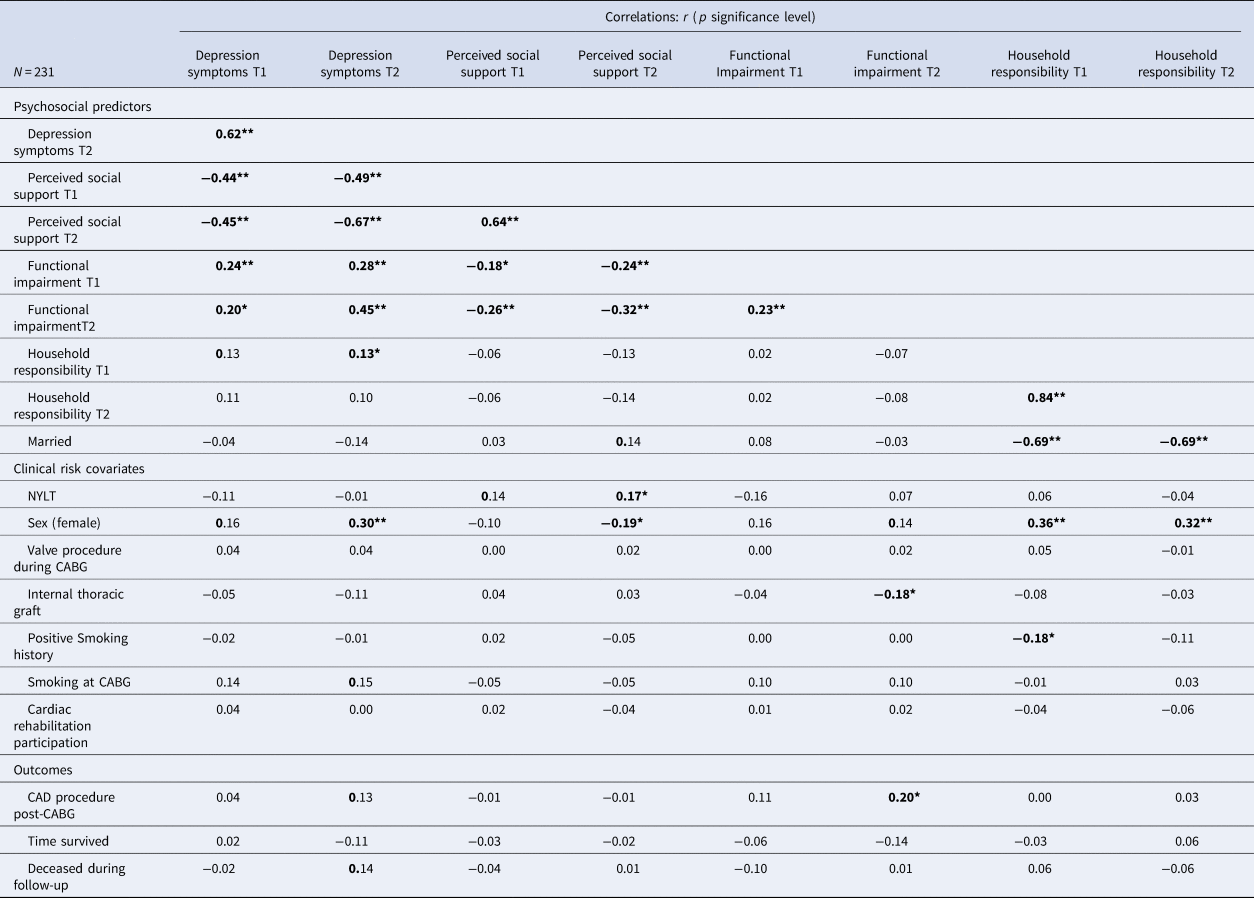
Analyses were conducted using IBM SPSS Statistics v.21. Following data cleaning and tests of statistical assumptions, univariate relationships among variables were described with Pearson's Correlations for continuous or Spearman's Rho for categorical variables. Mann–Whitney U and χ2 tests, as appropriate, were conducted to illustrate unadjusted differences of variables between men and women. Given there were 43 such tests (results are shown in Table 1), we organized the study variables into families of sociodemographic, medical, surgical, follow-up, and psychosocial variables. Holm-Bonferroni adjustments were applied to assure that the interpretation of significance was not overly liberal. This meant that for the four sociodemographic variables a p < 0.025 threshold was required for significance; for the 17 medical variables the significance threshold was 0.004; for the 11 surgical variables it was 0.005; for the two follow-up variables it was 0.05; and for the eight psychosocial variables it was 0.005. For the zero-order correlation matrix (Table 2) we used a conservative p < 0.01 threshold.
Characteristics of participants undergoing CABG surgery

Numbers are means + /− s.d. or column-wise count (valid%) by sex.
For some medical characteristics, data are missing
p values are for univariate Mann–Whitney U tests or chi-square as appropriate.
*CCS = Canadian Cardiovascular Society grading of angina pectoris, ** NYHA = New York Heart Association Functional Classification of heart failure, ***NYLT = Risk Score for Predicting Long-Term Mortality, New York State Cardiac Surgery Reporting System.
Unadjusted correlations among covariates and psychosocial measures, post-CABG surgery

*<0.01, **<0.001.
T1 = during hospitalization from CABG surgery, T2 = 1-year post-CABG surgery, NYLT = Risk Score for Predicting Long-Term Mortality After Coronary Artery Bypass Graft Surgery based on the New York State Cardiac Surgery Reporting System, CAD procedure post-CABG = diagnostic catheterization + percutaneous coronary intervention + open-heart surgery.
There was no similar concern for overly liberal test rests in the two main analyses for the prediction of mortality and CAD procedures because these tests were pre-planned and systematically adjusted for acceptable ratios of a sample size to the number of predictor variables (for more detail below).
The main research questions surrounding prospective associations with long-term outcomes were tested using Cox proportional hazards regression analysis to simultaneously assess the association of several risk factors with survival time. Unadjusted and adjusted hazard ratios (HR) of mortality over follow-up for all psychosocial variables were computed to assess the association of psychosocial variables over and above known medical risk factors. Periods at risk of all-cause mortality were measured in months and defined as the time from 1-year post-CABG (1999–2001) up to mortality or right-censored if death was not reported at 6 months prior to data merger (1 August 2013 to allow for the lag in updating data). Possible inaccuracies in reporting of death or procedures by Vital Statistics BC which could have resulted in lack of data were considered missing at random. All participants experienced on-pump CABG, with mainly saphenous vein and internal thoracic artery grafts. As no obvious change in surgical procedure was observed over the course of the study, survival experience was considered to be similar from surgery experienced throughout the recruitment period (1998–2000).
Logistic regression was used to assess the relationship between individual predictors and the odds of receiving a CAD procedure over the 12 years post-CABG surgery for those who either received a procedure or survived to 12 years without a procedure. ‘Procedure’ was defined as either diagnostic catheterization, percutaneous coronary intervention, or open-heart surgery. A cut point of 12 years was used to maximize time-analyzed and create equal time periods for comparison among participants. This reduced N to 160 and limited the power and number of covariates which could be considered. Hosmer and Lemeshow tests were used to indicate the adequacy of model fit. Due to lack of normality and homoscedasticity in some predictors, all models were bootstrapped to increase the reliability of coefficient confidence intervals. Univariate logistic regression of psychosocial variables was conducted with unadjusted and adjusted models.
For all multiple regression, continuous independent variables were z-transformed resulting in variables with Mean = 0 and s.d. = 1 to ease interpretation of interactions and provide a coefficient describing the change in outcome due to a 1 s.d. increase in predictor, after partialling out the effects of additionally included predictors. Variables were chosen a priori, tested with forced entry and retained regardless of significance. Squared multiple correlations (SMC) indicated no covariates were redundant or too highly associated, with all SMCs below 0.90 (not shown).
All multiple predictor analyses are adjusted for numerous covariates related to medical risk (i.e. NYLT score, sex, cardiac rehabilitation, smoking history, an additional cardiac procedure during CABG and receipt of thoracic artery graft) and baseline measures of BDI, ISEL, MRQ, and FI. This sample contains patients who had both isolated CABG surgery and CABG surgery combined with valve surgery. CABG plus valve surgery may increase the heterogeneity of the sample (Shahian et al., Reference Shahian, O'Brien, Filardo, Ferraris, Haan, Rich and Anderson2009). Independent variables included marital status and 1-year post-CABG measures of depression (BDI), social support (ISEL), functional impairment, household responsibilities and interactions of BDI × ISEL and psychosocial variables with sex to assess differences in hazard between men and women. Considering our goal of the importance of detecting sex differences in predictors, all interactions were assessed within blocks and individually. As age is related to mortality, adjustment for age was considered crucial to these analyses. Although many methods exist, the NYLT score included in our analyses contains an age factor, so was considered a sufficient method by which to adjust the analyses for age and did not require further addition of covariates which may have overfitted the model.
Unfortunately, due to the lower confidence in the stability of results conducted with more than one covariate per 10 events in Cox and logistic regression, simplified models with reduced numbers of covariates were run initially. As relaxing this to 1 in 5–10 may be acceptable, especially to determine adequate control of confounding (Vittinghoff & McCulloch, Reference Vittinghoff and McCulloch2007), full models with all control covariates were then run to assess adequate control of clinical risk factors. Additionally, the significant BDI × ISEL interaction was run in a bootstrapped model with all medical risk covariates. A significant interaction between 1-year BDI and ISEL was investigated by centering ISEL at its mean and 1 s.d. above and below the mean (Aiken & West, Reference Aiken and West1991).
Cases were excluded list-wise for participants lacking complete questionnaires. All prior directional hypotheses were evaluated with one-tailed tests (NYLT, cardiac rehabilitation, smoking history, thoracic graft, BDI, ISEL, marital status, household burden, and functional impairment).
Results
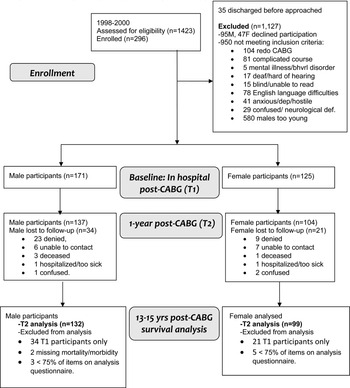
Of the 296 participants in the study, 65 were excluded for analysis of 14-year follow-up (55 due to non-participation at 1-year, 2 due to missing mortality data and 8 due to incomplete questionnaires; see Fig. 1 for further breakdown). Of baseline participants, 83.4% participated at 1-year post-CABG. Follow-up times post-CABG surgery ranged from 13 years to 15 years, 6 months (Median = 14 years, 3 months; Mean = 14 years, 1 month). More men participated early in the study resulting in a mean follow-up for men being 6.86 months longer [Median = 172.42 (s.d. = 3.64) months] than women [Median = 165.56 (s.d. = 7.32) months] (t (165.3) = 9.49, p < 0.0001). Overall, 40.0% of 1-year participants died during follow-up (n = 90); 46 women (46.5%) and 44 men (33.3%; χ2 (1) = 4.10, p = 0.043). A total of 62 participants (27.7%) experienced one or more post-CABG procedures.
Flow diagram of participants through the study process.

Table 1 provides a breakdown of participant characteristics; a number of sex differences were noted at baseline. On average, 1-year post-CABG participants were 65.3 years of age (36–84 years); men were more often married or living in common-law; women were older than men (67.1 v. 64.0 years) and less often working 1 year following CABG (19.6% v. 33.3%). Median NYLT mortality score was 5.0 (95% CI 5.0–6.0), ranging from 0 to 18 and did not differ by sex after excluding baseline participants who did not participate at 1 year. More men had angina with mild exertion [Canadian Cardiovascular Society Angina Classification (CCS = 3)], while more women had a diagnosis of hypertension, hypercholesterolemia, and angina at any level of physical exertion (CCS = 4) and had received fewer internal thoracic artery grafts 48% v. 67%). Women reported higher depression and greater household responsibility at both times, and lower social support at 1-year post-CABG but not immediately following CABG.
The only difference in participant characteristics between completers and non-completers which approached significance was a higher NYLT for female compared to male participants at baseline (U (294) = 8932.0, Z = 2.42, p = 0.015), although NYLT did not differ between baseline and 1-year post-CABG participants (U (294) = 6049.5, Z = 0.86, p = 0.391). After excluding baseline participants who died within the first year and non-completers, mean time to death (107.75 v. 143.54 months) was 35.79 months earlier for non-completers (p = 0.001).
Correlations
In Table 2 unadjusted correlations revealed that depression symptoms (at both times) were negatively associated with social support and positively with functional impairment. Social support also negatively correlated at time 1 with functional impairment; baseline NYLT was associated with greater perceived social support at Time 2. Having a thoracic graft was related to lower functional impairment 1-year post-CABG (i.e. time 2). Number of post-CABG CAD-related procedures was related to a greater functional impairment at 1-year post-CABG.
Survival analysis
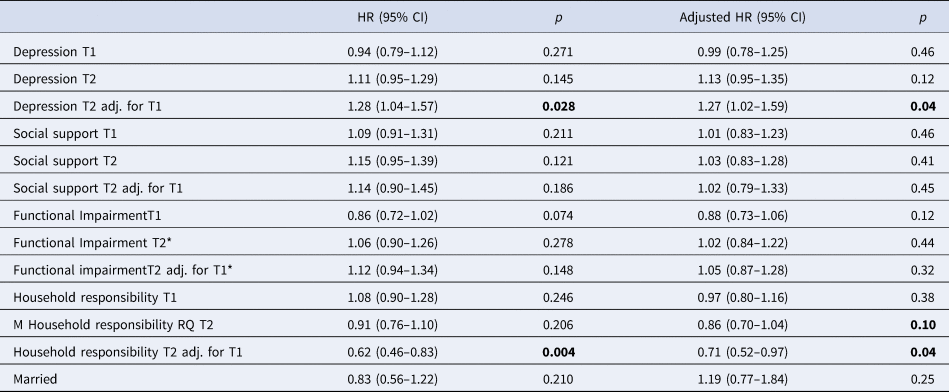
Adjusted and unadjusted HRs of isolated psychosocial covariates indicated statistically greater mortality with elevated 1-year BDI (p = 0.04 and p = 0.028 respectively). Further analysis revealed greater 1-year household responsibility was related to lower hazard of mortality during the follow-up, both alone and after adjustment for baseline clinical factors (p = 0.04 and p = 0.004; see Table 3).
Univariate HRs of psychosocial measures for the hazard of mortality, from 1-year post-CABG surgery to 12 years later (significant p values are bolded)

Multiple Cox regression
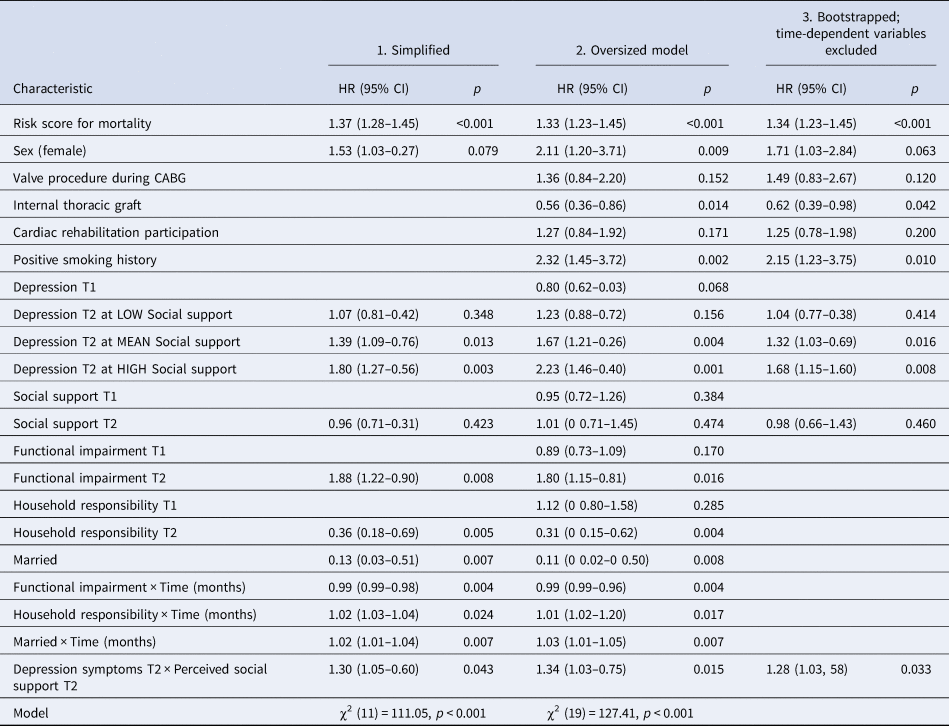
The simplified multiple Cox model (adjusted for NYLT and sex) indicated household responsibilities, functional impairment, marital status (along with household responsibilities, functional impairment and marital status interaction with time) and interaction between ISEL and BDI, was associated with survival time (see Table 4). A fully adjusted model was also significantly associated with time to mortality [−2LL = 812.748; χ2 (19) = 127.41, p < 0.001] with no change in direction or significance of the psychosocial predictors. No additional interactions between psychosocial variables and sex reached statistical significance. NYLT mortality score, sex, thoracic graft, positive smoking history, marital status, 1-year household responsibilities and functional impairment, (along with household responsibilities, functional impairment and marital status interaction with time) and interaction between 1-year ISEL and BDI, was associated with survival time (all p < 0.05). A one-point NYLT score increase, being female and having a positive smoking history were associated with a 33, 211 and 232% increased hazard of mortality.
Multivariate Cox proportional hazards analysis; time from CABG to mortality

Time covariate was set at the first month of follow-up and when viewed with included time interaction, indicates the effect of the independent variable at the first month of follow-up. Time interaction indicates ratio change in HRs from one subsequent month to the month prior (small confidence intervals are indicative of the large number of monthly time intervals).
T1 = during hospitalization from CABG surgery, T2 = 1-year post-CABG surgery, NYLT = Risk Score for Predicting Long-Term Mortality After Coronary Artery Bypass Graft Surgery based on the New York State Cardiac Surgery Reporting System.
Exploration of this interaction used analysis of simple effects of 1-year depression symptoms at varying levels of social support and indicated significant effects of depression at mean and high levels of social support. At low social support (1 s.d. below the mean), a 1 s.d. increase in depression score was associated with a non-significant 23% increase in the hazard of mortality (95% CI 0.88–1.72). At mean social support, a 1 s.d. increase in depression was associated with 67% greater hazard of mortality (95% CI 1.21–2.26). At High social support (1 s.d. above the mean), a 1 s.d. increase in depression scores was associated with 2.23 times the hazard of mortality (95% CI 1.46–3.40). To further assess reliability of the significant depression × social support interaction, a bootstrapped model including all medical predictors along with the depression × social support interaction (nine predictors; one predictor per event) was run and indicated the equivalent significance of depression, social support and their interaction.
Multiple predictor model testing for procedure experienced
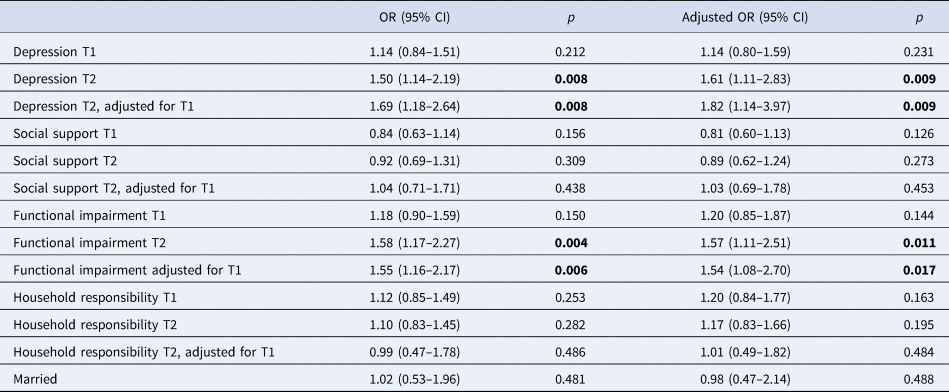
The need for a cardiac procedure was a proxy for disease recurrence. A total of 160 participants retested at year 1 either received a procedure (n = 62; 38.8%) or survived 13 or more years post-surgery without receiving a procedure. Both greater depression and functional impairment at 1-year post-CABG were associated with increased odds of having a cardiac procedure over the following 12 years (see Table 5). No baseline psychosocial variables were significantly associated with outcome individually or after adjusting for clinical risk factors.
Univariate ORs of psychosocial measures predicting CAD procedure during the first 12 years of study period (significant p values are bolded)

Continuous variables OR is for 1s.d. change in predictor.
All CI are bootstrapped.
OR adjusted for NYLT, valve procedure during CABG, internal thoracic artery graft, sex, cardiac rehabilitation participation & positive smoking history.
T1 = during hospitalization from CABG surgery, T2 = 1-year post-CABG surgery, NYLT = Risk Score for Predicting Long-Term Mortality After Coronary Artery Bypass Graft Surgery based on the New York State Cardiac Surgery Reporting System, procedure experienced post-CABG = diagnostic catheterization + percutaneous coronary intervention + open-heart surgery.
Given only 62 individuals with procedures were recorded, only six predictors could reliably be used. Again, the initial multiple LR model adjusted for NYLT and sex. Increased odds of receiving a cardiac procedure were associated with greater depression and functional impairment at 1-year. A one s.d. increase in depression score was associated with double the odds of having a procedure, while a one s.d. increase in functional impairment was associated with 50% greater odds of having a procedure over 12 years post-CABG surgery. These associations remained after further adjustment for all clinical risk factors (NYLT, sex, extra operation during CABG, thoracic graft, Cardiac Rehab participation, and smoking history) and baseline psychosocial risk. The Chi-square for the Hosmer and Lemeshow Test for all models was non-significant and indicated adequate model fit.
Discussion
This study has four core findings: first, mortality risk was prospectively linked with greater household responsibility and interaction of depression with social support (i.e. objectives a and b). Secondly, morbidity, defined as a need for cardiac procedure, was linked with depression and functional impairment (i.e. also objectives a and b). Next, year 1 functional and emotional adjustment status was associated with long-term cardiac outcomes but the corresponding status immediately following CABG was not (objective c). And lastly, no significant sex differences were found among the psychologically-based mortality predictor variables tested in this sample (objective d). The results are discussed in two distinct steps: prospective linkage with mortality v. linkage with event recurrence.
Prospective linkage with mortality
Regarding the psychosocial and functional variables measured at the time of surgery, as predicted, none were significantly associated with hazard of mortality during 13–15 year follow-up. The mortality risk over 13–15 year follow-up was best predicted by a mix of psychosocial, functional, and clinical risk factors when measured 1 year after the bypass.
Nevertheless, our hypothesis that perceived social support would be associated with decreased hazard of mortality and buffer the association between depression and mortality was not confirmed. Failing to find a beneficial main effect of high social support may be due to the fact that support availability may have changed for many participants over the 13–15-year follow-up. Typically, the main support provider is the spouse but given that participants were on average in the high 70 at follow-up and that women were older at baseline many spouses may have passed away by then. Unfortunately, the prevalence data for spousal loss were not available in the databases and despite its plausibility, this interpretation could not be tested.
Results for associations of mortality with depression were complex due to interactions. Depression symptoms measured 1 year after CABG surgery were associated with increased hazard of mortality only when perceived social support was at mean or higher levels. It is unclear why this may be true and any attempt at an explanation will inevitably be highly speculative. It might help to consider how depression, social support and functional impairment could be inter-related. Our measure of social support might have unintentionally tapped another dimension of functional impairment, in that those reporting high social support were actually reporting high need for support and when this is combined with higher levels of depression symptoms, it is associated with greater mortality. It is also possible that this interaction was further impacted by a third variable which we did not test.
Although we had postulated that household responsibilities might confer a greater stressor effect for women and thus poorer outcome, it was actually associated with better outcomes. While not directly measured, it is possible that the individuals with greater household responsibilities carry this role because they were functioning at a higher level and/or found this role inherently meaningful; greater functional expectations may have acted as a motive for rehabilitation. Another side of this same coin may be that those who are functioning poorly in marital, social, familial and recreational domains are also less engaged in their own rehabilitation.
Prospective linkage with cardiac event recurrence
Whether or not a CAD procedure was received over the 13–15 years post-CABG in fully adjusted analyses was associated with greater 1-year depression symptoms and functional impairment. Although symptoms of depression and functional impairment at 1 year were intercorrelated in this sample, and depression has also been linked to physical function in previous studies (Kendel et al., Reference Kendel, Dunkel, Muller-Tasch, Steinberg, Lehmkuhl, Hetzer and Regitz-Zagrosek2011; Sullivan, LaCroix, Spertus, Hecht, and Russo, Reference Sullivan, LaCroix, Spertus, Hecht and Russo2003), they were still independently and additively associated with needed CAD procedures in the adjusted analysis.
Consistent with our findings, depression has previously been related to CAD and procedure recurrence (Lichtman et al., Reference Lichtman, Froelicher, Blumenthal, Carney, Doering and Frasure-Smith2014). Given that CAD is also related to poorer physical function (Olafiranye et al., Reference Olafiranye, Jean-Louis, Antwi, Zizi, Shaw, Brimah and Ogedegbe2012), our findings were expected and reveal additive deleterious effects of depression and functional impairment. It may be that these individuals have lower participation in health-promoting activities, although our unadjusted correlations did not reveal a significant association between smoking or cardiac rehabilitation participation for depression symptoms, perceived social support or functional variables.
Prospective linkage measured right after CABG v. 1-year later
Psychosocial and functional variables measured 1-year after CABG surgery were related to mortality and CAD procedures over long-term follow-up whereas the corresponding characteristics immediately following the CABG procedure were not. The HR for depression right after CABG and subsequent mortality was non-significant (HR = 0.94) but was significant if determined 1-year post-CABG with an adjusted HR of 1.27. The same was true for functional impairment with HR = 1.08 v. HR = 0.62. This supports our hypothesis that assessing the psychological status and providing needed psychosocial interventions later in the recovery process (Linden, Phillips, & Leclerc, Reference Linden, Phillips and Leclerc2007), once individuals have stabilized, may be more effective because at this time continuing (or newly arising) depression is no longer confounded with initial reactions to the surgery.
Sex differences
A major strength of this study was the large subsample of women so that inferential tests were possible with adequate power. As expected, the women were older, more likely to live alone, and reported more depression at the beginning of the study. Prospective linkages of critical variables (namely depression, functional impairment and household responsibility), however, did not reveal sex-specific differential mortality or event recurrence risks (as would have been indicated via significant interaction effects). Given the extensive literature on sex differences in the acute phase of heart disease and its treatment that was summarized above, we were surprised that sex differences were non-existent in prospective linkage tests. On the other hand, this observation is notably consistent with the findings of a very recent, large sample study (n = 3253) of cardiovascular mortality over a 2-year follow-up. Bryant et al. (Reference Bryant, Jannat-Khah, Cornelius, Khodneva, Richman, Fleck and Moisem2020) observed that even though depression was more prevalent in women at baseline, sex had no discernible impact on the prospective, deleterious relationship of depression and cardiovascular death.
Limitations
This study was conducted on a sample of patients who underwent CABG surgery 13–15 years ago. Since that time CABG surgery protocols may have changed, the participation of women has increased in CABG and better and more aggressive medical control of risk factors are in place. Unfortunately, it is not possible to conduct long term follow-up without encountering some confounding via improved treatments over time.
We felt it was appropriate to investigate symptoms of depression instead of a formal depression diagnosis because cardiac outcomes have been related not only to a diagnosis of psychopathology but also symptoms (Frasure-Smith et al., Reference Frasure-Smith, Lesperance, Habra, Talajic, Khairy, Dorian and Roy2009; Schrader et al., Reference Schrader, Cheok, Hordacre and Guiver2004). Our exclusion criteria may have biased our sample. By recruiting patients healthy enough to consent and participate post-operatively we may have missed a subgroup of the most disabled after CABG surgery. On the other hand, this type of bias will also render our results more conservative.
Given we recruited only from one hospital, findings may not readily generalize to patient populations with different characteristics. This was a city hospital that treats patients from diverse cultures; it does have a subgroup of patients from impoverished backgrounds but the typical patient cohort is relatively educated and prosperous. Note also that patient care happened within a universal care, government funded system where all patients receive similar quality of care.
Summary
This study had tracked adjustment of CABG recipients over a mean follow-up of 14 years. The same psychosocial variables were assessed twice, namely within 3–5 days of the surgery and 1-year later. Medical charts and provincial death records provided objective long-term outcome data. Importantly, sampling had continued until an adequate balance of male and female participants was obtained. Overall, depression, household responsibility and functional impairment were prospectively associated with long-term mortality and also to the recurrence of a CAD procedure over and above traditional medical risk factors. Social support was not differentially associated with the main effect for outcomes. Year 1 functional and emotional adjustment status was a better predictor of long-term cardiac outcome than was the corresponding status immediately following CABG. These results were equally relevant for men and women.
Acknowledgements:
We wish to thank Dr Andrea Vodermaier for helpful comments on an earlier draft. British Columbia and Yukon Heart & Stroke Foundation.
Conflict of interest
none