Introduction
All ENT and audiological professionals will be aware of the relationship between exposure to excessive noise and the development of ear symptoms such as hearing loss and tinnitus. In many respects, this is a physiological response by the normal human ear to loud sound, where the symptoms resolve after the passage of a relatively short period of time.
The concept of acoustic trauma is well recognised by those involved in the field of audiological diagnosis and management, and indeed the effect of exposure to short-duration, very high intensity noise has been recognised for centuries.Reference Axelsson and Hamernik1 Historically, acoustic trauma has often been caused by the explosive discharge of weapons, and has therefore been seen in those involved in military duties and those who use firearms on a recreational basis. In this situation, peak noise levels are expected to exceed 137–140 dB (C-weighted), and thus have the potential to physically damage not only the inner ear but also the middle ear, tympanic membrane perforation, for example.
In similar fashion, exposure to long-term or chronic ‘steady state’ excessive noise is also accepted as having the potential to produce sensorineural hearing loss and, as an accompaniment, tinnitus. The typical audiometric diagnostic indicator for this type of ‘industrial’ noise-induced hearing loss includes a notch centred at or around 4 kHz in the presence of high frequency impairment.Reference Coles, Lutman and Buffin2 Indeed, those who have been in active practice over the years may have seen many individuals who have developed occupational hearing loss from this type of noise exposure. This is a potentially compensatable disorder in cases where there has been negligent exposure and there is associated material disability as a result. Traditionally, these cases have been clustered around centres of the country where there has been heavy industry in one form or another. Historically, for example, in Sheffield and South Yorkshire, significant employment was obtained for years, and for many generations, in the steel and coal industries, potentially exposing many thousands to excessive noise. These types of industry are now in decline, and, in particular, with the enforcement of appropriate hearing protection associated with enhanced health and safety considerations, along with various industrial processes now being quieter, this form of industrial injury is also declining.
This review discusses the development of symptoms associated with short-duration loud noise where the levels do not reach those traditionally associated with acoustic trauma; that is, the phenomenon known as acoustic shock. We set out proposed diagnostic criteria, along with some medicolegal considerations in light of a recent high-profile compensation case. With acoustic shock, an individual develops otological and other symptoms as a result of short-duration sound perceived as loud, which, given the current demography of the disorder, chiefly arises in those involved in telephone or headphone use.
Whilst ‘conventional’ or ‘steady state’ noise-induced hearing loss has well-established medical, physical and legally defined concepts,Reference Coles, Lutman and Buffin2 acoustic shock is a relatively new entity. There are statutory requirements in force and extensive case law in respect of steady state chronic noise exposure, which have produced well-defined protocols and codes of practice (e.g. Noise at Work Regulations, 1989),3 but these may have limited applicability in situations where acoustic shock can be sustained. Indeed, these regulations make no provisions specifically for this type of exposure, other than advising using equipment that produces the least possible noise, along with limitations of the duration and intensity of such exposure, with an appropriate work schedule and rest periods. As an example, it can be permissible to expose an individual to a noise level above 80–85 dB (A-weighted) at times but below the statutory peak levels of 135, 137 and 140 dB (C-weighted) within the framework of the legislation, providing the equivalent noise level over an 8-hour working day, or indeed the total noise dose or noise immission level, has not been excessive. Nevertheless, negligent exposure to noise, however it takes place in an occupational sense, opens the door for potential compensation claims if material injury is sustained, and prudent employers and insurers will wish to mitigate against these risks.
Terminology
An acoustic incident is defined as a short-duration loud (or perceived as loud) noise presented to an individual. It can take the form of an interference ‘spike’ in a headphone or telephone earpiece, or within a non-telephonic setting, for example, a domestic burglar alarm or a motorcar backfiring.Reference Hooper4 The acoustic incident need not in fact have involved a negligent exposure, as in the legal sense it need not have been ‘excessive’.
The phenomenon of temporary threshold shift and temporary tinnitus may develop following such exposures, but alongside this is the concept of acoustic startle. This is a possible response to an acoustic incident. The startle response is mediated by vestigial reflexes at brainstem levels, and it can be seen with any sudden-onset, short-duration, potentially injurious stimulus, which need not be acoustic in nature (e.g. a blast of wind into the eyes). This is an innate and normal physiological response that should not be regarded as a disease, damage or injury. Acoustic startle should therefore be taken as a physiological state and is not representative of pathology.
The startle response is very well characterised. It has been used by psychologists as a diagnostic indicator in, for example, those with post-traumatic stress disorder.Reference Asmundson and Carleton5 Grillon et al.Reference Grillon, Morgan, Davis and Southwick6 highlighted that Vietnam war veterans with post-traumatic stress disorder had exaggerated acoustic startle responses and hypervigilance to noise when compared with normal controls, whilst Garner et al.Reference Garner, Clarke, Graystone and Baldwin7 showed that socially anxious individuals have enhanced startle responses when compared to non-anxious controls. Animal modelling has also shown that rats exposed to a social defeat stress paradigm had a prolonged response to acoustic startle that persisted for up to 10 days.Reference Pulliam, Dawaghreh, Alema-Mensah and Plotsky8 It is of interest and probably relevant in a clinical setting that other factors associated with enhanced startle reactions include: childhood abuse,Reference Jovanovic, Blanding, Norrholm, Duncan, Bradley and Ressler9 being the child or grandchild of an individual with major depressive disorder,Reference Grillon, Warner, Hille, Merikangas, Bruder and Tenke10 acute tryptophan depletion in women,Reference Norra, Becker, Herpertz and Kunert11 anger in young malesReference Richter, Deter, Rudat, Schachinger, Zimmermann-Viegoff and Weber12 and smoking in those with post-traumatic stress disorder.Reference Calhoun, Wagner, McClemon, Lee, Dennis and Vrana13 The clinical relevance here is that in those with acoustic shock there are frequently neuropsychiatric and psychosocial components implicated in the development and maintenance of symptoms occurring after an acoustic incident.
Acoustic shock implies the persistence of ear-related symptoms and other symptoms that are no longer physiological or part of the normal startle response. It is important to point out that symptoms can develop in response to noise exposure at levels that fall below the statutory permitted maxima; therefore, in the legal sense, the exposure is not considered to be ‘loud’ or ‘excessive’, although those experiencing it would no doubt disagree. In at least some cases, there seems to be a degree of ‘unpreparedness’ of the individual to anticipate the exposure.
The ‘metal bashing’ and ‘smoke stack’ industries have been replaced with more clerical and telephone-based employment. These new sectors are responsible for the rise in this condition. Some of the earliest reports of acoustic shock come from Australia where there was an early proliferation of telephone call centres, with telephone or headset use being a prominent source of acoustic incidents.
In 2002, Milhinch,Reference Milhinch14 an audiologist in Melbourne, Australia, reported a series of 103 cases in call centre operators who experienced acoustic incidents from headsets. Milhinch considered that these incidents were typically associated with tones of 2.3–3.4 kHz, at intensities varying from 82 to 120 dB, with rise times of 0–20 ms and varying durations. Such exposure effectively ‘gets in under’ the stapedius reflex latency, of up to 100 ms in some cases, where the stapedius muscle on contraction attenuates sound presented to the inner ear by around 15–20 dB.
A later publication, by Westcott,Reference Westcott15 in 2006, concerned acoustic shock injury. Again from Australia, Westcott considered that acoustic shock occurs as a result of exposure to a sudden and unexpected loud sound that produces specific and consistent patterns of neurophysiological and psychological symptoms, including earache, tinnitus, hyperacusis, phonophobia, vertigo and, of particular interest to our institutional unit, other unusual symptoms such as numbness or burning sensations around the ear.
In 2007, McFerran and BaguleyReference McFerran and Baguley16 published a review in this journal discussing acoustic shock; this was the earliest publication to cover this topic in the UK literature. These authors recognised acoustic shock as a clinical entity that arises following an abrupt, intense and unanticipated acoustic stimulus, with the symptoms including otalgia, altered hearing, aural fullness, imbalance, tinnitus, dislike or even fear of loud noises, and anxiety and/or depression.
McFerran and BaguleyReference McFerran and Baguley16 proposed mechanisms for the condition, which included involvement of the tensor tympani muscle (so-called tonic tensor tympani syndrome, popularised by Patuzzi,Reference Patuzzi17 and Klockhoff and colleaguesReference Klockhoff18,Reference Klockhoff and Westerburg19 ). The existence of this disorder has attracted controversy, but it is widely accepted that the tensor tympani muscle is involved in the mediation of the startle response and its innervation is through the trigeminal nerve. On this basis, some of the more bizarre symptoms seen with this disorder, including burning sensations around the ear, a sense of ear discharge, and lancinating pain in or around the ear, are conceivably trigeminally mediated, and so this mechanism provides a plausible explanation.
Surprisingly, an inner-ear component was largely discounted by McFerran and BaguleyReference McFerran and Baguley16 because, in a significant number of individuals with acoustic shock, pure tone audiometry findings are normal. A significant contribution was thought to be more centrally derived (i.e. hyper-excitability of central auditory pathways, and a ‘precursive state of raised anxiety or arousal’), providing an explanation for some of the curious neuropsychiatric components of this disorder. The concept of acoustic shock as a clinical entity has previously been disputed, but in our opinion is now widely accepted. McFerran and Baguley considered it as such, and it has featured in both the current and previous editions of Scott-Brown's Otorhinolaryngology Head & Neck Surgery, within McCombe and Baguley's chapters on noise-induced hearing loss.Reference McCombe, Baguley, Watkinson and Clarke20,Reference Baguley, McCombe and Gleeson21
Characteristics
Our interest in acoustic shock was initially one of clinical curiosity. Our findings in respect of a review of some 30 cases were published in 2014.Reference Parker, Parker, Parker and Parker22 In our series, a significant number of individuals had more than one symptom (average of 3.2 per patient). Tinnitus and otalgia were the most frequent symptoms; other symptoms included hearing loss, hyperacusis, vertigo, and strange and difficult to explain symptoms such as a sense of aural discharge (Figure 1a). An audiometric analysis confirmed what had been previously shown: a significant number of individuals had perfectly normal pure tone audiometry findings (Figure 1b). In respect of our current state of knowledge, there is no defined audiometric pattern for acoustic shock, unlike that for chronic occupational noise exposure.Reference Coles, Lutman and Buffin2 Furthermore, our series showed that around two-thirds of the reported individuals were female, 70 per cent had some form of otopathology, and 60 per cent had neuropsychiatric histories which pre-dated the onset of the acoustic shock.
Audiovestibular symptoms (a) and audiometric findings (b) in a UK case series of 30 patients with acoustic shock. Adapted with permission.Reference Parker, Parker, Parker and Parker22

One of the fascinating aspects of acoustic shock is some of the bizarre symptoms that can accompany the condition. In our series, this included flailing of arms, perception of a burning sensation, a feeling of being electrocuted, paraesthesia and watery discharge, which are not easily explained according to a conventional acoustic or otoneurological basis, but which implicate neuropsychiatric or trigeminally mediated factors. In this respect, conceivably there could well be neurotransmitter abnormalities, such as gamma aminobutyric acid, tryptophan and/or serotonin, especially bearing in mind the link with anxiety and depression.
Around the early 2000s, this disorder started to attract the attention of the UK National Physical Laboratory, the Acoustic Safety Programme, the Call Centre Management Association and the Health and Safety Executive. At that time, the Health and Safety Executive felt that a detailed study of the evidence was required, but considered it too early to say whether it would be accurate to describe the onset of these symptoms as acoustic shock. They noted that these symptoms were seemingly sustained in individuals not normally exposed to levels of noise deemed likely to cause permanent hearing loss, and that even on those occasions where operators were exposed to perceived high intensity noise, such noises would be limited by protection built in to the operators’ headsets, and thus the associated risk was considered to be low.Reference :23 There has been understandable interest in this disorder from various telecommunication authorities. As a voluntary code of practice, headphone outputs have been electronically limited to 118–120 dB SPL,24 well below the statutory permitted peak exposure levels that would be enforced, for example, in a ball bearing factory in Sheffield.
Given the nature of acoustic shock, and considering that it can arise in an occupational setting, the disorder has aroused interest as being potentially compensatable following the usual lines of tort law, with the establishment of a breach of duty and a material disability, which can then sound in damages. These claims need not of course be related to telephone-based employment, and it is important to reiterate that any such exposure need not in fact be negligent.
Goldscheider versus Royal Opera House
Court proceedings are a matter of public record, as is the associated documentation involved in the disclosure process and formatting of trial bundles. Most recently, the senior author was asked to undertake an assessment of a then potential claimant who alleged sustaining material injury during his course of employment as a viola player with the Royal Opera House Orchestra, Covent Garden, London. Indeed, this turned out to be the most high-profile acoustic shock case yet in the UK. The case was heard in the Royal Courts of Justice between 30th January and 9th February 2018, and judgment was given on 28th March 2018.25
In summary, the claimant, Christopher Goldscheider, was employed by the Royal Opera House Covent Garden Foundation (the defendant) as an orchestral viola player. During the course of a rehearsal of Die Walküre by Richard Wagner, on Friday 31st August 2012 and Saturday 1st September 2012, the orchestra formation was re-organised in such a manner that the claimant was positioned immediately in front of a group of about 18–20 brass players. The claimant alleged that as a result of the sound level at which the orchestra was directed to play, and indeed for the length of time required, he was exposed to noise at a level which in legal terms was deemed excessive. The claimant was provided with and was wearing hearing protection, but it was alleged that this was insufficient to prevent his exposure to this potentially injurious noise.
The claimant remained in employment with the defendant until July 2014, although he was unable to continue working as a result of the alleged exposure from September 2012. Evidence was adduced that he was provided with earplugs, with a 9 dB attenuation, shortly after he joined the orchestra in 2002. The claimant also had access to ear protection, which provided up to 28 dB of attenuation, but this degree of sound reduction made it difficult for him to hear other instruments (particularly during quiet passages), instructions from the conductor and the claimant's own instrument. During the afternoon rehearsal on 31st August 2012, the claimant thought that the noise was abnormally loud. He felt that having so many brass instruments playing directly behind him in a confined area created ‘a wall of sound’ that was completely different to anything he had previously experienced.
The claimant told the Court that he found this noise to be excruciatingly loud and painful, particularly in respect to his right ear because the principal trumpet was directed to that side of his head. As a result of a complaint made by the claimant, personal noise dose meters were attached to various musicians, including one placed on the claimant's right shoulder. During a particularly loud passage, the claimant started to develop earache, particularly on the right side, together with increasing dizziness, and felt unable to work after that weekend.
The claimant attended his general practitioner in early September 2012 and a diagnostic link was made with the noise exposure, for which he was given decongestants and prochlorperazine. The claimant was subsequently seen by the defendant's occupational health adviser, who performed an audiogram. The findings showed a significant deterioration in hearing in the high frequencies in his right ear. There was also tinnitus and hyperacusis. He was later seen by various eminent ENT and audiological specialists, and audiovestibular medicine practitioners, who thought his symptoms were noise exposure related. The claimant was treated initially with steroids in an attempt to resolve his ear symptoms, but without significant effect. Subsequent pure tone audiograms consistently confirmed high frequency hearing loss.
Mr Goldscheider attempted to return to work on numerous occasions, but was not able to resume full duties, and he was no longer able to play in an orchestra as a result of continued ear symptoms. Of interest, it was noted by the Court that other members of the orchestra, in particular another viola player, also felt that the noise levels were too high during these index rehearsals. Analysis of the noise dosimeter data revealed that the claimant was playing in fluctuating excessive noise levels and with a significantly elevated 8-hour equivalent value.
When the claimant was assessed by the senior author in 2015 on the instruction of his solicitors, it was noted that after finishing the rehearsal on 1st September, his right ear felt not as it should: he was experiencing pain, dizziness, a blocked sensation and ‘feeling strange’. On the account given at this assessment, the right-sided hearing loss developed immediately, as did hypersensitivity to sound in his right ear. The claimant also became aware of a high frequency ‘electricity pylon sound’ tinnitus in both ears, worse on the left.
The otoscopy examination findings were normal, and there was diffuse unsteadiness on Romberg's test but without lateralisation. On Unterberger's stepping test on that occasion, there was deviation to the right. Pure tone audiometry showed high frequency hearing loss in both ears, worse on the right, which was consistent with the other post-exposure test findings. A semi-circular canal dehiscence had been excluded on previous scanning.
During the hearing at the Royal Courts of Justice, a significant number of publications dealing with acoustic shock were reviewed, as well as the contents of the then current edition of Scott-Brown's Otorhinolaryngology Head & Neck Surgery (7th edition).Reference Baguley, McCombe and Gleeson21 The defendant's expert contended that the claimant's ear symptoms had nothing to do with the alleged index exposure, and instead claimed that they resulted from coincidental and unrelated hydrops (i.e. Ménière's syndrome/Ménière's disease). The Court took into account that acoustic shock could be caused by peak exposure levels in the range of 82–120 dB.Reference Milhinch14
The Court found that the Royal Opera House did not inform the claimant, or indeed other players, of the mandatory requirement to wear hearing protection when the noise was likely to be above the upper action level, and determined that it was not adequate to leave this matter to the musicians to judge for themselves. It also found that the defendant had exposed the claimant to noise levels in excess of the statutory permitted maxima, and noted the contemporaneity and indeed temporal nature that existed between the alleged index exposure and the onset of the symptoms.
The Court found a clear factual and causal link between the breaches of the relevant regulations (the high level of noise during the index rehearsals) and the onset of symptoms. The Court upheld the claimant's case that he developed acoustic shock as a result of this index exposure, discounting the ‘coincidental’ onset of an idiopathic condition (i.e. Ménière's disease) during the course of the rehearsals.
Her Honour Dame Nicola Davies, the presiding judge, further felt that the diagnosis of acoustic shock was substantiated given the nature of the exposure, the absence of low frequency hearing loss, the documented symptom pattern and the absence in the extensive medical records (and indeed multiple consultations with eminent ENT, audiovestibular and medical audiological practitioners) of a Ménière's disease diagnosis. On this basis, causation was established and the Court concluded that the claimant had sustained a material injury which sounded in damages. The award was to be over £700 000. Not surprisingly, bearing in mind the size of the damages and the potential seismic impact upon the performing arts industry, this case went to the Court of Appeal, but the initial findings were subsequently upheld.
Recent developments and diagnostic criteria
Recent work has tried to tie in the more unusual symptoms in the evaluation of this potentially complex disorder. Indeed, as has been discussed above, some of these symptoms seem distinctly trigeminally mediated, and activation of the ‘trigeminal cervical complex’ has been postulated.Reference Londero, Charpentier, Ponsot, Fournier, Pezard and Norena26 Indeed, Norena et al.,Reference Norena, Fournier, Londero, Ponsot and Charpentier27 in 2018, demonstrated metabolic abnormalities in muscles around the temporomandibular joint, and in some respect there are similarities between temporomandibular joint dysfunction and at least some of the symptoms described. Furthermore, Londero et al.,Reference Londero, Charpentier, Ponsot, Fournier, Pezard and Norena26 in 2017, purported to show abnormal middle-ear muscle action in an acoustic shock affected ear, reinforcing the role of the tensor tympani muscle in the production of some symptoms.
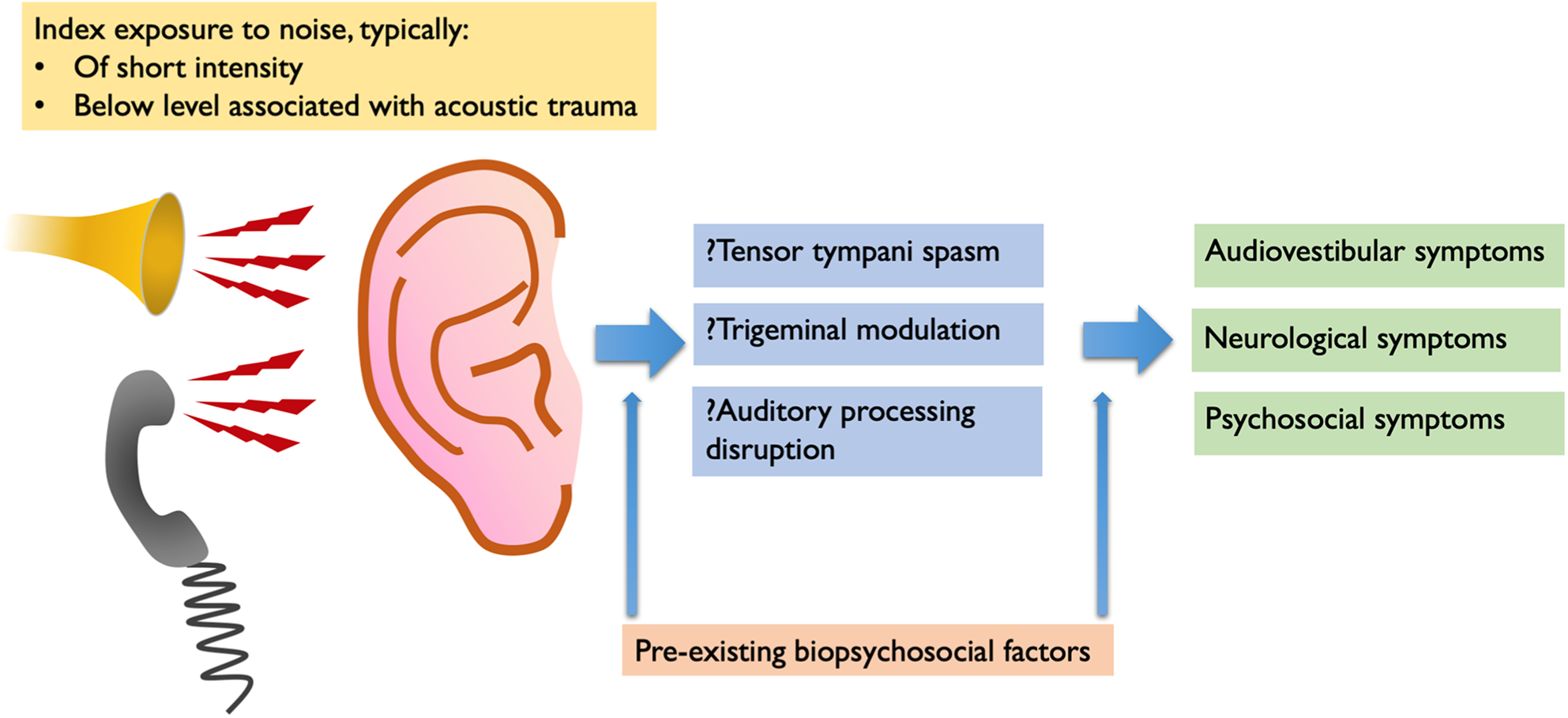
Having accepted acoustic shock as a clinical entity, its diagnosis is based upon the usual rules of engagement in clinical practice, once competing diagnoses are excluded. That is, there has to be a defined acoustic incident from which ear symptoms should commence straight away or shortly afterwards, and these need to be outside the physiological or startle response. The ear symptoms should be experienced in, or arise from, the exposed ear(s). Of particular interest are the ancillary and not necessarily ear-based symptoms that can accompany acoustic shock and indeed form part of the disorder, bearing in mind the neuropsychiatric component. These are highly relevant in subsequent disability and illness behaviour (Table 1 and Figure 2).
Proposed diagnostic criteria for acoustic shockReference Parker and Parker28

Conceptual figure illustrating the natural history of acoustic shock.

There is no doubt that individuals presenting with these symptoms following exposure to an acoustic incident form an increasing case load. Furthermore, with the expansion of call centre employment, and in the light of increasing compensation claims, there will be some inevitable implication in respect of employee selection for work in this industry. Clearly, the findings of a simple pure tone audiogram cannot predict who will go on to develop acoustic shock, and will serve only to identify those with pre-existing otopathology. Whilst it is categorically difficult to make stipulations in this respect, individuals who seem most at risk are middle-aged females with a previous neuropsychiatric disorder. No doubt further reports will clarify the clinical aspects, and forthcoming claims will define the legal parameters as these cases go through the courts.
Competing interests
None declared