


I would like to point out an odd consequence of the role that broadly pragmatic considerations regularly (and reasonably) play in determining moral demands. As a result of the way in which moral demands are formed, it turns out that people will frequently become morally good in a strange and rather dubious way.
Consider the following social states of affairs, which compare the level at which people are morally expected to contribute money to good causes, and their actual contributions (within a given period). For now, we need not consider why there are differences in what is morally expected in the two worlds, and merely compare the patterns of the relations within each world, between expected versus actual contribution. Let us also assume, for the time being, that every person in a given world contributes equally, and sidestep the question of economic inequality among them.
Contribution (in units of after-tax income)
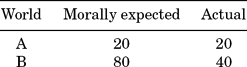
In World A, people are morally expected to contribute 20 units, and they do so. They thus fulfil all their moral obligations. In World B, by contrast, people are morally at fault (barring excuses etc.), since they contribute only half of what they are morally expected to. But notice that in World B people in fact contribute twice as much as they do in A. This shows that there are two distinct ways in which a person can be morally good (there are other ways as well, but they do not concern us here):
(1) By following the moral rules, and thus meeting the moral demands.
(2) By doing good deeds (e.g., giving money to good causes).
The two are different, as we can see at once by thinking of people who do good deeds that go beyond what morality demands. And indeed in our Worlds A and B, criteria (1) and (2) clearly pull in opposite directions. In World B people do much better (twice as well) with respect to criterion (2), as they contribute 40 instead of 20; but only 50 percent as well in fulfilling criteria (1), since they contribute 40/80, instead of 20/20. Which is more important, (1) or (2)? That is a difficult question. But fortunately we need not decide upon it here, and can proceed to a comparison of Worlds C and D. We are assuming that these two worlds are as similar as possible, aside from the difference in moral demandingness.
Contribution (in units of after-tax income)
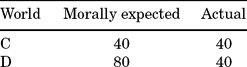
Now there is no cause for hesitation, since C is better than D overall, when taking into account both of the criteria. From the perspective of doing good – criterion (2) – C is just as good as D, as in both people contribute 40; while from the perspective of fulfilling the moral obligations – criterion (1) – C is better than D, as people contribute all that they are expected to. If one world is just as good as another from one aspect, and better from a second aspect, then, assuming that those two aspects are the only relevant ones, the first world is better.
Let us assume that 40 is, realistically, the most that we can expect people to contribute. Given human limitations, people being what they are, we cannot realistically expect more than 40. If this is so, we have good reason to require 40; namely, opt for World C. We will then get 40, the most that we can, and not create the drawbacks of World D, whereby people are made to feel morally inadequate, inducing guilt and dissatisfaction both with themselves and with the prevailing moral demands – to no avail. Recall World B, in comparison with A: admittedly, in B those drawbacks existed just as much as in D, but given the possibility of eliciting a contribution twice as high (a contribution of 40 instead of 20), perhaps it was worth it. That would depend on the comparative weight we give to criterion (1) as compared to (2). But given that D does not generate a greater contribution than C, there seems to be no reason to prefer D over C. The morally best world, if only C and D are being considered, is, then, C. Placing the moral demand at 80, as World D does, seems to be a mistake.
But why is 40 the most that can be expected? This is an empirical question: sometimes we can achieve more by raising the moral demands, but sometimes doing this, beyond a certain point, will be counter-productive, as people will perceive the demands as too high and lower their contribution. A useful analogy here is taxation. It is a commonplace that taxes cannot be raised indefinitely, without at some point leading to a high level of tax evasion, which will reduce overall revenue.
We can also imagine that instead of World D we have World E, where once the requirement for contribution is raised beyond 40, the actual contribution will proportionally begin to fall below 40 (so that a requirement of 41 will produce 39, a requirement of 42 will produce 38, and so on). Then it becomes even clearer that we should require no more than 40.
Yet this means that we have ended up with a very odd result. The reason why the bar is at 40 is that people are not sufficiently good to be willing to go above it. Either they will remain at 40 however much we ask of them (as in World D), or, worse, demanding more than 40 will even lower the contribution (as in World E). In any case, given human limitations, 40 is the optimal level of moral requirement. When people then go on to meet that requirement, they are morally good, in the sense of completely following the moral rules, and so fulfilling the moral expectation. But this means that people become morally good (completely meeting their moral obligations), because those obligations have been lowered, given that people are not good enough to meet higher obligations. People are not so good, and this, by being a pragmatic consideration that reasonably affects where we put the moral bar, makes it easier to jump over that bar, and thus people become good. Being not very good ends up making us – in one important sense – morally better.
Let us consider a number of possible objections. First, it might be objected to the original scenario that if indeed people cannot give more than 40, then there is no issue here, for they ought not to be asked to do so to begin with, since ‘ought implies can’. But this interprets matters too literally. It is not that people cannot give more than 40, but that, realistically, it is highly unlikely that the vast majority of them will do so, whatever the moral requirement. There will, however, be individuals who will give more, and these help to show that the problem is not one of strict impossibility.
It might, then, be countered that in that case, the very assumption we started with, i.e. that people will at most contribute 40, is itself shown to be untrue, for I myself admit that there are individuals who are ready to give a great deal more. But I do not need to deny this. There should always be room for supererogatory action, but the moral baseline should not be at the level of the rare person of extreme generosity. Again, it is an empirical question (analogous to taxation) which asks what can be expected of most people, but if something like 40 is the realistic reply, then arguably that, roughly, is where the bar should be set. As we saw with World E (where increasing demands beyond 40 results in decreasing returns), raising the bar of moral demands can be not only pointless, but also counterproductive.
Third, it might be objected that on some matters we should not allow much room for what can be called ‘moral pragmatics’. Some things are morally wrong, and ought to be forbidden, irrespective of pragmatic considerations. But once again, I have no need to object, as I have not claimed that the problem that I am pointing out pertains to all of morality. As long as it pertains to some significant parts of it, this matters. Similarly, my argument does not apply to a society of heartless misers: in such a society we might feel morally obliged to condemn everyone, simply because they are not willing to contribute anything (and we might do so irrespective of pragmatic considerations). The present argument is set in the context of fairly generous people, within the realistic confines of contemporary societies. The point remains, nevertheless, that a central reason for not requiring contributions of 60, or even 80, instead of 40, has to do with the limitation in people's goodness. I do not need to claim that pragmatic considerations are always over riding; it suffices for my case that sometimes they will be significant in determining the level of moral demands.
I emphasize that my point is not that pragmatic considerations will affect what we tell people about morality; so that, although morality really requires a contribution considerably larger than 40, society will demand only 40, once it realizes that requiring much more is likely to be pointless or even counterproductive. My point is deeper: within certain limitations, the content of true morality will be affected by human limitations. The claim is this:
(a) The demands of morality take into consideration human nature and its implications (there will be weighty morally relevant reasons to do so).
(b) Human nature is often not very admirable, and human beings are not in general very impressive, morally.
(c) As a result, moral demands will frequently not be too demanding.
(d) Most people might well, then, meet those moral demands.
(e) People who fulfil the demands of morality are prima facie morally good.
(f) Many people thus become morally good because we have lowered moral demands, since morally people are not very good.
But are not the higher criteria that I need in order to evaluate human beings, and find them lacking, shown by my discussion to be morally incorrect criteria? That would be going too far, in allowing only pragmatic considerations to be relevant to our moral judgment. We can see why contributing 60 is more admirable than 40, and evaluate (independently of pragmatic considerations) that morally impressive creatures would be ready to contribute 60 (as some people currently do). The only reason why the moral demand is not at 60 is that most people would not be ready to meet this demand. But while this sort of pragmatic consideration can be (as I have argued) decisive in determining the adequate level of moral demands, it cannot be the only perspective from which we view ourselves; in particular, it cannot alleviate the discomfort we feel, once we know the reason why the demand has been set so low.
Notice that my argument does not even depend on the idea that demanding more than can be realistically expected is always pointless (if not counter-productive). That assumption was a helpful simplification, but it is not essential. Perhaps some social ‘over-demandingness’ will occasionally enhance the result, ‘pulling’ most people higher than they would otherwise go (if still not all the way to fulfilling the actual demands made). Perhaps, even, a measure of moral guilt – resulting from demands one does not quite meet – can be functional. Yet the point still remains that at some stage we can pose demands that are too high, in pragmatic terms, and that this matters. When that is the case, we will typically have the effect I am showing, whereby people end up being morally good because they meet demands that have been lowered in lieu of their being morally not very good.
Let us go now beyond the example of giving money to good causes. The perplexity that I have pointed out applies in many places. Pragmatic considerations concerning human limitations, as represented by our frequently saying things such as ‘People being what they are. . .’, or ‘It's just not in human nature to. . .’ reasonably affect what we expect. It is perhaps shabby of people to become jealous if their spouse falls in love and has an affair with another man or woman, and to feel anger, resentment, or even hatred. But it is not realistic to expect otherwise (and there are biological explanations why we have evolved in this way). Thus we have very little expectation of people not to be jealous, angry, resentful, or hateful in such contexts: we put the bar, here, very low. Of course we do not morally (or legally) condone violence towards one's partner in such contexts, but feeling jealousy (and the accompanying emotions), in itself, seems perfectly acceptable to us. This is not because morality does not apply to emotions: being envious of the happiness or success of one's child, for instance, is not as a rule looked upon kindly, and we may be quick to condemn it morally. But in the context of marriage (or its equivalent) we have few expectations for the absence of jealousy and the accompanying emotions, in a case such as I have described. Again, there might be the odd man or woman who would not become jealous, nor feel any anger, resentment, or hate, in such a situation, and we might come to think of this as admirable. One might be admirably lacking in such emotions since one is happy for the person one loves, that this person has found his or her true love (which, alas, happens not to be oneself). But, people being what they are, in such a context morality cannot realistically require the absence of jealousy, anger, resentment, and even hate, at least in the short term.
I emphasize that my argument is not confined to some particular normative theory. It does fit nicely within rule-utilitarianism, for World C (which morally requires 40, and receives it) indeed seems optimal from such a perspective. It would also be difficult to defend a contractualist case for requiring more than 40, or for morally expecting the absence of jealousy, in the two scenarios we have examined, respectively. And since I take it that the people willing to contribute 40 are fairly generous, it is not clear that even a Kantian perspective would insist on raising the moral bar considerably above 40, when it is foreseen that this would only decrease people's contributions and discredit morality in their eyes (as in World E). If my interpretation of the examples is compelling, then their intuitive force will be widely apparent in a way that does not depend on particular theoretical commitments.
It should not be difficult to provide further examples. But the point, I take it, has been shown: given that we have good moral reasons to allow pragmatic considerations to affect the way we form our moral rules, we shall sometimes get a very odd result. Because human beings are not very good, we will lower our moral demands and, as a result, most people will turn out, in an important sense, to be morally good. Our relative badness, by giving us good reasons to limit moral demands, makes us morally good.


