The Banking Act of 1935 gave the Federal Reserve the power to double member bank reserve requirements. In 1936 and 1937 it used this power to reduce the extraordinarily high level of excess reserves. It did so not to reduce the then-prevailing level of bank credit or the money supply, but to avoid excessive credit growth in the future. This action has, however, been blamed for generating, or at least exacerbating, the short but sharp recession of 1937/38. It has generated much debate, mainly because of its bearing on the role of monetary policy in the Great Depression.
The main issue in this debate is whether banks held the excess reserves because they lacked profitable lending opportunities, or because they wanted to hold large precautionary balances. The difficulty in distinguishing between these two possibilities is that no adequate measure of the demand for bank credit is available. To avoid this problem we compare the reserve behavior of member and a subset of nonmember banks, which were not subject to the higher reserve requirements. The data are biannual for the period from June 1934 to June 1941. If member banks increased their total reserve ratios because of a decline in the demand for bank credit, then on the reasonable assumption that there was no concurrent change in the relative volume of credit demand from member and nonmember banks, the total reserve and loan ratios of member banks and nonmember banks should have behaved in the same way when member bank reserve requirements where raised. By contrast, if member banks held their large excess reserves as precautionary balances, and responded to the increased reserve requirements by restoring their excess reserves, then relative to nonmember banks their cash reserve ratios would have increased and their loan ratios would have decreased.
INSTITUTIONAL BACKGROUND
Prior to the 1935 Banking Act member banks' required reserve ratios were set by legislation, and differed (as they did for a long time afterwards) depending upon whether a bank was located in one of the two central reserve cities (New York and Chicago), a reserve city (there were about 50 of these with the exact number varying over time), or elsewhere. Reserve requirements for nonmember banks varied from state to state, both in their level and in their composition. For example, some states allowed their banks to hold a certain proportion of their required reserves in U.S. government securities or in securities issued by that state. Others required vault cash and interbank deposits. This makes it impossible to calculate excess reserve ratios for nonmember banks in a manner that would be comparable to the excess reserve ratios for member banks.
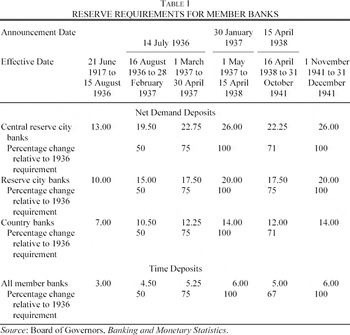
As Table 1 shows, in 1936 the Fed raised reserve requirements of member banks on both demand and time deposits by 50 percent. In 1937 it raised the requirements on demand and time deposits by a further 33 percent, thus doubling them from their 1935 level. This still left the banking system as a whole with sufficient reserves to meet its legal requirements, though some banks in large cities had insufficient reserves.1
Roos, Economics, p. 104.


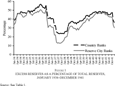
FIGURE 1 EXCESS RESERVES AS A PERCENTAGE OF TOTAL RESERVES, JANUARY 1934–DECEMBER 1941
PREVIOUS LITERATURE
Milton Friedman and Anna Schwartz argued that most of these reserves in excess of the legal requirement were not excess in an economic sense: banks wanted to hold them because they were afraid of further bank runs, having learned from their experience in 1930–1933 that they could not rely on the Fed to act as a lender of last resort.2
Friedman and Schwartz, Monetary History.
For the 1960s and 1970s, see Brunner and Meltzer, “Liquidity Traps”; Frost, “Bank's Demand”; Horwich, “Effective Reserves”; and Morrison, Liquidity Preferences. For recent works, see Calomiris and Mason, “Consequences”; Graham, “Commercial Bank Reserve Adjustment”; Lindley, Sowell, and Mounts, “Excess Reserves”; Meltzer, History; Mounts, Sowell, and Saxena, “Examination”; Ramos, “Bank Capital Structures”; and Telser, “Higher Member Bank Reserve Ratios.” Roos, (Economics, pp. 302–03) provides a survey of the earlier literature. Hirsch and de Machi (Milton Friedman, pp. 233) referred to Friedman and Schwartz's discussion of banks' response to the higher reserve requirements as one of their three “crucial experiments” showing the causal primacy of money. See Temin, Did Monetary Forces; and Mayer, “Money,” for more detail on the debate over the causes of the Great Depression.
Among these only Morrison proceeded, in part, by comparing the reserve ratios of member and nonmember banks.4
Morrison, Liquidity Preferences, pp. 45–47.
The significance of our test does not depend on the size of nonmember bank deposits. Instead, the fulcrum of our test is that the increase in the reserve requirements of one type of bank, and not of the other, provides a natural experiment for seeing how higher reserve requirements affected the banks subjected to them.
The view that the increase in reserve requirements caused the sharp downturn in 1937/38 appears to have become conventional wisdom despite little direct evidence beyond that offered by Friedman and Schwartz and by Morrison. In a recent review of a book on the Great Depression, Alexander Field, in summarizing the discussion of Fed policy in the second half of the 1930s, stated: “The downturn in 1937/38 is attributed conventionally to misguided monetary stringency….”6
Field, “Review,” p. 289.
Mishkin, Economics, p. 422.
It is tempting to view this discussion as part of the Keynesian-monetarist debate, with monetarists claiming that the Fed could have controlled the money supply if it had really tried, and is therefore responsible for the severity of the Great Depression, and some Keynesians arguing that banks would not have turned any additional reserves into earning assets, and deposits. But this simple picture needs qualification. Not all Keynesians confused legally and economically excess reserves. James Tobin noted in his review article of Friedman and Schwartz's Monetary History that most economists (who at the time of Tobin's review were predominantly Keynesians) believed that the increase in reserve requirements had been “too drastic,” which implies that banks were not in a liquidity trap.8
Tobin, “Monetary Interpretation,” p. 482.
Morrison, Liquidity Preferences, p. 53
Thus they wrote: “The increased fraction of bank assets held in the form of cash assets … can be partially explained by supply considerations…. [A] lagged reaction to the gold inflow may have contributed to the increase. More important, because longer lasting, rates of interest in general fell, which made cash assets more attractive compared to other assets…. Moreover, the shift in preferences depressed particularly the yields on short-term highly liquid assets…. At those yields it was hardly worthwhile to hold bills instead of cash. In consequence … the ratio of cash assets to total assets continued to rise until 1940. While supply considerations explain part of the shift into cash assets, they cannot explain the whole of the shift, which was motivated also by the same desire for liquidity as the shift into investments…. [After] 1936, the acquisition of cash assets became the most convenient and least costly way to achieve the desired liquidity.”(Friedman and Schwartz, Monetary History, p. 457.
Meltzer, History.
THE DATA
Because data on the excess reserve ratios of nonmember banks are not available, we instead compare proxies for the total reserve ratios of member banks and the total reserve ratios of nonmember banks. This is feasible because the two traditional hypotheses can be reformulated in terms of total reserves; one asserting that as reserve requirements increased, member banks wanted to increase their total reserve ratios to maintain their excess reserve ratios, and the other asserting that even though reserve requirements were increased, member banks wanted to keep total reserves unchanged, and meet the increased requirement by reducing their excess reserves, but were prevented from doing so by an inadequate demand for bank credit.
The idea of an “inadequate demand for bank credit” is vague and lacks foundation in maximizing behavior, but that is the way in which the Keynesian consensus prior to the publication of Friedman and Schwartz's Monetary History was formulated. More recently Calomiris and Wilson (forthcoming) have formulated the problem of how banks managed their balance sheets in the 1930s in a much more sophisticated way by treating banks as balancing at the margin the cost of losing deposits if their riskyness increases with the costs of issuing more capital, or switching from risky assets, such as loans, into riskless assets.12
Calomiris and Wilson, “Bank Capital.”
Testing the two traditional hypotheses by comparing the total reserve ratios of member and nonmember banks is valid only if the reserve requirements of nonmember banks did not change when those of member banks did. Compilations of state reserve requirements were published only in 1930, 1937, and 1944.13
Board of Governors, “Provisions” 1930, “Provisions” 1937, and “Summary.”
They are: Alabama, California, Georgia, Iowa, Kentucky, Massachusetts, Missouri, Montana, Nebraska, New Mexico, North Carolina, South Carolina, Tennessee, Utah, Virginia, West Virginia, and Wyoming. This does not necessarily mean that all other states changed their reserve requirements; for some states the information provided was insufficient to decide, and we excluded them from the sample. It is also possible that the total reserve ratios of nonmember banks were affected by the changes in member bank required reserves. Nonmember banks could have felt competitive pressure to raise their total reserves to enhance the safety of their deposits. But it is far from obvious that higher reserve requirements significantly raised the safety of member bank deposits. By reducing potential bank earnings they could also have increased the likelihood of bank failure.
There is the problem of window dressing in which banks adjust their asset mix just before the call-report dates to improve the appearance of their balance sheets. This problem is likely to have been more severe for nonmember banks because some states may have enforced their reserve requirements only at specific dates, such as the call-report dates.
The FDIC provides call-report data for member and nonmember insured banks in each state for 30 June and 31 December.
16Federal Deposit Insurance Corporation, Assets, various dates.
Regarding interbank deposits (a component of deposits): For the banking system as a whole, interbank deposits do, of course, equal balances with banks other than the Fed. But that is not so for member banks or nonmember banks taken separately.


The cash reserve ratio (CRR) is the proxy used here for total reserves. The denominator corresponds to the deposit measure against which member and nonmember banks had to hold reserves. The numerator corresponds to neither the definition of reserves applicable to member or nonmember banks. It differs from the former by including interbank deposits, and it differs from the latter by excluding the U.S. government securities and state securities that nonmember banks could count as reserves in some states.18
These states are California, Georgia, Nebraska, and Massachusetts. States generally limited the proportion of reserves that could be held in securities and in interbank deposits.

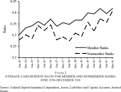
FIGURE 2 AVERAGE CASH RESERVE RATIO FOR MEMBER AND NONMEMBER BANKS, JUNE 1934–DECEMBER 1941
Relative shifts in the CRR reflect portfolio adjustments of the type hypothesized by Friedman and Schwartz. A simple model of the demand by banks for cash reserve assets and other assets can be written as


where CRA / TA is the ratio of cash assets to total assets, icra the yield (both monetary and imputed) on cash assets, ioa the yield on other assets, and λ the required reserve ratio. Equations 4 and 5 can be written separately for member and nonmember banks. The model cannot be estimated directly because measures of icra and ioa are not available, and the Treasury bill rate is not an acceptable proxy.
19It would not be correct to assume that, because at the margin net expected yields on all assets must be equal, the Treasury bill rate provides an adequate proxy for all yields. Bill rates when compared to loan rates contain large imputed yields in terms of liquidity and safety that may fluctuate. An attempt to estimate a fully specified model would also run into a causality problem; while interest rates affect the excess reserves that banks demand, these excess reserves also affect interest rates.
However, this framework can still provide insight into the relative portfolio choices of member and nonmember banks because, for our sample of nonmember banks, λ remained constant. Assuming the yield variables and their parameters are the same for member and nonmember banks, one can test whether changes in λ for member banks shifted their portfolio choice from the unconstrained state of equation 4 to the constrained state of equation 5 and thus affected their CRA / TA ratios, by seeing if for member banks this ratio changed relative to that for nonmember banks whose λ variable did not change.20
The assumption the yields and their coefficients are the same for member and nonmember banks is actually somewhat stricter than required. If the coefficients are the same, then all that is required is that the ratio of the yields that member banks obtain on earning assets and on excess reserves relative to these yields for nonmember banks remain constant, or conversely, if the yields are not constant, then the ratio of their coefficients is constant.
THE REGRESSIONS
To determine the impact of reserve requirement increases on the difference in the cash ratios we estimated a regression set combining state cross-section and time series data from June 1934 to June 1941, where the variables for member and nonmember banks are denoted by the subscripts “mem” and “non” respectively.

The variable ΔRR is the percentage point change in member bank reserve requirements in December 1936, June 1937, and June 1938 over their 1935 level.21
The reserve-requirement changes were calculated as weighted averages for time deposits and demand deposits in country and reserve city banks. The sample does not include any states with central reserve cities. The weights used are the deposits (Board of Governors, Banking and Money Statistics, pp. 97–103) at the first observation at which the new requirement became effective. We made no adjustments for the changes in the average required reserve ratio that occurred at other times due a shift in the composition of deposits. It would be preferable to compare state banks only with member country banks because nonmember banks were smaller than reserve city banks and functioned more like country banks, but the relevant data for country banks are not available. The date used for the reserve-requirement changes was the first call-report date following the date on which the new requirements became effective. (This is the same as the first call-report date following the announcement of the increase.)
Any observed changes in the relative size of member bank and nonmember bank reserve ratios could have been the result of deposit shifts between types of banks with different reserve requirements. For member banks shifts of deposits between different types of banks were relatively small. For nonmember banks such data are not available. But, fortunately, in nine of the 17 states in our sample, reserve requirements were the same for all types of nonmember banks. For the other eight states we rely on our control variables (bank size, the time deposit ratio, and the interbank deposit ratio) to pick up the effects of deposit shifts.
In an imperfect capital market bank loans play a special role; it may be much more damaging to economic activity if banks respond to an increase in reserve requirements by reducing bank loans than by reducing their security holdings. To investigate the effect of the reserve requirement changes on the supply of bank loans we used the same set of regressors as before with the ratio of loans to total assets as the dependent variable. That is

Three additional factors need to be considered: first, the possible asymmetry in the response of banks to increases and decreases in reserve requirements; second, the effect of changing reserve requirements on expectations; and third, the lag in the response of banks to the increase in reserve requirements.
There is no satisfactory way of testing for an asymmetric response with only two increases in reserve requirements interrupted by only one relatively small decrease combined with the small number of data points.
Reserve requirements might have affected aggregate demand by changing expectations. Agents might have believed that the 1936/37 increase in reserve requirements would generate a recession, or they might have become more optimistic when they saw the Fed taking action against potential inflation. Similarly, when the Fed lowered reserve requirements in 1938 they might have interpreted that as an indication that the recession would be brief, or as an indication that the Fed feared that the recession would get worse. But a review of news reports and editorials in the Wall Street Journal and the New York Times suggests neither a large negative or positive effect on expectations.22
The review of newspaper articles is available as appendix 1 at tcargill@att.net.
The variable ΔRR incorporates an implicit lag of a month or two because the June and December observations followed the announcement and effective date of the reserve requirement change. An additional, explicit lag may be appropriate, however. Considering the time from when the reserve requirement changes were announced to when they became effective a six months explicit lag—the minimum lag (other than zero) that our data permit—combined with our implicit lag, should provide sufficient time for banks to have adjusted their cash ratios, though not necessarily their loan ratios. But we cannot be certain, and therefore we ran regressions with zero, 6-month and 12-month lags, though we consider the 12-month case less plausible than the others. These lags are much shorter than those suggested by Friedman and Schwartz who concluded, apparently from a visual inspection of the data, that:23
Friedman and Schwartz, Monetary History, p. 543.
[I]t takes some seven months for banks to adjust to an unanticipated discrepancy between their actual and desired reserve positions produced by a change in their actual position, and some three years for banks to carry through a thoroughgoing revision of their reserve position as a result of a change in their desired position.
Friedman and Schwartz, however, did not present independent evidence for such long lags. Their argument is that because lags have to be that long in order to reconcile the data with their interpretation of excess reserves, one must conclude that the lags are that long. But one could equally well conclude that their interpretation of the excess reserves is wrong.
Morrison also found a very long lag in reserve adjustments after financial panics.24
Morrison, Liquidity Preferences.
Morrison, Liquidity Preferences, p. 59.
Tobin, “Monetary Interpretation.”
Calomiris and Wilson, “Bank Capital.”
REGRESSION RESULTS
The data set is a nearly balanced panel of cross-section and time-series data with 17 states and 15 time periods for each state. The regression coefficients and standard errors of equations 6 and 7 were estimated by a fixed-effects estimator designed for panel data and a robust errors estimator to adjust the standard errors for nonrandom behavior in the error term.28
These procedures were run with RATS, version 5 (Estima).
The complete set of results is available as appendix 2 at tcargill@att.net.
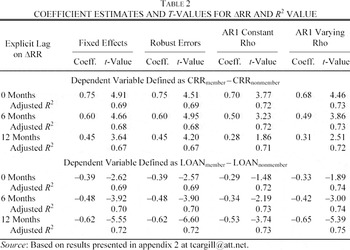
Table 2 presents the coefficients and t values of ΔRR and the R2 for the four estimators of equations 6 and 7 with no explicit lag, a 6-month lag, and a 12-month lag. The regressions account for a substantial percentage of variation in the dependent variable and the signs and significance of the control variables were not unusual. In general, although the specific control variables were not individually significant they were significant at the 5 percent level as a group. The macro control variable was negative and significant for the 0-month lag regression, but insignificant for the 6- and 12-month lag regressions.
The ΔRR variable is positive in all of the reserve ratio regressions and significant at the 5 percent level in all but one regression.30
One reader of an earlier version suggested that the change in relative cash ratios might have reflected a shift in holdings of government securities. This is unlikely because the ratio of government securities to assets for member and nonmember banks remained relatively stable after the first reserve requirement increase.
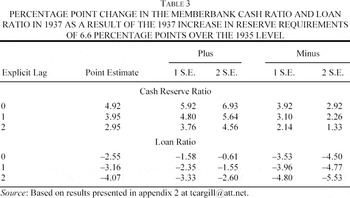
The ΔRR variable is not only statistically significant but is also large enough to be economically significant when its impact on the reserve and loan ratio is evaluated at the tails of the distribution. The ΔRR variable is measured in percentage point changes of the reserve requirement ratio, so that a coefficient of 0.75 for the cash ratio (Table 2, fixed effects coefficient at 0-months lag) means that the cash ratio increased by 0.75 percentage points for each 1 percentage point increase in the required reserves ratio. Focusing on the 1937 increase in reserve requirements as described in note 21, the mean cash reserve ratio increased by 6.6 percentage points over its 1935 level; thus, given a 0.7456 coefficient it raised the mean reserve requirement of member banks by 4.92 percentage points over the 1935 level. Table 3 presents this calculation for the 1937 increase for the entire set of fixed-effects estimates, which we regard as the most reasonable of the four estimators. The calculations for the point estimates of the coefficients suggest a 2.95 to 4.92 percentage point increase in the cash reserves ratio and a 2.55 to 4.07 decrease in the loan ratio of member banks in 1937 over the 1935 level depending upon the lag model used. Table 3 also presents the same calculation for the point coefficient estimate plus and minus one and two standard errors.


CONCLUSION
These results combined with the impressions suggested by Figure 2 do not support the claim that banks responded to the changes in reserve requirements essentially by changing their excess reserves. Instead, they support the hypothesis that member banks met a substantial part of their increased reserve requirements by reducing their earning assets, including loans. This strongly suggests that the decision to raise reserve requirements in 1936 and 1937 contributed to the 1937/38 recession. This finding does not rule at out factors such as fiscal policy and unbalanced inventories that contributed to the recession, but monetary policy was an important contributing factor and perhaps even the most important factor.
The authors are indebted to Ryan Brady, Mark Nickels, Montrice Yakimov, Len Samowitz, Neil Miller, Carter Golembe, George Kaufman, and Jeffrey Wooldridge for assistance at various stages of this article, and to the referees and the editor for helpful comments.