


How should a state allocate limited resources to defend against a strategic adversary like a terrorist group? This is part of the challenge facing the United States in the aftermath of the attacks of September 11, 2001. Since then, the federal government has spent over $150 billion on homeland security and is now spending about $15 billion a year on protecting the country's critical infrastructure and key assets (OMB 2003, 2004, 2005). But the scope of the task is vast. Prior to 9/11, the Environmental Protection Agency (EPA) reported on the risks posed by “worst-case” chemical accidents, finding that an accidental release at over 2,300 facilities would threaten between 10 and 100,000, 600 sites threatened between 100,000 and one million people, and 123 sites threatened more than one million people (Belke 2000). By the end of 2005, the National Asset Database listed about 80,000 sites including “nuclear power plants, pipelines, bridges, stadiums, and locations such as Times Square” (GAO 2005, 75). 1
A critical review of the database is DHS 2006b, which notes that the list of assets also includes petting zoos, fun parks, and some Wal-Marts.
The strategic nature of the adversary complicates these choices. “One fact dominates all homeland security threat assessments,” the National Strategy for Homeland Security emphasizes, “terrorists are strategic actors” (White House 2002, 7). No one thinks that hardening and rebuilding the levies around New Orleans affects the probability another hurricane like Katrina will strike that city. But strategic actors do try to strike where the defense is weak and the expected gains are high. Protecting one site may therefore shift the risk of attack to another. “Increasing the security of a particular type of target, such as aircraft or buildings, makes it more likely that terrorists will seek a different target. Increasing countermeasures to a particular terrorist tactic, such as hijacking, makes it more likely that terrorists will favor a different tactic” (White House 2002, 29).2
For statistical evidence of these “substitution” effects see Enders and Sandler 2004.
This paper develops a framework for analyzing the problem of allocating limited resources against a strategic adversary in four settings. 3
The present analysis focuses on understanding the first-best outcome, that is, the optimal allocation for a single unitary defender. Examples studying second-best outcomes due to the distorting effects of multiple actors with different interests include Bueno de Mesquita 2005 and Rosendorff and Sandler 2004.
In other words, the defender's equilibrium allocation minmaxes the attacker; that is, it is the allocation that minimizes the attacker's maximum payoff. This allocation is remarkably robust. It remains the unique equilibrium allocation whether the baseline model is zero-sum or not and regardless of whether the attacker sees the defender's allocation before deciding which site to attack (i.e., whether the game is static or dynamic). This is a surprising result. As is well known, a pair of strategies is an equilibrium of a two-actor, zero-sum game if and only if the actor's are minmaxing each other. But minmaxing is usually not an equilibrium strategy in nonzero-sum games. Nor it is it generally the case that the equilibrium action in a static game is the same as in a dynamic game.
The second setting extends the baseline case to allow the defender to allocate resources to border defense, counterterrorist operations, and intelligence in addition to spending on specific sites. The key idea here is that investing in these activities reduces the probability of a successful attack on every site whereas hardening a specific site only affects that site. The third setting examines the allocation problem if the threat has a strategic and nonstrategic component. For example, many of the steps that a state might want to take to protect public health against the outbreak or spread of a new virus like SARS or a highly contagious avian flu are the same as it would want to take to defend against a bio-terror attack (Chyba 2001, 2002). But the former is nonstrategic: viruses do not try to strike where a defender is weak and the expected gains are large. How should a defender allocate its resources if the threat has both strategic and non-strategic components? Finally, the fourth setting studies the resource-allocation problem when the defender is unsure of the terrorists' priorities, about the way that the terrorists rank potential targets. How, for example, should a defender allocate its resources if it is unsure whether its adversary is primarily interested in inflicting casualties and economic losses or in destroying symbolically significant targets like the Statue of Liberty?
The following analysis characterizes the defender's optimal (equilibrium) allocations in each of these settings. These characterizations show that although the extensions of the baseline case are substantively quite diverse, the same basic approach can be used to determine the optimal allocation in all of them.
STRATEGIC VERSUS NONSTRATEGIC TERRORISTS
Although the National Strategy for Homeland Security emphasizes the dominating fact that terrorists are strategic, early spending decisions on homeland security and, especially, on critical infrastructure protection have been widely criticized for being dominated by pork-barrel politics. As the 9/11 Commission Report delicately puts it, “In a free-for-all over money, it is understandable that representatives will work to protect the interests of their home states and districts. But this issue is too important for politics as usual to prevail. Resources must be allocated according to vulnerabilities” (2003, 396). 4
More direct criticisms include the 9/11 Public Discourse Project's final report (2005) and O'Beirne 2003.
In keeping with this, the cornerstone of the National Infrastructure Protection Plan is “its risk management framework” (DHS 2006a, 35). This framework does take an adversary's intentions into account, but it does not treat adversaries as fully strategic actors who try to counter a defender's decisions, who “modify their tactics and targets to exploit perceived vulnerabilities and observed strengths” (White House 2003, viii). Not treating an adversary as fully strategic can lead to a significant misallocation of resources. This section illustrates the potential for misallocation with a simple model in which the defender only has two sites to protect. The next section extends the model to an arbitrary number of sites and develops a more general framework for analyzing the allocation problem.5
Overviews and critiques of the DHS's risk-management approach are DHS 2006a, GAO 2005, Moteff 2004, 2006.
In the two-site model, the defender has a total of R resources to allocate and suffers a loss of L1 if site 1 is successfully attacked and L2 if site 2 is successfully attacked. Let r1 represent the resources dedicated to protecting the first site and r2 be the resources allocated to the second where r1+r2=R. Take vj(rj) to be the vulnerability of site j; that is, vj(rj) is the probability that an attack on site j succeeds if the defender allocates rj to protecting it. Finally, the probability of an attack on site 1 is α1 and the probability of an attack on site 2 is α2 where α1+α2= 1. All of this implies that the defender's expected loss to allocating r and R−r to sites 1 and 2, respectively, is L(r)=α1L1v1(r)+α2L2v2(R−r). The first term on the right in this equality is the expected loss from an attack on the first site, L1v1(r), weighted by the probability of an attack on that site. The second term is the expected loss from an attack on the second site weighted by the probability of an attack on that site.
The basic elements of this model parallel the three key components of DHS's approach to risk management which are vulnerability, threat, and consequence. Vulnerability “is the probability that a particular attack will succeed against a particular target” (GAO 2005, 25), and this is precisely what vj is. Threat “is the probability that a specific target is attacked in a specific way” (Willis et al. 2005, 8) and is formalized as the probability of attack αj. Finally, the loss Lj corresponds to the consequence which “is the range of loss or damage that can be expected from a successful attack” (2006a, 41).6
Strictly speaking, Lj is a von Neumann-Morgenstern utility which is related to but not the same as economic losses.
Because resources are limited, investing more in one site means investing less in another. Figure 1(a) plots the defender's expected loss and the trade off it faces when the value of the first site relative to the second is 3/2 (i.e., L1=3 and L2=2), the probability of a successful attack on a site is
, and total resources are R=10. The relative odds of an attack on a site are also taken to be the same as that of the sites' relative value (i.e., α1/α2=3/2, which means α1=3/5 and α2=2/5).

Strategic versus Nonstrategic Terrorists
The defender's optimal allocation r*≈8.3 minimizes its expected loss. At this allocation, the marginal gain from spending more on protecting the first site is just offset by the marginal loss of having less to spend on the second site. More formally, the optimal risk-management allocation r* given the threat assessment α1 satisfies the first-order condition dL(r*)/dr=0 or, equivalently, r* solves
.
But, equating the marginal costs and benefits in this way gives the wrong allocation against a strategic adversary. Figure 1(b) illustrates the misallocation. At r*, a terrorist group can impose a higher expected loss on the defender by attacking the second site rather than the first. Therefore a strategic adversary seeking to impose the highest expected cost on the defender will attack the second site.7
This zero-sum assumption will be discussed and relaxed below.
Put another way, the allocation r* and attack probability α=3/5 are not a Nash equilibrium of the underlying game. In a Nash equilibrium each actor plays optimally against the other; that is, each chooses a strategy which maximizes its payoff given the other actor's strategy. In this sense, r* and α are only “half” an equilibrium: the defender is playing optimally against the attacker's strategy α, but the attacker is not playing optimally against the defender. The allocation r* fails to reflect the strategic nature of the threat.
What is the optimal strategic allocation in this example? If the attacker is trying to impose the highest expected loss on the defender, the defender wants to minimize this maximum expected loss. Allocation
in Figure 1(b) does this. If the defender allocates less than this to protecting site 1, then that site becomes the most attractive target because it offers the attacker its highest expected payoff. If the defender spends more than
on site 1, say r*, site 2 becomes the most appealing target as striking that site now gives the attacker its highest expected payoff.
In brief, the risk-management allocation r* does take the adversary's intentions into account (through α). But this approach does not treat the adversary as fully strategic: if the terrorists anticipated the allocation r*, they would not want to behave in a way consistent with the threat assessment on which the allocation r* was based. Failing to take the strategic nature of the threat into account in this example leads to a significant misallocation of resources as the defender over spends on defending site 1 by more than 40% of the optimal allocation (
).
A BASIC FRAMEWORK
This section presents a basic game-theoretic framework for analyzing the resource-allocation problem. The solution to this baseline model also provides a simple algorithm for finding the unique optimal allocation of scarce resources against a strategic adversary. As will be seen, many sites may not receive any resources in the optimal allocation.
A defender must decide how to allocate R resources across S sites; a terrorist group then chooses which target to attack. In the static version of the game discussed here, the attacker is unable to observe the defender's allocation. (The dynamic version in which the attacker can see how the defender allocates its resources before deciding which site to hit is discussed below.) A strategy for the defender is simply a resource allocation (r1, …, rS) such that r1+[sdot ][sdot ][sdot ]+rS≤R; a strategy for the terrorist group is a set of probabilities (α1, …, αS), where αj is the probability the terrorist group attacks site j with α1+[sdot ][sdot ][sdot ]+αS=1.
To specify the player's payoffs, suppose that the defender suffers a loss Lj>0 if site j is successfully attacked. Allocating more resources to a site lowers the probability of a successful attack but with diminishing effect. In symbols, the probability that an attack on site j succeeds is vj(rj) with
and
as long as this site is imperfectly defended (i.e., as long as vj(rj)>0).8
In principle, it might be possible to defend some targets perfectly in which case
for some level of resources
. If so, then devoting additional resources to this site has no effect and vj(r)=0 for all
.
. As for the attacker's payoffs, let Gj>0 be the attacker's gain from successfully striking site j. Then the terrorist group's expected gain is
.
Finally resources are scarce in the sense that the defender cannot perfectly defend every target. That is, any allocation of R leaves one or more sites imperfectly defended.
ASSUMPTION 1. (SCARCE RESOURCES). For any allocation of R, vj(rj)>0 for some j.}
A Nash equilibrium is a pair of strategies (r, α) such that each player's strategy maximizes its payoff against the other player's strategy. If, therefore, the defender's allocation is (r1, …, rS), the terrorist group will attack the site offering the highest expected gain. That is, the attacker strikes a site j such that Gjvj(rj)=MA(r) where MA(r)≡max{G1v1(r1), …, GSvS(rS)}.
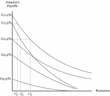
A simple algorithm yields the defender's optimal allocation. Assume that the defender has not allocated any of its resources and that the sites are indexed so that if the defender allocates no resources to any site, the attacker's expected gain from striking site 1 is larger than its expected gain to striking site 2, which is larger than its expected gain to striking site 3, and so on. That is, G1v1(0)>G2v2(0)>[sdot ][sdot ][sdot ]>GSvS(0).9
Indexing the sites in this way simplifies the exposition and has no effect on the results. The inequalities are assumed to be strict to ease the exposition. This assumption will be relaxed below.
in Figure 2, where
, G2v2(0), …, GSvS(0)}. From this point on, the defender must allocate resources to both sites 1 and 2 in order to keep G1v1(r1)=G2v2(r2). Otherwise the attacker would strike either site 1 or 2 depending on which offered the highest gain, and the resources allocated to the other site would effectively have been wasted.

The Optimal Allocation

When a Site Becomes Harder to Defend
The defender continues allocating resources to sites 1 and 2 keeping the attacker's payoffs to striking these sites equal until these two sites are no more attractive than site 3, that is, until
,
, G3v3(0), …, GSvS(0)}. Now the defender allocates resources to sites 1, 2, and 3 so as to keep G1v1(r1)=G2v2(r2)=G3v3(r3). The defender continues dividing its resources in this way reducing the attacker's maximum expected gain and having to spread its resources across more and more sites until it fully allocates its resources.
This allocation and the algorithm leading to it produce what may at first seem to be counterintuitive results. Suppose a site becomes uniformly more difficult to defend at the margin, that is, the marginal return to investing in protecting the site decreases. Formally, vj(r) shifts to wj(r), where wj(0)=vj(0) and
for all r. Intuitively, one might expect that this change would induce the defender to spend less on the site that is harder to secure, because this investment now does less to reduce the expected loss if the site is attacked. But this is not the case. As a site becomes more difficult to protect at the margin, the defender allocates more to that site and necessarily, less to the other sites. The attacker also becomes more likely to attack that site as shown below.
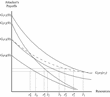
Figure 3 illustrates these results for the case in which site 3 becomes harder to protect and the original equilibrium allocation is
. If the original allocation remains unchanged, striking site 3 offers the attacker its highest payoff. But if the attacker is sure to go after this site, protecting any other site is a waste of resources and
is not an equilibrium allocation. Relative to
, the defender needs to spend more on site 3, which necessarily means spending less on the other sites. Equalizing the attacker's payoffs across the defended sties leads to allocation r* in Figure 3.
Stating the results formally, assume more generally the strict inequalities, mentioned previously, are weak so that G1v1(0)≥G2v2(0)≥[sdot ][sdot ][sdot ]≥GSvS(0). Then the defender's optimal allocation minmaxes the attacker by minimizing the attacker's maximum payoff. That is, the defender's unique equilibrium allocation
solves min{MA(r): r1+[sdot ][sdot ][sdot ]+rS≤R. Still more formally,
LEMMA 1. The defender has a unique minmax allocation.
Proposition 1. Nash equilibria of the static baseline game exist, and the defender plays the minmax allocation
in every Nash equilibrium.10
In fact, the static game has a generically unique Nash equilibrium. If
for all k for which
, the equilibrium is unique. Mulitplicity can arise if
for some n. The defender's equilibrium strategy in this case remains
, but now there will be multiple
's for which
is an equilibrium.
Proofs of these claims and the propositions below are in the Appendix. In related work, Powell (2006) analyzes the dynamic version of the baseline model in which the attacker decides which site to strike after seeing how the defender allocates its resources. He shows that subgame perfect equilibria exist and that the defender plays the minmax allocation
in all of them. The minmax allocation
thus turns out to be a remarkably robust equilibrium allocation, remaining optimal in both zero-sum and nonzero-sum versions of the game as well as in both static and dynamic versions.
These results are surprising in two ways. As is well known, minmax strategies are equilibrium strategies in two-actor, zero-sum games. The players' payoffs are diametrically opposed in these games so that anything that increases one actor's payoff decreases the other's. As a result, holding an adversary's payoff down as low as possible by minmaxing it also serves to maximize a player's own payoff and mutual minmaxing is an equilibrium. But the allocation problem described earlier is generally not zero sum, and minmax strategies are usually not equilibrium strategies in nonzero-sum games.
To see that the baseline allocation game is typically not zero sum and appreciate the significance of the zero-sum issue, it is useful to begin by noting the close relationship between the baseline model and “Colonel Blotto” games which have long been used to study force allocation issues (e.g., Blackett 1958; Shubik and Weber 1981; Tukey 1949). The classic blotto game is a two-actor, zero-sum game in which players A and B compete on S independent battlefields. Player A has FA units of force to distribute among these battlefields, and player B has FB. If A allocates
to battlefield k and B allocates
, A receives a payoff of
in the ensuing battle and B gets
. The players' payoffs in the game are the sums of their battlefield payoffs.
When the basic allocation game is zero sum, it is also a blotto game. If, for example, the defender's loss when a site is destroyed equals the attacker's gain; that is, if Lj=Gj for all sites j, then the defender's loss at j if it allocates rj and the attacker “allocates” αj is αjLjvj(rj) and exactly equal to the attacker's gain αjGjvj(rj).11
Blotto games are sometimes defined still more narrowly (e.g., Golman and Page 2006 and Roberson 2006) by assuming that a player is sure to win a battle if it allocates more to that battlefield than its adversary does:
if
,
if
, and
if
. Blackett (1958), by contrast, assumes that pk is continuous.
But the basic allocation game is generally not zero sum and therefore not a blotto game. The defender and attacker's payoffs are not diametrically opposed if, for example, they rank the sites differently. Suppose more concretely G1v1(0)>G2v2(0) but L1v1(0)<L2v2(0), then attacking site 1 maximizes the attacker's payoff but does not minimize the defender's. Indeed, even if the the attacker and defender rank the sites in the same order (i.e., Li>Lj [hArr ] Gi>Gj), the game will not be zero sum unless the defender and attacker put precisely the same relative weights on the sites (i.e., Li/Lj=Gi/Gj for all i and j).
Relaxing the zero-sum assumption is important for two reasons. First, assuming that the terrorist's gain equals the defender's loss may not sound very demanding intuitively. But its formal equivalent—that the actors' put the same relative weights on the sites—seems much more demanding and less substantively appealing. Still more fundamentally, some situations simply cannot be modeled as zero-sum games. Indeed, neither the case in which threats have nonstrategic components nor the case in which the defender is uncertain of the attacker's payoffs are zero sum.
Why does the defender minmax the attacker in the basic allocation game even though it is not zero sum? Observe that regardless of how the defender ranks the sites, the optimal use of the defender's resources is to protect only those sites that will be attacked. Spending on sites that will not be attacked brings no gain and means that there is less to be spent on sites that will be attacked with positive probability. But only the sites offering the attacker the highest expected payoff will be attacked with positive probability and allocating resources solely to these sites has the effect of minimizing the attacker's maximum payoff.
The second surprising aspect of the robustness of the minmax allocation is that the defender's equilibrium allocation remains the same in both the static and dynamic versions of the game. These different settings typically lead to different equilibrium behavior (see Powell 2006 for an analysis of the dynamic model).
The emphasis in this analysis is on the defender's allocation. But it is useful to specify the attacker's equilibrium strategy
given the optimal minmax allocation
. Let TA(r) be the set of sites giving the attacker its highest payoff at r. These are the sites the attacker might hit if the allocation were r. More formally, TA(r) is the set of pure-strategy, best replies to
:

If the defender plays
, the attacker's payoff to striking any site in
is the same as its payoff to striking any other site in
and higher than its payoff to going after any site not in
. This implies that the probability the attacker strikes any site
is zero:
. As for the probabilities of striking sites in TA,
must minimize the defender's expected loss
against the attacker's strategy
if
is to be an equilibrium. This requires the defender's marginal returns to investing in these sites be the same: ∂L/∂rj=∂L/∂ri for all
whenever rj>0 and ri>0.12
Because
for all j,
is strictly convex in r, so these marginal conditions pin down the unique best-reply to
. If
for some
, then αk may be positive and the marginal condition needed to rationalize
is that the defender cannot profitably shift resources from j to k; that is, ∂L/∂rk≥∂L/∂rj.
for j∈TA. Adding the
's for j∈TA and using the fact that these probabilities sum to one yields
. Corollary 1 summarizes these results:
COROLLARY The attacker's strategy in the generically unique equilibrium is to attack site
with probability
.
It follows that the probability of an attack on a site increases as that site becomes harder to defend. As shown previously, the defender spends more on a site (and necessarily less on the other sites) as that site becomes harder to defend at the margin. Because this site is both harder to defend and more is being spent on it, the marginal effect any additional investment has on reducing the probability that an attack on this site will succeed is lower. Given this lower marginal effect, the defender's larger investment in this site will only be optimal if the site is more likely to be attacked which raises the marginal expected gain from trying to protect this site enough to rationalize the defender's higher level of spending.13
Formally, suppose the initial equilibrium allocation is
and v1 shifts to w1, where
and w1(0)=v1(0). Then at
and the new equilibrium allocation r* define
and
for k>1, and observe that
,
, and
. Summing the probabilities gives
, which implies
.
BORDER DEFENSE, COUNTER-TERRORIST OPERATIONS, AND INTELLIGENCE
In addition to defending individual sites, the United States is attempting to “harden” its borders by making it more difficult for terrorists to enter and operate in the country. The United States also engages in significant counterterrorist operations throughout the world. And, good intelligence is seen to be critically important to disrupting terrorist attacks. Indeed, “intelligence and warning,” “border and transportation security,” and “domestic counter-terrorism” are three of the six critical mission areas specified in the National Strategy for Homeland Security (White House 2002). This section examines the trade off between defending individual sites as in the basic framework above and allocating resources to border defense, intelligence, or counterterrorist operations.
The key to introducing this trade off into the baseline model is that investing in these activities lowers the probability of a successful attack on all sites whereas investing in defending some sites only helps protect those sites. These activities “tend to reduce the overall level of risk without having to know in advance what the targets are, while also complementing site defenses” (O'Hanlon et al. 2003, 2).14
Assuming that border defense, intelligence, and counterterrorist operations protect all sites and, in the formalization below, protect all sites equally is clearly a tremendous simplification and at best a first approximation to be refined in future work.
Consider border defense. Given the difficulty of securing the borders, it might seem that the marginal gain from investing more in border defense is likely to be very small and less than the marginal gain from spending that money on hardening, say, a nuclear power plant or a chemical facility. If so, why allocate anything to border defense? Would it not be better to devote everything to site defense? But surely spending nothing on border defense cannot be the right thing to do.
The analysis below explains why spending on activities that protect all of the sites but have a very low marginal return makes sense. The defender's optimal allocation does equate the marginal gain from investing in border defense with the marginal gain from site defense. But as the analysis of the baseline case shows, any additional spending on site defense must be spread across multiple sites in order to keep the attacker's payoff to striking any one of these sites equal to its payoff to hitting any other site. Consequently, the marginal gain to site defense depends on the number of sites being defended and decreases as that number increases. Indeed, if the number of defended sites is quite large, the marginal gain to additional spending on site defense is very small and eventually equals the marginal gain to border defense even if the latter is also quite small.
The allocation algorithm leading to these results is also closely related to the algorithm that yields the optimal allocation in the baseline case. Suppose that the defender allocates all of its resources to border defense and none to site defense. (To ease the exposition, “border defense” will be used broadly to include counterterrorist and intelligence activities as well.) Then the attacker would strike the site that offers the highest expected payoff given this allocation. If, therefore, the defender wants to hedge by dedicating some of its resources to site defense, it should spend them on that site. But the more the defender takes out of border defense and spends on that site, the harder that site becomes. Eventually attacking that site will be no more appealing than going after what was originally the second most attractive site. If at this point the defender wants to invest still more in site defense, it must devote those additional resources to protecting both of those sites. At some point the payoff to attacking either of those sites will be the same as that of attacking what was originally the third most attractive site. The defender must divide any further spending on site defense among those three targets. As the defender shifts more and more resources from border defense to site defense, it has to spread the latter over more and more sites. The optimal division of resources between border and site defense occurs when the marginal gain from allocating more to site defense is just offset by the marginal loss of spending less on border defense.
To incorporate border defense in the basic framework formally, suppose that the defender has to decide how much to direct to the S individual sites and to border defense which has a low marginal return but protects all of the sites. The probability that an attack on a site succeeds now depends on the resources allocated to that individual site and to border defense. More specifically, the probability an attack on j succeeds is the probability that the terrorist group penetrates the border times the probability of a successful attack on j given that the terrorists reach that site. In symbols, the probability that an attack on j succeeds is vj(rj)β(b), where β(b) is the probability that the terrorists penetrate the border if the defender allocates b to border defense. This probability decreases as more resources are spent on border defense with diminishing returns (β′<0 and β′′>0). To capture the idea that it is much easier to protect one site than secure the entire border, assume that if the defender only had one site to protect, it would always do better by spending on that site rather than on border defense, but the marginal returns to such spending are decreasing. Formally,
ASSUMPTION 2. (BORDERS ARE HARD TO DEFEND). ∂β(b−rj)vj(rj)/∂rj<0 and
for all sites j, any
, and any r≤b.
The defender's and attacker's payoffs are now
and
. As before, the terrorist group attacks sites offering the highest expected gain; that is, those j such that Gjvj(rj)β(b)=max \{G1v1(r1)β(b), …, GSvS(rS)β(b)} = β(b)MA(r), where r=(r1, …, rS) is the defender's allocation to site defense.
As will be seen, the same fundamental formal approach can be used to characterize the defender's optimal allocation when the defender can invest in border defense, faces threats with nonstrategic components, or is uncertain of the terrorist's priorities. The intuition underlying this approach is also straightforward. The algorithm derived in the baseline case can be used to define a curve through the space of possible allocations where movement along the curve defines the fundamental trade off the defender faces in the particular substantive case: spending more on border defense and less on site defense, more on the strategic component of the threat and less on the nonstrategic component, or more to protect against one type of terrorist and less on any other. The equilibrium allocations lie along the curve where the marginal gain of spending more is just offset by the marginal loss of spending less.
In the case of border defense, take allocation r=(r1, …, rS) with
to be a point in
at which the defender is spending
on site defense and b=R−σ on border defense. Now define the curve PB through
parameterized by
. At PB(σ), the defender spends σ on site defense with those resources optimally allocated against the attacker. That is, r(σ) is the unique allocation that minimizes MA(r) subject to r1+[sdot ][sdot ][sdot ]+rS≤σ and can be found with the algorithm used to solve the baseline model.
We can now think of moving along PB from PB(0) to PB(R) as the allocations that result from the defender's spending less on border defense in order to spend more on site defense while being sure to allocate however much it does spend on site defense optimally. It follows that any equilibrium allocations must lie on PB. Otherwise the resources dedicated to site defense would not be allocated optimally. Moreover, the equilibria must lie at critical points along PB, where the marginal gain from dedicating slightly more to site defense is just offset by the marginal loss of spending slightly less on border defense.
To formalize these marginal conditions, define a pseudo-equilibrium attack strategy
to be a best response to r that also rationalizes the defender's relative spending on the sites in TA(r), where, recall, TA(r) is set of attacker's pure-strategy, best replies to r. In the case of border defense, this means that
for all j∉TA(r);
whenever j, k∈TA(r) with rj>0 and rk>0; and
whenever j, k∈TA(r) with rj>0 and rk=0.
Now observe that the defender's expected loss at point
can be written as ΠD(σ, α)β(R−σ), where
. It follows that the equilibrium allocations lie on PB, where
. The expression on the left is the marginal reduction in the defender's expected loss from spending slightly more on site defense, whereas the right side is the marginal reduction due to spending slightly more on border defense.
This marginal condition is quite intuitive if all of the sites are identical; that is, Lj=L1, Gj=G1, and vj=v1 for 1≤j≤S. In these circumstances, the defender simply divides the resources spent on site defensive evenly across all of the sites, and the attacker strikes each site with equal probability. The defender's payoff therefore can be written as
. The first-order condition is
. Hence, the marginal benefit of spending more on site defense (the left side of the previous equation) is the marginal gain of spending more on a site divided by the number of sites. If the number of sites is large, this marginal gain to site defense is small.
Proposition 2 states the results in the more general case when the sites are not identical.
Proposition 2. Nash equilibria exist, and the defender always plays a pure strategy lying on PB where the marginal loss of investing less on border defense just offsets the marginal gain of spending more on site defense. This condition generically satisfies
which is equivalent to:15
That is, the set of equilibrium allocations at which this condition does not hold has zero measure.

THREATS WITH STRATEGIC AND NONSTRATEGIC COMPONENTS
Some threats entail both a strategic and nonstrategic component and defending against one kind of threat also protects against the other. Chemical facilities in densely populated areas may pose a risk because of accidents as well as terrorism. For example, the EPA report on the risks posed by chemical accidents (Belke 2000) is now frequently cited in connection with the dangers of terrorist attacks (e.g., Flynn 2004). Many public health measures taken to detect and contain contagious diseases defend against natural outbreaks as well as deliberate bioterror attacks (Chyba 2001, 2002). Improved building codes for tall towers can help people evacuate more quickly in the event of a fire as well as a bomb (Dwyer and Lipton 2005). Better emergency communications and interoperability facilitate coordination and response to natural disasters and deliberate attacks (Mayer-Schönberger 2003).
Recognizing these complementarities, the Department of Homeland Security intends to take the overlap between natural disasters and terrorist attacks into account. Announcing the 2006 Urban Areas Security Initiative grants, Secretary Chertoff explained
sometimes there are capabilities you need in a natural disaster that can also be relevant in a terrorism-created disaster. That can involve hurricanes, it can involve fires, which may sometimes be caused by a natural event, sometimes by a terrorist. Therefore, capabilities such as evacuation, capabilities such as the ability to move rescue aid very quickly, which may have some value in a non-terrorism type of crisis, will be funded as long as there can be a demonstrable connection to a terrorism-related crisis as well. (Chertoff 2006, 7)
The answer and the way of finding the optimal allocation turn out to be quite similar to the problem of border defense and draw heavily on the analysis of the baseline case. Suppose that the defender completely discounts the possibility of a terrorist attack and allocates all of its resources optimally against the nonstrategic threat. This allocation equates the marginal gain from spending a little more on site j with the marginal gain of spending a bit more on k, where these margins depend on the chances of an accident at j and k, but not on the prospects of a deliberate attack. Spending a bit more or less on either site does not affect the nonstrategic threat to the other site.
But equating the margins to optimize spending against a nonstrategic threat means that a terrorists' payoffs will generally not be equal across the sites. Suppose that the attacker's payoff to striking site t1 is higher than its payoff to going after any other site. Then this site is sure to be attacked at the optimal allocation against the nonstrategic threat. If therefore the defender wants to hedge against a terrorist attack, it has to shift resources to t1 and necessarily away from the other sites, doing so in a way that keeps the marginal gains of protecting those other sites against the nonstrategic threat equal. As the defender allocates more resources to protecting t1, the attacker's payoff to striking that site decreases until some other site, say t2, now becomes an equally attractive target given the defender's allocation. If the defender shifts still more resources away from protecting against the nonstrategic threat, it must begin to distribute those resources across t1 and t2 so as to keep the terrorists' payoff to attacking either of the those sites the same. The defender continues shifting resources in this way, having to spread them across more and more sites, until the marginal gain of spending more on the strategic threat is just offset by the marginal loss of spending less on the nonstrategic threat.
To introduce the non-strategic component, let ηj be the probability of an “accidental,” that is, non-strategic, attack on site j. Then the overall probability of an attack on j is ηj+αj(1−ηj).16
The probability of no attack on j is (1−ηj)(1−αj). So the probability of an attack is 1−(1−ηj)(1−αj)=ηj+αj(1−ηj).
. As always, the attacker strikes sites offering the highest expected payoff, i.e., sites in TA(r).
As for the comparative statics, anything that increases the marginal gain of defending sites not subject to deliberate attack (i.e., those j∉TA(r)) leads (weakly) to greater spending on those sites and vice versa. 17
As elsewhere, a change in the marginal gain may not lead to a reallocation if the marginal conditions do not bind, and they may not when at m if Amvm(0)=MA(r).
increases), then the marginal cost of protecting against the nonstrategic threat rises and the defender (weakly) shifts resources toward the strategic threat by spending more on the sites in TA(r). Finally, suppose a site subject to deliberate attack becomes more difficult to guard at the margin. Then the marginal cost of strategic defense goes up, and the defender shifts resources away from it by spending less on the sites in TA(r).
As with border defense, the equilibrium allocations can be characterized formally by describing a curve through the space of possible allocations. In the case of border defense, the defender moved along the curve as it shifted resources from border defense to site defense, optimally allocating the latter among the sites. In the present case, the defender moves along the curve by shifting resources from defending against the nonstrategic threat to protecting against the strategic threat where the resources dedicated to each type of threat are optimally allocated against that threat. An equilibrium allocation lies on this curve at the point where the marginal gain from spending more to defend against the strategic threat is just offset by the marginal loss of having less to spend on defending against the nonstrategic threat.
To describe this curve analytically, suppose that the defender completely discounts the strategic threat. The resulting allocation δ equates the marginal benefit to protecting a given site against the nonstrategic threat with the marginal benefits of protecting any other site. That is, δ is the unique allocation minmizing
and, therefore, satisfying three conditions: (i)
whenever δj>0 and δk>0, (ii)
whenever δj>0 and δm=0, and (iii) δ1+[sdot ][sdot ][sdot ]+δS=R.
The path Pη begins at δ, and a point is on Pη if and only if the resources guarding against the nonstrategic threat are optimally allocated against that threat and those devoted to the strategic threat minimize the attacker's expected payoff. In symbols, r∈Pη if and only if conditions (i) and (ii) hold for all sites not in TA(r). These conditions guarantee that resources devoted to the nonstrategic threat, that is, to j∉TA(r), cannot be profitably reallocated among those sites. As for the resources dedicated to the strategic threat, the definition of TA(r) ensures that the resources spent on those sites minimize the attacker's payoff over these sites.18
Fix the set of sites in TA(r). Then the optimal allocation of the resources
across these sites minmizes the attacker's payoff max{Gjvj(rj): j∈TA(r)}. But, Gjvj(rj)=Gkvk(rk) for all j, k∈TA(r) by construction. So, any reallocation
of σ across TA(r) must give fewer resources to at least one site n. However,
implies
and consequently that
is not an optimal allocation of σ.
, where σ is defined over the interval
with
and
. As the defender moves along Pη, it is effectively changing the mix between the strategic and the nonstrategic threat but optimally allocating however much it dedicates to each of these separate threats.
To identify an equilibrium allocation where the marginal gain from allocating more to the strategic threat is just offset by the marginal loss from dedicated less to the nonstrategic threat, define the defender's expected loss from guarding against the strategic threat at r=Pη(σ) to be
and from the nonstrategic threat to be
. The defender's expected loss can now be written as is L(r(σ), α)= Lη(σ, α)+LD(σ, α). Then an equilibrium allocation lies on Pη and generically satisfies
, where
is the attacker's pseudo-equlibrium strategy at r.19
That is, the set of equilibrium allocations at which this condition does not hold has zero measure.
Before stating the results in the general case, consider the simpler case in which there are H identical high-value sites for the attacker and S−H identical low-value sites. The latter are so much less attractive that the attacker would never go after them.20
The payoff to striking the high-value targets is Ghvh(R/H) if the defender evenly distributes its resources across these sites. As long as this payoff is larger than that of attacking an undefended low-value site; that is, as long as Ghvh(R/H)>Glvl(0), then the attacker will never strike one of these sites and αl=0.
. The left side of this equation is the marginal gain to spending more against strategic threats; the right side is the marginal gain to spending more on protecting against nonstrategic threats.
Observe that if the number of potential targets subject to strategic threat (H) is very large, the probability of a strategic attack on any of them (1/H) is very small. The probability of a attack on this site is swamped by the nonstrategic component, and the equilibrium condition approximates
. But this is just what the defender would do if it completely ignored the terrorist threat and simply allocated its resources optimally against the non-strategic threat.
Turning to the general case:
Proposition 3. Nash equilibria exist, and the defender always plays a pure strategy lying on Pη where the marginal loss of spending less on the non-strategic threat just offsets the marginal gain of spending more on the strategic threat. This condition generically satisfies
which is equivalent to

for any
for which
. 21
That is the set of equilibrium allocations at which this condition does not hold has zero measure.
UNCERTAINTY ABOUT THE ATTACKER'S PREFERRED TARGETS
The previous discussion assumed that the defender knows how the attacker ranks potential targets. But what if the defender is uncertain about the targets that a terrorist group would most like to strike? How should a defender allocate its resources in the face of this uncertainty?
We simplify matters here by assuming that the defender is unsure whether it is facing one of two possible types of attacker, γ and τ. These types may get different payoffs from attacking a particular site and may even rank the sites in a different order. Attacker γ might, for example, rank a successful attack on a nuclear facility higher than on a chemical site, whereas τ might rank the latter higher than the former. 22
See Bier, Oliveros, and Samuelson 2005 for a complementary analysis which allows for a continuum of types of attacker but assumes the defender only has two sites to protect.
The answer to the resource allocation question and the approach to finding the optimal allocation are quite similar to the border-defense and nonstrategic threat problems. Suppose the defender were certain it was facing γ and allocated all of its resources accordingly. (The baseline algorithm can be used to find this allocation.) This allocation equalizes γ's payoff to attacking across the defended sites. But this allocation generally is not optimal against a terrorist like τ with different priorities. The optimal allocation against γ will usually not minmax τ by equalizing its payoffs across all of the defended sites.
Suppose attacking site t1 maximizes τ's payoff at the optimal allocation against γ. Then the defender, if it wants to hedge against the prospect of facing τ, should shift resources to t1 and necessarily away from the other sites while keeping γ's payoff to attacking those sites equal. As the defender dedicates more resources to defending against τ by hardening t1, τ's payoff to striking this site decreases until some other site, say t2, becomes equally attractive. At this point allocating still more resources to protect against τ means that the defender has to spend those resources on both t1 and t2 so as to keep τ's payoff to attacking them equal while at the same time keeping γ's payoff to attacking the other sites equal. The defender continues shifting resources in this way, having to spread them across more and more sites, until the marginal loss of spending less on defending against γ just offsets the marginal gain from allocating more to defending against τ. These marginal conditions define an equilibrium allocation.
To formalize the defender's uncertainty and the argument as a whole, suppose that the defender believes that it is facing γ with probability μ and τ with probability 1−μ. Type γ's payoff to a successful attack on site j is
and τ's payoff is
. Then the attackers' expected payoffs are
and
, where α and ϕ are γ's and τ's strategies. The defender's expected loss is

The comparative static results parallel those in the case of threats with nonstrategic components. Anything that increases the marginal gain to defending against one type induces the defender to spend (weakly) more guarding against that type. If, for example, the defender is more confident it is facing γ (μ increases), the defender spends (weakly) more on the sites γ threatens (the j∈Tγ(r) which are the sites offering γ its highest payoff). Similarly, if a site γ threatens becomes harder to protect at the margin, the defender shifts resources away from defending against γ and invests more in protecting against τ by reallocating from sites in Tγ(r) to sites in Tτ(r).
As before, we characterize the defender's equilibrium allocation by describing a curve through the space of possible allocations. In the case of border defense, the defender moved along the curve by shifting resources between border defense and site defense while optimally allocating the latter among the sites. In the case of threats with nonstrategic components, the defender moved along the curve by shifting resources between defending against the nonstrategic and strategic threats where the resources dedicated to each type of threat are optimally allocated against that threat. In the present case, the defender moves along the curve by shifting resources between the optimal allocation against γ and against τ. An equilibrium allocation lies on this curve where the marginal loss of having less to spend on defending against γ just offsets the marginal gain from dedicating more to defending against τ.
To specify the path, let g and t be the defender's optimal allocation if it were sure that it was facing γ or τ, respectively. Then a point is on the path Pg from g to t if the defender is allocating all of its resources against the sites that offer γ or τ their highest payoffs. That is,
if and only if
. Parameterize movement along Pg in terms of σ, the resources the defender allocates against τ, by defining Pg(σ) to be the point r∈Pg, where
for
with
and
.
Clearly any equilibrium allocation must lie on Pg. If r′∉Pg, then
. Consequently, there exists a site k such that
and k∉Tγ(r′)∪Tτ(r′). Thus, neither γ nor τ attack k with positive probability, so the defender can profitably deviate from r′ by reallocating
across the sites in Tγ(r′)∪Tτ(r′).
An equilibrium allocation equates the marginal loss of spending less on guarding against γ by increasing σ with the marginal gain to spending more defending against τ. To characterize these allocations, take the defender's expected loss from defending against γ and τ at any
to be
and
. Combining these payoffs gives the defender's total payoff
. Then the equilibrium allocation lies on Pg and generically satisfies
, where
and
are γ's and τ's pseudo-equilibrium strategies. This leaves:
Proposition 4. Bayesian Nash equilibria exist, and the defender always plays a pure strategy lying on Pg where the marginal loss of spending less on defending against γ just offsets the marginal gain of spending more protecting against τ. This condition generically satisfies
which is equivalent to:

CONCLUSION
Protecting a country's critical infrastructure from a terrorist attack is an immense challenge. Although the United States is spending billions on this effort, resources are scarce when compared to the number of possible targets. The country cannot completely protect everything and choices have to be made about what to defend and how much to spend on trying to defend it. One of the central recommendations of the 911 Commission was that these decisions “should be based strictly on an assessment of risks and vulnerabilities” (2004, 396), and Secretary Chertoff has emphasized the importance of a risk-management approach throughout his tenure. To this end, the Department of Homeland Security is developing a National Asset Database of critical infrastructure and key resources (CI/KR) and an accompanying methodology “that will allow the prioritization of CI/KR assets necessary for the optimal allocation of finite CI/KR protection resources” (DHS 2005, 125). But this risk-management approach appears to treat terrorists as only partially and not fully strategic actors. This is likely to lead to a significant misallocation of resources even if the distortions of pork-barrel politics can be overcome.
This paper offers a framework for analyzing the defender's allocation problem in a baseline case and three substantively different extensions. The framework shows that these problems share a common formal structure and that one can think about the allocation problem in each of them in a broadly similar way. A strategic adversary deciding where to attack attempts to strike where the defender is weak and the expected gains are large. Anticipating this, the defender tries to minimize the attacker's highest expected payoff. But as the defender invests more in protecting the sites offering the attacker its highest payoff, the payoff to striking those sites declines and eventually other sites become equally attractive. At this point, the defender has to begin to devote resources to protecting those sites as well. As the defender allocates more and more to site defense, it must spread those resources across a larger and larger set of sites. The defender continues in this way until it has fully allocated its resources.
This algorithm defines the optimal allocation if the sites are independent and the attacker only has to decide how much to invest in hardening each site. The algorithm also highlights a key contrast between treating actors as fully or only partially strategic. If a site becomes harder to defend and an adversary is assumed to be only partially strategic, the defender would generally spend less on that site. Against a fully strategic actor, however, the defender spends more to equalize the payoff to attacking this site with the payoff to attacking the other defended sites.
In the cases of border defense, threats with nonstrategic components, and uncertainty about the attacker's priorities, the baseline algorithm case can also be used to trace a curve through the space of possible allocations where movement along the curve reflects the fundamental trade off defining the substantive case: spending more on border defense and less on site defense, more on the strategic component of the threat and less on the nonstrategic component, or more to protect against one type of terrorist and less on the other. The equilibrium allocations lie along the curve where the marginal gain of spending more is just offset by the marginal loss of spending less.
This conceptualization leads to the relevant comparative statics. If the risk of a nonstrategic “attack”—a natural disaster or an accident—increases, the defender allocates more to guarding against this type of threat and less to defending against the prospects of a deliberate attack. If the defender is uncertain about its adversary's priorities but becomes more confident that it is facing one type of terrorist, the defender allocates more to the sites this type would strike.
APPENDIX
Proof of Lemma 1. Recalling that MA(r)≡max{G1v1(r1), …, GSvS(rS)}, then
is a minmax allocation if
for every allocation r. At least one minmax allocation is sure to exist because the vj(r) are continuous in r and the set of possible allocations is compact.
Arguing by contradiction to show that only one minmax allocation exists, assume that
both minmax the attacker. Because
, there exists a site j such that
. Without loss of generality suppose
. Then
because both r′ and
minmax the terrorists, and
because
. Hence,
. Continuity ensures that there is an ε>0 such that
. This ε of resources can now be distributed across the other sites to form the allocation r*, where
and
for all k≠j. Clearly, MA(r*)<MA(r′), contradicting the assumption that r′ minimizes MA(r) and thereby establishing the claim that the minmax allocation is unique.
Proof of Proposition 1. Observe first that equilibria always exist and that the defender always plays a pure strategy in equilibrium. This follows from the fact that the defender's set of pure strategies and the attacker's set of mixed strategies are nonempty, convex, and compact. Each actor's payoff, −L(r, α) or G(r, α), is also continuous in r and α and quasiconcave in each actor's own strategy. This ensures that an equilibrium exists in which the defender plays a pure strategy (Fudenberg and Tirole 1991, 34). In fact, the defender's payoffs are strictly concave which ensures that it never plays a mixed strategy in equilibrium. For the defender to mix, it must be indifferent between the strategies over which it is randomizing. But concavity implies that it would strictly prefer a convex combination of these strategies and thus that the defender would have a profitable deviation from the mixed strategy.
To see that the minmax allocation
is the unique equilibrium allocation, observe first that the discussion prior to the statement of Corollary 1 in the text shows that there exists an attack profile
such that
is a Nash equilibrium. All that remains to be shown is that the defender always plays
in any equilibrium.
Suppose
is an equilibrium allocation. Then there must exist an α* such that (r*, α*) is an equilibrium. The fact that
implies
. It follows that there exists some site j such that
and
. But any of the attacker's best replies to r* only put positive probability on the sites that offer the highest payoff; that is, those k for which
. Hence,
in any best reply α* to r*. The defender then can profitably deviate from r* against any best reply to it by reallocating resources away from j. Consequently, r* is not an equilibrium allocation.
Proof of Corollary 1. The claim follows directly from the discussion in the text and a more detailed proof is omitted.
Proof of Proposition 2. Observe first that L is strictly convex in (r, b) for a fixed α. (Algebra shows the Hessian is positive definite given
.) The argument at the start of the proof of Proposition 1 then ensures that equilibria exist and that the defender never mixes in equilibrium.
To establish that all equilibrium allocations lie on PB, recall that r=PB(σ) if and only if r minimizes MA(r′) subject to
. Now suppose
is an equilibrium allocation. Then
for some
, and the defender can clearly profitably deviate from
by reallocating
across
.
To see that an equilibrium allocation satisfies the condition stated in Proposition 2 except possibly at a set of points along PB with zero measure, say that j becomes a target (i.e., a best reply) by entering TA at
if
and j∉TA(r(σ)) for
. Because there are only finitely many sites, there are only finitely many points along PB at which sites become targets. Let E be this set and define E+ to be E along with the endpoints PB(0) and PB(R). Then if
is an equilibrium allocation, it satisfies the condition described in Proposition 2.23
If a site, say e, enters TA at
, the summations in the expression for
for
and for
are taken over different sets. The continuity of the individual terms in ΠD will therefore not ensure the continuity of the sums, and
will generally not equal
.
Since
is an equilibrium allocation, there must be a strategy
such that
is Nash. Because
is a best response to
,
for all
. As for the
,
because
. Hence,
for all i, j∈TA. Solving these equations for
in terms of
, summing the
over
, and using the fact that the sum equals one yield
.
Since
is not an endpoint, positive amounts are being spent on both site and border defense. So
must satisfy the marginal condition ∂L/∂rj=∂L/∂b or
for
. Substituting for the
's gives
.
This expression is moreover equivalent to
. Differentiation yields
. Substituting for
gives
. But
, so
and consequently
.
Now multiply
by ∂ΠD/∂σ to obtain
. The expressions for
then yield
or
.
Proof of Proposition 3. The argument in the proof of Proposition 1 again ensures that equilibria exist and that the defender never mixes in equilibrium. To show that any equilibrium allocation must lie on Pη, suppose the contrary. Then there would be an equilibrium allocation
such that one of the following two conditions does not hold:
whenever
,
, and
and, second,
whenever
,
, and
. If the set of sites not in
is empty or a singleton, these conditions are satisfied trivially, so
would lie on Pη. This implies that there must be at least two distinct sites j,
at which at least one of the previous conditions does not hold. But if either of these conditions fails to hold, the defender can clearly reduce its expected loss by reallocating its resources between j and k. This contradiction leaves
.
To see that an equilibrium allocation satisfies the condition stated in Proposition 3 except possibly at a set of points along Pη with zero measure, let Z be the set of points where a site k enters TA at zero allocation; that is, rk=0 when k enters. Take Z+ to be Z along with the endpoints
and Pη(R). Then if
is an equilibrium allocation, it satisfies the condition described in Proposition 3.
Since
is an equilibrium allocation, there must be a strategy
such that
is Nash. Because
is a best response to
,
for all
. As for the
,
means
for all
. Hence,
for all i,
; otherwise the defender could profitably reallocate across sites in
. Solving these equations for
in terms of
, summing the
over
, using the fact that the sum equals one, and rearranging terms yield
for
.
Since
is not an endpoint,
, so there exists a site
such that
. Again because
is a best response to
,
. Otherwise the defender could profitably reallocate between j and k. Substituting the expression for
gives
.
This expression is equivalent to
. Since
for all i,
,
. And,
, so
. This along with the expression for
yield
.
Turning to the marginal loss from investing less against the non-strategic threat,
. By construction,
along Pη whenever rj>0, rk>0, and j, k
. The fact that
then implies
.
Proof of Proposition 4. The proof closely parallels that of Proposition 3 and will only be sketched. Once again the argument in the proof of Proposition 1 ensures that equilibria exist and that the defender never mixes in equilibrium.
Any equilibrium allocation must clearly lie on Pg. If r′∉Pg, then
. Consequently, there exists a site k such that
and k∉Tγ(r′)∪Tτ(r′). Thus, neither γ nor τ attack k with positive probability, so the defender can profitably deviate from r′ by reallocating
across the sites in Tγ(r′)∪Tτ(r′).
To see that an equilibrium allocation satisfies the condition stated in Proposition 4 except possibly at a set of points along Pg with zero measure, let Z be the set of points points where sites leave Tγ or enter Tτ. Take Z+ to be Z and the endpoints,
and
. Then if
is an equilibrium allocation, it satisfies the condition described in Proposition 4.
Since
is an equilibrium allocation, there must be strategies
and
such that
is Nash. Since
,
for all
and
for all
. What is more,
implies
. Hence,
for
,
for j∈Tγ(r(σ)),
for j∉Tτ(r(σ)), and
for j∈Tτ(r(σ)).
That
is not an endpoint also implies there are sites
and
such that rj>0 and rk>0. Because
is a best reply to
and
, ∂L/∂rj=∂L/∂rk or
. Substituting the expressions for
and
gives
as stated in the proposition.
The marginal condition
also implies
. Substituting for
yields
. Similarly,
.
For helpful comments, criticisms, and discussion, I thank Daron Acemoglu, Manas Baveja, Mariano-Florentino Cuéllar, Ernesto Dal Bó, Lynn Eden, James Fearon, Ron Hassner, William Kastenberg, Lance Kim, Victoria Kingsley, Michael May, Santiago Oliveros, Gerard Padro-i-Miquel, Per Peterson, Larry Samuelson, Todd Sandler, Jacob Shapiro, and Dean Wilkening. I also gratefully acknowledge the support of the National Science Foundation.




Comments
No Comments have been published for this article.