In models of voting behavior in the United States, the American South is a common “dummy” variable because of its peculiar electoral dynamics, characterized by the electoral dominance of one party. Underneath that party dominance, there has always been an undercurrent of competition and conflict. In the last couple of decades as the South itself has changed, the undercurrent is becoming more evident in electoral politics. In this symposium, we will explore some explanations for the manifestations of that changing electoral landscape.
The structure of federal elections grants the 11 states of the former confederacy with significant leverage in decisions about who controls the institutions of the government in Washington, DC. Together these states cast 160 votes in the Electoral College, 30% of the total and 59% of the 270 needed for presidential victory. They elect 22 US Senators, or 43% of the number needed for control. Similarly, in the US House of Representatives, the South elects nearly one third of all seats and 63% of the number necessary for majority control.
Of course, almost any collection of a dozen or so states would represent a significant number of Electoral College votes and seats in the US Senate and House of Representatives. What has made the South so powerful in American political history is the near total control of these votes and seats by a single party. For about a century, the Democratic Party held nearly every congressional seat from the South and its presidential candidates usually swept the southern states until the middle of the twentieth century. Since that time, southern politics has been dominated by the Republican Party, though not as totally as it had been by the Democrats earlier.
The combination of the region’s institutional leverage in both the Electoral College and Congress with near singular control of this leverage by one party has allowed the South to exert unique influence on American politics. Today, Republicans hold 19 of the 22 US Senate seats from the states of the former confederacy. These 19 senators constitute more than 35% of all seats in the chamber held by Republicans. Republicans hold 73% of the US House seats elected from southern states, and these seats make up 41% of the party’s majority in the chamber. In the 2012 presidential contest, all but two of these states cast their Electoral College votes for Mitt Romney, giving him 57% of his total Electoral College votes. In short, the Republican Party’s control of Congress and the fate of its presidential nominees depend in large part on the bulwark provided by the South.
The combination of the region’s institutional leverage in both the Electoral College and Congress with near singular control of this leverage by one party has allowed the South to exert unique influence on American politics.
Yet, the South is in transition—or, at least, it may be. Barack Obama made significant gains in certain areas of the South during his two presidential elections. In 2008, he became the first Democrat presidential nominee to carry Virginia since 1964 and North Carolina since 1976. He held Virginia in 2012 and also held Florida for a second time. Although the Democrats generally fared worse in elections for lower offices in the South during the late 2000s and early 2010s, they regained the two senate seats in Virginia and held another in Florida. They also recaptured the governorship of Virginia.
Clearly, these gains have not been region wide. Indeed, they suggest a fracturing of the South—that is, the emergence of a new party system in which the South is no longer consolidated under one dominant political party.
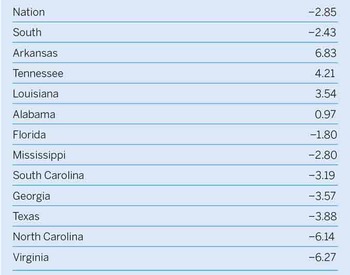
Consider county-level vote share for Republican presidential candidates from the 2000 and 2004 elections versus the 2008 and 2012 elections. The average Republican vote share in US counties fell by 2.85 points from the George W. Bush elections to the Obama elections. In the South it fell by nearly as much (2.43)(see table 1). The county trend in individual southern states looks quite different (table 1). Counties, on average, in three southern states became significantly more Republican by 2008 and 2012 relative to 2000 and 2004: Louisiana (by 3.54 points), Tennessee (by 4.21 points), and Arkansas (by 6.83 points). Even states like Alabama that show little change were becoming relatively more Republican than the nation as a whole, which was trending Democratic.
Trend in Republican Presidential Vote Share from 2000 & 2004 to 2008 & 2012

Note: Values are the difference between average Republican vote share for 2000 and 2004 and average Republican vote share for 2008 and 2012.
Counties, on average, from five southern states not only became less Republican, but did so at a greater rate than the national trend: South Carolina, Georgia, Texas, North Carolina, and Virginia.
Still, the county trends within states mask considerable sub-regional heterogeneity. Much of the trend in Georgia, for example, is driven by the metro Atlanta area. The counties containing and surrounding Atlanta trended away from the Republicans by 7.27 percentage points in 2008 and 2012 relative to 2000 and 2004. Similarly, in North Carolina, the counties of ‘the research triangle’ shifted away from the Republicans by 7.42 percentage points. Within Virginia, which has been the strongest Democratic gain in the South, areas of the state contrast starkly. The northern suburban counties surrounding Washington, DC shifted away from Republican presidential candidates by 9.11 points, more than 3 times the national trend. At the opposite end of the state in the Appalachian counties of the southwest, the Republican candidates gained 10.78 percentage points.
Therefore the “Solid South” is being stretched in different directions. Parts of states are clearly becoming more liberal and Democratic. In other parts, solid south conservatism, now manifestly Republican, is even more entrenched. Demographic changes provide a partial explanation, but other dynamics are at play as well.
Given this moment in the political history of the American South, it is a good time to reassess what political science has to say about the forces of change and continuity in southern politics. Angie Maxwell explores southern Tea Party politics as the latest manifestation of continuity in the white conservative south. Matthew Fowler examines southern African Americans as distinct from both whites and non-southern blacks. Betina Cutaia Wilkinson and Natasha Bingham explore southern African American response to Latino immigration in the region. Seth McKee and Jeremy Teigen examine the impact of non-southerners on southern politics. Finally we include three short essays that explore southern continuity and change in the results of 2015 elections for governor in Louisiana, Mississippi, and Kentucky.