


Realists maintain that states should be very unlikely to seek international arbitration or adjudication to resolve their disputes, particularly when the dispute involves fundamental security issues. Yet the historical record shows that on several occasions states successfully have resolved many types of disputes through international legal bodies. For example, in recent years governments have begun to resolve disputes over the use of ocean resources by going before the International Tribunal for the Law of the Sea. In addition, since 1995, World Trade Organization (WTO) member states have submitted an average of 30 disputes per year before that organization's legal dispute settlement mechanism. Even in the realm of international security, since the end of World War I, governments have pursued international arbitration or adjudication as a means of resolving territorial disputes nearly three dozen times. Across all of these spheres, compliance with legal rulings has been high, and the awards almost always have resolved the issues in dispute. Resort to legal dispute settlement, then, has been and continues to be an important option for states that wish to resolve international disputes.
Existing scholarship provides relatively little guidance for understanding why legal dispute settlement might be an attractive option for state leaders embroiled in an international dispute. As suggested previously, realist theory does not provide an adequate answer to this question. On the contrary, realist theoretical arguments focus on why states would not want to turn disputes over to international legal bodies. But the aforementioned examples demonstrate that there clearly are situations in which state leaders view the use of third-party legal procedures as an attractive dispute settlement option. As global dispute settlement bodies grow in prominence, a recent scholarly literature on international legalization has emerged to analyze the various international legal institutions that exist in the world today (e.g., Keohane, Moravcsik, and Slaughter 2000; Koremenos, Lipson, and Snidal 2001). Yet most of the recent scholarship on international dispute settlement focuses primarily on the evolution and design of dispute settlement bodies (e.g., Keohane, Moravcsik and Slaughter; Smith 2000) and largely ignores the question of why leaders would want to turn to these bodies to resolve international disputes.
In our view, there is a need for more theoretical and empirical work that identifies the types of situations in which states are most likely to turn to international judicial bodies to resolve their disputes (see Coplin and Rochester 1972). It is particularly important to understand why state leaders would sometimes view the resort to legal dispute settlement as preferable to reaching a settlement agreement through bilateral negotiations. Although governments might be inclined to resolve most disputes bilaterally, legal dispute resolution can be an effective strategy for the settlement of certain types of disputes. Therefore, we develop and test a general argument that identifies the conditions under which state leaders are most likely to choose international arbitration or adjudication over bilateral negotiations as a means to settle disputes. Our central claim is that leaders will seek legal dispute settlement in situations where they anticipate sizeable domestic political costs should they attempt to settle a dispute through the making of bilateral, negotiated concessions. Put differently, state leaders will view international legal rulings as a form of “political cover” that allows them to counter domestic political opposition to a controversial settlement agreement. This general assertion receives strong, robust support in our empirical tests, and we find no evidence that our findings are tainted by selection bias.
To understand why governments might seek the legal resolution of an international dispute, we examine cases in which leaders sought to resolve competing territorial claims through international arbitration or adjudication. We utilize the Huth and Allee (2002) dataset on claims to disputed territory, which contains detailed data on 348 territorial disputes across all regions throughout the period 1919–95. Examining decisions to resolve territorial disputes has several advantages. Most notably, territorial disputes often linger for many years; thus there are considerable opportunities for the two sides to pursue various strategies to resolve the dispute. In addition, there is likely to be considerable variation in the domestic political institutions of both states over time, which allows us to identify the conditions that are most conducive to the strategy of turning to international legal bodies as a way to end the dispute. Finally, the dataset's broad spatial coverage provides considerable variation in terms of the countries involved in territorial disputes, and regime differences across those countries.
THE CONCEPT OF INTERNATIONAL LEGAL DISPUTE SETTLEMENT
International legal dispute settlement refers to the state practice of submitting disputes to a deliberative body that assesses the merits of rival state claims and issues a summary decision as to how to settle the dispute. We use the term legal dispute settlement in the broadest sense to include both arbitration bodies and international courts. Both types of deliberative bodies share two common and important features. First, legal principles play an important role in determining the relative merits of state claims and in reaching settlement decisions. Second, states agree in advance to abide by the final award or ruling issued by the deliberative body. These two common features—the general reliance on legal principles and the ex ante pledge to comply with any ruling—are central to the theoretical arguments we present later.
We recognize that legal scholars have identified and discussed differences between the work of arbitration panels and that of international courts (e.g., Brownlie 1990, ch. 30), yet such differences should not be overstated. For instance, in a strict sense, international courts are to be guided solely by legal considerations, whereas arbitration panels frequently have a mandate to assess rival claims on the basis of nonlegal criteria. In practice, however, courts often are provided the opportunity to consider nonlegal factors by the mandate to apply the general principle of “equity” in their deliberations. At the same time, the customary norm has evolved that arbitration panels should employ legal considerations, even if their mandate is silent on the issue (Brownlie, ch. 30; Gray and Kingsbury 1992). According to noted international law scholar Louis Sohn (1961, 210), “The distinction between arbitral and judicial panels is not well grounded. In the international field, most arbitrators behave like judges; they show no special tendency to compromise or to go outside the framework of established legal principles and precedents.” As a result, although legal scholars often note the differences between arbitration and formal judicial settlements, they frequently treat the two processes as quite similar in many respects (see Brownlie, ch. 30). We follow this practice of treating the two as functionally similar, as have other political scientists (see Simmons 1999, 2002).
From the cases in the Huth and Allee (2002) dataset, we identify 30 instances between 1919 and 1995 in which the disputing states agreed to resolve their territorial disputes through either international arbitration or adjudication (see Table 1).1
The 30 cases in Table 1 are based on decisions to arbitrate or adjudicate that are reached between 1919 and 1995. There are two arbitration rulings issued in the 1920s and 1930s that are not included in our data set, because the actual agreements to adjudicate were reached prior to 1919.
Two potential cases, Cambodia and Thailand over Preah Vihear, and Qatar and Bahrain over Hawar, Dibal, and Jarada, are eliminated due to this requirement. The inclusion or exclusion of these cases, however, has no substantive impact on our empirical findings.

We are interested in building and testing a theory of decisions by two states to seek international legal dispute settlement, as opposed to the final decision of the deliberative body, or the degree to which the parties ultimately comply with that decision. As noted earlier, however, in the overwhelming majority of cases the initial agreement to seek legal remedies produced a legal ruling, the parties complied with the ruling, and the dispute was resolved. Indeed, in explaining why states agree to legal dispute settlement, we argue that both parties expect compliance by the other side. In fact, of the 30 cases of an agreement to arbitrate or adjudicate a territorial dispute, in only three cases was the arbitration or adjudication not fully successful in ending the dispute.3
In only one case did the agreement to adjudicate subsequently breakdown with the result that no ruling was ever issued (UK and Saudi Arabia over the Buraimi Oasis, 1954). In one other case (Pakistan and India over the East Bengal border, 1948) the third-party ruling in 1950 settled the initial areas in dispute, although the dispute continued once additional disagreements subsequently emerged over other border areas. In one final case (Argentina and Chile over the Beagle Channel Islands, 1970), a ruling was issued but was not accepted by one of the parties (Argentina). It should be noted, however, that although Argentina rejected the ruling in 1977 that supported Chile's claim to the Beagle Islands, in 1984 they did concede to Chile following Papal mediation on terms quite similar to those presented in 1977.
THEORETICAL MODEL OF CHOICES IN DISPUTE RESOLUTION
In the following section we put forward our theoretical model of dispute resolution, focusing on the motivations for state leaders to pursue legal processes as a means of settling international disputes. In particular, we consider the relative merits of a dispute settlement strategy based on seeking third-party, legal dispute settlement, as opposed to the making of voluntary, bilateral concessions.
The Structure of Negotiations
The first thing to note is that decisions to pursue arbitration or adjudication, or any other initiative intended to resolve an international dispute, emerge from a round of negotiations between the disputing parties. In other words, the presence of negotiations is a necessary condition for the decision to seek legal dispute settlement, because state leaders must be discussing the disputed issue in order for them to decide to pursue international judicial settlement of that issue. Therefore, in analyzing the decision to seek legal dispute settlement, the appropriate units of analysis are rounds of negotiations over a disputed issue. In our case, the units of observation are all rounds of negotiations between states with competing claims to disputed territory.
When state leaders engage in rounds of talks over disputed territory, or any other disputed issue, the negotiations typically will end in one of three ways: (1) a situation of stalemate or deadlock, (2) the making of bilateral concessions, or (3) a decision to seek international legal dispute settlement. We focus on the comparison between these last two options, which can be thought of as alternative ways of ending the dispute, or making progress toward ending the dispute. We argue that certain domestic political conditions should compel leaders to prefer third-party, legal techniques to bilateral concession making as a dispute settlement strategy.
The context in which state leaders negotiate over disputed issues resembles the structure of a two-level game (Putnam 1988). Negotiations over disputed territory, for instance, take place between the leaders of two states at what is commonly known as Level I. Looming over any negotiations at Level I, however, are expectations about the anticipated reaction of domestic groups in both states at Level II. How each leader behaves in negotiations at Level I—whether he offers territorial concessions or proposes referring the issue for international arbitration or adjudication—is strongly affected by how those at Level II are likely to react to such proposals.
Leaders care about the reactions of domestic groups at Level II for multiple reasons. In the most direct sense, relevant political actors at Level II must approve any changes to the status quo that are negotiated by political leaders at Level I, or else the initiative is unlikely to succeed. In many political systems, negotiated agreements may need to be ratified by legislatures or parliaments. Even in the absence of formal ratification mechanisms leaders still may need to obtain the explicit, or at least tacit, approval of domestic political or military elites. Furthermore, negotiated outcomes that are unpopular with elites and the population at large are unlikely to be implemented in the short term, or sustainable in the long term.
In a broader sense, actors at Level II control the political fortunes of incumbent leaders—they determine whether a leader is able to govern effectively and whether he is able to stay in power. We assume that executives place a high priority on retaining office. The success or failure of foreign policy initiatives, then, affects a leader's current political standing and future prospects of staying in power. Leaders who are associated with failed or controversial foreign policies face a greater risk of having their political authority challenged by domestic opposition forces and possibly being removed from power.
Therefore, we assume that political leaders are likely to be rational and strategic in their foreign policy choices as they attempt to anticipate how domestic groups at Level II will respond to alternative policies they might pursue in negotiations over a disputed international issue. In particular, leaders will assess the relative costs and benefits of each course of action that is available to them during negotiations. These costs and benefits are likely to vary depending on the political and institutional setting in which political executives operate. Across different political systems, those systems that contain greater institutional checks on the executive's power produce greater accountability for failed or controversial foreign policies. In addition, within any given political system, certain conditions are likely to produce a greater degree of political accountability for the executive.
The Costs and Benefits of Various Dispute Resolution Options
We now consider the various costs and benefits associated with a dispute settlement strategy based on the use of international legal procedures as opposed to one based on the making of bilateral concessions. Dispute resolution efforts of either type are potentially costly for incumbent leaders. Negotiations often end in stalemate—with neither side making any move toward dispute settlement—due to the fact that leaders on both sides face strong domestic political incentives to take and maintain a hard-line stance. This is because domestic populations generally possess relatively hawkish policy preferences with regard to international disputes. As disputes evolve over time, the public on each side is likely to believe in the historical or moral correctness of its position in the dispute. In addition, political leaders often will frame a disputed international issue in the context of nationalism and ingroup and outgroup images, thereby emphasizing the adversarial nature of interstate relationships as well as the threats posed by the other countries. As a result, we generally expect domestic groups to hold relatively negative views of the adversary and to be more supportive of coercive policies in the dispute. This will be particularly true in certain high-salience disputes, namely, those that possess the types of nationalist and ingroup and outgroup dynamics mentioned earlier.
Many territorial disputes, in fact, are characterized by such dynamics. Issues of territorial sovereignty are well suited to nationalist symbols, because the disputed territory is likely to be identified as a fundamental part of a nation's history and heritage. In making territorial claims, leaders are likely to portray the other state as an adversary who has a competing claim that is somehow flawed or illegitimate. Therefore, political elites and citizens in both states are less likely to support concessionary policies toward the other side in many territorial disputes, particularly those that possess strong nationalistic and adversarial dynamics. Leaders in such situations will find it politically risky to offer concessions and generally will prefer to end negotiations with a deadlocked status quo intact.
Although domestic groups are likely to support hard-line policies in highly salient disputes, there are possible political payoffs for incumbents who seek the settlement of such disputes (Dominguez 2003; Simmons 2002). For one, the resolution of territorial disputes provides an opportunity for incumbent governments to shift some expenditures away from military spending and border security to other pressing domestic policy needs such as education or health expenditures. In addition, the settlement of a dispute may allow the government to expand trade and investment relationships with their former adversary, as well as to attract new foreign investment and trade from other countries. Finally, a government may be able to secure a new ally by offering concessions to the former adversary in exchange for its support in other international conflicts. As a result, despite the presence of powerful political forces content with continued stalemate and confrontation in a dispute, there also may be counteracting political groups that could be mobilized in support of more accommodative policies.
Our focus, however, is not on whether state leaders are likely to settle territorial disputes; rather it is on how they are likely to go about doing so under varying political conditions. As noted earlier, state leaders typically have two options when they wish to resolve an international dispute. The first option is to make voluntary concessions to one another during a round of negotiations over the disputed territory. For reasons we discuss next, this is the most likely and most common option.4
When states make concessions in negotiations, the concessions typically are made reciprocally. That is, the data indicate that when one side makes at least minor concessions during a round of talks, the other side also makes at least minor concessions nearly three-fourths of the time.
The second option is to refer the dispute for legal dispute settlement.5
We generally believe that the addition of arbitration or adjudication as a dispute resolution option makes dispute settlement more likely, because it provides the parties with an additional avenue for dispute settlement that is quite different from bilateral negotiations.
This assertion is bolstered by the fact that the legal rulings in most of the cases listed in Table 1 are split awards, in which a portion of the territory is awarded to both states.
In sum, under both courses of action—bilateral concession making and legal dispute settlement—each state anticipates that it ultimately may be required to relinquish part of its claim and to make some concessions. The primary difference between the two options, then, lies with the process by which concessions are made and the different costs and benefits of concession making associated with each option. When state leaders seek the settlement of an international dispute, they will compare the relative costs and benefits of making negotiated concessions in bilateral talks as opposed to pursuing international arbitration or adjudication.
The Relative Merits of Bilateral Concession-Making
Governments generally will prefer the strategy of making voluntary concessions during a round of bilateral negotiations, due to the benefits associated with bilateral concession making coupled with the costs of legal dispute settlement. The making of concessions during bilateral negotiations offers several advantages to state leaders that are not available to leaders who instead turn the dispute over to an international legal body.
First, direct negotiations allow the two sides to control, at least in part, information about the bargaining process and the timing of settlement agreements. Given the salience of many long-standing international disputes, it is important for leaders engaged in bilateral negotiations over such issues to maintain control over potentially politically sensitive issues such as the release of information about the existence and status of negotiations. In contrast, leaders who pursue legal settlement may have less control over such matters, because the existence of arbitration and adjudication proceedings is typically common knowledge. Furthermore, leaders who reach political settlements through the making of bilateral concessions also have the ability to control the timing of such settlement agreements and are able to conclude such agreements at politically advantageous times. On the other hand, the timing of legal rulings and awards is often controlled by the third-party arbitration or adjudication body, not by the two disputants.
Another important benefit of direct negotiations is that the two sides have the flexibility to craft the precise terms of any settlement agreement. The disputants themselves maintain considerable control over the settlement outcome, because they determine the exact terms of any settlement agreement they might negotiate directly. The pursuit of legal dispute settlement efforts, in contrast, requires the two sides to cede control over the terms of settlement to a third party. In that case, the dispute is resolved primarily through a reliance on legal criteria. This transfer of control inherent to legal processes of dispute resolution generates a greater deal of uncertainty for the two disputants, who may not be able to fully anticipate how the third party will rule. In a related sense, governments engaged in direct negotiations also have certain devices at their disposal that enhance their ability to elicit concessions from one another, such as the use of side-payments and the ability to link issues across different issue areas. However, when state leaders instead pursue legal dispute settlement, they lose the ability to utilize issue-linkage strategies and to directly incorporate political side payments into the settlement agreement.
There are a couple of additional costs associated with legal dispute settlement that may make bilateral concessions a relatively more appealing option. For one, legal dispute settlement can be lengthy and financially costly for governments to pursue. International legal proceedings often take place over the course of several years, and the disputing parties may spend a substantial amount of money on such proceedings (Guzman and Simmons 2002; Romano 1997). Finally, there might also be some reputational costs if the government fails to comply with an international legal ruling, despite a prior pledge to do so. That is, a country's international reputation for respecting international law and commitments in international agreements may be damaged if the leadership of the country disregards the decision of a legal panel (but see Downs and Jones 2002). For all of the aforementioned reasons, in most instances state leaders will prefer a strategy of bilateral concession-making to legal dispute settlement.
The Relative Merits of International Legal Dispute Settlement
However, if leaders anticipate that the domestic costs of reaching a bilateral agreement may be high, they then have incentives to consider whether the alternative strategy of legal dispute settlement might reduce the anticipated costs of offering concessions. At times there can be potentially sizeable costs associated with the making of voluntary, negotiated concessions. Perhaps the biggest potential cost is that responsibility for making negotiated concessions is squarely attributable to government leaders. If the executive makes concessions that are unpopular, or a negotiated agreement fails, the executive is solely to blame for the decision to offer such concessions to the adversary. Given the salience of many international disputes, it will be apparent to interested domestic actors who made the potentially controversial decision to offer concessions to the adversary.
In addition, although governments have considerable flexibility when they pursue a strategy of bilateral concession making in negotiations, this flexibility also raises additional new risks. For instance, if leaders use this flexibility to shift from a hard-line stance to a more conciliatory one, they risk acquiring a weak bargaining reputation as a result of conceding after protracted negotiations. In addition, if domestic groups are entrenched at a more hawkish position on the issue, they may react negatively to any reversal or conciliatory initiative that the leader may pursue. Critics may charge their government with a major reversal in policy that sacrifices long-standing interests and important principles (also see Simmons 2002, 834). In sum, the freedom and flexibility to follow a path of bilateral concession making is a double-edged sword, and at times can be quite costly for political leaders.
The pursuit of legal settlements, on the other hand, provides leaders with an important benefit, namely, the added legitimacy associated with judicial rulings. It may be easier for leaders who face opposition to dispute settlement to justify the making of concessions if they are mandated as part of a ruling laid down by an international legal body. This is the primary benefit of legal dispute resolution vis-à-vis a strategy of voluntary concession-making—legal rulings provide a degree of “political cover” that allows leaders to make certain concessions that are required to settle the dispute. In the absence of a legal ruling, it would be difficult for leaders to justify the making of voluntary concessions to the adversary. Yet arbitration and adjudication awards are likely to induce the compliance of the disputing parties because domestic groups will view the decision of a legal body as being legitimate, even if the ruling is not particularly popular within the country. The legitimacy of legal awards stems from at least four features of the legal dispute settlement process, each of which warrants more detailed discussion.
First, the neutral or balanced composition of international courts and third-party panels enhances the legitimacy of their decisions because such bodies are unlikely to be politically biased against the interests of either side.7
Franck finds little evidence of political bias in his review of scholarship on the neutrality of ICJ decisions (1995: 324–25). For a recent dissenting view, see Posner and de Figueiredo (2004).
Second, decisions reached by legal bodies also should be viewed as legitimate on procedural grounds. Decisions based on a more formal and structured process help to ensure that each side has the full and equal opportunity to advance all of its arguments and evidence. Indeed, one legal scholar argues that before the ICJ states “have freedom to introduce, more or less, whatever evidence they may consider appropriate to prove their cases” (Franck 1995, 337). Therefore, decisions issued by third-party bodies are likely to be based on a full consideration of both sides' claims. As a result, domestic critics are in a weaker position to argue that their government did not have the opportunity to make its best case, or that relevant information was not considered. Instead, governments are in a much better position to insist before domestic audiences that every effort was made in support of national claims to disputed territory.
Third, on substantive grounds the explicit consideration or reliance on legal principles bolsters the legitimacy of decisions reached by third-party arbitration panels and courts. This is because legal principles provide a general and common set of prevailing standards by which to assess the merits of rival claims. Domestic critics will find it more difficult to challenge settlement agreements reached using legally based criteria, because they are not in a particularly strong position to effectively challenge the legal expertise of experienced judges, scholars, and lawyers who serve on panels and courts. Instead, domestic critics are in a much stronger position to argue that the government made a poor decision in voluntarily granting concessions under the alternative scenario in which leaders make concessions during bilateral negotiations. Furthermore, in the particular situation in which two disputing governments have reached an impasse and are mired in deadlock, legal principles can serve an important dual purpose. For one, they serve as focal points for breaking deadlocks by serving as common and accepted criteria for assessing competing claims (e.g., Franck 1990; Ginsburg and McAdams 2004; Simmons 1999). Perhaps more importantly, legal focal points also serve a valuable political function. When two governments have taken a hard-line position over one or more issues in dispute, it will be politically difficult for either side to reverse course and offer voluntary concessions. Legal principles not only establish the relative validity of the two sides' claims but also provide leaders with a rationale for abandoning their previous hard-line position to make the concessions needed to comply with a legal judgment.
Finally, the legitimacy of international legal awards is enhanced by the fact that both states agree in advance to accept the final ruling when they submit the dispute for legal dispute resolution. Incumbent governments can justify compliance with the third-party ruling by claiming that their country's general international reputation is at stake. Potential domestic critics of the settlement agreement will have a difficult time claiming the ruling should not be respected. To reject a third-party ruling would invite charges by the government that the domestic critics are irresponsible and that their policy of opposition would damage the country's reputation for honoring its international obligations.8
HYPOTHESES ON LEGAL DISPUTE SETTLEMENT
Drawing upon the previous discussion of the relative merits of legal dispute settlement, we now identify the situations in which leaders are likely to prefer arbitration or adjudication to bilateral concessions as a dispute settlement strategy. Our central argument is that state leaders are most likely to seek third-party adjudication of international disputes in those situations where they face potentially strong domestic opposition to any settlement agreement that includes the making of concessions. In such situations, leaders can draw upon the high degree of legitimacy associated with legal rulings to defend themselves against potential attacks from domestic opponents. We do not necessarily believe that states should be particularly eager to pursue the settlement of a dispute through international arbitration or adjudication when they face possible domestic political opposition to a settlement agreement. Rather, we maintain that if leaders who face anticipated domestic opposition wish to pursue a settlement to the dispute, they are likely to view legal settlement as a relatively more attractive option than negotiating an agreement that requires them to make voluntary concessions.
In addition, we expect that arbitration and adjudication will become relatively more attractive only in those situations in which state leaders on both sides face considerable domestic costs for making negotiated concessions. In situations where only one side faces high domestic costs of concession making, then a negotiated agreement (on terms favorable to that state) is still more likely than a decision to pursue legal dispute settlement. In such a situation, the asymmetry in the costs of concession making creates a situation in which the constrained state possesses a bargaining advantage, because it may be able to credibly demand lopsided concessions by the other side in order to reach a negotiated agreement (e.g., Putnam 1988; Schelling 1960). The asymmetry thus creates a relatively clear course of action for the two sides to reach a negotiated settlement. However, when both states face high costs of concession making, any potential bargaining advantage is nullified. In such cases, neither of the two constrained leaders is in a position to offer the concessions required by the other side to reach a negotiated settlement. It is only in these situations where both sides face equally high costs of concession making that we expect legal dispute settlement to be preferred to a negotiated agreement.
There are five particular situations in which leaders are more likely to prefer international legal dispute settlement to negotiated concessions. These five situations are: when leaders face strong domestic political opposition (H1), when leaders are from states with democratic institutions (H2), when the disputed territory involves ethnic co-nationals (H3), when the dispute adversary is an enduring rival (H4), and when the states have taken a hard-line stance in previous negotiations on the disputed issue (H5). The unifying argument that underlies Hypotheses 1 to 5 is that in each situation state leaders will be better able to counter the anticipated domestic opposition to dispute settlement if they can use the legitimacy of legal rulings to justify the making of any necessary concessions. Domestic audiences are more likely to tolerate concessions that are required by a careful and unbiased legal ruling as opposed to concessions that are made voluntarily by the leadership during bilateral negotiations.
The five primary hypotheses (H1–H5) are split into two categories. The first pair of hypotheses focuses on situations in which leaders are highly accountable to domestic opposition groups for any failed or unpopular foreign policy actions. The second group of hypotheses identifies those situations in which disputes are most salient to domestic political audiences, and in which voluntary concessions are likely to be unpopular.
Hypotheses on the Accountability of Leaders to Domestic Opposition
H1: Executives who face strong domestic political opposition are more likely to seek the settlement of international disputes through international legal mechanisms as opposed to concessions in bilateral negotiations.
This first hypothesis represents our most general claim that across all political systems (both democratic and nondemocratic) politically weak executives face political opposition groups who are in a favorable position to impose costs on them for negotiating agreements that require substantial concessions. Leaders who are in a weak position vis-à-vis political opposition are less likely to pursue a strategy of dispute settlement through bilateral concessions. This is because political opposition is well positioned to behave opportunistically and to deny support for any bilateral agreement that is reached. Leaders facing strong opposition also are particularly sensitive to failed foreign policy actions and they worry that the voluntary making of concessions could leave them vulnerable to removal from office. Furthermore, as noted earlier, when both leaders are in a weak governing position, they are unlikely to be able to conclude a settlement agreement in the first place. This is because neither executive is in a position to offer the concessions needed to make the agreement acceptable to domestic audiences in the other state. As a result, when the executives face strong domestic political opposition, they should be more likely to turn to legal dispute settlement as a way to legitimize territorial concessions. The rulings of third-party legal bodies can be used strategically by politically weak executives to justify their actions and to challenge the arguments of domestic opponents. The goal of such a policy is to place the opposition on the defensive and to prevent a political coalition from forming that could block acceptance of a settlement agreement that requires territorial concessions.
To test H1 we identify those leaders within all regime types who face significant domestic political opposition. Executives in democratic countries are considered to face strong domestic political opposition when their governing coalition does not control a majority of seats in the primary legislative or parliamentary body. Executives in nondemocratic countries are said to face significant domestic political opposition if there has been an attempted or actual coup within the country in the past year.9
See Huth and Allee 2002 (95–98) for details on the measurement of the governing coalition's legislative strength, as well as for the existence and timing of coups and coup attempts.
H2: Democratic leaders are more likely than non-democratic leaders to seek the settlement of international disputes through international legal mechanisms as opposed to concessions in bilateral negotiations.
Democratic leaders therefore should be more hesitant to pursue a strategy of bilateral concession making to settle an international dispute. For instance, if a democratic executive agrees to negotiated territorial concessions, political opposition in the legislature is in a stronger position to charge the leadership with sacrificing their country's national interests and to block ratification of any territorial settlement agreement. Democratic leaders who negotiate these types of failed agreements also are more vulnerable to removal from office due to regular elections, as well as the potential for impeachment or votes of no confidence. As a result, a strategy of third-party arbitration or adjudication should be relatively more attractive to democratic leaders, who generally have a stronger need to address and counter any possible domestic political opposition to a settlement agreement. Therefore, we claim that legal settlement attempts should be more likely when both countries in an international dispute are democratic. We classify as democratic those regimes that have a Polity net-democracy score of +6 or higher (Jaggers and Gurr 1995).
Hypotheses on the Salience of Disputes to Domestic Audiences
We argue that there are three situations in which international disputes are highly salient to domestic audiences, thus where the making of negotiated concessions would be particularly unpopular among these groups. Two of the hypotheses, H3 and H4, identify conditions in which the public is likely to have strong nationalist feelings about the dispute and to view the adversary with considerable hostility. Similarly, H5 identifies situations in which leaders previously have taken a hard-line position in the dispute, and therefore where reversing course by offering voluntary concessions could be costly.
H3: State leaders are more likely to seek the settlement of international disputes through international legal mechanisms as opposed to concessions in bilateral negotiations when issues of political self-determination for ethnic co-nationals are at stake.
H4: State leaders are more likely to seek the settlement of international disputes through international legal mechanisms as opposed to concessions in bilateral negotiations when the dispute adversary is an enduring rival.
For discussions of the concept of an enduring international rivalry, see Bennett 1997, 1998; Diehl and Goertz 2000; and Thompson 1995.
In both of the aforementioned situations, executives should expect considerable opposition to the voluntary making of concessions, which would likely provoke domestic controversy and mobilize critics in an effort to defeat any such policy. A policy of favoring a negotiated settlement will run counter to the general wishes of domestic audiences and represent a sharp reversal from long-standing policies of the past. When ethnic ties and rivalry dynamics create a context of anticipated domestic political costs, we would argue that the greater legitimacy of a ruling by an arbitration panel or standing court can be used by executives to help diffuse and weaken political challenges to a policy of concession-making. Put differently, a third-party ruling should provide a greater degree of legitimacy to any proposed settlement, thereby providing political cover to executives in situations where it would be politically difficult to justify the making of bilateral, negotiated concessions.
To test H3, we first identify whether a state engaged in a territorial disputes has ethnic ties to some segment of the population located in the disputed territory. That is, does the dispute concern, at least in part, the status of some group of ethnic co-nationals who inhabit the disputed territory? If each state involved in the dispute has ethnic ties with a population living in the disputed territory, the dummy variable used to test H3 is given a value of one (and zero otherwise). Data for this variable are taken from the Huth and Allee (2002) dataset. To test the hypothesis regarding enduring rivalry (H4), we utilize a variable that captures whether the two disputants have experienced at least ten militarized conflicts during the past two decades. For purposes of robustness, we also consider a more lenient threshold of five militarized conflicts during the past twenty years.11
Both enduring rivalry indicators are taken directly from the Huth and Allee dataset (2002, 94).
H5: State leaders are more likely to seek the settlement of international disputes through international legal mechanisms as opposed to concessions in bilateral negotiations when they both have taken a hard-line stance and refused to make concessions in previous negotiations over the disputed issue.
To test H5, we devise an operational indicator to capture the degree to which the two leaders have taken a hard-line stance in previous rounds of negotiations on the disputed issue. In particular, we look to see how many consecutive rounds of talks in the last five years have ended in stalemate; that is, with both sides refusing to make even limited concessions.12
Data on behavior in past negotiations comes from the Huth and Allee (2002) data set.
Control Variables
We also include a set of control variables in the statistical model to control for alternative explanations for dispute settlement choices. The first control variable is drawn from the democratic peace literature and focuses on the relationship between democratic norms and legal dispute settlement. Some studies of third-party dispute settlement posit that democratic states should be more likely to seek legal settlement because they possess norms of nonviolent conflict resolution (e.g., Dixon 1993, 1994; Mitchell 2002; Raymond 1994; Slaughter 1995). We, too, claim that democratic states are more likely to seek legal dispute resolution, although we attribute this to the presence of higher levels of accountability in democratic states. In our view, the democratic norms argument suggests that democratic states should be equally likely to resolve disputes through reciprocal concession making or through international legal mechanisms, as both are consistent with norms of nonviolent conflict resolution. Our accountability-based argument (see H2) posits that democratic states will prefer legal dispute settlement to bilateral concessions, since democratic leaders face significant domestic political controversy if they attempt to achieve a negotiated resolution of a dispute through concessions.
Therefore, we also include an indicator that captures the extent to which democratic norms are ingrained in the two disputing countries, to test the relative explanatory power of norms-based versus accountability-based arguments. In operational terms, we measure the extent to which each state's political system has been democratic over the previous twenty-year period. The final operational measure, then, is a dummy variable given a value of one if both states possessed Polity net-democracy scores of +6 or greater for at least 16 of the past 20 years.13
In cases where the state entered the international system within the past twenty years, the coding of the previous political entity is used for the relevant portions of the twenty-year period.
The operational indicators are correlated by a degree of .6.
Although we assign a central role for domestic politics as an explanation for legal dispute settlement, those who favor a realist theoretical approach would challenge our logic. Therefore, we also include a set of three realist control variables in our empirical tests. The first of these three variables is an indicator of the degree to which one of the states has an advantage over the other in the balance of military capabilities. According to realist logic, an agreement to adjudicate the dispute is very unlikely when there is a significant imbalance of military power between two disputants (also see Bilder 1989; Merrills 1984). In such a situation, the more powerful side is unlikely to agree to legal dispute resolution, even though such an arrangement might be favored by the weaker side. We expect the more powerful state to have a strong preference for bilateral negotiations exclusively, because the disparity in military power establishes a situation in which the stronger side has considerable bargaining leverage over the weaker party. Therefore, we include in the model a variable that captures the degree to which the relative military capability of the two states differs from parity.15
This variable is drawn from the Huth and Allee (2002) data set. The original relative military capability variable ranges from 0 to 1, with values near .5 indicating a situation of military parity. We subtract this original variable from .5, and take the absolute value, to capture the degree to which one side in the dispute has an advantage over the other.
A second realist indicator is employed to capture the idea that states that share common security ties should be less likely to settle disputes through international legal bodies as opposed to bilateral concessions. In general, states that share common security ties have incentives to resolve any dispute that exists between them to secure the support of their likely ally in other disputes with outside states. However, we expect that states with common security interests would prefer to resolve disputes by reaching agreements through bilateral negotiations. As noted earlier, bilateral negotiations offer flexibility in shaping the terms of an agreement and entail greater speed and less cost. Furthermore, the international reputational costs of conceding to an ally should be limited. We assign a value of one to a security ties indicator if the two sides currently have a defense pact or entente military alliance, and a value of zero if they simply have a nonaggression pact or do not share a military alliance. The updated COW dataset on interstate alliances is used to code this variable.
The third and final realist control variable is an indicator of the degree to which the disputed issue has important national security implications. According to realist logic, when the security stakes of an international dispute are high, state leaders should be unwilling to allow a third party to make decisions that could adversely affect their country's security interests. In territorial disputes, where control of territory carries with it important security implications, state leaders should be very unlikely to allow the fate of strategically valuable territory to be decided by a third-party ruling. Although leaders also should be relatively unlikely to offer negotiated concessions on important security matters, decisions to seek legal settlements should be even more unlikely. To identify those territories that are of strategic value to the disputants, we rely on the data and coding rules described in Huth (1996, 67) and Huth and Allee (2002, 256).
EMPIRICAL FINDINGS
Operational Details
Before presenting and discussing findings from our empirical tests, it is useful to discuss details regarding the units of observation, rules for coding the dependent variable, and features of the econometric model. Our units of observation are rounds of negotiations between two states engaged in an international dispute over control of territory. We identify the month in which a round of negotiations effectively concludes; that is, when the two sides determine whether stalemate, bilateral concessions, or a decision to seek legal dispute settlement is the ultimate outcome of that round of talks. The data for each case of negotiations, then, are “month-specific” and pertain directly to the particular month in which the states make their decision regarding the outcome of a round of negotiations.
Across the 348 disputes in the dataset there are 1,490 rounds of bilateral negotiations over disputed territory. The most common outcome is stalemate, in which little to no progress is made in resolving the disputed issue. Within the dataset, approximately 72% (1,073 of 1,490) of the rounds of negotiations over disputed territory end in stalemate, in which neither side makes concessions, or at most one side makes limited concessions. The second possible outcome for a round of negotiations is when both sides make some type of voluntary, bilateral concessions; thus the dispute is either resolved, or there is significant progress toward resolution. A round of talks is coded as ending with bilateral concessions when both sides make at least limited concessions, which includes cases in which one or both sides makes major concessions.16
For a discussion of the various levels of concession-making, see Huth and Allee 2002, 49.
The third and final outcome of interest is the decision by both states to pursue legal dispute settlement. Once again, we code a round of talks as ending with a decision to seek some form of legal dispute settlement when both sides agree to submit the dispute to a third-party arbitration panel or a standing international court. Thirty of the 1,490 cases of territorial negotiations (just over 2%) end with a decision by the two states to pursue dispute resolution through an international legal body (see Table 1). It is the comparison of the final two outcomes—of the decision to seek legal dispute resolution as opposed to making bilateral, negotiated concessions—that we focus on in the empirical tests.
Because the three outcomes (stalemate, bilateral concessions, legal dispute settlement) are not clearly ordered, we require a model that treats outcomes as nominal instead of ordinal (Long 1997, ch. 6). As a result, we estimate a multinomial logit model to explain the outcomes of rounds of talks over disputed territory (e.g., Amemiya 1985; Maddala 1983). Models for nominal outcomes, such as multinomial logit, allow us to make pairwise comparisons between any two of the three choices. This is quite useful, because our hypotheses focus on a direct comparison of the likelihood of legal dispute settlement as opposed to bilateral concessions. In estimating our model, we check to ensure that the independence of irrelevant alternatives (IIA) assumption is met. Because we examine only those cases in which negotiations occur (i.e., we “select” on negotiations), we also consider whether our findings might be subject to selection bias.
Discussion of Findings
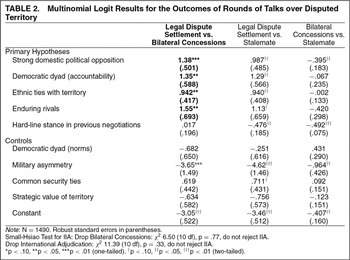
Table 2 presents the estimated results from a multinomial logit model estimated with robust standard errors. The first thing to notice is that a pair of Small-Hsiao tests reveals no violation of the IIA assumption. In addition, there is no evidence of significant multicollinearity among the explanatory variables in the model, because the largest auxiliary r2 value for any single explanatory variable is .42.

Moving to the actual findings, the first column of results in Table 2 is of primary interest. The parameter estimates in this column compare the impact of each independent variable on the relative likelihood that a round of talks will end with a decision to seek legal dispute settlement as opposed to the making of bilateral concessions. On the whole there is strong support for our general argument that anticipated domestic audience costs make legal settlement a more attractive option to state leaders than bilateral concessions. Looking at the highlighted results in the first column of Table 2, four of the five four primary hypotheses (H1–H4) receive support. In other words, when territorial concessions are likely to be costly domestically, political leaders attempt to use the cover of a third-party ruling to justify making concessions to end an international dispute. It is now useful to consider the findings for various hypotheses in more detail and to discuss the substantive impact of important domestic political variables.
First, there is strong support for the hypothesis (H1) that governments of all types who face strong domestic political opposition are more likely to seek legal dispute resolution and are less likely to make bilateral concessions. The direct comparison in the first column in Table 2 indicates that executives who are in a weak governing position are more likely to choose third-party arbitration or adjudication over a strategy of bilateral concession making.17
This finding is consistent across both democratic and nondemocratic regimes. We also estimated a model in which we replaced the general domestic opposition variable with a pair of regime-specific variables. We found that both democratic leaders who face strong opposition (p-value of .001, one-tailed) as well as nondemocratic leaders who face strong opposition (p-value of .003, one-tailed) prefer legal dispute settlement to a strategy of bilateral concession-making.

Although constrained leaders in any type of regime are more likely to prefer legal dispute settlement to bilateral concessions, the results from Table 2 also confirm our hypothesis (H2) that all else equal, democratic leaders should have stronger preferences for legal settlement due to the greater accountability inherent to democratic regimes. The coefficient estimate for the Democratic dyad (accountability) variable in the first column of Table 2 is positive and statistically significant at the .01 level. This supportive finding for democratic dyads stands in contrast to findings reported by Simmons (2002) and Hensel (2001). Differences in spatial–temporal domain likely explain this divergence in findings. The Simmons and Hensel studies focus only on Latin America, during a longer period dating back to the nineteenth century. Among the several cases of legal dispute settlement in Latin America in earlier times, most were undertaken by nondemocratic dyads, which probably explains the lack of supportive findings for a democratic dyad variable in their analyses. In contrast, our post-World War I temporal domain includes a more notable percentage of democratic dyads globally, many of whom pursued legal settlements to their territorial disputes. Therefore, although our finding about the propensity of democratic leaders to seek legal dispute settlement holds for the post-World War I period, we are not confident in generalizing this finding to earlier time periods.
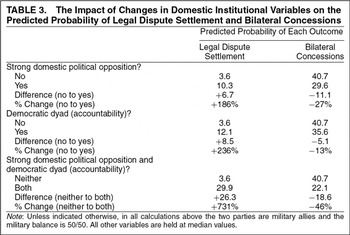
Once again, it is useful to get a sense of the substantive effect of this relationship between democratic dyads and legal dispute settlement. Turning to Table 3, one sees that pairs of democratic countries are more than three times as likely (12.1% vs. 3.6%) to seek the political cover of a legal ruling to settle an international dispute. Comparisons of the predicted probability of legal dispute settlement and bilateral concessions are particularly striking when one examines the situation in which leaders on both sides are democratic and they face strong domestic political opposition, a situation that characterizes eight of the 30 cases of legal dispute settlement in our analyses. When both conditions are indeed present, the predicted probability of arbitration or adjudication rises dramatically, from 3.6% to nearly 30%. In contrast, the probability of bilateral concessions between democratic leaders who face strong domestic opposition drops from more than 40% to around 22%. In sum, when leaders are highly accountable to domestic audiences—when they are democratic and face strong internal opposition—legal dispute settlement is considerably more likely than are bilateral concessions.
Although the hypothesis about democracy and accountability (H2) receives strong support, the alternative hypothesis about democratic norms is not supported by the empirical findings. In the first column near the middle of Table 2, one can see that pairs of states that share democratic norms are not more likely to choose legal dispute settlement over bilateral concessions in talks. The relevant coefficient estimate for Democratic dyad (norms) variable is actually negative for the comparison of third party legal settlement to bilateral concessions, although it is not statistically significant. Even when one substitutes a violence-based measure for democratic norms in place of the Polity-based measure, there continues to be no evidence of a relationship between democratic norms and resort to international legal mechanisms.18
In terms of the comparison between international legal dispute settlement and bilateral concessions, the coefficient for the violence-based measure of democratic norms is negative (−.050), yet the standard error is very large (.460).
The findings in Table 2 also provide solid support for the hypotheses regarding Ethnic ties with territory (H3) and Enduring rivals (H4). Leaders are indeed more likely to seek legal dispute settlement as compared to pursue bilateral concessions when the territorial issue is particularly salient to domestic audiences. Only the hypothesis about reversals from a hard-line stance in previous negotiations (H5) is not supported by the findings.
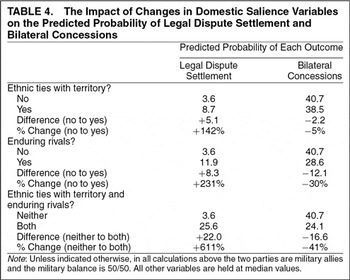
In the first column of Table 2, the coefficient estimate for the ethnic ties variable is positive and statistically significant (p-value of just over .05, one-tailed). In substantive terms, the presence of ethnic ties with inhabitants of the disputed territory more than doubles the predicted probability of arbitration or adjudication, while also producing a modest decrease in the probability of bilateral concession-making (see Table 4). Also supported is the idea that leaders are more likely to seek the cover of a third-party legal ruling when the territorial dispute adversary is an enduring rival. The enduring rivalry coefficient estimate in the first column of Table 2 is positive and statistically significant at the .05 level, and this finding is robust to alternate codings of the concept of enduring rivalry.19
The substitution of an alternate coding for enduring rivalry, based on only five disputes in the past twenty years, also produces a positive and statistically significant coefficient estimate (p-value <.10, one-tailed) for the comparison of legal dispute settlement to bilateral concessions.

We now consider the findings for the realist control variables. Although Common security ties and Strategic value of territory had no significant impact, the hypothesis that international adjudication is unlikely in the presence of substantial Military asymmetry is borne out by the results in Table 2. When one of the two states has a significant military advantage over the other, international arbitration or adjudication is highly unlikely and is notably less likely to occur than the making of bilateral concessions. Similar findings are reported in recent studies of adjudication and mediation (Hensel 2001; Mitchell 2002; Simmons 2002).
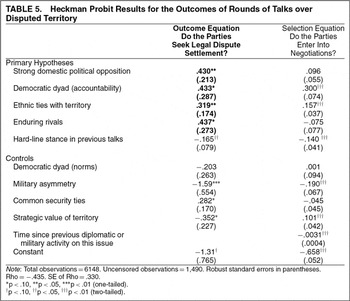
Finally, we also consider the possibility that our findings could be affected by selection bias. The concern is that decisions regarding the initiation of talks and the outcomes of talks could be systematically related, and by failing to account for the initial decision to pursue talks our empirical findings regarding the outcome of talks could be biased. To address this concern, we estimate a Heckman or “censored” probit model to simultaneously model the initial decision to enter into negotiations along with the subsequent decision of whether or not to seek international arbitration or adjudication (Greene 2002; Heckman 1979).20
To estimate this model, we collapse the number of possible outcomes for rounds of talks from three to two, although our results are not sensitive to this decision. In particular, we combine the categories of bilateral concessions and stalemate and code both outcomes with a value of zero. The cases of international arbitration and adjudication are then given a value of one. The results in Table 5 do not change significantly if we drop the stalemate cases from the analysis (or drop the bilateral concession cases from the analysis) as an alternative to collapsing the two categories into one category.
The model is identified due to the inclusion of an additional control for time in the selection equation, as well as the fact that the selection and outcome decisions are made in different months and thus the values for some variables will have changed. Also see Huth and Allee 2002 (ch. 2) for a discussion of the more than 6,000 cases of potential negotiations.

CONCLUSION
Despite the fact that states have resolved numerous disputes through international arbitration and adjudication, to date there has been relatively little theoretical and empirical work to explain why state leaders would resolve interstate disputes through these legal mechanisms. Therefore, we developed a general theoretical model to explain this decision and then tested our hypotheses using a data set comprised of rounds of negotiations between states regarding competing territorial claims. The statistical analyses revealed robust support for our general argument that leaders forego voluntary negotiated concessions and instead pursue legal dispute settlement when they anticipate sizeable domestic political opposition to the making of concessions. More precisely, governments were more likely to turn to arbitration or adjudication to resolve a dispute when (1) they were in a weak position vis-à-vis domestic political opponents, (2) the disputants were democratic, (3) the dispute was between enduring rivals, and (4) the dispute involved ethnic co-nationals in the disputed territory.
One general implication of our study is that our model could be applied to legal dispute resolution in other global settings. There are now many legal dispute resolution procedures that pertain to many areas of international affairs on both a global and regional level. We believe that scholars interested in the resolution of security, economic, and environmental disputes, among others, could draw upon our framework and findings. One might argue that the cases we examine, which concern disputes over territory, are particularly salient to domestic audiences; thus our model might not be generalizable to other spheres of international relations. However, many other types of disputes, including disputes over trade policies or precious natural resources, also can be highly salient to domestic political groups.
Our study also has direct implications for several existing literatures within international relations research. For one, our empirical findings illustrate broadly that domestic political factors often exert a strong influence on government behavior in interstate disputes. In fact, we found that the primary motivations for seeking the cover of an international legal ruling could be found in domestic politics. More precisely, our findings contribute to an increasing body of scholarship on international conflict behavior that emphasizes the way in which the domestic political accountability of foreign policy leaders influences their policy choices. For example, we believe our model and empirical findings converge nicely with certain scholars in the democratic peace literature (e.g. Bueno de Mesquita et. al. 2003; Reiter and Stam 2002) who have argued that institutional accountability is a stronger influence on foreign policy decision makers than are domestic norms of conflict resolution. In our empirical tests we found that norms-based arguments received far weaker support than our accountability-based hypotheses.
Second, our model and findings contribute to a recent and growing literature among political scientists on international legal institutions and their impact on state behavior (e.g., Morrow 2001; Simmons 2000). In fact, our study contributes to the legalization literature in several ways. For one, we identify the specific conditions under which state leaders are most likely to pursue legal methods of settling an international dispute. We accomplish this by performing one of the few systematic, large-n tests of government decisions to seek international legal dispute settlement. We also highlight the importance of the legitimacy of rulings from international legal bodies. In particular, we carefully discuss the ways in which the perceived legitimacy of third-party legal rulings can help state leaders to cooperate to resolve disputes.
Finally, we also believe that our research significantly advances the understanding of the role of legal institutions in the domain of security policy. This is important for at least two reasons. First, much of the legalization literature focuses on economic, environmental, and human rights issues. Scholars also need to examine security issues, however, to assess more fully the theoretical and empirical generalizability of claims. In addition, there is a strong theoretical tradition in security studies associated with realism that clearly questions the importance of legal institutions. We think security policy is a difficult issue area in which to find legal institutions playing important roles. Therefore, the supportive findings produced by our empirical tests are particularly noteworthy. Although the military power and security policy goals of states no doubt shape and constrain legal institutions in important ways, we believe the causal chain may also work in the other direction, as legal institutions and principles enable states to better manage the complexities of dispute resolution.
We thank Tom Ginsburg, Lloyd Gruber, Kris Miler, Charles Lipson, and participants in the PIPES seminar at the University of Chicago for their useful comments and suggestions. The research in this paper was generously supported by a grant from the National Science Foundation.




Comments
No Comments have been published for this article.