


In recent years, interest in concepts such as “good governance” and “quality of government” has increased considerably, and leading institutions such as the IMF and the World Bank have been embracing the idea of “good governance” (Doornbos Reference Doornbos2001; Hewitt de Alcántara Reference Hewitt de Alcántara1998; Mkandawire Reference Mkandawire2007; Weiss Reference Weiss2000).Footnote 1 Acknowledging the failure to draw a straight causal arrow from a particular ideological or institutional system to some recognized desired states of affairs, attention has often turned toward what other qualities might earn normative approval for a political system. Chiseling out an accurate concept of good governance or quality of government (QoG) is then commonly seen as an important part of a remedy for obstacles to societal well-being and economic growth.Footnote 2 Although QoG and similar concepts have been immensely popular, their popularity has not been matched by analytical attention. Hence, there is no consensus on what QoG means (Grindle Reference Grindle2007; Rothstein and Teorell Reference Rothstein and Teorell2008a, 167). The various scholars engaged in its analysis have tended to come from the fields of comparative politics, development studies, and the like. The subsequent definitions of QoG reflect those orientations by being heavily geared toward outcomes and measurability. The issue of how public authority should be administered has therefore escaped much needed analytical scrutiny.
In this article, I offer a novel definition of QoG. I begin with a critique of some of the recent accounts of QoG: QoG as efficiency, QoG as empirically grounded, and QoG as impartiality. I argue that the first and the third account fail because they are too narrow and that the second fails because it is not a definition at all, but rather an impressionistic sketch hidden beneath plenty of empirical data and statistical calculations. I then go on to suggest a more complex definition of QoG. This proposed definition is complex in the sense that it consists of a set of indispensable components structured in a particular way. My proposed definition is by necessity a rough sketch, and I therefore make no claims to have provided a final or perfect definition. What I do claim is that we have, after due reflection, a sense of what QoG means and that my proposed definition tracks that meaning better than any of its competitors. If plausible, then, it enables real headway toward a complete and acceptable definition of QoG.
QUALITY OF GOVERNMENT: SOME ATTEMPTS AT A DEFINITION
There are numerous definitions and general characterizations of QoG, the quality of which varies greatly (Graham, Amos, and Plumptre Reference Graham, Amos and Plumptre2003; Grindle Reference Grindle2007; Rothstein Reference Rothstein2011; Rothstein and Teorell Reference Rothstein and Teorell2008a; Weiss Reference Weiss2000). In what follows, I discuss and ultimately reject three prominent approaches to the concept of QoG.
Quality of Government as Efficiency
It might be tempting to define QoG in terms of economic performance; this is an understandable approach given that the debate over QoG initially was motivated by the failures of many developing countries to achieve sustainable economic growth (Mkandawire Reference Mkandawire2007; Nanda Reference Nanda2006; Weiss Reference Weiss2000). An institution exhibiting some degree of QoG would then be identified as one having above average economic output. States maintaining comparatively high growth rates would then be regarded as having a high degree of QoG, as would those with low unemployment rates, high GDP, and the like. However, such a characterization is clearly not a serious candidate when seeking a definition of QoG. Economic success can be achieved accidentally or be gained by various negative tactics, including widespread corruption and immoral practices and policies. It is unclear in what way such an economically successful state or administration deserves the praiseworthiness implied by an attribution of QoG. A similar approach is to define QoG as “good-for-economic-development” governance. This approach identifies and measures QoG not through actual outcomes, but through various indicators, such as the security of property rights, that are generally perceived as leading to economic development (La Porta et al. Reference La Porta, Lopez-de-Silanes, Schleifer and Vishny1999).Footnote 3 But defining QoG in this way is unsatisfactory. On most economic indicators China performs outstandingly well, but most people would be hesitant to attribute QoG to China, reflecting the view that the causes of China's economic success do not exhaust the meaning of QoG (cf. Rothstein and Teorell Reference Rothstein, Teorell, Holmberg and Rothstein2012, 22).
A more plausible approach is to identify QoG with high levels of efficiency, in which the economic dimension is merely one of several measured (Adserà, Boix, and Payne Reference Adserà, Boix and Payne2003; Charron and Lapuente Reference Charron and Lapuente2010). QoG then equals a use of available resources, broadly understood, conducive to some desired aim, and the greater the conduciveness to the desired aim, the greater the degree of QoG. Although I defend the position that efficiency is an inescapable component of QoG later in this article, placing efficiency at the center of QoG or making it the concept's sole dimension will not provide us with a decent definition of QoG. The main reason is that the normative status of efficiency hinges on what is the goal of efficient action. Although efficiency is commonly regarded as a virtue, it can also be a vice: Hutus were remarkably efficient when killing Tutsies during the 1994 Rwanda genocide, but nobody would deem their efficiency a virtue. If the downsides of efficiency are not as obvious in political discourse, it is because a number of additional premises have been implicitly assumed. Most prominently, in any organization, the existence of and the adherence to ethical standards and a system of explicit rules within that organization are what make efficiency into a virtue. If correct, it means that QoG is never only, or fundamentally, efficiency.
Empirical Approaches to Quality of Government
By “empirical approaches” to a definition of QoG I mean the category of impressionistic ostensive definitions where a bundle of indicators or elements are identified as jointly constituting QoG. Kaufmann, Kraay, and Mastruzzi (Reference Kaufmann, Kraay and Mastruzzi2009; Reference Kaufmann, Kraay and Mastruzzi2010) provide a typical example of such a definition: Governance is the “processes by which governments are selected, monitored and replaced; the capacity of the government to effectively formulate and implement sound policies; and the respect of citizens and the state for the institutions that govern economic and social interactions among them” (2009, 5). Governance thus understood is further characterized with the help of six dimensions: the rule of law, control of corruption, government effectiveness, regulatory quality, political stability and absence of violence, and voice and accountability. Assessing the performance of governments in each dimension and then aggregating the results yield a value allowing comparisons in the realm of QoG. The aggregate value of the six individual values determines the level of QoG. By applying this definition to empirical findings consisting of 441 variables stemming from 35 data sources and including 212 countries, an impressive amount of data pertaining to perceptions of good governance are obtained.
Although the empirical work done by Kaufmann and his colleagues is impressive, it lacks a real conceptual analysis and definition. The informants are asked to assess performance on a wide range of variables, and their answers are then categorized along the six dimensions mentioned earlier. If the study measures QoG at all, it does so by allowing the six dimensions to characterize QoG. But this approach is deeply problematic for two reasons. First, few of the dimensions seem to be related to the actions of governments, institutions, administrations, or public officials in general. Instead, the dimensions, as explained, refer to considerations such as the citizens’ abilities, the state's abilities, the likelihood of destabilization of the government through terrorism, or the likelihood of a coup d’état—none of which are directly related to how the authorities act and few of which are related to the character or the agent exercising public authority. The only directly related dimensions are government effectiveness and the rule of law, with the former being described in terms of achievements without regard for background conditions (2009, 6; 2010, 4). Such a definition of governance is clearly not consistent with any natural usage of the term. At its core, the concept of governance refers to the exercise of public authority and the internal conditions governing such exercise. Kaufmann and his colleagues’ definition deviates from the core meaning of governance, because it allows exogenous considerations to determine QoG. It thus seems to equate governance with something akin to political and civil life more generally.
Second, the definition provided by Kaufmann and his colleagues is stated, but not justified. Any justification or explanation of the preferred definition and its six dimensions is not even found in the report on the methodology of the Worldwide Governance Indicators project. Although this absence is in part explained by the predominantly comparative focus of many political scientists doing research on the topic, it is an omission nevertheless.
Impartiality as a Quality of Government
Rothstein and Teorell (Reference Rothstein and Teorell2008a, 169; Reference Rothstein, Teorell, Holmberg and Rothstein2012, 23) claim that a part of the explanation why researchers have failed to define QoG is that they have paid too little attention to normative perspectives. With the earlier two approaches to QoG in mind, one must concede to their claim. Both approaches seemed preoccupied with measuring, through various indicators, what they had yet to properly define. The definition of QoG as impartiality suggested by Rothstein and his colleagues is therefore a refreshing contribution in the discussion of QoG.
In various works, Rothstein has defended QoG as impartiality (Rothstein Reference Rothstein2011; Rothstein and Teorell Reference Rothstein and Teorell2008a; Reference Rothstein and Teorell2008b). According to the theory of QoG as impartiality, QoG is a concept built around a core value or basic norm: impartiality. The closer to the ideal of the impartial exercise of public power, the higher the QoG. Impartiality in the exercise of public power is defined as the implementation of laws and policies in which government officials—broadly defined as those who exercise public authority—do not “take into consideration anything about the citizen/case that is not beforehand stipulated in the policy or the law”Footnote 4 (Rothstein and Teorell Reference Rothstein and Teorell2008a, 170). Rothstein and colleagues emphasize that the concept only pertains to the “output” side of government (i.e., the exercise of public authority or power), as compared to the “input side”—denoting access to political power, decision making processes, and the norms and values guiding the mentioned arrangements and that are found in actual policies and laws (2008a, 169).Footnote 5 Impartiality is thus a “procedural norm” (2008a, 166).
QoG as impartiality can be illustrated by the example of a football referee. A good referee is guided solely by the established rules of the sport. He or she is not neutral, because the rulings will favor one team and burden the other, but is nevertheless impartial in the sense of not favoring one of the teams by letting those rulings be influenced by considerations outside the rule book. The referee is not to be blamed if the rules themselves are badly written; in such a case, we would still say that the referee is doing a good job given the rules he or she (impartially) enforces.
This characterization of impartiality in the exercise of public authority means that an impartial government is a government that would, per definition, also be identified as a noncorrupt government. Being impartial, in the sense of strictly adhering to the rules and guidelines stipulated in laws and policy, rules out corruption conceptually. Further, QoG as impartiality is also meant to imply that governance is foreseeable and therefore also reliable, because the impartial exercise of public authority presupposes a reasonably well-defined body of laws or policies to be implemented.
Although the idea of impartiality is easily grasped, the nature of the definition needs to be elaborated. First, it is a moral definition; that is, it constitutes an ideal to which government/governance and public administration morally ought to aspire (Rothstein Reference Rothstein2011, 6, 12; Rothstein and Teorell Reference Rothstein and Teorell2008a, 166; Reference Rothstein and Teorell2008b, 201). This feature sets the definition apart from the definitions discussed earlier. Second, the definition purports to be universally applicable. QoG is a concept valid in relation to all exercises of public authority, regardless of culture and state, and therefore it is also potentially applicable as an evaluative tool to all such exercises (Rothstein Reference Rothstein2011, 19; Rothstein and Teorell Reference Rothstein and Teorell2008a, 174–75; Reference Rothstein and Teorell2008b, 201). Third, it is procedural. Both initial circumstances and subsequent outcomes are thus irrelevant when determining the level of QoG (e.g., see Rothstein Reference Rothstein2011, 8; Rothstein and Teorell Reference Rothstein and Teorell2008a, 166). Fifth, it is consistent with and constrained by deontological moral theory. QoG is motivated by rights-based moral reasoning, such as the theories of justice presented by Ronald Dworkin and John Rawls; hence consequentialism is rejected (Rothstein Reference Rothstein2011, 9, 25, 30; Rothstein and Teorell Reference Rothstein and Teorell2008b, 202).Footnote 6 Sixth, the definition posits impartiality as the basic value. Other values are merely added to impartiality as extras or are derived from it (Rothstein and Teorell Reference Rothstein and Teorell2008b, 201).
So what is wrong with Rothstein's theory? Despite being a much more elaborate and well-reasoned theory than any of the previous ones, it nevertheless falls short of providing us with an acceptable definition of QoG. Without exhausting the possible criticisms, I next present two arguments for why we should reject QoG as impartiality.
First, QoG as impartiality is described as a procedural norm, because any values from the input side are denied entry into the definition of QoG.Footnote 7 Although Rothstein first assures us that “[a] state that enacts ‘apartheid type’ laws, for example, cannot be seen as having a high QoG even if they are applied by ever so impartial bureaucrats,” he later seems to arrive at the conclusion that QoG as impartiality does not need to be supplemented by values or principles—thereby allowing morally despicable regimes to score high in the realm of qualitative government (Rothstein and Teorell Reference Rothstein and Teorell2008a, 170; cf. Charron, Lapuente, and Rothstein Reference Charron, Lapuente and Rothstein2011, 16n; Rothstein Reference Rothstein2011, 17, 25).
But the insistence on a purely procedural definition of QoG is strikingly counterintuitive. Rothstein seems to miss the fact that by excluding normative content—indeed, all substantial content—from his proposed definition, crucial value connotations are rejected, and a worrying kind of emptiness is achieved. QoG as impartiality would then be little more than strict rule-following or, even worse, acting in ways consistent with existing rules.
The natural rejoinder is then to ask exactly what desirable quality “rule-following no-matter-what” confers on the use of public authority. The value of rule-following seems to be premised on the content of the rules, and by emptying QoG of considerations of both input and consequences, the existence of QoG may be perfectly compatible with severe immorality. So much bad political behavior is then consistent with the definition that it loses its moral significance and becomes solely a concept of theoretical interest. To put it succinctly, who would care about whether or not a (perhaps democratically elected) Nazi regime implements its laws and policies—amounting to genocide—impartially? Even if one insisted, in response, that the concept of QoG as impartiality is not exhaustive of the ideal of good political institutions or of a good society, one can reply that QoG as a virtue would cease to be a virtue, when paired with morally corrupt laws and policies. Then, rather than remaining an ever so insignificant independent “good” characteristic, impartiality turns into a full-fledged vice.
A possible retort would be that a procedural, morally empty definition of QoG is itself prompted by moral reasons, overriding our worry about impartial but corrupt governments. Rothstein states that “the idea in rights-based political theory is that social scientists should limit their ambitions to constructing fair procedures” (2011, 11) Democratic practices must be fair, although not necessarily the resulting laws and policies (Rothstein and Teorell Reference Rothstein and Teorell2008, 180). Once fair elections have established a law- and policy-making body, are we not morally obligated to respect and to impartially implement whatever laws it promulgates?
But such a retort is not convincing. Again, such “fair procedures” would allow for deeply immoral outcomes, the implementation of which, or the public power they would grant, would make impartiality into a vice. As I expound later, although the “right to be wrong” may appeal to our democratic convictions, it needs to be appropriately constrained by moral considerations. Moreover, if when exercising public authority the public agent encounters a gap—a case in which laws and policies provide no guidance—QoG as impartiality seems to allow strikingly immoral action to be compatible with high QoG scores, even if “fair procedures” are in place on the input side.
The co-writer from the 2008 article, Jan Teorell, when expounding the methodological underpinnings of QoG as impartiality, provides material for a more elaborate strategy. He argues that a decent definition of QoG must be conducive to morally preferred outcomes, a criterion sometimes insisted on by Rothstein (Rothstein Reference Rothstein2011, 12; Rothstein and Teorell Reference Rothstein and Teorell2008a, 179; Teorell Reference Teorell2009, 4). If so, impartial Nazi governments would not qualify for QoG. But Teorell does not seem to be aware of the problems with such an approach, where conduciveness to morally preferred outcomes is identified as a criterion for an acceptable definition, rather than as an element in such a definition. Making conduciveness to preferred outcomes into a criterion for the definition of QoG implies that we must establish a certain quality or a set of qualities that are generally or always conducive to that preferred outcome. But requiring a definition of QoG to have a content that is always, all other things being equal, conducive to a specific preferred outcome is much too strong, because it is unlikely that we would be able to establish such a quality. Even the weaker version of this criterion—a content that is generally conducive—is unsatisfactory, because the weak version implies that (1) there will be instances where either a government produces morally preferred outcomes but has little or none of the desired quality, or (2) it has that quality but does not generate the morally preferred outcomes: both cases show the definition to be unsatisfactory.
A second line of criticism stems from the claim that impartiality is the sole basic value of QoG, while allowing other values and norms to be added or derived. Rothstein and Teorell (2008b, 201) claim impartiality to be the “one, and only one” basic norm: instilling other virtues might be required only to “effectuate” the ideal of impartiality (Rothstein Reference Rothstein2011, 13), and the only substantial considerations that might influence implementation apart from what is found in the laws and policies themselves are factual considerations such as “time or budget constraints” (Rothstein Reference Rothstein2011, 13n). But this rather monolithic account of QoG is misguided for several reasons. Consider two modes of governances, G1 and G2, each aiming at the same values and outcomes and both being identical on the input side. G1 strictly follows the norm of impartiality and achieves outcome 0, meaning that under G1 the people are on the brink of starvation, despite no unusual circumstances burdening the state in question. However, had the government and its officials been more flexible and taken other values into account, outcome 0 might have been avoided. In such a case, it seems odd to say that G1 is an instance of ideal QoG. G2, in contrast, slightly deviates from impartiality and achieves outcome 1 in the same circumstances, meaning that the people under G2 prosper to an unprecedented degree.Footnote 8 It seems to me that G2 is more deserving of the label QoG than G1, ceteris paribus, despite G2's deviation from the ideal of impartiality. Similar examples can be constructed using differences in moral fiber and other parameters as well. This indicates that there is no straightforward priority for impartiality.
TOWARD A MORE COMPLEX DEFINITION OF QUALITY OF GOVERNMENT: COMPONENTS
Part of the reason why the definitions discussed earlier have failed is that they did not appear to fit considered moral and linguistic intuitions, which point toward a more complex definition. Their shortcomings seem to stem from not paying enough attention to what kind of a definition is warranted and to how we are to reach such a definition.
How are we then to recognize a satisfactory normative definition of QoG? For starters, QoG is clearly not an idea invented ex nihilo. We all have a rough idea of what quality in general means and what government might be. QoG and similar concepts express something vital to modern societies, which is not to be taken lightly. It is a noble idea that cannot be reduced to trivial matters; it must have—short of changing the entire discourse—a substantial content related to but not equal to the idea of the good society. QoG connotes a part of that awe-inspiring idea. Hence QoG as a concept must have a content that we somehow recognize as having certain goodness in relation to the political community. In short, when saying that a public agent has QoG, we attribute a certain positive value to that public agent. When trying to establish a more detailed normative definition, we are therefore to some extent bound by such intuition. If one wishes to use the concept of QoG while at the same time depriving the normatively rich concept of its meaning, by deviating too far from common linguistic and moral intuitions, one would be sailing under a false flag.
Rothstein repeatedly appeals to what “we” would think, accept, or reject. Although not wrong, this appeal is simply too thin. Relying on Rawls's formulation, he states that he searches for a definition that will be “acceptable to groups in a democracy with . . . ‘a pluralism of incompatible yet reasonable’, comprehensive religious, philosophical, and moral doctrines” (Rothstein Reference Rothstein2011, 8). But moral intuitions, and to some extent also linguistic intuitions, tend to be both vague and poorly organized. Often particularistic intuitions conflict with principles and even with facts, as we know them. Moreover, common opinions can be easily perverted. Therefore moral intuitions should not be naïvely accepted at face value, because they tend to be inherently conservative of current practices and opinions. Definitions that are supposed to express ideals cannot simply be copied from existing intuitions and opinions.
An attempt to avoid such dependence is Rawls's well-known method of reflective equilibrium (Rawls [Reference Rawls1971] Reference Rawls1999; Reference Rawls1974–75; [Reference Rawls1993] 1996; see also Daniels Reference Daniels1979; Petersson Reference Petersson, Van der Burg and van Willigenburg1998). Briefly explained, the method is a search for equilibrium between considered convictions, moral principles, and—in what is called “wide” reflective equilibrium—background theories. When all three components support each other we have a reflective equilibrium that is considered to be justified. This, or similar methods, has become somewhat of a standard approach in ethics and is also the kind of method to be preferred when searching for normative definitions, such as a definition of QoG.Footnote 9 Hence, an acceptable definition of QoG should constitute an equilibrium reached by carefully considering, weighing, and adjusting both moral and linguistic intuitions concerning the concept; principles of morality, justice, and governance; and theories of the world and the values we believe to pertain to it. If we seek a universally valid definition, then the components and the weighing in the equilibrium should be universally anchored. If we take this method seriously, we need a more complex definition of QoG.
Keeping Rothstein's characterization of QoG as a quality pertaining to government output only, as well as the ambition to construct an, as far as possible, universal definition, I next expound the core elements of a new definition of QoG. Although not all of these elements can be separately justified, they are nevertheless treated as distinct for analytical purposes. With the help of hypothetical cases and scenarios, I hope to show that a definition relying on these elements coheres better with our moral principles, common moral and linguistic intuitions, background theories, and values.
Minimal Morality and Public Ethos
Earlier, I pointed to the dangers of making QoG morally vacuous. Can this problem be mitigated in a fruitful way, without causing the definition to expand indefinitely or becoming operationally useless? According to John Rawls, justice is the first virtue of social institutions (Rawls [Reference Rawls1971] 1999, 3). Taking seriously the criticism leveled against QoG as impartiality, we need to account for what such a “first” virtue would look like, even if we do not adopt a Rawlsian conception of justice as part of QoG.
Deciding what moral content must constrain QoG is bound to provoke controversy; disagreement over moral standards is to be expected and accepted. However, although we may not be able to guarantee that every community will endorse our full set of moral values, norms, and principles or will accept them for the same reasons, there is a moral baseline accepted in all or almost all communities. Such a moral baseline can be described as minimal morality. But full-fledged, local moralities should also be respected, because they are important to people's identities and the lives they lead. A communally entrenched full-fledged morality is an instance of a public ethos: the reflective collective morality of the citizens, beyond mere minimalist standards and limited to the local community. Whether or not public agents in their exercise of public authority respect the normative content of the public ethos of their community is also relevant for an assessment of QoG.
The normative component that needs to be added to the definition of QoG thus comes in two parts: minimal morality and a thicker, more detailed public ethos. The former is basic, and the latter contains the former. Minimal morality consists of a set of basic prohibitions and duties that are universally or almost universally accepted after due reflection as morally authoritative. As explained later, fulfillment of the requirements of minimal morality is necessary for any governance to qualify as good; fulfilling the more demanding standards of a community's respective public ethos adds to that goodness.
Many contemporary ethicists and moral philosophers embrace some version of a de facto shared minimal morality, existing in the midst of competing ethical theories and systems (Appiah Reference Appiah2006; Barry Reference Barry2001; Beauchamp and Childress Reference Beauchamp and Childress2009; Bok Reference Bok1995; Donnelly Reference Donnelly2003; Gert Reference Gert2004; Küng Reference Küng1997; Orend Reference Orend2002; Sen Reference Sen1999; Walzer Reference Walzer1994).Footnote 10 Michael Walzer arguably presents the most defensible version, on which I rely here (Walzer Reference Walzer1977; Reference Walzer1987; Reference Walzer1994). He distinguishes between a thin morality and thick moralities, the former being a minimalist morality and the latter full-fledged, locally grounded moral standards. According to Walzer, the thin morality is a part of the thick moralities, but is distinguishable from it by being reiterated in all or almost all moral communities. Walzer, who is not concerned with meta-ethical issues, observes that morality already exists among us as authoritative: there is no need to “discover” it or to “invent” it. However, the morality is not immediately available to us, and we need to interpret the morality existing in a community to avoid any shallow accounts of it (Walzer Reference Walzer1987). From every thick, local morality, already functioning in an actual society and regarded as authoritative, we then abstract a thin morality. Because the thin morality is part of the thick moralities already accepted as authoritative, it gains its legitimacy from the fact that it is reiterated in every moral community.
According to Walzer, the minimal morality is often expressed as prohibitions on “murder, deceit, torture, oppression, and tyranny” (Walzer Reference Walzer1994, 10). Typical contents of minimal morality would be prima facie injunctions against harming others, cruelty, and coercing others, but it would also include prima facie positive duties, such as the duty to assist people in need.Footnote 11 These prohibitions and duties apply both to individuals and collective entities, although in some circumstances one or the other might be appointed the primary duty-holder.
Although an exact description of the contents of minimal morality is beyond the scope of this article, its outline is likely to resemble or to be expressed through a narrow set of human rights; for example, a trimmed-down set of the first-generation rights found in the Universal Declaration of Human Rights (UDHR). A number of human rights theorists and moral philosophers (e.g., Griffin Reference Griffin2008; Ignatieff Reference Ignatieff2000; Rawls Reference Rawls1999; Shue Reference Shue1996) have proposed such a narrow or prioritized set of rights. Although such accounts are not sufficiently clear to prevent any dispute over their interpretation, they give us a rough idea of what is needed. In practice, we might resort to parts of the UDHR or similar charters for approximations and operationalization.
If fulfilling the demands of minimal morality is a necessary requirement, fulfilling the demands of the remaining contents of the public ethos is optional, viewed from the perspective of QoG. Optional does not imply pointless, however. The level of QoG can be improved on by public agents respecting the local public ethos. This reflects the principle that the moral life of political communities, if consistent with the demands of minimalist morality, should be respected. Following the lead of Walzer, a thick morality should be regarded as an expression of the identity of the community and its members (Walzer Reference Walzer1983; Reference Walzer1987). For sure, beyond minimalist morality there will be substantial disagreement over right and wrong. Yet, given a minimalist morality, such diversity could be acceptable, and the moral values, principles, and norms of different communities can be respected.
In the way of a short summary, a decent conception of QoG would incorporate such minimalist morality in the sense that no exercise of public authority would exhibit QoG unless in accordance with the precepts of minimal morality. Further, the level of QoG rises as the exercise of public authority increasingly adheres to the norms found in the public ethos.
Decision Making and Reason Giving
Consider a situation in which Smith, a public official, is faced with different ways to implement a policy. Smith decides on his course of action by giving two different sized carrots to his pet rabbit. If the rabbit chews on the bigger carrot, Smith implements the policy in way W1. If the rabbit starts chewing on the smaller carrot, then Smith implements the policy in way W2. The rabbit chooses the bigger carrot, and Smith subsequently goes for W1. As it happens, W1 means that the policy is impartially implemented, fully aligned with the content found on the input side. There is nothing in implementing W1 that runs counter to our public ethos. Is Smith's decision making procedure an instance of QoG? Arguably no. Although the implementation of the policy carried out by Smith is fully compatible with previously stipulated laws, values, and aims, the decision making prior to the implementation was guided by something else (or, rather, by nothing at all). Moreover, even though Smith's way of choosing W1 is consistent with the ideal of impartiality, the rule of law, and the public ethos, it will not strike most people as compatible with QoG. This judgment, to the extent it is shared by most people after due reflection, indicates that a quality needed for QoG is lacking. My claim is then that good decision making is an essential part of QoG.
Defining good decision making in a precise way is difficult. A tentative definition would be to characterize good decision making as decision making based on a rational or reasonable assessment of available alternatives. But this definition only pushes the problem ahead, because rationality and reasonableness have resisted attempts at more detailed definitions. I believe that the most promising approach is to start from the other direction. At its minimum, good decision making can thus be described as decision making consistent with the law of noncontradiction and where none of the well-known spoilers of rationality and reason have any influence on the decision. Typical examples of such spoilers are coercion, manipulation, substandard reasoning capacities, inadequate information, adaptive preference formation, and various biases. To paraphrase Jon Elster, decisions must not have the “wrong causal history” (Reference Elster1983, 16).
The criterion of good decision making is merely formal, meaning that it does not directly restrict the content of the decision. By itself, it is insufficient as a definition of QoG, because rational and reasonable thinking can lead to disastrous result if based on faulty or immoral premises. But good decision making is a necessary component of QoG, because as long as agents endowed with the capacity for moral thinking and rational deliberation are responsible for implementing government policy, they constitute a link in the chain leading to implementation that cannot be called “qualitative” unless it avoids the common pitfalls of irrationality and unreasonableness.
As a practically motivated corollary, transparency is also required. Transparency in the sense I have in mind here amounts to reason giving: the agent must make public—or be able to make public on request—the reasons for every decision made in the process from input to actual implementation. Note that this is a stronger requirement than transparency as it is usually understood, because transparency commonly refers only to procedures and documents. Unless reasons are provided, the citizens cannot assess whether or not implementation is performed for the right reasons, and holding public agents accountable thus becomes difficult. Reason giving is not merely a mechanism for avoiding corruption and ensuring that public agents comply, for the right reasons, with whatever rules they are intended to follow; it is also a means to arrive at gradual improvement in implementation and the maintenance of its quality. This requirement also emphasizes the interaction between citizens and public agents—that governance is not merely a unilateral exercise of public authority. Public agents must perform their obligations for the right reasons, and they must allow us to see that they do so.
The Principle of Beneficence
The need for the integration of a higher order principle into the definition of QoG is justified by two facts: (1) the existence of conflicts and gaps, actual or interpretative, in the system of laws and policies and (2) the potential inability of the public ethos to adjudicate in case of such conflicts and gaps. With no higher order principle, the public agent will be forced to operate on its own, outside the existing framework, unguided by the public ethos.
I call this higher order principle the principle of beneficence (PB). PB provides guidance in cases where laws, policies, and the public ethos are all silent or in unresolvable conflict. Although PB could be justified in the same way as minimal morality and to some extent can be regarded as a moral principle, it does not operate on the same level as minimal morality. It plays the role of a higher order principle, and thus I treat it as an independent principle.
PB can be defined as follows:
(PB) Under conditions of uncertainty, public agents ought, when exercising public authority, to treat the subjects under their authority in accordance with the most beneficial alternative that is materially and ethically available.
By the phrase “conditions of uncertainty” is meant conditions where laws, policies, and the public ethos are all ambiguous, vague, in conflict, or simply silent. Conditions of uncertainty also include conditions where there is a shortcoming on the agent side or when the lack of factual input or external circumstances make a law or policy impossible to apply. The lack of reliable facts and probabilities, which laws and policies are meant to rely on when applied, creates further room for maneuver for the public agent. Epistemic uncertainty therefore adds to an overall condition of uncertainty, allowing PB to come into play. This also means that PB is parasitic on the existence of laws and policies. The subject of a government is in no position to claim any services from that government, beyond what is required by the public ethos and stipulated in laws and policies; whatever he or she receives from the government exceeding such standards is given not because of legally or morally recognized claims, but because of the benevolence of the government and its public agents. This fact makes PB parasitic and readily describable as a principle operating “in the gaps” of existing institutional frameworks.
By “beneficial” is here meant that which can reasonably be regarded as favoring the interests of the citizen or of a particular group of citizens. Hence “beneficial” is weakly paternalistic because it makes no direct allusion to the individual's first- or second-order preferences, instead relying on what is deemed to be, after due reflection and deliberation among competent citizens, overall favorable to that person.
By “most beneficial alternative that is materially and ethically available” is meant an alternative consistent with (although, per definition, not prescribed by) laws, policies, and the public ethos and that is materially feasible given available resources. Both conditions are necessary. Even if an alternative is materially feasible, it might be ruled out because it diverges from what can be morally accepted in that community.
The primary justification of PB can be phrased as a rhetorical question: would individuals not prefer a state that would give them beneficial treatment, all other things being equal? Such intuitive justification may or may not be moral, which is another reason for not treating PB as a part of minimal morality. Beneficence is then seen as an additional good-making quality in general, lending quality to public agents. It seems natural that we would prefer public agents acting in accordance with PB, rather than not.
An instrumental justification is also possible. In a well-functioning society, community should hold between citizens, and according to G. A. Cohen “the requirement of community . . . is that people care about, and, when necessary and possible, care for, one another, and, too, care that they care about one another” (Cohen Reference Cohen2009, 34–35). The idea underpinning this principle could—and should—be extended to the relation between citizens and the state (or, more generally, subjects and authorities), because it enables a well-functioning and pleasant society. However, because laws, policies, and the public ethos already govern the relations between citizens and the state, a modified version of the community principle applies only to gaps. And because laws, policies, and public ethos already partly specify the “caring about” and the “caring for,” a more general notion is needed to fill the gaps: hence PB and its “beneficial” treatment.
Efficiency
An acceptable definition of QoG cannot ignore efficiency or place it second to impartiality or some other basic value: performance matters. How are we to accommodate such an intuition? Clearly, it is not efficiency measured by outcomes that we are interested in, but performance relative to one's unique starting point. If public official Smith manages to exercise his power in such way as to increase his capital, broadly understood as the society's holdings of desired goods, from 100 to 101 units, it is surely a good thing, but we would rightly give more praise to public official Jenny, who has increased the capital she is responsible for from 50 to 70 units. Moreover, if Smith would increase his capital from 100 to 120, and Jenny would do the same, but with the difference that Smith accomplishes the feat by using up most of the resources available and thereby only gains a temporary peak in output, while Jenny manages the same increase using only renewable means, then Jenny deserves our praise to a greater extent than does Smith. Performing at the cost of the next generation is, I believe, not consistent with a reasonable conception of QoG. Efficiency can thus be defined as sustainable positive performance, concerning socially desired goods and relative to available resources.
Because it is impossible to determine a single relevant index for such efficiency, one should use a compound of various dimensions to unpack and assess overall efficiency: economic indicators; indicators of societal, physical, and psychological well-being; equality indicators; measures of innovativeness; and the like. The relevant compound index for measuring efficiency is also bound to vary according to cultural norms and public ethos. Such variation will make assessments and comparisons gruesomely difficult, but that is no reason for not following the arguments where they lead us.
The Rule of Law and Impartiality
A cornerstone in any conception of QoG is the rule of law, because this feature is believed to provide the basic reliability needed for individuals, organizations, and corporations to plan and invest for actions and aims. I take the rule of law to include the impartial exercise of public power, the same principle that Rothstein claimed to be foundational to QoG. However, my inclusion of impartiality differs from Rothstein's in at least two crucial respects. First, Rothstein claims that impartiality “implies” the rule of law because the rule of law is identified as “an impartially applied legal system” (Rothstein and Teorell Reference Rothstein and Teorell2008a, 182; also, see Rothstein Reference Rothstein2011, 25, 28–29). But impartiality implies the rule of law only by construing the rule of law so narrowly that it becomes identical to impartiality. If so, describing QoG in terms of impartiality rather than the rule of law involves little innovation.
To see why this conception of the rule of law is too narrow, consider the following case: our friend Smith, the public official, is well versed in the laws and policies of his state. He meticulously exercises his authority impartially. However, Smith—or anybody else for that matter—never cares to make public the laws and policies that constitute the guidelines and framework for his actions. Because the people do not know the content or extent of the laws, Smith's impartial exercise of his public authority does not amount to predictability.Footnote 12 Yet Smith's impartial exercise of public authority clearly fulfills Rothstein's narrow version of the rule of law, which portrays it only as a relation between laws and the public agents applying them. But that is surely not the best way to understand the rule of law, as this example indicates. A broader, fuller conception of the rule of law also involves a certain relation between a set of rules and the people. This broader and standard conception of the rule of law includes laws being written down, publicly promulgated by the appropriate authority, being forward-looking (not ex post facto), and fairly applied. I agree with this more substantial definition.Footnote 13
Second, although Rothstein unconditionally embraces impartiality, my claim is that impartiality can only be accepted with a ceteris paribus clause. What is required is reasonable impartiality, not dogmatic impartiality. There is no need to make a fetish out of the rule of law. There might be cases where the rule of law, under any reasonable interpretation of QoG, must be tempered by moral considerations. Such cases will range from instances of institutionalized property theft by the state to atrocities backed by morally corrupt laws.Footnote 14
Stability
By stability is meant the intrinsic stability of the public authorities and their exercise of public power. It is important to distinguish intrinsic stability from domestic and external stability. Domestic stability refers to the capacity of public authorities to maintain their function and implement laws and policies given the elements within the domain over which they exercise power. External stability refers to the same capacity in relations to elements outside its jurisdiction. Intrinsic stability refers to the capacity to remain reasonably stable as an administration/set of agents exercising public authority, given the resources available. Intrinsic stability should therefore not be confused with general stability in the society, which is a likely consequence of QoG. Examples of agents lacking intrinsic stability would be institutions that, because they are poorly organized, harbor tensions among its parts, as well as institutions that issue and implement decisions that undermine their own authority.
On this interpretation, stability is a forward-looking quality, not taking external or domestic threats to the administration into consideration.Footnote 15 It is not to be confused with efficiency, because stability as here defined is not concerned with outcomes produced by public agents, but instead with the stability of the public agents as such. Such stability is consistent with the idea that QoG is a quality that can be controlled by the public authorities themselves and for which they can be held responsible.
TOWARD A MORE COMPLEX DEFINITION OF QUALITY OF GOVERNMENT: STRUCTURE
In this section I sketch the structure of my proposed definition. By “structure” I mean what fulfillment of each component is required and how the various components should be weighted against each other. I call these dimensions nature and weight.Footnote 16 However, I do not attempt to settle the question of how to apply the definition; I also bracket the question of how to realize QoG. Although measuring QoG might require an ideal definition to provide guidance, we might have to resort to non-ideal operational definitions when assessing the extent to which QoG is prevalent. Moreover, because the world is non-ideal in terms of resources, capacities, knowledge, and compliance, realizing QoG in a sensible way requires prioritizing and taking contextual considerations into account (Grindle Reference Grindle2007).
The Nature of the Components
Many usages of QoG refer only to “dimensions” or “indicators,” meaning that QoG can function as a measurement of bad governance as well, in the sense that low QoG scores imply a lack of quality of governance. Although I accept that QoG comes in degrees, the fact that we are aiming for a definition of good governance entails that negative—bad—governance is an area to which the concept of QoG reasonably does not apply. When defining the concept, we are not allowed to speak merely of “dimensions” or “indicators.” This point can be illustrated with the help of an analogy. Consider buying fruit at the local market. There is plenty of fruit and of varying quality. Some fruits are tasty, some are fresh, and the like: these are dimensions of quality. But if you want to speak of quality in a normative fashion, dimensions are clearly not enough: you must also distinguish between bad fruit and good fruit. You do this easily by setting some kind of threshold. In the case of freshness, a good apple must be crisp and have a crunchy feel to it; in the case of taste, a good apple must have a certain sweetness to it. In the same fashion, if we want to speak of QoG in a normative sense, then we have to establish thresholds for the components involved.
It might be replied that a different but equally natural way of assessing apples is to establish not thresholds, but ideals functioning as endpoints in the relevant dimensions. We might simply imagine the perfect apple and use it as a critical standard. This strategy would then apply to QoG as well. If we define QoG as impartiality, we can use the “ideal apple strategy” because impartiality, per definition, is a closed-end notion: You can abide by the rules perfectly, and that would be it. Unfortunately, this strategy does not work in the case of the complex definition proposed here, because many of the components I have suggested are open-ended. For instance, it is hard to see what the endpoint of reason giving would be, because you can add to a (good) argument indefinitely by giving reasons for your reasons. Defining QoG as an ideal in the endpoint sense is therefore not feasible.
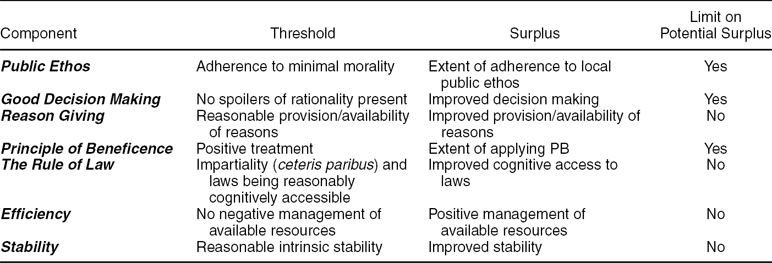
This means that an account of QoG ideally must identify the location of the threshold for each component; it must also identify which components are open-ended and which are not, because some components, once past the threshold, allow indefinite quality improvements, whereas others do not. Perhaps to the disappointment of the reader, I do not attempt to pinpoint the exact location of each threshold. Such thresholds can only be imperfectly positioned, and surpassing them will tend to be qualified with “in general.”Footnote 17 Therefore I restrict myself to pointing out which ones have thresholds, approximately where the thresholds are to be found, and which components have an open-ended surplus.
No exercise of public authority fulfills the ideal of QoG if it involves unnecessary and abhorrent immoral deeds. Complete fulfillment (with some qualifications explained later) of the requirements of minimal morality is therefore a threshold that must necessarily be passed if that exercise of public authority is to deserve the label QoG. The moral component was also said to include a public ethos, which constitutes the component's surplus. QoG increases, all other things being equal, proportionally to the adherence to the public ethos embedded in the community over which the public authority is exercised. If the observance of the public ethos is complete, then the moral component of QoG has reached its maximum.
Good decision making implies the absence of the common spoilers of rationality and reason; that is the threshold that must be passed. Above the threshold, improvements in decision making quality will increase QoG. However, the surplus of good decision making has, at least regarding some decisions, an endpoint, beyond which it cannot be improved on. Such decision making would be deductive in nature and would rely on undeniably true premises, for which no further support is believed to be needed and no stronger support can be given.
The sibling component, reason giving, has a threshold set at the level at which the information provided is reasonably needed for the citizen to reasonably accept, or to criticize, the decision made by the public agents. The surplus above such threshold is open-ended because, at least potentially, reason giving can be extended indefinitely.
Efficiency also has a threshold. To be eligible for attribution of QoG, the public agent's performance must, given the available resources and circumstances, not be on the negative side. This, in effect, means that maintaining the current level of, or current level of increase in, resources would qualify a public agent for QoG, and any positive result of managing available resources will count as a surplus. This condition is difficult to assess in practice, because operational definitions will be imperfect and comparisons between different sets of available resources will be difficult to make. Such difficulties, however, are no reason to change the normative definition of QoG.
The threshold of the rule of law component is the following: Impartiality, ceteris paribus, must be satisfied, and the laws and policies must be reasonably cognitively accessible to the citizens in general. Whereas impartiality, ceteris paribus, reaches its limit at the threshold, thus allowing no surplus in itself, the accessibility of laws and policy to the general public does allow a surplus. Theoretically, there is no endpoint for such a surplus.
Stability also involves a threshold, although perhaps it is even more difficult to pinpoint than the previous components. For what is “reasonable” intrinsic stability? I suggest that the notion of reasonable, and thus the threshold, be tied to the public ethos: in a live-in-the-moment community, the time horizon will be notably shorter than in a plan-for-the-future community; in a culture of risk, stability is easier satisfied than in a play-it-safe culture. That said, because sustainability is perceived as a good, it has a surplus in the form of improved stability, in both temporal terms and in terms of quality. Described in this way, sustainability has no endpoint.
Last, there is the principle of beneficence (PB). PB also has a threshold that must be surpassed. Although efficiency requires the status quo to be maintained or the positive management of available resources for QoG to be a possibility, PB, when coming into play, also has a threshold that must be surpassed: on this account, neutral treatment is not enough. Let me explain. When encountering a gap, public agents have an opportunity to further the interests of one or several citizens. If they do not seize that opportunity, the public agents owe us an explanation, because they could have benefited the citizens in a way consistent with (although not prescribed by) the public ethos, but opted for not doing so. Moreover, it allows a surplus that is ultimately constrained by material conditions and the public ethos.
Having outlined the necessary components, QoG can now be defined as a positive descriptive characteristic of exercises of public authority that surpass the threshold of each necessary component. To arrive at an adequate normative definition, however, we need to be able to distinguish among the various exercises of public authority fitting that description.
The Nature of the Components of QoG

The Weight of the Components
In cases where several indicators or components of QoG are adopted, there is a tendency to simply assign them a numerical value based on the extent to which they are satisfied in a particular setting and then to aggregate the numbers to gain another numeric value as output, thereby allowing us to easily compare how different administrations perform. Such an approach is questionable not only because of the interdependence of and potential conflicts among many components (Keefer Reference Keefer2004, 7) but also because we are unlikely to give the same normative weight to every component. Although all components in the proposed definition are necessary, some are likely to be given more weight than others. Hence an account of their respective approximate weight is necessary.
Each component might generate a relevant surplus. For instance, QoG requires a minimum quality of decision making, but even better decision making means that the level of QoG is higher. This has important consequences. If all components have thresholds that necessarily must be passed, then we have drawn the line between good and bad governance; we have established the realm of QoG. There is no weighing to be performed at the thresholds, because that realm is established with the help of necessary conditions. The existence of surplus, in contrast, means that we have to weigh the surplus to gain a more fine-tuned grading of QoG.
There is no universal and complete weighing procedure. However, one can perform an incomplete weighing, at least in theory, because it will be inescapably messy in practice. The incomplete weighing follows four simple principles, all of them internal to the definition of QoG:
-
I. The requirements of the minimal morality govern the weight assigned to each other components’ surplus.
A component's weight vis-à-vis another component is then determined on the basis of how well it is consistent with, protects, and promotes fulfillment of the requirements of the minimal morality. This also means that the requirements of minimal morality are given priority. I cannot provide a blueprint for how to apply such a weighting principle: messy empirics are bound to result in different weights dependent on the situation. Consistency with minimal morality could be deemed more important than the promotion of minimal morality in one case, whereas a different judgment can be the outcome in a different situation. This is why I also describe the method as incomplete. I do not address here the extent to which such incompleteness can be overcome.
I accept that in some cases principle (I) will not yield conclusive advice on how to weigh the different components. In the political realm and elsewhere, there are tragic cases—dirty hands dilemmas—where no ethically preferable solution might be forthcoming. Also, note that the PB component is a special case here, because per definition it only applies when the requirements of the public ethos and of positive laws and policies have taken us as far as they can. Hence, principle (I) will not help us assign the proper weight to PB. It might then be thought that PB remains a problem, because it is clear that PB can be fulfilled in degrees. But this would be an imaginary problem, because the fact that PB comes into play also entails that principle (I), which, under normal circumstances, is a prioritized principle, has been fulfilled as far as is possible. In short, when the limits of (I) have been reached, the different weighings of the components of QoG are equal, allowing the extent to which PB is fulfilled to function as the tie-breaking component. Hence a second principle:
-
II. In cases where (I) does not yield definitive rankings, the principle of beneficence (PB) is appealed to.
A third and fourth principle also govern the components of QoG:
-
III. Each component, including principle (II), can be temporarily left unsatisfied only to (a) ensure an increase of the overall surplus and/or the stability of such a surplus in the long run and/or (b) to ensure an increased surplus and/or the stability of such a surplus of a particular component in the long run.
-
IV. Principle (III) must be consistent with the requirements of minimal morality, unless the circumstances are those of a supreme emergency.
Principle (III) acknowledges that minor sacrifices can sometimes be acceptable to gain something better or to maintain the desired conditions. This intuition also pertains to QoG as a whole, as well as to its components. When weighing the various components of QoG, (III) assures that a component left unsatisfied with a reference to greater gains will, pending actual results, be given the same weight as the component had before embarking on any improvement strategy.
However, as principle (IV) states, the means-to-end thinking apparent in (III) should also be tempered by moral concerns of a deontological nature, as expressed in the moral minimalist standard referred to in (I).Footnote 18 Principle (IV) also contains a caveat: the forward-looking approach prescribed by (III) may be adopted all out in supreme emergencies. Supreme emergencies are commonly understood as instances where some morally basic or overarching good is threatened and the ordinary rules of morality therefore do not apply—the paradigmatic case being a threat to the entire political community or to the world, as we know it (cf. Nozick Reference Nozick1974, Walzer Reference Walzer1977). In such an unusual case, principle (III) is allowed to take precedence before (I).
Principles (I) – (IV) illustrate the basic principles structuring the relation between the various components in QoG. Accounting for such structural and normative relations is difficult, and most scholars tend to leave such accounts for others or to be determined solely in practice. However, I believe that a description of the relations involved is necessary, and I have therefore attempted to outline such a structure.
Having outlined the principles needed to distinguish good QoG from even better QoG, we are finally in a position to define ideal QoG formally. Ideal QoG then equals an exercise of public authority that surpasses the threshold of each necessary component and delivers as much surplus as possible in a given situation and as compatible with principles (I)–(IV). I claim that this definition fits the concept of QoG better than any existing competing definition.
CONCLUDING REMARKS
If we take the criticism of the standard definitions of QoG seriously, another concept of QoG begins to take shape. A revised concept of QoG must take into account the moral status of the laws and policies on which the public agents’ exercise of public power rests. A revised concept of QoG must also include various components at its very foundation, components that are endogenous to the exercise of public authority. I have discussed several of such components in this article, but it would be premature to claim that the list of components is definitive and exhaustive. A deepening of the discussion will yield whether one or several components need to be removed, added, or thoroughly revised. In addition to the mere list of components, I added a set of principles for how to weigh them, and thus a rough manual for how to compare and to rank different instances of QoG. Operational definitions and measurements remain to be worked out. The proposal in this article is merely a beginning. Nevertheless, it is a necessary beginning.



Comments
No Comments have been published for this article.