Introduction
The number of people seeking international protection in Ireland has exponentially increased. In 2021 there were 2,648 applications for international protection in Ireland. This increased to 18,561 in 2024, representing an increase of 601% in just three years (IPO 2026). These numbers remained elevated in 2025, with 13,162 applications. In 2024, the Irish population grew by 1.6% equating to seven times the EU average (RTL Today 2025), largely driven by net migration, of which 16% of the total population was born in a non-EU country (Eurostat 2024). Refugees and Asylum seekers (RAS) make up a growing percentage of the Irish population. An asylum seeker is someone who present in another state, fearing persecution or serious harm if returned (International Protection Act 2015). Refugees have been granted leave to remain, while Asylum Seekers are awaiting a decision.
By the end of June 2025, 117.3 million people globally had been forced to flee their homes (UNHCR, 2026; n.d.), suggesting that displacement is not a temporary phenomenon but an enduring feature of contemporary societies.
Apart from Ireland’s legal, ethical and humanitarian responsibility, it has also been suffering from a declining and ageing population. The argument for receiving RAS is consequently more nuanced and multi-factorial, but shows promise if it can be successfully managed through integration.
Mental health (MH) care has been acknowledged as a key component to having a healthy, happy and contributing population. (Perkins et al. Reference Perkins, Michalek, Dikomitis, Shergill and Mareschal2025; UNHCR. n.d.; Walther et al. Reference Walther, Rayes, Amann, Flick, Ta, Hahn and Bajbouj2021). It is also well known that RAS suffer higher levels of MH distress (Blackmore et al. Reference Blackmore, Boyle, Fazel, Ranasinha, Gray, Fitzgerald, Misso and Gibson-Helm2020).
This paper employs a narrative literature-based review to map existing MH service provision in Ireland and assess its alignment with the needs of RAS. Consistent with narrative review methodology (Sukhera Reference Sukhera2022), this review prioritises conceptual synthesis and interpretive integration of evidence rather than systematic aggregation. An initial scoping of literature identified recurring themes relating to asylum policy frameworks, MHPSS models, MH outcomes in RAS, and service delivery structures. These themes were developed inductively through engagement with the literature and conceptual grouping of key ideas across policy, clinical, and service-level sources. Literature was identified through manual and database searches and reference lists of key papers. Inclusion prioritised peer-reviewed studies, relevant policy documents, and high-quality NGO and institutional reports.
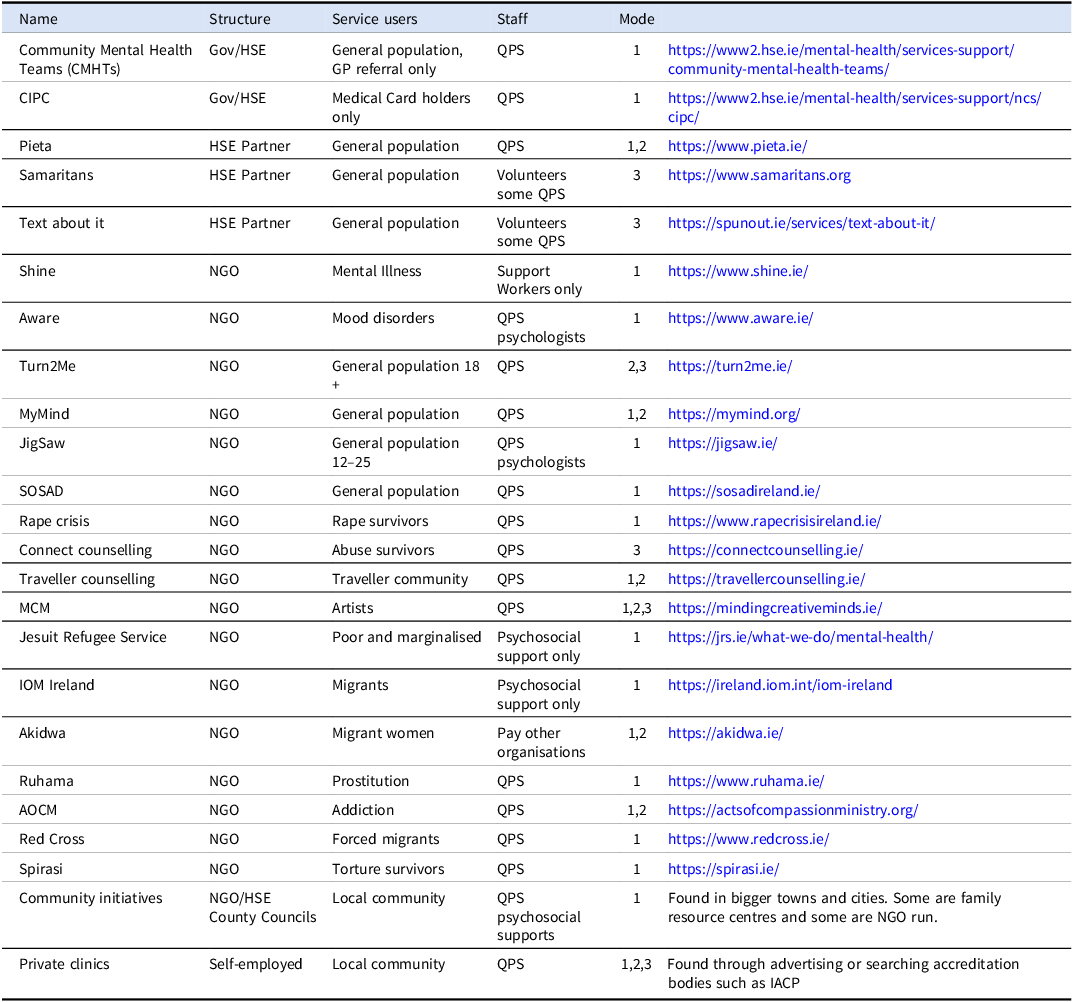
Approximately 50 peer-reviewed papers informed the conceptual and empirical background of the review, with a summary sample captured in Table 1. In addition, a targeted manual search was conducted to identify Irish psychotherapeutic service providers, informing a novel synthesis of service availability (Table 2). Over 90 sources were ultimately included to support the analysis and interpretation presented.
Summary of key papers

Table 1. Long description
A table summarizing key papers on mental health and asylum seekers. The table has 10 rows and 5 columns. The columns are labeled Author, year, Country, Study type, Focus, and Key findings. The rows present data on various studies and their findings. Row 1: Author, Kennedy and Fitzgerald; year, 2002; Country, Ireland; Study type, Clinical service review; Focus, Psychiatric referrals of asylum seekers; Key findings, Identified high morbidity and lack of culturally appropriate services. Row 2: Author, O’Connell et al.; year, 2016; Country, Ireland; Study type, Policy and service analysis; Focus, Mental healthcare and asylum system; Key findings, Irish mental health services insufficiently adapted for RAS needs. Row 3: Author, Nwachukwu et al.; year, 2009; Country, Ireland; Study type, Policy needs assessment; Focus, Service requirements; Key findings, Highlighted structural gaps in specialist RAS mental health provision. Row 4: Author, WHO; year, 2025; Country, Global; Study type, Policy report; Focus, RAS mental health; Key findings, Emphasises system-level integration and specialist capacity building. Row 5: Author, AIDA; year, 2025; Country, Ireland; Study type, Policy report; Focus, Access to healthcare; Key findings, Documents barriers to healthcare access for asylum seekers in Ireland. Row 6: Author, Blackmore et al.; year, 2020; Country, Global; Study type, Systematic review & meta-analysis; Focus, Prevalence of mental illness in RAS; Key findings, High prevalence of PTSD, depression, and anxiety among RAS populations compared to host populations. Row 7: Author, Henkelmann et al.; year, 2020; Country, High-income countries; Study type, Systematic review & meta-analysis; Focus, PTSD, depression, and anxiety in resettled RAS; Key findings, Mental disorders remain prevalent post-resettlement, indicating unmet long-term care needs. Row 8: Author, Perkins et al.; year, 2025; Country, Global; Study type, Systematic review; Focus, Trauma, PTSD, and post-migration functioning; Key findings, PTSD significantly impairs social functioning and integration outcomes. Row 9: Author, Jannesari et al.; year, 2020; Country, Global; Study type, Systematic review; Focus, Post-migration stressors; Key findings, Legal insecurity, housing, and social exclusion strongly linked to mental health deterioration. Row 10: Author, Patanè et al.; year, 2022; Country, Global; Study type, Systematic review & meta-analysis; Focus, Prevalence of mental disorders in RAS; Key findings, Confirms elevated rates of common and severe mental disorders across RAS groups.
Service mapping of Irish psychotherapeutic providers

Table 2. Long description
A table titled ‘Service mapping of Irish psychotherapeutic providers’ with 20 rows and 5 columns. The columns are labeled ‘Name’, ‘Structure’, ‘Service users’, ‘Staff’, and ‘Mode’. The table lists various organizations and services providing psychotherapeutic support in Ireland, detailing their structure, target service users, staffing, and modes of operation. Each row provides specific information about a different service provider. The ‘Name’ column lists the names of the service providers, such as ‘Community Mental Health Teams (CMHTs)’, ‘CIPC’, ‘Pieta’, ‘Samaritans’, and others. The ‘Structure’ column indicates whether the service is provided by ‘Gov/HSE’, ‘HSE Partner’, or ‘NGO’. The ‘Service users’ column specifies the target population for each service, such as ‘General population’, ‘Medical Card holders only’, ‘Mental Illness’, ‘Mood disorders’, and more. The ‘Staff’ column details the type of staff involved, including ‘QPS’, ‘Volunteers some QPS’, ‘Support Workers only’, and ‘Psychosocial support only’. The ‘Mode’ column provides links to the respective websites or services, with some entries having multiple modes indicated by numbers 1, 2, and 3. The table provides a comprehensive overview of the availability and specifics of psychotherapeutic services in Ireland.
QPS = qualified psychotherapists.
Face-to-Face = 1.
Online = 2.
Telephone = 3.
Why countries need to receive asylum seekers
European law
European states accept RAS primarily because they are legally bound by international and regional refugee and human rights laws, to protect individuals fleeing from persecution and serious harm. The 1967 Protocol (United Nations, 1967) was adopted to respond to displacement beyond Europe. The already established 1951 Refugee Convention (United Nations 1951) and Protocol together, creates a binding legal obligation that affords refugees legal rights and entitlements. This includes residence, employment and education (UNHCR 2011, 2024). Article 33 from the 1951 Refugee Convention prohibits states from returning refugees to territories where their lives or freedom would be threatened. Within the EU, the right to asylum is enshrined in Article 18 of the EU Charter of Fundamental Rights, and EU law seeks to harmonise standards through the Common European Asylum System.
Ireland signed the Convention against Torture and other Cruel, Inhuman or Degrading Treatment or Punishment, known as UNCAT (2000). Article 14 of the Convention affirms that each state must provide for “as full a rehabilitation as possible” for victims of torture within their jurisdiction.
Torture is defined as “Any act by which severe pain or suffering, whether physical or mental, is intentionally inflicted on a person” for purposes of obtaining information, punishment, intimidation, coercion, or discrimination, when carried out by, or with the consent of, a public official (UN 1984).
This right to rehabilitation applies to all persons, regardless of residency status. It does not relate to the available resources of the State and may not be postponed. Ireland also applies EU and international protections and refusing to accept asylum seekers will violate international laws.
Under the new EU Pact on Migration and Asylum (Council of the EU 2023), there is a responsibility-sharing mechanism allowing EU member states to make financial contributions if they cannot host asylum seekers. This is subject to political agreement and legal conditions. Asylum is therefore a legal duty, not a discretionary act.
Ageing and declining local population
Ireland’s local population is not only declining, but also rapidly ageing. Between 2014 and 2024, 65+ year olds increased from 12.7% to 15.5%. There has been a decline in cohorts under the age of 10 since 2017 and Ireland’s fertility rate has dropped below the replacement level (CSO 2025). Research suggests that Ireland will see one in three people in Ireland aged 60 or older by 2057 (Public Policy 2025). Reports from the Department of Finance (2024) outline that this will have significant implications for public finance in terms of fiscal pressures and long-term sustainability challenges.
While demographic benefits are not the basis for asylum policy, it represents secondary benefits of integration into labour markets to contribute to society and economy (Bevelander Reference Bevelander2023; European Parliament 2021; Tjaden, et al. Reference Tjaden, Seuthe and Weinert2024), offering solutions to a shrinking and declining population (Murphy-Lawless and McCarthy Reference Murphy-Lawless and McCarthy1999). Ireland already has a labour and skills shortage, specifically the healthcare and factory sector. Research shows that those are the areas in which migrants are likely to get absorbed (ESRI 2023; gov.ie 2025).
Are these challenges specific to the Irish context?
Declining populations are echoed all over Europe (Eurostat). When Angela Merkel implemented the open border policy in Germany in 2015, some scholars interpreted it as a response to Germany’s demographic situation, even though it was not publicly framed that way (Salles Reference Salles2017; Triadafilopoulos Reference Triadafilopoulos2018). The intake of refugees was considered a potential mitigation for demographic decline, and provided a much-needed boost to labour supply (Al Jazeera Centre for Studies 2015).
Approximately one million people sought refuge in Germany during 2015 (BAMF 2016; UNHCR 2016). Ten years on, research have shown relevant findings:
-
1. Despite remaining challenges, successful economic integration has been achieved (Brucker et al. Reference Brucker, Jaschke and Kosyakova2025; Hannafi and Marouani Reference Hannafi and Marouani2023; Migrando 2025).
-
2. To achieve this, expenditures on healthcare for RAS included the establishment of a central point for psychiatrically ill or traumatised refugees, with related programmes (Matlin et al. Reference Matlin, Depoux, Schütte, Flahault and Saso2018).
Understanding the MH care needs in Ireland
Specialist psychotherapeutic mental health care (MHPSS)
MHPSS is an internationally recognised framework acknowledging that MH care requires holistic, broad psychosocial support approaches that includes housing, education, community participation, self-help, and short-term interventions. According to the Inter-Agency Standing Committee (2007), MHPSS refers to “any type of local or outside support that aims to protect or promote psychosocial well-being and/or prevent or treat mental disorder.” The UNHCR’s layered model of care similarly promotes a multi-tiered intervention pyramid, with specialist clinical services positioned at the highest level of intervention (UNHCR 2024). Many organisations (Table 1) offer MHPSS without specialist psychotherapeutic services.
MH presentations within RAS populations are complex and may include psychosis, depression, substance misuse, somatic presentations, trauma-related disorders, and significant comorbidity. Holistic and psychosocial approaches are not substitutes for psychotherapeutic services that match the clinical needs of severe and complex psychological distress (Bisson and Olff Reference Bisson and Olff2021; Charney et al. Reference Charney, Hellberg, Bui and Simon2018; Roberts et al. Reference Roberts, Kitchiner, Kenardy, Lewis and Bisson2019). While lower tiered MHPSS demonstrate positive outcomes for low to moderate distress, specialised psychotherapy may be more effective for complex clinical presentations (Delgadillo et al. Reference Delgadillo, Ali, Fleck, Agnew, Southgate, Parkhouse, Cohen, DeRubeis and Barkham2021).
This paper adopts a deliberately narrow clinical focus within the broader field of MH care, concentrating specifically on the highest tier of specialist psychotherapeutic interventions, including but not limited to trauma-focused CBT, narrative exposure therapy, phase-based trauma models, and CPTSD-informed treatments (Watkins et al. Reference Watkins, Sprang and Rothbaum2018). For the purposes of this paper, “MH care” refers specifically to specialist psychotherapeutic services delivered by clinicians with appropriate training in working with RAS populations.
Competing for the same services
Although this paper differentiates RAS from the rest of Ireland’s population, it is important to look at the needs of both groups under one umbrella because they are expected to access the same finite MH resources. This came about as the statutory sector claims not to discriminate against RAS (Sansani Reference Sansani2004).
The Department of Health (2024) indicated that around 12% of adults in the wider Irish population show probable MH problems, while other research suggests that over 40% of Irish adults meet the criteria for a mental disorder (Hyland et al. Reference Hyland, Fox and Vallières2022).
The Report of the Expert Group on Mental Health Policy (2006) notes that Ireland has one of the highest rates of mental illness in Europe. According to Kelly (Reference Kelly2024), it is as a result of the inability of individuals to access appropriate MH care in a timely and consistent fashion.
Ireland ranks in the middle-tier of global suicide prevalence (HSE/NOSP 2021) with roughly 520 suicides per year. Data are believed to be underreported and numbers remain static regardless of HSE efforts (NOSP 2024). Each suicide affects up to 135 individuals, increasing their risk of MH conditions (Logan et al. Reference Logan, Krysińska and Andriessen2024).
According to the Health Research Board’s National Drug Treatment Reporting System, around 14.8% of the Irish population shows evidence of a substance use disorder (SUD), referring to maladaptive patterns of alcohol or drug use (APA 2022). Substances are often used to manage psychological distress (Grant et al. Reference Grant, Stinson, Dawson, Chou, Dufour, Compton, Pickering and Kaplan2004). Treatment cases for SUD increased by approximately a 9.1% in 2023 (Lynch et al. Reference Lynch, Condron, Lyons and Carew2024).
The pressures on the Irish healthcare system within which RAS seek care, highlights the additional challenges they may face in accessing timely and appropriate MH services. McVeigh and Binchy (Reference McVeigh and Binchy1998 p. 28, 51) postulates that the government’s anti-discrimination stance is used as an excuse for not having specific programmes to address the particular needs of RAS. They further argue that the failure to respond to the specific needs of RAS distorts policy and achieves precisely what it set out not to do Twenty-seven years on, this still concern still holds true.
The asylum phenomenon
Wessels (Reference Wessels2014) postulates that the needs of RAS can be defined into three stages: pre-migration, transit and post-migration. These stages are multifactorial, deeply layered and cumulative, each giving increasing rise to high rates of PTSD, depression, anxiety, substance misuse, and sleeping problems (Henkelmann et al. Reference Henkelmann, de Best, Deckers, Jensen, Shahab, Elzinga and Molendijk2020; Jannesari et al. Reference Jannesari, Hatch, Prina and Oram2020; Patanè et al. Reference Patanè, Ghane, Karyotaki, Cuijpers, Schoonmade, Tarsitani and Sijbrandij2022). RAS rates of MH disorders are disproportionately higher compared to the average population (Goodkind et al. Reference Goodkind, Hess, Isakson, LaNoue, Githinji, Roche, Vadnais and Parker2014).
Up to 46% of asylum seekers experience severe psychological distress (Blackmore et al. Reference Blackmore, Boyle, Fazel, Ranasinha, Gray, Fitzgerald, Misso and Gibson-Helm2020; Ryan, et al. Reference Ryan, Benson and Dooley2008) with one in three experiencing depression and anxiety (Kennedy et al. Reference Kennedy, Jerrard-Dunne, Gill and Webb2002). RAS have experiences of rape, murder, forced slavery, human trafficking and witnessing loved ones die in violent circumstances.
A study of asylum seekers in Norway found that 93% were food insecure and experiencing lack of basic needs such as water and shelter (Henjum et al. Reference Henjum, Morseth, Arnold, Mauno and Terragni2019; Piwowarczyk et al. Reference Piwowarczyk, Keane and Lincoln2008). The WHO noted that RAS often have to adopt coping strategies such as skipping meals (WHO 2025).
Many RAS have also experienced torture, which is associated with substantial psychiatric and psychological morbidity (Duffy et al. Reference Duffy, O’Sullivan, Straton, Singleton and Kelly2017). At least one in every three RAS are survivors of torture. Spirasi, the only NGO in Ireland for torture survivors, estimates that the two years between 2022 and 2023, approximately 8,900 people with immense MH care needs, arrived in Ireland (Spirasi 2023). Based on arrival trends, the number have increased significantly.
First-generation migrants make up a substantial proportion of people presenting with a first episode of psychosis to an Irish Early Intervention for psychosis service (O’Donoghue et al. Reference O’Donoghue, Sexton, Lyne, Roche, Mifsud, Brown, Renwick, Behan and Clarke2023).
Other common symptoms that RAS present with are irritability, low self-esteem, dissociation, somatic complaints, unexplained pain and neuropsychological complaints (Spirasi 2022b; Steele et al. Reference Steel, Chey, Silove, Marnane, Bryant and van Ommeren2009).
Language barriers
Interpreters provide culturally relevant and meaningful information as well as reassurance. Effective interpreter-mediated MH care depends on professionally trained providers since even when present, communication may still break down due to power dynamics and role confusion (Zimányi Reference Zimányi2009). Language barriers are compounded by systemic inconsistencies in quality interpreter provision. Deficits exist in both interpreter and clinician training (Geary et al. Reference Geary, O’Keeffe and Clarke2026). Concerns about confidentiality and judgement may further inhibit disclosure, particularly where trust in services is already fragile (Gartner et al. Reference Gartner, Mösko, Becker and Hanft-Robert2024).
Stigmatisation
RAS experience high levels of stigmatisation operating at interpersonal, community and service level, which contributes to poorer MH outcomes (Graef-Calliess et al. Reference Graef-Calliess, Erdmann, Mohwinkel, Özkan, Finkelstein, Loos, Penteker and Trilesnik2023).
At interpersonal level, shame and fear that help-seeking will attract sanctions from family and community members have been reported (DeSa et al. Reference DeSa, Gebremeskel, Omonaiye and Yaya2022).
In addition, circumstances such as visa insecurity, remote reception settings, and prolonged asylum processes can intensify the effects of stigma, making help-seeking perceived as not worthwhile (Mankinen et al. Reference Mankinen, Nordberg, Castaneda, Klemettilä, Somersalo-Cavén, Snellman and Skogberg2025).
The projected outcome of ignored MH care
Ignoring MH needs can have profound and far-reaching consequences for individuals as well as society as a whole. On an individual level, untreated MH concerns are associated with worsening psychological distress, increased risk of chronic physical illness, substance abuse, criminal behaviour, self-harm, and suicide (Baranyi et al. Reference Baranyi, Harron, Rajah and Fitzsimons2025;Rho et al. Reference Rho, Won, Lim and Boo2025; Woo, et al. Reference Woo, Whyne and Steinhardt2023). These risks are particularly pronounced in vulnerable populations (Williams et al. Reference Williams, Jones, Arcelus, Townsend, Lazaridou and Michail2021; Zhang et al. Reference Zhang, Jiang, Wang, Qiu, Li, Wang, Luo and Ju2025).
Socially, poor MH can lead to strained family relationships, social isolation, unemployment, incarceration, and financial instability, contributing to broader societal and economic concerns of significant long-term public expenditure (Akpanekpo et al. Reference Akpanekpo, Srasuebkul, Butler, Trollor, Kasinathan, Kenny, Greenberg, Simpson, Gaskin, Jones, Chowdhury, Ekanem and Kariminia2025; Patel et al. Reference Patel, Burns, Dhingra, Tarver, Kohrt and Lund2018; Trautmann et al. Reference Trautmann, Rehm and Wittchen2016).
Additionally, communities may experience heightened healthcare costs, increased reliance on emergency services, and reduced social cohesion when MH needs are unmet (OECD 2018). For RAS, ignoring MH care can exacerbate pre-existing trauma, impede integration, and reinforce cycles of violence and marginalisation (Fazel et al. Reference Fazel, Wheeler and Danesh2005; Silove et al. Reference Silove, Ventevogel and Rees2017).
Collectively, these findings underscore the critical pressure that Ireland’s MH care infrastructure is experiencing, but also the urgency for timely accessible, and specialist MH interventions.
Mapping Ireland’s provision of psychotherapeutic care (Table 2)
MH in Ireland falls under the remit of the HSE, with total health care spending per capita 17% above the EU average (OECD 2025). Despite this, accessibility of primary care services remains a significant challenge. An average of 5% of adults who needed medical care indicated that their needs were unmet due to costs, distance, or waiting times (OECD 2025).
While services have transitioned from large institutions to community-based, recovery-oriented services, underfunding, unavailable services and long waits remain major problems (Swords and Norton Reference Swords and Norton2020). MH funding has fallen from 7% of the health budget in 2004 to about 5% in 2023, well below the 10% recommended by WHO (White Reference White2025). Currently, the responsibility for MH care is shared between the government, NGOs, community projects and private providers.
HSE Community Mental Health Teams (CMHTs) – for moderate to severe MH difficulties
CMHTs provide MH care through multidisciplinary teams that may include psychiatrists, psychologists, psychiatric nurses, social workers, and occupational therapists. These services manage only moderate to severe mental illness within geographically defined catchment areas and only accessible through GP referral. Surveys of 70 CMHTs found very low numbers of fully staffed effective teams and shortages of psychologists and health professionals. As a result, service users experience inadequate access (Vitale et al. Reference Vitale, Mannix-McNamara and Cullinan2015).
While RAS are not excluded from CMHT, literature suggests that mainstream services lack RAS expertise, cultural competency, interpreter integration, and trauma-specific infrastructure (O’Connell et al. Reference O’Connell, Duffy and Crumlish2016; Silove et al. Reference Silove, Ventevogel and Rees2017).
The Balseskin Centre functions as the State’s primary reception facility for international protection applicants. Preliminary health screening is undertaken on arrival but following transfer to longer-term accommodation, access to ongoing primary care is dependent on securing local GP services within the community. In a context of GP shortages and long waiting times, this creates additional barriers to accessing specialist care (AIDA 2025).
CIPC – for mild to moderate MH difficulties
The National counselling service available from the HSE is called Counselling in Primary Care (CIPC). Sessions are limited to 8 per patient, accessed through GP referral with only those in receipt of a medical card able to register. RAS are eligible to apply for a medical card on the same basis as Irish residents. Waiting times average excess of 6 months and are outsourced (Smith Reference Smith2021). Several researchers report that patients are offered pharmacological treatment rather than psychotherapy (Kennedy et al. Reference Kennedy, Jerrard-Dunne, Gill and Webb2002). CIPC is also the service recommended for RAS.
Partner organisations
Partner Organisations such as Pieta, Samaritans and Text About It (HSE.ie 2025) are part-funded by the HSE. Services are heavily reliant on volunteer-led models with their main function to alleviate immediate distress and facilitate suicide prevention.
Pieta offers targeted face to face and online therapy for suicide, self-harm and bereavement by suicide. In 2024, they provided 51,493 hours of free therapy and of their 297 staff, 121 – less than half – was listed as clinical (Pieta 2024).
Samaritans offer limited face to face services, with the bulk delivered via phone calls and emails. Other services divert their phone lines to Samaritans after hours. In 2023, they had 15 staff and some 2,000 volunteers, all trained as “listening volunteers” with none listed as psychotherapists or recognised as clinical (Samaritans 2024).
Text About It is solely a text messaging service, helping people in immediate crisis. In 2024, there was 188 trained listening volunteers, with a clinical team to support them. Fifty-seven people classed as “charitable and support” staff were employed, with six staff identifiable as holding psychotherapy qualifications based on publicly available information (Spunout 2024).
Available public reports suggest very limited numbers of clinically qualified psychotherapists, and qualification data inconsistently reported.
Non-government organisations
Excluding CIPC and the three Partner Organisations, MH care is outsourced to community initiatives and NGOs. Funding is mainly received through donations, fund raising, government partners and applying for various grants. Each NGO targets a different MH problem or sector of the population.
Shine and Aware concentrates on mood and mental disorders, Turn2Me and MyMind offers online counselling to adults. Some offer free sessions, but mostly low and full cost counselling. There are also JigSaw for adolescents, services for artists, and the Travelling community.
There is no central database that lists the exact number of organisations providing counselling and psychotherapy services in Ireland. It is up to each individual to find these services for themselves.
Organisations including RAS as service users
Jesuit Refugee Service offer MPHSS as part of their programme (JRS n.d.). While their international website lists counselling with referrals to specialist MH services, their Irish branch only notes their Failte programme, which provides information and advice but no Psychotherapy.
International Organization for Migration Ireland (IOM) offers a range of vulnerability supports, including MPHSS with referrals to specialised MH services (IOM Ireland 2007).
Akidwa promotes equality of migrant women. They do not offer therapy in-house, but outsource a limited number of therapy sessions to other organisations (AkiDwA 2023).
Ruhama helps women impacted by prostitution and offers in-house Psychotherapy (Ruhama.ie)
Acts of Compassion Ministries has a drop-in centre for RAS and offer face to face and online Psychotherapy services. (actsofcompassionministry.org).
Irish Red Cross offers counselling services by trained therapists as part of their services.
Spirasi works exclusively with survivors of torture. They are funded by the HSE, grants and donations. In 2020 they reported a waiting list of 8–10 months (Spirasi 2020). In 2021 they reported insufficient resources to deal with demand, citing high staff turnover and the need to train frontline staff (Spirasi 2022a).
Community initiatives and private practises
Private and semi-private MH services include funded and part-funded community initiatives as well as private psychotherapy practices, where access is generally contingent on private payment.
Some services provide reduced-cost options through the involvement of trainee or student therapists. However, White concludes in recent research that MH care needs urgent reform (White Reference White2025).
Wider under-representation
This fragmented, under-representation is echoed in the reports of multiple other organisations. The WHO compiled a database for each country for migrant health research.
The Irish database for 2000–2023 have 142 peer-reviewed articles, of which just 19 concern themselves with MH and only 11 of them had direct relevance to this article (Database 2000–2023).
Ireland has no dedicated national MH policy for RAS. “A Vision for Change” makes only one brief reference to RAS with no specific operational policy from the HSE (O’Connell et al. Reference O’Connell, Duffy and Crumlish2016).
In the Asylum Information Database (AIDA), the Irish Refugee Council (IRC) reports that they are only aware of Spirasi offering specialised MH care.
They also add that Spirasi has no formal arrangements to deal with torture survivors in a way that is different to someone who has not experienced torture. The IRC also highlights that there is no specific MH service established for the purposes of providing supports to RAS.
While they acknowledge the support of voluntary organisations, they voice the under-resourced, and long waiting lists of mainstream MH services which do not have the specialist expertise to effectively deal with the complex experiences of RAS (AIDA 2025).
The Asylum, Migration and Integration Fund (AMIF) was established to promote the implementation, strengthening and development of a common EU approach to asylum and immigration. Ireland’s total AMIF allocation for 2021–2027 is €63.5 million (Oireachtas 2025). From 18 awarded proposals in 2023, just 2 was for MH.
In 2009 (Nwachukwu et al.) and again in 2016, the College of Psychiatrists of Ireland has recommended the establishment of a number of specialist refugee MH teams (O’Connell et al. Reference O’Connell, Duffy and Crumlish2016). Literature also suggests that the optimal approach could be a hybrid model that combines specialist expertise with integration into mainstream services, providing consultation, training and direct care for complex cases while building capacity within the healthcare system (Corcoran Reference Corcoran2020; Duffy et al. Reference Duffy, O’Sullivan, Straton, Singleton and Kelly2017).
Outcomes
Policy does not translate into implementation
Despite progressive language in policy frameworks, gaps remain between commitments and implementation, a pattern widely documented in RAS MH system literature (Bisson and Olff Reference Bisson and Olff2021; Roberts et al. Reference Roberts, Kitchiner, Kenardy, Lewis and Bisson2019). This leaves a challenging question to policy makers with regards to legal implications.
Data fragmentation
There is no centralised system for collating data and information in Ireland, limiting evaluation and service planning capacity. This fragmentation has been identified as a key barrier to evidence-informed policy development (IASC 2007; World Health Organization 2022).
Governance inefficiencies
Studying publicly available annual NGO reports suggest an over-reliance on volunteers, affecting staff retention and service capacity (Spirasi 2020; Spunout 2024).
Trained workforce constraints
Only a proportion of staff are qualified psychotherapists, with many roles filled by volunteers, student therapists, or professionals without specialist RAS MH training World Health Organization (WHO 2018) notes scarcity of specialist MH professionals in humanitarian settings and reliance on non-specialists.
Absence of a specialist infrastructure
There are no specialist units that can be tasked with the complex psychotherapeutic needs of RAS. Most RAS with MH problems will never receive appropriate services (Silove et al. Reference Silove, Ventevogel and Rees2017).
Absence of specialist training
This paper could not locate any specialist RAS training qualifications or any gold standard RAS treatment models. WHO (2018), notes that at present the existing evidence regarding interventions for the prevention and treatment of mental disorders in RAS is scarce.
Conclusion
Evidence indicates that while Ireland recognises the high burden of psychological distress among RAS, its capacity is insufficient, leaving many RAS reliant on overstretched generalist services that are ill-equipped for complex trauma.
This paper provides a critical insight for policymakers, healthcare providers and researchers working to improve MH outcomes for RAS.
Effective MH support is closely linked to successful integration and it reduces the risk of future cost to the state through crisis-driven care. Addressing these challenges requires a renewed commitment to take responsibility for next steps to implement national policy reform and create a specialist psychotherapeutic infrastructure.
Future work should focus on establishing and evaluating scalable intervention models for RAS.
Author contributions
This study was conducted as a single independent author.
Funding statement
This research received no grant from any funding agency, commercial, or not-for-profit sectors.
Competing interests
The author completed clinical placement for the requirement of a Psychotherapy degree at AOCM, one of the service providers mentioned in the report.
Ethical standards
The authors assert that all procedures contributing to this work comply with the ethical standards of the relevant national and institutional committee on human experimentation with the Helsinki Declaration of 1975, as revised in 2008. No human or animal experimentation were involved.