BACKGROUND
Family caregivers are central to providing care for patients with life-threatening illnesses (Aoun et al., Reference Aoun, Kristjanson and Currow2005; Grande & Ewing, Reference Grande and Ewing2008). Caregiving has been described as a natural process—something done partly out of love, but also out of feelings of obligation and responsibility (Carlander et al., Reference Carlander, Sahlberg-Blom and Hellstrom2010). Being a family caregiver may involve considerable physical, emotional, and social challenges, and the situation is often arduous and exhausting (Hudson et al., Reference Hudson, Aranda and Kristjanson2004; Eggenberger & Nelms, Reference Eggenberger and Nelms2007; Grande et al., Reference Grande, Stajduhar and Aoun2009). It is important to stress the uniqueness of palliative family caregiving in the context of facing the emotional challenges associated with loss and approaching death. Several investigators have identified the negative and distressing consequences experienced by family caregivers in palliative care (Wennman-Larsen & Tishelman, Reference Wennman-Larsen and Tishelman2002; Brazil et al., Reference Brazil, Bedard and Willison2003; Proot et al., Reference Proot, Abu-Saad and Crebolder2003; Hudson et al., Reference Hudson, Thomas and Trauer2011). When a patient's illness progresses to more advanced stages, with more symptoms, greater loss of physical function, and more complex care needs, family caregivers are more likely to be distressed (McCorkle et al., Reference Mccorkle, Robinson and Nuamah1998; Given et al., Reference Given, Given and Stommel1999; Brazil et al., Reference Brazil, Bedard and Willison2003).
While the difficulties associated with palliative family caregiving have been extensively studied and recognized, less attention has been paid to the potential for favorable outcomes. It cannot be disputed that negative and distressing consequences exist and are often overwhelming, but research on caring has tended to play down the positive and rewarding aspects (Sinding, Reference Sinding2003). This lack of attention to the positive skews our understanding of the caring experience (Kramer, Reference Kramer1997). In fact, many family caregivers describe mixed emotions regarding their caregiving role and highlight both negative and positive aspects (Smith, Reference Smith and Payne2004). Although palliative care is recognized as being emotionally draining (Payne et al., Reference Payne, Smith and Dean1999; Waldrop, Reference Waldrop2007), some studies have revealed positive aspects of family caregiving, including increased closeness and strengthened relationship with the person cared for and the experience of caring as a privilege (Hudson, Reference Hudson2004; Jo et al., Reference Jo, Brazil and Lohfeld2007).
Palliative family caregivers appear to experience positive consequences and rewards concurrent with burdens and negative feelings. The caregiving experience seems to carry the potential for a deepened sense of meaning, greater connection, and accompanying positive effect. Some studies have described how family caregivers experience feelings of satisfaction, thankfulness, and pleasure (Stajduhar & Davies, Reference Stajduhar and Davies2005; Andershed, Reference Andershed2006). Caring can be a way of demonstrating love and partially repaying a patient for what they have previously given (Stajduhar & Davies, Reference Stajduhar and Davies1998; Grbich et al., Reference Grbich, Parker and Maddocks2001). Other studies have shown that the caring experience can create personal enrichment, provide a feeling of meaning, and also contribute to increased insights and self-knowledge (Stajduhar, Reference Stajduhar2003; Oldham & Kristjanson, Reference Oldham and Kristjanson2004; Wolff et al., Reference Wolff, Dy and Frick2007). Caregivers have reported discovering emotional strength and new physical abilities (Jo et al., Reference Jo, Brazil and Lohfeld2007). Positive and rewarding aspects may be important and meaningful for family caregivers in their endeavors to reconcile the difficulties and loss they have experienced (Wong et al., Reference Wong, Ussher and Perz2009). Some studies indicate that experiences of caregiving vary between groups of different sex and age (Diehl et al., Reference Diehl, Coyle and Labouvie-Vief1996; Lockenhoff et al., Reference Lockenhoff, Costa and Lane2008). However, few studies have examined sex and age in relation to positive outcomes for family caregivers in palliative care.
Of those few studies which have paid attention to the positive and rewarding aspects of palliative family caregiving, most are retrospective and thus examine the past experiences of bereaved family caregivers (Koop & Strang, Reference Koop and Strang2003; Hudson, Reference Hudson2004; Wong et al., Reference Wong, Ussher and Perz2009). These retrospective studies seem to be more likely to report the positive features of caregiving (Mangan et al., Reference Mangan, Taylor and Yabroff2003). It is possible that family caregivers may reconstruct their caring experiences as positive and rewarding as a way of attributing positive meaning to the situation and diminishing the negatives.
AIM
The aim of our study was to describe feelings of reward among family caregivers during ongoing palliative care. A further goal was to compare the experience of reward in relation to sex and age.
METHOD
Settings, Sample, and Procedure
Data were obtained from a quasi-experimental study of an intervention for family caregivers of patients with life-threatening illness (Henriksson et al., Reference Henriksson, Andershed and Benzein2012). The intervention consisted of a psychoeducational group program (six meetings) aimed at increasing preparedness for caregiving and to support well-being among family caregivers. The inclusion criteria were being: (1) over 18 years of age, (2) able to understand Swedish, and (3) identified as a family caregiver by a patient receiving specialized palliative care. All participants were individually approached by caring staff at the study settings and received written and verbal study information from the first author. A total of 125 family caregivers gave their written informed consent to participate and completed the baseline assessment, which was handed out by the caring staff and returned by post to the first author after completion. Data were collected between January and December of 2009. Baseline data from an intervention group and a comparison group were used for the analyses undertaken. Thus, all the data were collected from both groups before the start of the intervention.
The study took place in four settings. Three of these settings were specialist palliative care units that included advanced homecare and inpatient care for severely ill patients (mostly with cancer diagnoses). The patients had a life expectancy of approximately three months. The fourth setting was a hematology unit that included homecare and inpatient care for patients with malignant hematological diseases and brain tumors at different illness stages. All four settings delivered 24-hour services and were staffed by multidisciplinary teams. Ethics approval was obtained from a regional ethical review board (2008/341).
Measurements
The questionnaire included demographic background questions and the Rewards of Caregiving Scale (RCS). The RCS was originally developed in the United States. It consists of three subscales measuring rewards of caregiver learning, rewards of being there, and rewards of meaning for oneself (Archbold & Stewart, Reference Archbold and Stewart1996). Our study employed an abbreviated version that included 10 items; the learning subscale was excluded due to a focus on caregivers for the elderly. Psychometric testing supported the use of one overall score (Hudson & Hayman-White, Reference Hudson and Hayman-White2006). All items were assessed on a five-point Likert-type scale ranging from “not at all rewarding” (0) to “a great deal of reward” (4). A total score ranging from 0 to 40 was calculated by summing the responses for all items, with a higher score indicating more feelings of reward. The 10-item version of RCS has shown good validity and reliability among caregivers of patients in palliative care. A validated Swedish version was used in the present study (Henriksson et al., Reference Henriksson, Andershed and Benzein2012), which had a Cronbach's alpha of 0.93.
Data Analysis
Descriptive statistics were employed to describe the characteristics of the participants and levels of reward. Radar charts were created to illustrate the level of attachment for each separate item, and the Mann–Whitney U test was used to compare differences between groups of different sex and age. Age was categorized into two groups: younger (<65 years) and elderly (≥65 years). The statistical analyses were performed with Stata 12.1 (StataCorp LP, College Station, TX, USA), and the level of statistical significance was set at p < 0.05.
RESULTS
The Participants
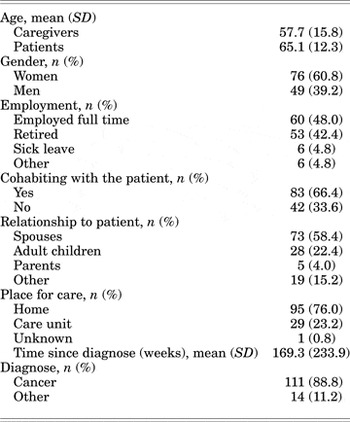
The sample consisted of 125 family caregivers with a mean age of 58 ± 16 years. Most caregivers were women (61%), partners (58%), employed (48%), cohabiting with the patient (66%), and caring for the patient at home (76%). Further characteristics of the participants are presented in Table 1.
Characteristics of participants (N = 125)

Feelings of Rewards
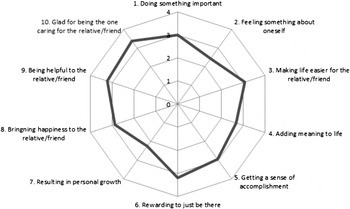
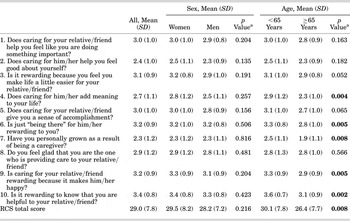
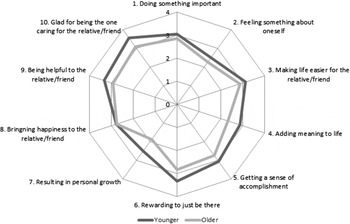
Palliative family caregivers generally reported high levels of reward (Table 2, Fig. 1). The largest source of reward was a feeling of being helpful to the patient (item 10, mean 3.4 ± 0.8). This was closely followed by a feeling of reward as a consequence of giving something to the patient that brought them happiness (item 9, mean 3.2 ± 0.9) and of just being there for the patient (item 6, mean 3.2 ± 0.9). These aspects of reward are all partially related to the item about making life easier for the patient, which was also a fairly large source of feelings of reward (item 3, mean 3.1 ± 0.9). The smallest sources of reward for the family caregivers in this study were personal growth (item 7, mean 2.3 ± 1.2), self-satisfaction (item 2, mean 2.4 ± 1.0), and personal meaning from caregiving (item 4, mean 2.7 ± 1.1).
Mean levels of rewards of caregiving for all caregivers.

Level of attachment in relation to sex and age (N = 125)

RCS = Rewards of Caregiving Scale
aMann-Whitney U test
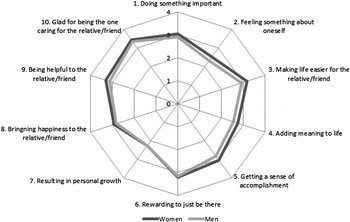
There were no differences in feelings of reward between women and men (Table 2, Fig. 2). In contrast, age was associated with feelings of reward (Table 2, Fig. 3). Overall, and in 5 out of 10 individual items, younger family caregivers reported significantly higher levels of reward compared to those aged 65 and older. The mean differences were largest for reward as a consequence of personal growth (item 7, Δ = 0.62 ± 0.22) and personal meaning from caregiving (item 4, Δ = 0.54 ± 0.22). Other items that were scored significantly higher by younger caregivers were just being there for the patient (item 6, Δ = 0.50 ± 0.17), being helpful to the patient (item 10, Δ = 0.49 ± 0.16), and being able to give something to the patient that brought them happiness (item 9, Δ = 0.42 ± 0.18).
Mean levels of rewards of caregiving for women and men.

Mean levels of rewards of caregiving for younger and older caregivers.

DISCUSSION
Discussion of Results
These findings support previous research suggesting that palliative family caregivers experience the rewards of caregiving despite their often arduous situations. The largest sources of rewards concerned experiences of doing something good for the patient; specifically, being helpful and being able to provide something that brought happiness and made life easier for the patient. Similar findings have been reported among family caregivers of patients with Alzheimer's disease, whose largest source of caregiver satisfaction was bringing the patient happiness and pleasure. The same study found that the giving of pleasure was often based on simple acts of kindness, underpinned by previous knowledge of the patient's likes and dislikes (Lundh, Reference Lundh1999). This can be further compared with the findings of Sand et al. (Reference Sand, Olsson and Strang2010), who revealed that family caregivers expressed a strong desire to foster the patient's well-being in the best possible way. These caregivers tried to keep the patient comfortable by maintaining everyday structures, by maintaining hope, and by standing up for dignity. Their actions were taken not only out of concern for the patients but also out of concern for themselves.
Wong et al. (Reference Wong, Ussher and Perz2009) found that meeting the expressed needs of the patient, feeling truly helpful, and gaining the patient's appreciation were all rewarding to family caregivers. Jo et al. (Reference Jo, Brazil and Lohfeld2007) also found that appreciation from the patient was a source of reward and satisfaction for family caregivers. These are important aspects of reward. In addition, some caregivers feel better able to cope with the demands of caregiving when the patient recognizes and appreciates their caregiving efforts, when they do not feel taken for granted, and when the patient treats them with respect (Stajduhar et al., Reference Stajduhar, Martin and Barwich2008).
The quality of the relationship between caregiver and patient may influence the caregiver's ability to cope with the caregiving situation (Stajduhar et al., Reference Stajduhar, Martin and Barwich2008), and it seems reasonable that relationship quality would also influence family caregivers' feelings of reward. Illness can change the nature and quality of the relationship between caregiver and patient. It sometimes makes people realize how much they appreciate one another, and this can make the relationship stronger. Family caregivers may experience a profound and positive change in the relationship with the person for whom they care, which can result in feelings of reward as a consequence of caring (Wong et al., Reference Wong, Ussher and Perz2009). Illness may actually result in deepened relationships within a family, with an increased consciousness of preciousness that creates a feeling of togetherness (Sand et al., Reference Sand, Olsson and Strang2010). It should be noted, though, that illness does not always affect the quality of these relationships in a positive way. Consequently, family caregivers with a strained or deteriorating relationship might not gain feelings of reward from bringing happiness to the patient. However, it might be possible that they will still feel rewarded as a consequence of standing up for, taking responsibility for, and staying with and caring for the patient despite everything else.
Reward may in some cases stem from doing something important that meets cultural expectations of “doing the right thing” (Wong et al., Reference Wong, Ussher and Perz2009). For most people, one reason for becoming a caregiver is that we have learned since childhood to commit ourselves to and feel responsibility for our family and friends. Caring for and helping family and friends is mostly seen as a basic human way to act (Sand et al., Reference Sand, Olsson and Strang2010). There is an imperative to provide the necessary care (Stajduhar, Reference Stajduhar2003), though the obligation to care is not in itself as negative as it may appear (Wong et al., Reference Wong, Ussher and Perz2009). Family caregivers may feel rewarded as a consequence of fulfilling social obligations (Zapart et al., Reference Zapart, Kenny and Hall2007). They might experience caring as rewarding since they believe it is important and expected of them; they feel glad to do it because they believe it is the right thing to do. This is an important aspect to consider when undertaking research with scales and instruments. It could be that reward is something that people expect themselves to feel and think that others expect them to feel, and this may have an impact on their ratings.
In our findings, the second smallest sources of rewards were self-satisfaction and finding meaning in life as a consequence of caring, and the smallest source was personal growth. This was somewhat surprising, since the literature suggests that personal growth and finding meaning in life are often significant when it comes to feelings of reward. Caregiving has been described as involving reflection on life's values and existential concerns, including facing one's fears, strengths, and shortcomings. This may not be easy, but it is probably a source of personal development (Sand et al., Reference Sand, Olsson and Strang2010; Carlander et al., Reference Carlander, Ternestedt and Sahlberg-Blom2011). One reason for this discrepancy may be that our study was conducted during ongoing palliative care. It is possible that finding meaning in life and experiencing personal growth as a consequence of caring can only be felt retrospectively, not while one is in the middle of the process. Previous researchers have described how the meaning and purpose of caring may only begin to crystallize sometime into the grieving process, when memories and emotions can be sorted through (Hoppes, Reference Hoppes2005). However, it should be noted that persons in our study younger than 65 years felt significantly more rewarded as a consequence of personal growth and personal meaning from caregiving. In addition, we found (somewhat in contradiction to other studies) that younger caregivers overall felt more rewarded than their older counterparts.
METHODOLOGICAL CONSIDERATIONS
It is possible that our participants, in light of their agreement to participate in the study, represent a group of caregivers who were coping relatively well and feeling sufficiently supported and therefore experienced high levels of feelings of reward. It could be that caregivers who chose to participate in intervention studies were already naturally engaged in their role, and more likely to find benefit in it, than those who do not participate in such studies. There is also a need to critically examine the Rewards of Caregiving Scale that was employed for data collection. The items in the RCS are posed in a positive manner, which may contribute to higher scoring. However, many measurements are constructed in the opposite way, in order to capture negative aspects of caring. We reiterate that there is a need to focus on positive aspects in the context of palliative care. We believe that our findings highlight an important issue and contribute knowledge about and understanding of the rewards of palliative family caregiving.
CONCLUSIONS AND IMPLICATIONS FOR CLINICAL PRACTICE AND FUTURE RESEARCH
This study demonstrates that our family caregivers experienced the rewards of caregiving during ongoing palliative care notwithstanding their unique and often stressful situations. The largest sources of reward concerned being helpful to the patient and being able to provide something that brought happiness to and made life easier for the patient. The smallest sources of reward were self-satisfaction, finding meaning in life, and personal growth as a consequence of caring.
Although a considerable number of family caregivers experience poor psychosocial well-being, many will experience feelings of reward associated with this role. This does not mean that caregivers do not need support; on the contrary, they should be offered support that will help sustain them in their role and promote optimal psychosocial well-being (Hudson & Payne, Reference Hudson and Payne2009; Applebaum & Breitbart, Reference Applebaum and Breitbart2013).
Feelings of reward seem, in fact, to be to a great extent about handling the situation in a satisfying way, feeling competent and confident in taking care of the patient, and thereby feeling proud (Salmon et al., Reference Salmon, Kwak and Acquaviva2005; Jo et al., Reference Jo, Brazil and Lohfeld2007). Support could preferably be designed with the aim of improving family caregivers' abilities to care, facilitating positive aspects of caregiving, and focusing on strengths and resources (Grande et al., Reference Grande, Stajduhar and Aoun2009; Carlander et al., Reference Carlander, Ternestedt and Sahlberg-Blom2011). Such psychoeducational interventions have already been found to increase feelings of reward (Hudson et al., Reference Hudson, Aranda and Hayman-White2005; Reference Hudson, Thomas and Quinn2009; Henriksson et al., Reference Henriksson, Arestedt and Benzein2013). More prepared family caregivers may be able to see the good with the bad, in order to reconcile the difficulties embedded in their caring experiences. However, it is important to avoid trying to explicitly encourage caregivers to think positively, since this might have a detrimental effect on those caregivers already challenged by the demands of caregiving (Stajduhar et al., Reference Stajduhar, Martin and Barwich2008).
Family caregivers in our study reported feelings of reward during ongoing palliative care even though the patients were severely ill and many were close to death. However, the cross-sectional design of the study did not allow us to take into account the possibility that feelings of reward may change over time. There is a need for future research into palliative family caregiving using longitudinal methodology to offer important insights into the nature and consequences of rewards for family caregivers. This research should examine factors associated with rewards in addition to age and sex, such as relationship to the patient, cohabitation status, duration of illness, and place of care for the patient. There is also a need for knowledge about the associations of rewards with caregiver outcomes such as anxiety, depression, and health.
ACKNOWLEDGMENTS
This work was supported by the Erling-Persson Family Foundation and the Signhild Engkvist Foundation. The authors declare that there is no conflict of interest.