The economic and political transformations of Spain in the early modern period, first rising to the helm of a global empire and then dramatically losing population and productive strength, are among the quintessential topics in European economic history.1
Major works on Early Modern Spain have continued to appear at a sustained rate in the last decade. For just three very recent influential examples, see Marcos Martín, España; Kamen, Empire; and Yun, Marte. For an institutionalist treatment of the Spanish case within a wider European context, see North and Thomas, Rise; and Acemoglu et al., “Rise.”
Greif, Institutions.
As part of a wider research agenda on the institutional foundations of early modern Spain, this article takes a close look at the Castilian lower nobility, the hidalgos of Don Quixote fame, on whom scholars of the caliber of Carlo Cipolla, Fernand Braudel, J. H. Elliott, and David Landes among others have squarely placed the blame of spreading a mentality of idleness and a disdain for manual labor.3
The references to hidalgos and the “hidalgo mentality” can be found in Elliott, Imperial Spain, pp. 115–17; Braudel, Mediterranean, pp. 520–23; Cipolla, Before the Industrial Revolution, pp. 237–41; and Landes, Wealth, pp. 172–73. MacKay, Lazy, Improvident People, provides a strongly revisionist view, which is consistent with the findings in this article.
Braudel, Mediterranean, p. 517.
Baumol, “Entrepreneurship”; and Murphy et al., “Allocation of Talent.”
Contrary to the widespread belief that large numbers of hidalguías were sold by the Crown, the almost exclusive gateway into the lower nobility in the sixteenth century was litigation in one of the two Royal Chancery Courts of the kingdom. The holdings of the Archivo de la Real Chancillería de Valladolid, well known to genealogists but barely exploited by social scientists, are a treasure trove for the study of hidalguía. In a first attempt to characterize the temporal evolution of the institution, I have compiled a time series of the surviving 42,313 cases filed with the Valladolid Chancery Court, which had jurisdiction over the northern half of Castile. The series, which extends between 1490 and 1834, shows a large increase in legal activity in the mid-sixteenth century, thus confirming the impression that the pace of ennoblement was fastest during that period.
Although the argument for the treason of the bourgeoisie seems unpersuasive, a careful examination of the archival record points to a different and more compelling rent-seeking scenario. It starts by challenging the conventional wisdom that places tax exemptions at the center of the quest for nobility while ignoring or summarily treating the remaining entitlements of hidalgos. By matching lawsuit costs to tax data, I show that the fiscal benefits of ennoblement could not alone have justified its cost. The evidence points instead to the acquisition of municipal offices and the control over common resources that came with them as the main reason—the “central transaction” in Greif's terms—behind the quest for nobility.6
Greif, Institutions, p. 47.
See Ekelund and Tollison, Politicized Economies, for an example mostly focused on the Mesta.
I then trace a distinction between nobility lawsuits, which commoners used to attain noble status, and distributive lawsuits, which existing hidalgos used to wrestle control of municipal offices from incumbent commoners, and consider the efficiency costs of redistributive and ennoblement activities revealed by archival documents. I find that in the towns with high levels of litigation the transfers to central courts, lawyers, and royal officials were large enough to cripple local economies and forestall their possibilities of growth.8
A substantial literature exists on the relationship between rent seeking and economic growth; see Murphy et al., “Why is Rent Seeking”; DeLong and Shleifer, “Princes”; and Tornell and Lane, “Voracity Effect.”
For a model where rent seeking can occur while open conflict remains off the equilibrium path see González, “Insecure Property.”
THE NATURE AND EVOLUTION OF HIDALGUIA
Hidalgos: The Sons of Something
The very word hidalgo embodies the nature of those who wore the title with pride; while even its origin has been unable to escape dispute, the most commonly accepted etymology is hijo de algo, literally “son of something” (where “something” means “someone of value”). The oldest hidalgo families claimed to be able to trace their origins to the Visigothic lineages of the days before the Muslim invasion of the peninsula in 711 ad, and to have gained their status through distinguished military service to the monarchs of the northern kingdoms in the course of the Reconquista. During the Middle Ages, hidalgos were in fact expected to maintain weapons and a horse, and to join the king's army whenever called to war; in return, they were granted special privileges, foremost among which the exemption from royal and municipal taxes.10
Hidalguía, in its most open meaning, is synonymous with nobility; all Spanish nobles, including grandees and títulos (dukes, marquises, counts and viscounts), were technically hidalgos. I am not concerned with those upper echelons, and will therefore use the word in its narrow sense, designating the lower nobility that, while always striving to climb the ranks of society, was just one step above the plain commoner. For a thorough discussion of the structure of the Spanish nobility see Domínguez Ortiz, Clases. For an excellent historical survey on the several social strata that gradually converged into Early Modern hidalgos, see Díaz de la Guardia, “Litigios,” chapters 1–4.
Whereas tax exemptions were the most transparent and visible attribute of hidalgo status, they were not always the most valuable one.11
So indissoluble were hidalgo status and the exemption from royal and municipal pechos that someone who did not pay them and remained unchallenged would in time be recognized as an hidalgo, while paying them at any point without protest would jeopardize any chances of affirming an hidalguía. Such identity is again etched into the language: the Spanish word for a commoner is pechero, someone who pays direct taxes. See Thompson, “In So Many Words,” for a discussion on the language of class distinction in Spain.
Although the system of mitad de los oficios has normally received very little attention in the scholarly literature, the recent doctoral dissertation by Díaz de la Guardia, “Litigios,” is now a mandatory reference for its study.
A much debated attribute of hidalguía is its theoretical incompatibility with the so-called “mechanical” and “vile” professions, virtually any occupation that involved manual work, together with tax collection (but not tax farming) and a few other outcast activities.13
Some insightful works on “mechanical and vile” occupations are Domínguez Ortiz, Clases; Díez, Viles y Mecánicos; and MacKay, Lazy, Improvident People.
The natives of Biscay, for example, were all considered hidalgos. See Marcos Martín, España, p. 301.
MacKay, Lazy, Improvident People.
In the lawsuit of Benito de Caldas the original complaint stated that the claimant was an ironsmith. Apparently someone noticed the blunder, as the word “herrador” was hastily crossed out; it was not, however, a sufficient source of concern for the scribe to rewrite the entire page. See Archivo de la Real Chancillería de Valladolid (hereafter ARChV) Sala de Hijosdalgo Pleitos (hereafter SHP) 68.3. In a different case, a copy of an ejecutoria from 1547 states that Hernán García, from Tordesillas, was a carpenter (ARChV SHP 1646.1). In both cases the claimants were successful in gaining noble status. Finally, in a distributive lawsuit from Peñafiel in 1582, the town contended that hidalgos should have been forbidden from discharging two public offices at the same time; the case arose because one hidalgo had been elected mayor while at the same time working in the butcher shop, a city-operated establishment. See ARChV Pérez Alonso Fenecidos (hereafter PAF) 538.5.
It has long been contended that the number of hidalgos swelled in the sixteenth century, but the dynamics, magnitude, and significance of this phenomenon have not been the subject of a thorough scholarly discussion so far. A very common misconception is that the increase in the hidalgo ranks was the result of massive sales of letters of privilege on the part of the Crown during the reigns of Charles V and Philip II; the myth has continued to surface every now and then, even in the face of I. A. A. Thompson's categorical refutation.17
Thompson, “Purchase.” For two notable examples where the incorrect view receives attention see Elliott, Imperial Spain, p. 116; and Nadal, España, p. 40.
Thompson, “Purchase,” p. 357.
The Lawsuits Over Hidalguía
When an hidalguía was challenged, usually by a town council that tried to collect direct taxes from its holder, the individual claiming to be an hidalgo could only affirm his status by suing the town in one of the two Royal Chancery Courts of Castile, which resided at Valladolid and Granada. The Chancery Courts (chancillerías) were the highest tribunals in the kingdom short of the Royal Council, and, from the fifteenth century onwards, had exclusive jurisdiction in all cases concerning the dispute of an hidalguía, which were heard by a special chamber called the Sala de Hijosdalgo.19
The mandatory source for the structure and operation of the Sala de Hijosdalgo is Martín Postigo and Domínguez Rodríguez, Sala, on which virtually all my references on the functioning of the chamber are based. A thorough historical and juridical treatment of the lawsuit of hidalguía can be found in Díaz de la Guardia, “Litigios,” chapter 3.2.
To win a lawsuit, a claimant of hidalguía would have to prove, at a minimum, that his father and grandfather had been hidalgos, widely reputed as such in the places where they had lived. He had therefore to produce witnesses that had known (or claimed to have known) his father and grandfather, and could confirm their status. The town council, together with the king's prosecutor (who intervened ex-officio in all lawsuits of hidalguía), would try to show that the claimant or his ancestors were not hidalgos, presenting evidence that they had paid direct taxes or had not enjoyed certain criminal or legal privileges. Alternatively, they could try to find one or more impediments to their hidalguía, such as being illegitimate sons or having Jewish ancestry.20
As a result, the prosecution often presented very colorful stories. The lawsuit of St. Theresa's father contains a copy of the Inquisition proceedings that documented how his grandfather had converted from Judaism and had been forced to wear the shameful robe of the conversos for two months (Ejido, Linaje). In the lawsuit of Benito de Caldas in 1544 witnesses for the prosecution testified that his grandfather had been held in a common jail and sentenced to lashes for petty theft (ARChV SHP 68.3). In the lawsuit of Alonso de Melgar in 1556, in a standard contention, the prosecutor alleged that he was the son of “plain commoners, converted Jews, adulterous and incestuous” (ARChV SHP 871.8). Similarly, in the lawsuit of the brothers Gaspar and Francisco de Villodas in 1554, the town produced witnesses who testified that their grandfather had been a clergyman, and hence their father was an illegitimate child (ARChV SHP 351.3). Melgar lost his case, but all the others were able to have their hidalguías confirmed despite the obvious impediments.
If the claimant won the case, upon receiving a favorable final sentence (which might not come until after one or two appeals) he could ask the court to issue a final writ, called a carta ejecutoria, which summarized the lawsuit and ordered all authorities in the kingdom to recognize its holder as an hidalgo.
Lawsuits were not cheap; a claimant had to retain attorneys in Valladolid or Granada, pay a number of court and secretarial fees, pay for the travel, room, and board of witnesses called to testify on his behalf from remote locations and, if successful, pay the fee for the issuance of the carta ejecutoria. In addition, more or less overt bribes and gifts to several court officials were essential to ensure that the proceedings would move forward at a reasonable pace.
Two cheaper legal devices, albeit of lower standing than a lawsuit, were available to claimants of hidalguía. An hidalgo who anticipated a legal challenge or feared that his supporting witnesses could die or relocate could register the depositions of those witnesses with the court in a document called probanza ad perpetuam rei memoriam (which, for lack of a better term, I shall hereafter call “deposition”). The town and the king's prosecutor normally did not intervene in the process and the document was not enforceable by itself; it could, however, be used as evidence in lawsuits, and therefore its existence could conceivably deter future legal challenges. Another possibility was to request a royal provision from the court, which certified the “known status” of its holder. The town and the king's prosecutor normally opposed the claim of hidalguía in the legal proceedings (called expedientes provisionales, translated here as “provisional files,”) which, although reminiscent of lawsuits, were simpler, faster and cheaper. They did not result in a carta ejecutoria, though, which remained the only enforceable document. Royal provisions became mandatory in the eighteenth century for hidalgos moving to another jurisdiction to become registered as such, causing a large increase in the numbers of these proceedings.21
Díaz de la Guardia, “Litigios,” p. 449.
The Archive of the Royal Chancery Court of Valladolid is an invaluable source of information on the judicial route to nobility.22
The main reference on the history of the Archive of the Royal Chancery Court of Valladolid, on which this account relies, is Martín Postigo, Historia.
The checked inventory book was ARChV Sala de Hijosdalgo, Libro 81. This is the only book that is cross-referenced to the current catalogue in a systematic way, and hence allowed for the check to be conducted. It contains all the defunct lawsuits from one of the two secretary offices serving the Sala de Hijosdalgo. Because cases were randomly assigned to the secretary offices upon being filed, this inventory book constitutes a 50 percent random sample of all defunct lawsuits. The assistance of Clara Ortego, who worked on the original mapping of the inventory books to the electronic catalogue, was instrumental in designing this check.
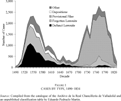
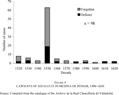
Figure 1 shows the temporal distribution of the 42,313 cases preserved in the section Sala de Hijosdalgo of the Archive of the Royal Chancery Court of Valladolid. Lawsuits proper are classified according to whether a carta ejecutoria was issued in the case or not; if a carta ejecutoria exists (and hence the hidalguía was confirmed), the lawsuit is said to be “defunct” (fenecido).24
If the hidalguía was denied, the town could always tax the claimant or seize his goods without the need of a royal writ; it is hence safe to assume that all fenecido lawsuits did confirm an hidalguía. In an extremely rare exception, the town of Medina de Pomar requested a carta ejecutoria on the lawsuit it had won against Juan del Campo, its second wealthiest taxpayer, in 1555. The town might have sought additional assurances in view of the wealth, and perhaps power, of its opponent. See ARChV SHP 424.4, ARChV Registro de Ejecutorias 845.2, ARChV Protocolos y Padrones (hereafter PP) 68.6.

FIGURE 1 CASES BY TYPE, 1490–1834
Figure 1 reveals that the activity in the Sala de Hijosdalgo had two peaks, in the sixteenth and eighteenth centuries, with a prolonged slump in the seventeenth. Lawsuits proper, however, are concentrated only in the sixteenth century, peaking in the decade of 1550, which had a yearly average of almost 200 cases filed, with over half of them resulting in a confirmation of the hidalguía.25
The second peak is a result of the administrative requirement, enacted in 1703, of obtaining a royal provision before an hidalgo could be registered as such in his new place of residence, and hence it does not reflect new ennoblement. See Díaz de la Guardia, “Litigios,” pp. 449–50.
The number of defunct lawsuits is not an exact reflection of the increase in the number of hidalgo families. A substantial number of forgotten lawsuits also confirm the hidalguía; it is possible that the claimant, having settled his position within the town, did not request a carta ejecutoria to avoid further expenses. On the other hand, some lawsuits were filed by legitimate claimants whose rights were being infringed; favorable sentences in such cases did not increase the number of hidalgos (although unfavorable ones might have reduced it). Finally, it is important to keep in mind that legal proceedings only capture situations of conflict; if someone declared himself an hidalgo and no one challenged him, after a few years he would most likely be reputed as such without the need of a lawsuit. As a speaker in the Cortes of 1624 put it:
The officials of the towns and villages will not dare list anyone in the tax tolls who is prepared to go to litigation, however well known a commoner he is. Thus he is left exempted as if he were an hidalgo, and so becomes one. Contrariwise, if they list an hidalgo who is poor, he cannot litigate and loses his hidalguía.26
Quoted in Thompson, “In So Many Words,” p. 26.
A Glimpse of the Composition of Northern Castilian Society
The only relatively firm observation on the number of hidalgos in sixteenth-century Spain is the census of households taken in 1590, which revealed that 108,358 out of 897,130 households in the Crown of Castile, about 12 percent of the total, enjoyed noble status.27
González, Censo. A household corresponded to roughly five inhabitants, which puts the population of Castile in 1590 at about four and half million. Excluded from this are the roughly 100,000 households of the Crown of Aragon, which had a different nobility structure. See Artola, Enciclopedia, vol. 6, p. 589.
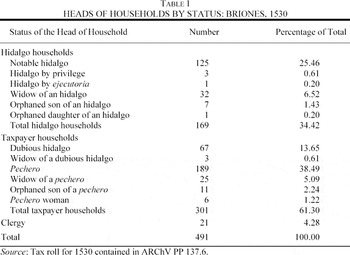
A rare 1530 tax roll from the town of Briones, in modern-day La Rioja, can provide some additional insight into the matter. This document lists the individual assessments of a direct royal tax (moneda forera), which the village paid to the Crown every six years. Unlike most rolls that only list commoners (called “pecheros” after the name of the taxes they paid, the pechos), this particular one lists hidalgos as well, further breaking down their status into “notable” hidalgos (i.e., those whose status no one would dare question), those who had obtained the title by royal privilege, and those who were in possession of a carta ejecutoria, all of them duly entered with a zero tax liability. It also identifies “dubious” hidalgos, who were assessed taxes as plain taxpayers, but by being listed as such preserved the right to litigate in the future. Table 1 reports the breakdown of this tax roll by the status of the head of household.28
As discussed later in the article, my attention was drawn to Briones because of the elevated number of “distributive” lawsuits emanating from this town. That this peculiar tax roll was compiled might well be a result of such litigation. However, in the over 500 individual lawsuits I have manually examined, I have not come across another tax roll that provides a similar breakdown of the population by social standing.

Even at the early date of 1530, this northern community of approximately 2,500 inhabitants already had 34.42 percent hidalgo households, with 13.65 percent more claiming to be such while still paying taxes. Of the 169 hidalgo households, only one had won its status in the courts, while three had attained it by royal privilege, either bought or conferred. Hidalgos were twice as likely as pecheros to leave behind widows and orphans; this might possibly reflect the disincentive that kept hidalgo widows from marrying anyone but another hidalgo, as they would have otherwise lost their noble status. Finally, 28 taxpayer households were exempted from taxes by reason of extreme poverty; their breakdown was 20 pecheros, two dubious hidalgos, three widows of pecheros, and three pechero women. These figures imply a 9.3 percent poverty rate among taxpayer households. Because the tax was assessed on a capitation basis, it is not possible to use these data to draw further inference about the wealth distribution of the town.
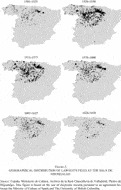
Figure 2 shows the geographical distribution of all the lawsuits filed at the Sala de Hijosdalgo of the Royal Chancery Court of Vallodolid between 1501 and 1650, by quarter century. The jurisdiction of the court, the Kingdom of Castile north of the river Tagus, is clearly delineated by the data points.29
Occasionally a lawsuit would be filed from outside these boundaries because the claimant had previously lived in the jurisdiction of the court and the evidence would be gathered in Old Castile. The boundaries in the maps are the modern Spanish regions (comunidades autónomas).

FIGURE 2 GEOGRAPHICAL DISTRIBUTION OF LAWSUITS FILED AT THE SALA DE HIJOSDALGO
The first noteworthy pattern emerging from the maps is the temporal distribution of legal activity, which parallels the arc of population growth and economic performance in early modern Castile. Castilian population grew rapidly in the second and third quarters of the sixteenth century, prompting a shift to more intensive land use, higher urbanization, and possibly higher productivity. This trend started to reverse around 1575, with a marked population decline and a corresponding movement to less intensive farming starting in earnest after 1600. Figures 1 and 2 show that litigation followed a remarkably similar trend. Lawsuits peaked in the third quarter of the sixteenth century, fell slightly in the fourth, and experienced a marked decline after 1600. Such a pattern suggests that any process linking ennoblement to economic performance should focus on a contemporary causal link, and that such a link could well run from economic performance to ennoblement, rather than in the opposite direction often assumed in the literature.
A second point worthy of attention is that, at the beginning and at the end of the period, litigation was roughly uniformly distributed throughout the entire geographical area, with few population centers showing more than a handful of lawsuits; in the years between 1525 and 1600, however, there were several towns with large numbers of filings (shown as larger circles). This concentration of legal activity is the key to the arguments presented in the remainder of the article.
The nobility lawsuits described in this section all reflect individual bids for hidalguía, and constitute only the first piece of the rent-seeking puzzle in early modern Castile. The next section studies a different kind of legal proceeding which hidalgos and pecheros used to jostle for the control of towns and the distribution of the fiscal burden.
DISTRIBUTIVE CONFLICT
During the Middle Ages, towns and cities enjoyed an extraordinary degree of autonomy that, together with specific prerogatives and tailor-made legal codes (fueros), had been granted by the Crown as a way of securing widespread support in the war against the Arab kingdoms. Town councils were usually dominated by a commoner elite, which freely ignored the privileges of hidalgos, blocking them from access to public office, taxing them, and even banning them from living in their jurisdiction altogether. While such actions violated the nobles' privileges, their concerns were normally shrugged off by the pechero-dominated councils, and any royal rulings favorable to hidalgos were dutifully acknowledged and promptly ignored.30
The Spanish legal jargon even contains the expression “obedezco pero no cumplo”—I obey but I do not comply—to describe the flagrant flouting of orders from a higher authority. It is most often associated with the administration of Spanish America, where the monarchy could do little to prevent distant viceroys and lower officials from acting as they pleased. For a treatment of the weak position of hidalgos within the pechero-dominated councils in the late Middle Ages, see Díaz de la Guardia, “Litigios,” chapter 3.
See Lynch, Spain 1516–1598, for an account of the consolidation of absolutist power in early-sixteenth-century Spain.
The ennoblement and distributive litigation by which hidalgos gained control of the administration of municipal affairs must not be confused with the sale of jurisdictions, a legal figure by which the king relinquished the eminent domain over townships in exchange for a lump-sum payment. The jurisdictions were often acquired by members of the upper nobility, who were invested as overlords of the town and became entitled to collect the royal taxes generated by it. Overlords, however, were often barred from interfering in the day-to-day affairs of the towns they acquired, leaving hidalgos and commoners free to jostle over municipal positions. Several lawsuits from Peñafiel, for example, state that people in the payroll of the Duke of Osuna, overlord of the town, were barred from holding municipal office (ARChV PAF 538.5, 538.6, 502.3, 329.1). The town of Villalpando also witnessed intense distributive litigation despite being subject to the overlordship of the Enriquez family (ARChV SHP 633.22). Brumont, “Oligarchie,” makes the case that the two processes—sale of jurisdictions and fight over municipal offices—did not influence each other. Yun, Sobre la transición, pp. 77–81, argues that overlords treated their domains with the same hands-off approach to municipal matters employed by the king in the royal demesne. For further detail on the sale of jurisdictions see Nader, Liberty.
Two perennial issues of contention between hidalgos and pecheros were the allocation of local government posts and the use of town revenues. An old unwritten custom, often toyed with by the Cortes and respected by the courts but never written into hard law, established that hidalgos and pecheros should split evenly the available positions in local government; as pecheros were normally much more numerous, the system, known as mitad de los oficios (literally “half the offices”), gave enormous influence to hidalgos, although it was rarely enforced before the sixteenth century.33
On the system of mitad de los oficios see Díaz de la Guardia, “Litigios”; and Domínguez Ortiz, Clases, p. 129.
Castilian cities were also richly endowed with a particular kind of communal goods called propios; unlike actual commons, a local government could enclose or otherwise grant the exclusive use of propios to a private party in exchange for a monetary payment. Just as they had bestowed a large degree of autonomy on Castilian towns during the Reconquista, medieval monarchs had also generously granted them propios as way of attracting settlers to the newly recovered lands.34
On propios see Artola, Enciclopedia, vol. 5, pp. 981–83.
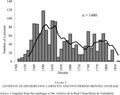
The key document for the analysis of this distributive conflict is a particular kind of lawsuit in which hidalgos and pecheros took part as collective units (estados). For lack of a better word, I use the term “distributive” to refer to these lawsuits (as opposed to the individual “nobility” lawsuits described in the previous section). Figure 3 shows their temporal distribution.35
The way to identify distributive lawsuits in the database of the Archive of the Royal Chancery Court is to exclude those lawsuits to which an individual was a part, as individuals could only sue in the Sala de Hijosdalgo if their nobility was in question, and not because of distributive matters. Because of the peculiarities of the search engine, which does not allow searches by exclusion, I identified distributive lawsuits as those in which one of the parties is formed by hidalgos as a collective, and the other by pecheros. I also allowed either hidalgos or pecheros to be replaced by village authorities, such as alcaldes, regidores or justicia. The search strings used on the database of the archive were: the hidalgos, the state of the hijosdalgo, those who call themselves hidalgos, hidalgo neighbors, the officers of the hijosdalgo, the pecheros, the state of the pecheros, pechero neighbors, the mayor, the council, the justice. Whereas in principle this methodology does not guarantee that the identified lawsuits would have dealt with distributive issues, a 10 percent hand check resulted in finding only distributive lawsuits. These lawsuits were heard by both the Sala de Hijosdalgo and the four civil chambers of the Royal Chancery Courts. The civil chambers were served by 12 secretaries (escribanos), but only the lawsuits held by two of them were fully catalogued by the archive at the time of writing (Fernando Alonso and Pérez Alonso). However, because cases were assigned on a strictly random basis to the different secretaries, the catalogued ones can be safely taken to be a one-sixth random sample of the population. To estimate the total number, I multiplied the catalogued cases from the civil chambers by six, and added the cases from the Sala de Hijosdalgo (which is fully catalogued). For a description of the random assignment mechanism to the secretaries, see Aulestia, Práctica, pp. 36–41.

FIGURE 3 ESTIMATE OF DISTRIBUTIVE LAWSUITS AND FIVE-PERIOD MOVING AVERAGE
Distributive lawsuits follow a similar progression to that of lawsuits proper during the life of the Chancery Court, peaking in the late sixteenth century and then declining to about half their peak level. Most towns in my sample were only involved in distributive litigation once or twice, with a record nine cases registered by Briones between 1529 and 1570. The remainder of this section uses six examples to illustrate the workings of distributive lawsuits and their impact on the finances of towns. The examples are purposefully drawn from areas with distinct geographical, economic, and administrative features. They suggest that distributive litigation, often followed by large levels of ennoblement, was a phenomenon that pervaded small and medium-sized Castilian towns regardless of their geographical location, eminent domain status, and predominant economic activity.
The hidalgos of Medina de Pomar, a medium-sized town in the jurisdiction of Burgos, won a ruling in 1553 preventing the council from paying royal taxes out of propios revenue, and granting them half of the town's offices.36
ARChV SHP 828.2.
Distributive litigation was often followed by a flurry of ennoblement lawsuits. Commoners who had formerly been excluded from the town government tried to join the hidalgo camp to gain political voice, and incumbents in town government tried to retain control by seeking ennoblement themselves. The commoners of Medina de Pomar, for example, bitterly complained that soon after the first distributive lawsuit was filed:
[…] those who were then holding public office pretended to be hidalgos and tried to hold on to their offices, saying that they held them as hidalgos, appointing to office others who pretend the same, and excluding those who do not hide the fact that they have paid taxes in the past.37
Ibid.
See the section “The Subjects, Motives and Timing of Ennoblement” for a detailed discussion of the economics of nobility litigation in Medina de Pomar.
In Briones the distributive conflict dragged on longer and, in a significant difference, the town was allowed to cover legal expenses out of propios revenue at least until 1571, despite vigorous opposition from the hidalgos.39
Several lawsuits result in or refer to royal provisions authorizing the town council to use propios to cover legal expenses. See ARChV SHP 675.9 (1529), ARChV SHP 1546.6 (1554), ARChV SHP 70.17 (1563), ARChV SHP 162.3 (1571).
ARChV SHP 641.3.
ARChV SHP 50.11. This lawsuit also gives a detailed account of the town's budget. Its total annual income was slightly over 50,000 maravedíes, all of which were committed to the payment of salaries and repairs. Except for an attorney on its regular payroll, all legal expenses had to be funded out of extraordinary income.
The pecheros of Briones made one last stand in 1589, trying to keep hidalgos out of positions of power by interpreting in a peculiar way the requirement that the nobles hold at least half of the town's offices. Town officials maneuvered to place hidalgos in those offices that would be regarded as incompatible with nobility, such as innkeeper and tax collector. Such a move had no chance of success, and after a swift intervention by the Chancery Court, the hidalgos firmly established their right to hold at least half of the honorable positions in the town, and with them a sufficient amount of power to control its resources. After that date, no further distributive lawsuits were filed by residents of Briones.42
ARChV SHP 1632.1. Because in many places appointments to public office could not be refused under penalty of prison, commoners hoped to place hidalgos in the dilemma of declining to serve, thus breaking the law, or accepting offices incompatible with nobility. The mandatory character of public service was often used to punish one's enemies; in 1654, for example, Luis de Vega was appointed by the mayor of the town of Valderas, in the jurisdiction of León, as a collector of the excise on wine. Being illiterate, de Vega could not hope to discharge his duty in any meaningful way, but he was nonetheless imprisoned for refusing it. He then appealed to the Royal Chancery Court, claiming that, being an hidalgo, he was nonetheless exempt from acting as a tax collector. See ARChV SHP 1982.9.
Very similar situations are evident from the lawsuits originating from the group of towns known as the Hermandad de Montes de Oca, near Burgos. Like Medina de Pomar, the hermandad (brotherhood) experienced a flurry of litigation after the first distributive lawsuits resulted in the introduction of direct taxes and shared power around 1535, with over 60 commoners claiming hidalguía between 1540 and 1550; and like Briones, it eventually ran out of money to defend its lawsuits, but not before selling or leasing its communal assets and incurring large debts.43
The distributive conflict in the Hermandad de Montes de Oca is documented in ARChV SHP 685.6, 100.13, 656.15, ARChV PP 200.1 and 200.2. In ARChV SHP 656.15 the King's prosecutor denounced the fact that most claimants of hidalguía were acting as one another's witnesses and attorneys and that witnesses brought to Valladolid to testify in favor of the claimants were regularly treated to luxurious accommodations and meals right before their court hearings.
The three cases we have examined are clustered in a relatively compact geographic region in the upper Ebro valley, an area characterized by intensive farming and comprised mostly in the royal demesne (realengo). The same pattern, however, holds true for towns with very different characteristics. One example is Peñafiel, located in the Duero valley east of Valladolid. The town is in an area of fertile plains that lend themselves to more extensive agriculture and cattle breeding. It was subject to the overlordship of the Duke of Osuna, who collected the royal taxes generated by the town but was barred from interfering in its internal affairs. The record does not show when the hidalgos of Peñafiel secured their right to hold half the town's offices, but we know it was in place by 1532, the date of the first distributive lawsuit. The litigation in Peñafiel revolved around the troubles the hidalgos encountered with filling all the offices allocated to them. The commoners had in fact obtained a Chancery Court ruling that mandated term limits of one year for most town officials and imposed a waiting period of two or three years before officials could be re-elected. Furthermore, all persons in the employ of the Duke of Osuna were barred from serving in public office, as were those associated with the butcher shops, some of whom were hidalgos despite the clearly manual nature of the occupation. As a result, the few hidalgos of Peñafiel often found themselves unable to fill the offices allocated to them. In an underhanded attempt to retain their half of the town's offices, hidalgos resorted to nominating minors, prisoners, or even exiles. The commoners fought these maneuvers time and again, managing to retain their control of the town's finances. Their success discouraged people from becoming hidalgos, and hence there were few ennoblement lawsuits in Peñafiel.44
The distributive lawsuits from Peñafiel that support this account are ARChV SHP 783.36 and ARChV PAF 329.1, 502.3, 503.1, 538.5, 538.6.
A second revealing case from the Castilian plains is that of Villalpando, a thriving mercantile center in the Tierra de Campos (an area composed of parts of the modern provinces of Zamora, Valladolid, Palencia and León) subject to the overlordship of the Enríquez family. The town had experienced a large wave of ennoblement in the 1530s, with fully 23 lawsuits filed in 1535 alone. No distributive lawsuits survive from that period in the catalogued portion of the archive; a distributive lawsuit from 1568, however, provides an invaluable window onto the size of the resources at stake in distributive litigation.45
ARChV SHP 633.22.
This amount excludes taxes and revenues from the fairs, which accrued directly to the overlords of the town and were not under the control of the town council (Yun, Sobre la transición, pp. 77, 82–86). The amount of those resources was also sizable, and many towns sought to retain control over them by purchasing their own charter of cityhood when the king decided to sell their jurisdiction (Nader, Liberty).
In a final example, the council of Ibias, a region dotted with small villages in mountainous Asturias, did not witness any nobility lawsuits until 1571. From then to 1595, 69 families—virtually the entire commoner population of the council—claimed hidalguía. A distributive lawsuit from 1572 tells a story that is in many ways the mirror image of that of Peñafiel. Asturias was one of the most ancient provinces of Castile, and it had a high proportion of nobles—in Ibias, hidalgos made up around 90 percent of the population in 1571.47
See ARChV SHP 21.5.
ARChV SHP 447.20 describes how the hidalgo-dominated town council redefined the fiscal obligations of the town to the Crown, shifting their burden to direct taxes.
The six communities studied represent many of the varied physical, productive, and political environments of Old Castile. They were not isolated cases; the archival record shows that several other towns found themselves in similar situations. Luis Díaz de la Guardia documents a similar pattern for Southern Spain as well.49
Díaz de la Guardia, “Litigios.”
THE SUBJECTS, MOTIVES, AND TIMING OF ENNOBLEMENT
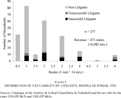
Who sought ennoblement, why did they seek it, and what motivated their timing? We can answer these questions by examining the abundant nobility litigation in Medina de Pomar. The choice of this town was entirely dictated by its excellent archival record. In order to identify the socio-economic extraction of litigants and their success rates, I need to match them to at least two different tax rolls several years apart. Portions of tax rolls were sometimes filed by towns to show that a claimant of hidalguía had paid taxes in the past, but complete tax rolls are rare, and only for Medina de Pomar was I able to find two of them within a meaningful period. In all other respects, however, Medina de Pomar is an average Castilian town, and its pattern of litigation is found repeatedly throughout Castile. The distribution of nobility lawsuits involving its residents is shown in Figure 4.

FIGURE 4 LAWSUITS OF HIDALGUÍA IN MEDINA DE POMAR, 1490–1630
The legal activity emanating from Medina de Pomar would clearly not be worthy of mention if it were not for the 1550s. A closer look at the 63 lawsuits filed between 1550 and 1559 further reveals that fully 41 of them were filed in 1554 alone. The key to the flurry of litigation is found in a 1553 distributive lawsuit in which hidalgos won half the offices of the town:
In this town there has never been a difference between hidalgos and pecheros because all the pechos (direct royal taxes paid by the town to the Crown) were always paid from communal revenues until one and a half years ago, when it was ordered that they should not be paid from communal revenues.50
ARChV SHP 828.2. In a similar case, we learn that the small town of Villalobos, in the jurisdiction of Montes de Oca, was also free of direct taxes until 1540. See ARChV SHP 679.1.
In another document related to the same dispute, several witnesses were asked how many households there were in the town, and how many of them were headed by hidalgos. All but one of them reported that the town counted about 300 households (roughly 1,500 inhabitants), of which no more than three or four were from hidalgo lineages; the last witness put the numbers at 350 households and six or seven hidalgo ones.51
ARChV SHP 707.2. Most of the witnesses were former town officials, including a former mayor, which lends some credibility to their estimates. These figures are consistent with the 1590 census (González, Censo).
Matching Litigants to Tax Rolls
The opening salvo in the battle of Medina de Pomar was a request filed in 1554, asking the Royal Chancery Court to authorize a special contribution of 15,000 maravedíes to pay for the several lawsuits it had to fight. Despite the vigorous opposition of those claiming to be hidalgos, the Chancery Court granted the request, with the added provision that all those who were not in firm possession of an hidalguía should be included in the assessment.52
ARChV SHP 653.107.
The 1554 tax roll is found in ARChV PP 68.5. Although the general rule was that richer people should receive a higher assessment, the tax assessor, who was appointed by the town council, had a large degree of discretion in determining individual tax bills. Because the situation was being closely monitored and there were no cries of outrage over unfair assessments, it does not seem unreasonable to assume that the rule was largely observed.
I started by looking for the name of everyone who filed a lawsuit between 1550 and 1559 in the 1554 tax roll. Unlike the list from Briones, this one was compiled with the utmost care to identify each taxpayer with fully spelled first and last names. Common names were supplemented with the neighborhood in which the person lived, and sometimes with their profession as well. As a result, I have been able to uniquely match 50 of the 63 claimants to the tax roll, almost an 80 percent success rate; the missed matches are spread in almost exact proportion to the cases filed each year and hence do not pose any bias concerns.
I then used a 1562 tax roll corresponding to the regular royal tax (the first extant one after 1554) to determine whether the people in my matched sample were still paying taxes eight years later. I defined a litigant as “unsuccessful” if, despite having filed a lawsuit, he or she was still being assessed direct taxes by 1562. Conversely, if the litigant was no longer in the tax roll, I called him or her “successful.” Unlike the 1530 document from Briones, the tax rolls of Medina de Pomar did not list neighbors without any tax liability, and so the meaning of “success” needs to be qualified: while winning an ejecutoria would certainly make someone a successful litigant by this measure, so would dying, becoming poor, relocating to a different town, or simply being missed in the matching exercise. Unsuccessful litigants, on the other hand, are a sharp lower bound on the ability of the town to keep claimants of hidalguía within its tax rolls.
For the purposes of the 1554 extraordinary tax, the population of the town was divided into eight brackets; at the lower end, people were taxed in increments of half a real (1 real = 34 maravedíes). After the two-reales bracket, tax liability was assessed in increments of one real, with a maximum of six reales. A total of 257 households were assessed; the remaining ones would have been hidalgo, poor, or might have been exempted for other reasons. If the poverty rate had been similar to the 9.3 percent observed in Briones, these numbers would be strongly consistent with the witness accounts that put the population of the town at about 300 households, of which between three and seven would have been hidalgo. Overall, slightly over 16,000 maravedíes of tax liability were assessed; while this exceeded the 15,000 authorized by the court, the extra amount was probably meant to compensate for potential nonpayers.
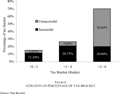
Figure 5 shows the distribution of the tax liability that emerges from the 1554 tax roll, further broken down by the litigant status of the household. The implied distribution of wealth has a very plausible shape; the 1562 tax roll suggests an even more skewed distribution, as some of the households that were assessed at the maximum of six reales in 1554 were even further to the right when the total tax bill allowed for it.54
Because the court had allowed the town to assess anyone without an ejecutoria for the purposes of the 1554 extraordinary contribution, town officials might have wanted to tax as many households as possible as a way to strengthen the case for denying them hidalgo status. As a consequence, the tax bill of the richer households might have been kept artificially low to ensure that every taxable household in the lower wealth brackets was assessed at least some tax, while not exceeding the maximum revenue allowed by the court.

FIGURE 5 DISTRIBUTION OF TAX LIABILITY BY LITIGANTS: MEDINA DE POMAR, 1554.
The preceding data allow for examination of the town's strategy for fighting the avalanche of lawsuits. Figure 6 divides the population into two-reales tax brackets, and reports the percentage of each tax bracket that filed a lawsuit of hidalguía between 1550 and 1559, further broken down by whether they were successful or not as previously defined.
It is clear that richer households were much more likely to claim being hidalgo; 70 percent of households in the highest tax bracket filed a lawsuit, while only 14.95 percent of those in the lower bracket did. It is also apparent that those in power directed the town's legal efforts to keep the wealthy households out of the ranks of hidalgos. Two-thirds of the households in the upper bracket of the 1554 assessment who claimed hidalguía were still paying taxes in 1562; in comparison, only one-quarter of the lower income households who filed lawsuits during the 1550 decade were still in the 1562 tax roll. Securing noble status was not a guaranteed outcome, especially for the rich.
A cursory glance at the data might suggest that the traditional interpretation of ennoblement was not too implausible; changes in the fiscal burden were, after all, contemporaneous with claims of nobility.55
In many towns no new taxes were levied, but old taxes were redefined to fall on commoners rather than on nobles. This is the case of Medina de Pomar and Ibias in my sample.
The standard source on Castilian fiscality in the second half of the sixteenth century is Ulloa, Hacienda.
ARChV PP 37.13.
ARChV PP 68.6. The person who received a 1,200 maravedíes assessment was Juan del Campo, who had sued the town for an hidalguía in 1554, but lost. His lawsuit is ARChV SHP 424.4.
Laborer wages for the relevant years in Old Castile are available in Hamilton, American Treasure. In 1568 they were 68 mrs. per day, and in 1580 they were 60 mrs. per day.

FIGURE 6 LITIGANTS AS PERCENTAGE OF TAX BRACKET
The Returns to Ennoblement
Obtaining a precise estimate of the total cost of a lawsuit is an arduous task, as no clear information survives in this respect. A 1570 estimate by a royal auditor put the cost of the average lawsuit at 24,000 maravedíes, and Richard Kagan, using evidence from civil cases, reached a very similar value.60
Kagan, Lawsuits, p. 39.
These costs are reported in a loose paper, ARChV SHP 1923.1, containing a 1556 legal filing against the mayor of the town, who was refusing to levy a special contribution to pay the judgment. The lawsuit in question is ARChV SHP 743.7. Because Mr. Barbero had won it before 1554, he was not included in that year's special levy, and so we do not know in what particular tax bracket he would have fallen.
The norm was for parties to lawsuits to cover their own costs. One party to a suit could be sentenced to reimburse its opponent if the judges found it had litigated in bad faith. All cases from Medina de Pomar were individually checked to determine cost assessments.
ARChV SHP 100.16.
ARChV SHP 20.3.
ARChV SHP 27.14.
So what was the rate of return on ennoblement if only the resulting tax exemption is considered? Let us take the wealthiest taxpayers from Medina de Pomar, who paid 375 maravedíes per year in direct taxes. Assume that there was no risk of losing the lawsuit (although two-thirds of the wealthy residents of Medina de Pomar who filed actually lost), and that there was also no risk of the city challenging the hidalguía further down the road (which was not an unusual occurrence). Assume as well that the claimant was completely altruistic about his offspring and considered the hidalguía a perpetual stream of tax relief, and that he expected direct taxes to remain constant in real terms (when in fact their value was steadily being eroded by inflation). Finally, assume an impossibly cheap lawsuit, costing in all 5,000 maravedíes (when all indications are that the cheapest lawsuits would have easily more than doubled that figure), and abstract from the foregone interest on the legal costs during the proceedings (which could drag on for several years). Such a setup is equivalent to a risk free perpetuity paying 375 maravedíes per year in return for an initial investment of 5,000 maravedíes; this would imply an annual rate of return of 7.5 percent, barely higher than what most relatively safe bonds paid at the time, and below what could be obtained in the mortgage market.66
A wealthy sixteenth-century Castilian would have been able to use a variety of lending devices to earn interest on capital. The most popular private alternative was a form of mortgage—the censo—and, for larger sums, purchasing long-term bonds from the Crown—the famed juros—was also an option. Juros provided a relatively safe return of catorce mil al millar—7.14 percent. Yun, Sobre la transición, pp. 257–58, puts the yield of “perfectly safe and solvent” censos in Tierra de Campos at 9.9 percent per year, at least until the 1590s.
Litigation and City Size
As discussed in the previous sections, distributive litigation points to political access and the redistribution of rents as the main source of the value of ennoblement. To further buttress this argument, it is worth noting that the vast majority of the nobility lawsuits heard by the Sala de Hijosdalgo originated in small and medium-sized communities not unlike Briones or Medina de Pomar. The large cities of Northern Castile, among which were the economic and administrative powerhouses of Madrid, Valladolid, and Burgos, exhibit a negligible number of cases when compared to small provincial towns, and none of them show a pattern of concentrated lawsuits like the one exhibited by Medina de Pomar.
We can explore the relationship between population size and litigation per capita taking advantage of the population census of 1590, known as the “Censo de Tomás González.”67
González, Censo.
One point of concern is that the limitations of both the census and my own data do not allow for any kind of comprehensive sampling of towns without litigation. This creates a bias, as a possibly large number of small villages would not have experienced litigation, and hence my estimates of average litigation per capita in small cities would overstate the true value. The bias disappears as the population grows, as larger towns were more likely to experience at least one lawsuit in the course of 100 years. To minimize its impact, I focus on towns and cities with a 1590 population greater than or equal to 100 households (roughly 500 people); it would have been unlikely for towns of that size not to have experienced any nobility litigation at all in the entire sixteenth century. As a further safeguard, the count-based discussion that follows Figure 7 is immune to this bias.

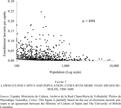
FIGURE 7 LAWSUITS PER CAPITA AND POPULATION: CITIES WITH MORE THAN 100 HOUSEHOLDS, 1500–1600
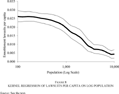
Figure 7 shows a scatter plot of lawsuits per capita against population for cities reported to have 100 households and over in the 1590 census. The plot shows a clearly negative relationship between population and litigation rates. Only one out of 48 cities (2.08 percent) with more than 1,000 households had a litigation rate above 5 percent (Alfaro, in modern-day La Rioja, with 1,207 households). By contrast, 92 out of 645 towns (14.3 percent) with between 100 and 1,000 households exceeded the 5 percent litigation rate. Figure 8 shows a nonparametric regression of lawsuits per capita on log population using the preceding data (the horizontal scale in both figures has been converted to show actual population numbers for ease of interpretation).68
The nonparametric regression was conducted using an Epanechnikov kernel with a bandwidth equal to 0.5. The thinner lines show 95 percent bootstrapped confidence intervals generated with 1,000 iterations.

FIGURE 8 KERNEL REGRESSION OF LAWSUITS PER CAPITA ON LOG POPULATION
If tax exemptions had motivated the flight to nobility there would have been no reason for such a clear pattern in the geographical distribution of lawsuits. The distributive motive, on the other hand, is much more consistent with the data. The reason is that the government of large cities was already in the hands of nobles and grandees; hence those cities would have generated no incentives for distributive and nobility litigation. But as the case of Villalpando (743 households, 72 lawsuits) and its yearly income of over 440,000 maravedíes shows, medium-sized towns had attractive enough resources to justify their capture via ennoblement.
The Decline of Litigation
Several factors combined to reduce the number of nobility lawsuits by the end of the sixteenth century. The marked increase in the number of hidalgos had become a concern for the Crown, which in 1593 intervened by adding a number of costly and time consuming hurdles to hidalguía litigation, thereby reducing the expected payoff for litigants.69
The most important rules imposed by Philip II in 1593 were that all witnesses travel to Valladolid to be personally examined by one of the three judges rather than having an itinerant court official depose them in their hometowns; that when a witness was unable to make the trip, one of the three judges travel to take a deposition; and that all “dubious” ejecutorias issued in the last 20 years be revised and, if justified, revoked. Although the extent of the enforcement of this last requirement is unclear, the other two (and many minor ones) were certainly a major factor in increasing the length and cost of the proceedings. The judges protested the new norms, but the king imposed his will. See ARChV Cédulas y Pragmáticas 5.5 and 5.7.
The legal (though unenforced) incompatibility of hidalguía with manual professions was eliminated in 1783. See Thompson, “In So Many Words,” p. 29.
CONCLUSION
The institution of hidalguía emerged during the late Middle Ages as a product of the war against the Arab kingdoms; distinguished military service was rewarded with an honorific title, the advantages of which included tax exemptions and legal privileges, in return for an ongoing commitment to serve in times of war. The prohibition of engaging in “vile” or “mechanical” occupations, though of unclear origin, was intended to keep hidalgos well trained in the military arts.
Over time, the concept of hidalguía came under pressure from several directions. The grant of universal privileges to certain areas, such as Biscay, made it difficult for everyone to honor the technical requirements of the title. By the sixteenth century the entire peninsula was in Christian hands, all but ending the intermittent episodes of small-scale warfare to which hidalgos had been normally summoned, and the changes in military technology required the creation of armies with an increasing degree of time commitment and professionalism.71
On Spain's role in pioneering the military revolution of the sixteenth century see Parker, “Military Revolution.”
The revival and rapid expansion of hidalguía during the sixteenth century was traditionally blamed on supposedly indiscriminate sales of patents by Charles V and Philip II. Although that argument has been proved wrong by Thompson, no alternative explanation has surfaced to replace it.72
Thompson, “Purchase.”
The sixteenth century ushered in a renewed assertion of royal power, spearheaded by the Catholic Kings and consolidated under Charles V and Philip II. As a result, towns that had previously met royal tax obligations from their communal properties were increasingly forced to impose direct taxes on their commoners. Hidalgos were also successful in reclaiming their right to half of towns' offices, backed by the Royal Chancery Courts when needed.
In the cases where litigation flared, the conflict over local control could easily deplete the resources of the towns, which were spent fighting nobility and distributive lawsuits. Distributive and ennoblement litigation came at a time when municipal resources were strained. Many towns had indeed gone to great financial efforts to purchase their charters of cityhood from the Crown; doing so prevented local overlords from capturing their royal tax streams but did lead to heavy debts.73
Nader, Liberty.
The archival record is silent on the efficiency implications of the redistribution; there is nothing to indicate that hidalgos would have made better or worse administrators of town property or, in the case they embezzled or appropriated public resources, that they would have diverted them from their most productive use. There is also little support for the “treason of the bourgeoisie” hypothesis; while hidalgos took pride in their title and ostensibly complied with all its requirements, I have been unable to find a single piece of evidence showing hidalgos being stripped of their privileges for engaging in banned professions. Quite to the contrary, several documents casually mention hidalgos freely engaging in “mechanical and vile” activities throughout Spain; of course, in the areas that enjoyed universal hidalguía, such occurrences were almost a tautology.
The number of hidalgos did in fact grow substantially during the sixteenth century. By 1600 at least 6,221 ejecutorias had been issued for Northern Castile alone, each representing the start of a new hidalgo lineage or the confirmation of one whose purity had been challenged. Since ejecutorias do not include self-avowed hidalgos who were not challenged or whose lawsuits were dropped by the towns, they represent just a lower bound on the number of families that established themselves as part of the petty nobility. The rest of the traditional wisdom regarding hidalgos, though, needs to be thoroughly reexamined. Tax incentives seem to have had little to do with ennoblement; distributive conflict, often dismissed as inconsequential, played an important role; and although the misallocation of talent argument holds some appeal, what evidence is available suggests that occupational restrictions were widely ignored. Finally, while substantial redistribution certainly took place at the local level, and some localities suffered large losses through litigation, these processes seem unlikely candidates in explaining the prolonged population decline and economic stagnation that Castile experienced in the seventeenth century.
I owe a debt of gratitude to Eduardo Pedruelo Martín, director of the Archivo de la Real Chancillería de Valladolid, for sharing unpublished work that proved crucial for coding my data, as well as for the long hours spent educating me in the peculiarities of the lawsuits of hidalguía. I would also like to thank all the staff of the archive for their invaluable help; Ann Carlos, Nicole Fortin, Francisco González, David Green, Vadim Marmer, Hugh Neary, Angela Redish, Jean-Laurent Rosenthal, three anonymous referees, and seminar participants at Universitat Pompeu Fabra, the Canadian Institute for Advanced Research, Boston University, UBC, the 2005 CNEH Conference, the 2005 SED Conference and the 2005 EHA meetings for helpful comments and engaging discussions; and Nicolás Della Penna, Paula Hokama, Ken Jackson, María García Morales and Yamila Simonovsky for expert research assistance. Financial support from the Canadian Institute for Advanced Research, CLEER, TARGET/INE, SSHRCC and an EHA Cole Grant-in-Aid is gratefully acknowledged. All errors remain mine.