Introduction
The area off the Antarctic Peninsula, including the Bransfield Strait and adjacent waters, hosts a diverse Antarctic larval fish assemblage (Loeb et al. Reference Loeb, Kellermann, Koubbi, North and White1993). The bottom topography and dominant water circulation pathways within the Bransfield Strait give rise to a large clockwise gyre, promoting larval retention and limiting dispersal by currents (Loeb et al. Reference Loeb, Kellermann, Koubbi, North and White1993). However, the confluence in the Bransfield Strait of water masses of different origins, such as the Weddell and Bellingshausen seas (e.g. Huneke et al. Reference Huneke, Huhn and Schröeder2016), contributes to enrich the larval fish assemblage with species spawning elsewhere. Species composition and relative abundance of fish larval stages in this area show extreme seasonal and interannual variability, possibly linked to several biotic and abiotic factors (Kellermann Reference Kellermann1989, Morales-Nin et al. Reference Morales-Nin, Palomera and Schadwinkel1995). Differences associated with variabilities in the reproductive effort of adults, egg and larval survival, and environmental conditions affecting dispersal, as well as the use of different sampling gear or locations, strongly determine the understanding of temporal changes of larval fish assemblages (Loeb et al. Reference Loeb, Kellermann, Koubbi, North and White1993).
The larval fish assemblage within the zone of seasonal pack ice cover off the Antarctic Peninsula is dominated by notothenioids (e.g. Kellermann Reference Kellermann1986), a benthic group of fishes that has progressively radiated into several ice-associated or water column habitats (Eastman Reference Eastman1993). The early life stages of many notothenioids are pelagic, spending 1–2 years in the water column before they become predominantly demersal (Kock Reference Kock1992). Hence, larval dispersal can be one of the most important mechanisms for promoting connectivity among different populations of circum-Antarctic notothenioids, which are often confined to coastal shelf areas during their adult stages (Damerau et al. Reference Damerau, Matschiner, Salzburger and Hanel2014). Dispersal is greatly influenced by growth rate and pelagic larval duration, which is one of the main factors determining the structure of marine populations (Shanks Reference Shanks2009). However, physical mechanisms allowing retention, such as local gyres, or shelf-break frontal systems limiting offshore transport of larvae should promote genetic heterogeneity among distant populations, fostering speciation (White Reference White1998). The role of larval dispersal in population structure and, on a longer timescale, to biogeography of notothenioids is still debated (Damerau et al. Reference Damerau, Matschiner, Salzburger and Hanel2012).
During pelagic sampling efforts in the Antarctic Peninsula area, the Antarctic dragonfish Parachaenichthys charcoti (Vaillant) was the most frequently encountered bathydraconid species of the larval fish community (Kellermann Reference Kellermann1989), as it is collected all year round except in winter (Morales-Nin et al. Reference Morales-Nin, Palomera and Schadwinkel1995). Unlike most bathydraconids with a circum-Antarctic distribution, P. charcoti is confined to the southern Scotia Arc, including the South Orkney Islands, the South Shetland Islands and the tip of the Antarctic Peninsula (Gon Reference Gon1990). The sister species within the genus, P. georgianus (Fischer), has an allopatric distribution and is endemic to the shelves of South Georgia and the South Sandwich Islands (Gon Reference Gon1990). Adult specimens of both species prefer inshore waters down to 90 m depth, and are predominantly encountered in fjords (Burchett Reference Burchett1983). Both species produce relatively large demersal eggs, which are spawned in late summer (P. charcoti) or autumn (P. georgianus) in shallow waters (Burchett et al. Reference Burchett, Sayers, North and White1983, Barrera-Oro & Lagger Reference Barrera-Oro and Lagger2010). Nesting behaviour in P. charcoti has been recently described in the inner part of Potter Cove (South Shetland Islands) at 30 m depth (Barrera-Oro & Lagger Reference Barrera-Oro and Lagger2010). All of these data suggest a limited gene flow between adult populations of Parachaenichthys inhabiting islands separated by deep oceanic waters, such as those forming the southern Scotia Arc.
However, the contribution of the early life history counterparts in determining the current population structure and zoogeography within the genus Parachaenichthys remains unclear, as larval traits of these species are still poorly understood. To address this, the sagittal otolith microstructure from larvae and juvenile P. charcoti collected off the Antarctic Peninsula during summer and winter were analysed. Microincrement patterns were used to determine hatch dates, yolk absorption time and growth rates in the field, as well as to estimate pelagic larval duration for this species. Comparing the present data with those from P. georgianus reported in literature, we attempted to assess the consistency between geographical patterns of distribution and early life history traits of the two species of Parachaenichthys.
Materials and methods
Field activities
Early juveniles of P. charcoti were collected during a summer survey carried out in the Bransfield Strait from Brabant to Joinville islands and the shelf north of Elephant Island. As part of the US Antarctic Marine Living Resources (AMLR) programme, the cruise was conducted in February/March 2011 aboard the RV Moana Wave using two different mid-water net systems for comparative purposes. A total of 70 stations were sampled using a 1.8m Isaac Kidd mid-water trawl (IKMT) with a mesh size of 505 μm towed at 0–170 m depth, and a 4 m2 multiple opening and closing Tucker trawl equipped with three nets (mesh size between 505 μm and 5 mm) towed at 0–170 m, 170–300 m and 300–600 m depth strata (Jones et al. Reference Jones, Koubbi, Catalano, Dietrich and Ferm2014).
Early larvae of P. charcoti were sampled during two winter surveys carried out in the same area. The two AMLR cruises were conducted in August/September 2013 and 2014 aboard the RV Nathaniel B. Palmer, exclusively using the IKMT. Overall, 85 stations set at 40–600 m depth and 117 stations set at 60–220 m depth were sampled during the 2013 and 2014 surveys, respectively.
Sample sorting and processing
The early life stages of P. charcoti were sorted and identified according to Kellermann (Reference Kellermann1990). The stage of development was assigned to each specimen according to Koubbi et al. (Reference Koubbi, Duhamel and Camus1990). Larvae and juveniles were measured from the tip of the snout to the end of caudal peduncle (standard length, SL) to the nearest mm below and stored in ethanol for further analyses. From larval samples, the amount of yolk was calculated by measuring major and minor axes of the yolk sac from images acquired by digitized computer video system (Leica Application Suite 4.3.0; Leica Microsystems, Wetzlar, Germany) composed of a CCD camera (Leica IC80HD) connected to a stereomicroscope (Leica M205C). Assuming the shape of yolk sac to be similar to a prolate spheroid, the volume was calculated applying the formula:
 $${\rm V}{\,\equals\,}4/3{\rm \rpi a}^2{\rm b},$$
where a and b were half minor and major axes, respectively. The yolk sac at hatching was assumed to be roughly a spheroid of 3 mm diameter.
Sagittal otoliths were removed from all specimens under a stereomicroscope using fine needles and mounted on glass slides. They were embedded medial side down in Petropoxy 154 resin (Burnham Petrographics LLC, Rathdrum, ID, USA) and left to be cured in an oven at 80°C for c. 12 h. For juveniles, it was necessary to grind otoliths after embedding to get to the core using metallographic grinding paper discs and to polish with 0.05 µm alumina powder.
Ageing procedure
Otolith microstructure was analysed using a light microscope (Leica DM4000B) connected by a digital camera (Leica DFC295) to a computer equipped with a digital video system. Microincrement counts were made from the primordium to the otolith margin at 630x magnification, recording along the count path microincrement width and the presence of checks. Each otolith was read twice and the mean value was calculated unless counts differed by >10% from each other. In these cases otoliths were discarded. Individual age in days was estimated by counting all microincrements, assuming that they were laid down from hatching with daily periodicity as in many other notothenioids (e.g. Kellermann et al. Reference Kellermann, Gauldie and Ruzicka2002).
Data analyses
The index of average percent error (APE) (Beamish & Fournier Reference Beamish and Fournier1981) and the mean coefficient of variation (cvmean) (Chang Reference Chang1982) were calculated to assess the precision (or reproducibility) between matched pairs of age readings. Generally, APE and cvmean values not exceeding 7% and 5%, respectively, provide good ageing precision (Campana Reference Campana2001). Age estimates and bias plots were generated to measure systematic differences between readings. Monthly hatch date distribution was obtained considering individual age estimate and date of capture for all specimens successfully aged.
Based on the Akaike Information Criterion (AIC), early growth of P. charcoti was best described by the Gompertz model, which is usually suitable for modelling growth of larvae and juveniles of fishes (Campana & Jones Reference Campana and Jones1992). The model fitted to the age–length data pairs was:
 $${\rm SL}{\,\equals\,}{\rm L}_{\infty} \,{\rm exp}\,\left( {{\hbox-}{\rm k}\,\,{\rm exp}\left( {{\hbox-}{\rm Gt}} \right)} \right),$$
where L∞ is the asymptotic length, k is a dimensionless parameter, G is the instantaneous growth rate at the inflexion point of the curve and t is the age of fish. The absolute daily growth rate at age was calculated starting from the equation above, as follows:
 $${\rm g}_{{\rm t}} {\,\equals\,}{\rm GL}_{{\rm t}} \left( {{\rm lnL}_{\infty} {\,\hbox-\,\,}{\rm lnL}_{{\rm t}} } \right),$$
where gt is the absolute growth rate at age t, G is the instantaneous growth rate, L∞ and Lt are the fish length at the asymptote and at age t, respectively (Campana & Jones Reference Campana and Jones1992).
Yolk sac resorption rate in larval specimens was assessed by fitting individual age estimate and yolk sac volume to an exponential model of decay in the form:
 $${\rm V}_{{\rm t}} {\,\equals\,}{\rm V}_{{\rm 0}} \,{\rm exp}\,\left( {{\rm rt}} \right),$$
where Vt is the volume of yolk sac at age t, V0 is the volume of yolk sac at hatching, r is the resorption rate and t is the age of larva. All statistical analyses were performed using the PAleontological STatistics (PAST, version 3.14) software (Hammer et al. Reference Hammer, Harper and Ryan2001), which uses the Levenberg–Marquardt optimization for non-linear least squares parameter estimation.
Results
Composition, abundance and spatial distribution of fish samples
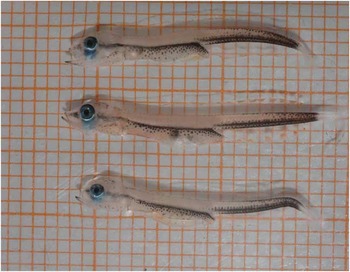
Overall, 24 larvae of P. charcoti ranging from 15–23 mm SL and four juveniles ranging from 47–56 mm SL were collected in winter and summer, respectively. Sixteen larvae were at stage 1 (yolk sac) and eight were at stage 2 (preflexion) of development. All juveniles were at stage 4 (fin rays formed). The pigmentation patterns of larvae closely resemble those reported previously for larger individuals collected in the Antarctic Peninsula Region between late October and early December, consisting of a dorsal row and a ventral band of melanophores in the postanal section, as well as a dorsal and lateral pigment on the abdomen (Fig. 1).
Yolk sac larvae of P. charcoti collected in the Bransfield Strait during the winter, showing the overall pigmentation pattern.

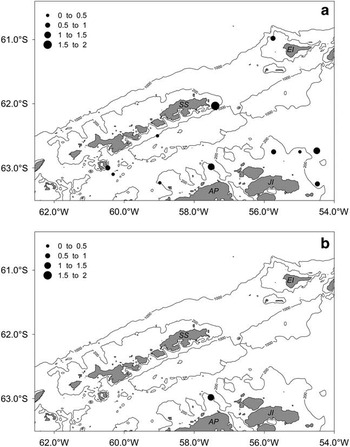
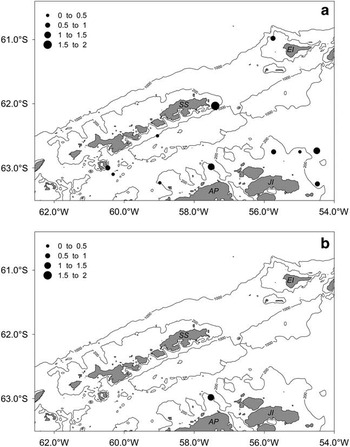
Larvae were sampled almost exclusively in the Bransfield Strait, along the inner shelf of the South Shetland Islands and Joinville Island at depths <200 m (Fig. 2a). The relative larval abundance ranged between 0.28 and 1.53 individuals per 1000 m3 of filtered seawater (mean±standard error: 0.75±0.13). Juveniles were only collected by the Tucker trawl from a single station located off the Antarctic Peninsula at 0–110 m depth (Fig. 2b).
Spatial distribution of catches of early life stages of P. charcoti in the study area: a. larvae and b. juveniles. Dots indicate the relative abundance as individuals per 1000 m3 of filtered seawater. AP=Antarctic Peninsula, EI=Elephant Island, JI=Joinville Island, SS=South Shetland Islands.
Microstructure of sagittal otoliths
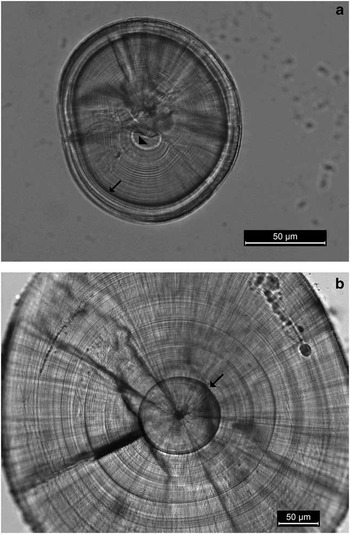
Sagittal otoliths of larvae and juveniles of P. charcoti have a discoid shape, with a maximum diameter of 104–155 μm and 480–580 μm, respectively (Fig. 3). Otoliths grow from single or multiple primordia, surrounded by a pronounced check assumed to be laid down at hatching. After hatching, thin and evenly spaced microincrements (width range 1–1.5 μm) are deposited and encircled by another evident check located at 25–35 microincrements from the primordium (Fig. 3). This check is probably linked to the onset of exogenous feeding (feeding check) rather than to yolk sac resorption, as it was evident in individuals with and without the yolk sac. Beyond the feeding check, microincrements become progressively wider (up to 1.6 μm) towards the otolith margin.
Light micrographs of sagittal otolith of early life stages of P. charcoti. a. Larva 35 days after hatching, showing multiple primordia delimited by the hatching check (arrow head) and the first feeding check (arrow) close to the margin. b. Juvenile showing the microincrement patterns beyond the first feeding check (arrow).

Estimating age and growth rate
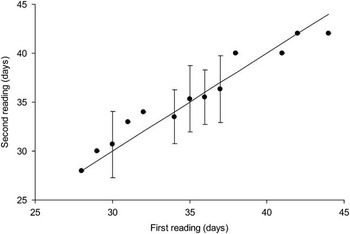
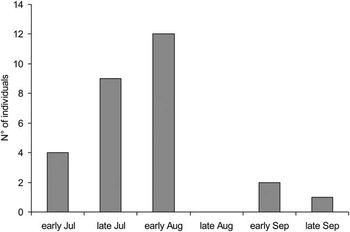
All individuals of P. charcoti were successfully aged, showing a clear alternating pattern of growth rings formed by a discontinuous zone (D-zone) and an increment zone (L-zone) which appeared dark and light under transmitted light. Based on microincrement counts, age estimates ranged between 28–43 days for larvae and 160–204 days for juveniles. As measures of ageing precision, APE and cvmean were relatively low (2.9% and 2.0%, respectively), indicating good consistency between readings. Difference between readings and bias plots showed no systematic error or bias across the estimated age range (Fig. 4). Matching individual age estimate and date of capture, hatch date distribution was spread over a relatively wide period, lasting from July to September (Fig. 5).
Bias plot applied to age readings carried out on P. charcoti larvae. Bars represent 95% confidence intervals.

Hatch date distribution back-calculated by age estimates and sampling dates of early life stages of P. charcoti. ‘Early’ and ‘late’ represent the first and second half of the month, respectively.

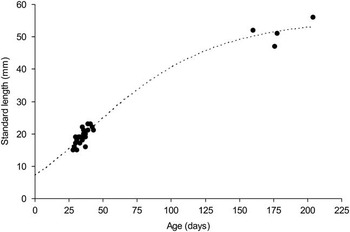
The Gompertz model was fitted to age–length data pairs of larvae and juveniles (Fig. 6), providing the following relationship:
 $${\rm SL}{\,\equals\,}55.494\,{\rm exp}\,\left( {{\hbox-}2.053\,{\rm exp}\,\left( {{\hbox-}0.019\,{\rm t}} \right)} \right),$$
where SL is the standard length (mm) and t is the age (days). Applying the model, the larval size at hatching (i.e. SL at age t=0) was c. 7.1 mm and the absolute daily growth rate (gt) was 0.05–0.38 mm day-1 (mean±standard error: 0.22±0.008).
Gompertz growth curve fitted to age–length data pairs estimated for early life stages of P. charcoti.

Yolk sac resorption rate
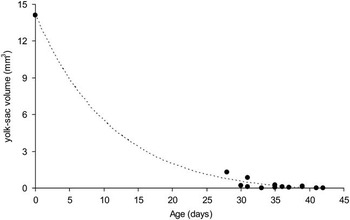
Yolk resorption rate was assessed by plotting yolk sac volume against individual age of larvae with yolk remains (Fig. 7). The exponential model fitted to these data was:
 $${\rm V}_{{\rm t}} {\,\equals\,}14.572\,{\rm exp}\,\left( {{\hyphen}0.0897\,{\rm t}} \right),$$
where Vt is the volume at age t (mm3) and t the age (days). The resorption rate in larvae older than 30 days was relatively low and fairly constant, consistent with the onset of exogenous feeding before completing yolk resorption observed in most individuals.
Exponential curve fitted to yolk sac resorption rate calculated for P. charcoti larvae.

Discussion
The demersal fish community inhabiting the continental shelves of the South Shetland Islands and South Orkney Islands consists of several species of notothenioids, of which P. charcoti is a minor component (e.g. Kock et al. Reference Kock, Jones and Wilhelms2000, Jones et al. Reference Jones, Damerau, Deitrich, Driscoll, Kock, Kuhn, Moore, Morgan, Near, Pennington and Schöling2009). During bottom trawl surveys, catches of this species are made up almost exclusively of juvenile or sub-adult individuals collected within the 200 m depth isobath (La Mesa et al. Reference La Mesa, Catalano, Kock and Jones2012). Large adults are generally caught in small coves or fjords where they spawn in summer (Barrera-Oro & Lagger Reference Barrera-Oro and Lagger2010), as reported for P. georgianus from South Georgia (Burchett et al. Reference Burchett, Sayers, North and White1983). Based on field observation of nesting behaviour of P. charcoti (Barrera-Oro & Lagger Reference Barrera-Oro and Lagger2010) and hatch date distribution estimated by microincrement counts of larvae, the time spent by parents guarding eggs until hatching is extremely long, lasting at least four months. The apparent spatial segregation of spawners in inshore waters and the limited bathymetric distribution of the entire population may have contributed to determine the allopatric distribution patterns of the two species within the genus Parachaenichthys. Based on genetic data, a similar distribution pattern has been reported in Lepidonotothen nudifrons (Lönnberg), which includes two morphologically identical but genetically distinct species along the Scotia Arc (Dornburg et al. Reference Dornburg, Federman, Eytan and Near2016).
Nevertheless, as spatial connectivity among different populations of notothenioids is mainly promoted by passive larval dispersal (e.g. Damerau et al. Reference Damerau, Matschiner, Salzburger and Hanel2014), early life history traits can play a key role in determining the geographical patterns of distribution at the species level. In turn, dispersal is influenced by the spawning location of adults and larval behaviour. Based on a modelling approach for notothenioid fishes, larvae hatching in inshore waters are more likely to be retained on the shelf than those hatching on the outer shelf, which are more vulnerable to advection by currents (Young et al. Reference Young, Rock, Meredith, Belchier, Murphy and Carvalho2012). Considering the spatial distribution of early larvae of P. charcoti off the Antarctic Peninsula, they are almost exclusively confined to the Bransfield Strait on the inner shelves of Joinville Island and the South Shetland Islands (Kellermann Reference Kellermann1989, Morales-Nin et al. Reference Morales-Nin, Palomera and Schadwinkel1995, present data). This area is characterized by a large cyclonic basin-scale circulation with several minor eddies, assisting in larval retention and the possibility of a long residence time in a food-rich environment (Zhou et al. Reference Zhou, Niiler and Hu2002). Similarly, at South Georgia, P. georgianus spawn in the deep fjord of Cumberland East Bay, where early larvae are found from June onwards (Burchett et al. Reference Burchett, Sayers, North and White1983, North & Murray Reference North and Murray1992). The high density and species diversity of early life stages of notothenioids within Cumberland Bay provides evidence of the importance of the fjord as a nursery and spawning area of the demersal fish community of the South Georgia shelf through mechanisms of larval retention (Belchier & Lawson Reference Belchier and Lawson2013).
Based on microincrement counts made on sagittal otoliths, the mean growth rate estimated for early life stages of P. charcoti from the Antarctic Peninsula is within the range reported for other notothenioids (North Reference North1991), although faster than for P. georgianus derived from modal progression of larval size through time (North Reference North1998, Belchier & Lawson Reference Belchier and Lawson2013). Early growth differences between the two species could be due to the different methodological approaches, taking into account that mean growth rates derived from field data of larval size through time may be underestimated in species with protracted spawning, multiple cohorts and advection of larvae from neighbouring areas. Larval hatching of both species of Parachaenichthys is spread over a relatively long period throughout the winter. To be able to cope with low food availability during winter, newly hatched larvae exhibit large yolk reserves, which are totally consumed within 6–8 weeks of hatching (North Reference North1991, present data). However, in cases of food availability, both species start to feed before full yolk sac resorption (North & Ward Reference North and Ward1989, present data).
Compared to other notothenioids (North Reference North1991), the pelagic larval duration of P. charcoti is relatively short, lasting about six months. From hatching in winter, larvae take advantage of favourable food conditions during the following spring and summer, developing to the early juvenile stage of 45–50 mm in January/February (Kellermann Reference Kellermann1989, present data). At South Georgia, the pelagic larval duration of P. georgianus is very similar to its southern congener, lasting from June to January, when juveniles attain a size of 55 mm (Efremenko Reference Efremenko1983). From March onwards, juveniles of both species probably recruit to suitable inner shelf nursery grounds, as they are no longer sampled in pelagic waters until the following winter. Consequently, the short pelagic phase during the early ontogeny would restrict the passive transport of larvae driven by the local currents, limiting the larval dispersal between distant populations.
In conclusion, early life history traits and ecological characteristics of adults are consistent with the current allopatric geographical distributions of P. charcoti and P. georgianus, which include the South Shetland Islands–South Orkney Islands and South Georgia–South Sandwich Islands, respectively. Abiotic factors, such as fine-scale circulation patterns that promote retention for larval stages, and biological factors, such as short pelagic larval duration and spatial distribution of adults restricted to inshore waters, may have contributed to limit the gene flow between neighbouring populations producing, on an evolutionary timescale, the vicariant speciation within the genus Parachaenichthys.
Acknowledgements
We thank the US AMLR and scientific staff, as well as the crew members and personnel aboard the RV Moana Wave and the RV Nathaniel B. Palmer for their support in sampling activities. We have greatly appreciated the comments raised by two anonymous reviewers, who greatly improved an earlier version of the manuscript. This study was carried out within the projects 2009/A1.07 and 2013/C1.07 funded by the PNRA.
Author contribution
MLM conceived the study and wrote the paper. ER and CDJ conducted the field activities providing fish samples and contributed significantly to the interpretation of data and manuscript editing before submission.